

RELIABILITY CENTERED 
MAINTENANCE 
WHAT WENT WRONG WI TH BOEING 
Presented By – 
Aman Rawat (07304), Ankit Goyal (07305), Ashlesh Sonkusare 
(07310), Nandhagopal Muralithar (07335)
WHAT IS BOEING 
• An American multinational corporation. 
• It designs, manufactures, and sells fixed-wing aircraft, 
rotorcraft, rockets and satellites. 
• It is among the largest global aircraft manufacturers. 
• It is the second-largest aerospace & defence contractor in the 
world based on 2012 revenue. 
• Boeing Company's corporate headquarters are located 
in Chicago.
INTRODUCTION TO BOEING 
• Revenue in 2012 – US $ 81.7 billion 
• One of the largest US exporters 
• Customers and in 150 countries 
• 0.17 million employees in 70 countries. 
• 2 Business Units 
Boeing Commercial Planes 
Boeing Defense Space and Security
RELIABILITY CENTERED MAINTENANCE 
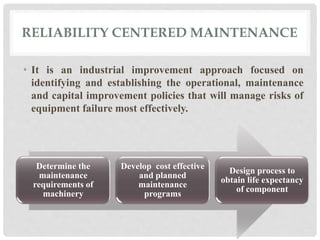
• It is an industrial improvement approach focused on 
identifying and establishing the operational, maintenance 
and capital improvement policies that will manage risks of 
equipment failure most effectively. 
Determine the 
maintenance 
requirements of 
machinery 
Develop cost effective 
and planned 
maintenance 
programs 
Design process to 
obtain life expectancy 
of component
RELIABILITY CENTERED MAINTENANCE 
• Objectives of RCM: 
Minimum Cost 
Safety of system 
Reliability i.e. avoid risk of failure 
• RCM 2 – 1983 
Objective - To improve the consequence rather than just 
failure avoidance.
IMPLEMENTATION OF RCM AT BOEING 
• Year 1969 
• RCM was used to analyze the causes, impact remedies for 
asset failure and taking preventive action to minimize 
failure rates throughout operation. 
• Maintenance Performance Toolbox is one of the key 
Boeing solutions have to help airlines. 
• RCM focus on 
Failure analysis 
Consequence analysis 
Task analysis
APPLICATION OF RCM AT BOEING 
• Health Monitoring Systems 
Allow airplane to self monitor and report maintenance requirements 
to ground based computer systems. 
• Mobile Application 
Mobile Applications were used for schedule maintenance and faster 
detecting aircraft issues (Toolbox Mobile Parts, Maintenance turn 
time) 
Simultaneously, improvement in real time regulations, decrease 
flight delays and reduce operational expenditures can be handled.
APPLICATION OF RCM AT BOEING 
• RFID (Radio Frequency Identification) 
RFID Systems automated maintenance task on Emergency 
equipment Management, Rotables Management, Repairable 
Management, Structural Repair, Essential Cabin Items etc. 
RFID enabled process were used to check security and servicability, 
independently or simultaneously.
REASONS FOR FAILURE AT BOEING 
• Failure of the Boeing 787 fleet 
• Tried to save costs related to providing on-site 
quality, supplier management and technical 
support by outsourcing them 
• Outsourced 70% compared to 35-50% for 737 & 747 
• Had to send its engineers to sites of various Tier-1, 2 
& 3 suppliers worldwide to solve the technical 
problems
REASONS FOR FAILURE AT BOEING 
• Extra risk in dealing with lengthy supply chain, and 
cultural and language differences with suppliers 
• Important especially when the team did not have members 
with expertise on supply chain risk management 
• Technical problems – overheating batteries, glitches 
with brakes, hydraulic pumps, power issues and ice 
forming in engines 
• Results of failure – lower reliability; higher 
maintenance costs; falling reputation of the 
company
SUGGESTIONS 
• Change in focus from complete outsourcing to 
monitored outsourcing of parts 
• Fundamental change in focus from failure assessment 
based on age to “memoryless” exponential probability 
distribution 
• Effort to be focused on process on failure than 
predicting life expectancy 
• Equal focus on user requirements and design reliability 
• Focus on condition monitoring and predictive 
maintenance 
• Linking levels of tolerable risk to maintenance strategy 
development
SUGGESTIONS 
• Finding root cause without resorting to redesign all 
the time 
• Don’t be afraid of short term solutions, but always 
have long term plan for defect elimination 
• Infant mortality and unknown failure risk high in 
redesign 
• RCM can be used to mitigate defects while also 
working on risks associated with maintenance 
measures.
THANK - YOU

Boeing - Reliability Centered Maintenance

  • 1.
    RELIABILITY CENTERED MAINTENANCE WHAT WENT WRONG WI TH BOEING Presented By – Aman Rawat (07304), Ankit Goyal (07305), Ashlesh Sonkusare (07310), Nandhagopal Muralithar (07335)
  • 2.
    WHAT IS BOEING • An American multinational corporation. • It designs, manufactures, and sells fixed-wing aircraft, rotorcraft, rockets and satellites. • It is among the largest global aircraft manufacturers. • It is the second-largest aerospace & defence contractor in the world based on 2012 revenue. • Boeing Company's corporate headquarters are located in Chicago.
  • 3.
    INTRODUCTION TO BOEING • Revenue in 2012 – US $ 81.7 billion • One of the largest US exporters • Customers and in 150 countries • 0.17 million employees in 70 countries. • 2 Business Units Boeing Commercial Planes Boeing Defense Space and Security
  • 4.
    RELIABILITY CENTERED MAINTENANCE • It is an industrial improvement approach focused on identifying and establishing the operational, maintenance and capital improvement policies that will manage risks of equipment failure most effectively. Determine the maintenance requirements of machinery Develop cost effective and planned maintenance programs Design process to obtain life expectancy of component
  • 5.
    RELIABILITY CENTERED MAINTENANCE • Objectives of RCM: Minimum Cost Safety of system Reliability i.e. avoid risk of failure • RCM 2 – 1983 Objective - To improve the consequence rather than just failure avoidance.
  • 6.
    IMPLEMENTATION OF RCMAT BOEING • Year 1969 • RCM was used to analyze the causes, impact remedies for asset failure and taking preventive action to minimize failure rates throughout operation. • Maintenance Performance Toolbox is one of the key Boeing solutions have to help airlines. • RCM focus on Failure analysis Consequence analysis Task analysis
  • 7.
    APPLICATION OF RCMAT BOEING • Health Monitoring Systems Allow airplane to self monitor and report maintenance requirements to ground based computer systems. • Mobile Application Mobile Applications were used for schedule maintenance and faster detecting aircraft issues (Toolbox Mobile Parts, Maintenance turn time) Simultaneously, improvement in real time regulations, decrease flight delays and reduce operational expenditures can be handled.
  • 8.
    APPLICATION OF RCMAT BOEING • RFID (Radio Frequency Identification) RFID Systems automated maintenance task on Emergency equipment Management, Rotables Management, Repairable Management, Structural Repair, Essential Cabin Items etc. RFID enabled process were used to check security and servicability, independently or simultaneously.
  • 9.
    REASONS FOR FAILUREAT BOEING • Failure of the Boeing 787 fleet • Tried to save costs related to providing on-site quality, supplier management and technical support by outsourcing them • Outsourced 70% compared to 35-50% for 737 & 747 • Had to send its engineers to sites of various Tier-1, 2 & 3 suppliers worldwide to solve the technical problems
  • 10.
    REASONS FOR FAILUREAT BOEING • Extra risk in dealing with lengthy supply chain, and cultural and language differences with suppliers • Important especially when the team did not have members with expertise on supply chain risk management • Technical problems – overheating batteries, glitches with brakes, hydraulic pumps, power issues and ice forming in engines • Results of failure – lower reliability; higher maintenance costs; falling reputation of the company
  • 11.
    SUGGESTIONS • Changein focus from complete outsourcing to monitored outsourcing of parts • Fundamental change in focus from failure assessment based on age to “memoryless” exponential probability distribution • Effort to be focused on process on failure than predicting life expectancy • Equal focus on user requirements and design reliability • Focus on condition monitoring and predictive maintenance • Linking levels of tolerable risk to maintenance strategy development
  • 12.
    SUGGESTIONS • Findingroot cause without resorting to redesign all the time • Don’t be afraid of short term solutions, but always have long term plan for defect elimination • Infant mortality and unknown failure risk high in redesign • RCM can be used to mitigate defects while also working on risks associated with maintenance measures.
  • 13.