Planned
Maintenance
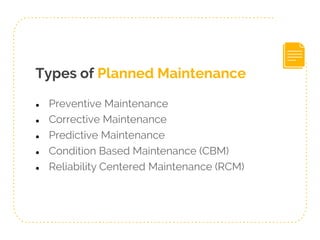
Types of Planned Maintenance
● Preventive Maintenance
● Corrective Maintenance
● Predictive Maintenance
● Condition Based Maintenance (CBM)
● Reliability Centered Maintenance (RCM)
Preventive Maintenance
Objectives │Elements │Steps Involved │Benefits
│Disadvantages
1
“
“Prevention is better than cure”
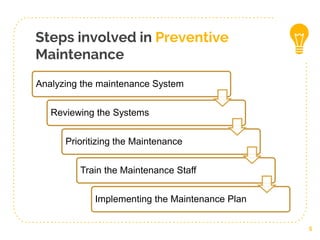
Steps involved in Preventive
Maintenance
5
Analyzing the maintenance System
Reviewing the Systems
Prioritizing the Maintenance
Train the Maintenance Staff
Implementing the Maintenance Plan
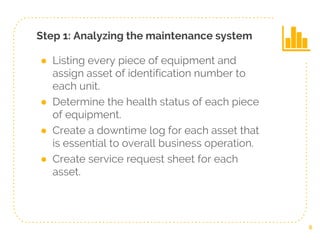
Step 1: Analyzing the maintenance system
● Listing every piece of equipment and
assign asset of identification number to
each unit.
● Determine the health status of each piece
of equipment.
● Create a downtime log for each asset that
is essential to overall business operation.
● Create service request sheet for each
asset.
6
Step 2: Reviewing the systems
● Starting with the highest priority assets,
each system’s downtime and production
logs should be reviewed.
● Operator’s manual should be reviewed for
maintenance and repair schedules. (daily:
lubrication etc.)
● Each should be inspected, areas that need
for repair to be listed and prioritize the
repairs that need to be made.
7
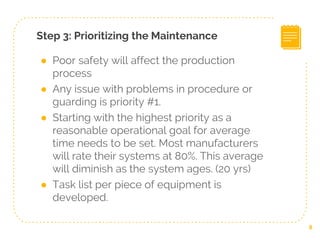
Step 3: Prioritizing the Maintenance
● Poor safety will affect the production
process
● Any issue with problems in procedure or
guarding is priority #1.
● Starting with the highest priority as a
reasonable operational goal for average
time needs to be set. Most manufacturers
will rate their systems at 80%. This average
will diminish as the system ages. (20 yrs)
● Task list per piece of equipment is
developed.
8
Step 4: Train the Maintenance Staff
● Training must not be afterthought. It is
crucial to ensure the success.
● It is the best way to make sure that
employees learn the right way to do tasks.
● Each machine operator operational team
should be met and need to be
demonstrated for proper safety lock-out
and tag-out procedures
● Maintenance staff should be trained for
correct service and repair procedures in
the respective area of expertise /
equipment.
9
Step 5: Implementing the Maintenance Plan
10
● 5-10 minutes should be set aside prior to
each shift for basic lubrication and
inspection. Another 5-10 minutes should be
allocated for cleanup after each shift.
● The process should begin by coding all
purchase orders.
● There is a need to separate old and new
parts and need to create a storage room to
house parts and manuals.
● There is a need to make sure electronic
components for well-protected from static
and moisture.
Benefits or Importance of Preventive Maint.
11
a) In general, the cost incurred towards
breakdown maintenance is usually higher
than the cost incurred on preventive
maintenance.
b) It keeps equipment in good condition to
prevent large problems
c) It prolongs the effective life of the
equipment
d) It detects the problem at earlier stages
e) It reduces the equipment or process failure.
Benefits or Importance Contd…
f) It minimizes/eliminates the rework/scrap
and helps in reducing the process variability
g) It significantly reduces unplanned downtime
h) It is an excellent training tool for technicians
i) It keeps equipment safer
j) The parts stocking levels can be optimized
k) It greatly reduces unplanned downtime.
12
Disadvantages of Preventive Maintenance
a) Catastrophic failures still likely to occur.
b) Performance of maintenance based on
schedule is not required.
c) Labour intensive.
d) It includes performance of unneeded
maintenance.
e) Risk of damage when conducting unneeded
maintenance.
f) Saving not readily visible without a baseline.
13
Corrective Maintenance
Objectives │Prerequisites │Steps Involved
│Advantages and Disadvantages
2
“ “Corrective maintenance can
be defined as the
maintenance carried out to
restore the unserviceable
equipment that has stopped
working to acceptable
standards.”
Main Objectives
The main objectives of this program is to
1. eliminate breakdowns
2. eliminate deviations from optimum
operating conditions
3. eliminate necessary repairs
4. optimize all critical plant systems
16
Prerequisites
1. Existence of trained fulltime maintenance
planners
2. Properly skilled craftsmen to complete the
repair
3. Standard maintenance procedure for
recurring repairs and maintenance task.
4. Allowing sufficient time to maintenance
amidst tight production schedules and
management constraints.
5. A thorough verification process to ensure
the completion of repair.
17
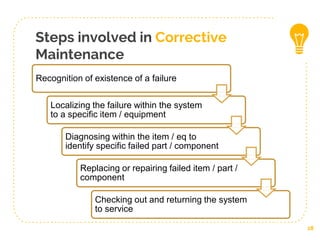
Steps involved in Corrective
Maintenance
18
Recognition of existence of a failure
Localizing the failure within the system
to a specific item / equipment
Diagnosing within the item / eq to
identify specific failed part / component
Replacing or repairing failed item / part /
component
Checking out and returning the system
to service
Advantages of Corrective Maintenance
● It lowers the short-term costs
● It requires less staff since less work is being
done.
19
Disadvantages of Corrective Maintenance
● It increases long-term costs due to
unplanned equipment downtime.
● It is possible secondary equipment or
process damage.
● It is prone to neglect of assets.
20
Predictive Maintenance
Discussion│Advantages and Disadvantages
3
Predictive Maintenance
● It is a method in which the service life of
important part is predicted based on
inspection or diagnosis in order to use the
parts to the limit of their service life.
● It reduces unscheduled breakdown.
● It assures that the machine in acceptable
condition after repair.
● Predictive maintenance allows the
maintenance frequency to be as low as
possible.
● Preventive maintenance is time based.
22
Predictive Maintenance Contd…
● Activities such as changing lubricant based
on time such as calendar time or equipment
runtime.
● For example most of the service providers
advise to change the oil in their cehicles
every 5000 to 10000 KM travelled or 3 to 6
months time interval.
● Example for Predictive Maintenance:
○ Vibration analysis
○ Oil analysis
○ Thermal imaging
○ Equipment observation…. Etc…
23
Predictive Maintenance Contd…
● When predictive maintenance is working
effectively as a maintenance strategy,
maintenance is only performed on machines
when it is required.
● It means just before failure is likely to occur.
● It brings the several cost savings as follows:
○ Minimizing the time the equipment is being
maintained
○ Minimizing the production hours lost to
maintenance
○ Minimizing the cost of spare parts and supplies
24
Advantages of Preventive Maintenance
● It reduces the breakdown losses
● It reduces the maintenance cost of the equipment
● It reduces the total maintenance time of the
equipment
● It increases the component operational life and
availability
● It reduces the part and labour cost
● It saves energy
● It allows for preemptive corrective action
● It improve safety and environment
● Product quality is better
● It increases net operating profit
25
Disadvantages of Preventive Maintenance
● The cost of condition monitoring equipment
needed for predictive maintenance is often
high
● Skill level and experience required to
accurately interpret condition monitoring
data are also high
● Investment on diagnostic equipment
required for predictive maintenance is high
26
27
Thanks!
Any questions?
mech16.blogspot.com
aask@vcet.ac.in

Planned Maintenance

  • 1.
  • 2.
    Types of PlannedMaintenance ● Preventive Maintenance ● Corrective Maintenance ● Predictive Maintenance ● Condition Based Maintenance (CBM) ● Reliability Centered Maintenance (RCM)
  • 3.
    Preventive Maintenance Objectives │Elements│Steps Involved │Benefits │Disadvantages 1
  • 4.
  • 5.
    Steps involved inPreventive Maintenance 5 Analyzing the maintenance System Reviewing the Systems Prioritizing the Maintenance Train the Maintenance Staff Implementing the Maintenance Plan
  • 6.
    Step 1: Analyzingthe maintenance system ● Listing every piece of equipment and assign asset of identification number to each unit. ● Determine the health status of each piece of equipment. ● Create a downtime log for each asset that is essential to overall business operation. ● Create service request sheet for each asset. 6
  • 7.
    Step 2: Reviewingthe systems ● Starting with the highest priority assets, each system’s downtime and production logs should be reviewed. ● Operator’s manual should be reviewed for maintenance and repair schedules. (daily: lubrication etc.) ● Each should be inspected, areas that need for repair to be listed and prioritize the repairs that need to be made. 7
  • 8.
    Step 3: Prioritizingthe Maintenance ● Poor safety will affect the production process ● Any issue with problems in procedure or guarding is priority #1. ● Starting with the highest priority as a reasonable operational goal for average time needs to be set. Most manufacturers will rate their systems at 80%. This average will diminish as the system ages. (20 yrs) ● Task list per piece of equipment is developed. 8
  • 9.
    Step 4: Trainthe Maintenance Staff ● Training must not be afterthought. It is crucial to ensure the success. ● It is the best way to make sure that employees learn the right way to do tasks. ● Each machine operator operational team should be met and need to be demonstrated for proper safety lock-out and tag-out procedures ● Maintenance staff should be trained for correct service and repair procedures in the respective area of expertise / equipment. 9
  • 10.
    Step 5: Implementingthe Maintenance Plan 10 ● 5-10 minutes should be set aside prior to each shift for basic lubrication and inspection. Another 5-10 minutes should be allocated for cleanup after each shift. ● The process should begin by coding all purchase orders. ● There is a need to separate old and new parts and need to create a storage room to house parts and manuals. ● There is a need to make sure electronic components for well-protected from static and moisture.
  • 11.
    Benefits or Importanceof Preventive Maint. 11 a) In general, the cost incurred towards breakdown maintenance is usually higher than the cost incurred on preventive maintenance. b) It keeps equipment in good condition to prevent large problems c) It prolongs the effective life of the equipment d) It detects the problem at earlier stages e) It reduces the equipment or process failure.
  • 12.
    Benefits or ImportanceContd… f) It minimizes/eliminates the rework/scrap and helps in reducing the process variability g) It significantly reduces unplanned downtime h) It is an excellent training tool for technicians i) It keeps equipment safer j) The parts stocking levels can be optimized k) It greatly reduces unplanned downtime. 12
  • 13.
    Disadvantages of PreventiveMaintenance a) Catastrophic failures still likely to occur. b) Performance of maintenance based on schedule is not required. c) Labour intensive. d) It includes performance of unneeded maintenance. e) Risk of damage when conducting unneeded maintenance. f) Saving not readily visible without a baseline. 13
  • 14.
    Corrective Maintenance Objectives │Prerequisites│Steps Involved │Advantages and Disadvantages 2
  • 15.
    “ “Corrective maintenancecan be defined as the maintenance carried out to restore the unserviceable equipment that has stopped working to acceptable standards.”
  • 16.
    Main Objectives The mainobjectives of this program is to 1. eliminate breakdowns 2. eliminate deviations from optimum operating conditions 3. eliminate necessary repairs 4. optimize all critical plant systems 16
  • 17.
    Prerequisites 1. Existence oftrained fulltime maintenance planners 2. Properly skilled craftsmen to complete the repair 3. Standard maintenance procedure for recurring repairs and maintenance task. 4. Allowing sufficient time to maintenance amidst tight production schedules and management constraints. 5. A thorough verification process to ensure the completion of repair. 17
  • 18.
    Steps involved inCorrective Maintenance 18 Recognition of existence of a failure Localizing the failure within the system to a specific item / equipment Diagnosing within the item / eq to identify specific failed part / component Replacing or repairing failed item / part / component Checking out and returning the system to service
  • 19.
    Advantages of CorrectiveMaintenance ● It lowers the short-term costs ● It requires less staff since less work is being done. 19
  • 20.
    Disadvantages of CorrectiveMaintenance ● It increases long-term costs due to unplanned equipment downtime. ● It is possible secondary equipment or process damage. ● It is prone to neglect of assets. 20
  • 21.
  • 22.
    Predictive Maintenance ● Itis a method in which the service life of important part is predicted based on inspection or diagnosis in order to use the parts to the limit of their service life. ● It reduces unscheduled breakdown. ● It assures that the machine in acceptable condition after repair. ● Predictive maintenance allows the maintenance frequency to be as low as possible. ● Preventive maintenance is time based. 22
  • 23.
    Predictive Maintenance Contd… ●Activities such as changing lubricant based on time such as calendar time or equipment runtime. ● For example most of the service providers advise to change the oil in their cehicles every 5000 to 10000 KM travelled or 3 to 6 months time interval. ● Example for Predictive Maintenance: ○ Vibration analysis ○ Oil analysis ○ Thermal imaging ○ Equipment observation…. Etc… 23
  • 24.
    Predictive Maintenance Contd… ●When predictive maintenance is working effectively as a maintenance strategy, maintenance is only performed on machines when it is required. ● It means just before failure is likely to occur. ● It brings the several cost savings as follows: ○ Minimizing the time the equipment is being maintained ○ Minimizing the production hours lost to maintenance ○ Minimizing the cost of spare parts and supplies 24
  • 25.
    Advantages of PreventiveMaintenance ● It reduces the breakdown losses ● It reduces the maintenance cost of the equipment ● It reduces the total maintenance time of the equipment ● It increases the component operational life and availability ● It reduces the part and labour cost ● It saves energy ● It allows for preemptive corrective action ● It improve safety and environment ● Product quality is better ● It increases net operating profit 25
  • 26.
    Disadvantages of PreventiveMaintenance ● The cost of condition monitoring equipment needed for predictive maintenance is often high ● Skill level and experience required to accurately interpret condition monitoring data are also high ● Investment on diagnostic equipment required for predictive maintenance is high 26
  • 27.