







Basics of Civil EngineeringBasics of Civil EngineeringBasics of Civil EngineeringBasics of Civil Engineering
SUPERSTRUCTURE
Superstructure of a building is the portion of the Structure aboveSuperstructure of a building is the portion of the Structure above
the foundation. It provides the necessary utility of the building withthe foundation. It provides the necessary utility of the building with
comfort, Structural safety, ventilation, etc.comfort, Structural safety, ventilation, etc.
TypesTypes
• MasonryMasonry
• RoofingRoofing
• FlooringFlooring
• PlasteringPlastering
BEAMS,COLUMNS AND LINTELSBEAMS,COLUMNS AND LINTELS
BEAMSBEAMS
Beam is the horizontal member of a structure, carrying transverseBeam is the horizontal member of a structure, carrying transverse
loads. Beam is rectangular in cross-section. Beam carry the Floor slabloads. Beam is rectangular in cross-section. Beam carry the Floor slab
or the roof slab. Bram transfer all the loads including its self-weight toor the roof slab. Bram transfer all the loads including its self-weight to
the columns or walls.the columns or walls.
R.C.C. Beam is subjected to bending moments and shear. Due to theR.C.C. Beam is subjected to bending moments and shear. Due to the
vertical external load , bending compresses the top fibers of thevertical external load , bending compresses the top fibers of the
beam and elongates the bottom fibers. The strength of R.C.C. beambeam and elongates the bottom fibers. The strength of R.C.C. beam
depends on the composite action of concrete and steelsdepends on the composite action of concrete and steels
R.C.C. BEAMSR.C.C. BEAMS
Load Acting on a StructureLoad Acting on a Structure
• Dead LoadDead Load
• Live LoadLive Load
Dead load is the self-weight of the various components of a building.Dead load is the self-weight of the various components of a building.
Live load is the external superimposed load on a structure. Live loads may beLive load is the external superimposed load on a structure. Live loads may be
(i)(i) Uniformly distributed loadUniformly distributed load
(ii)(ii) Uniformly varying loadUniformly varying load
(iii)(iii) Concentrated loadConcentrated load
Types of BEAMSTypes of BEAMS
• SIMPLY SUPPORTED BEAMSIMPLY SUPPORTED BEAM
• FIXED BEAMFIXED BEAM
• CANTILEVER BEAMCANTILEVER BEAM
• CONTINUOUS BEAMCONTINUOUS BEAM
• OVERHANGING BEAMOVERHANGING BEAM
Simply supported beamSimply supported beam
It is a beam supportedIt is a beam supported
freely at the two endsfreely at the two ends
on walls or columns. Inon walls or columns. In
actual practice, noactual practice, no
beam rests freely on thebeam rests freely on the
supports (walls orsupports (walls or
columns).columns).
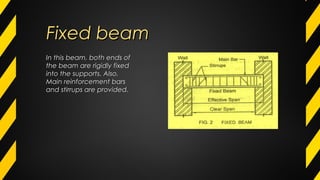
Fixed beamFixed beam
In this beam, both ends ofIn this beam, both ends of
the beam are rigidly fixedthe beam are rigidly fixed
into the supports. Also,into the supports. Also,
Main reinforcement barsMain reinforcement bars
and stirrups are provided.and stirrups are provided.
Cantilever beamCantilever beam
It is fixed in a wall orIt is fixed in a wall or
column at one end andcolumn at one end and
the other end is free, it isthe other end is free, it is
called cantilever beam. Itcalled cantilever beam. It
has tension zone in the tophas tension zone in the top
side and compression zoneside and compression zone
in the bottom sidein the bottom side
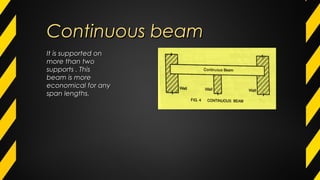
Continuous beamContinuous beam
It is supported onIt is supported on
more than twomore than two
supports . Thissupports . This
beam is morebeam is more
economical for anyeconomical for any
span lengths.span lengths.
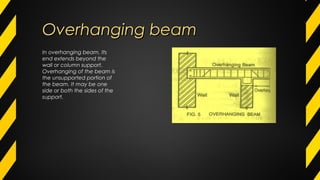
Overhanging beamOverhanging beam
In overhanging beam, Its
end extends beyond the
wall or column support.
Overhanging of the beam is
the unsupported portion of
the beam. It may be one
side or both the sides of the
support.
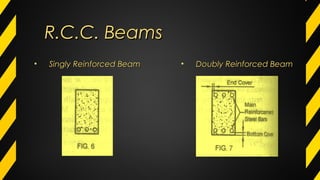
R.C.C. BeamsR.C.C. Beams
• Singly Reinforced BeamSingly Reinforced Beam • Doubly Reinforced BeamDoubly Reinforced Beam
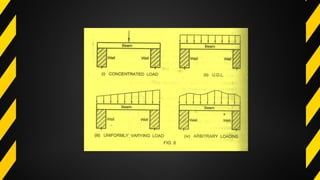
Types of Loading on BeamsTypes of Loading on Beams
• Concentrated LoadConcentrated Load
• Uniformly Distributed LoadsUniformly Distributed Loads
• Uniformly Varying LoadsUniformly Varying Loads
• Arbitrary LoadingArbitrary Loading
COLUMNSCOLUMNS
Column is a vertical structural member. It transmits the load fromColumn is a vertical structural member. It transmits the load from
ceiling/roof slab and beam, including its self-weight to theceiling/roof slab and beam, including its self-weight to the
foundation. Columns may be subjected to a pure compressivefoundation. Columns may be subjected to a pure compressive
load. R.C.C. columns are the most widely used now-a-days.load. R.C.C. columns are the most widely used now-a-days.
Types of ColumnsTypes of Columns
• Long Column Or SlenderLong Column Or Slender
• Short ColumnShort Column
• Intermediate ColumnIntermediate Column
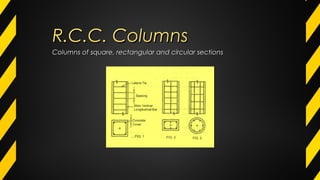
R.C.C. ColumnsR.C.C. Columns
Columns of square, rectangular and circular sectionsColumns of square, rectangular and circular sections
Precautions of Columns constructionPrecautions of Columns construction
• Process of constructionProcess of construction
• Vertical Height of concreteVertical Height of concrete
• Columns for more then one storeyColumns for more then one storey
• Load on the column of the top storeyLoad on the column of the top storey
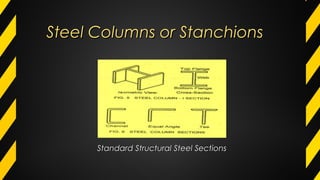
Steel Columns or StanchionsSteel Columns or Stanchions
Standard Structural Steel SectionsStandard Structural Steel Sections
Build-up Column SectionsBuild-up Column Sections
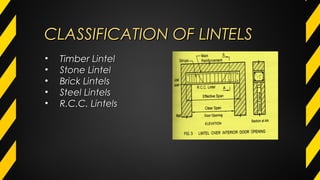
LINTELSLINTELS
Lintel is a short beam with its ends built into a wall. It is a horizontal
structural member placed over small openings of the wall for door,
window, ventilator, cupboard, etc.
CLASSIFICATION OF LINTELSCLASSIFICATION OF LINTELS
• Timber LintelTimber Lintel
• Stone LintelStone Lintel
• Brick LintelsBrick Lintels
• Steel LintelsSteel Lintels
• R.C.C. LintelsR.C.C. Lintels
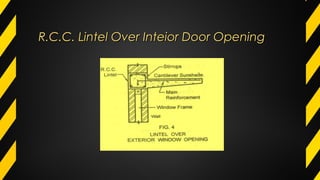
R.C.C. Lintel Over Inteior Door OpeningR.C.C. Lintel Over Inteior Door Opening
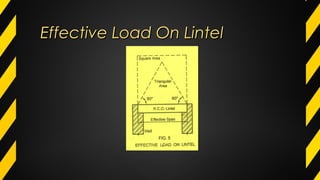
Effective Load On LintelEffective Load On Lintel
Skillcruise.com

Civil Engineering basics

  • 1.
    Basics of CivilEngineeringBasics of Civil EngineeringBasics of Civil EngineeringBasics of Civil Engineering
  • 2.
    SUPERSTRUCTURE Superstructure of abuilding is the portion of the Structure aboveSuperstructure of a building is the portion of the Structure above the foundation. It provides the necessary utility of the building withthe foundation. It provides the necessary utility of the building with comfort, Structural safety, ventilation, etc.comfort, Structural safety, ventilation, etc.
  • 3.
    TypesTypes • MasonryMasonry • RoofingRoofing •FlooringFlooring • PlasteringPlastering BEAMS,COLUMNS AND LINTELSBEAMS,COLUMNS AND LINTELS
  • 4.
    BEAMSBEAMS Beam is thehorizontal member of a structure, carrying transverseBeam is the horizontal member of a structure, carrying transverse loads. Beam is rectangular in cross-section. Beam carry the Floor slabloads. Beam is rectangular in cross-section. Beam carry the Floor slab or the roof slab. Bram transfer all the loads including its self-weight toor the roof slab. Bram transfer all the loads including its self-weight to the columns or walls.the columns or walls.
  • 5.
    R.C.C. Beam issubjected to bending moments and shear. Due to theR.C.C. Beam is subjected to bending moments and shear. Due to the vertical external load , bending compresses the top fibers of thevertical external load , bending compresses the top fibers of the beam and elongates the bottom fibers. The strength of R.C.C. beambeam and elongates the bottom fibers. The strength of R.C.C. beam depends on the composite action of concrete and steelsdepends on the composite action of concrete and steels R.C.C. BEAMSR.C.C. BEAMS
  • 6.
    Load Acting ona StructureLoad Acting on a Structure • Dead LoadDead Load • Live LoadLive Load Dead load is the self-weight of the various components of a building.Dead load is the self-weight of the various components of a building. Live load is the external superimposed load on a structure. Live loads may beLive load is the external superimposed load on a structure. Live loads may be (i)(i) Uniformly distributed loadUniformly distributed load (ii)(ii) Uniformly varying loadUniformly varying load (iii)(iii) Concentrated loadConcentrated load
  • 7.
    Types of BEAMSTypesof BEAMS • SIMPLY SUPPORTED BEAMSIMPLY SUPPORTED BEAM • FIXED BEAMFIXED BEAM • CANTILEVER BEAMCANTILEVER BEAM • CONTINUOUS BEAMCONTINUOUS BEAM • OVERHANGING BEAMOVERHANGING BEAM
  • 8.
    Simply supported beamSimplysupported beam It is a beam supportedIt is a beam supported freely at the two endsfreely at the two ends on walls or columns. Inon walls or columns. In actual practice, noactual practice, no beam rests freely on thebeam rests freely on the supports (walls orsupports (walls or columns).columns).
  • 9.
    Fixed beamFixed beam Inthis beam, both ends ofIn this beam, both ends of the beam are rigidly fixedthe beam are rigidly fixed into the supports. Also,into the supports. Also, Main reinforcement barsMain reinforcement bars and stirrups are provided.and stirrups are provided.
  • 10.
    Cantilever beamCantilever beam Itis fixed in a wall orIt is fixed in a wall or column at one end andcolumn at one end and the other end is free, it isthe other end is free, it is called cantilever beam. Itcalled cantilever beam. It has tension zone in the tophas tension zone in the top side and compression zoneside and compression zone in the bottom sidein the bottom side
  • 11.
    Continuous beamContinuous beam Itis supported onIt is supported on more than twomore than two supports . Thissupports . This beam is morebeam is more economical for anyeconomical for any span lengths.span lengths.
  • 12.
    Overhanging beamOverhanging beam Inoverhanging beam, Its end extends beyond the wall or column support. Overhanging of the beam is the unsupported portion of the beam. It may be one side or both the sides of the support.
  • 13.
    R.C.C. BeamsR.C.C. Beams •Singly Reinforced BeamSingly Reinforced Beam • Doubly Reinforced BeamDoubly Reinforced Beam
  • 14.
    Types of Loadingon BeamsTypes of Loading on Beams • Concentrated LoadConcentrated Load • Uniformly Distributed LoadsUniformly Distributed Loads • Uniformly Varying LoadsUniformly Varying Loads • Arbitrary LoadingArbitrary Loading
  • 16.
    COLUMNSCOLUMNS Column is avertical structural member. It transmits the load fromColumn is a vertical structural member. It transmits the load from ceiling/roof slab and beam, including its self-weight to theceiling/roof slab and beam, including its self-weight to the foundation. Columns may be subjected to a pure compressivefoundation. Columns may be subjected to a pure compressive load. R.C.C. columns are the most widely used now-a-days.load. R.C.C. columns are the most widely used now-a-days.
  • 17.
    Types of ColumnsTypesof Columns • Long Column Or SlenderLong Column Or Slender • Short ColumnShort Column • Intermediate ColumnIntermediate Column
  • 18.
    R.C.C. ColumnsR.C.C. Columns Columnsof square, rectangular and circular sectionsColumns of square, rectangular and circular sections
  • 19.
    Precautions of ColumnsconstructionPrecautions of Columns construction • Process of constructionProcess of construction • Vertical Height of concreteVertical Height of concrete • Columns for more then one storeyColumns for more then one storey • Load on the column of the top storeyLoad on the column of the top storey
  • 20.
    Steel Columns orStanchionsSteel Columns or Stanchions Standard Structural Steel SectionsStandard Structural Steel Sections
  • 21.
  • 22.
    LINTELSLINTELS Lintel is ashort beam with its ends built into a wall. It is a horizontal structural member placed over small openings of the wall for door, window, ventilator, cupboard, etc.
  • 23.
    CLASSIFICATION OF LINTELSCLASSIFICATIONOF LINTELS • Timber LintelTimber Lintel • Stone LintelStone Lintel • Brick LintelsBrick Lintels • Steel LintelsSteel Lintels • R.C.C. LintelsR.C.C. Lintels
  • 24.
    R.C.C. Lintel OverInteior Door OpeningR.C.C. Lintel Over Inteior Door Opening
  • 25.
    Effective Load OnLintelEffective Load On Lintel
  • 26.