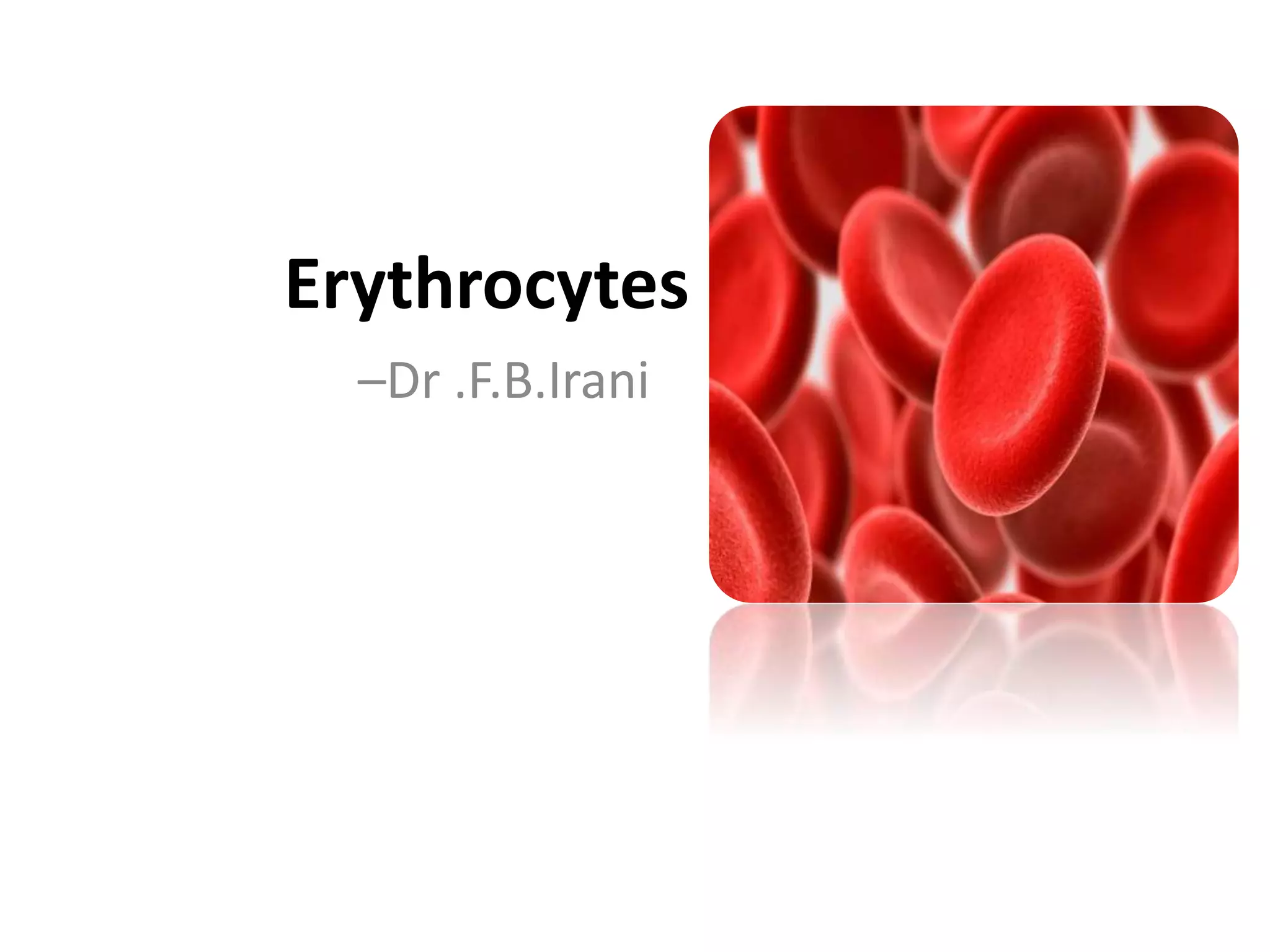
Erythrocytes
–Dr .F.B.Irani
Learning Objectives
• Give the dimensions, normal count and functions of RBC.
• Give the list of abnormal forms of RBCs
• define erythropoiesis, give the different steps.
• describes the details of regulation of erythropoiesis =
- erythropoietin
- Vit.B12
- Folic acid
-Factors for Hb
Morphology of RBC
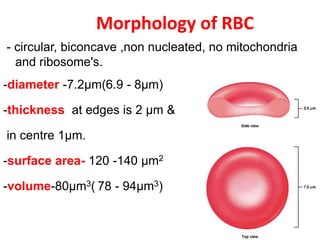
- circular, biconcave ,non nucleated, no mitochondria
and ribosome's.
-diameter -7.2µm(6.9 - 8µm)
-thickness at edges is 2 µm &
in centre 1µm.
-surface area- 120 -140 µm2
-volume-80µm3( 78 - 94µm3)
-Advantage of biconcavity-
1) It makes RBC flexible so that they can pass through
capillaries.
2) It increases surface area for exchange of gases
3)Surface area is greater than volume ,RBC can resist
haemolysis to certain in hypotonic sol.
4) Due to absence of mitochondria, RBCs do not
consume any of the O2 that they transport.
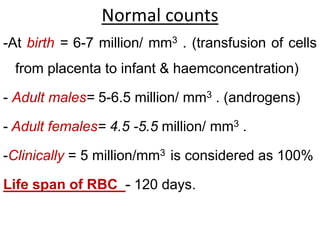
Normal counts
-At birth = 6-7 million/ mm3 . (transfusion of cells
from placenta to infant & haemconcentration)
- Adult males= 5-6.5 million/ mm3 . (androgens)
- Adult females= 4.5 -5.5 million/ mm3 .
-Clinically = 5 million/mm3 is considered as 100%
Life span of RBC - 120 days.
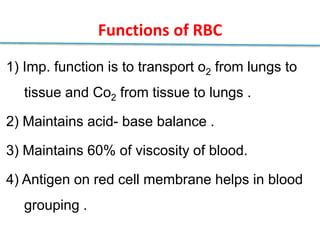
Functions of RBC
1) Imp. function is to transport o2 from lungs to
tissue and Co2 from tissue to lungs .
2) Maintains acid- base balance .
3) Maintains 60% of viscosity of blood.
4) Antigen on red cell membrane helps in blood
grouping .
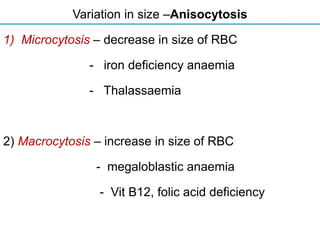
Variation in size –Anisocytosis
1) Microcytosis – decrease in size of RBC
- iron deficiency anaemia
- Thalassaemia
2) Macrocytosis – increase in size of RBC
- megaloblastic anaemia
- Vit B12, folic acid deficiency
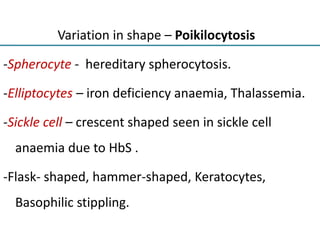
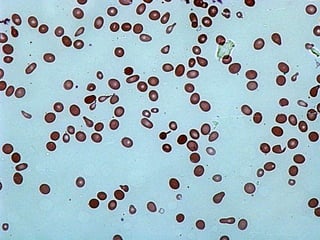
Variation in shape – Poikilocytosis
-Spherocyte - hereditary spherocytosis.
-Elliptocytes – iron deficiency anaemia, Thalassemia.
-Sickle cell – crescent shaped seen in sickle cell
anaemia due to HbS .
-Flask- shaped, hammer-shaped, Keratocytes,
Basophilic stippling.
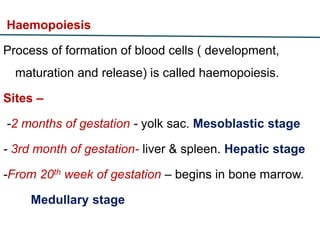
Haemopoiesis
Process of formation of blood cells ( development,
maturation and release) is called haemopoiesis.
Sites –
-2 months of gestation - yolk sac. Mesoblastic stage
- 3rd month of gestation- liver & spleen. Hepatic stage
-From 20th week of gestation – begins in bone marrow.
Medullary stage
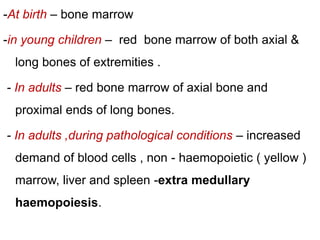
-At birth – bone marrow
-in young children – red bone marrow of both axial &
long bones of extremities .
- In adults – red bone marrow of axial bone and
proximal ends of long bones.
- In adults ,during pathological conditions – increased
demand of blood cells , non - haemopoietic ( yellow )
marrow, liver and spleen -extra medullary
haemopoiesis.
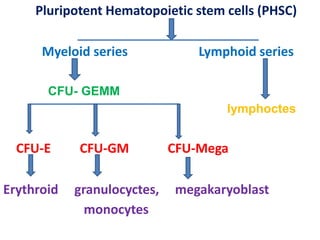
Erythroid granulocyctes, megakaryoblast
monocytes
Pluripotent Hematopoietic stem cells (PHSC)
Myeloid series Lymphoid series
CFU- GEMM
lymphoctes
CFU-E CFU-GM CFU-Mega
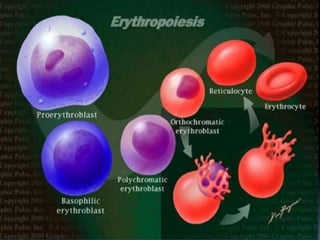
Erythropoiesis
-Process of origin ,development ,maturation of RBC.
-RBC develop from colony forming unit-erythrocyte
of red bone marrow.
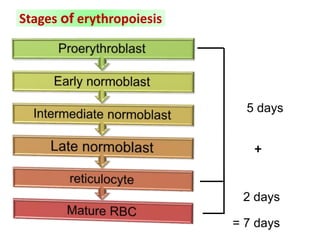
= 7 days
+
5 days
2 days
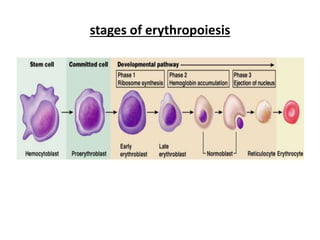
Stages of erythropoiesis
Stages of Erythrocytes
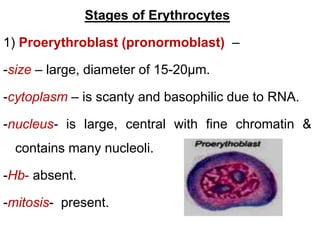
1) Proerythroblast (pronormoblast) –
-size – large, diameter of 15-20µm.
-cytoplasm – is scanty and basophilic due to RNA.
-nucleus- is large, central with fine chromatin &
contains many nucleoli.
-Hb- absent.
-mitosis- present.
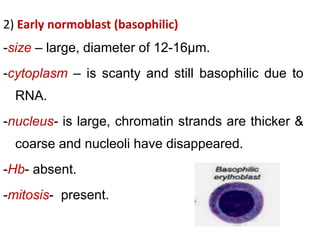
2) Early normoblast (basophilic)
-size – large, diameter of 12-16µm.
-cytoplasm – is scanty and still basophilic due to
RNA.
-nucleus- is large, chromatin strands are thicker &
coarse and nucleoli have disappeared.
-Hb- absent.
-mitosis- present.
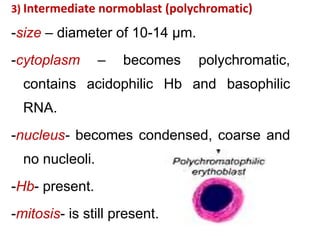
3) Intermediate normoblast (polychromatic)
-size – diameter of 10-14 µm.
-cytoplasm – becomes polychromatic,
contains acidophilic Hb and basophilic
RNA.
-nucleus- becomes condensed, coarse and
no nucleoli.
-Hb- present.
-mitosis- is still present.
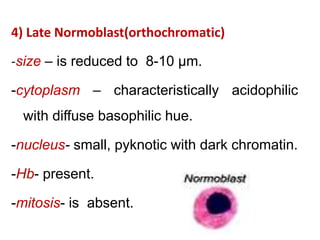
4) Late Normoblast(orthochromatic)
-size – is reduced to 8-10 µm.
-cytoplasm – characteristically acidophilic
with diffuse basophilic hue.
-nucleus- small, pyknotic with dark chromatin.
-Hb- present.
-mitosis- is absent.
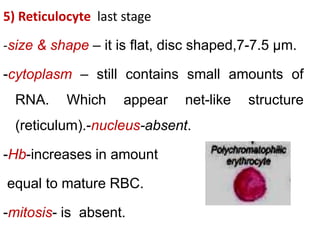
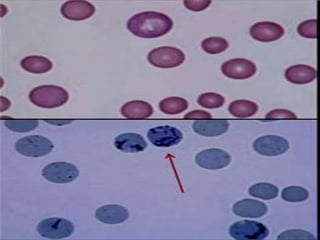
5) Reticulocyte last stage
-size & shape – it is flat, disc shaped,7-7.5 µm.
-cytoplasm – still contains small amounts of
RNA. Which appear net-like structure
(reticulum).-nucleus-absent.
-Hb-increases in amount
equal to mature RBC.
-mitosis- is absent.
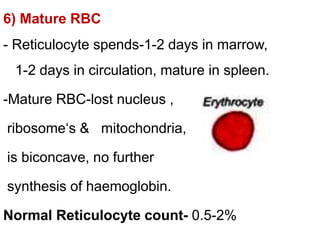
6) Mature RBC
- Reticulocyte spends-1-2 days in marrow,
1-2 days in circulation, mature in spleen.
-Mature RBC-lost nucleus ,
ribosome‘s & mitochondria,
is biconcave, no further
synthesis of haemoglobin.
Normal Reticulocyte count- 0.5-2%
stages of erythropoiesis
Factors necessary for erythropoiesis-
General factors- Erythropoietin
Special maturation factors –Vit B12 & folic acid
Factors necessary for haemoglobinization
-proteins
-iron
-metals and vitamines
-bile salts
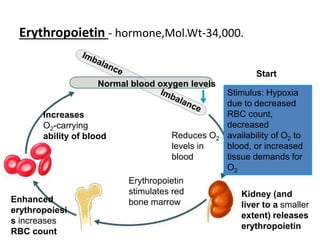
Erythropoietin - hormone,Mol.Wt-34,000.
Figure 17.6
Reduces O2
levels in
blood
Erythropoietin
stimulates red
bone marrow
Enhanced
erythropoiesi
s increases
RBC count
Normal blood oxygen levels
Stimulus: Hypoxia
due to decreased
RBC count,
decreased
availability of O2 to
blood, or increased
tissue demands for
O2
Start
Kidney (and
liver to a smaller
extent) releases
erythropoietin
Increases
O2-carrying
ability of blood
Action of erythropoietin-
1) Chief effect on the stem cell causing
differentiation
2) Promotes Hb synthesis by increasing
globlin & δ- amino acid.
3) Promotes every stage of maturation.
4) Promotes also release of RBC from bone
marrow in circulation.
Factors affecting erythropoietin secretion –
Increase- 1) Hormones- Androgens, Thyroxine,
growth hormone, Prolactin, ACTH, adrenal
steroids.
2) Haemolysates-product released during RBC
destruction.
3) Nucleotides- cAMP, NAD, & NADP.
Decrease-
1) Adenosine antagonists-e.g. theophylline
2) Oestrogen- decrease synthesis of globin
by liver.
- depress erythropoietin response to
hypoxia.
Vitamin B12 (cyanocobalamin)
- also known as extrinsic factor.
-daily requirement-1-2 µg.
-role- in synthesis of DNA and maturation of
nucleus & cell.
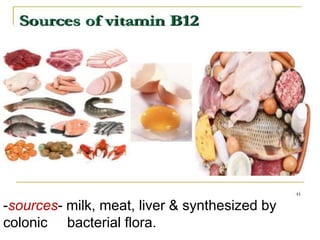
-sources- milk, meat, liver & synthesized by
colonic bacterial flora.
Folic acid-(pteroylglutamic acid) -
-daily requirement-100 µg.
-sources- leafy vegetables, yeasts, pulses,
& liver
-role- for synthesis of DNA
- tetrahydrofolate = for thymine synthesis
-for maturation of RBC.
.
Factor necessary for haemoglobinization-
1)Role of protein- first class proteins are
required for globin part of Hb.
a) liver, spleen, kidney, heart most valuable.
b) muscle – intermediate value.
c) bread, cereals, dairy products, vegetables ,
fruits- least value.
2) Role of iron- necessary for synthesis of Haem part
of haemoglobin.
-dietary iron and iron released from degradation of
RBCs is reused.
3) Role of other metals-
-copper- essential for absorption, mobilization,
utilization of iron.
-Cobalt- is required for synthesis of vit B12 by
bacterial action.
-Calcium – required indirectly for conserving iron.
4) Role of vitamins- vit B12, folic acid, vit C
required for maturation. Vit C help in
absorption of iron from gut.
5) Role of bile salts- required for absorption
of copper and nickel which in turn essential
for haemoglobin synthesis.
SAQ:-
1) Erythropoietin
2) Erythropoiesis
3) Factors affecting erythropoiesis
LAQ:-
1) Define erythropoiesis, & describe its stages.
2) Describe erythropoiesis with factors affecting it.

Erythropoiesis

  • 1.
  • 2.
    Learning Objectives • Givethe dimensions, normal count and functions of RBC. • Give the list of abnormal forms of RBCs • define erythropoiesis, give the different steps. • describes the details of regulation of erythropoiesis = - erythropoietin - Vit.B12 - Folic acid -Factors for Hb
  • 3.
    Morphology of RBC -circular, biconcave ,non nucleated, no mitochondria and ribosome's. -diameter -7.2µm(6.9 - 8µm) -thickness at edges is 2 µm & in centre 1µm. -surface area- 120 -140 µm2 -volume-80µm3( 78 - 94µm3)
  • 4.
    -Advantage of biconcavity- 1)It makes RBC flexible so that they can pass through capillaries. 2) It increases surface area for exchange of gases 3)Surface area is greater than volume ,RBC can resist haemolysis to certain in hypotonic sol. 4) Due to absence of mitochondria, RBCs do not consume any of the O2 that they transport.
  • 5.
    Normal counts -At birth= 6-7 million/ mm3 . (transfusion of cells from placenta to infant & haemconcentration) - Adult males= 5-6.5 million/ mm3 . (androgens) - Adult females= 4.5 -5.5 million/ mm3 . -Clinically = 5 million/mm3 is considered as 100% Life span of RBC - 120 days.
  • 6.
    Functions of RBC 1)Imp. function is to transport o2 from lungs to tissue and Co2 from tissue to lungs . 2) Maintains acid- base balance . 3) Maintains 60% of viscosity of blood. 4) Antigen on red cell membrane helps in blood grouping .
  • 7.
    Variation in size–Anisocytosis 1) Microcytosis – decrease in size of RBC - iron deficiency anaemia - Thalassaemia 2) Macrocytosis – increase in size of RBC - megaloblastic anaemia - Vit B12, folic acid deficiency
  • 8.
    Variation in shape– Poikilocytosis -Spherocyte - hereditary spherocytosis. -Elliptocytes – iron deficiency anaemia, Thalassemia. -Sickle cell – crescent shaped seen in sickle cell anaemia due to HbS . -Flask- shaped, hammer-shaped, Keratocytes, Basophilic stippling.
  • 10.
    Haemopoiesis Process of formationof blood cells ( development, maturation and release) is called haemopoiesis. Sites – -2 months of gestation - yolk sac. Mesoblastic stage - 3rd month of gestation- liver & spleen. Hepatic stage -From 20th week of gestation – begins in bone marrow. Medullary stage
  • 11.
    -At birth –bone marrow -in young children – red bone marrow of both axial & long bones of extremities . - In adults – red bone marrow of axial bone and proximal ends of long bones. - In adults ,during pathological conditions – increased demand of blood cells , non - haemopoietic ( yellow ) marrow, liver and spleen -extra medullary haemopoiesis.
  • 12.
    Erythroid granulocyctes, megakaryoblast monocytes PluripotentHematopoietic stem cells (PHSC) Myeloid series Lymphoid series CFU- GEMM lymphoctes CFU-E CFU-GM CFU-Mega
  • 13.
    Erythropoiesis -Process of origin,development ,maturation of RBC. -RBC develop from colony forming unit-erythrocyte of red bone marrow.
  • 14.
    = 7 days + 5days 2 days Stages of erythropoiesis
  • 15.
    Stages of Erythrocytes 1)Proerythroblast (pronormoblast) – -size – large, diameter of 15-20µm. -cytoplasm – is scanty and basophilic due to RNA. -nucleus- is large, central with fine chromatin & contains many nucleoli. -Hb- absent. -mitosis- present.
  • 16.
    2) Early normoblast(basophilic) -size – large, diameter of 12-16µm. -cytoplasm – is scanty and still basophilic due to RNA. -nucleus- is large, chromatin strands are thicker & coarse and nucleoli have disappeared. -Hb- absent. -mitosis- present.
  • 17.
    3) Intermediate normoblast(polychromatic) -size – diameter of 10-14 µm. -cytoplasm – becomes polychromatic, contains acidophilic Hb and basophilic RNA. -nucleus- becomes condensed, coarse and no nucleoli. -Hb- present. -mitosis- is still present.
  • 18.
    4) Late Normoblast(orthochromatic) -size– is reduced to 8-10 µm. -cytoplasm – characteristically acidophilic with diffuse basophilic hue. -nucleus- small, pyknotic with dark chromatin. -Hb- present. -mitosis- is absent.
  • 19.
    5) Reticulocyte laststage -size & shape – it is flat, disc shaped,7-7.5 µm. -cytoplasm – still contains small amounts of RNA. Which appear net-like structure (reticulum).-nucleus-absent. -Hb-increases in amount equal to mature RBC. -mitosis- is absent.
  • 21.
    6) Mature RBC -Reticulocyte spends-1-2 days in marrow, 1-2 days in circulation, mature in spleen. -Mature RBC-lost nucleus , ribosome‘s & mitochondria, is biconcave, no further synthesis of haemoglobin. Normal Reticulocyte count- 0.5-2%
  • 22.
  • 23.
    Factors necessary forerythropoiesis- General factors- Erythropoietin Special maturation factors –Vit B12 & folic acid Factors necessary for haemoglobinization -proteins -iron -metals and vitamines -bile salts
  • 24.
    Erythropoietin - hormone,Mol.Wt-34,000. Figure17.6 Reduces O2 levels in blood Erythropoietin stimulates red bone marrow Enhanced erythropoiesi s increases RBC count Normal blood oxygen levels Stimulus: Hypoxia due to decreased RBC count, decreased availability of O2 to blood, or increased tissue demands for O2 Start Kidney (and liver to a smaller extent) releases erythropoietin Increases O2-carrying ability of blood
  • 25.
    Action of erythropoietin- 1)Chief effect on the stem cell causing differentiation 2) Promotes Hb synthesis by increasing globlin & δ- amino acid. 3) Promotes every stage of maturation. 4) Promotes also release of RBC from bone marrow in circulation.
  • 26.
    Factors affecting erythropoietinsecretion – Increase- 1) Hormones- Androgens, Thyroxine, growth hormone, Prolactin, ACTH, adrenal steroids. 2) Haemolysates-product released during RBC destruction. 3) Nucleotides- cAMP, NAD, & NADP.
  • 27.
    Decrease- 1) Adenosine antagonists-e.g.theophylline 2) Oestrogen- decrease synthesis of globin by liver. - depress erythropoietin response to hypoxia.
  • 28.
    Vitamin B12 (cyanocobalamin) -also known as extrinsic factor. -daily requirement-1-2 µg. -role- in synthesis of DNA and maturation of nucleus & cell.
  • 29.
    -sources- milk, meat,liver & synthesized by colonic bacterial flora.
  • 30.
    Folic acid-(pteroylglutamic acid)- -daily requirement-100 µg. -sources- leafy vegetables, yeasts, pulses, & liver -role- for synthesis of DNA - tetrahydrofolate = for thymine synthesis -for maturation of RBC. .
  • 31.
    Factor necessary forhaemoglobinization- 1)Role of protein- first class proteins are required for globin part of Hb. a) liver, spleen, kidney, heart most valuable. b) muscle – intermediate value. c) bread, cereals, dairy products, vegetables , fruits- least value.
  • 32.
    2) Role ofiron- necessary for synthesis of Haem part of haemoglobin. -dietary iron and iron released from degradation of RBCs is reused. 3) Role of other metals- -copper- essential for absorption, mobilization, utilization of iron. -Cobalt- is required for synthesis of vit B12 by bacterial action. -Calcium – required indirectly for conserving iron.
  • 33.
    4) Role ofvitamins- vit B12, folic acid, vit C required for maturation. Vit C help in absorption of iron from gut. 5) Role of bile salts- required for absorption of copper and nickel which in turn essential for haemoglobin synthesis.
  • 35.
    SAQ:- 1) Erythropoietin 2) Erythropoiesis 3)Factors affecting erythropoiesis LAQ:- 1) Define erythropoiesis, & describe its stages. 2) Describe erythropoiesis with factors affecting it.