Fasteners Manufacturing
By Rupal Jyotishi
Fasteners Manufacturing
Rupal Jyotishi…
Fasteners Manufacturing
By Rupal Jyotishi
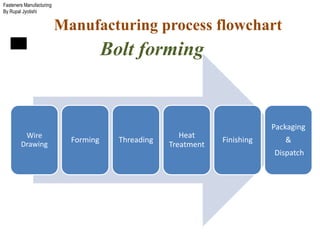
Manufacturing process flowchart
Wire
Drawing
Forming Threading
Heat
Treatment
Finishing
Packaging
&
Dispatch
Bolt forming
Fasteners Manufacturing
By Rupal Jyotishi
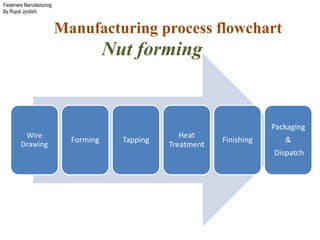
Manufacturing process flowchart
Nut forming
Wire
Drawing
Forming Tapping
Heat
Treatment
Finishing
Packaging
&
Dispatch
Fasteners Manufacturing
By Rupal Jyotishi
Module 1.1
Raw Material Handling
Note:- “Before starting this we need to identify few areas...”& for this I designed a “Level 1 –
Technique” _write me on rupaljyotishi@gmail.com to get a copy of “Level 1-Tech” ..
Fasteners Manufacturing
By Rupal Jyotishi
Fastener Material..
• There is no one fastener material that is right for every environment. Selecting
right material from vast array of material is important from technical and
commercial perspective.
• Apart from the cost and availability, careful consideration may need to be given to
strength, temperature , corrosion, vibration, fatigue and many other variables.
Fasteners Manufacturing
By Rupal Jyotishi
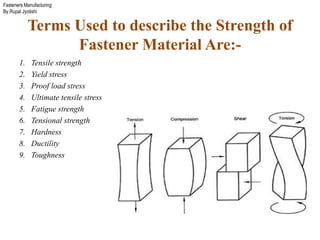
Terms Used to describe the Strength of
Fastener Material Are:-
1. Tensile strength
2. Yield stress
3. Proof load stress
4. Ultimate tensile stress
5. Fatigue strength
6. Tensional strength
7. Hardness
8. Ductility
9. Toughness
Fasteners Manufacturing
By Rupal Jyotishi
Mechanical Properties…
• Tensile Strength:- is an expression of the maximum capacity of a particular
material to stretch under tensile load , prior to failure.
Its normally expressed in :- Pound/Tons - inch terms
Kilo Newton – metric terms
• Yield Stress:- is an expression of the theoretical point of stress (pressure) beyond
which the material losses its elasticity and becomes permanently stretched.
Its normally expressed in :- ibf/ in2 - inch term
N/ mm2 - metric terms
Fasteners Manufacturing
By Rupal Jyotishi
• Proof Load Stress:- is an expression of the minimum stress a material must achieve,
prior to permanent elongation and, the stress which would be applied to test and
re-measure a specific fastener to prove it had not permanently stretched and that it
will carry the required load.
Its normally expressed in :- ibf/ in2
N/ mm2
Approximately between 80% and 90% of the theoretical yield stress.
• Ultimate Tensile strength:- is the theoretical minimum point at which the material
will fracture. It is expressed in the same terms as yield stress and proof load stress.
These properties used to calculate the Proof Load and Breaking load for each
diameter of each grade or class of product.
Its normally expressed in :- Pounds force - inch terms
Kilo Newton (KN)- metric terms
Mechanical Properties…(cont.)
Fasteners Manufacturing
By Rupal Jyotishi
• Fatigue Strength:- is a maximum stress a fastener can withstand for a specified
number of repeated cycles prior to its failure.
• Torsional Strength:- is a load usually expressed in terms torque, at which fasteners
fails by being twisted of about its axis.
• Ductility:- is a measure of the degree of plastic deformation that has been sustained
at fracture. In other words , it is the ability of material to deform before it fracture.
• Toughness:- is defined as a material’s ability to absorb impact or shock loading.
Impact strength toughness is rarely a specification requirement.
Mechanical Properties…(cont.)
Fasteners Manufacturing
By Rupal Jyotishi
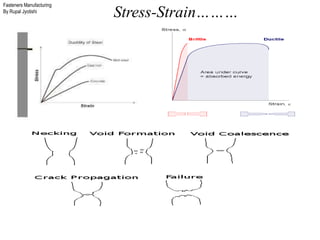
Stress-Strain………
Fasteners Manufacturing
By Rupal Jyotishi
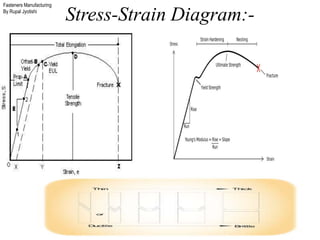
Stress-Strain Diagram:-
Fasteners Manufacturing
By Rupal Jyotishi
Material used in Fasteners Manufacturing
Alloy
Brass
Bronze
Aluminum
Magnesium
Low carbon
Stainless steel
Fasteners Manufacturing
By Rupal Jyotishi
Stainless steel….
• Stainless steel is a family of iron-based alloy that must contain at least 10.5%
chromium . The presence of chromium creates an invisible surface film that resists
oxidation and makes the material “passive” or corrosion resistant.
Stainless steel can be simply and logically divided into three classes on the basis of
their microstructure:-
Austenitic :-
* 300 series contains nickel
* Not heat treatable
* Strength through cold-working
Martensitic :-
* 400 series contains no nickel
* Responds to heat treat
Ferritic :-
* 400 series (430)contains no nickel
* Not heat treatable
* Strength through cold working
Fasteners Manufacturing
By Rupal Jyotishi
Stainless Steel 302
• Most common grade available in HQ (with Cu)
• Excellent salt spray resistance
• Strength as received 75 ksi (app. 517.10 Mpa)
• Work hardenable to 110 ksi (app. 758.42 Mpa )
• Becomes slightly magnetic when cold worked
• Tendency to gall
Note:- 1 ksi=6.89 Mpa
• Common heat treatable grade used for high strength
• Hardenable to range 35-45 HRC
• Magnetic
• Average corrosion resistance
• High K factor
• Similar corrosion resistance to heavy zinc plating
Stainless Steel 410
Fasteners Manufacturing
By Rupal Jyotishi
Aluminum
• Common alloys are 2024,6061 and 380 (for casting)
• Tensile strength range from 45 ksi to 75 ksi
• Softness can cause some heading problems (build-up vs wear)
• For grade 8 fasteners consideration needs to be given to under head bearing stress
to reduce embedment*
• When used with stainless steel screws aluminum has a high probability of galling.
• If aluminum is combined with stainless steel in a corrosive environment, the
aluminum will corrode due to galvanic action.
*(Embedment is a phenomenon in mechanical engineering in which the surfaces between mechanical members of a loaded joint
embed)
Fasteners Manufacturing
By Rupal Jyotishi
Magnesium
• Very good strength to weight ratio
• Very low formability
• High galling tendency
• Tensile strength around 40ksi
• Strongly attacked by galvanic corrosion.
Fasteners Manufacturing
By Rupal Jyotishi
Carbon Steel
Majority of fasteners manufactured are out of steel. Steel is readily available, less
expensive, excellent workability, offers a wide range of attainable strength
properties.
• Low carbon steel:-
Contains less than 0.25% carbon
Some are heat treatable (Generally boron based low carbon steels)
Most commonly used AISI 1006-1022
• Medium Carbon Steel:-
Carbon contains 0.25% to 0.60%
Heat treatable
Most commonly used AISI 1030,1035,1045 and 1541
• Alloy Steel:-Steel with one or more mix elements./ <2% carbon etc.
Heat Treatable
Most commonly used AISI 4037,4140,4135 and SCM435
Fasteners Manufacturing
By Rupal Jyotishi
Processes of Material Handling..
Raw material handling in a fasteners industry contains several steps before going to
next operation as input. The processes are:-
1. Pre-cleaning
2. Phosphating
3. Wire drawing
4. Annealing
5. Storage by assigning color code
Fasteners Manufacturing
By Rupal Jyotishi
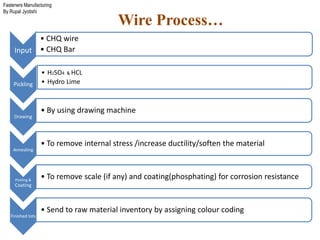
Wire Process…
Input
• CHQ wire
• CHQ Bar
Pickling
• H2SO4 & HCL
• Hydro Lime
Drawing
• By using drawing machine
Annealing
• To remove internal stress /increase ductility/soften the material
Pickling &
Coating
• To remove scale (if any) and coating(phosphating) for corrosion resistance
Finished lots
• Send to raw material inventory by assigning colour coding
Fasteners Manufacturing
By Rupal Jyotishi
For detailed description of these processes, you
can write an email to me on _
rupaljyotishi@gmail.com
1.Pre-cleaning
2.Phosphating
3.Wire drawing
4.Annealing
5.Storage by assigning color code
Facebook:-
https://www.facebook.com/fastenersmanufacturingbyRj1/
Fasteners Manufacturing
By Rupal Jyotishi
Thank You

Raw Material Handling in Fasteners Manufacturing Process by Rupal Jyotishi

  • 1.
    Fasteners Manufacturing By RupalJyotishi Fasteners Manufacturing Rupal Jyotishi…
  • 2.
    Fasteners Manufacturing By RupalJyotishi Manufacturing process flowchart Wire Drawing Forming Threading Heat Treatment Finishing Packaging & Dispatch Bolt forming
  • 3.
    Fasteners Manufacturing By RupalJyotishi Manufacturing process flowchart Nut forming Wire Drawing Forming Tapping Heat Treatment Finishing Packaging & Dispatch
  • 4.
    Fasteners Manufacturing By RupalJyotishi Module 1.1 Raw Material Handling Note:- “Before starting this we need to identify few areas...”& for this I designed a “Level 1 – Technique” _write me on rupaljyotishi@gmail.com to get a copy of “Level 1-Tech” ..
  • 5.
    Fasteners Manufacturing By RupalJyotishi Fastener Material.. • There is no one fastener material that is right for every environment. Selecting right material from vast array of material is important from technical and commercial perspective. • Apart from the cost and availability, careful consideration may need to be given to strength, temperature , corrosion, vibration, fatigue and many other variables.
  • 6.
    Fasteners Manufacturing By RupalJyotishi Terms Used to describe the Strength of Fastener Material Are:- 1. Tensile strength 2. Yield stress 3. Proof load stress 4. Ultimate tensile stress 5. Fatigue strength 6. Tensional strength 7. Hardness 8. Ductility 9. Toughness
  • 7.
    Fasteners Manufacturing By RupalJyotishi Mechanical Properties… • Tensile Strength:- is an expression of the maximum capacity of a particular material to stretch under tensile load , prior to failure. Its normally expressed in :- Pound/Tons - inch terms Kilo Newton – metric terms • Yield Stress:- is an expression of the theoretical point of stress (pressure) beyond which the material losses its elasticity and becomes permanently stretched. Its normally expressed in :- ibf/ in2 - inch term N/ mm2 - metric terms
  • 8.
    Fasteners Manufacturing By RupalJyotishi • Proof Load Stress:- is an expression of the minimum stress a material must achieve, prior to permanent elongation and, the stress which would be applied to test and re-measure a specific fastener to prove it had not permanently stretched and that it will carry the required load. Its normally expressed in :- ibf/ in2 N/ mm2 Approximately between 80% and 90% of the theoretical yield stress. • Ultimate Tensile strength:- is the theoretical minimum point at which the material will fracture. It is expressed in the same terms as yield stress and proof load stress. These properties used to calculate the Proof Load and Breaking load for each diameter of each grade or class of product. Its normally expressed in :- Pounds force - inch terms Kilo Newton (KN)- metric terms Mechanical Properties…(cont.)
  • 9.
    Fasteners Manufacturing By RupalJyotishi • Fatigue Strength:- is a maximum stress a fastener can withstand for a specified number of repeated cycles prior to its failure. • Torsional Strength:- is a load usually expressed in terms torque, at which fasteners fails by being twisted of about its axis. • Ductility:- is a measure of the degree of plastic deformation that has been sustained at fracture. In other words , it is the ability of material to deform before it fracture. • Toughness:- is defined as a material’s ability to absorb impact or shock loading. Impact strength toughness is rarely a specification requirement. Mechanical Properties…(cont.)
  • 10.
    Fasteners Manufacturing By RupalJyotishi Stress-Strain………
  • 11.
    Fasteners Manufacturing By RupalJyotishi Stress-Strain Diagram:-
  • 12.
    Fasteners Manufacturing By RupalJyotishi Material used in Fasteners Manufacturing Alloy Brass Bronze Aluminum Magnesium Low carbon Stainless steel
  • 13.
    Fasteners Manufacturing By RupalJyotishi Stainless steel…. • Stainless steel is a family of iron-based alloy that must contain at least 10.5% chromium . The presence of chromium creates an invisible surface film that resists oxidation and makes the material “passive” or corrosion resistant. Stainless steel can be simply and logically divided into three classes on the basis of their microstructure:- Austenitic :- * 300 series contains nickel * Not heat treatable * Strength through cold-working Martensitic :- * 400 series contains no nickel * Responds to heat treat Ferritic :- * 400 series (430)contains no nickel * Not heat treatable * Strength through cold working
  • 14.
    Fasteners Manufacturing By RupalJyotishi Stainless Steel 302 • Most common grade available in HQ (with Cu) • Excellent salt spray resistance • Strength as received 75 ksi (app. 517.10 Mpa) • Work hardenable to 110 ksi (app. 758.42 Mpa ) • Becomes slightly magnetic when cold worked • Tendency to gall Note:- 1 ksi=6.89 Mpa • Common heat treatable grade used for high strength • Hardenable to range 35-45 HRC • Magnetic • Average corrosion resistance • High K factor • Similar corrosion resistance to heavy zinc plating Stainless Steel 410
  • 15.
    Fasteners Manufacturing By RupalJyotishi Aluminum • Common alloys are 2024,6061 and 380 (for casting) • Tensile strength range from 45 ksi to 75 ksi • Softness can cause some heading problems (build-up vs wear) • For grade 8 fasteners consideration needs to be given to under head bearing stress to reduce embedment* • When used with stainless steel screws aluminum has a high probability of galling. • If aluminum is combined with stainless steel in a corrosive environment, the aluminum will corrode due to galvanic action. *(Embedment is a phenomenon in mechanical engineering in which the surfaces between mechanical members of a loaded joint embed)
  • 16.
    Fasteners Manufacturing By RupalJyotishi Magnesium • Very good strength to weight ratio • Very low formability • High galling tendency • Tensile strength around 40ksi • Strongly attacked by galvanic corrosion.
  • 17.
    Fasteners Manufacturing By RupalJyotishi Carbon Steel Majority of fasteners manufactured are out of steel. Steel is readily available, less expensive, excellent workability, offers a wide range of attainable strength properties. • Low carbon steel:- Contains less than 0.25% carbon Some are heat treatable (Generally boron based low carbon steels) Most commonly used AISI 1006-1022 • Medium Carbon Steel:- Carbon contains 0.25% to 0.60% Heat treatable Most commonly used AISI 1030,1035,1045 and 1541 • Alloy Steel:-Steel with one or more mix elements./ <2% carbon etc. Heat Treatable Most commonly used AISI 4037,4140,4135 and SCM435
  • 18.
    Fasteners Manufacturing By RupalJyotishi Processes of Material Handling.. Raw material handling in a fasteners industry contains several steps before going to next operation as input. The processes are:- 1. Pre-cleaning 2. Phosphating 3. Wire drawing 4. Annealing 5. Storage by assigning color code
  • 19.
    Fasteners Manufacturing By RupalJyotishi Wire Process… Input • CHQ wire • CHQ Bar Pickling • H2SO4 & HCL • Hydro Lime Drawing • By using drawing machine Annealing • To remove internal stress /increase ductility/soften the material Pickling & Coating • To remove scale (if any) and coating(phosphating) for corrosion resistance Finished lots • Send to raw material inventory by assigning colour coding
  • 20.
    Fasteners Manufacturing By RupalJyotishi For detailed description of these processes, you can write an email to me on _ rupaljyotishi@gmail.com 1.Pre-cleaning 2.Phosphating 3.Wire drawing 4.Annealing 5.Storage by assigning color code Facebook:- https://www.facebook.com/fastenersmanufacturingbyRj1/
  • 21.