STAINLESS STEEL
&
PROPERTIES OF ALLOYS
-KAVYA KALAPALA
STAINLESS STEEL
Steel:
-Steels are iron based alloys that
contain less than 1.2% carbon.
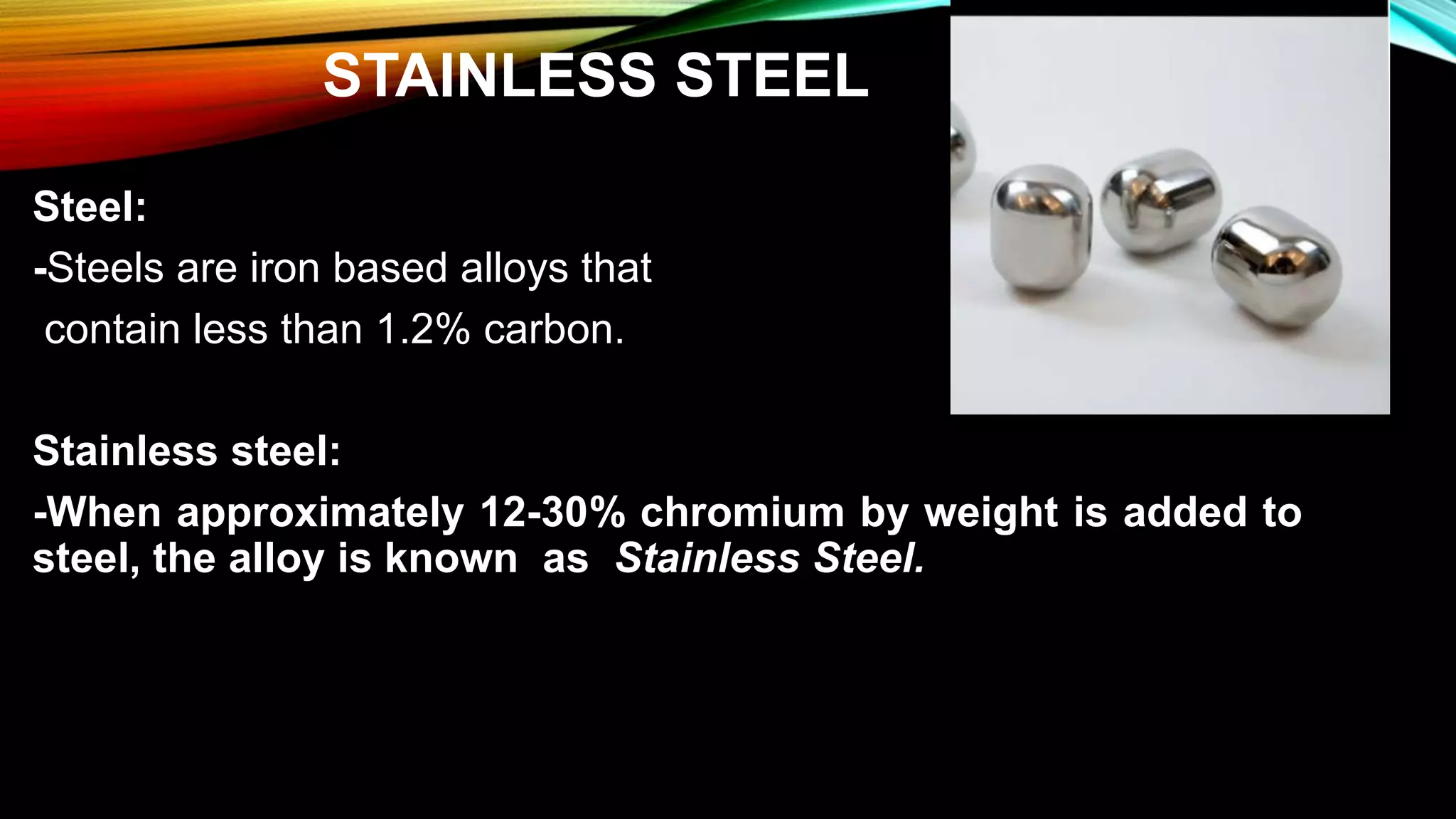
Stainless steel:
-When approximately 12-30% chromium by weight is added to
steel, the alloy is known as Stainless Steel.
HISTORY OF STAINLESS
STEEL
MANUFACTURE OF STAINLESS
STEEL
• Hematite, magnetite,limonite & siderite are the main ores of iron.
• These ores are reduced to iron using a blast furnace,from where it is transferred to
other plants for the manufacture of steel.
• There are 3 main processes of making steel
1.Bessemer process: by Henry Bessemer in 1856
Molten iron + O2 (air)》Steel + Heat + CO2
2.Open hearth process: By William Siemens in
1960
Pig iron + scrap + flux (in contact with hot
flames ) 》》Steel
3.Heroult’s electric arc furnace :-by Paul Heroult in 19th
century
-He used an electric furnace with a high temperature generated
between an arc,which was placed between electrodes and the
metal.
COMPOSITION OF STAINLESS STEEL
• Macroelements:
1. iron-very strong,very corrosive,main component Of
stainless steel
2. Nickel-soft,provides corrosion resistance, increases
ductility and toughness,adds luster
3. Chromium-provides passivation effect,
• Micro elements :
1. Carbon:increases mechanicalstrength & hardness
2. Manganese;improves ductility, binds the steel alloys
together,decreases brittleness
3. Silicon:increases resistance to oxidation, increases
strength
4. Titanium:stabilises the sensitised steel
TYPES OF STAINLESS STEEL
• Based on the different crystallised configuration of the structure, stainless steel is of 3 types
1. Ferritic stainless steel
2. Martensitic stainless steel
3. Austenitic stainless steel
1 Ferritic stainless steel :
• Pure iron at room temperature has BCC structure and is referred to as ferrite
• It is stable upto 912`C
Advantages :-Good resistance to corrosion
-Low cost
Disadvantages :-Low strength
-Cannot be heat hardened
2.Martensitic stainless steel :
• Named after the Germans metallurgist ,Adolf Martens.
FCC of austenite (on heating &quenching) 》》BCT of martensite
• This transformation is spontaneous and diffusionless and there is subtle
but rapid rearrangement of atomic positions.
• The rapid cooling traps the carbon atoms that do not have time to diffuse
out of the crystal structure.
Advantages :
-Can be heat treated
-Because of its high strength and hardness, it can be used for
surgical and cutting instruments, but shanks & orthodontic pliers.
Disadvantages :
-It is highly brittle owing to the distorted and strained lattice structure.
-Corrosion resistance is less than in other types.
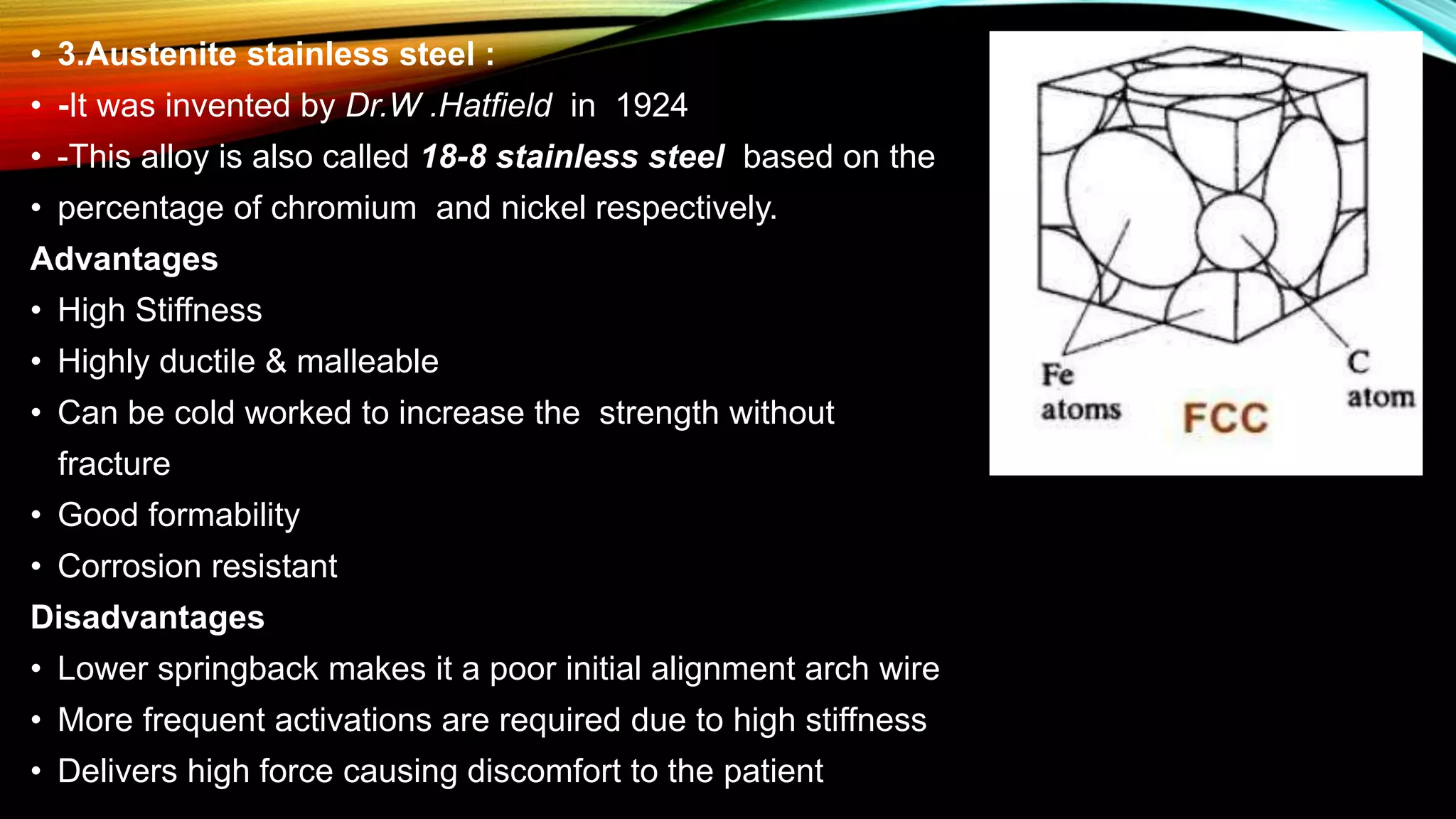
• 3.Austenite stainless steel :
• -It was invented by Dr.W .Hatfield in 1924
• -This alloy is also called 18-8 stainless steel based on the
• percentage of chromium and nickel respectively.
Advantages
• High Stiffness
• Highly ductile & malleable
• Can be cold worked to increase the strength without
fracture
• Good formability
• Corrosion resistant
Disadvantages
• Lower springback makes it a poor initial alignment arch wire
• More frequent activations are required due to high stiffness
• Delivers high force causing discomfort to the patient
PEARLITE
• When a plain carbon steel
containing 0.8 % carbon is cooled
slowly in the austenite phase to
723‘C, it undergoes a solid-state eutectoid transformation to yield a
microstructural constituent called Pearlite.
• Pearlite consists of alternating fine scale lamellae of ferrite and iron carbide,
referred to as cementite or simply carbide
• The carbide phase is much harder and more rigid than austenite or ferrite
DUPLEX
• Steel having a 2 phase structure
of almost equal properties of
austenite & ferrite is known as
Duplex
Properties:
• High resistance to stress corrosion
cracking
• High tensile strength than austenite/
ferrite steel
• Increased resistance to chloride ion
attack
USES OF STAINLESS STEEL IN
ORTHODONTICS
1. Brackets and buccal tubes
2. Archwire
3. Bands
4. Attachment (buttons,cleats,hooks,etc)
5. Ligatures
6. Springs
7. Micro implants
8. Wires used in removable appliances & retainers
9. Orthodontic instruments & pliers
PASSIVATION
• To provide resistance to tarnish
& corrosion, chromium is
added to stainless steel, which
forms a thin,transparent but
tough and impervious oxide
layer on the surface of the
alloy,which is called
passivation
• It provides a barrier to diffusion oxygen and other corrosive species, also prevents further corrosion
of the underlying alloy.
SENSITISATION
• 18-8 stainless steel may loose it’s resistance to corrosion if it is heated between
400’C-900‘C,it is due to precipitation of chromium carbide at the grain boundaries
at high temperature as passivation qualities are lost.
STABILISATION
• It is a method to minimise sensitisation
• An element is introduced in place of chromium that precipitates as carbide
• Titanium is most commonly used
SHAPE MEMORY :
• Significant:during phase transition from austenite to martensite.
• Memory effect is achieved by first establishing a shape at temperature
near 482’C;then on cooling,a second shape is formed; on
subsequent heating through a lower transition temperature,
the material returns to its original shape.
SUPERELASTICITY / PSEUDOELASTICITY:
• It is produced by transition of austenite to martensite by stress due
to volume change which results from change in crystal structure
• Initially stressing alloy results in standard stress –strain behaviour, at the areas of stress, where phase
transition is induced,there is increase in strain reffered to as superelasticity.
• Unloading results in reverse transition & recovery
LLOYS & THEIR PROPERTIES
Alloy:
• An alloy is a material composed of 2/more elements, at least one of which should
be a metal
• It is made by fusing 2/more metals or a metal and a non metal
BASE METAL
• A metal which readily oxidises or dissolves to release ions
Eg:Al,Sn,Pb,Ni,Cu
NOBLE METAL
• A metal which is highly resistant to oxidation and dissolution in organic solutions
Eg Pt, Pd,Rh, Ir, Os
CAST METAL
• Solidification of pure metal produced cast metal
WROUGHT METAL
• It is formed when the parent metal is subjected to various deformation processes
like drawing, machining, beating,rolling,etc
INGOT
• An ingot is a piece of relatively pure metals that is cast into a shape suitable for
further processing
WHAT IS STRESS……..???!!
STRESS
• It is the internal resistance of the body to external force
• It is equal and opposite in direction to force applied
STRAIN
• It is expressed as change in dimension to its original dimension, when internal
resistance is not sufficient to withstand external force
HOOKE’S LAW
• With in the elastic limit stress is directly proportional to strain
MODULUS OF ELASTICITY
• It is the relative stiffness or rigidity with in the elastic limit
WHAT IS RESILIENCY…,?
RESILIENCY
• It is the energy storage capacity of the wires which is the combination of strength and
springiness
LOAD DEFLECTION RATE
• Deflection observed for a given load within elastic limit
SPRINGINESS
• It is the measure of how far a wire can be deflected without causing permanent
deformation
FORMABILITY
• It represents the amount of permanent bending the wire will tolerate before it breaks
ELASTICITY
• It is the tendency of a solid material to return to the original
shape after being deformed
ELASTIC LIMIT
• Maximum stress a material will withstand without permanent deformation
POISSON‘S RATIO
• It is the ratio of axial strain to lateral strain
YIELD STRENGTH
• Stress at which ,material exhibits a specified limiting deviation when greater than the
proportionality of stress to strain
FATIGUE
• Material weakening or break down when it is subjected to repeated series of stress
• A point at which wire breaks
FAILURE POINT
SPRING BACK
• The amount of elastic strain that a metal can recover when loaded to unloaded
from its yield strength
STIFFNESS
• Amount of force required to produce a specific deformation
HARDNESS
• Ability of a material to resist scratching
MALLEABILITY
• It is the ability of a material to withstand rupture under compression,as in rolling or
hammering into a sheet
DUCTILITY
• It is the ability of material to withstand permanent deformation under a tensile load
without rupture
BAUSCHINGER EFFECT
• The property of materials where material stress or strain characteristics change as
a result of microscopic stress distribution of material
COEFFICIENT OF THERMAL
EXPANSION
• Fraction change in size per degree change in temperature at constant pressure
COEFFICIENT OF THERMAL
CONDUCTIVITY
• It is the quantity of heat in calories per second that passes through a specimen,
1cm thick and a cross sectional area of 1 cm2, when the temperature difference
between the surfaces perpendicular to the heat flow of specimen is 1 degree K
COLD WORKING /WORK
HARDENING
• The process of strengthening a metal by changing it’s shape without the use of
heat and subjecting to mechanical stress to cause a permanent change
HEAT TREATMENT
1.Softening heat treatment / solution heat treatment / annealing :
• Heating metal to specific temperature and then cooling at slow rate which produces
refined microstructure, forms single phase solid solution via quenching
• Removes internal stresses due to cold working, welding,casting,rapid cooling
STAGES OF ANNEALING
1. RECOVERY :
• Most beneficial changes occur
• Maximum residual stresses get relieved
2.RECRYSTALLISATION :
• Deformed grains begin to recrystallisation
• New stress free grains are formed
3.GRAIN GROWTH:
• Recrystallised grains continue to grow with
larger grains consuming smaller grains
2.Hardening heat treatment /precipitation heat treatment /age hardening:
• Alloys must be kept at elevated temperatures for hours to allow precipitation to take place ,called Ageing
• Used to increase the yield strength of malleable metals
• It involves the addition of impure particles to increase material strength
SOLDERING
• It is a process where two or more metals are joined together by melting and flowing
a filler metal into the joint
• Types:1.Soft solderin: MP of filler metal below 350’C
2.Hard soldering:MP of filler metal below 450’C
3.Brazing:MP of filler metal more than 450’C
WELDING
• It is the process by which two pieces of similar metals are joined together without
the addition of another metal
BIOCOMPATIBILITY
• It is the ability of a material to induce an appropriate and advantageous host
response during its intended clinical usage
BIOHOSTABILITY
• The ease with which a material will culture or accumulate bacteria,spores and
viruses
Stainless steel and their properties

Stainless steel and their properties

  • 1.
    STAINLESS STEEL & PROPERTIES OFALLOYS -KAVYA KALAPALA
  • 2.
    STAINLESS STEEL Steel: -Steels areiron based alloys that contain less than 1.2% carbon. Stainless steel: -When approximately 12-30% chromium by weight is added to steel, the alloy is known as Stainless Steel.
  • 3.
  • 5.
    MANUFACTURE OF STAINLESS STEEL •Hematite, magnetite,limonite & siderite are the main ores of iron. • These ores are reduced to iron using a blast furnace,from where it is transferred to other plants for the manufacture of steel. • There are 3 main processes of making steel 1.Bessemer process: by Henry Bessemer in 1856 Molten iron + O2 (air)》Steel + Heat + CO2
  • 6.
    2.Open hearth process:By William Siemens in 1960 Pig iron + scrap + flux (in contact with hot flames ) 》》Steel 3.Heroult’s electric arc furnace :-by Paul Heroult in 19th century -He used an electric furnace with a high temperature generated between an arc,which was placed between electrodes and the metal.
  • 7.
    COMPOSITION OF STAINLESSSTEEL • Macroelements: 1. iron-very strong,very corrosive,main component Of stainless steel 2. Nickel-soft,provides corrosion resistance, increases ductility and toughness,adds luster 3. Chromium-provides passivation effect, • Micro elements : 1. Carbon:increases mechanicalstrength & hardness 2. Manganese;improves ductility, binds the steel alloys together,decreases brittleness 3. Silicon:increases resistance to oxidation, increases strength 4. Titanium:stabilises the sensitised steel
  • 8.
    TYPES OF STAINLESSSTEEL • Based on the different crystallised configuration of the structure, stainless steel is of 3 types 1. Ferritic stainless steel 2. Martensitic stainless steel 3. Austenitic stainless steel 1 Ferritic stainless steel : • Pure iron at room temperature has BCC structure and is referred to as ferrite • It is stable upto 912`C Advantages :-Good resistance to corrosion -Low cost Disadvantages :-Low strength -Cannot be heat hardened
  • 9.
    2.Martensitic stainless steel: • Named after the Germans metallurgist ,Adolf Martens. FCC of austenite (on heating &quenching) 》》BCT of martensite • This transformation is spontaneous and diffusionless and there is subtle but rapid rearrangement of atomic positions. • The rapid cooling traps the carbon atoms that do not have time to diffuse out of the crystal structure. Advantages : -Can be heat treated -Because of its high strength and hardness, it can be used for surgical and cutting instruments, but shanks & orthodontic pliers. Disadvantages : -It is highly brittle owing to the distorted and strained lattice structure. -Corrosion resistance is less than in other types.
  • 10.
    • 3.Austenite stainlesssteel : • -It was invented by Dr.W .Hatfield in 1924 • -This alloy is also called 18-8 stainless steel based on the • percentage of chromium and nickel respectively. Advantages • High Stiffness • Highly ductile & malleable • Can be cold worked to increase the strength without fracture • Good formability • Corrosion resistant Disadvantages • Lower springback makes it a poor initial alignment arch wire • More frequent activations are required due to high stiffness • Delivers high force causing discomfort to the patient
  • 11.
    PEARLITE • When aplain carbon steel containing 0.8 % carbon is cooled slowly in the austenite phase to 723‘C, it undergoes a solid-state eutectoid transformation to yield a microstructural constituent called Pearlite. • Pearlite consists of alternating fine scale lamellae of ferrite and iron carbide, referred to as cementite or simply carbide • The carbide phase is much harder and more rigid than austenite or ferrite
  • 12.
    DUPLEX • Steel havinga 2 phase structure of almost equal properties of austenite & ferrite is known as Duplex Properties: • High resistance to stress corrosion cracking • High tensile strength than austenite/ ferrite steel • Increased resistance to chloride ion attack
  • 13.
    USES OF STAINLESSSTEEL IN ORTHODONTICS 1. Brackets and buccal tubes 2. Archwire 3. Bands 4. Attachment (buttons,cleats,hooks,etc) 5. Ligatures 6. Springs 7. Micro implants 8. Wires used in removable appliances & retainers 9. Orthodontic instruments & pliers
  • 14.
    PASSIVATION • To provideresistance to tarnish & corrosion, chromium is added to stainless steel, which forms a thin,transparent but tough and impervious oxide layer on the surface of the alloy,which is called passivation • It provides a barrier to diffusion oxygen and other corrosive species, also prevents further corrosion of the underlying alloy.
  • 15.
    SENSITISATION • 18-8 stainlesssteel may loose it’s resistance to corrosion if it is heated between 400’C-900‘C,it is due to precipitation of chromium carbide at the grain boundaries at high temperature as passivation qualities are lost.
  • 16.
    STABILISATION • It isa method to minimise sensitisation • An element is introduced in place of chromium that precipitates as carbide • Titanium is most commonly used
  • 17.
    SHAPE MEMORY : •Significant:during phase transition from austenite to martensite. • Memory effect is achieved by first establishing a shape at temperature near 482’C;then on cooling,a second shape is formed; on subsequent heating through a lower transition temperature, the material returns to its original shape. SUPERELASTICITY / PSEUDOELASTICITY: • It is produced by transition of austenite to martensite by stress due to volume change which results from change in crystal structure • Initially stressing alloy results in standard stress –strain behaviour, at the areas of stress, where phase transition is induced,there is increase in strain reffered to as superelasticity. • Unloading results in reverse transition & recovery
  • 18.
    LLOYS & THEIRPROPERTIES Alloy: • An alloy is a material composed of 2/more elements, at least one of which should be a metal • It is made by fusing 2/more metals or a metal and a non metal
  • 19.
    BASE METAL • Ametal which readily oxidises or dissolves to release ions Eg:Al,Sn,Pb,Ni,Cu
  • 20.
    NOBLE METAL • Ametal which is highly resistant to oxidation and dissolution in organic solutions Eg Pt, Pd,Rh, Ir, Os
  • 21.
    CAST METAL • Solidificationof pure metal produced cast metal
  • 22.
    WROUGHT METAL • Itis formed when the parent metal is subjected to various deformation processes like drawing, machining, beating,rolling,etc
  • 23.
    INGOT • An ingotis a piece of relatively pure metals that is cast into a shape suitable for further processing
  • 24.
  • 25.
    STRESS • It isthe internal resistance of the body to external force • It is equal and opposite in direction to force applied
  • 26.
    STRAIN • It isexpressed as change in dimension to its original dimension, when internal resistance is not sufficient to withstand external force
  • 27.
    HOOKE’S LAW • Within the elastic limit stress is directly proportional to strain
  • 28.
    MODULUS OF ELASTICITY •It is the relative stiffness or rigidity with in the elastic limit
  • 29.
  • 30.
    RESILIENCY • It isthe energy storage capacity of the wires which is the combination of strength and springiness
  • 31.
    LOAD DEFLECTION RATE •Deflection observed for a given load within elastic limit
  • 32.
    SPRINGINESS • It isthe measure of how far a wire can be deflected without causing permanent deformation
  • 33.
    FORMABILITY • It representsthe amount of permanent bending the wire will tolerate before it breaks
  • 34.
    ELASTICITY • It isthe tendency of a solid material to return to the original shape after being deformed
  • 35.
    ELASTIC LIMIT • Maximumstress a material will withstand without permanent deformation
  • 36.
    POISSON‘S RATIO • Itis the ratio of axial strain to lateral strain
  • 37.
    YIELD STRENGTH • Stressat which ,material exhibits a specified limiting deviation when greater than the proportionality of stress to strain
  • 38.
    FATIGUE • Material weakeningor break down when it is subjected to repeated series of stress
  • 39.
    • A pointat which wire breaks FAILURE POINT
  • 40.
    SPRING BACK • Theamount of elastic strain that a metal can recover when loaded to unloaded from its yield strength
  • 41.
    STIFFNESS • Amount offorce required to produce a specific deformation
  • 42.
    HARDNESS • Ability ofa material to resist scratching
  • 43.
    MALLEABILITY • It isthe ability of a material to withstand rupture under compression,as in rolling or hammering into a sheet
  • 44.
    DUCTILITY • It isthe ability of material to withstand permanent deformation under a tensile load without rupture
  • 45.
    BAUSCHINGER EFFECT • Theproperty of materials where material stress or strain characteristics change as a result of microscopic stress distribution of material
  • 46.
    COEFFICIENT OF THERMAL EXPANSION •Fraction change in size per degree change in temperature at constant pressure
  • 47.
    COEFFICIENT OF THERMAL CONDUCTIVITY •It is the quantity of heat in calories per second that passes through a specimen, 1cm thick and a cross sectional area of 1 cm2, when the temperature difference between the surfaces perpendicular to the heat flow of specimen is 1 degree K
  • 48.
    COLD WORKING /WORK HARDENING •The process of strengthening a metal by changing it’s shape without the use of heat and subjecting to mechanical stress to cause a permanent change
  • 49.
    HEAT TREATMENT 1.Softening heattreatment / solution heat treatment / annealing : • Heating metal to specific temperature and then cooling at slow rate which produces refined microstructure, forms single phase solid solution via quenching • Removes internal stresses due to cold working, welding,casting,rapid cooling
  • 50.
    STAGES OF ANNEALING 1.RECOVERY : • Most beneficial changes occur • Maximum residual stresses get relieved 2.RECRYSTALLISATION : • Deformed grains begin to recrystallisation • New stress free grains are formed 3.GRAIN GROWTH: • Recrystallised grains continue to grow with larger grains consuming smaller grains
  • 51.
    2.Hardening heat treatment/precipitation heat treatment /age hardening: • Alloys must be kept at elevated temperatures for hours to allow precipitation to take place ,called Ageing • Used to increase the yield strength of malleable metals • It involves the addition of impure particles to increase material strength
  • 52.
    SOLDERING • It isa process where two or more metals are joined together by melting and flowing a filler metal into the joint • Types:1.Soft solderin: MP of filler metal below 350’C 2.Hard soldering:MP of filler metal below 450’C 3.Brazing:MP of filler metal more than 450’C
  • 53.
    WELDING • It isthe process by which two pieces of similar metals are joined together without the addition of another metal
  • 54.
    BIOCOMPATIBILITY • It isthe ability of a material to induce an appropriate and advantageous host response during its intended clinical usage
  • 55.
    BIOHOSTABILITY • The easewith which a material will culture or accumulate bacteria,spores and viruses