ITERATIVE AND
EVOLUTIONARY
Introduction to the Rational Unified Process
The Unified Process
• The Unified Process has emerged as a popular and
effective software development process.
• In particular, the Rational Unified Process, as modified at
Rational Software, is widely practiced and adopted by
industry.
The Most Important Concept
• The critical idea in the Rational Unified Process is Iterative
Development.
• Iterative Development is successively enlarging and
refining a system through multiple iterations, using
feedback and adaptation.
• Each iteration will include requirements, analysis, design,
and implementation.
• Iterations are timeboxed.
What is Rational Unified Process
(RUP)?
 RUP is a complete software-development process
framework , developed by Rational Corporation.
 It’s an iterative development methodology.
 Processes derived from RUP vary from lightweight—
addressing the needs of small projects —to more
comprehensive processes addressing the needs of large,
possibly distributed project teams.
Phases in RUP
 RUP is divided into four phases, named:
 Inception
 Elaboration
 Construction
 Transition
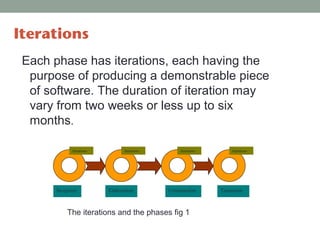
Each phase has iterations, each having the
purpose of producing a demonstrable piece
of software. The duration of iteration may
vary from two weeks or less up to six
months.
Inception Elaboration Construction Transition
Iterations Iterations IterationsIterations
The iterations and the phases fig 1
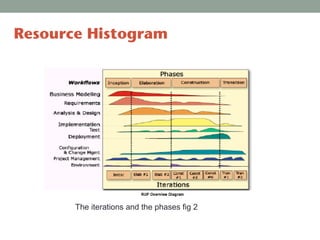
Iterations
The iterations and the phases fig 2
Resource Histogram
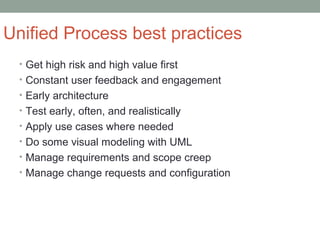
Unified Process best practices
• Get high risk and high value first
• Constant user feedback and engagement
• Early architecture
• Test early, often, and realistically
• Apply use cases where needed
• Do some visual modeling with UML
• Manage requirements and scope creep
• Manage change requests and configuration
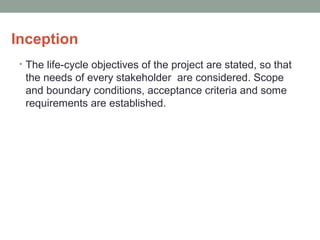
Inception
• The life-cycle objectives of the project are stated, so that
the needs of every stakeholder are considered. Scope
and boundary conditions, acceptance criteria and some
requirements are established.
Inception - Activities
 Formulate the scope of the project.
 Needs of every stakeholder, scope, boundary
conditions and acceptance criteria established.
 Plan and prepare the business case.
 Define risk strategy, develop an initial project plan and
identify known cost, schedule, and profitability trade-offs.
 Synthesize candidate architecture.
 Candidate architecture is picked from various potential
architectures
 Prepare the project environment.
Elaboration
• An analysis is done to determine the risks, stability of
vision of what the product is to become, stability of
architecture and expenditure of resources.
Elaboration - Activities
 Define the architecture.
 Project plan is defined. The process, infrastructure and
development environment are described.
 Validate the architecture.
 Baseline (Starting point) the architecture.
 design and implementation effort in the construction phase.
Construction
• The Construction phase is a manufacturing process. It
emphasizes managing resources and controlling
operations to optimize costs, schedules and quality. This
phase is broken into several iterations.
Construction - Activities
 Develop and test components.
 Components required satisfying the use cases, scenarios, and
other functionality for the iteration are built. Unit and integration
tests are done on Components.
 Manage resources and control process.
 Assess the iteration
 Satisfaction of the goal of iteration is determined.
Transition
• The transition phase is the phase where the product is put
in the hands of its end users. It involves issues of
marketing, packaging, installing, configuring, supporting
the user-community, making corrections, etc.
Transition - Activities
 Test the product deliverable in a customer
environment.
 Fine tune the product based upon customer feedback
 Deliver the final product to the end user
 Finalize end-user support material
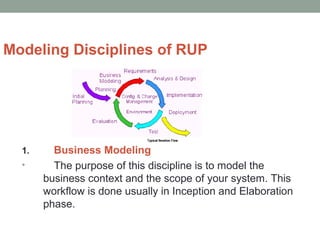
Modeling Disciplines of RUP
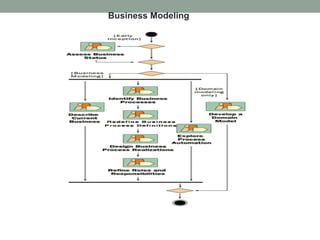
1. Business Modeling
• The purpose of this discipline is to model the
business context and the scope of your system. This
workflow is done usually in Inception and Elaboration
phase.
Activities include the development of:
-A context model showing how the system fits
into its overall environment
-A high-level business requirements model eg.
use case model
-A domain model eg. class diagram or data
diagram depicting major business classes or
entities
-A business process model
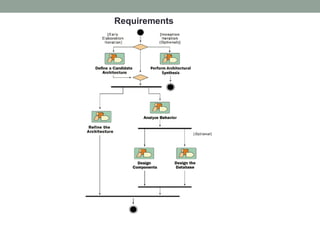
2. Requirements
The purpose of this discipline is to
engineer the requirements for the project,
including their identification, modeling,
and documentation. The main deliverable
of this discipline is the Software
Requirements Specification (SRS), also
referred to as the Requirements Model,
which encompasses the captured
requirements.
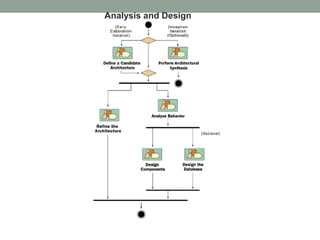
3. Analysis & Design
The purpose of this discipline is to evolve a
robust architecture for the system based on
the requirements, to transform the
requirements into a design, and to ensure
that implementation environment issues are
reflected in the design.
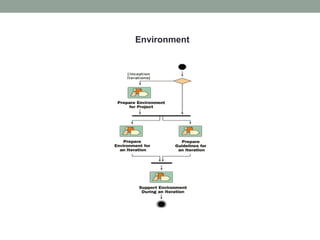
4. Environment
The purpose of this discipline is to support
development work. Practically all the work
in this workflow are done in Inception
phase.The activities include
- implementing and configuring RUP ,
selecting and acquiring required tools,
developing in-house tools
- providing software and hardware
maintenance and training.
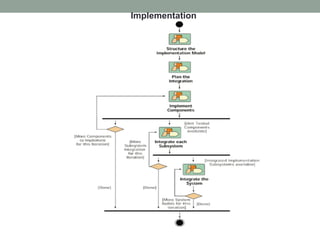
5. Implementation
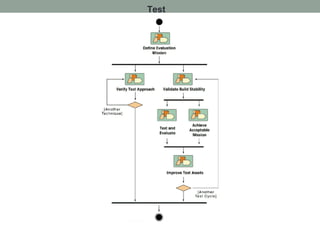
6. Test
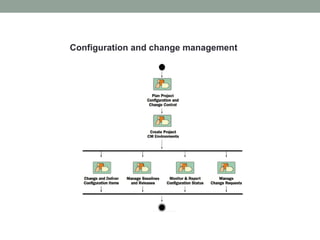
7. Configuration and Change Management
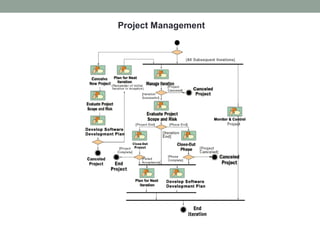
8. Project Management
PS: See appendix for flowcharts
Practices
 Develop software iteratively
 Software must be developed in small increments
and short iterations
 Manage requirements
 Requirements that change over time and those
requirements that have greater impact on project goals
must be identified
 Use component-based architecture Components
that are most likely to change and components that
can be re-used must be identified and built
 Visually model software
Models must be built using visualization
methods like UML, to understand the
complexity of the system
 Verify software quality
Testing must be done to remove defects at early
stages, thus reducing the costs at later stages
 Control software changes
Any changes to requirements must be
managed and their effect on software should be
traceable.
Life-Cycle Artifacts
• Rational suggests the following typical set of
• documents.
 Management artifacts:
• Artifacts used to drive or monitor the progress of the
project, estimate the risks, adjust the resources, give
visibility to the customer or the investors.
 Technical artifacts:
• Artifacts that are either the delivered goods, executable
software and manuals, or the blueprints that were used to
manufacture the delivered goods.
Management artifacts:
 An organizational policy document
 A Vision document
 A Business Case document
 A Development Plan document
 An Evaluation Criteria document
 Release Description documents
for each release
 Deployment document
 Status Assessment documents
Technical artifacts:
 User’s Manual
 Software documentation, preferably in the form of
self-documenting source code, and models (use
cases, class diagrams, process diagrams, etc.)
captured and maintained with appropriate CASE
tools.
 A Software Architecture document, describing the
overall structure of the software: class categories,
classes, processes, subsystems, the definition of
critical interfaces, and rationale for the key design
decisions.
Roles and Responsibilities
• RUP defines thirty roles called workers. Roles are assigned for
each activity. Besides the conventional roles (Architect,
Designer, Design Reviewer, Configuration Manager etc), specific
roles are assigned in Business Modeling and Environment
workflows:
 Business-Process Analyst
 Business designer
 Business Model Reviewer
 Course developer
 Tool smith
Examples of RUP
• RUP for Large Contractual Software
• development:
• Rational proposes the procurement of large
• software in 3 stages, associated with 3 different
• kinds of contract.
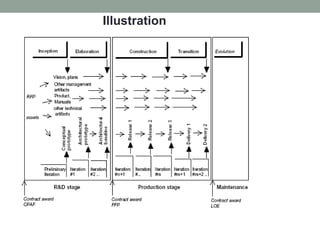
 An R&D stage, comprising the inception and elaboration
phase, typically bid in a risk sharing manner, e.g., as a
cost plus award fee contract (CPAF).
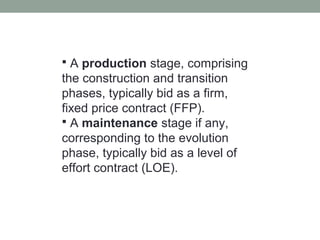
 A production stage, comprising
the construction and transition
phases, typically bid as a firm,
fixed price contract (FFP).
 A maintenance stage if any,
corresponding to the evolution
phase, typically bid as a level of
effort contract (LOE).
Illustration
RUP for a small commercial
software product
• A small commercial development would see
• a more fluid process, with only limited
• amount of formalism at the major
• milestones and a more limited set of
• documents:
 a product vision
 a development plan
 Release description documents,
specifying the goal of an iteration at the
beginning of the iteration, and updated
to serve as release notes at the end.
 User documentation, as necessary
 Software architecture, software
design, development process and
procedures
Advantages of RUP
 The RUP puts an emphasis on addressing very early high
risks areas.
 It does not assume a fixed set of firm requirements at the
inception of the project, but allows to refine the
requirements as the project evolves.
 It does not put either a strong focus on documents or
‘ceremonies’
 The main focus remains the software product itself, and
its quality.
Drawbacks of RUP
RUP is not considered particularly “agile” However,
recent studies have shown that by adopting the right
essential artifacts RUP is agile.
 It fails to provide any clear implementation guidelines.
 RUP leaves the tailoring to the user entirely.
References
 Agile software development methods – review and
analysis by Pekka Abrahamsson, Outi Salo & Jussi
Ronkainen
 http://www.rational.com
 Using the Rational unified Process for small projects –
Gary Pollice, Rational software
Appendix
• Flow-charts for the workflows of RUP
Business Modeling
Requirements
Analysis and Design
Environment
Implementation
Test
Configuration and change management
Project Management

Rational unified process lecture-5

  • 1.
    ITERATIVE AND EVOLUTIONARY Introduction tothe Rational Unified Process
  • 2.
    The Unified Process •The Unified Process has emerged as a popular and effective software development process. • In particular, the Rational Unified Process, as modified at Rational Software, is widely practiced and adopted by industry.
  • 3.
    The Most ImportantConcept • The critical idea in the Rational Unified Process is Iterative Development. • Iterative Development is successively enlarging and refining a system through multiple iterations, using feedback and adaptation. • Each iteration will include requirements, analysis, design, and implementation. • Iterations are timeboxed.
  • 4.
    What is RationalUnified Process (RUP)?  RUP is a complete software-development process framework , developed by Rational Corporation.  It’s an iterative development methodology.  Processes derived from RUP vary from lightweight— addressing the needs of small projects —to more comprehensive processes addressing the needs of large, possibly distributed project teams.
  • 5.
    Phases in RUP RUP is divided into four phases, named:  Inception  Elaboration  Construction  Transition
  • 6.
    Each phase hasiterations, each having the purpose of producing a demonstrable piece of software. The duration of iteration may vary from two weeks or less up to six months. Inception Elaboration Construction Transition Iterations Iterations IterationsIterations The iterations and the phases fig 1 Iterations
  • 7.
    The iterations andthe phases fig 2 Resource Histogram
  • 8.
    Unified Process bestpractices • Get high risk and high value first • Constant user feedback and engagement • Early architecture • Test early, often, and realistically • Apply use cases where needed • Do some visual modeling with UML • Manage requirements and scope creep • Manage change requests and configuration
  • 9.
    Inception • The life-cycleobjectives of the project are stated, so that the needs of every stakeholder are considered. Scope and boundary conditions, acceptance criteria and some requirements are established.
  • 10.
    Inception - Activities Formulate the scope of the project.  Needs of every stakeholder, scope, boundary conditions and acceptance criteria established.  Plan and prepare the business case.  Define risk strategy, develop an initial project plan and identify known cost, schedule, and profitability trade-offs.  Synthesize candidate architecture.  Candidate architecture is picked from various potential architectures  Prepare the project environment.
  • 11.
    Elaboration • An analysisis done to determine the risks, stability of vision of what the product is to become, stability of architecture and expenditure of resources.
  • 12.
    Elaboration - Activities Define the architecture.  Project plan is defined. The process, infrastructure and development environment are described.  Validate the architecture.  Baseline (Starting point) the architecture.  design and implementation effort in the construction phase.
  • 13.
    Construction • The Constructionphase is a manufacturing process. It emphasizes managing resources and controlling operations to optimize costs, schedules and quality. This phase is broken into several iterations.
  • 14.
    Construction - Activities Develop and test components.  Components required satisfying the use cases, scenarios, and other functionality for the iteration are built. Unit and integration tests are done on Components.  Manage resources and control process.  Assess the iteration  Satisfaction of the goal of iteration is determined.
  • 15.
    Transition • The transitionphase is the phase where the product is put in the hands of its end users. It involves issues of marketing, packaging, installing, configuring, supporting the user-community, making corrections, etc.
  • 16.
    Transition - Activities Test the product deliverable in a customer environment.  Fine tune the product based upon customer feedback  Deliver the final product to the end user  Finalize end-user support material
  • 17.
    Modeling Disciplines ofRUP 1. Business Modeling • The purpose of this discipline is to model the business context and the scope of your system. This workflow is done usually in Inception and Elaboration phase.
  • 18.
    Activities include thedevelopment of: -A context model showing how the system fits into its overall environment -A high-level business requirements model eg. use case model -A domain model eg. class diagram or data diagram depicting major business classes or entities -A business process model
  • 19.
    2. Requirements The purposeof this discipline is to engineer the requirements for the project, including their identification, modeling, and documentation. The main deliverable of this discipline is the Software Requirements Specification (SRS), also referred to as the Requirements Model, which encompasses the captured requirements.
  • 20.
    3. Analysis &Design The purpose of this discipline is to evolve a robust architecture for the system based on the requirements, to transform the requirements into a design, and to ensure that implementation environment issues are reflected in the design.
  • 21.
    4. Environment The purposeof this discipline is to support development work. Practically all the work in this workflow are done in Inception phase.The activities include - implementing and configuring RUP , selecting and acquiring required tools, developing in-house tools - providing software and hardware maintenance and training.
  • 22.
    5. Implementation 6. Test 7.Configuration and Change Management 8. Project Management PS: See appendix for flowcharts
  • 23.
    Practices  Develop softwareiteratively  Software must be developed in small increments and short iterations  Manage requirements  Requirements that change over time and those requirements that have greater impact on project goals must be identified  Use component-based architecture Components that are most likely to change and components that can be re-used must be identified and built
  • 24.
     Visually modelsoftware Models must be built using visualization methods like UML, to understand the complexity of the system  Verify software quality Testing must be done to remove defects at early stages, thus reducing the costs at later stages  Control software changes Any changes to requirements must be managed and their effect on software should be traceable.
  • 25.
    Life-Cycle Artifacts • Rationalsuggests the following typical set of • documents.  Management artifacts: • Artifacts used to drive or monitor the progress of the project, estimate the risks, adjust the resources, give visibility to the customer or the investors.  Technical artifacts: • Artifacts that are either the delivered goods, executable software and manuals, or the blueprints that were used to manufacture the delivered goods.
  • 26.
    Management artifacts:  Anorganizational policy document  A Vision document  A Business Case document  A Development Plan document  An Evaluation Criteria document  Release Description documents for each release  Deployment document  Status Assessment documents
  • 27.
    Technical artifacts:  User’sManual  Software documentation, preferably in the form of self-documenting source code, and models (use cases, class diagrams, process diagrams, etc.) captured and maintained with appropriate CASE tools.  A Software Architecture document, describing the overall structure of the software: class categories, classes, processes, subsystems, the definition of critical interfaces, and rationale for the key design decisions.
  • 28.
    Roles and Responsibilities •RUP defines thirty roles called workers. Roles are assigned for each activity. Besides the conventional roles (Architect, Designer, Design Reviewer, Configuration Manager etc), specific roles are assigned in Business Modeling and Environment workflows:  Business-Process Analyst  Business designer  Business Model Reviewer  Course developer  Tool smith
  • 29.
    Examples of RUP •RUP for Large Contractual Software • development: • Rational proposes the procurement of large • software in 3 stages, associated with 3 different • kinds of contract.  An R&D stage, comprising the inception and elaboration phase, typically bid in a risk sharing manner, e.g., as a cost plus award fee contract (CPAF).
  • 30.
     A productionstage, comprising the construction and transition phases, typically bid as a firm, fixed price contract (FFP).  A maintenance stage if any, corresponding to the evolution phase, typically bid as a level of effort contract (LOE).
  • 31.
  • 32.
    RUP for asmall commercial software product • A small commercial development would see • a more fluid process, with only limited • amount of formalism at the major • milestones and a more limited set of • documents:  a product vision  a development plan
  • 33.
     Release descriptiondocuments, specifying the goal of an iteration at the beginning of the iteration, and updated to serve as release notes at the end.  User documentation, as necessary  Software architecture, software design, development process and procedures
  • 34.
    Advantages of RUP The RUP puts an emphasis on addressing very early high risks areas.  It does not assume a fixed set of firm requirements at the inception of the project, but allows to refine the requirements as the project evolves.  It does not put either a strong focus on documents or ‘ceremonies’  The main focus remains the software product itself, and its quality.
  • 35.
    Drawbacks of RUP RUPis not considered particularly “agile” However, recent studies have shown that by adopting the right essential artifacts RUP is agile.  It fails to provide any clear implementation guidelines.  RUP leaves the tailoring to the user entirely.
  • 36.
    References  Agile softwaredevelopment methods – review and analysis by Pekka Abrahamsson, Outi Salo & Jussi Ronkainen  http://www.rational.com  Using the Rational unified Process for small projects – Gary Pollice, Rational software
  • 37.
    Appendix • Flow-charts forthe workflows of RUP
  • 38.
  • 39.
  • 40.
  • 41.
  • 42.
  • 43.
  • 44.
  • 45.