www.zaber.com
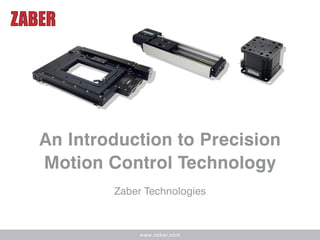
An Introduction to Precision
Motion Control Technology
Zaber Technologies
www.zaber.com
First, a little information about us
Zaber is a Vancouver-based
company that was founded in
1997. Our first product was the
T-LA linear actuator. It had a
built-in controller, which set it
apart from other actuators on
the market.
The very first prototype of
our T-LA actuator featured all
control and drive electronics in
one small, compact package.
We’ve grown since then...
We now offer over 56 series of devices and
hundreds of models, which are distributed
around the world. Many of our products are
designed with built-in controllers.
www.zaber.com
Our focus continues to be on
Simplifying motion control»»
Advancing our inhouse design and assembly capabilities»»
Continuously improving our products based on customer feedback»»
and suggestions
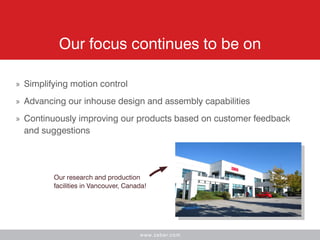
Our research and production
facilities in Vancouver, Canada!
So, what is motion control?
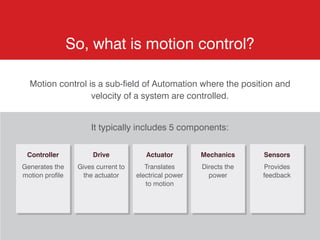
Motion control is a sub-field of Automation where the position and
velocity of a system are controlled.
It typically includes 5 components:
Controller
Generates the
motion profile
Drive
Gives current to
the actuator
Actuator
Translates
electrical power
to motion
Mechanics
Directs the
power
Sensors
Provides
feedback
www.zaber.com
High precision positioning
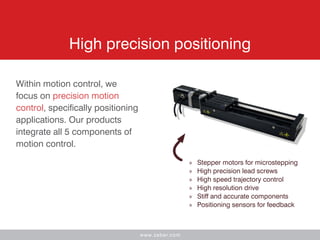
Within motion control, we
focus on precision motion
control, specifically positioning
applications. Our products
integrate all 5 components of
motion control.
Stepper motors for microstepping»»
High precision lead screws»»
High speed trajectory control»»
High resolution drive»»
Stiff and accurate components»»
Positioning sensors for feedback»»
www.zaber.com
Who uses these products?
Our typical customers are labs, universities, and original equipment
manufacturers (OEMs), and they come from industries like:
Photonics and optics»»
Industrial automation»»
Laboratory automation»»
Material science»»
Measurement and instrumentation»»
Aerospace»»
Surveillance and security»»
And the list goes on...»»
www.zaber.com
And what for?
Common positioning applications include:
Mass spectrometers»»
Thin film coating»»
Optical inspection systems»»
Camera focusing and testing»»
Material property testing»»
Microscope automation»»
Fiberoptic and laser alignment»»
Laser wavelength tuning»»
Complex printing»»
Insect tracking»»
Semiconductor wafer analysis»»
Optical beam profiling»»
Sorting and automated handling»»
systems
And the list goes on...»»
www.zaber.com
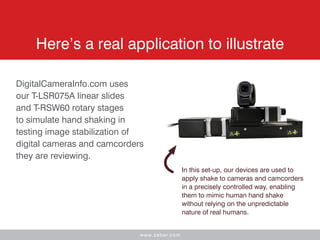
Here’s a real application to illustrate
DigitalCameraInfo.com uses
our T-LSR075A linear slides
and T-RSW60 rotary stages
to simulate hand shaking in
testing image stabilization of
digital cameras and camcorders
they are reviewing.
In this set-up, our devices are used to
apply shake to cameras and camcorders
in a precisely controlled way, enabling
them to mimic human hand shake
without relying on the unpredictable
nature of real humans.
www.zaber.com
And here’s another example
WITec GmbH uses our T-LA28A-S
linear actuators in their Scanning
Near-field Optical Microscope
alpha300 S for moving the
inverted microscope’s objective
in three axes.
The T-LA28A-S offers a resolution of
100 µm, which perfectly matches the
demanding requirements of high-
resolution microscopy.
www.zaber.com
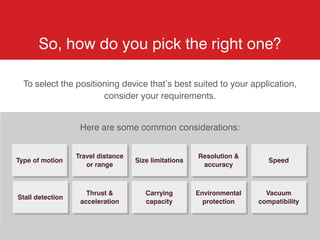
So, how do you pick the right one?
To select the positioning device that’s best suited to your application,
consider your requirements.
Here are some common considerations:
Type of motion
Travel distance
or range
Size limitations
Resolution &
accuracy
Speed
Stall detection
Thrust &
acceleration
Carrying
capacity
Environmental
protection
Vacuum
compatibility
www.zaber.com
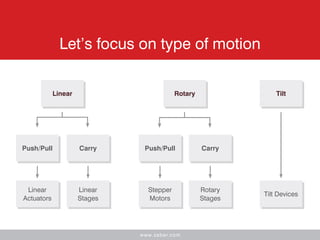
Let’s focus on type of motion
Tilt
Tilt Devices
Push/Pull Carry
Linear
Actuators
Linear
Stages
Linear Rotary
Rotary
Stages
Stepper
Motors
Push/Pull Carry
www.zaber.com
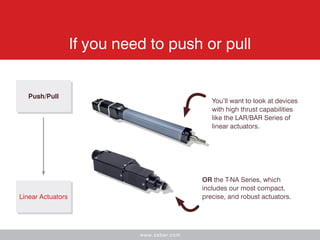
If you need to push or pull
Push/Pull
Linear Actuators
You’ll want to look at devices
with high thrust capabilities
like the LAR/BAR Series of
linear actuators.
OR the T-NA Series, which
includes our most compact,
precise, and robust actuators.
www.zaber.com
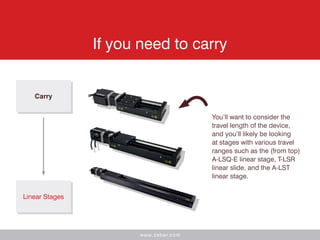
If you need to carry
Carry
Linear Stages
You’ll want to consider the
travel length of the device,
and you’ll likely be looking
at stages with various travel
ranges such as the (from top)
A-LSQ-E linear stage, T-LSR
linear slide, and the A-LST
linear stage.
www.zaber.com
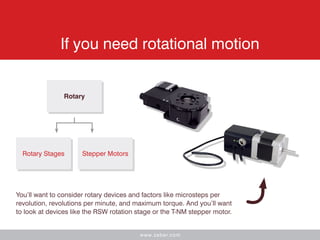
If you need rotational motion
You’ll want to consider rotary devices and factors like microsteps per
revolution, revolutions per minute, and maximum torque. And you’ll want
to look at devices like the RSW rotation stage or the T-NM stepper motor.
Rotary
Rotary Stages Stepper Motors
www.zaber.com
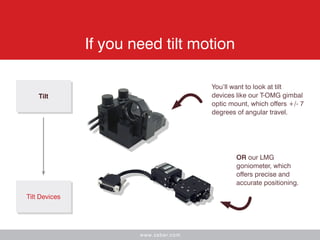
If you need tilt motion
Tilt
Tilt Devices
You’ll want to look at tilt
devices like our T-OMG gimbal
optic mount, which offers +/- 7
degrees of angular travel.
OR our LMG
goniometer, which
offers precise and
accurate positioning.
www.zaber.com
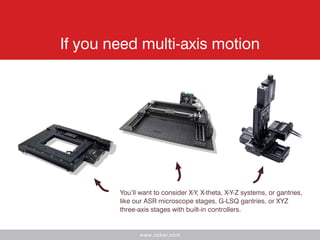
If you need multi-axis motion
You’ll want to consider X-Y, X-theta, X-Y-Z systems, or gantries,
like our ASR microscope stages, G-LSQ gantries, or XYZ
three-axis stages with built-in controllers.
www.zaber.com
If you have limited space
From top to bottom: T-LSM
miniature motorized linear stage,
T-NA micro linear actuators, and
LSA micro motorized linear stages.
Many of our products are
designed to be compact,
making them suitable for
applications with limited space.
Here are just a few of our most
compact products:
www.zaber.com
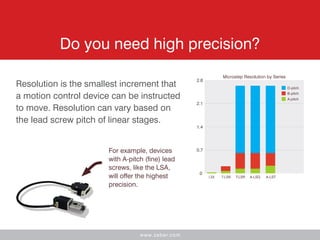
Do you need high precision?
Resolution is the smallest increment that
a motion control device can be instructed
to move. Resolution can vary based on
the lead screw pitch of linear stages.
Microstep Resolution by Series
2.8
2.1
1.4
0.7
0
LSA T-LSM T-LSR A-LSQ A-LST
D-pitch
B-pitch
A-pitch
For example, devices
with A-pitch (fine) lead
screws, like the LSA,
will offer the highest
precision.
www.zaber.com
Do you need consistent motion?
Repeatability is the deviation in actual position when a device is
repeatedly instructed to move to a target position from the same
direction.
50
45
40
35
30
25
20
15
10
5
0
Measured final position [µm]
Numberoftrials
0 0.2 0.4 0.6 0.8 1 1.2 1.4 1.6 1.8 2 2.2 2.4 2.6 2.8
www.zaber.com
Do you need to be accurate?
Accuracy is the measure of how close the actual position will be
compared to the requested position over the entire travel range.
Target Position [µm]
PositionError(µm)
4
3
2
1
0
-1
-2
-3
-4
0 500 1000 1500 2000 2500 3000 3500 4000
T-LSMxxxA Typical Accuracy over 4 mm
www.zaber.com
If you need to move something fast
Our A-LSQ linear stages offer
speed up to 1000 mm/s, up to 20
kg load capacity, as well as various
travel ranges from 75 - 600 mm.
Here are some of our products that
offer high speed travel: Our A-BLQ-E linear stages offer up
to 2.0 m/s speed, up to 20 kg load
capacity, and travel ranges from 70
- 2095 mm.
www.zaber.com
High thrust and carrying capacity?
Our G-LSQ gantries offer up
to 100 N thrust, depending on
choice of lead screw.
You’ll want to consider heavy duty devices with high peak thrust,
suitable for applications like industrial manufacturing, for example.
Our A-LST-C stages with dust covers
offer up to 560 N thrust and 100 kg
load capacity.
www.zaber.com
If you need stall detection
You may experience stalling when you operate above rated speed or
thrust. Some devices offer rotary encoders that provide closed-loop
position feedback with slip/stall detection and automatic recovery.
Our A-BLQ-E closed-loop
linear stage features a built-
in rotary encoder for stall
detection.
www.zaber.com
So you’ve chosen a suitable device
Now what? You’ll probably want to set up the device and get it to do
something. Our devices with built-in controllers simplify set-up and
daisy-chaining. The benefits include reduced cost, shorter set-up time,
and less cable clutter.
Built-in controller and daisy-
chaining makes setting up
easier and faster.
www.zaber.com
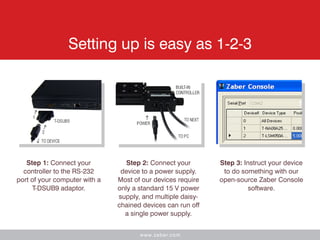
Setting up is easy as 1-2-3
Step 1: Connect your
controller to the RS-232
port of your computer with a
T-DSUB9 adaptor.
Step 2: Connect your
device to a power supply.
Most of our devices require
only a standard 15 V power
supply, and multiple daisy-
chained devices can run off
a single power supply.
Step 3: Instruct your device
to do something with our
open-source Zaber Console
software.
www.zaber.com
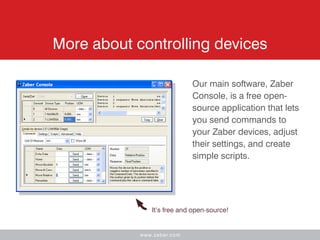
More about controlling devices
Our main software, Zaber
Console, is a free open-
source application that lets
you send commands to
your Zaber devices, adjust
their settings, and create
simple scripts.
It’s free and open-source!
www.zaber.com
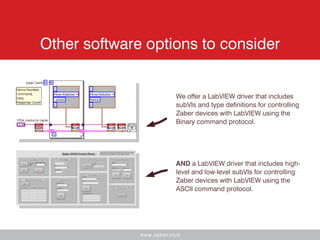
Other software options to consider
We offer a LabVIEW driver that includes
subVIs and type definitions for controlling
Zaber devices with LabVIEW using the
Binary command protocol.
AND a LabVIEW driver that includes high-
level and low-level subVIs for controlling
Zaber devices with LabVIEW using the
ASCII command protocol.
www.zaber.com
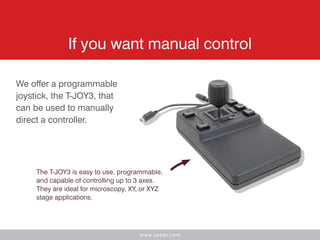
If you want manual control
We offer a programmable
joystick, the T-JOY3, that
can be used to manually
direct a controller.
The T-JOY3 is easy to use, programmable,
and capable of controlling up to 3 axes.
They are ideal for microscopy, XY, or XYZ
stage applications.
www.zaber.com
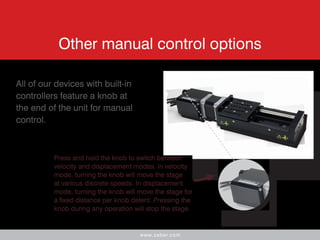
Other manual control options
All of our devices with built-in
controllers feature a knob at
the end of the unit for manual
control.
Press and hold the knob to switch between
velocity and displacement modes. In velocity
mode, turning the knob will move the stage
at various discrete speeds. In displacement
mode, turning the knob will move the stage for
a fixed distance per knob detent. Pressing the
knob during any operation will stop the stage.
www.zaber.com
We’re here to support you
All our standard products are backed by a 30-day satisfaction
guarantee. If you’re not satisfied with your device(s) for any reason, you
can return them within 30 days of the purchase date for a refund.
You’re also welcome to email contact@zaber.com or call 1-888-276-
8033 to speak with an applications engineer if you have any questions
or need assistance with your application.
www.zaber.com
Questions? Interested in more?
Visit www.zaber.com to learn more about our products and/or services.
Want the latest in Zaber news? Subscribe
to our mailing list to receive our newsletters.
Subscribers get access to the latest product
news and tips, as well as exclusive access to
promotions and coupons. Sign up online at
www.zaber.com.

An Introduction to Precision Motion Control

  • 1.
    www.zaber.com An Introduction toPrecision Motion Control Technology Zaber Technologies
  • 2.
    www.zaber.com First, a littleinformation about us Zaber is a Vancouver-based company that was founded in 1997. Our first product was the T-LA linear actuator. It had a built-in controller, which set it apart from other actuators on the market. The very first prototype of our T-LA actuator featured all control and drive electronics in one small, compact package.
  • 3.
    We’ve grown sincethen... We now offer over 56 series of devices and hundreds of models, which are distributed around the world. Many of our products are designed with built-in controllers.
  • 4.
    www.zaber.com Our focus continuesto be on Simplifying motion control»» Advancing our inhouse design and assembly capabilities»» Continuously improving our products based on customer feedback»» and suggestions Our research and production facilities in Vancouver, Canada!
  • 5.
    So, what ismotion control? Motion control is a sub-field of Automation where the position and velocity of a system are controlled. It typically includes 5 components: Controller Generates the motion profile Drive Gives current to the actuator Actuator Translates electrical power to motion Mechanics Directs the power Sensors Provides feedback
  • 6.
    www.zaber.com High precision positioning Withinmotion control, we focus on precision motion control, specifically positioning applications. Our products integrate all 5 components of motion control. Stepper motors for microstepping»» High precision lead screws»» High speed trajectory control»» High resolution drive»» Stiff and accurate components»» Positioning sensors for feedback»»
  • 7.
    www.zaber.com Who uses theseproducts? Our typical customers are labs, universities, and original equipment manufacturers (OEMs), and they come from industries like: Photonics and optics»» Industrial automation»» Laboratory automation»» Material science»» Measurement and instrumentation»» Aerospace»» Surveillance and security»» And the list goes on...»»
  • 8.
    www.zaber.com And what for? Commonpositioning applications include: Mass spectrometers»» Thin film coating»» Optical inspection systems»» Camera focusing and testing»» Material property testing»» Microscope automation»» Fiberoptic and laser alignment»» Laser wavelength tuning»» Complex printing»» Insect tracking»» Semiconductor wafer analysis»» Optical beam profiling»» Sorting and automated handling»» systems And the list goes on...»»
  • 9.
    www.zaber.com Here’s a realapplication to illustrate DigitalCameraInfo.com uses our T-LSR075A linear slides and T-RSW60 rotary stages to simulate hand shaking in testing image stabilization of digital cameras and camcorders they are reviewing. In this set-up, our devices are used to apply shake to cameras and camcorders in a precisely controlled way, enabling them to mimic human hand shake without relying on the unpredictable nature of real humans.
  • 10.
    www.zaber.com And here’s anotherexample WITec GmbH uses our T-LA28A-S linear actuators in their Scanning Near-field Optical Microscope alpha300 S for moving the inverted microscope’s objective in three axes. The T-LA28A-S offers a resolution of 100 µm, which perfectly matches the demanding requirements of high- resolution microscopy.
  • 11.
    www.zaber.com So, how doyou pick the right one? To select the positioning device that’s best suited to your application, consider your requirements. Here are some common considerations: Type of motion Travel distance or range Size limitations Resolution & accuracy Speed Stall detection Thrust & acceleration Carrying capacity Environmental protection Vacuum compatibility
  • 12.
    www.zaber.com Let’s focus ontype of motion Tilt Tilt Devices Push/Pull Carry Linear Actuators Linear Stages Linear Rotary Rotary Stages Stepper Motors Push/Pull Carry
  • 13.
    www.zaber.com If you needto push or pull Push/Pull Linear Actuators You’ll want to look at devices with high thrust capabilities like the LAR/BAR Series of linear actuators. OR the T-NA Series, which includes our most compact, precise, and robust actuators.
  • 14.
    www.zaber.com If you needto carry Carry Linear Stages You’ll want to consider the travel length of the device, and you’ll likely be looking at stages with various travel ranges such as the (from top) A-LSQ-E linear stage, T-LSR linear slide, and the A-LST linear stage.
  • 15.
    www.zaber.com If you needrotational motion You’ll want to consider rotary devices and factors like microsteps per revolution, revolutions per minute, and maximum torque. And you’ll want to look at devices like the RSW rotation stage or the T-NM stepper motor. Rotary Rotary Stages Stepper Motors
  • 16.
    www.zaber.com If you needtilt motion Tilt Tilt Devices You’ll want to look at tilt devices like our T-OMG gimbal optic mount, which offers +/- 7 degrees of angular travel. OR our LMG goniometer, which offers precise and accurate positioning.
  • 17.
    www.zaber.com If you needmulti-axis motion You’ll want to consider X-Y, X-theta, X-Y-Z systems, or gantries, like our ASR microscope stages, G-LSQ gantries, or XYZ three-axis stages with built-in controllers.
  • 18.
    www.zaber.com If you havelimited space From top to bottom: T-LSM miniature motorized linear stage, T-NA micro linear actuators, and LSA micro motorized linear stages. Many of our products are designed to be compact, making them suitable for applications with limited space. Here are just a few of our most compact products:
  • 19.
    www.zaber.com Do you needhigh precision? Resolution is the smallest increment that a motion control device can be instructed to move. Resolution can vary based on the lead screw pitch of linear stages. Microstep Resolution by Series 2.8 2.1 1.4 0.7 0 LSA T-LSM T-LSR A-LSQ A-LST D-pitch B-pitch A-pitch For example, devices with A-pitch (fine) lead screws, like the LSA, will offer the highest precision.
  • 20.
    www.zaber.com Do you needconsistent motion? Repeatability is the deviation in actual position when a device is repeatedly instructed to move to a target position from the same direction. 50 45 40 35 30 25 20 15 10 5 0 Measured final position [µm] Numberoftrials 0 0.2 0.4 0.6 0.8 1 1.2 1.4 1.6 1.8 2 2.2 2.4 2.6 2.8
  • 21.
    www.zaber.com Do you needto be accurate? Accuracy is the measure of how close the actual position will be compared to the requested position over the entire travel range. Target Position [µm] PositionError(µm) 4 3 2 1 0 -1 -2 -3 -4 0 500 1000 1500 2000 2500 3000 3500 4000 T-LSMxxxA Typical Accuracy over 4 mm
  • 22.
    www.zaber.com If you needto move something fast Our A-LSQ linear stages offer speed up to 1000 mm/s, up to 20 kg load capacity, as well as various travel ranges from 75 - 600 mm. Here are some of our products that offer high speed travel: Our A-BLQ-E linear stages offer up to 2.0 m/s speed, up to 20 kg load capacity, and travel ranges from 70 - 2095 mm.
  • 23.
    www.zaber.com High thrust andcarrying capacity? Our G-LSQ gantries offer up to 100 N thrust, depending on choice of lead screw. You’ll want to consider heavy duty devices with high peak thrust, suitable for applications like industrial manufacturing, for example. Our A-LST-C stages with dust covers offer up to 560 N thrust and 100 kg load capacity.
  • 24.
    www.zaber.com If you needstall detection You may experience stalling when you operate above rated speed or thrust. Some devices offer rotary encoders that provide closed-loop position feedback with slip/stall detection and automatic recovery. Our A-BLQ-E closed-loop linear stage features a built- in rotary encoder for stall detection.
  • 25.
    www.zaber.com So you’ve chosena suitable device Now what? You’ll probably want to set up the device and get it to do something. Our devices with built-in controllers simplify set-up and daisy-chaining. The benefits include reduced cost, shorter set-up time, and less cable clutter. Built-in controller and daisy- chaining makes setting up easier and faster.
  • 26.
    www.zaber.com Setting up iseasy as 1-2-3 Step 1: Connect your controller to the RS-232 port of your computer with a T-DSUB9 adaptor. Step 2: Connect your device to a power supply. Most of our devices require only a standard 15 V power supply, and multiple daisy- chained devices can run off a single power supply. Step 3: Instruct your device to do something with our open-source Zaber Console software.
  • 27.
    www.zaber.com More about controllingdevices Our main software, Zaber Console, is a free open- source application that lets you send commands to your Zaber devices, adjust their settings, and create simple scripts. It’s free and open-source!
  • 28.
    www.zaber.com Other software optionsto consider We offer a LabVIEW driver that includes subVIs and type definitions for controlling Zaber devices with LabVIEW using the Binary command protocol. AND a LabVIEW driver that includes high- level and low-level subVIs for controlling Zaber devices with LabVIEW using the ASCII command protocol.
  • 29.
    www.zaber.com If you wantmanual control We offer a programmable joystick, the T-JOY3, that can be used to manually direct a controller. The T-JOY3 is easy to use, programmable, and capable of controlling up to 3 axes. They are ideal for microscopy, XY, or XYZ stage applications.
  • 30.
    www.zaber.com Other manual controloptions All of our devices with built-in controllers feature a knob at the end of the unit for manual control. Press and hold the knob to switch between velocity and displacement modes. In velocity mode, turning the knob will move the stage at various discrete speeds. In displacement mode, turning the knob will move the stage for a fixed distance per knob detent. Pressing the knob during any operation will stop the stage.
  • 31.
    www.zaber.com We’re here tosupport you All our standard products are backed by a 30-day satisfaction guarantee. If you’re not satisfied with your device(s) for any reason, you can return them within 30 days of the purchase date for a refund. You’re also welcome to email contact@zaber.com or call 1-888-276- 8033 to speak with an applications engineer if you have any questions or need assistance with your application.
  • 32.
    www.zaber.com Questions? Interested inmore? Visit www.zaber.com to learn more about our products and/or services. Want the latest in Zaber news? Subscribe to our mailing list to receive our newsletters. Subscribers get access to the latest product news and tips, as well as exclusive access to promotions and coupons. Sign up online at www.zaber.com.