Presentation
On
Programming Paradigm
Presented By:
Shoaib Nusrat
BCA V SEM
GH5204
15CAB03
Under Supervision of:
Prof. M.U. Bokhari
Prof. R.Z. Khan
Dr. Swaleha Zubair
Mrs. Sajida Khatoon
Mr. Mohd. Zeyauddin
CONTENT
 Introduction
 History
 Imperative Programming Paradigm
 Declarative Programming Paradigm
 Functional Programming Paradigm
 Object Oriented Programming Paradigm
 Multi-Paradigm
 A glance of different Paradigms
 Conclusion
 References
INTRODUCTION
What is programming paradigm ?
 A programming paradigm is a fundamental style of
computer programming.
 Paradigms differ in the concepts and methods used
to represent the elements of a program (such as
objects, functions, variables, constraints).
 And also steps that comprise a computation (such
as assignations, evaluation, continuations, data
flows).
HISTORY
 Different approaches to programming
have developed over time.
 The concept of a "programming paradigm" as
such dates at least to 1978.
 The lowest-level programming paradigms
are machine code.
 In the 1960s, assembly languages were
developed followed by development of
procedural languages.
 Following the widespread use of procedural
languages, object-oriented programming (OOP)
languages were created and followed by many
more…
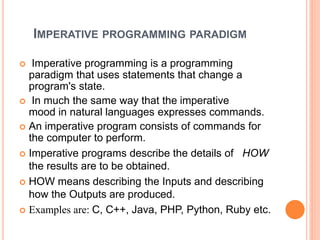
IMPERATIVE PROGRAMMING PARADIGM
 Imperative programming is a programming
paradigm that uses statements that change a
program's state.
 In much the same way that the imperative
mood in natural languages expresses commands.
 An imperative program consists of commands for
the computer to perform.
 Imperative programs describe the details of HOW
the results are to be obtained.
 HOW means describing the Inputs and describing
how the Outputs are produced.
 Examples are: C, C++, Java, PHP, Python, Ruby etc.
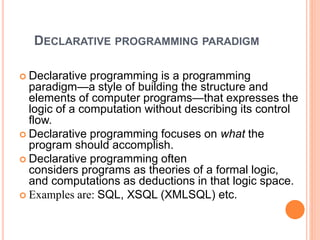
DECLARATIVE PROGRAMMING PARADIGM
 Declarative programming is a programming
paradigm—a style of building the structure and
elements of computer programs—that expresses the
logic of a computation without describing its control
flow.
 Declarative programming focuses on what the
program should accomplish.
 Declarative programming often
considers programs as theories of a formal logic,
and computations as deductions in that logic space.
 Examples are: SQL, XSQL (XMLSQL) etc.
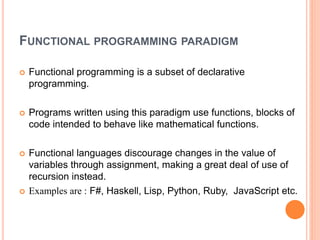
FUNCTIONAL PROGRAMMING PARADIGM
 Functional programming is a subset of declarative
programming.
 Programs written using this paradigm use functions, blocks of
code intended to behave like mathematical functions.
 Functional languages discourage changes in the value of
variables through assignment, making a great deal of use of
recursion instead.
 Examples are : F#, Haskell, Lisp, Python, Ruby, JavaScript etc.
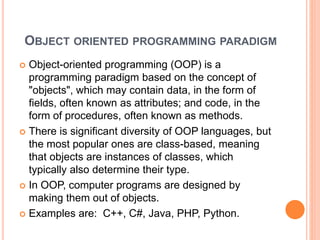
OBJECT ORIENTED PROGRAMMING PARADIGM
 Object-oriented programming (OOP) is a
programming paradigm based on the concept of
"objects", which may contain data, in the form of
fields, often known as attributes; and code, in the
form of procedures, often known as methods.
 There is significant diversity of OOP languages, but
the most popular ones are class-based, meaning
that objects are instances of classes, which
typically also determine their type.
 In OOP, computer programs are designed by
making them out of objects.
 Examples are: C++, C#, Java, PHP, Python.
MULTI PARADIGM
 A multi-paradigm programming language is a
programming language that supports more than
one programming paradigm.
 The design goal of such languages is to allow
programmers to use the most suitable programming
style and associated language constructs for a
given job.
 Languages such as C++, Java, Python are multi-
paradigm programming languages that support
object-oriented programming to a greater or lesser
degree, typically in combination with imperative,
procedural programming.
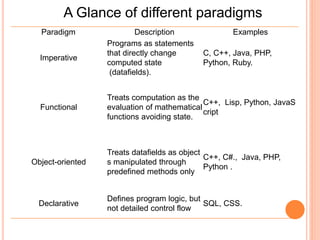
Paradigm Description Examples
Imperative
Programs as statements
that directly change
computed state
(datafields).
C, C++, Java, PHP,
Python, Ruby.
Functional
Treats computation as the
evaluation of mathematical
functions avoiding state.
C++, Lisp, Python, JavaS
cript
Object-oriented
Treats datafields as object
s manipulated through
predefined methods only
C++, C#., Java, PHP,
Python .
Declarative
Defines program logic, but
not detailed control flow
SQL, CSS.
A Glance of different paradigms
CONCLUSION
 There is still not a consensus (and probably
there will never be) on a programming paradigm
and a programming language is most suitable.
 All approaches have their advantages and
disadvantages, with many supporting arguments and
Case-studies.
 Despite that, it seems that nowadays the most popular
paradigms for introductory courses are the procedural,
with programming language C and procedural part of
C++, the object-oriented, with languages Java and C++.
REFERENCES
 docs.microsoft.com
 www.wikipedia.com
QUERIES
OR
SUGGESTIONS
Thanks

Programming paradigm

  • 1.
    Presentation On Programming Paradigm Presented By: ShoaibNusrat BCA V SEM GH5204 15CAB03 Under Supervision of: Prof. M.U. Bokhari Prof. R.Z. Khan Dr. Swaleha Zubair Mrs. Sajida Khatoon Mr. Mohd. Zeyauddin
  • 2.
    CONTENT  Introduction  History Imperative Programming Paradigm  Declarative Programming Paradigm  Functional Programming Paradigm  Object Oriented Programming Paradigm  Multi-Paradigm  A glance of different Paradigms  Conclusion  References
  • 3.
    INTRODUCTION What is programmingparadigm ?  A programming paradigm is a fundamental style of computer programming.  Paradigms differ in the concepts and methods used to represent the elements of a program (such as objects, functions, variables, constraints).  And also steps that comprise a computation (such as assignations, evaluation, continuations, data flows).
  • 4.
    HISTORY  Different approachesto programming have developed over time.  The concept of a "programming paradigm" as such dates at least to 1978.  The lowest-level programming paradigms are machine code.  In the 1960s, assembly languages were developed followed by development of procedural languages.  Following the widespread use of procedural languages, object-oriented programming (OOP) languages were created and followed by many more…
  • 5.
    IMPERATIVE PROGRAMMING PARADIGM Imperative programming is a programming paradigm that uses statements that change a program's state.  In much the same way that the imperative mood in natural languages expresses commands.  An imperative program consists of commands for the computer to perform.  Imperative programs describe the details of HOW the results are to be obtained.  HOW means describing the Inputs and describing how the Outputs are produced.  Examples are: C, C++, Java, PHP, Python, Ruby etc.
  • 6.
    DECLARATIVE PROGRAMMING PARADIGM Declarative programming is a programming paradigm—a style of building the structure and elements of computer programs—that expresses the logic of a computation without describing its control flow.  Declarative programming focuses on what the program should accomplish.  Declarative programming often considers programs as theories of a formal logic, and computations as deductions in that logic space.  Examples are: SQL, XSQL (XMLSQL) etc.
  • 7.
    FUNCTIONAL PROGRAMMING PARADIGM Functional programming is a subset of declarative programming.  Programs written using this paradigm use functions, blocks of code intended to behave like mathematical functions.  Functional languages discourage changes in the value of variables through assignment, making a great deal of use of recursion instead.  Examples are : F#, Haskell, Lisp, Python, Ruby, JavaScript etc.
  • 8.
    OBJECT ORIENTED PROGRAMMINGPARADIGM  Object-oriented programming (OOP) is a programming paradigm based on the concept of "objects", which may contain data, in the form of fields, often known as attributes; and code, in the form of procedures, often known as methods.  There is significant diversity of OOP languages, but the most popular ones are class-based, meaning that objects are instances of classes, which typically also determine their type.  In OOP, computer programs are designed by making them out of objects.  Examples are: C++, C#, Java, PHP, Python.
  • 9.
    MULTI PARADIGM  Amulti-paradigm programming language is a programming language that supports more than one programming paradigm.  The design goal of such languages is to allow programmers to use the most suitable programming style and associated language constructs for a given job.  Languages such as C++, Java, Python are multi- paradigm programming languages that support object-oriented programming to a greater or lesser degree, typically in combination with imperative, procedural programming.
  • 10.
    Paradigm Description Examples Imperative Programsas statements that directly change computed state (datafields). C, C++, Java, PHP, Python, Ruby. Functional Treats computation as the evaluation of mathematical functions avoiding state. C++, Lisp, Python, JavaS cript Object-oriented Treats datafields as object s manipulated through predefined methods only C++, C#., Java, PHP, Python . Declarative Defines program logic, but not detailed control flow SQL, CSS. A Glance of different paradigms
  • 11.
    CONCLUSION  There isstill not a consensus (and probably there will never be) on a programming paradigm and a programming language is most suitable.  All approaches have their advantages and disadvantages, with many supporting arguments and Case-studies.  Despite that, it seems that nowadays the most popular paradigms for introductory courses are the procedural, with programming language C and procedural part of C++, the object-oriented, with languages Java and C++.
  • 12.
  • 13.
  • 14.