WELCOMSE TO
THE RATIONAL ZONE
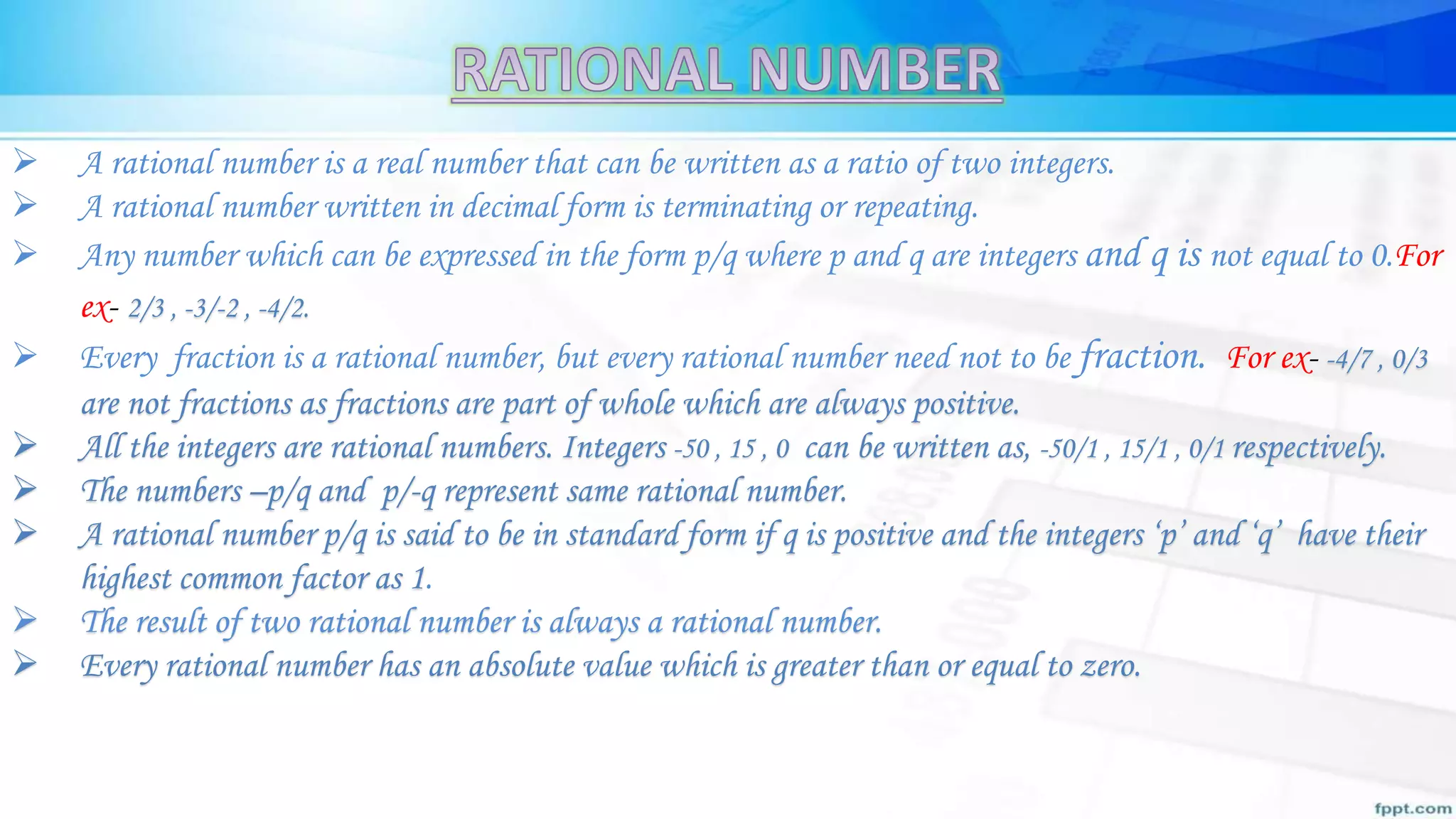
 A rational number is a real number that can be written as a ratio of two integers.
 A rational number written in decimal form is terminating or repeating.
 Any number which can be expressed in the form p/q where p and q are integers and q is not equal to 0.For
ex- 2/3 , -3/-2 , -4/2.
 Every fraction is a rational number, but every rational number need not to be fraction. For ex- -4/7 , 0/3
are not fractions as fractions are part of whole which are always positive.
 All the integers are rational numbers. Integers -50 , 15 , 0 can be written as, -50/1 , 15/1 , 0/1 respectively.
 The numbers –p/q and p/-q represent same rational number.
 A rational number p/q is said to be in standard form if q is positive and the integers ‘p’ and ‘q’ have their
highest common factor as 1.
 The result of two rational number is always a rational number.
 Every rational number has an absolute value which is greater than or equal to zero.
Property 1:-
Two rational numbers p/q and r/s are said to be equivalent if
p*s=r*q.
Example :-
Property 2:-
If p/q is a rational number and m be any integer different from zero then
p/q = p*m/q*m.
Example :-
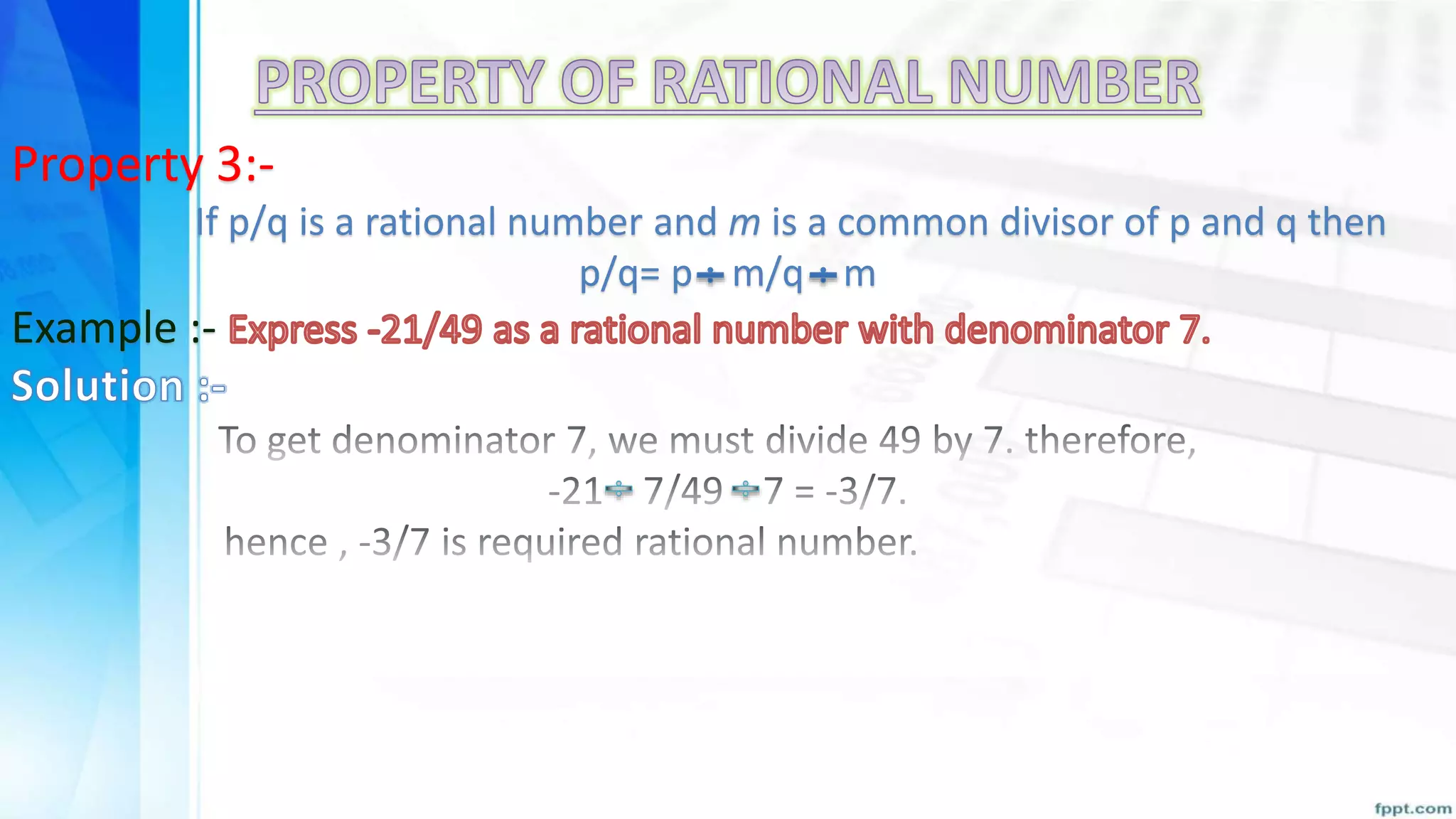
Property 3:-
If p/q is a rational number and m is a common divisor of p and q then
p/q= p m/q m
Example :-
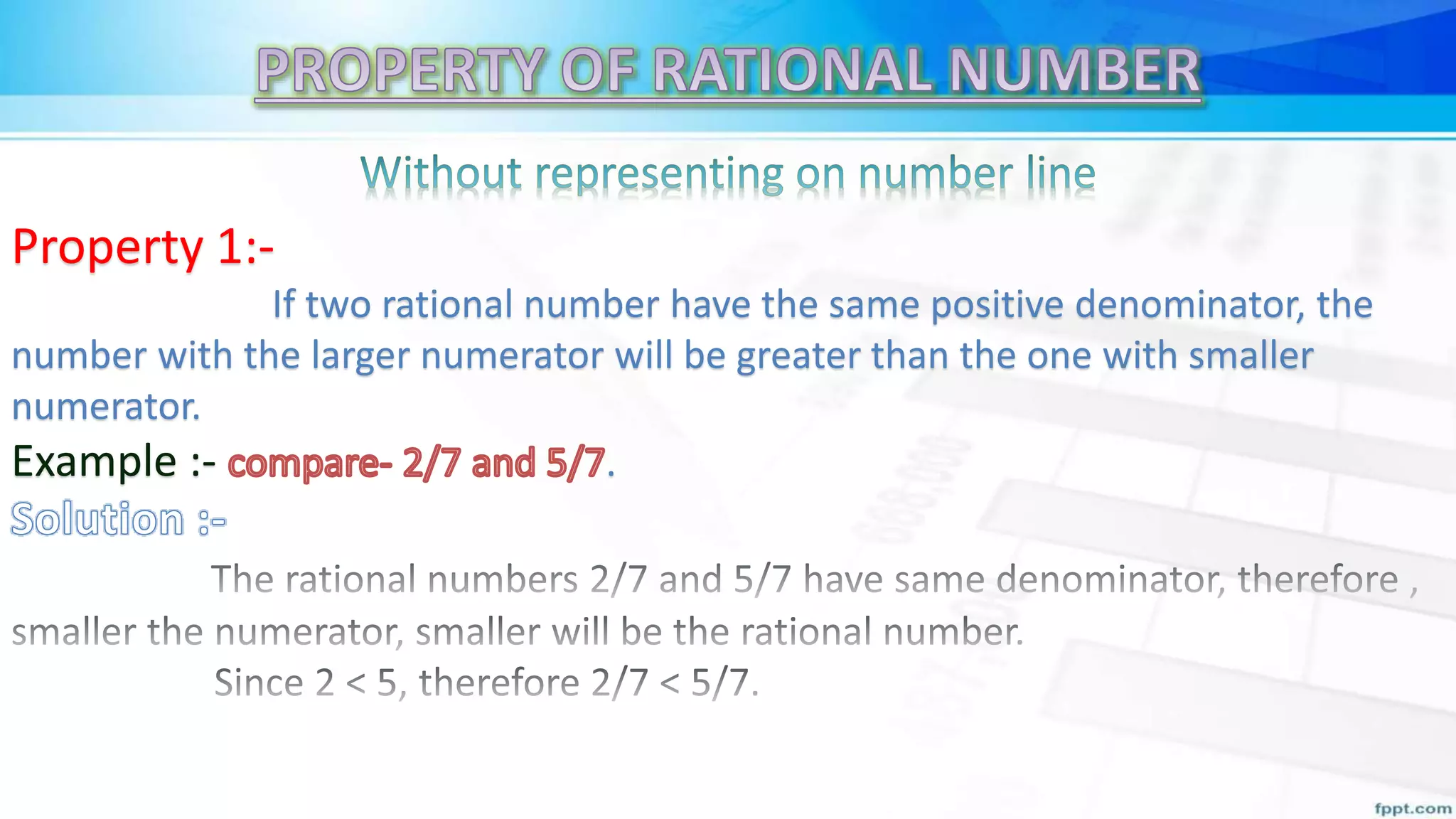
Property 1:-
If two rational number have the same positive denominator, the
number with the larger numerator will be greater than the one with smaller
numerator.
Example :- .
Property 2:-
if two rational numbers have different denominator , then first make
denominators equal and then compare.
Or
Another method to compare two rational number p/q and r/s with unequal
denominator. It is assumed that q and s are both positive integers.
Example :-
Property 1:-
The sum remain the same even if we change the order of addends, ie.,
for two rational number x and y, x + y = y + x.
*This is commutative law of addition.
Example :-
same
Property 2:-
Sum of three rational numbers remain the same even after
changing the grouping of addends, ie., if x, y and z are three rational number
then (x + y) + z = x + (y + z).
*This is known as associative law of addition.
Example :-
same
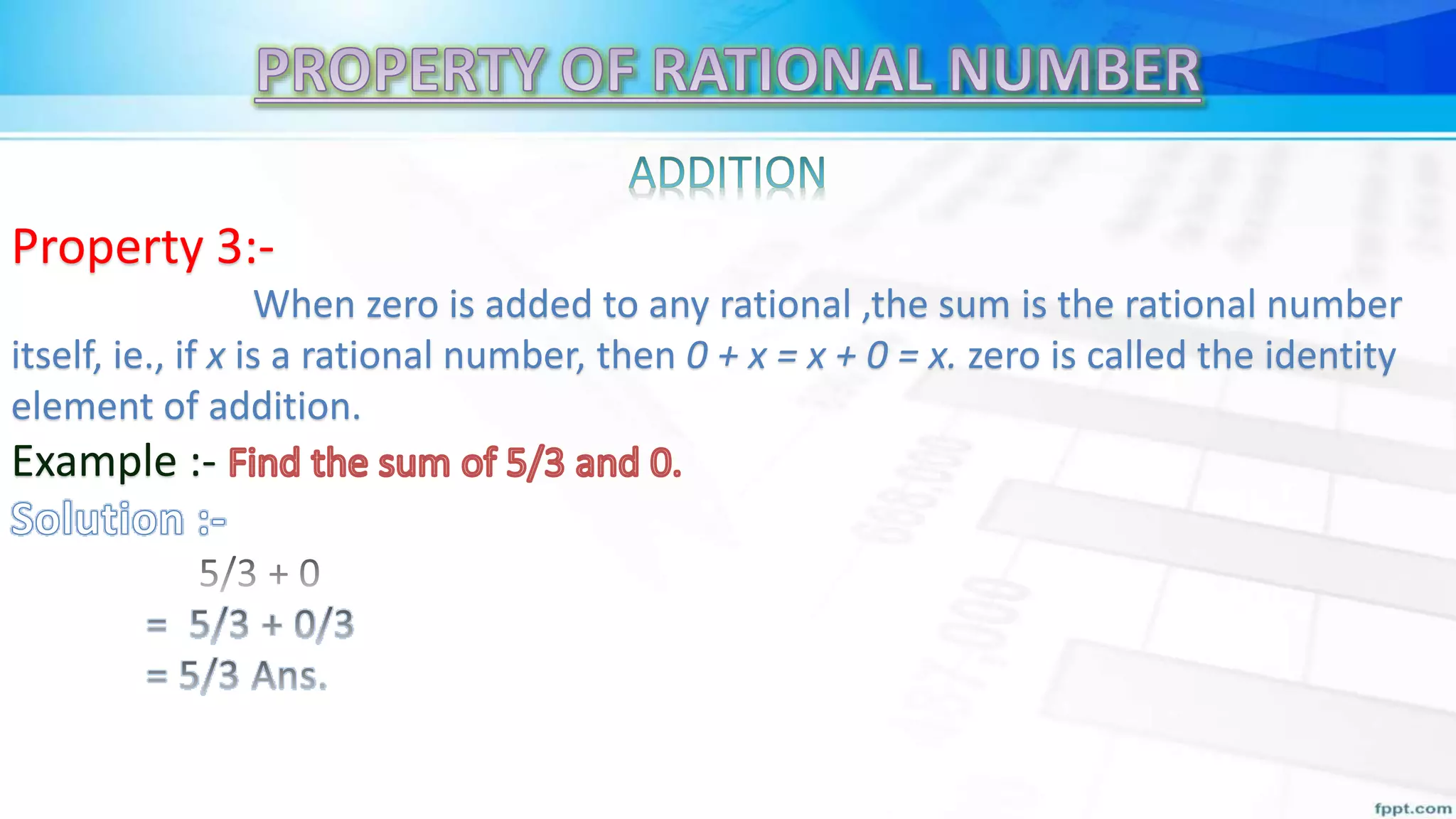
Property 3:-
When zero is added to any rational ,the sum is the rational number
itself, ie., if x is a rational number, then 0 + x = x + 0 = x. zero is called the identity
element of addition.
Example :-
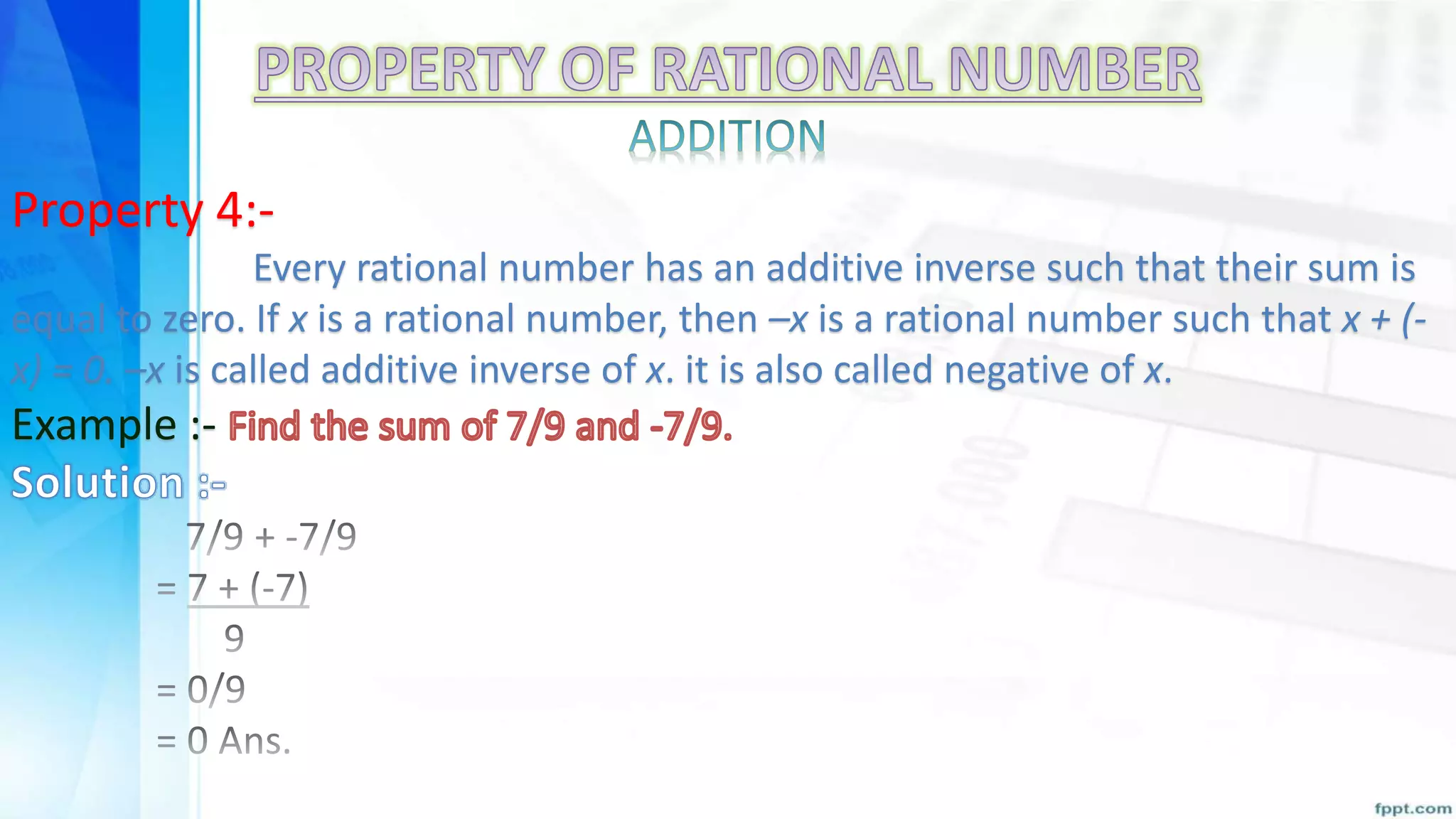
Property 4:-
Every rational number has an additive inverse such that their sum is
equal to zero. If x is a rational number, then –x is a rational number such that x + (-
x) = 0. –x is called additive inverse of x. it is also called negative of x.
Example :-
Property 1:-
For rational number x and y, x - y = y-x in general . In fact , x - y = -(y-
x), ie., commutative property does not hold true for subtraction.
Example :-
Not same
Property 2:-
For rational number x, y, z in general, (x - y) -z = x -(y - z), ie., The
associative property does not hold true for subtraction.
Example :-
Not same
Property 3:-
Identity element for subtraction does not exist.
Property 4:-
Since the identity for subtraction does not exist, the question for
finding inverse for subtraction does not arise.
Example :-
Property 1:-
Product of two number remain the same even if we change their
order, ie., If x and y are rational numbers, then :- x*y = y*x. This is commutative
law of multiplication.
Example :-
Product is same
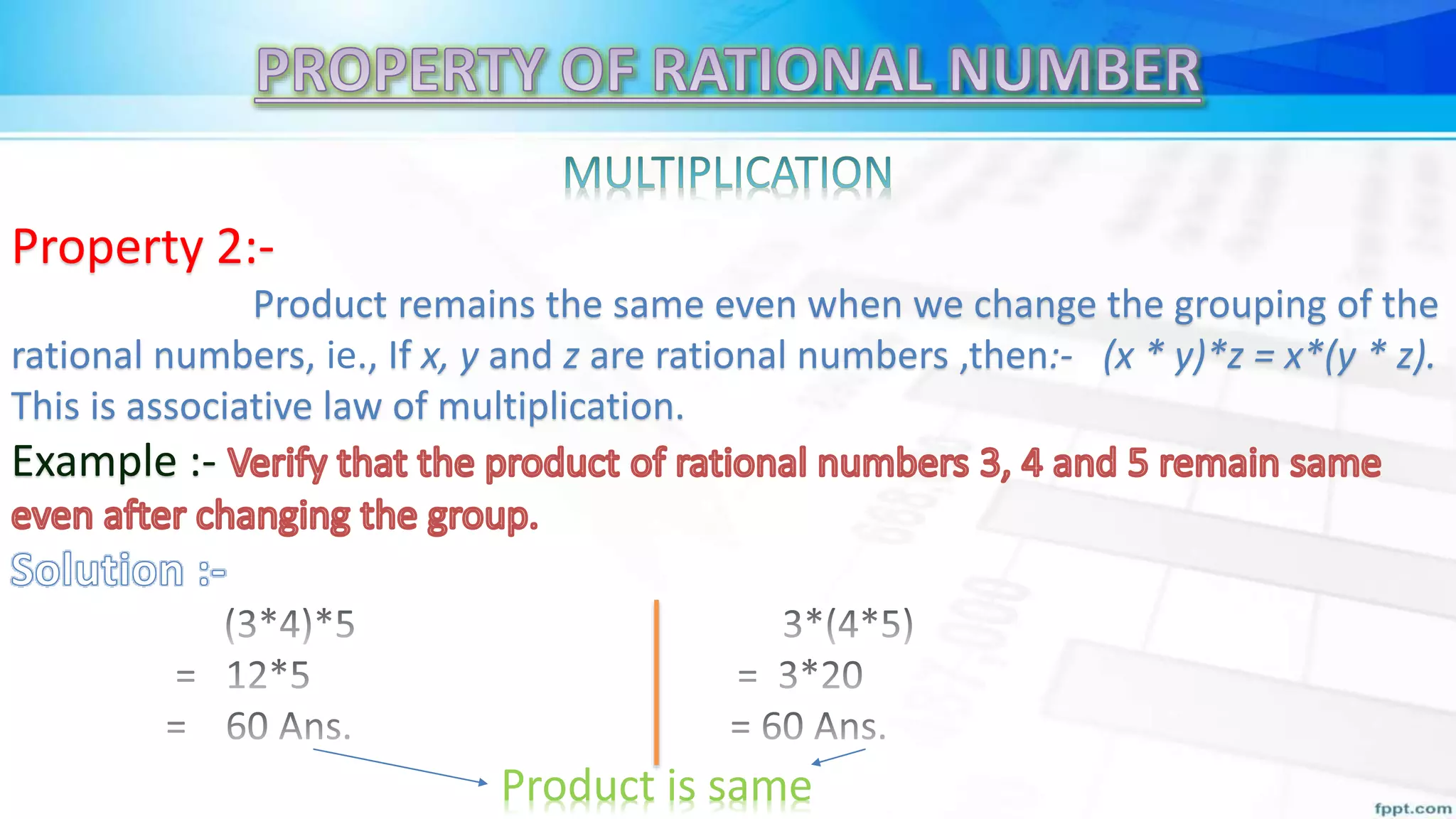
Property 2:-
Product remains the same even when we change the grouping of the
rational numbers, ie., If x, y and z are rational numbers ,then:- (x * y)*z = x*(y * z).
This is associative law of multiplication.
Example :-
Product is same
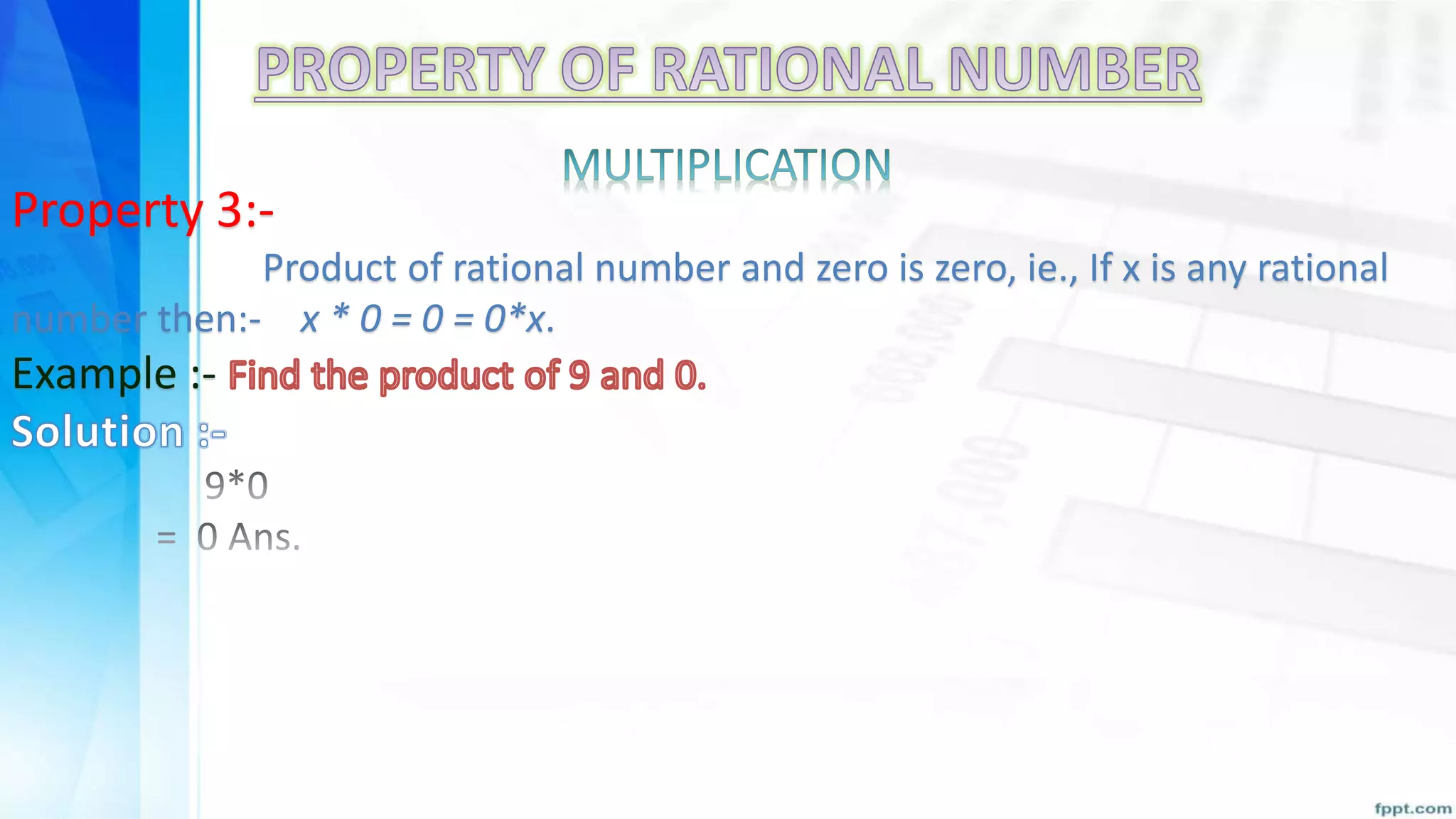
Property 3:-
Product of rational number and zero is zero, ie., If x is any rational
number then:- x * 0 = 0 = 0*x.
Example :-
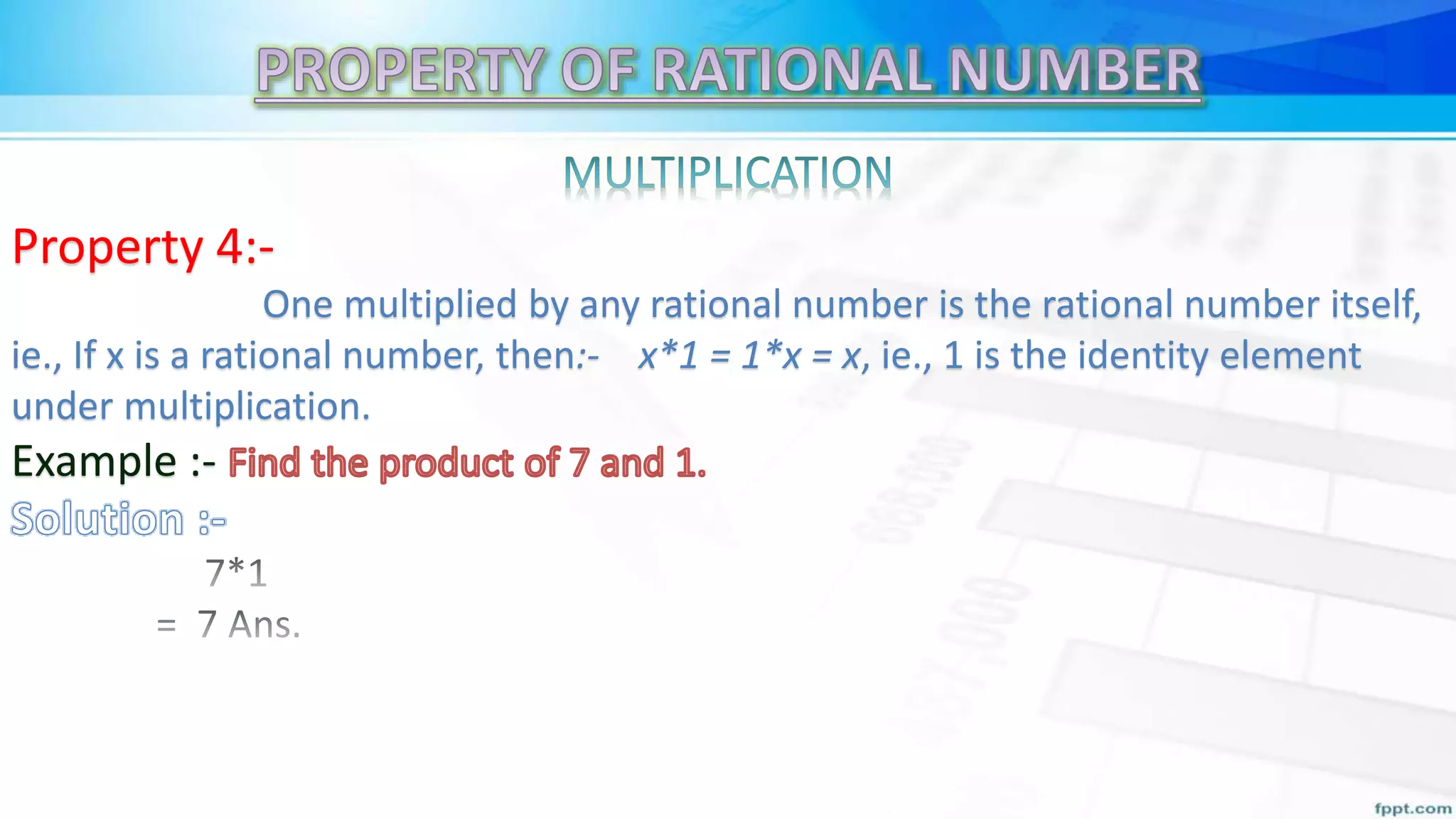
Property 4:-
One multiplied by any rational number is the rational number itself,
ie., If x is a rational number, then:- x*1 = 1*x = x, ie., 1 is the identity element
under multiplication.
Example :-
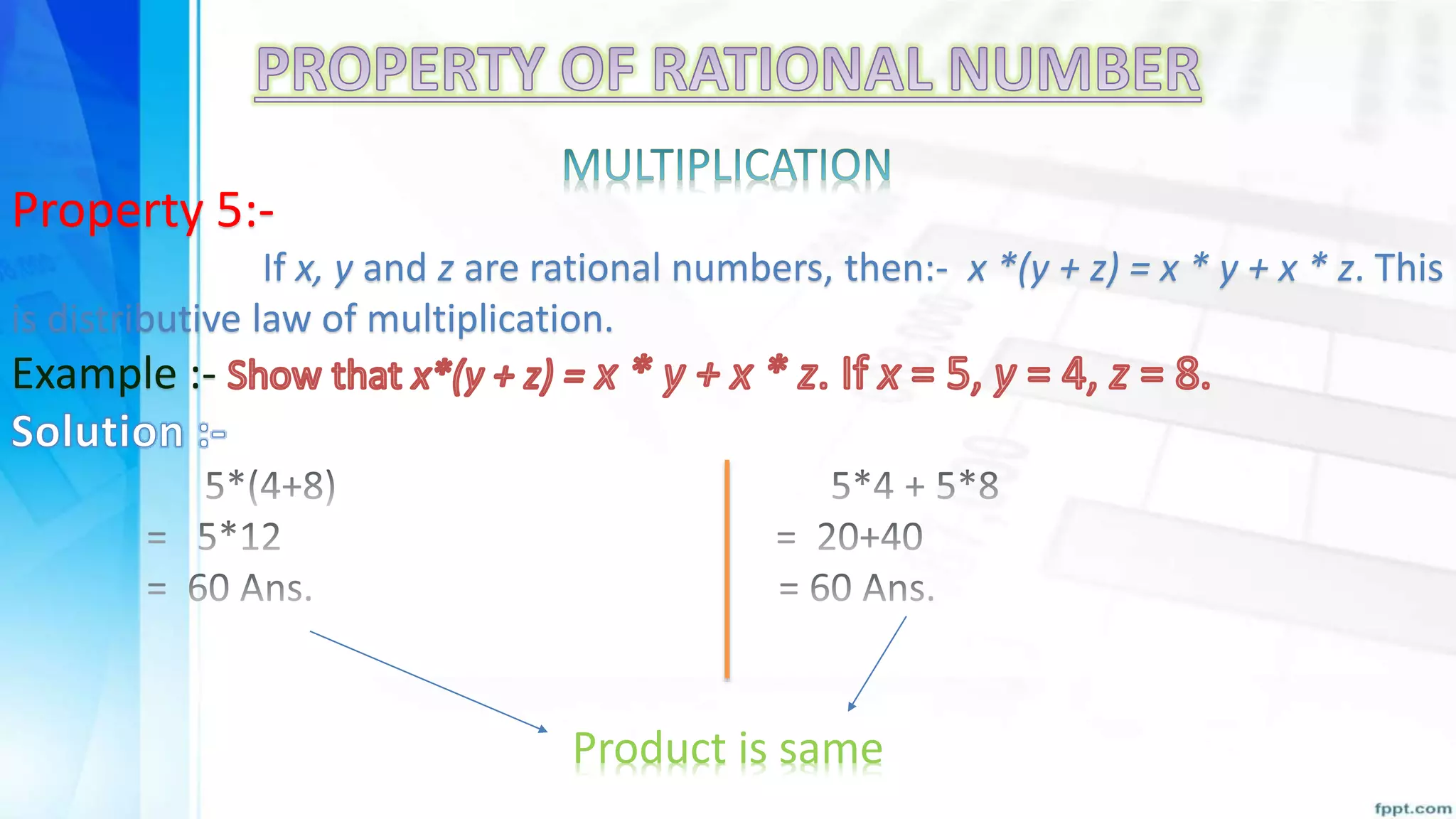
Property 5:-
If x, y and z are rational numbers, then:- x *(y + z) = x * y + x * z. This
is distributive law of multiplication.
Example :-
Product is same
Property 1:-
Division of a rational number by another rational number expect
zero ,is a rational number.
Example :-
Property 2:-
When a rational number (non zero) is divided by the same rational
number, the quotient is one.
Example :-
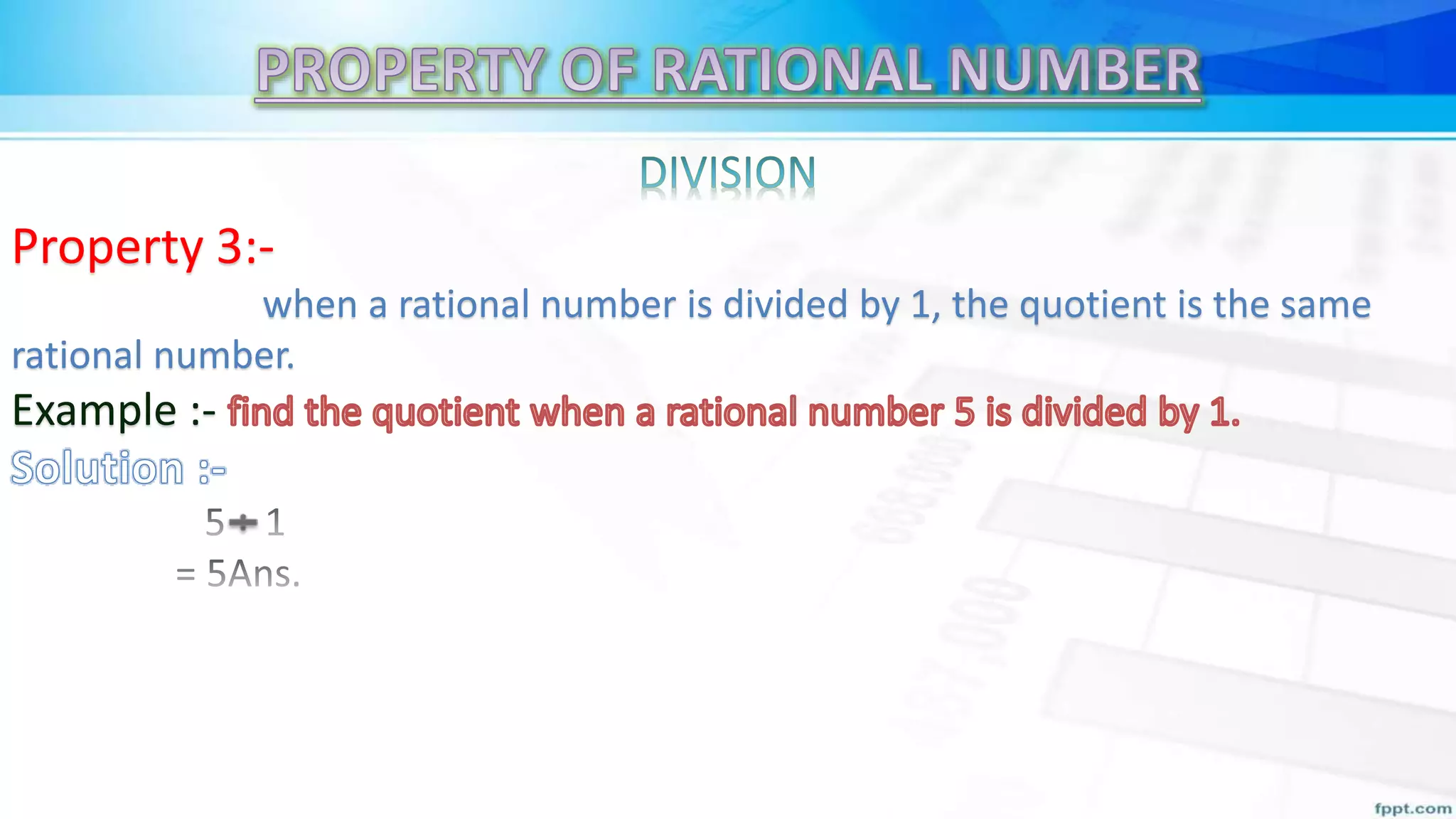
Property 3:-
when a rational number is divided by 1, the quotient is the same
rational number.
Example :-
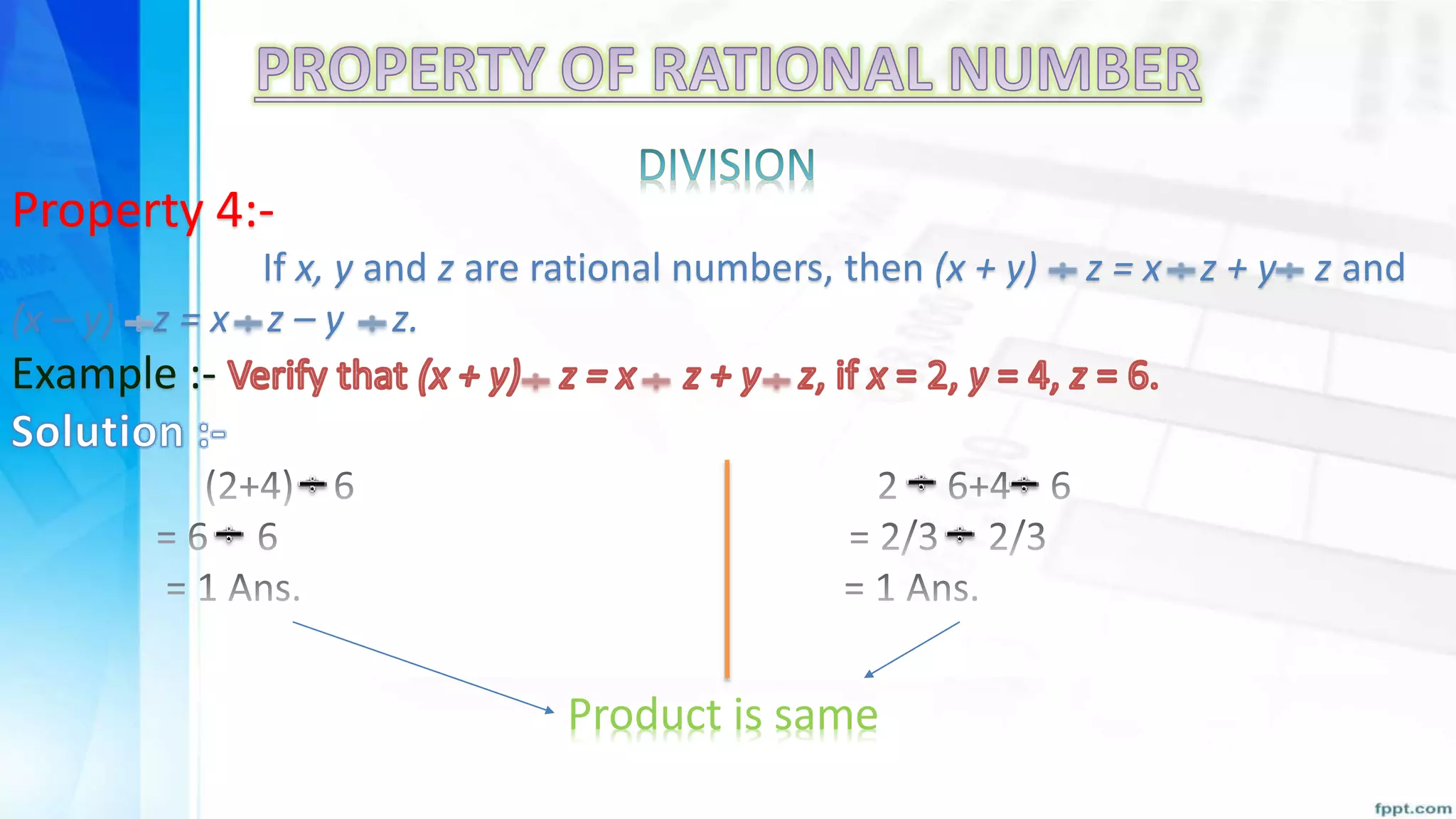
Property 4:-
If x, y and z are rational numbers, then (x + y) z = x z + y z and
(x – y) z = x z – y z.
Example :-
Product is same
Property 5:-
If x and y are non zero rational numbers, then in general, x y= y x
ie., Commutative property does not hold true for division.
Example :-
Not same
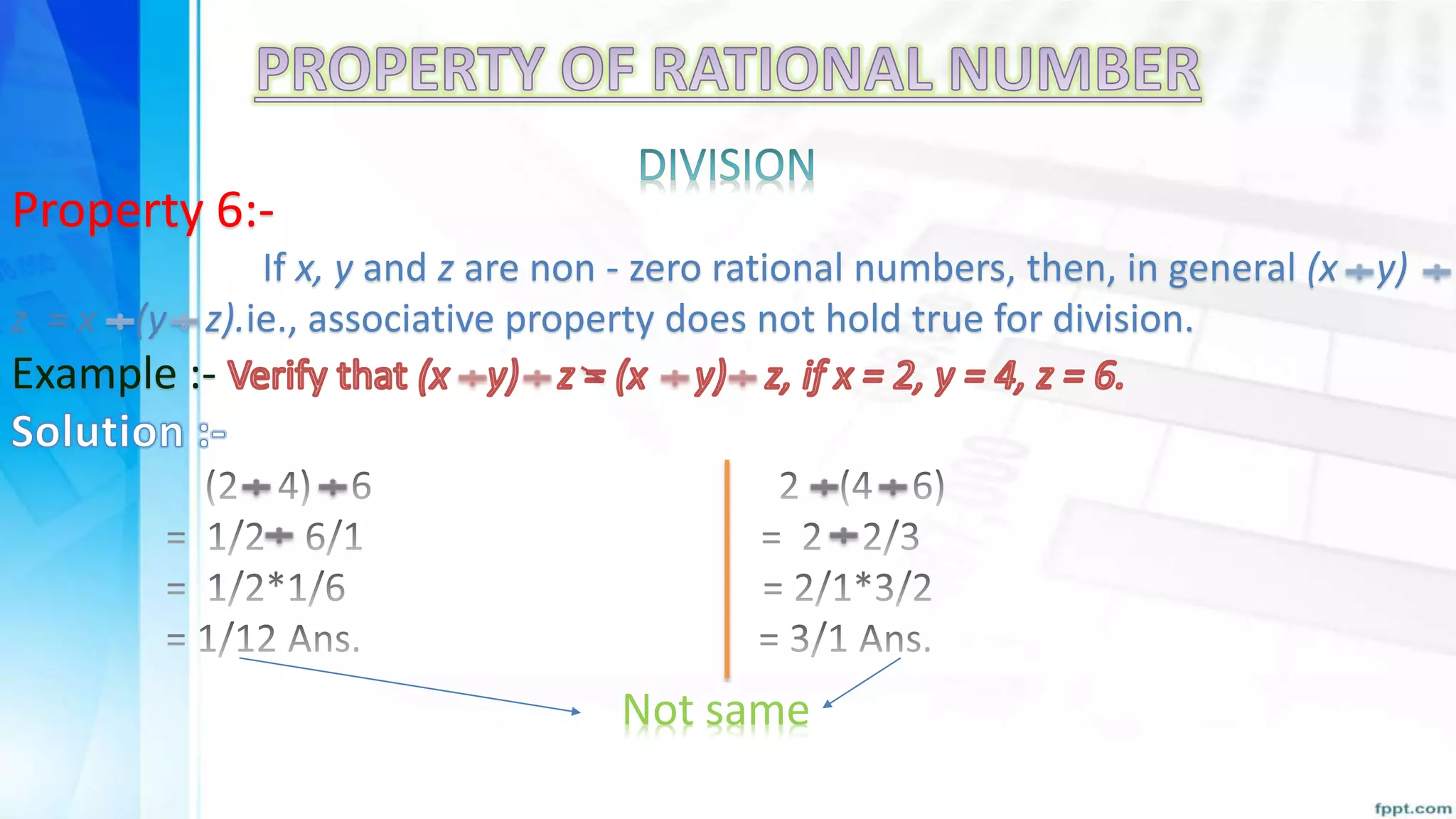
Property 6:-
If x, y and z are non - zero rational numbers, then, in general (x y)
z = x (y z).ie., associative property does not hold true for division.
Example :-
Not same
Property 7:-
For three non zero rational numbers x, y, and z, x (y + z) = x y + x
z, ie., distributive property does not hold true for division.
Example :-
Not same
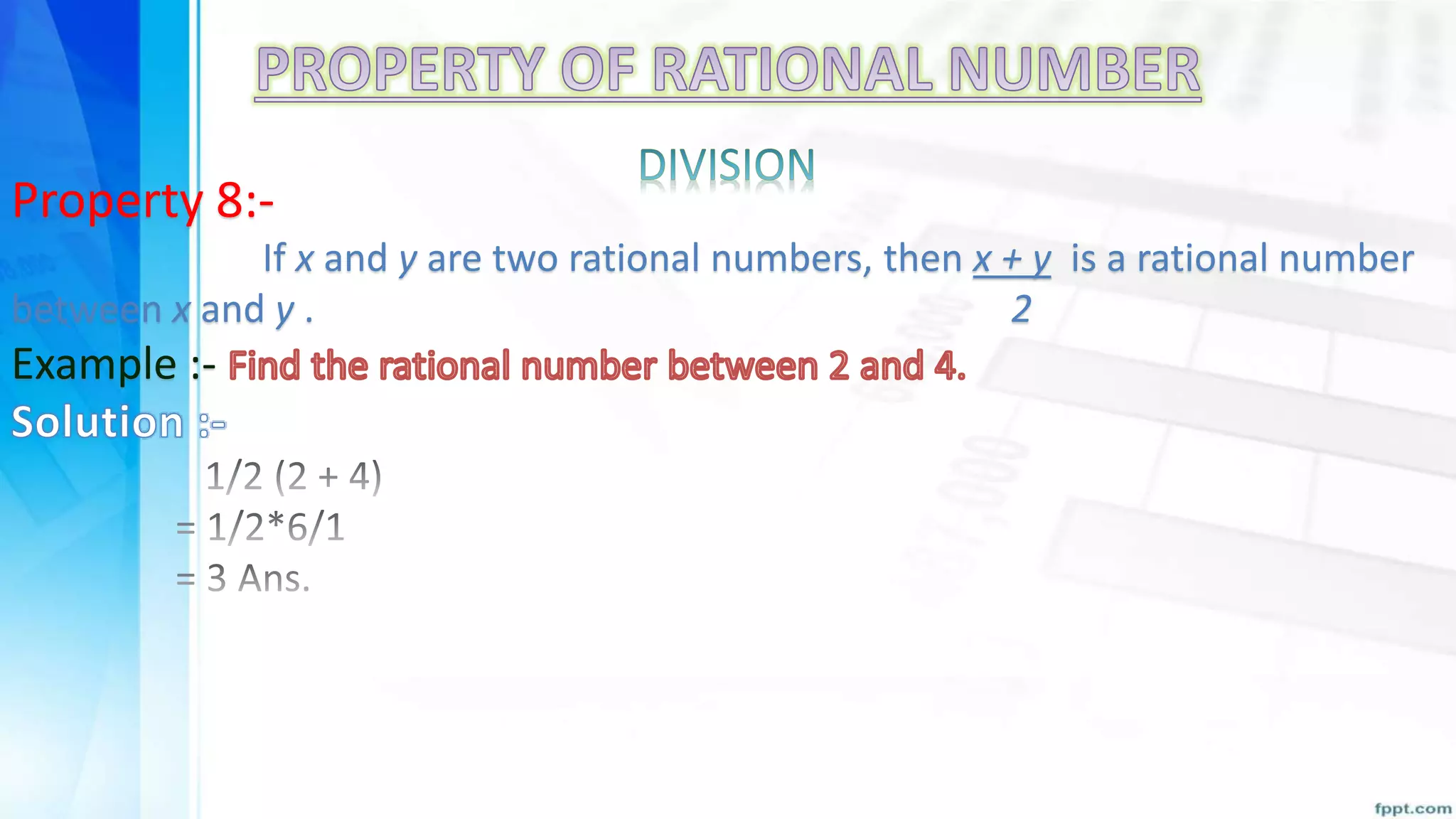
Property 8:-
If x and y are two rational numbers, then x + y is a rational number
between x and y . 2
Example :-
BY -

rational number

  • 1.
  • 3.
     A rationalnumber is a real number that can be written as a ratio of two integers.  A rational number written in decimal form is terminating or repeating.  Any number which can be expressed in the form p/q where p and q are integers and q is not equal to 0.For ex- 2/3 , -3/-2 , -4/2.  Every fraction is a rational number, but every rational number need not to be fraction. For ex- -4/7 , 0/3 are not fractions as fractions are part of whole which are always positive.  All the integers are rational numbers. Integers -50 , 15 , 0 can be written as, -50/1 , 15/1 , 0/1 respectively.  The numbers –p/q and p/-q represent same rational number.  A rational number p/q is said to be in standard form if q is positive and the integers ‘p’ and ‘q’ have their highest common factor as 1.  The result of two rational number is always a rational number.  Every rational number has an absolute value which is greater than or equal to zero.
  • 4.
    Property 1:- Two rationalnumbers p/q and r/s are said to be equivalent if p*s=r*q. Example :-
  • 5.
    Property 2:- If p/qis a rational number and m be any integer different from zero then p/q = p*m/q*m. Example :-
  • 6.
    Property 3:- If p/qis a rational number and m is a common divisor of p and q then p/q= p m/q m Example :-
  • 7.
    Property 1:- If tworational number have the same positive denominator, the number with the larger numerator will be greater than the one with smaller numerator. Example :- .
  • 8.
    Property 2:- if tworational numbers have different denominator , then first make denominators equal and then compare. Or Another method to compare two rational number p/q and r/s with unequal denominator. It is assumed that q and s are both positive integers. Example :-
  • 9.
    Property 1:- The sumremain the same even if we change the order of addends, ie., for two rational number x and y, x + y = y + x. *This is commutative law of addition. Example :- same
  • 10.
    Property 2:- Sum ofthree rational numbers remain the same even after changing the grouping of addends, ie., if x, y and z are three rational number then (x + y) + z = x + (y + z). *This is known as associative law of addition. Example :- same
  • 11.
    Property 3:- When zerois added to any rational ,the sum is the rational number itself, ie., if x is a rational number, then 0 + x = x + 0 = x. zero is called the identity element of addition. Example :-
  • 12.
    Property 4:- Every rationalnumber has an additive inverse such that their sum is equal to zero. If x is a rational number, then –x is a rational number such that x + (- x) = 0. –x is called additive inverse of x. it is also called negative of x. Example :-
  • 13.
    Property 1:- For rationalnumber x and y, x - y = y-x in general . In fact , x - y = -(y- x), ie., commutative property does not hold true for subtraction. Example :- Not same
  • 14.
    Property 2:- For rationalnumber x, y, z in general, (x - y) -z = x -(y - z), ie., The associative property does not hold true for subtraction. Example :- Not same
  • 15.
    Property 3:- Identity elementfor subtraction does not exist. Property 4:- Since the identity for subtraction does not exist, the question for finding inverse for subtraction does not arise. Example :-
  • 16.
    Property 1:- Product oftwo number remain the same even if we change their order, ie., If x and y are rational numbers, then :- x*y = y*x. This is commutative law of multiplication. Example :- Product is same
  • 17.
    Property 2:- Product remainsthe same even when we change the grouping of the rational numbers, ie., If x, y and z are rational numbers ,then:- (x * y)*z = x*(y * z). This is associative law of multiplication. Example :- Product is same
  • 18.
    Property 3:- Product ofrational number and zero is zero, ie., If x is any rational number then:- x * 0 = 0 = 0*x. Example :-
  • 19.
    Property 4:- One multipliedby any rational number is the rational number itself, ie., If x is a rational number, then:- x*1 = 1*x = x, ie., 1 is the identity element under multiplication. Example :-
  • 20.
    Property 5:- If x,y and z are rational numbers, then:- x *(y + z) = x * y + x * z. This is distributive law of multiplication. Example :- Product is same
  • 21.
    Property 1:- Division ofa rational number by another rational number expect zero ,is a rational number. Example :-
  • 22.
    Property 2:- When arational number (non zero) is divided by the same rational number, the quotient is one. Example :-
  • 23.
    Property 3:- when arational number is divided by 1, the quotient is the same rational number. Example :-
  • 24.
    Property 4:- If x,y and z are rational numbers, then (x + y) z = x z + y z and (x – y) z = x z – y z. Example :- Product is same
  • 25.
    Property 5:- If xand y are non zero rational numbers, then in general, x y= y x ie., Commutative property does not hold true for division. Example :- Not same
  • 26.
    Property 6:- If x,y and z are non - zero rational numbers, then, in general (x y) z = x (y z).ie., associative property does not hold true for division. Example :- Not same
  • 27.
    Property 7:- For threenon zero rational numbers x, y, and z, x (y + z) = x y + x z, ie., distributive property does not hold true for division. Example :- Not same
  • 28.
    Property 8:- If xand y are two rational numbers, then x + y is a rational number between x and y . 2 Example :-
  • 29.