RATIO ANALYSIS
Dr K.Sunanda
Associate Professor
Department of Business Management
1
Introduction
Ratio analysis is a useful tool to evaluate a
company's financial performance.
It helps to identify strengths and
weaknesses in the company's financial
position.
Ratios are calculated by dividing one
number by another number to provide
meaningful insights.
Business Decisions
 Operating Decisions
 Investing Decisions
 Financing Decisions
The efficiency of these decisions is captured through a tool called ‘Ratio
Analysis’
Scope of ratio analysis
 Ratio analysis is a simple and cost-effective way to
evaluate a company's financial performance.
 It helps to identify areas of strengths and
weaknesses in the company's financial position.
 It provides insights to make informed decisions
about investments or lending.
Objectives of ratio analysis
Ratio analysis is a technique of financial analysis that uses various ratios to
Evaluate and compare the performance and position of the business entity.
 To measure the profitability of a business by calculating ratios such as gross
profit margin, return on equity etc.
 To assess the operational efficiency of a business by calculating ratios such as
Current ratio, quick ratio, cash ratio.
 To evaluate the overall performance and position of the business by
calculating Debt equity ratio, interest coverage ratio, solvency ratio, etc.
 To evaluate financial strength of a business so on.
2
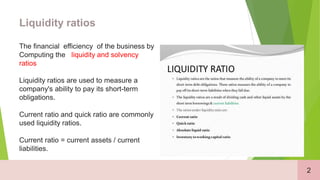
Liquidity ratios
The financial efficiency of the business by
Computing the liquidity and solvency
ratios
Liquidity ratios are used to measure a
company's ability to pay its short-term
obligations.
Current ratio and quick ratio are commonly
used liquidity ratios.
Current ratio = current assets / current
liabilities.
3
Profitability ratios
Profitability ratios are used to measure a
company's ability to generate profits.
Gross profit margin, operating profit
margin, and net profit margin are
commonly used profitability ratios.
Net profit margin = net income / total
revenue.
4
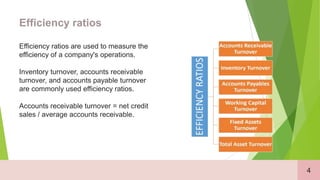
Efficiency ratios
Efficiency ratios are used to measure the
efficiency of a company's operations.
Inventory turnover, accounts receivable
turnover, and accounts payable turnover
are commonly used efficiency ratios.
Accounts receivable turnover = net credit
sales / average accounts receivable.
5
Solvency ratios
Solvency ratios are used to measure a
company's ability to meet its long-term
obligations.
Debt-to-equity ratio and interest coverage
ratio are commonly used solvency ratios.
Debt-to-equity ratio = total liabilities /
shareholder's equity.
6
Market ratios
Market ratios are used to measure the
market's perception of a company's
performance.
Price-to-earnings ratio and earnings per
share are commonly used market ratios.
Price-to-earnings ratio = market price per
share / earnings per share.
7
Analytical Presentation of ratios
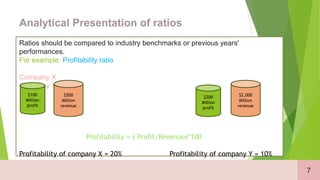
Ratios should be compared to industry benchmarks or previous years'
performances.
For example: Profitability ratio
Company X
Company Y
Profitability = ( Profit/Revenue)*100
Profitability of company X = 20% Profitability of company Y = 10%
$100
Million
profit
$200
Million
profit
$500
Million
revenue
$2,000
Million
revenue
Turnover Ratio
 Total Asset turnover ratios = Revenue/Average Total Assets
Unilever Figures in million dollars
2016 2015 2014
Total Assets 56,429 52,298 48,027
Average Total Assets 54,364 50,163
Total Asset Turnover Ratio 2016 2015
Revenue 52,713 53,272
Average Total Assets 54,364 50163
Total asset turnover Ratio .97 times 1.06 times
9
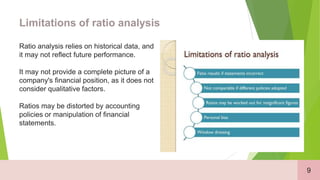
Limitations of ratio analysis
Ratio analysis relies on historical data, and
it may not reflect future performance.
It may not provide a complete picture of a
company's financial position, as it does not
consider qualitative factors.
Ratios may be distorted by accounting
policies or manipulation of financial
statements.
10
Conclusion
Ratio analysis is a powerful tool to evaluate
a company's financial performance.
It provides meaningful insights to make
informed decisions about investments or
lending.
It should be used in conjunction with
qualitative factors to provide a complete
picture of a company's financial position.

Ratio Analysis PPT.pptx

  • 1.
    RATIO ANALYSIS Dr K.Sunanda AssociateProfessor Department of Business Management
  • 2.
    1 Introduction Ratio analysis isa useful tool to evaluate a company's financial performance. It helps to identify strengths and weaknesses in the company's financial position. Ratios are calculated by dividing one number by another number to provide meaningful insights.
  • 3.
    Business Decisions  OperatingDecisions  Investing Decisions  Financing Decisions The efficiency of these decisions is captured through a tool called ‘Ratio Analysis’
  • 4.
    Scope of ratioanalysis  Ratio analysis is a simple and cost-effective way to evaluate a company's financial performance.  It helps to identify areas of strengths and weaknesses in the company's financial position.  It provides insights to make informed decisions about investments or lending.
  • 5.
    Objectives of ratioanalysis Ratio analysis is a technique of financial analysis that uses various ratios to Evaluate and compare the performance and position of the business entity.  To measure the profitability of a business by calculating ratios such as gross profit margin, return on equity etc.  To assess the operational efficiency of a business by calculating ratios such as Current ratio, quick ratio, cash ratio.  To evaluate the overall performance and position of the business by calculating Debt equity ratio, interest coverage ratio, solvency ratio, etc.  To evaluate financial strength of a business so on.
  • 6.
    2 Liquidity ratios The financialefficiency of the business by Computing the liquidity and solvency ratios Liquidity ratios are used to measure a company's ability to pay its short-term obligations. Current ratio and quick ratio are commonly used liquidity ratios. Current ratio = current assets / current liabilities.
  • 7.
    3 Profitability ratios Profitability ratiosare used to measure a company's ability to generate profits. Gross profit margin, operating profit margin, and net profit margin are commonly used profitability ratios. Net profit margin = net income / total revenue.
  • 8.
    4 Efficiency ratios Efficiency ratiosare used to measure the efficiency of a company's operations. Inventory turnover, accounts receivable turnover, and accounts payable turnover are commonly used efficiency ratios. Accounts receivable turnover = net credit sales / average accounts receivable.
  • 9.
    5 Solvency ratios Solvency ratiosare used to measure a company's ability to meet its long-term obligations. Debt-to-equity ratio and interest coverage ratio are commonly used solvency ratios. Debt-to-equity ratio = total liabilities / shareholder's equity.
  • 10.
    6 Market ratios Market ratiosare used to measure the market's perception of a company's performance. Price-to-earnings ratio and earnings per share are commonly used market ratios. Price-to-earnings ratio = market price per share / earnings per share.
  • 11.
    7 Analytical Presentation ofratios Ratios should be compared to industry benchmarks or previous years' performances. For example: Profitability ratio Company X Company Y Profitability = ( Profit/Revenue)*100 Profitability of company X = 20% Profitability of company Y = 10% $100 Million profit $200 Million profit $500 Million revenue $2,000 Million revenue
  • 12.
    Turnover Ratio  TotalAsset turnover ratios = Revenue/Average Total Assets Unilever Figures in million dollars 2016 2015 2014 Total Assets 56,429 52,298 48,027 Average Total Assets 54,364 50,163 Total Asset Turnover Ratio 2016 2015 Revenue 52,713 53,272 Average Total Assets 54,364 50163 Total asset turnover Ratio .97 times 1.06 times
  • 13.
    9 Limitations of ratioanalysis Ratio analysis relies on historical data, and it may not reflect future performance. It may not provide a complete picture of a company's financial position, as it does not consider qualitative factors. Ratios may be distorted by accounting policies or manipulation of financial statements.
  • 14.
    10 Conclusion Ratio analysis isa powerful tool to evaluate a company's financial performance. It provides meaningful insights to make informed decisions about investments or lending. It should be used in conjunction with qualitative factors to provide a complete picture of a company's financial position.