Job Analysis & Job Design
1
Dr K.Sunanda
Associate professor
Department of Business Management
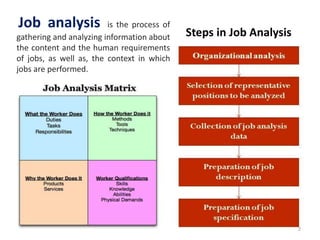
Steps in Job Analysis
Job analysis is the process of
gathering and analyzing information about
the content and the human requirements
of jobs, as well as, the context in which
jobs are performed.
2
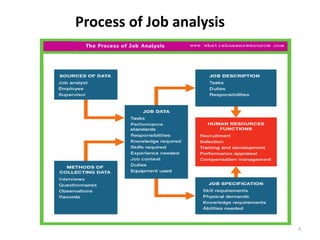
Process of Job analysis
3
• Job Description
A list of a job’s duties, responsibilities, reporting relationships,
working conditions, and supervisory responsibilities—one
product of a job analysis.
• Job Specifications
A list of a job’s “human requirements,” that is, the requisite
education, skills, personality, and so on—another product of a
job analysis.
4
Job Description
JD is a statement of job
Content such as
• Job Identification
• Job Summary
• Duties and Responsibilities
• Supervision
• Relation to Other Jobs
• Machine, tools and
equipment
• Working Conditions
• Social Environment
Job Specifications
JS is a statement of human
Qualification such as
• Physical characteristics
• Psychological and social
characteristics
• Mental Characteristics
• Personal Characteristics such
as sex, education, family
background, job experience,
hobbies, extracurricular
activities etc.
5
Job Design
6
• Job design involves systematic attempt to organize tasks, duties
and responsibilities into a unit of work to achieve certain objectives.
• According to Jon Werner and DeSimone, “Job design is the
development and alteration of the components of a job (such as the
tasks one performs, and the scope of one’s responsibilities) to
improve productivity and the quality of the employees’ work life.”
Job design Why?
• Boredom to the employees
• Increased employee turnover
• Job dissatisfaction
• Low productivity and
• An increase in overall costs of the organization
To avoid
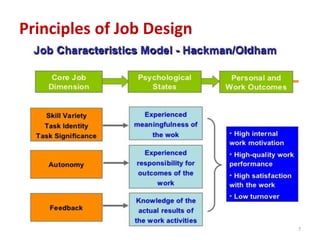
Principles of Job Design
7
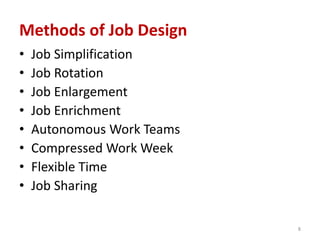
Methods of Job Design
• Job Simplification
• Job Rotation
• Job Enlargement
• Job Enrichment
• Autonomous Work Teams
• Compressed Work Week
• Flexible Time
• Job Sharing
8
THANK YOU
9

JOB Analysis &Job design.pptx

  • 1.
    Job Analysis &Job Design 1 Dr K.Sunanda Associate professor Department of Business Management
  • 2.
    Steps in JobAnalysis Job analysis is the process of gathering and analyzing information about the content and the human requirements of jobs, as well as, the context in which jobs are performed. 2
  • 3.
    Process of Jobanalysis 3
  • 4.
    • Job Description Alist of a job’s duties, responsibilities, reporting relationships, working conditions, and supervisory responsibilities—one product of a job analysis. • Job Specifications A list of a job’s “human requirements,” that is, the requisite education, skills, personality, and so on—another product of a job analysis. 4
  • 5.
    Job Description JD isa statement of job Content such as • Job Identification • Job Summary • Duties and Responsibilities • Supervision • Relation to Other Jobs • Machine, tools and equipment • Working Conditions • Social Environment Job Specifications JS is a statement of human Qualification such as • Physical characteristics • Psychological and social characteristics • Mental Characteristics • Personal Characteristics such as sex, education, family background, job experience, hobbies, extracurricular activities etc. 5
  • 6.
    Job Design 6 • Jobdesign involves systematic attempt to organize tasks, duties and responsibilities into a unit of work to achieve certain objectives. • According to Jon Werner and DeSimone, “Job design is the development and alteration of the components of a job (such as the tasks one performs, and the scope of one’s responsibilities) to improve productivity and the quality of the employees’ work life.” Job design Why? • Boredom to the employees • Increased employee turnover • Job dissatisfaction • Low productivity and • An increase in overall costs of the organization To avoid
  • 7.
  • 8.
    Methods of JobDesign • Job Simplification • Job Rotation • Job Enlargement • Job Enrichment • Autonomous Work Teams • Compressed Work Week • Flexible Time • Job Sharing 8
  • 9.