WHAT DO YOU MEAN BY RATIO ANALYSIS?
A ratio is a mathematical relationship between two
items expressed in a quantitative form. Ratio analysis
involves the process of computing, determining and
presenting the relationship of items or groups of items
in the financial statements.
Steps in ratio analysis
Selection of Relevant Information: The first step in
ratio analysis is to select relevant information from
financial statements and calculate appropriate ratios
required for decision under consideration.
Comparison of Calculated Ratios: In order to assess
the relative meaning the ratios calculated are
compared with the past ratios and industry ratios.
Interpretation and Reporting: This is the final step
where inferences are made and the report is written.
The report recommends specific action and present
alternatives with enables the decision making.
STATE THE MODES OF EXPRESSION OF RATIOS.
Ratios may be expressed in any one or more of the
following ways:
In proportion: In this type of expression the amounts of
two items are expressed in a common denominator. An
example of this form of expression is the relationship
between current assets and current liabilities as 2:1
In rates or times of Coefficient: In this type of
expression, a quotient obtained by dividing one item by
another is taken as unit of expression. E.g. cost of sales
divided by average stock.
In percentage: In this type of expression, a quotient
obtained by dividing on item by another is multiplied by
one hundred to show the relationship in terms of
percentage. E.g. relationship between net profit and sales.
ADVANTAGES OF RATIO ANALYSIS.
Managerial Control
Forecasting
Facilitates Communication
Measuring Efficiency
Facilitating Investment Decisions
Useful in Measuring Financial Solvency
Inter firm Comparisons
LIMITATIONS OF RATIO ANALYSIS
Practical Knowledge
Ratios are Means
Inter Relationship
Non Availability of Standards or Norms
Accuracy of Financial Information
Consistency in Preparation of Financial
Statements
Detachment from Financial Statements
Time Lag
Change in Price Level
CLASSIFICATION OF RATIOS
Solvency Ratios: Short term and long term solvency ratios.
E.g.: Current ratio, Debt equity ratio.
Profitability Ratios: E.g.: Gross profit ratio, Net profit ratio,
Operating profit ratio, Return on capital employed.
Turnover or Activity Ratio: E.g.: Stock turnover ratio,
Debtors turnover ratio, Creditors turnover ratio.
Capital Structure Ratio: E.g.: Capital gearing ratio.
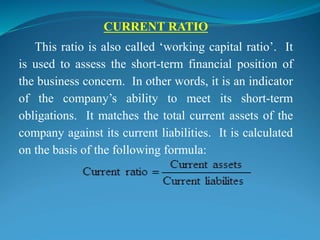
CURRENT RATIO
This ratio is also called ‘working capital ratio’. It
is used to assess the short-term financial position of
the business concern. In other words, it is an indicator
of the company’s ability to meet its short-term
obligations. It matches the total current assets of the
company against its current liabilities. It is calculated
on the basis of the following formula:
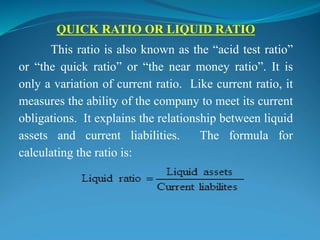
QUICK RATIO OR LIQUID RATIO
This ratio is also known as the “acid test ratio”
or “the quick ratio” or “the near money ratio”. It is
only a variation of current ratio. Like current ratio, it
measures the ability of the company to meet its current
obligations. It explains the relationship between liquid
assets and current liabilities. The formula for
calculating the ratio is:
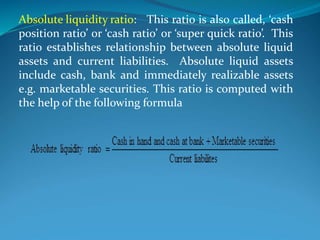
Absolute liquidity ratio: This ratio is also called, ‘cash
position ratio’ or ‘cash ratio’ or ‘super quick ratio’. This
ratio establishes relationship between absolute liquid
assets and current liabilities. Absolute liquid assets
include cash, bank and immediately realizable assets
e.g. marketable securities. This ratio is computed with
the help of the following formula

Management Accounting Unit II.ppt

  • 2.
    WHAT DO YOUMEAN BY RATIO ANALYSIS? A ratio is a mathematical relationship between two items expressed in a quantitative form. Ratio analysis involves the process of computing, determining and presenting the relationship of items or groups of items in the financial statements.
  • 3.
    Steps in ratioanalysis Selection of Relevant Information: The first step in ratio analysis is to select relevant information from financial statements and calculate appropriate ratios required for decision under consideration. Comparison of Calculated Ratios: In order to assess the relative meaning the ratios calculated are compared with the past ratios and industry ratios. Interpretation and Reporting: This is the final step where inferences are made and the report is written. The report recommends specific action and present alternatives with enables the decision making.
  • 4.
    STATE THE MODESOF EXPRESSION OF RATIOS. Ratios may be expressed in any one or more of the following ways: In proportion: In this type of expression the amounts of two items are expressed in a common denominator. An example of this form of expression is the relationship between current assets and current liabilities as 2:1 In rates or times of Coefficient: In this type of expression, a quotient obtained by dividing one item by another is taken as unit of expression. E.g. cost of sales divided by average stock. In percentage: In this type of expression, a quotient obtained by dividing on item by another is multiplied by one hundred to show the relationship in terms of percentage. E.g. relationship between net profit and sales.
  • 5.
    ADVANTAGES OF RATIOANALYSIS. Managerial Control Forecasting Facilitates Communication Measuring Efficiency Facilitating Investment Decisions Useful in Measuring Financial Solvency Inter firm Comparisons
  • 6.
    LIMITATIONS OF RATIOANALYSIS Practical Knowledge Ratios are Means Inter Relationship Non Availability of Standards or Norms Accuracy of Financial Information Consistency in Preparation of Financial Statements Detachment from Financial Statements Time Lag Change in Price Level
  • 7.
    CLASSIFICATION OF RATIOS SolvencyRatios: Short term and long term solvency ratios. E.g.: Current ratio, Debt equity ratio. Profitability Ratios: E.g.: Gross profit ratio, Net profit ratio, Operating profit ratio, Return on capital employed. Turnover or Activity Ratio: E.g.: Stock turnover ratio, Debtors turnover ratio, Creditors turnover ratio. Capital Structure Ratio: E.g.: Capital gearing ratio.
  • 8.
    CURRENT RATIO This ratiois also called ‘working capital ratio’. It is used to assess the short-term financial position of the business concern. In other words, it is an indicator of the company’s ability to meet its short-term obligations. It matches the total current assets of the company against its current liabilities. It is calculated on the basis of the following formula:
  • 9.
    QUICK RATIO ORLIQUID RATIO This ratio is also known as the “acid test ratio” or “the quick ratio” or “the near money ratio”. It is only a variation of current ratio. Like current ratio, it measures the ability of the company to meet its current obligations. It explains the relationship between liquid assets and current liabilities. The formula for calculating the ratio is:
  • 10.
    Absolute liquidity ratio:This ratio is also called, ‘cash position ratio’ or ‘cash ratio’ or ‘super quick ratio’. This ratio establishes relationship between absolute liquid assets and current liabilities. Absolute liquid assets include cash, bank and immediately realizable assets e.g. marketable securities. This ratio is computed with the help of the following formula