1
Dr K.Sunanda
Associate Professor
Department of Business Management
HR Planning
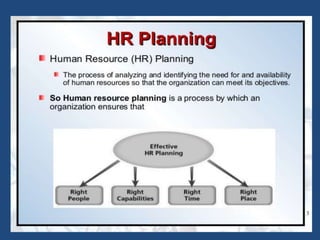
• The process of systematically reviewing HR
requirements to ensure that the required
number of employees, with the required skills,
are available when they are needed
2
• HR Planning at National level, Industry level
and Industrial unit level
• Just think about employee movement in an
organization
3
Factors Affecting HR Planning
• Type and Structure of Organization
• Organizational growth cycle and planning
• Environmental Uncertainties
• Time horizons
• Type and Quality of information
• Nature of Jobs Being Filled
• Availability of funds
• Labour market
• Outsourcing
4
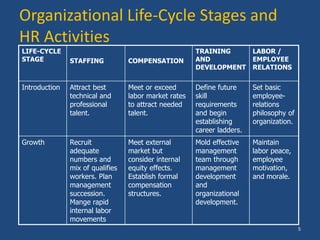
Organizational Life-Cycle Stages and
HR Activities
5
LIFE-CYCLE
STAGE STAFFING COMPENSATION
TRAINING
AND
DEVELOPMENT
LABOR /
EMPLOYEE
RELATIONS
Introduction Attract best
technical and
professional
talent.
Meet or exceed
labor market rates
to attract needed
talent.
Define future
skill
requirements
and begin
establishing
career ladders.
Set basic
employee-
relations
philosophy of
organization.
Growth Recruit
adequate
numbers and
mix of qualifies
workers. Plan
management
succession.
Mange rapid
internal labor
movements
Meet external
market but
consider internal
equity effects.
Establish formal
compensation
structures.
Mold effective
management
team through
management
development
and
organizational
development.
Maintain
labor peace,
employee
motivation,
and morale.
6
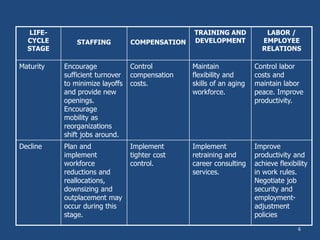
LIFE-
CYCLE
STAGE
STAFFING COMPENSATION
TRAINING AND
DEVELOPMENT
LABOR /
EMPLOYEE
RELATIONS
Maturity Encourage
sufficient turnover
to minimize layoffs
and provide new
openings.
Encourage
mobility as
reorganizations
shift jobs around.
Control
compensation
costs.
Maintain
flexibility and
skills of an aging
workforce.
Control labor
costs and
maintain labor
peace. Improve
productivity.
Decline Plan and
implement
workforce
reductions and
reallocations,
downsizing and
outplacement may
occur during this
stage.
Implement
tighter cost
control.
Implement
retraining and
career consulting
services.
Improve
productivity and
achieve flexibility
in work rules.
Negotiate job
security and
employment-
adjustment
policies
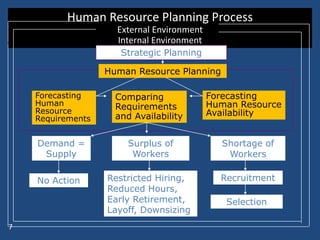
Human Resource Planning Process
External Environment
Internal Environment
7
Strategic Planning
Human Resource Planning
Forecasting
Human
Resource
Requirements
Comparing
Requirements
and Availability
Forecasting
Human Resource
Availability
Surplus of
Workers
Demand =
Supply
No Action Restricted Hiring,
Reduced Hours,
Early Retirement,
Layoff, Downsizing
Shortage of
Workers
Recruitment
Selection
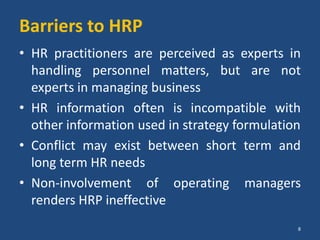
Barriers to HRP
• HR practitioners are perceived as experts in
handling personnel matters, but are not
experts in managing business
• HR information often is incompatible with
other information used in strategy formulation
• Conflict may exist between short term and
long term HR needs
• Non-involvement of operating managers
renders HRP ineffective
8
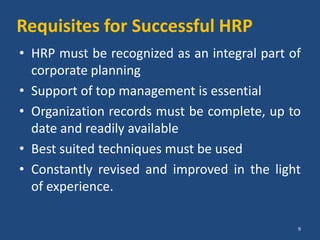
Requisites for Successful HRP
• HRP must be recognized as an integral part of
corporate planning
• Support of top management is essential
• Organization records must be complete, up to
date and readily available
• Best suited techniques must be used
• Constantly revised and improved in the light
of experience.
9
THANK YOU
10

Human resource planning.pptx

  • 1.
  • 2.
    HR Planning • Theprocess of systematically reviewing HR requirements to ensure that the required number of employees, with the required skills, are available when they are needed 2 • HR Planning at National level, Industry level and Industrial unit level • Just think about employee movement in an organization
  • 3.
  • 4.
    Factors Affecting HRPlanning • Type and Structure of Organization • Organizational growth cycle and planning • Environmental Uncertainties • Time horizons • Type and Quality of information • Nature of Jobs Being Filled • Availability of funds • Labour market • Outsourcing 4
  • 5.
    Organizational Life-Cycle Stagesand HR Activities 5 LIFE-CYCLE STAGE STAFFING COMPENSATION TRAINING AND DEVELOPMENT LABOR / EMPLOYEE RELATIONS Introduction Attract best technical and professional talent. Meet or exceed labor market rates to attract needed talent. Define future skill requirements and begin establishing career ladders. Set basic employee- relations philosophy of organization. Growth Recruit adequate numbers and mix of qualifies workers. Plan management succession. Mange rapid internal labor movements Meet external market but consider internal equity effects. Establish formal compensation structures. Mold effective management team through management development and organizational development. Maintain labor peace, employee motivation, and morale.
  • 6.
    6 LIFE- CYCLE STAGE STAFFING COMPENSATION TRAINING AND DEVELOPMENT LABOR/ EMPLOYEE RELATIONS Maturity Encourage sufficient turnover to minimize layoffs and provide new openings. Encourage mobility as reorganizations shift jobs around. Control compensation costs. Maintain flexibility and skills of an aging workforce. Control labor costs and maintain labor peace. Improve productivity. Decline Plan and implement workforce reductions and reallocations, downsizing and outplacement may occur during this stage. Implement tighter cost control. Implement retraining and career consulting services. Improve productivity and achieve flexibility in work rules. Negotiate job security and employment- adjustment policies
  • 7.
    Human Resource PlanningProcess External Environment Internal Environment 7 Strategic Planning Human Resource Planning Forecasting Human Resource Requirements Comparing Requirements and Availability Forecasting Human Resource Availability Surplus of Workers Demand = Supply No Action Restricted Hiring, Reduced Hours, Early Retirement, Layoff, Downsizing Shortage of Workers Recruitment Selection
  • 8.
    Barriers to HRP •HR practitioners are perceived as experts in handling personnel matters, but are not experts in managing business • HR information often is incompatible with other information used in strategy formulation • Conflict may exist between short term and long term HR needs • Non-involvement of operating managers renders HRP ineffective 8
  • 9.
    Requisites for SuccessfulHRP • HRP must be recognized as an integral part of corporate planning • Support of top management is essential • Organization records must be complete, up to date and readily available • Best suited techniques must be used • Constantly revised and improved in the light of experience. 9
  • 10.

Editor's Notes

  • #4 HR Planning at National level, Sector level, Industry level and Industrial unit level