
RATIO
ANALYSIS
-BY
DIVANSHU SACHDEVA, RIDDHI DEB
ANINDYA DAS, AYAN SHAHI
ANSHIKA GOEL & MREEDU SINGH
WHAT IS RATIO ANALYSIS?
Ratio Analysis is a form of Financial Statement Analysis that is used to
obtain a quick indication of a firm’s financial performance in several key
areas.
Let’s see how it is calculated and what the objective of this calculation is?
Calculation Basis
 A relationship expressed in mathematical terms
 Between two individual figures or group of figures
 Connect with each other in some logical manner
 Selected from financial statements of the concern
OBJECTIVE
• Objective for financial ratios is that all
the stakeholders (owners, investors,
lenders, employees, etc.) can draw
conclusion about the:
Performance (present, past & future)
Strength and weakness of a firm
Can take decisions in relation to firm
ADVANTAGE OF RATIO ANALYSIS
FORECASTING
AND PLANNING
BUDGETING MEASUREMENT
OF OPERATING
EFFICIENCY
COMMUNICATION CONTROL OF
PERFORMANCE
AND COST
LIMITATIONS OF RATIO ANALYSIS
Limitations
of financial
statements
Historical
information
Different
accounting
policies
Changes in
price level
Quantitative
analysis
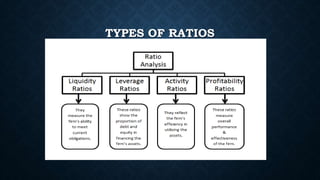
TYPES OF RATIOS
LIQUIDITY
RATIO
These are those ratios which are computed to evaluate
the capacity of the entity to meet its short-term liabilities.
Commonly used liquidity ratios are:
Current Ratio
Quick Ratio
Absolute Liquidity Ratio
CAPITAL STRUCTURE/ LEVERAGE RATIOS
• Capital structure/ leverage ratio may be
defined as those ratios which measure
the long-term stability and structures of
the firm.
o Debt- Equity Ratio
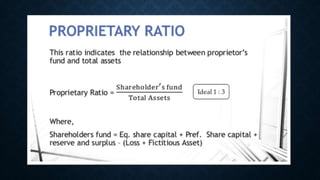
o Proprietary Ratio
o Capital Gearing Ratio
o Fixed Asset Ratio
TURNOVER OR ACTIVITY RATIOS
These ratios are employed to evaluate the efficiency with which the firms manages and
utilizes its asset. For this reason, they are often called as ‘ Asset Management Ratio’.
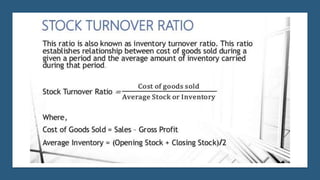
• Stock Turnover Ratio
• Debtor Turnover Ratio
• Creditor Turnover Ratio
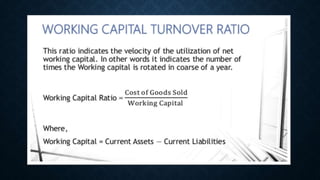
• Working Capital Turnover Ratio
PROFITABILITY RATIOS
The profitability ratios measures the profitability or the operational efficiency of the firm. They
are some of the most closely watched and widely quoted ratios.
General Profitability Ratio:
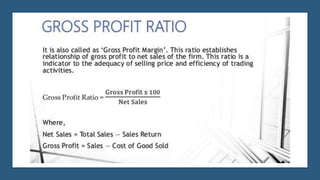
i. Gross Profit Ratio
ii. Net Profit Ratio
iii. Operating Profit Ratio
Overall Profitability Ratio:
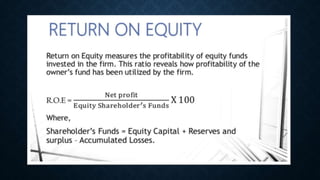
i. Return on Equity
ii. Return on Capital Employed
iii. Return on Proprietor Fund
THANK YOU!

Ratio Analysis

  • 1.
    RATIO ANALYSIS -BY DIVANSHU SACHDEVA, RIDDHIDEB ANINDYA DAS, AYAN SHAHI ANSHIKA GOEL & MREEDU SINGH
  • 2.
    WHAT IS RATIOANALYSIS? Ratio Analysis is a form of Financial Statement Analysis that is used to obtain a quick indication of a firm’s financial performance in several key areas. Let’s see how it is calculated and what the objective of this calculation is? Calculation Basis  A relationship expressed in mathematical terms  Between two individual figures or group of figures  Connect with each other in some logical manner  Selected from financial statements of the concern
  • 3.
    OBJECTIVE • Objective forfinancial ratios is that all the stakeholders (owners, investors, lenders, employees, etc.) can draw conclusion about the: Performance (present, past & future) Strength and weakness of a firm Can take decisions in relation to firm
  • 4.
    ADVANTAGE OF RATIOANALYSIS FORECASTING AND PLANNING BUDGETING MEASUREMENT OF OPERATING EFFICIENCY COMMUNICATION CONTROL OF PERFORMANCE AND COST
  • 5.
    LIMITATIONS OF RATIOANALYSIS Limitations of financial statements Historical information Different accounting policies Changes in price level Quantitative analysis
  • 6.
  • 7.
    LIQUIDITY RATIO These are thoseratios which are computed to evaluate the capacity of the entity to meet its short-term liabilities. Commonly used liquidity ratios are: Current Ratio Quick Ratio Absolute Liquidity Ratio
  • 11.
    CAPITAL STRUCTURE/ LEVERAGERATIOS • Capital structure/ leverage ratio may be defined as those ratios which measure the long-term stability and structures of the firm. o Debt- Equity Ratio o Proprietary Ratio o Capital Gearing Ratio o Fixed Asset Ratio
  • 16.
    TURNOVER OR ACTIVITYRATIOS These ratios are employed to evaluate the efficiency with which the firms manages and utilizes its asset. For this reason, they are often called as ‘ Asset Management Ratio’. • Stock Turnover Ratio • Debtor Turnover Ratio • Creditor Turnover Ratio • Working Capital Turnover Ratio
  • 21.
    PROFITABILITY RATIOS The profitabilityratios measures the profitability or the operational efficiency of the firm. They are some of the most closely watched and widely quoted ratios. General Profitability Ratio: i. Gross Profit Ratio ii. Net Profit Ratio iii. Operating Profit Ratio Overall Profitability Ratio: i. Return on Equity ii. Return on Capital Employed iii. Return on Proprietor Fund
  • 28.