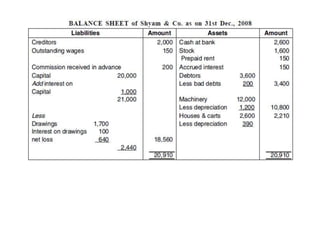
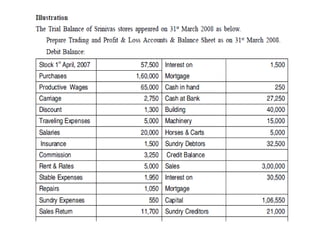
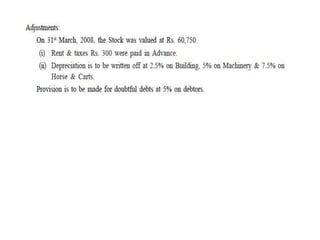
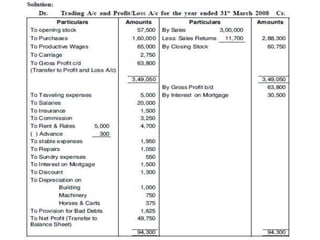
FINAL ACCOUNTS WITH
ADJUSTMENTS
Pooja Kumar
Faculty
IMS, RU
MEANING OF ADJUSTMENT
• All the transactions which pertain to the period of
final accounts but are not considered while
preparing the trial balance are called adjustments.
• These are entries which are passed at the end of
the accounting period.
• For example if an expense has been incurred but
not paid during that period, liability for the unpaid
amount should be created before the accounts can
be said to show the profit or loss.
NEED FOR ACCOUNTING ADJUSTMENTS
i. To know the correct net profit or net loss of the
business for an accounting year.
ii. To know the correct financial position of the business.
iii. To record the expenses which have become due but
have not been paid.
iv. To record the expenses which have been paid in
advance for future year(s).
v. To provide for depreciation on fixed assets.
ACCOUNTING TREATMENT
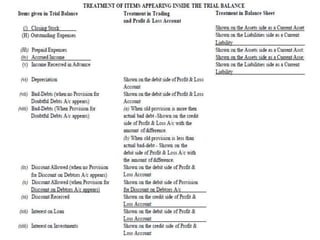
• Item appearing in the trial balance appears only once in
final accounts, either on the debit or credit.
• Any adjustment entry requires two postings, debit and
credit for the same amount.
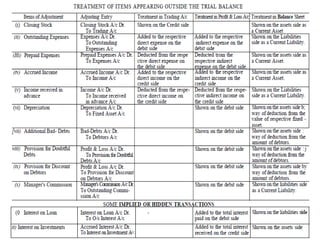
• Adjustments given outside the trial balance represent
entries yet to be made in the journal and the ledger.
• All the adjustments given outside the trial balance will
appear in both the trading or profit and loss account
and the balance sheet.
IMPORTANT
ADJUSTMENTS
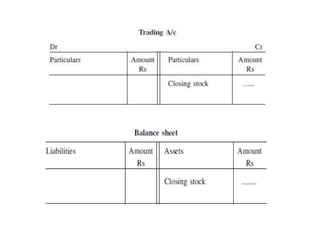
CLOSING STOCK
• Closing Stock is the stock of goods remaining unsold
at the end of the accounting year.
• Ordinarily this does not appear in the Trial Balance.
• EFFECT OF THE ADJUSTMENT:
– credit side of the Trading Account
– Assets side of the Balance Sheet.
– If already given in Trial balance, then put it only on the
asset side of the Balance Sheet.
OUTSTANDING EXPENSES
• Expense which is related to the current accounting period
but not yet paid is known as Outstanding Expense.
• Suppose the accounts are closed on 31st December every
year. Salary for the month of December is due but not paid.
It is an example of salary outstanding.
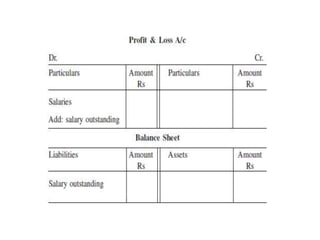
• EFFECT OF THE ADJUSTMENT:
– Amount of expense outstanding will be added to its paid amount
which is shown in the Trading A/c or Profit & Loss A/c as the
case may be.
– on the liabilities side of the Balance Sheet because it is an item
of liabilities.
– If already given in Trial balance, then put it only on the liability
side of the Balance Sheet.
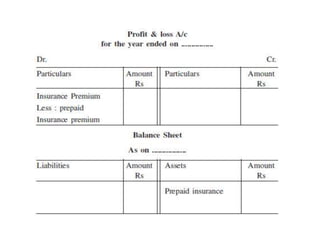
PREPAID EXPENSES
• Sometimes a part of a certain expense paid may relate to the next
accounting period. Such expenses is called prepaid expense or
expenses paid in advance.
• For example, insurance premium paid in the current year may be for
the year ending, the date of which falls in the next year. The part of
insurance premium which relates to next accounting year is the
insurance premium paid in advance.
• EFFECT OF THE ADJUSTMENT:
– It is deducted from the amount paid
– shown as an item of asset on balance sheet.
– If already given in Trial balance, then put it only on the Asset side of
the Balance Sheet.
• Similarly, such items may be rent prepaid, tax prepaid etc.
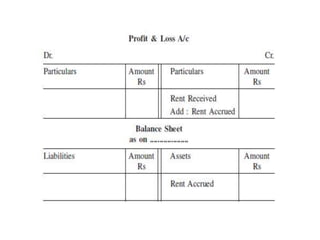
ACCRUED INCOME (DUE BUT NOT RECEIVED)
• Accrued income means income earned but not received till
the end of the accounting year.
• For example, interest on securities or dividends on shares,
which has become due but may be received on a date falling
in the next year.
• EFFECT OF THE ADJUSTMENT:
– The amount of accrued income is added to the relevant item of
income on the credit side of the Profit and Loss Account to
increase the amount of income for the current year.
– The amount of accrued income is a debt due from a third party to
the business, so it is shown on the assets side of the Balance
Sheet.
– If already given in Trial balance, then put it only on the Asset
side of the Balance Sheet.
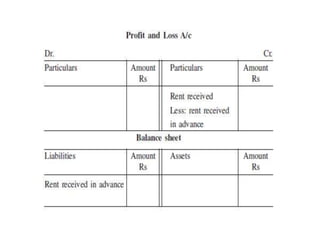
UNEARNED INCOME/INCOME RECEIVED IN
ADVANCE
• Sometimes income is received before it becomes actually
due. Such income is called “unearned income” or “income
received in advance”.
• Example of such income is rent that has been received for
the months of January and February of the coming
accounting year.
• EFFECT OF THE ADJUSTMENT:
– Since this income does not relate to the accounting year, it
should be deducted from the relevant head of income in the
Profit & Loss A/c.
– It is a liability and hence is shown in the liability side of the
Balance Sheet.
– If already given in Trial balance, then put it only on the liability
side of the Balance Sheet.
INTEREST ON CAPITAL
• As per business entity concept capital of the proprietor is a liability
for the business. Like other loans interest can be paid on capital also.
• Calculation of Interest on Capital:
– Interest is calculated on the opening balance of the capital at the given
rate for the full accounting period.
– If some additional amount of capital has been brought in the business
during the course of accounting period, interest on such additional
amount of capital is calculated from the date of introduction to the end
of the accounting period.
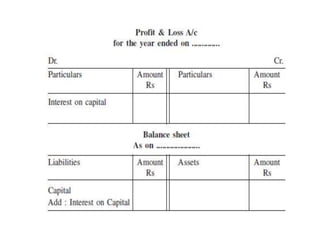
• EFFECT OF THE ADJUSTMENT:
– Interest allowed on capital is an expense for the business and is debited
to Profit and Loss Account, i.e. it is shown on the debit side of the
Profit and Loss Account.
– Such interest is not actually paid in cash to the businessman but added
to his capital account. Hence, it is shown as an addition to capital on
the liabilities side of the Balance Sheet.
– If already given in Trial balance, then shown on the debit side of the
Profit and Loss Account.
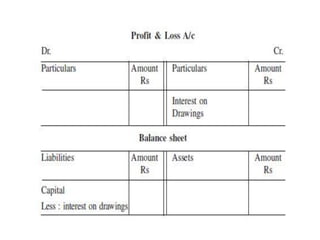
INTEREST ON DRAWINGS
• Interest may also be charged on money withdrawn
by the proprietor for household use.
• EFFECT OF THE ADJUSTMENT:
– Interest on drawings will be shown on the credit side
of Profit and Loss Account.
– Shown on the liabilities side of the Balance Sheet by
way of addition to the drawings which are ultimately
deducted from the capital.
– If already given in Trial balance, then shown on the
credit side of Profit and Loss Account.
INTEREST ON LOAN
•Interest must be paid on loans, whether there is profit or loss.
• It is calculated by reference to the rate of interest agreed to be paid by the
firm.
•Example: a loan of Rs. 20,000 is taken on 1st May 2008 at 18%, if the
accounts are closed on 31st December, the interest for the year will be Rs.
2,400 i.e., Rs. 20,000 × 18/ 100 × 8/ 12.
•The amount of the interest, if not paid, is to be credited to the Outstanding
Interest Account.
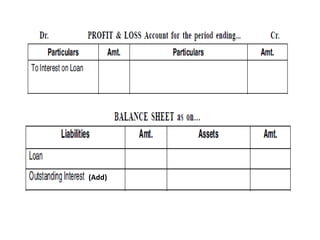
EFFECT OF THE ADJUSTMENT:
•Interest allowed on loan is an expense for the business and is debited to
Profit and Loss Account, i.e. it is shown on the debit side of the Profit and
Loss Account
•It is shown as an addition to loan on the liabilities side of the Balance Sheet.
•If already given in Trial balance, then shown on the debit side of the Profit
and Loss Account.
(Add)
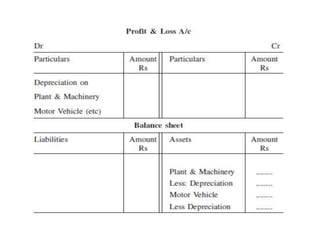
DEPRECIATION
• The value of fixed assets such as Plant and Machinery,
Furniture and Fixtures, Land & Building, Motor Vehicles
etc. goes on reducing year after year due to wear and tear,
obsolescence or for any other reason.
• As the fixed assets are used for earning revenue the amount
by which the value of a fixed asset decreases is an item of
expense, similar to other expenses. This is called
depreciation.
• EFFECT OF THE ADJUSTMENT:
– Depreciation is shown on the debit side of Profit and Loss
Account.
– It is shown on the asset side of the balance sheet by way of
deduction from the value of concerned asset.
– If it already appears on the debit column of the Trial Balance. It
will be shown only on the debit of profit & Loss A/c
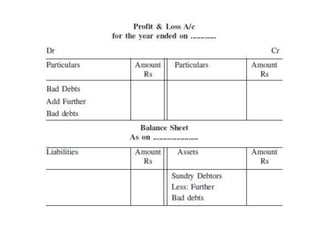
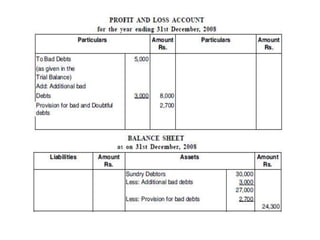
FURTHER BAD DEBTS
• When the goods are sold on credit basis some of the debtors partly
pay the due amount or do not pay at all.
• If this amount cannot be recovered it is called bad debts and is a loss
to the firm and is entered on the debit side of the Profit & loss A/c.
• But then there may be amount of bad debt which was not recorded
in the books of accounts and hence did not appear in the Trial
Balance. But the same was discovered before preparing the financial
statements. It is called further bad-debts.
• EFFECT OF THE ADJUSTMENT:
– In the profit and Loss Account, will be added to the amount of bad
debts already existing.
– In the Balance Sheet, the Sundry Debtors balance will be reduced by
the same amount in the assets side.
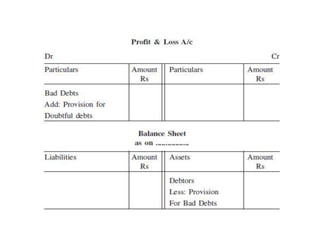
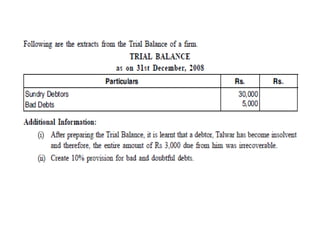
PROVISION FOR BAD AND DOUBTFUL DEBTS
• Some Debts of a particular year may become bad debts in the next
year. It means the loss due to bad debts will be written off in the
year it takes place instead of the year it belongs to.
• It will be a sound accounting practice that a suitable amount is kept
aside in the current year to meet the possible loss of bad debts in
the next year. Decision regarding maintenance for provision for Bad
Doubtful Debts is taken at the end of the year so it is an item of
adjustment. It is called a provision for Bad and Doubtful Debt.
• EFFECT OF THE ADJUSTMENT:
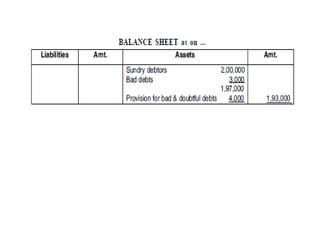
– The amount of provision for doubtful debts is a provision against a
possible loss so it should be debited to Profit and Loss account by
adding it to the existing bad debts.
– The amount of provision for doubtful debts is deducted from sundry
debtors on the assets side of the balance sheet.
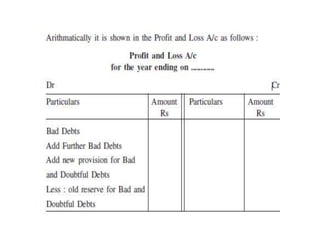
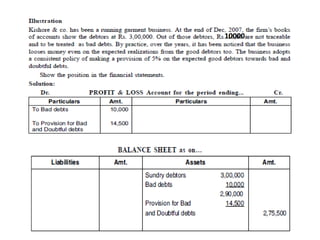
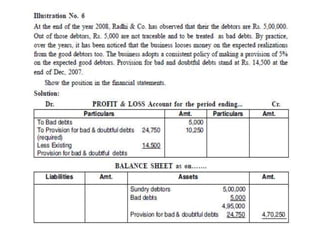
•Over the years businessman might have experienced that a certain percentage
of the debts created due to credit sales go bad every year. So a provision
for bad and doubtful debt is made on the debtors of a year at a fixed
percentage say 5%.
• In case there is further bad debts, provision for bad and doubtful Debts will be
calculated on the amount of debtors after deducting from it the amount of further
Bad Debts.
•This percentage may change if the circumstances have changed. For example, it
may be less if the businessman has become selective in selling goods on credit.
•Provision for bad and doubtful debt is maintained at every year at a fixed
percentage of the debtors.
• Last year balance is carried forward in the current year. This may be called old
provision of bad and doubtful debts.
•Current years bad debts or/and further bad debts is adjusted towards this
provision and more provision is created, which may be called new provision for
bad debts.
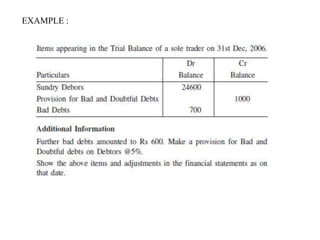
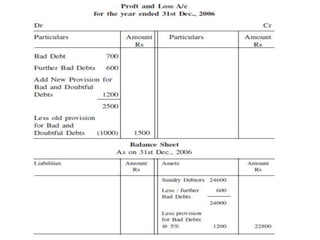
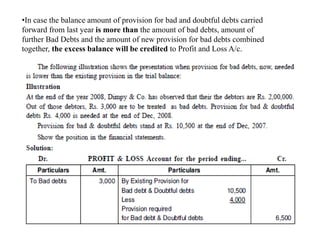
EXAMPLE :
10000
•In case the balance amount of provision for bad and doubtful debts carried
forward from last year is more than the amount of bad debts, amount of
further Bad Debts and the amount of new provision for bad debts combined
together, the excess balance will be credited to Profit and Loss A/c.
PROVISION FOR DISCOUNT ON DEBTORS
• It is a normal practice in business to allow discount to customers for
prompt payment and it constitutes a substantial sum.
• Some times the goods are sold on credit to customers in one accounting
period whereas the payment of the same is received in the next accounting
period and discount is to be allowed.
• It is a wise/ prudent policy to charge this expenditure (discount allowed) to
the period in which sales have been made, so a provision is created in the
same manner, as in case of provision for doubtful debts.
• EFFECT OF THE ADJUSTMENT:
– Provision for discount on debtors is a probable loss, so it should be shown on
the debit side of Profit and Loss account.
– Amount of provision for discount on debtors is deducted from sundry debtors
on the assets side of the Balance Sheet.
• Note: Such provision is made on debtors after deduction of further bad
debts and provision for doubtful debts because discount is allowable to
debtors who intend to make the payment.
RESERVE FOR DISCOUNT ON CREDITORS
• Prompt payments to creditors enable a businessman to earn
discount from them. When a businessman receives cash
discount regularly, he can make a provision for such
discount since he is likely to receive the discount from his
creditors in the following years also.
• The discount received being a profit, the provision for
discount on creditors amounts to an addition to the profit.
• EFFECT OF THE ADJUSTMENT:
– Reserve for discount on creditors is shown on the credit side of
Profit and Loss account.
– In the liabilities side of the Balance Sheet, the reserve for
discount on creditors is shown by way of deductions from
Sundry Creditors.
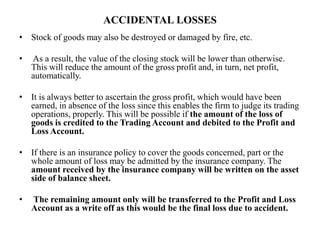
ACCIDENTAL LOSSES
• Stock of goods may also be destroyed or damaged by fire, etc.
• As a result, the value of the closing stock will be lower than otherwise.
This will reduce the amount of the gross profit and, in turn, net profit,
automatically.
• It is always better to ascertain the gross profit, which would have been
earned, in absence of the loss since this enables the firm to judge its trading
operations, properly. This will be possible if the amount of the loss of
goods is credited to the Trading Account and debited to the Profit and
Loss Account.
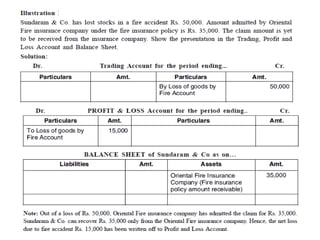
• If there is an insurance policy to cover the goods concerned, part or the
whole amount of loss may be admitted by the insurance company. The
amount received by the insurance company will be written on the asset
side of balance sheet.
• The remaining amount only will be transferred to the Profit and Loss
Account as a write off as this would be the final loss due to accident.
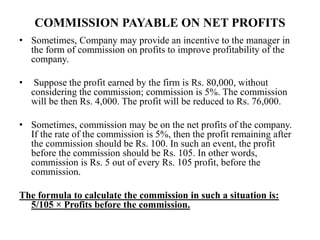
COMMISSION PAYABLE ON NET PROFITS
• Sometimes, Company may provide an incentive to the manager in
the form of commission on profits to improve profitability of the
company.
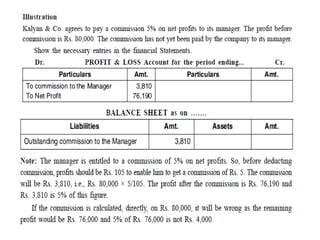
• Suppose the profit earned by the firm is Rs. 80,000, without
considering the commission; commission is 5%. The commission
will be then Rs. 4,000. The profit will be reduced to Rs. 76,000.
• Sometimes, commission may be on the net profits of the company.
If the rate of the commission is 5%, then the profit remaining after
the commission should be Rs. 100. In such an event, the profit
before the commission should be Rs. 105. In other words,
commission is Rs. 5 out of every Rs. 105 profit, before the
commission.
The formula to calculate the commission in such a situation is:
5/105 × Profits before the commission.
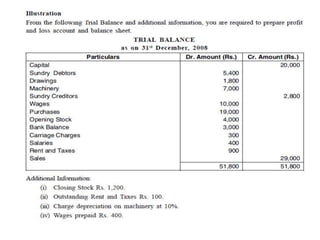
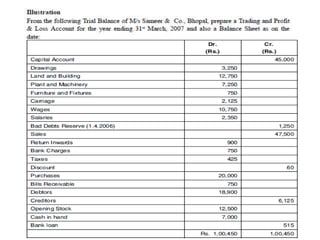
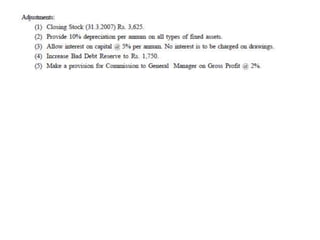
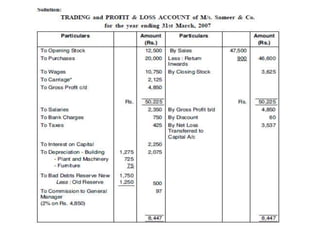
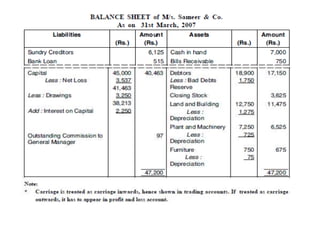
NUMERICALS
5. FINAL ACCOUNTS WITH ADJUSTMENTS.pptx

5. FINAL ACCOUNTS WITH ADJUSTMENTS.pptx

  • 1.
  • 2.
    MEANING OF ADJUSTMENT •All the transactions which pertain to the period of final accounts but are not considered while preparing the trial balance are called adjustments. • These are entries which are passed at the end of the accounting period. • For example if an expense has been incurred but not paid during that period, liability for the unpaid amount should be created before the accounts can be said to show the profit or loss.
  • 3.
    NEED FOR ACCOUNTINGADJUSTMENTS i. To know the correct net profit or net loss of the business for an accounting year. ii. To know the correct financial position of the business. iii. To record the expenses which have become due but have not been paid. iv. To record the expenses which have been paid in advance for future year(s). v. To provide for depreciation on fixed assets.
  • 4.
    ACCOUNTING TREATMENT • Itemappearing in the trial balance appears only once in final accounts, either on the debit or credit. • Any adjustment entry requires two postings, debit and credit for the same amount. • Adjustments given outside the trial balance represent entries yet to be made in the journal and the ledger. • All the adjustments given outside the trial balance will appear in both the trading or profit and loss account and the balance sheet.
  • 5.
  • 6.
    CLOSING STOCK • ClosingStock is the stock of goods remaining unsold at the end of the accounting year. • Ordinarily this does not appear in the Trial Balance. • EFFECT OF THE ADJUSTMENT: – credit side of the Trading Account – Assets side of the Balance Sheet. – If already given in Trial balance, then put it only on the asset side of the Balance Sheet.
  • 8.
    OUTSTANDING EXPENSES • Expensewhich is related to the current accounting period but not yet paid is known as Outstanding Expense. • Suppose the accounts are closed on 31st December every year. Salary for the month of December is due but not paid. It is an example of salary outstanding. • EFFECT OF THE ADJUSTMENT: – Amount of expense outstanding will be added to its paid amount which is shown in the Trading A/c or Profit & Loss A/c as the case may be. – on the liabilities side of the Balance Sheet because it is an item of liabilities. – If already given in Trial balance, then put it only on the liability side of the Balance Sheet.
  • 10.
    PREPAID EXPENSES • Sometimesa part of a certain expense paid may relate to the next accounting period. Such expenses is called prepaid expense or expenses paid in advance. • For example, insurance premium paid in the current year may be for the year ending, the date of which falls in the next year. The part of insurance premium which relates to next accounting year is the insurance premium paid in advance. • EFFECT OF THE ADJUSTMENT: – It is deducted from the amount paid – shown as an item of asset on balance sheet. – If already given in Trial balance, then put it only on the Asset side of the Balance Sheet. • Similarly, such items may be rent prepaid, tax prepaid etc.
  • 12.
    ACCRUED INCOME (DUEBUT NOT RECEIVED) • Accrued income means income earned but not received till the end of the accounting year. • For example, interest on securities or dividends on shares, which has become due but may be received on a date falling in the next year. • EFFECT OF THE ADJUSTMENT: – The amount of accrued income is added to the relevant item of income on the credit side of the Profit and Loss Account to increase the amount of income for the current year. – The amount of accrued income is a debt due from a third party to the business, so it is shown on the assets side of the Balance Sheet. – If already given in Trial balance, then put it only on the Asset side of the Balance Sheet.
  • 14.
    UNEARNED INCOME/INCOME RECEIVEDIN ADVANCE • Sometimes income is received before it becomes actually due. Such income is called “unearned income” or “income received in advance”. • Example of such income is rent that has been received for the months of January and February of the coming accounting year. • EFFECT OF THE ADJUSTMENT: – Since this income does not relate to the accounting year, it should be deducted from the relevant head of income in the Profit & Loss A/c. – It is a liability and hence is shown in the liability side of the Balance Sheet. – If already given in Trial balance, then put it only on the liability side of the Balance Sheet.
  • 16.
    INTEREST ON CAPITAL •As per business entity concept capital of the proprietor is a liability for the business. Like other loans interest can be paid on capital also. • Calculation of Interest on Capital: – Interest is calculated on the opening balance of the capital at the given rate for the full accounting period. – If some additional amount of capital has been brought in the business during the course of accounting period, interest on such additional amount of capital is calculated from the date of introduction to the end of the accounting period. • EFFECT OF THE ADJUSTMENT: – Interest allowed on capital is an expense for the business and is debited to Profit and Loss Account, i.e. it is shown on the debit side of the Profit and Loss Account. – Such interest is not actually paid in cash to the businessman but added to his capital account. Hence, it is shown as an addition to capital on the liabilities side of the Balance Sheet. – If already given in Trial balance, then shown on the debit side of the Profit and Loss Account.
  • 18.
    INTEREST ON DRAWINGS •Interest may also be charged on money withdrawn by the proprietor for household use. • EFFECT OF THE ADJUSTMENT: – Interest on drawings will be shown on the credit side of Profit and Loss Account. – Shown on the liabilities side of the Balance Sheet by way of addition to the drawings which are ultimately deducted from the capital. – If already given in Trial balance, then shown on the credit side of Profit and Loss Account.
  • 20.
    INTEREST ON LOAN •Interestmust be paid on loans, whether there is profit or loss. • It is calculated by reference to the rate of interest agreed to be paid by the firm. •Example: a loan of Rs. 20,000 is taken on 1st May 2008 at 18%, if the accounts are closed on 31st December, the interest for the year will be Rs. 2,400 i.e., Rs. 20,000 × 18/ 100 × 8/ 12. •The amount of the interest, if not paid, is to be credited to the Outstanding Interest Account. EFFECT OF THE ADJUSTMENT: •Interest allowed on loan is an expense for the business and is debited to Profit and Loss Account, i.e. it is shown on the debit side of the Profit and Loss Account •It is shown as an addition to loan on the liabilities side of the Balance Sheet. •If already given in Trial balance, then shown on the debit side of the Profit and Loss Account.
  • 21.
  • 22.
    DEPRECIATION • The valueof fixed assets such as Plant and Machinery, Furniture and Fixtures, Land & Building, Motor Vehicles etc. goes on reducing year after year due to wear and tear, obsolescence or for any other reason. • As the fixed assets are used for earning revenue the amount by which the value of a fixed asset decreases is an item of expense, similar to other expenses. This is called depreciation. • EFFECT OF THE ADJUSTMENT: – Depreciation is shown on the debit side of Profit and Loss Account. – It is shown on the asset side of the balance sheet by way of deduction from the value of concerned asset. – If it already appears on the debit column of the Trial Balance. It will be shown only on the debit of profit & Loss A/c
  • 24.
    FURTHER BAD DEBTS •When the goods are sold on credit basis some of the debtors partly pay the due amount or do not pay at all. • If this amount cannot be recovered it is called bad debts and is a loss to the firm and is entered on the debit side of the Profit & loss A/c. • But then there may be amount of bad debt which was not recorded in the books of accounts and hence did not appear in the Trial Balance. But the same was discovered before preparing the financial statements. It is called further bad-debts. • EFFECT OF THE ADJUSTMENT: – In the profit and Loss Account, will be added to the amount of bad debts already existing. – In the Balance Sheet, the Sundry Debtors balance will be reduced by the same amount in the assets side.
  • 26.
    PROVISION FOR BADAND DOUBTFUL DEBTS • Some Debts of a particular year may become bad debts in the next year. It means the loss due to bad debts will be written off in the year it takes place instead of the year it belongs to. • It will be a sound accounting practice that a suitable amount is kept aside in the current year to meet the possible loss of bad debts in the next year. Decision regarding maintenance for provision for Bad Doubtful Debts is taken at the end of the year so it is an item of adjustment. It is called a provision for Bad and Doubtful Debt. • EFFECT OF THE ADJUSTMENT: – The amount of provision for doubtful debts is a provision against a possible loss so it should be debited to Profit and Loss account by adding it to the existing bad debts. – The amount of provision for doubtful debts is deducted from sundry debtors on the assets side of the balance sheet.
  • 28.
    •Over the yearsbusinessman might have experienced that a certain percentage of the debts created due to credit sales go bad every year. So a provision for bad and doubtful debt is made on the debtors of a year at a fixed percentage say 5%. • In case there is further bad debts, provision for bad and doubtful Debts will be calculated on the amount of debtors after deducting from it the amount of further Bad Debts. •This percentage may change if the circumstances have changed. For example, it may be less if the businessman has become selective in selling goods on credit. •Provision for bad and doubtful debt is maintained at every year at a fixed percentage of the debtors. • Last year balance is carried forward in the current year. This may be called old provision of bad and doubtful debts. •Current years bad debts or/and further bad debts is adjusted towards this provision and more provision is created, which may be called new provision for bad debts.
  • 30.
  • 34.
  • 36.
    •In case thebalance amount of provision for bad and doubtful debts carried forward from last year is more than the amount of bad debts, amount of further Bad Debts and the amount of new provision for bad debts combined together, the excess balance will be credited to Profit and Loss A/c.
  • 38.
    PROVISION FOR DISCOUNTON DEBTORS • It is a normal practice in business to allow discount to customers for prompt payment and it constitutes a substantial sum. • Some times the goods are sold on credit to customers in one accounting period whereas the payment of the same is received in the next accounting period and discount is to be allowed. • It is a wise/ prudent policy to charge this expenditure (discount allowed) to the period in which sales have been made, so a provision is created in the same manner, as in case of provision for doubtful debts. • EFFECT OF THE ADJUSTMENT: – Provision for discount on debtors is a probable loss, so it should be shown on the debit side of Profit and Loss account. – Amount of provision for discount on debtors is deducted from sundry debtors on the assets side of the Balance Sheet. • Note: Such provision is made on debtors after deduction of further bad debts and provision for doubtful debts because discount is allowable to debtors who intend to make the payment.
  • 39.
    RESERVE FOR DISCOUNTON CREDITORS • Prompt payments to creditors enable a businessman to earn discount from them. When a businessman receives cash discount regularly, he can make a provision for such discount since he is likely to receive the discount from his creditors in the following years also. • The discount received being a profit, the provision for discount on creditors amounts to an addition to the profit. • EFFECT OF THE ADJUSTMENT: – Reserve for discount on creditors is shown on the credit side of Profit and Loss account. – In the liabilities side of the Balance Sheet, the reserve for discount on creditors is shown by way of deductions from Sundry Creditors.
  • 40.
    ACCIDENTAL LOSSES • Stockof goods may also be destroyed or damaged by fire, etc. • As a result, the value of the closing stock will be lower than otherwise. This will reduce the amount of the gross profit and, in turn, net profit, automatically. • It is always better to ascertain the gross profit, which would have been earned, in absence of the loss since this enables the firm to judge its trading operations, properly. This will be possible if the amount of the loss of goods is credited to the Trading Account and debited to the Profit and Loss Account. • If there is an insurance policy to cover the goods concerned, part or the whole amount of loss may be admitted by the insurance company. The amount received by the insurance company will be written on the asset side of balance sheet. • The remaining amount only will be transferred to the Profit and Loss Account as a write off as this would be the final loss due to accident.
  • 42.
    COMMISSION PAYABLE ONNET PROFITS • Sometimes, Company may provide an incentive to the manager in the form of commission on profits to improve profitability of the company. • Suppose the profit earned by the firm is Rs. 80,000, without considering the commission; commission is 5%. The commission will be then Rs. 4,000. The profit will be reduced to Rs. 76,000. • Sometimes, commission may be on the net profits of the company. If the rate of the commission is 5%, then the profit remaining after the commission should be Rs. 100. In such an event, the profit before the commission should be Rs. 105. In other words, commission is Rs. 5 out of every Rs. 105 profit, before the commission. The formula to calculate the commission in such a situation is: 5/105 × Profits before the commission.
  • 46.