ORGANIZATION STRUCTURE
What Is Organizational Structure
Organisation structure is the outcome of the organising
process.
The organisation structure can be defined as the framework
within which managerial and operating tasks are performed.
It specifies the relationships between people, work and
resources.
3
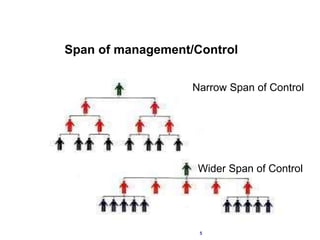
The span of management, to a large extent gives shape to
the organisational structure. Span of management refers to
the number of subordinates that can be effectively
managed by a superior. This determines the levels of
management in the structure.
Narrow Span of Control
Wider Span of Control
5
Span of management/Control
1–4
Copyright © 2006 Thomson Business and Economics. All rights reserved.
1–5
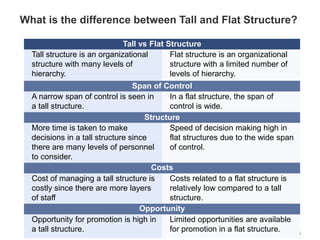
Tall vs Flat Structure
Tall structure is an organizational
structure with many levels of
hierarchy.
Flat structure is an organizational
structure with a limited number of
levels of hierarchy.
Span of Control
A narrow span of control is seen in
a tall structure.
In a flat structure, the span of
control is wide.
Structure
More time is taken to make
decisions in a tall structure since
there are many levels of personnel
to consider.
Speed of decision making high in
flat structures due to the wide span
of control.
Costs
Cost of managing a tall structure is
costly since there are more layers
of staff
Costs related to a flat structure is
relatively low compared to a tall
structure.
Opportunity
Opportunity for promotion is high in
a tall structure.
Limited opportunities are available
for promotion in a flat structure.
What is the difference between Tall and Flat Structure?
1–6
Delegation
Theo Haimman, Delegation of authority merely means
the granting of authority to subordinates to operate within
prescribed limits.
Elements of Delegation
1.Authority
2.Responsibility
3.Accountability
Importance of delegation is that it helps in effective
management, employee development, motivation,
growth and coordination
Decentralisation
decentralisation refers to delegation of authority throughout
all the levels of the organisation. Decision making
authority is shared with lower levels and is consequently
placed nearest to the points of action
Centralization
The degree to which decision making is concentrated at a
single point in the organization.
1–7
1–8
Copyright © 2006 Thomson Business and Economics. All rights reserved.
1–9
Copyright © 2006 Thomson Business and Economics. All rights reserved.
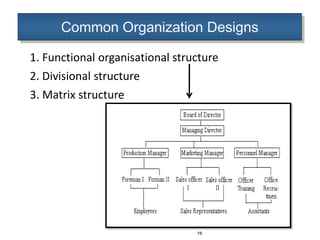
Common Organization Designs
10
1. Functional organisational structure
2. Divisional structure
3. Matrix structure
11
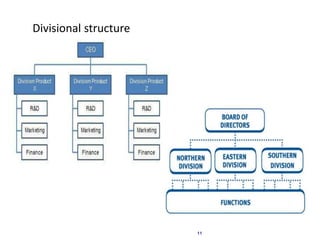
Divisional structure
12
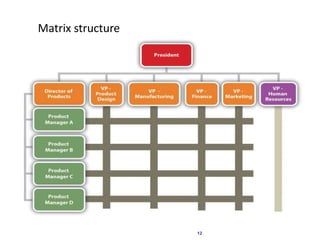
Matrix structure
Organization Structure ppt.pptx

Organization Structure ppt.pptx

  • 1.
  • 2.
    What Is OrganizationalStructure Organisation structure is the outcome of the organising process. The organisation structure can be defined as the framework within which managerial and operating tasks are performed. It specifies the relationships between people, work and resources. 3 The span of management, to a large extent gives shape to the organisational structure. Span of management refers to the number of subordinates that can be effectively managed by a superior. This determines the levels of management in the structure.
  • 3.
    Narrow Span ofControl Wider Span of Control 5 Span of management/Control
  • 4.
    1–4 Copyright © 2006Thomson Business and Economics. All rights reserved.
  • 5.
    1–5 Tall vs FlatStructure Tall structure is an organizational structure with many levels of hierarchy. Flat structure is an organizational structure with a limited number of levels of hierarchy. Span of Control A narrow span of control is seen in a tall structure. In a flat structure, the span of control is wide. Structure More time is taken to make decisions in a tall structure since there are many levels of personnel to consider. Speed of decision making high in flat structures due to the wide span of control. Costs Cost of managing a tall structure is costly since there are more layers of staff Costs related to a flat structure is relatively low compared to a tall structure. Opportunity Opportunity for promotion is high in a tall structure. Limited opportunities are available for promotion in a flat structure. What is the difference between Tall and Flat Structure?
  • 6.
    1–6 Delegation Theo Haimman, Delegationof authority merely means the granting of authority to subordinates to operate within prescribed limits. Elements of Delegation 1.Authority 2.Responsibility 3.Accountability Importance of delegation is that it helps in effective management, employee development, motivation, growth and coordination
  • 7.
    Decentralisation decentralisation refers todelegation of authority throughout all the levels of the organisation. Decision making authority is shared with lower levels and is consequently placed nearest to the points of action Centralization The degree to which decision making is concentrated at a single point in the organization. 1–7
  • 8.
    1–8 Copyright © 2006Thomson Business and Economics. All rights reserved.
  • 9.
    1–9 Copyright © 2006Thomson Business and Economics. All rights reserved.
  • 10.
    Common Organization Designs 10 1.Functional organisational structure 2. Divisional structure 3. Matrix structure
  • 11.
  • 12.