PRESENTED BY :-
AFTAB.MULLA
DEFINATION

WHAT DO YOU MEAN BY RATION ANALYSIS

ADVANTAGES & USES

LIMITATIONS

BIBLOGRAPHY
According to Myers, “Ratio analysis
of financial statements is a study of
relationship among various financial
factors in a business as disclosed by
a single set of statements and a
study of trend of these factors as
shown in a series of statements.”
A TOOL USED BY INDIVIDUAL TO CONDUCT A
QUANTITATIVE ANALYSIS OF INFORMATION

ONE OF THE TECHNIQUE OF FINANCIAL ANALYSIS TO
EVALUATE THE FINANCIAL CONDITION AND
PERFORMANCE OF A BUSINESS CONCERN

THE COMPARISION OF ONE FIGURE TO OTHER
RELEVANT FIGURE OR FIGURES
TO WORKOUT THE PROFITABILITY

TO WORK THE SOLVENCY

HELPFUL IN ANALYSIS OF FINANCIAL STATEMENT

HELPFUL IN COMPARATIVE ANALYSIS OF THE PERFORMANCE

TO SIMPLIFY THE ACCOUNTING INFORMATION

TO WORKOUT THE OPERATING EFFICIENCY

TO WORKOUT SHORT-TERM FINANCIAL POSITION

HELPFUL FOR FORECASTING PURPOSES
LIMITED COMPARABILITY
FALSE RESULTS
EFFECT OF PRICE LEVEL CHANGES
QUALITATIVE FACTORS ARE IGNORED
EFFECT OF WINDOW-DRESSING
COSTLY TECHNIQUE
MISLEADING RESULTS
ABSENCE OF STANDARD UNVERSITY ACCEPTED
TERMINOLOGY
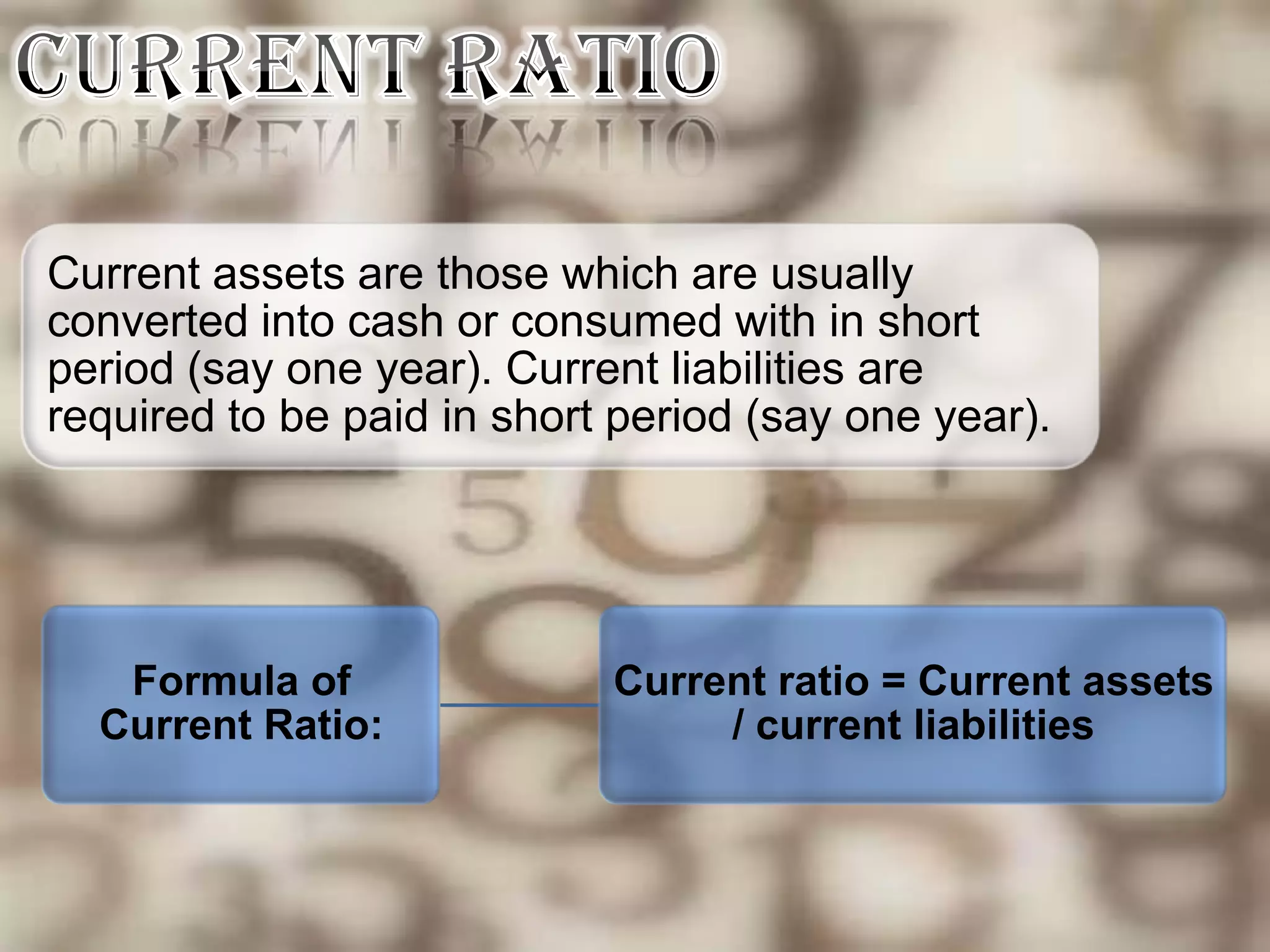
Current assets are those which are usually
converted into cash or consumed with in short
period (say one year). Current liabilities are
required to be paid in short period (say one year).


   Formula of               Current ratio = Current assets
  Current Ratio:                 / current liabilities
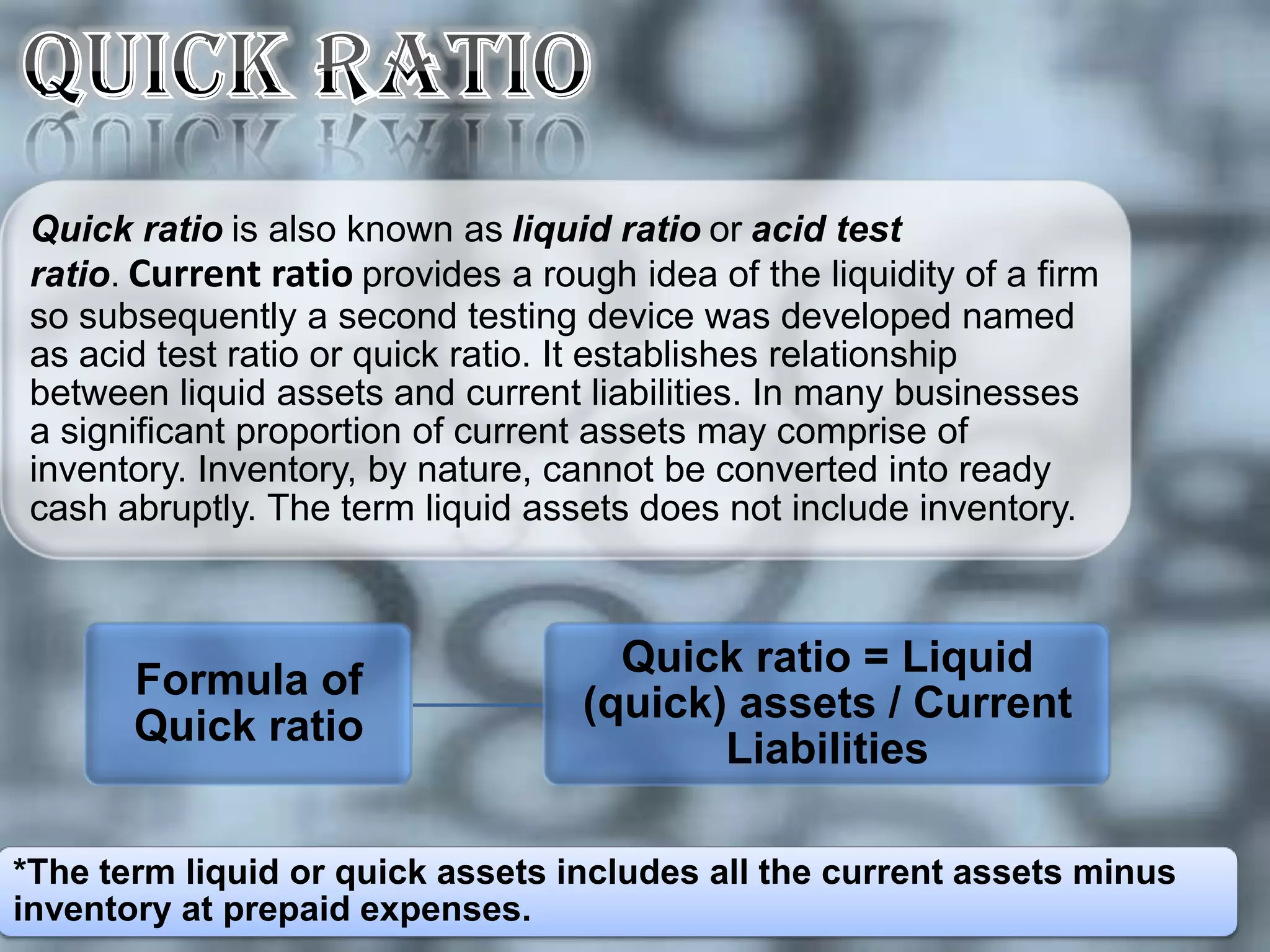
Quick ratio is also known as liquid ratio or acid test
 ratio. Current ratio provides a rough idea of the liquidity of a firm
 so subsequently a second testing device was developed named
 as acid test ratio or quick ratio. It establishes relationship
 between liquid assets and current liabilities. In many businesses
 a significant proportion of current assets may comprise of
 inventory. Inventory, by nature, cannot be converted into ready
 cash abruptly. The term liquid assets does not include inventory.


                                      Quick ratio = Liquid
       Formula of
                                    (quick) assets / Current
       Quick ratio
                                           Liabilities

*The term liquid or quick assets includes all the current assets minus
inventory at prepaid expenses.
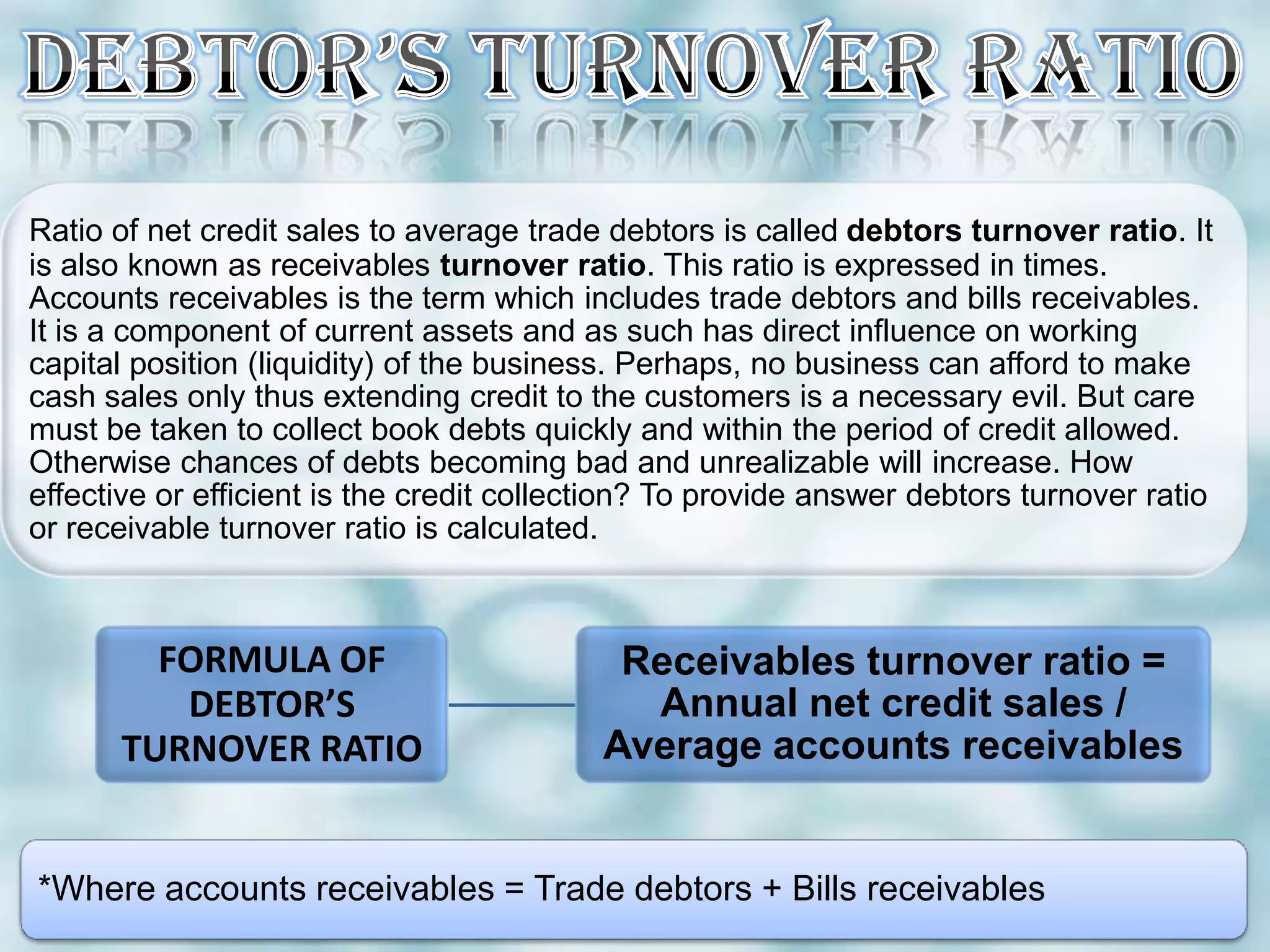
Ratio of net credit sales to average trade debtors is called debtors turnover ratio. It
is also known as receivables turnover ratio. This ratio is expressed in times.
Accounts receivables is the term which includes trade debtors and bills receivables.
It is a component of current assets and as such has direct influence on working
capital position (liquidity) of the business. Perhaps, no business can afford to make
cash sales only thus extending credit to the customers is a necessary evil. But care
must be taken to collect book debts quickly and within the period of credit allowed.
Otherwise chances of debts becoming bad and unrealizable will increase. How
effective or efficient is the credit collection? To provide answer debtors turnover ratio
or receivable turnover ratio is calculated.


        FORMULA OF                          Receivables turnover ratio =
         DEBTOR’S                            Annual net credit sales /
      TURNOVER RATIO                       Average accounts receivables


*Where accounts receivables = Trade debtors + Bills receivables
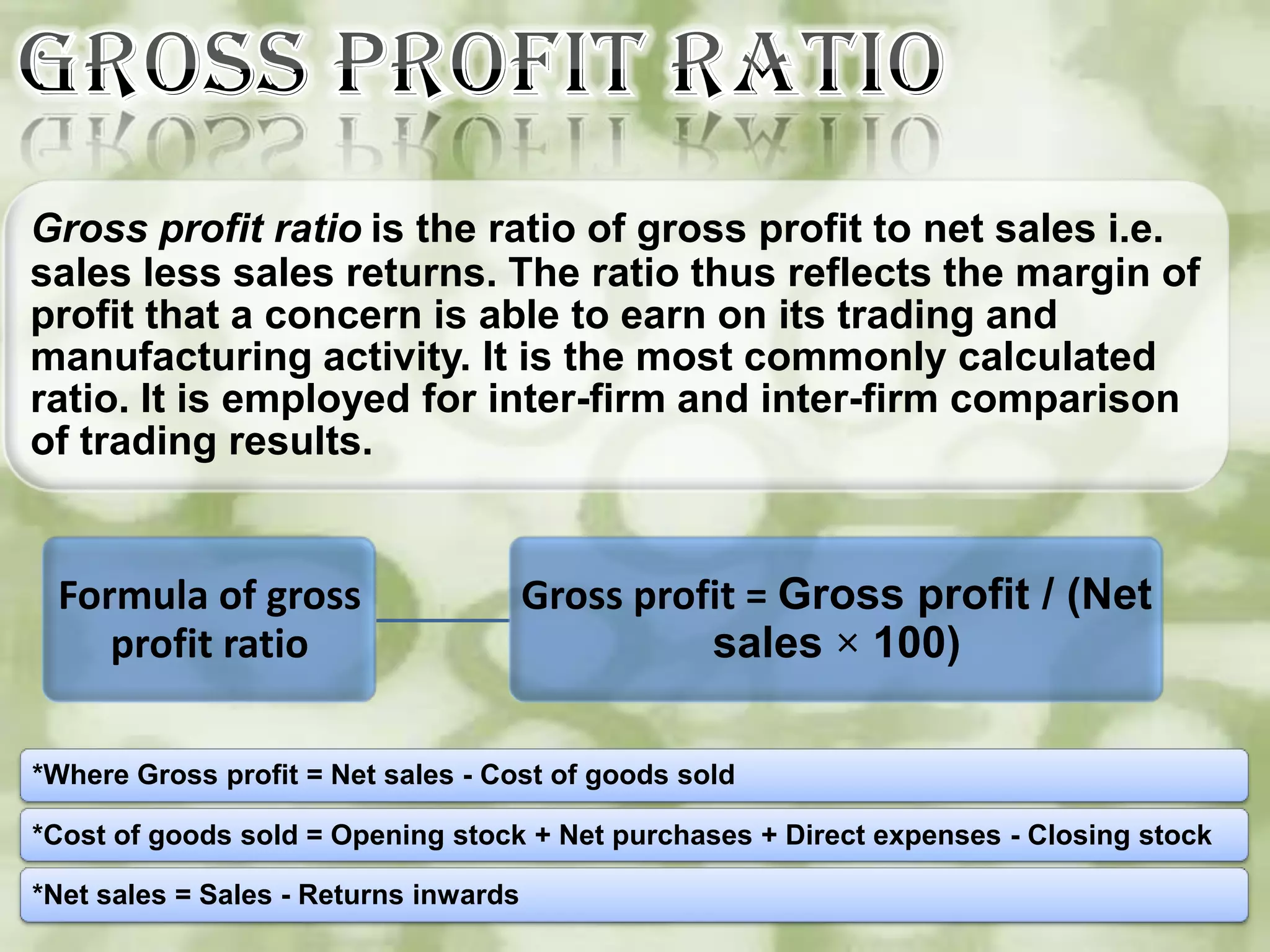
Gross profit ratio is the ratio of gross profit to net sales i.e.
sales less sales returns. The ratio thus reflects the margin of
profit that a concern is able to earn on its trading and
manufacturing activity. It is the most commonly calculated
ratio. It is employed for inter-firm and inter-firm comparison
of trading results.


 Formula of gross                      Gross profit = Gross profit / (Net
    profit ratio                                 sales × 100)

*Where Gross profit = Net sales - Cost of goods sold

*Cost of goods sold = Opening stock + Net purchases + Direct expenses - Closing stock

*Net sales = Sales - Returns inwards
The operating ratio is determined by
  comparing the cost of the goods sold
  and other operating expenses with net
  sales.

                                  Operating Ratio = [(Cost of goods
     Formula for                   sold + Operating expenses /
    Operating Ratio               Net sates)] × 100 OR Net sales -
                                            Gross profit
*Here cost of goods sold = Operating stock + Net purchases + Manufacturing
expenses - Closing stock
*Operating expenses = Office and administrative expenses + Selling and
distribution expenses
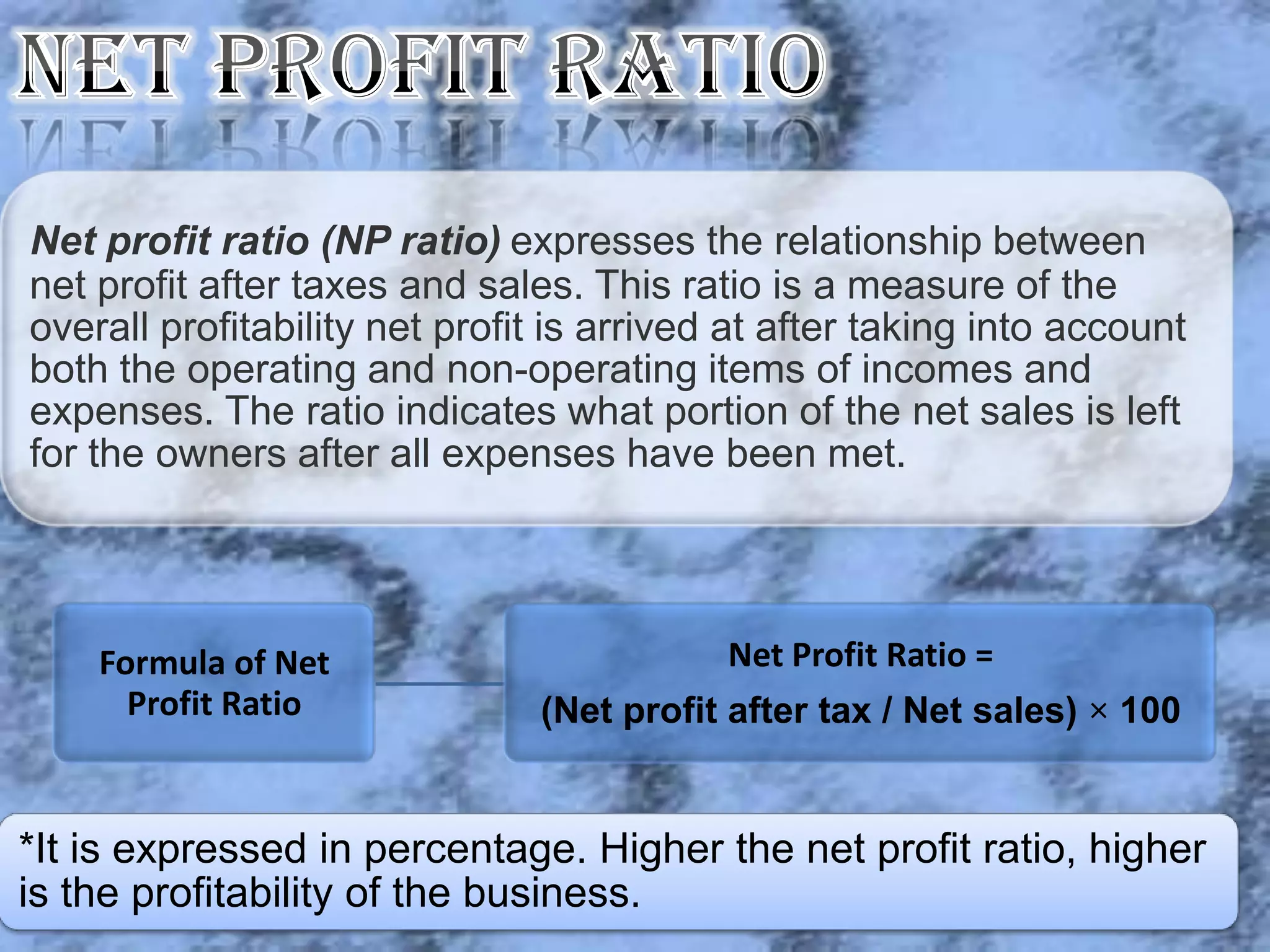
Net profit ratio (NP ratio) expresses the relationship between
net profit after taxes and sales. This ratio is a measure of the
overall profitability net profit is arrived at after taking into account
both the operating and non-operating items of incomes and
expenses. The ratio indicates what portion of the net sales is left
for the owners after all expenses have been met.


    Formula of Net                         Net Profit Ratio =
      Profit Ratio             (Net profit after tax / Net sales) × 100


*It is expressed in percentage. Higher the net profit ratio, higher
is the profitability of the business.
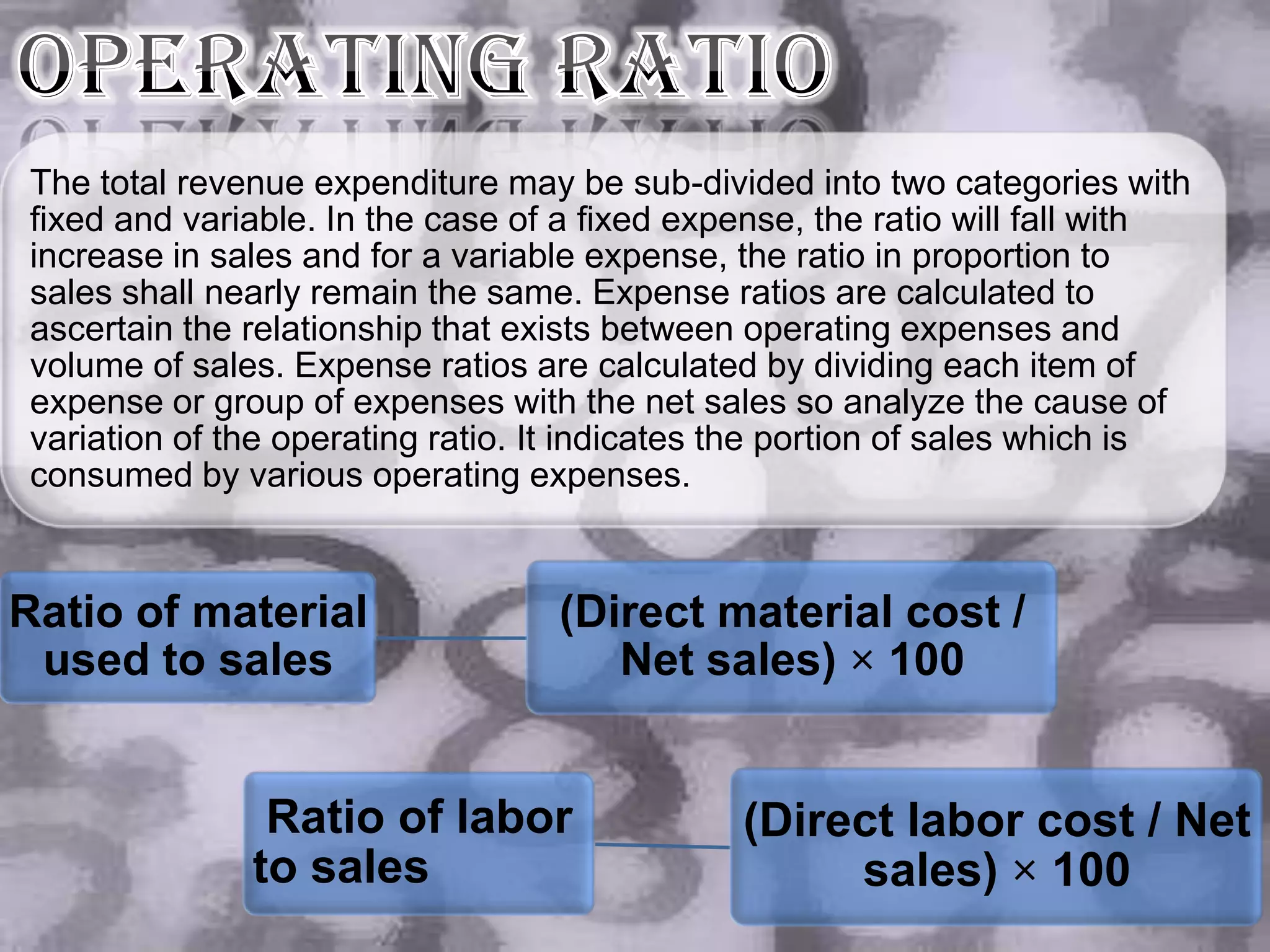
The total revenue expenditure may be sub-divided into two categories with
 fixed and variable. In the case of a fixed expense, the ratio will fall with
 increase in sales and for a variable expense, the ratio in proportion to
 sales shall nearly remain the same. Expense ratios are calculated to
 ascertain the relationship that exists between operating expenses and
 volume of sales. Expense ratios are calculated by dividing each item of
 expense or group of expenses with the net sales so analyze the cause of
 variation of the operating ratio. It indicates the portion of sales which is
 consumed by various operating expenses.


Ratio of material                  (Direct material cost /
 used to sales                        Net sales) × 100


                Ratio of labor                 (Direct labor cost / Net
               to sales                             sales) × 100
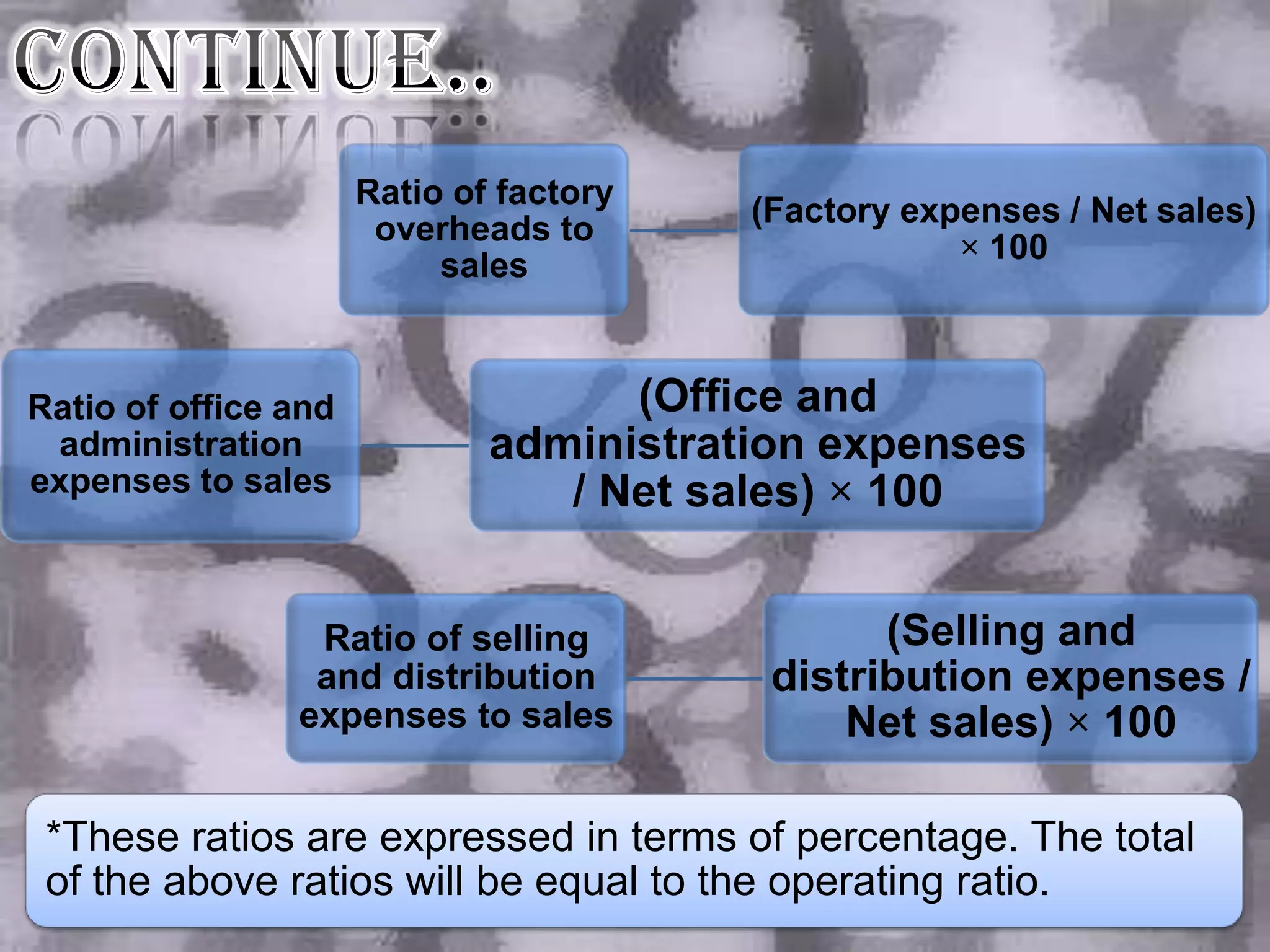
Ratio of factory
                                         (Factory expenses / Net sales)
                       overheads to
                                                     × 100
                           sales


Ratio of office and                 (Office and
 administration               administration expenses
expenses to sales                / Net sales) × 100


                 Ratio of selling               (Selling and
                 and distribution         distribution expenses /
                expenses to sales             Net sales) × 100

 *These ratios are expressed in terms of percentage. The total
 of the above ratios will be equal to the operating ratio.
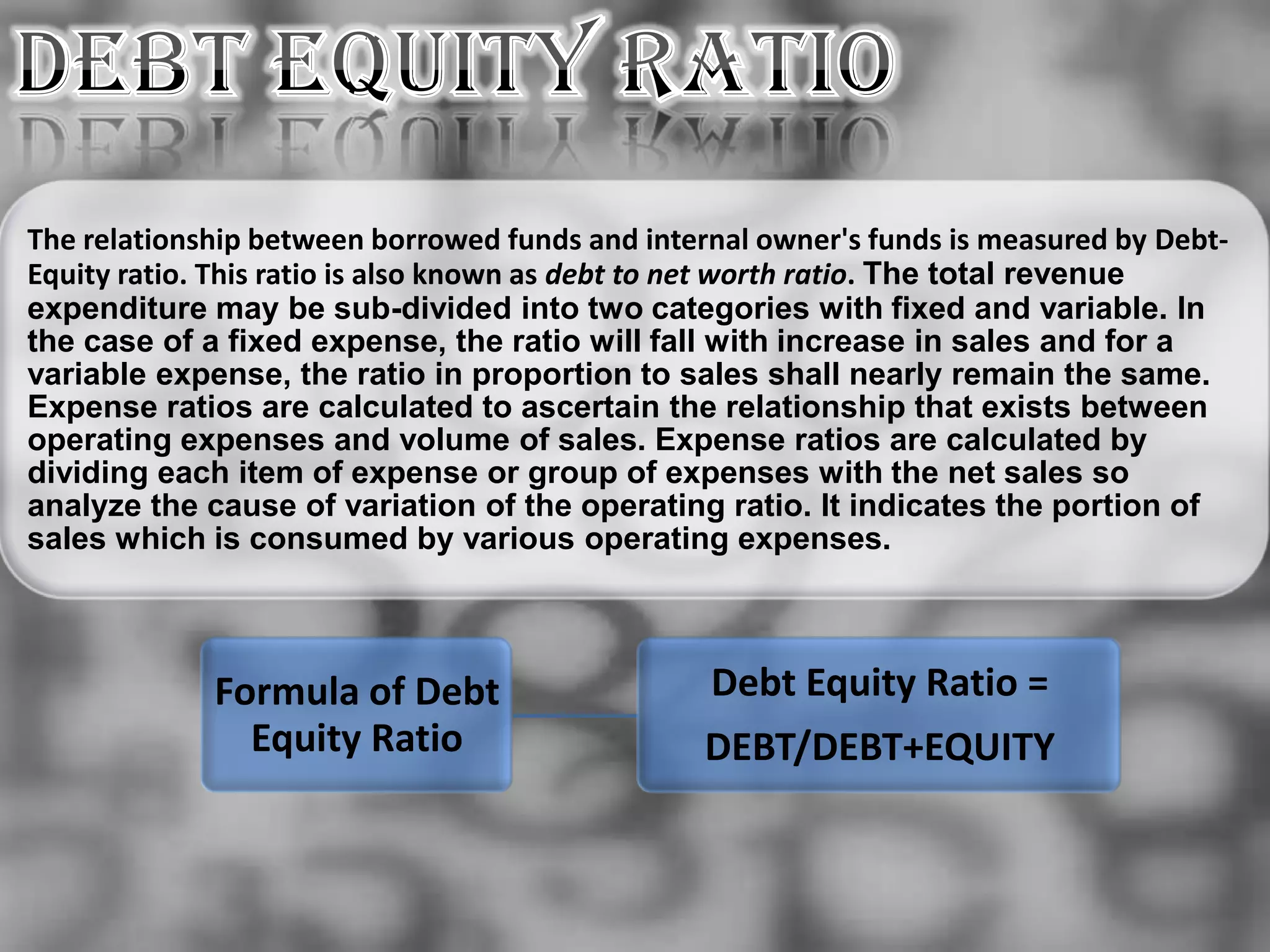
The relationship between borrowed funds and internal owner's funds is measured by Debt-
Equity ratio. This ratio is also known as debt to net worth ratio. The total revenue
expenditure may be sub-divided into two categories with fixed and variable. In
the case of a fixed expense, the ratio will fall with increase in sales and for a
variable expense, the ratio in proportion to sales shall nearly remain the same.
Expense ratios are calculated to ascertain the relationship that exists between
operating expenses and volume of sales. Expense ratios are calculated by
dividing each item of expense or group of expenses with the net sales so
analyze the cause of variation of the operating ratio. It indicates the portion of
sales which is consumed by various operating expenses.


             Formula of Debt                     Debt Equity Ratio =
               Equity Ratio                      DEBT/DEBT+EQUITY
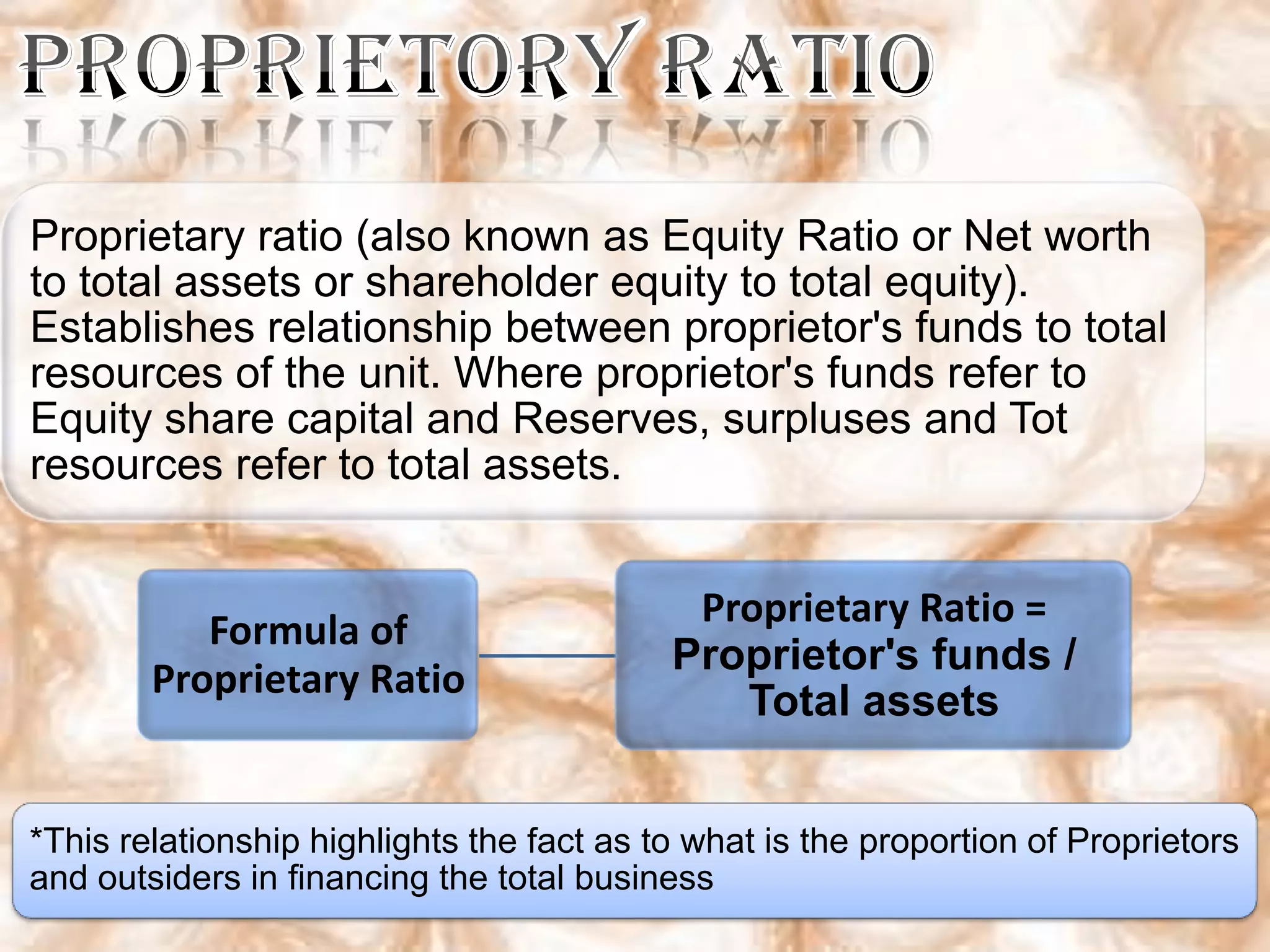
Proprietary ratio (also known as Equity Ratio or Net worth
to total assets or shareholder equity to total equity).
Establishes relationship between proprietor's funds to total
resources of the unit. Where proprietor's funds refer to
Equity share capital and Reserves, surpluses and Tot
resources refer to total assets.


                                            Proprietary Ratio =
           Formula of
                                           Proprietor's funds /
        Proprietary Ratio
                                              Total assets


*This relationship highlights the fact as to what is the proportion of Proprietors
and outsiders in financing the total business
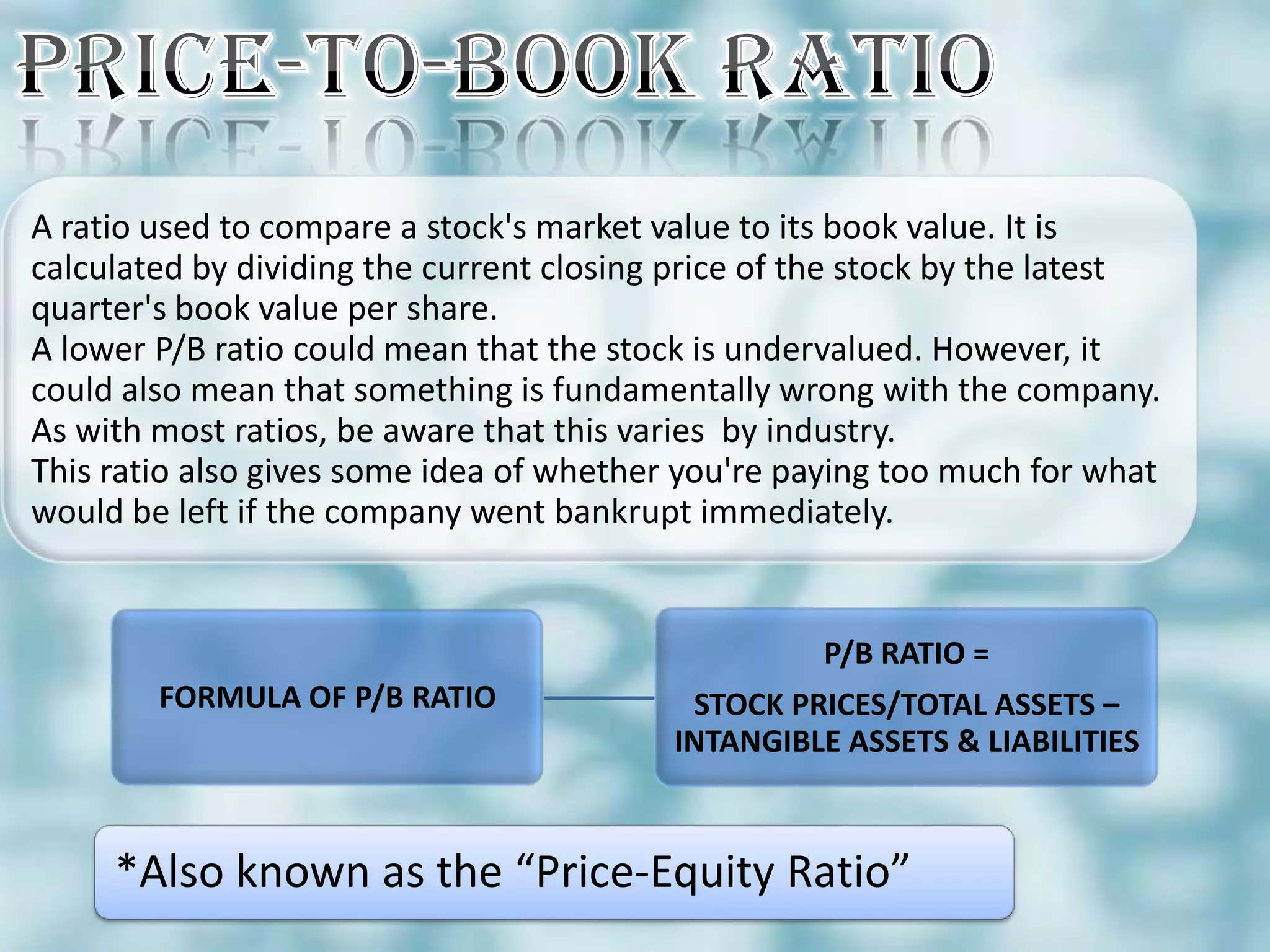
A ratio used to compare a stock's market value to its book value. It is
calculated by dividing the current closing price of the stock by the latest
quarter's book value per share.
A lower P/B ratio could mean that the stock is undervalued. However, it
could also mean that something is fundamentally wrong with the company.
As with most ratios, be aware that this varies by industry.
This ratio also gives some idea of whether you're paying too much for what
would be left if the company went bankrupt immediately.


                                                    P/B RATIO =
        FORMULA OF P/B RATIO               STOCK PRICES/TOTAL ASSETS –
                                          INTANGIBLE ASSETS & LIABILITIES


     *Also known as the “Price-Equity Ratio”
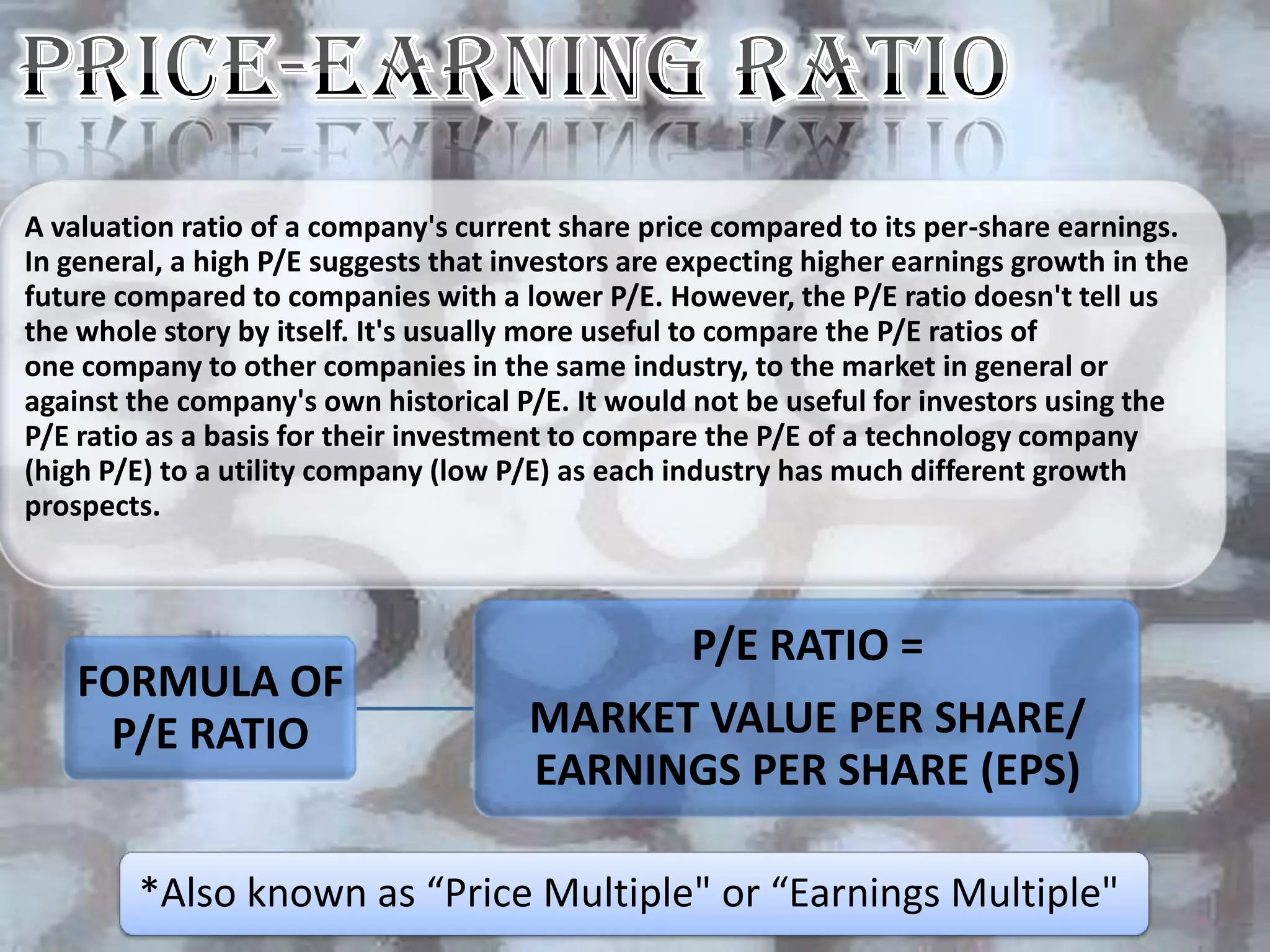
A valuation ratio of a company's current share price compared to its per-share earnings.
In general, a high P/E suggests that investors are expecting higher earnings growth in the
future compared to companies with a lower P/E. However, the P/E ratio doesn't tell us
the whole story by itself. It's usually more useful to compare the P/E ratios of
one company to other companies in the same industry, to the market in general or
against the company's own historical P/E. It would not be useful for investors using the
P/E ratio as a basis for their investment to compare the P/E of a technology company
(high P/E) to a utility company (low P/E) as each industry has much different growth
prospects.


                                                   P/E RATIO =
    FORMULA OF
     P/E RATIO                         MARKET VALUE PER SHARE/
                                       EARNINGS PER SHARE (EPS)

        *Also known as “Price Multiple" or “Earnings Multiple"
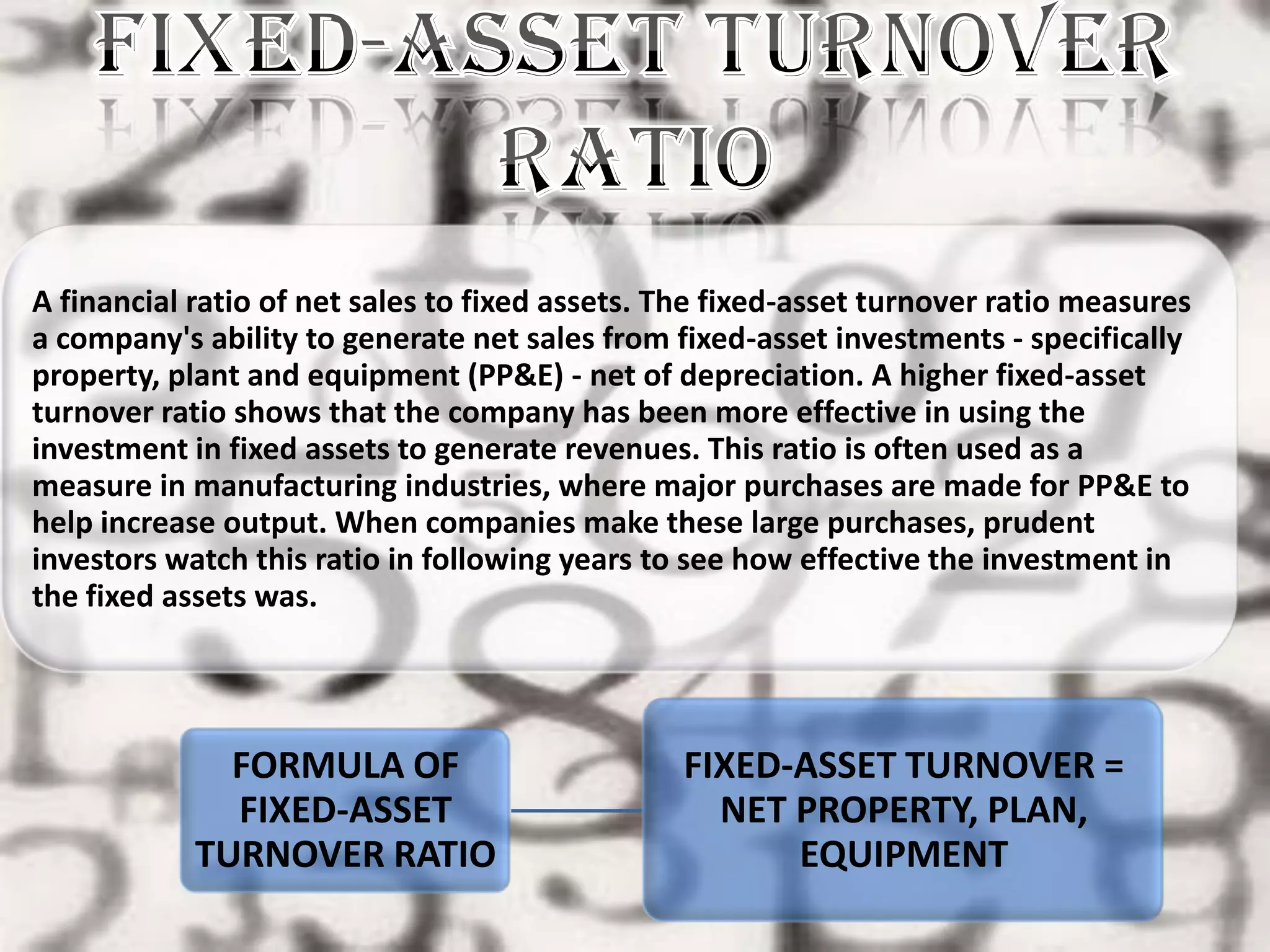
A financial ratio of net sales to fixed assets. The fixed-asset turnover ratio measures
a company's ability to generate net sales from fixed-asset investments - specifically
property, plant and equipment (PP&E) - net of depreciation. A higher fixed-asset
turnover ratio shows that the company has been more effective in using the
investment in fixed assets to generate revenues. This ratio is often used as a
measure in manufacturing industries, where major purchases are made for PP&E to
help increase output. When companies make these large purchases, prudent
investors watch this ratio in following years to see how effective the investment in
the fixed assets was.


              FORMULA OF                        FIXED-ASSET TURNOVER =
              FIXED-ASSET                         NET PROPERTY, PLAN,
            TURNOVER RATIO                            EQUIPMENT
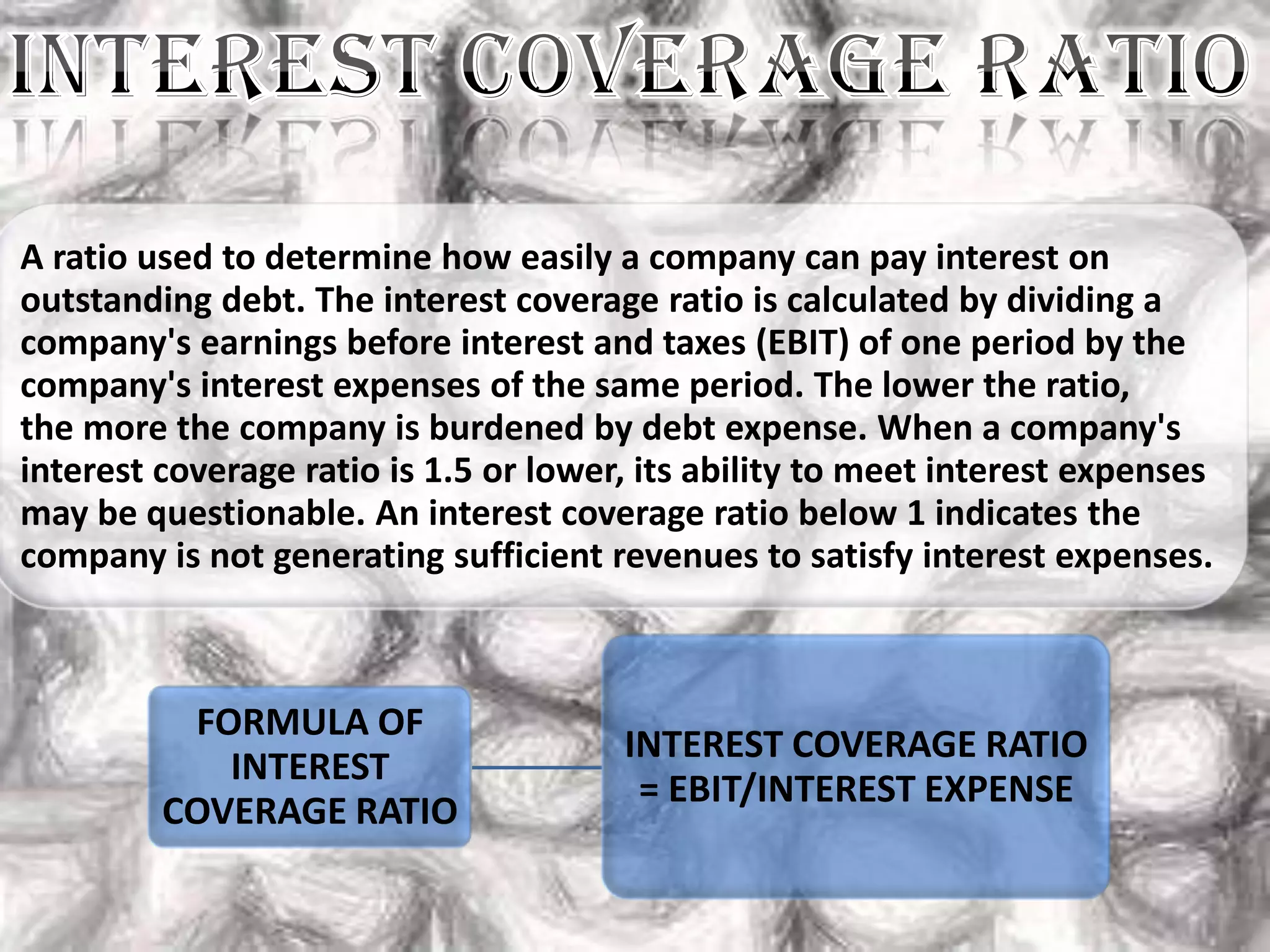
A ratio used to determine how easily a company can pay interest on
outstanding debt. The interest coverage ratio is calculated by dividing a
company's earnings before interest and taxes (EBIT) of one period by the
company's interest expenses of the same period. The lower the ratio,
the more the company is burdened by debt expense. When a company's
interest coverage ratio is 1.5 or lower, its ability to meet interest expenses
may be questionable. An interest coverage ratio below 1 indicates the
company is not generating sufficient revenues to satisfy interest expenses.


          FORMULA OF
                                       INTEREST COVERAGE RATIO
            INTEREST
                                        = EBIT/INTEREST EXPENSE
         COVERAGE RATIO
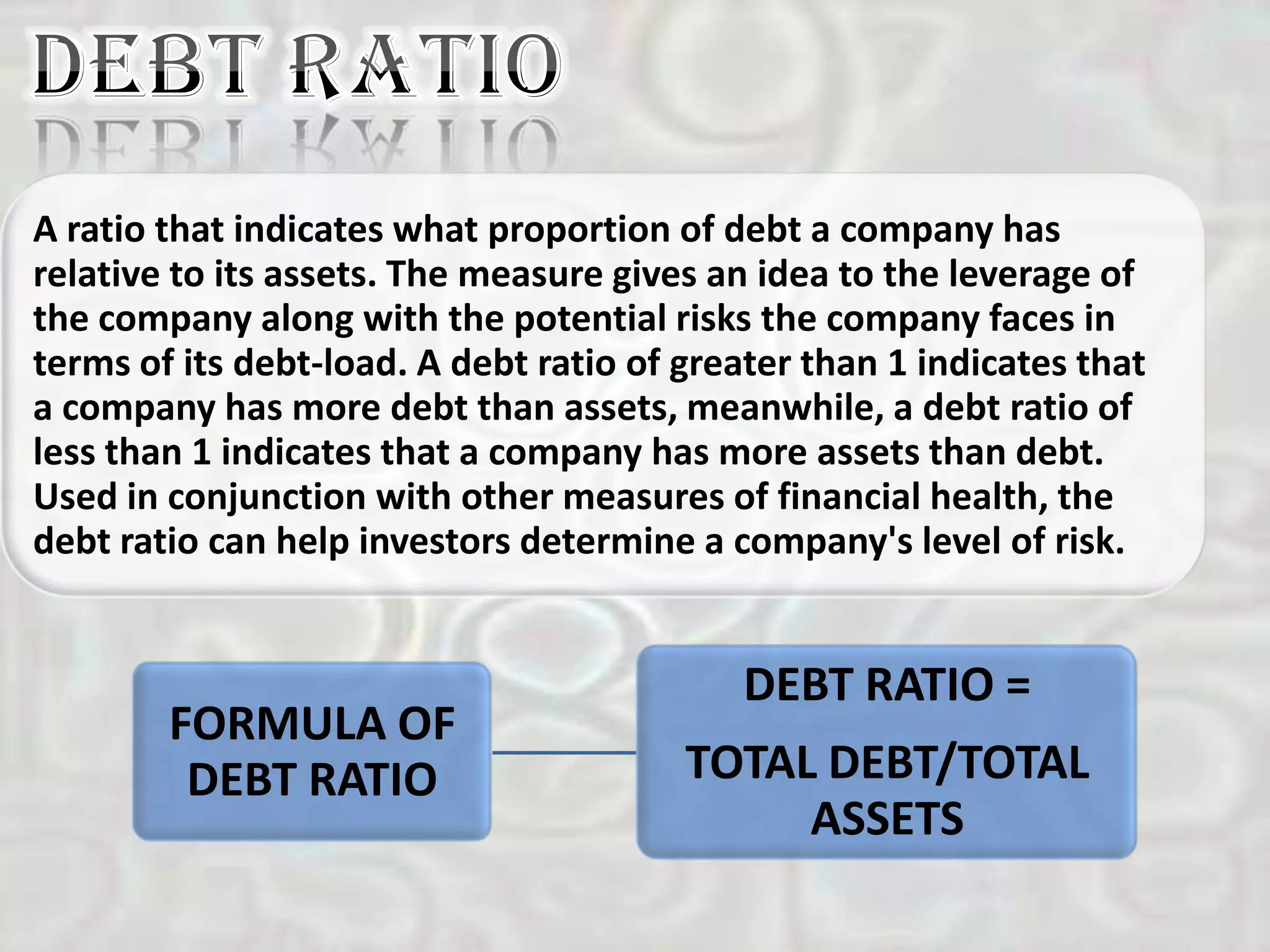
A ratio that indicates what proportion of debt a company has
relative to its assets. The measure gives an idea to the leverage of
the company along with the potential risks the company faces in
terms of its debt-load. A debt ratio of greater than 1 indicates that
a company has more debt than assets, meanwhile, a debt ratio of
less than 1 indicates that a company has more assets than debt.
Used in conjunction with other measures of financial health, the
debt ratio can help investors determine a company's level of risk.


                                            DEBT RATIO =
        FORMULA OF
         DEBT RATIO                     TOTAL DEBT/TOTAL
                                             ASSETS
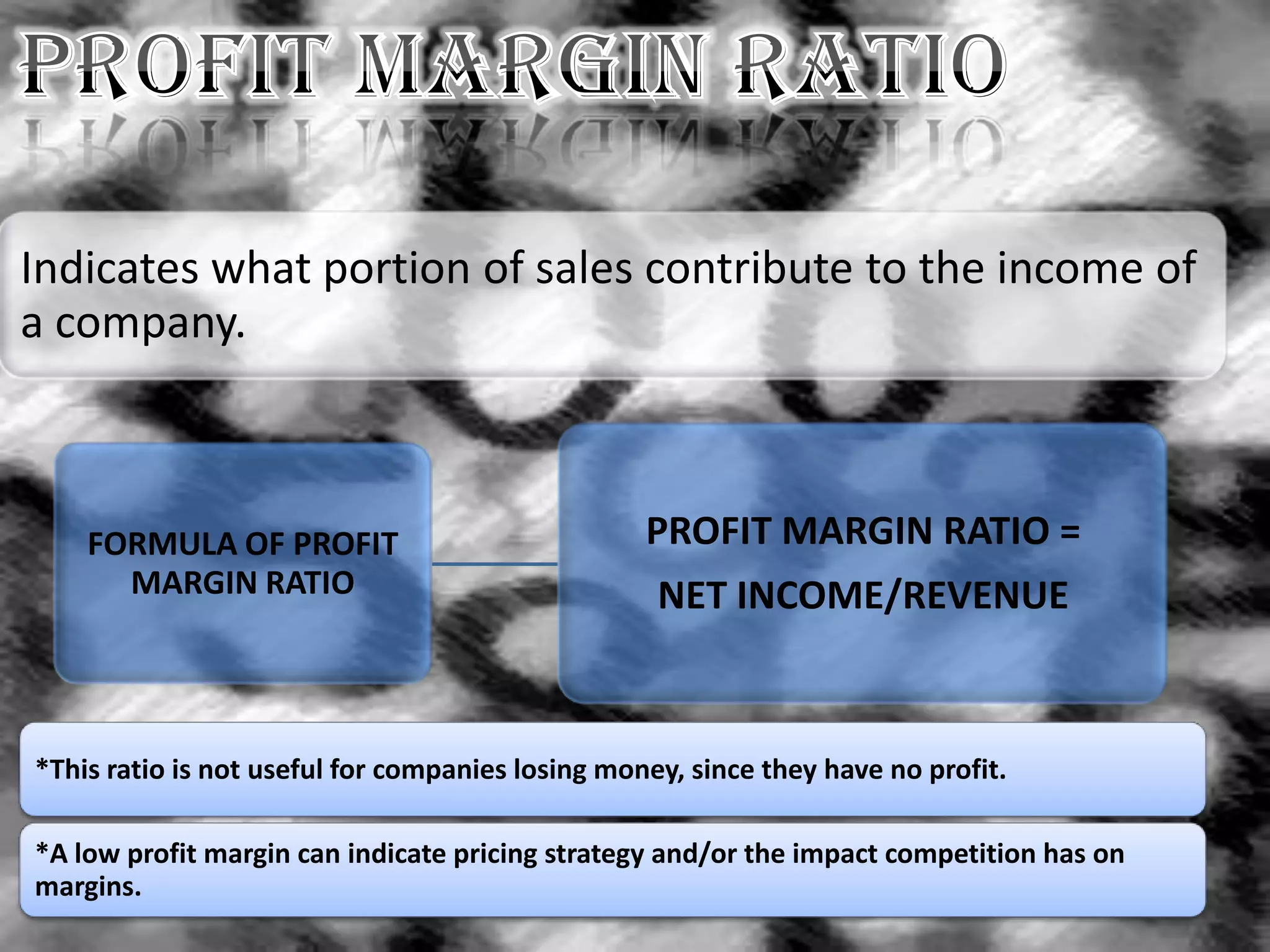
Indicates what portion of sales contribute to the income of
a company.


    FORMULA OF PROFIT                             PROFIT MARGIN RATIO =
      MARGIN RATIO                                 NET INCOME/REVENUE


*This ratio is not useful for companies losing money, since they have no profit.

*A low profit margin can indicate pricing strategy and/or the impact competition has on
margins.
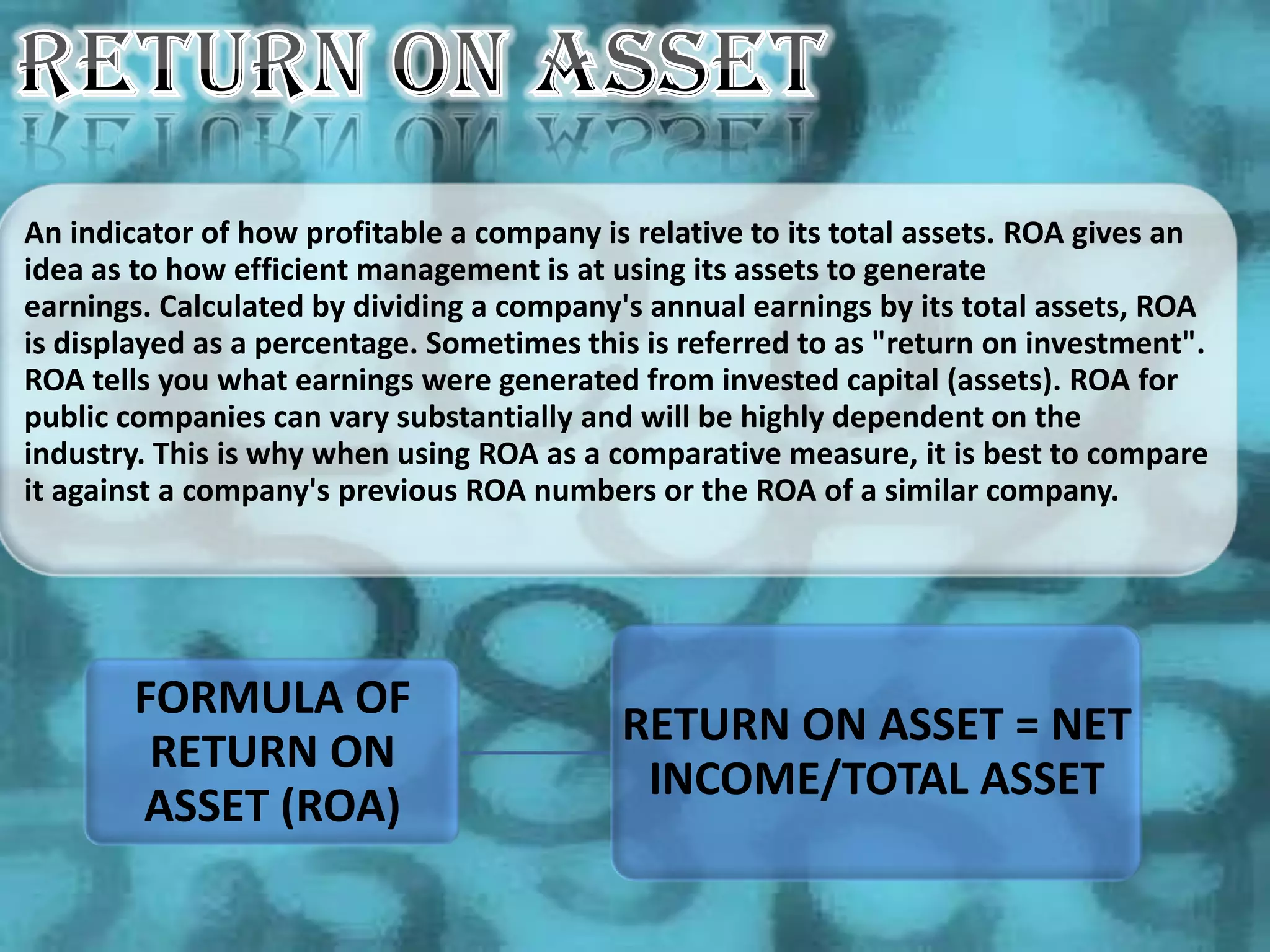
An indicator of how profitable a company is relative to its total assets. ROA gives an
idea as to how efficient management is at using its assets to generate
earnings. Calculated by dividing a company's annual earnings by its total assets, ROA
is displayed as a percentage. Sometimes this is referred to as "return on investment".
ROA tells you what earnings were generated from invested capital (assets). ROA for
public companies can vary substantially and will be highly dependent on the
industry. This is why when using ROA as a comparative measure, it is best to compare
it against a company's previous ROA numbers or the ROA of a similar company.


       FORMULA OF
                                           RETURN ON ASSET = NET
        RETURN ON
                                            INCOME/TOTAL ASSET
       ASSET (ROA)
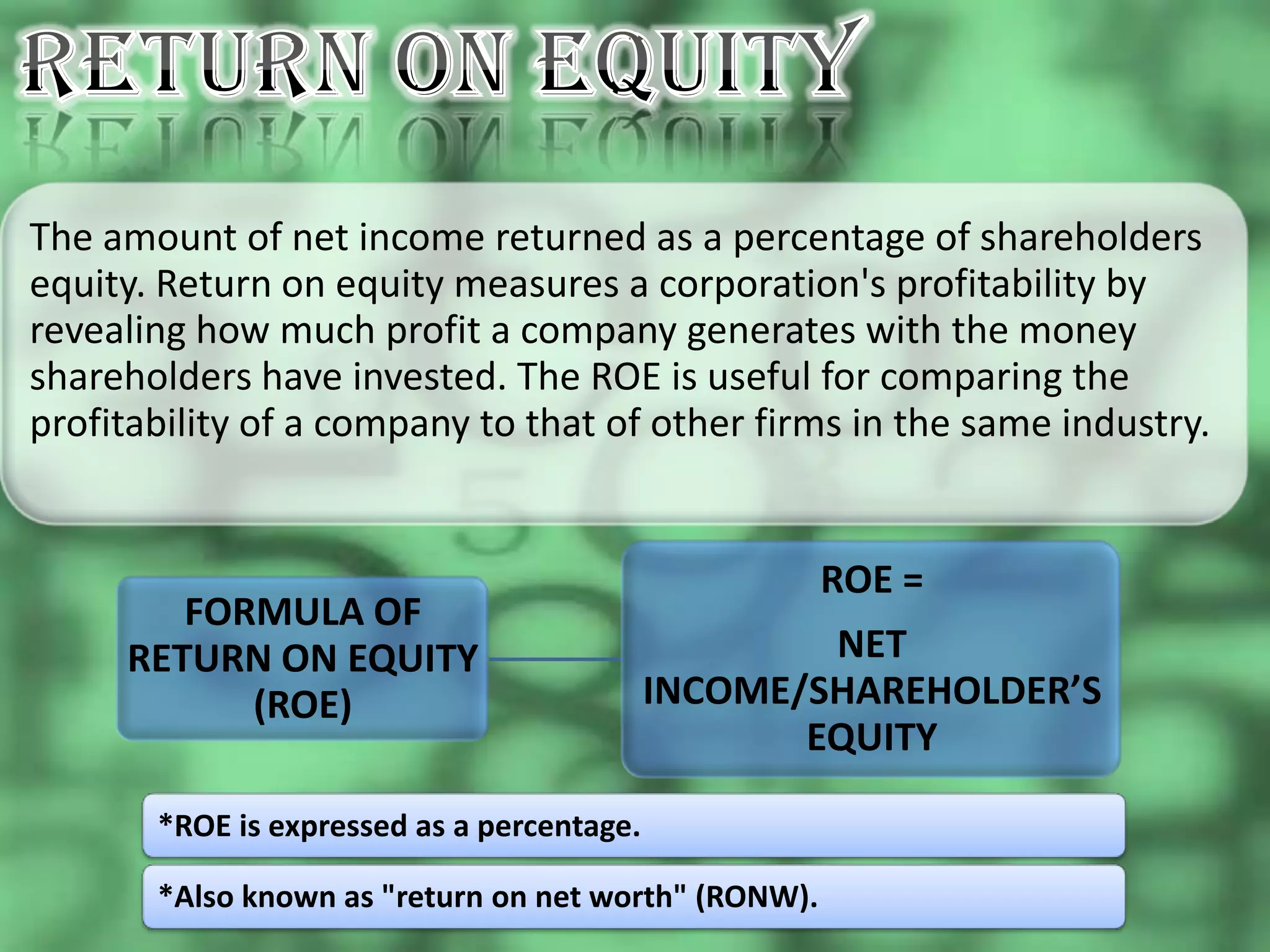
The amount of net income returned as a percentage of shareholders
equity. Return on equity measures a corporation's profitability by
revealing how much profit a company generates with the money
shareholders have invested. The ROE is useful for comparing the
profitability of a company to that of other firms in the same industry.


                                                      ROE =
        FORMULA OF
     RETURN ON EQUITY                               NET
           (ROE)                            INCOME/SHAREHOLDER’S
                                                   EQUITY

       *ROE is expressed as a percentage.

       *Also known as "return on net worth" (RONW).
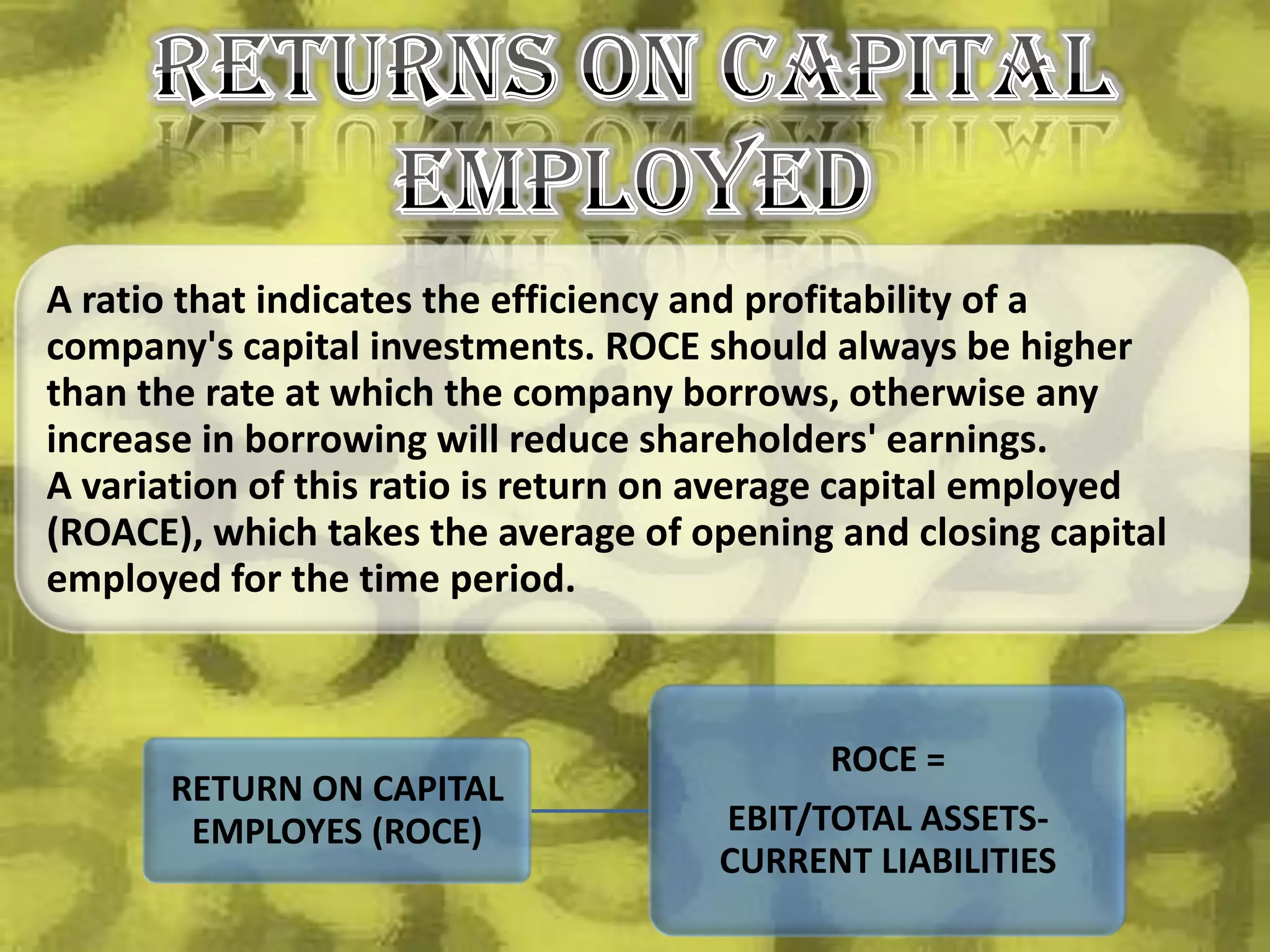
A ratio that indicates the efficiency and profitability of a
company's capital investments. ROCE should always be higher
than the rate at which the company borrows, otherwise any
increase in borrowing will reduce shareholders' earnings.
A variation of this ratio is return on average capital employed
(ROACE), which takes the average of opening and closing capital
employed for the time period.


                                            ROCE =
      RETURN ON CAPITAL
       EMPLOYES (ROCE)               EBIT/TOTAL ASSETS-
                                     CURRENT LIABILITIES
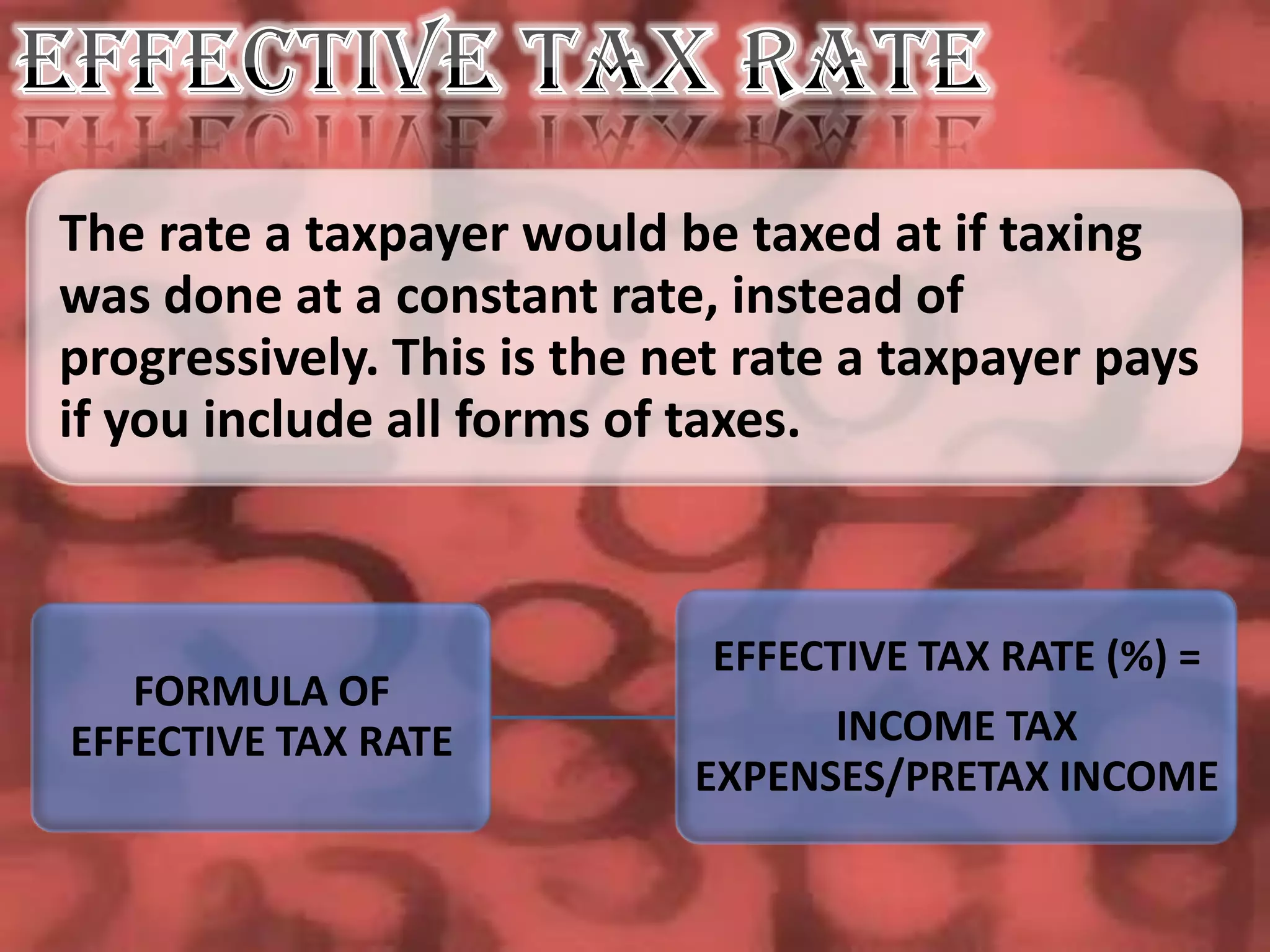
The rate a taxpayer would be taxed at if taxing
was done at a constant rate, instead of
progressively. This is the net rate a taxpayer pays
if you include all forms of taxes.


                             EFFECTIVE TAX RATE (%) =
   FORMULA OF
EFFECTIVE TAX RATE                INCOME TAX
                            EXPENSES/PRETAX INCOME
www.google.com


Wikipedia
Ratio analysis

Ratio analysis

  • 1.
  • 2.
    DEFINATION WHAT DO YOUMEAN BY RATION ANALYSIS ADVANTAGES & USES LIMITATIONS BIBLOGRAPHY
  • 3.
    According to Myers,“Ratio analysis of financial statements is a study of relationship among various financial factors in a business as disclosed by a single set of statements and a study of trend of these factors as shown in a series of statements.”
  • 4.
    A TOOL USEDBY INDIVIDUAL TO CONDUCT A QUANTITATIVE ANALYSIS OF INFORMATION ONE OF THE TECHNIQUE OF FINANCIAL ANALYSIS TO EVALUATE THE FINANCIAL CONDITION AND PERFORMANCE OF A BUSINESS CONCERN THE COMPARISION OF ONE FIGURE TO OTHER RELEVANT FIGURE OR FIGURES
  • 5.
    TO WORKOUT THEPROFITABILITY TO WORK THE SOLVENCY HELPFUL IN ANALYSIS OF FINANCIAL STATEMENT HELPFUL IN COMPARATIVE ANALYSIS OF THE PERFORMANCE TO SIMPLIFY THE ACCOUNTING INFORMATION TO WORKOUT THE OPERATING EFFICIENCY TO WORKOUT SHORT-TERM FINANCIAL POSITION HELPFUL FOR FORECASTING PURPOSES
  • 6.
    LIMITED COMPARABILITY FALSE RESULTS EFFECTOF PRICE LEVEL CHANGES QUALITATIVE FACTORS ARE IGNORED EFFECT OF WINDOW-DRESSING COSTLY TECHNIQUE MISLEADING RESULTS ABSENCE OF STANDARD UNVERSITY ACCEPTED TERMINOLOGY
  • 7.
    Current assets arethose which are usually converted into cash or consumed with in short period (say one year). Current liabilities are required to be paid in short period (say one year). Formula of Current ratio = Current assets Current Ratio: / current liabilities
  • 8.
    Quick ratio isalso known as liquid ratio or acid test ratio. Current ratio provides a rough idea of the liquidity of a firm so subsequently a second testing device was developed named as acid test ratio or quick ratio. It establishes relationship between liquid assets and current liabilities. In many businesses a significant proportion of current assets may comprise of inventory. Inventory, by nature, cannot be converted into ready cash abruptly. The term liquid assets does not include inventory. Quick ratio = Liquid Formula of (quick) assets / Current Quick ratio Liabilities *The term liquid or quick assets includes all the current assets minus inventory at prepaid expenses.
  • 9.
    Ratio of netcredit sales to average trade debtors is called debtors turnover ratio. It is also known as receivables turnover ratio. This ratio is expressed in times. Accounts receivables is the term which includes trade debtors and bills receivables. It is a component of current assets and as such has direct influence on working capital position (liquidity) of the business. Perhaps, no business can afford to make cash sales only thus extending credit to the customers is a necessary evil. But care must be taken to collect book debts quickly and within the period of credit allowed. Otherwise chances of debts becoming bad and unrealizable will increase. How effective or efficient is the credit collection? To provide answer debtors turnover ratio or receivable turnover ratio is calculated. FORMULA OF Receivables turnover ratio = DEBTOR’S Annual net credit sales / TURNOVER RATIO Average accounts receivables *Where accounts receivables = Trade debtors + Bills receivables
  • 10.
    Gross profit ratiois the ratio of gross profit to net sales i.e. sales less sales returns. The ratio thus reflects the margin of profit that a concern is able to earn on its trading and manufacturing activity. It is the most commonly calculated ratio. It is employed for inter-firm and inter-firm comparison of trading results. Formula of gross Gross profit = Gross profit / (Net profit ratio sales × 100) *Where Gross profit = Net sales - Cost of goods sold *Cost of goods sold = Opening stock + Net purchases + Direct expenses - Closing stock *Net sales = Sales - Returns inwards
  • 11.
    The operating ratiois determined by comparing the cost of the goods sold and other operating expenses with net sales. Operating Ratio = [(Cost of goods Formula for sold + Operating expenses / Operating Ratio Net sates)] × 100 OR Net sales - Gross profit *Here cost of goods sold = Operating stock + Net purchases + Manufacturing expenses - Closing stock *Operating expenses = Office and administrative expenses + Selling and distribution expenses
  • 12.
    Net profit ratio(NP ratio) expresses the relationship between net profit after taxes and sales. This ratio is a measure of the overall profitability net profit is arrived at after taking into account both the operating and non-operating items of incomes and expenses. The ratio indicates what portion of the net sales is left for the owners after all expenses have been met. Formula of Net Net Profit Ratio = Profit Ratio (Net profit after tax / Net sales) × 100 *It is expressed in percentage. Higher the net profit ratio, higher is the profitability of the business.
  • 13.
    The total revenueexpenditure may be sub-divided into two categories with fixed and variable. In the case of a fixed expense, the ratio will fall with increase in sales and for a variable expense, the ratio in proportion to sales shall nearly remain the same. Expense ratios are calculated to ascertain the relationship that exists between operating expenses and volume of sales. Expense ratios are calculated by dividing each item of expense or group of expenses with the net sales so analyze the cause of variation of the operating ratio. It indicates the portion of sales which is consumed by various operating expenses. Ratio of material (Direct material cost / used to sales Net sales) × 100 Ratio of labor (Direct labor cost / Net to sales sales) × 100
  • 14.
    Ratio of factory (Factory expenses / Net sales) overheads to × 100 sales Ratio of office and (Office and administration administration expenses expenses to sales / Net sales) × 100 Ratio of selling (Selling and and distribution distribution expenses / expenses to sales Net sales) × 100 *These ratios are expressed in terms of percentage. The total of the above ratios will be equal to the operating ratio.
  • 15.
    The relationship betweenborrowed funds and internal owner's funds is measured by Debt- Equity ratio. This ratio is also known as debt to net worth ratio. The total revenue expenditure may be sub-divided into two categories with fixed and variable. In the case of a fixed expense, the ratio will fall with increase in sales and for a variable expense, the ratio in proportion to sales shall nearly remain the same. Expense ratios are calculated to ascertain the relationship that exists between operating expenses and volume of sales. Expense ratios are calculated by dividing each item of expense or group of expenses with the net sales so analyze the cause of variation of the operating ratio. It indicates the portion of sales which is consumed by various operating expenses. Formula of Debt Debt Equity Ratio = Equity Ratio DEBT/DEBT+EQUITY
  • 16.
    Proprietary ratio (alsoknown as Equity Ratio or Net worth to total assets or shareholder equity to total equity). Establishes relationship between proprietor's funds to total resources of the unit. Where proprietor's funds refer to Equity share capital and Reserves, surpluses and Tot resources refer to total assets. Proprietary Ratio = Formula of Proprietor's funds / Proprietary Ratio Total assets *This relationship highlights the fact as to what is the proportion of Proprietors and outsiders in financing the total business
  • 17.
    A ratio usedto compare a stock's market value to its book value. It is calculated by dividing the current closing price of the stock by the latest quarter's book value per share. A lower P/B ratio could mean that the stock is undervalued. However, it could also mean that something is fundamentally wrong with the company. As with most ratios, be aware that this varies by industry. This ratio also gives some idea of whether you're paying too much for what would be left if the company went bankrupt immediately. P/B RATIO = FORMULA OF P/B RATIO STOCK PRICES/TOTAL ASSETS – INTANGIBLE ASSETS & LIABILITIES *Also known as the “Price-Equity Ratio”
  • 18.
    A valuation ratioof a company's current share price compared to its per-share earnings. In general, a high P/E suggests that investors are expecting higher earnings growth in the future compared to companies with a lower P/E. However, the P/E ratio doesn't tell us the whole story by itself. It's usually more useful to compare the P/E ratios of one company to other companies in the same industry, to the market in general or against the company's own historical P/E. It would not be useful for investors using the P/E ratio as a basis for their investment to compare the P/E of a technology company (high P/E) to a utility company (low P/E) as each industry has much different growth prospects. P/E RATIO = FORMULA OF P/E RATIO MARKET VALUE PER SHARE/ EARNINGS PER SHARE (EPS) *Also known as “Price Multiple" or “Earnings Multiple"
  • 19.
    A financial ratioof net sales to fixed assets. The fixed-asset turnover ratio measures a company's ability to generate net sales from fixed-asset investments - specifically property, plant and equipment (PP&E) - net of depreciation. A higher fixed-asset turnover ratio shows that the company has been more effective in using the investment in fixed assets to generate revenues. This ratio is often used as a measure in manufacturing industries, where major purchases are made for PP&E to help increase output. When companies make these large purchases, prudent investors watch this ratio in following years to see how effective the investment in the fixed assets was. FORMULA OF FIXED-ASSET TURNOVER = FIXED-ASSET NET PROPERTY, PLAN, TURNOVER RATIO EQUIPMENT
  • 20.
    A ratio usedto determine how easily a company can pay interest on outstanding debt. The interest coverage ratio is calculated by dividing a company's earnings before interest and taxes (EBIT) of one period by the company's interest expenses of the same period. The lower the ratio, the more the company is burdened by debt expense. When a company's interest coverage ratio is 1.5 or lower, its ability to meet interest expenses may be questionable. An interest coverage ratio below 1 indicates the company is not generating sufficient revenues to satisfy interest expenses. FORMULA OF INTEREST COVERAGE RATIO INTEREST = EBIT/INTEREST EXPENSE COVERAGE RATIO
  • 21.
    A ratio thatindicates what proportion of debt a company has relative to its assets. The measure gives an idea to the leverage of the company along with the potential risks the company faces in terms of its debt-load. A debt ratio of greater than 1 indicates that a company has more debt than assets, meanwhile, a debt ratio of less than 1 indicates that a company has more assets than debt. Used in conjunction with other measures of financial health, the debt ratio can help investors determine a company's level of risk. DEBT RATIO = FORMULA OF DEBT RATIO TOTAL DEBT/TOTAL ASSETS
  • 22.
    Indicates what portionof sales contribute to the income of a company. FORMULA OF PROFIT PROFIT MARGIN RATIO = MARGIN RATIO NET INCOME/REVENUE *This ratio is not useful for companies losing money, since they have no profit. *A low profit margin can indicate pricing strategy and/or the impact competition has on margins.
  • 23.
    An indicator ofhow profitable a company is relative to its total assets. ROA gives an idea as to how efficient management is at using its assets to generate earnings. Calculated by dividing a company's annual earnings by its total assets, ROA is displayed as a percentage. Sometimes this is referred to as "return on investment". ROA tells you what earnings were generated from invested capital (assets). ROA for public companies can vary substantially and will be highly dependent on the industry. This is why when using ROA as a comparative measure, it is best to compare it against a company's previous ROA numbers or the ROA of a similar company. FORMULA OF RETURN ON ASSET = NET RETURN ON INCOME/TOTAL ASSET ASSET (ROA)
  • 24.
    The amount ofnet income returned as a percentage of shareholders equity. Return on equity measures a corporation's profitability by revealing how much profit a company generates with the money shareholders have invested. The ROE is useful for comparing the profitability of a company to that of other firms in the same industry. ROE = FORMULA OF RETURN ON EQUITY NET (ROE) INCOME/SHAREHOLDER’S EQUITY *ROE is expressed as a percentage. *Also known as "return on net worth" (RONW).
  • 25.
    A ratio thatindicates the efficiency and profitability of a company's capital investments. ROCE should always be higher than the rate at which the company borrows, otherwise any increase in borrowing will reduce shareholders' earnings. A variation of this ratio is return on average capital employed (ROACE), which takes the average of opening and closing capital employed for the time period. ROCE = RETURN ON CAPITAL EMPLOYES (ROCE) EBIT/TOTAL ASSETS- CURRENT LIABILITIES
  • 26.
    The rate ataxpayer would be taxed at if taxing was done at a constant rate, instead of progressively. This is the net rate a taxpayer pays if you include all forms of taxes. EFFECTIVE TAX RATE (%) = FORMULA OF EFFECTIVE TAX RATE INCOME TAX EXPENSES/PRETAX INCOME
  • 27.