Ratio Analysis
By. Dr. Bhavik R. Shah
[M.Com, M.Ed, M.Phil, Ph.D]
9898462148
Ratio analysis
 Is a method or process by which the
relationship of items or groups of items in the
financial statements are computed, and
presented.
 Is an important tool of financial analysis.
 Is used to interpret the financial statements so
that the strengths and weaknesses of a firm, its
historical performance and current financial
condition can be determined.
Ratio
 ‘A mathematical yardstick that measures
the relationship between two figures or
groups of figures which are related to
each other and are mutually inter-
dependent’.
 It can be expressed as a pure ratio,
percentage, or as a rate
Words of caution
 A ratio is not an end in itself. They are only a
means to get to know the financial position of
an enterprise.
 Computing ratios does not add any information
to the available figures.
 It only reveals the relationship in a more
meaningful way so as to enable us to draw
conclusions there from.
Utility of Ratios
 Accounting ratios are very useful in
assessing the financial position and
profitability of an enterprise.
 However its utility lies in comparison of
the ratios.
Utility of Ratios
 Comparison may be in any one of the following
forms:
 For the same enterprise over a number of years
 For two enterprises in the same industry
 For one enterprise against the industry as a whole
 For one enterprise against a pre-determined standard
 For inter-segment comparison within the same
organisation
Classification of Ratios
Ratios can be broadly classified into four groups
namely:
 Liquidity ratios
 Capital structure/leverage ratios
 Profitability ratios
 Activity ratios
Liquidity ratios
These ratios analyse the short-term financial
position of a firm and indicate the ability of the firm
to meet its short-term commitments (current
liabilities) out of its short-term resources (current
assets).
These are also known as ‘solvency ratios’. The
ratios which indicate the liquidity of a firm are:
 Current ratio
 Liquidity ratio or Quick ratio or acid test ratio
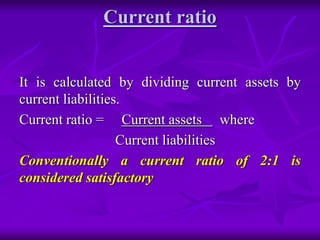
Current ratio
It is calculated by dividing current assets by
current liabilities.
Current ratio = Current assets where
Current liabilities
Conventionally a current ratio of 2:1 is
considered satisfactory
CURRENT ASSETS
include –
Inventories of raw material, WIP, finished goods,
stores and spares,
sundry debtors/receivables,
short term loans deposits and advances,
cash in hand and bank,
prepaid expenses,
incomes receivables and
marketable investments and short term securities.
CURRENT LIABILITIES
include –
sundry creditors/bills payable,
outstanding expenses,
unclaimed dividend,
advances received,
incomes received in advance,
provision for taxation,
proposed dividend,
instalments of loans payable within 12 months,
bank overdraft and cash credit
Quick Ratio or Acid Test Ratio
This is a ratio between quick current assets and current
liabilities (alternatively quick liabilities).
It is calculated by dividing quick current assets by
current liabilities (quick current liabilities)
Quick ratio = quick assets where
Current liabilities/(quick liabilities)
Conventionally a quick ratio of 1:1 is considered
satisfactory.
QUICK ASSETS & QUICK
LIABILITIES
QUICK ASSETS are current assets (as stated
earlier)
less prepaid expenses and inventories.
QUICK LIABILITIES are current liabilities (as
stated earlier)
less bank overdraft and incomes received in
advance.
Capital structure/ leverage ratios
These ratios indicate the long term solvency
of a firm and indicate the ability of the firm
to meet its long-term commitment with
respect to
(i) repayment of principal on maturity or in
predetermined instalments at due dates and
(ii) periodic payment of interest during the
period of the loan.
Capital structure/ leverage ratios
The different ratios are:
 Debt equity ratio
 Proprietary ratio
 Debt to total capital ratio
 Interest coverage ratio
 Debt service coverage ratio
Debt equity ratio
This ratio indicates the relative proportion of debt and
equity in financing the assets of the firm. It is
calculated by dividing long-term debt by shareholder’s
funds.
Debt equity ratio = long-term debts where
Shareholders funds
Generally, financial institutions favour a ratio of 2:1.
However this standard should be applied having regard
to size and type and nature of business and the degree of
risk involved.
LONG-TERM FUNDS are long-term loans whether
secured or unsecured like – debentures, bonds, loans
from financial institutions etc.
SHAREHOLDER’S FUNDS are equity share
capital plus preference share capital plus reserves and
surplus minus fictitious assets (eg. Preliminary
expenses, past accumulated losses, discount on issue
of shares etc.)
Proprietary ratio
This ratio indicates the general financial strength of the
firm and the long- term solvency of the business.
This ratio is calculated by dividing proprietor’s funds by
total funds.
Proprietary ratio = proprietor’s funds where
Total funds/assets
As a rough guide a 65% to 75% proprietary ratio is
advisable
PROPRIETOR’S FUNDS are same as
explained in shareholder’s funds
TOTAL FUNDS are all fixed assets and all
current assets.
Alternatively it can be calculated as
proprietor’s funds plus long-term funds plus
current liabilities.
Debt to total capital ratio
In this ratio the outside liabilities are related to
the total capitalisation of the firm. It indicates
what proportion of the permanent capital of the
firm is in the form of long-term debt.
Debt to total capital ratio =long- term debt
Shareholder’s funds + long- term debt
Conventionally a ratio of 2/3 is considered
satisfactory.
Interest coverage ratio
This ratio measures the debt servicing capacity of a firm
in so far as the fixed interest on long-term loan is
concerned. It shows how many times the interest
charges are covered by EBIT out of which they will be
paid.
Interest coverage ratio = EBIT
Interest
A ratio of 6 to 7 times is considered satisfactory.
Higher the ratio greater the ability of the firm to pay
interest out of its profits. But too high a ratio may
imply lesser use of debt and/or very efficient operations
Debt service coverage ratio
This is a more comprehensive measure to compute the
debt servicing capacity of a firm. It shows how many
times the total debt service obligations consisting of
interest and repayment of principal in instalments are
covered by the total operating funds after payment of
tax.
Debt service coverage ratio =
EAT+ interest + depreciation + other non-cash exp
Interest + principal instalment
EAT is earnings after tax.
Generally financial institutions consider 2:1 as a
satisfactory ratio.
Profitability ratios
These ratios measure the operating efficiency of
the firm and its ability to ensure adequate returns
to its shareholders.
The profitability of a firm can be measured by its
profitability ratios.
Further the profitability ratios can be determined
(i) in relation to sales and
(ii) in relation to investments
Profitability ratios
Profitability ratios in relation to sales:
 gross profit margin
 Net profit margin
 Expenses ratio
Profitability ratios
Profitability ratios in relation to investments
 Return on assets (ROA)
 Return on capital employed (ROCE)
 Return on shareholder’s equity (ROE)
 Earnings per share (EPS)
 Dividend per share (DPS)
 Dividend payout ratio (D/P)
 Price earning ratio (P/E)
Gross profit margin
This ratio is calculated by dividing gross
profit by sales. It is expressed as a percentage.
Gross profit is the result of relationship
between prices, sales volume and costs.
Gross profit margin = gross profit x 100
Net sales
Gross profit margin
 A firm should have a reasonable gross profit
margin to ensure coverage of its operating
expenses and ensure adequate return to the
owners of the business ie. the shareholders.
 To judge whether the ratio is satisfactory or
not, it should be compared with the firm’s past
ratios or with the ratio of similar firms in the
same industry or with the industry average.
Net profit margin
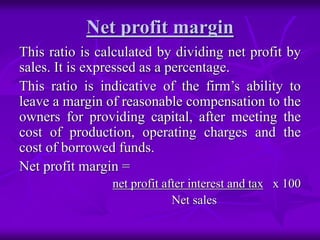
This ratio is calculated by dividing net profit by
sales. It is expressed as a percentage.
This ratio is indicative of the firm’s ability to
leave a margin of reasonable compensation to the
owners for providing capital, after meeting the
cost of production, operating charges and the
cost of borrowed funds.
Net profit margin =
net profit after interest and tax x 100
Net sales
Net profit margin
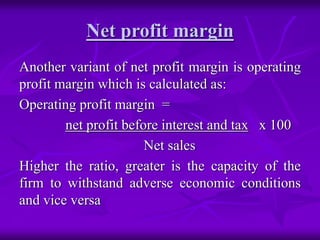
Another variant of net profit margin is operating
profit margin which is calculated as:
Operating profit margin =
net profit before interest and tax x 100
Net sales
Higher the ratio, greater is the capacity of the
firm to withstand adverse economic conditions
and vice versa
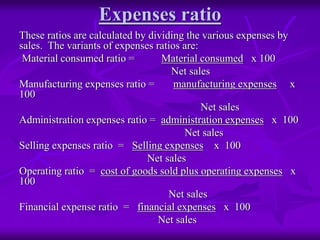
Expenses ratio
These ratios are calculated by dividing the various expenses by
sales. The variants of expenses ratios are:
Material consumed ratio = Material consumed x 100
Net sales
Manufacturing expenses ratio = manufacturing expenses x
100
Net sales
Administration expenses ratio = administration expenses x 100
Net sales
Selling expenses ratio = Selling expenses x 100
Net sales
Operating ratio = cost of goods sold plus operating expenses x
100
Net sales
Financial expense ratio = financial expenses x 100
Net sales
Expenses ratio
The expenses ratios should be compared over a
period of time with the industry average as
well as with the ratios of firms of similar type.
A low expenses ratio is favourable.
The implication of a high ratio is that only a
small percentage share of sales is available for
meeting financial liabilities like interest, tax,
dividend etc.
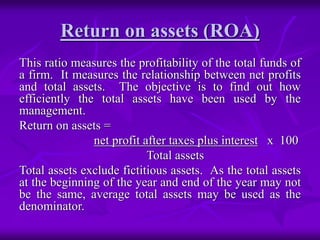
Return on assets (ROA)
This ratio measures the profitability of the total funds of
a firm. It measures the relationship between net profits
and total assets. The objective is to find out how
efficiently the total assets have been used by the
management.
Return on assets =
net profit after taxes plus interest x 100
Total assets
Total assets exclude fictitious assets. As the total assets
at the beginning of the year and end of the year may not
be the same, average total assets may be used as the
denominator.
Return on capital employed (ROCE)
This ratio measures the relationship between net profit and capital
employed. It indicates how efficiently the long-term funds of
owners and creditors are being used.
Return on capital employed =
net profit after taxes plus interest x 100
Capital employed
CAPITAL EMPLOYED denotes shareholders funds and long-
term borrowings.
To have a fair representation of the capital employed, average
capital employed may be used as the denominator.
Return on shareholders equity
This ratio measures the relationship of profits to
owner’s funds. Shareholders fall into two groups
i.e. preference shareholders and equity
shareholders. So the variants of return on
shareholders equity are
Return on total shareholder’s equity =
net profits after taxes x 100
Total shareholders equity
.
 TOTAL SHAREHOLDER’S EQUITY
includes preference share capital plus equity
share capital plus reserves and surplus less
accumulated losses and fictitious assets. To
have a fair representation of the total
shareholders funds, average total shareholders
funds may be used as the denominator
Return on ordinary shareholders equity =
net profit after taxes – pref. dividend x 100
Ordinary shareholders equity or net worth
ORDINARY SHAREHOLDERS EQUITY
OR NET WORTH includes equity share capital
plus reserves and surplus minus fictitious assets.
Earnings per share (EPS)
This ratio measures the profit available to the
equity shareholders on a per share basis. This
ratio is calculated by dividing net profit available
to equity shareholders by the number of equity
shares.
Earnings per share =
net profit after tax – preference dividend
Number of equity shares
Dividend per share (DPS)
This ratio shows the dividend paid to the
shareholder on a per share basis. This is a better
indicator than the EPS as it shows the amount of
dividend received by the ordinary shareholders,
while EPS merely shows theoretically how much
belongs to the ordinary shareholders
Dividend per share =
Dividend paid to ordinary shareholders
Number of equity shares
Dividend payout ratio (D/P)
This ratio measures the relationship between the
earnings belonging to the ordinary shareholders and the
dividend paid to them.
Dividend pay out ratio =
total dividend paid to ordinary shareholders x 100
Net profit after tax –preference dividend
OR
Dividend pay out ratio = Dividend per share x 100
Earnings per share
Price earning ratio (P/E)
This ratio is computed by dividing the market
price of the shares by the earnings per share. It
measures the expectations of the investors and
market appraisal of the performance of the firm.
Price earning ratio = market price per share
Earnings per share
Activity ratios
These ratios are also called efficiency ratios / asset
utilization ratios or turnover ratios. These ratios
show the relationship between sales and various
assets of a firm. The various ratios under this group
are:
 Inventory/stock turnover ratio
 Debtors turnover ratio and average collection
period
 Asset turnover ratio
 Creditors turnover ratio and average credit
period
Inventory /stock turnover ratio
This ratio indicates the number of times inventory is
replaced during the year. It measures the relationship
between cost of goods sold and the inventory level.
There are two approaches for calculating this ratio,
namely:
Inventory turnover ratio = cost of goods sold
Average stock
AVERAGE STOCK can be calculated as
Opening stock + closing stock
2
Alternatively
Inventory turnover ratio = sales_________
Closing inventory
Inventory /stock turnover ratio
A firm should have neither too high nor too
low inventory turnover ratio. Too high a ratio
may indicate very low level of inventory and a
danger of being out of stock and incurring high
‘stock out cost’. On the contrary too low a
ratio is indicative of excessive inventory
entailing excessive carrying cost.
Debtors turnover ratio and average
collection period
This ratio is a test of the liquidity of the debtors
of a firm. It shows the relationship between
credit sales and debtors.
Debtors turnover ratio =
Credit sales
Average Debtors and bills receivables
Average collection period =
Months/days in a year
Debtors turnover
Debtors turnover ratio and average
collection period
These ratios are indicative of the efficiency of
the trade credit management. A high turnover
ratio and shorter collection period indicate
prompt payment by the debtor. On the
contrary low turnover ratio and longer
collection period indicates delayed payments
by the debtor.
In general a high debtor turnover ratio and
short collection period is preferable.
Asset turnover ratio
Depending on the different concepts of assets employed, there are
many variants of this ratio. These ratios measure the efficiency
of a firm in managing and utilising its assets.
Total asset turnover ratio = sales/cost of goods sold
Average total assets
Fixed asset turnover ratio = sales/cost of goods sold
Average fixed assets
Capital turnover ratio = sales/cost of goods sold
Average capital employed
Working capital turnover ratio = sales/cost of goods sold
Net working capital
Asset turnover ratio
Higher ratios are indicative of efficient
management and utilisation of resources while
low ratios are indicative of under-utilisation of
resources and presence of idle capacity.
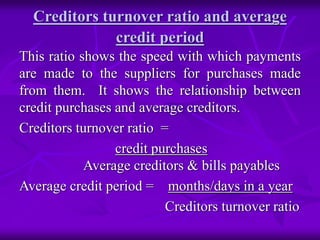
Creditors turnover ratio and average
credit period
This ratio shows the speed with which payments
are made to the suppliers for purchases made
from them. It shows the relationship between
credit purchases and average creditors.
Creditors turnover ratio =
credit purchases
Average creditors & bills payables
Average credit period = months/days in a year
Creditors turnover ratio
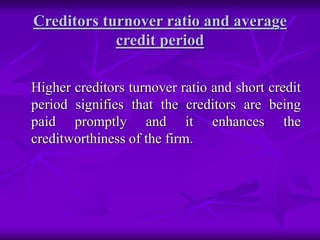
Creditors turnover ratio and average
credit period
Higher creditors turnover ratio and short credit
period signifies that the creditors are being
paid promptly and it enhances the
creditworthiness of the firm.

Ratio analysis

  • 1.
    Ratio Analysis By. Dr.Bhavik R. Shah [M.Com, M.Ed, M.Phil, Ph.D] 9898462148
  • 2.
    Ratio analysis  Isa method or process by which the relationship of items or groups of items in the financial statements are computed, and presented.  Is an important tool of financial analysis.  Is used to interpret the financial statements so that the strengths and weaknesses of a firm, its historical performance and current financial condition can be determined.
  • 3.
    Ratio  ‘A mathematicalyardstick that measures the relationship between two figures or groups of figures which are related to each other and are mutually inter- dependent’.  It can be expressed as a pure ratio, percentage, or as a rate
  • 4.
    Words of caution A ratio is not an end in itself. They are only a means to get to know the financial position of an enterprise.  Computing ratios does not add any information to the available figures.  It only reveals the relationship in a more meaningful way so as to enable us to draw conclusions there from.
  • 5.
    Utility of Ratios Accounting ratios are very useful in assessing the financial position and profitability of an enterprise.  However its utility lies in comparison of the ratios.
  • 6.
    Utility of Ratios Comparison may be in any one of the following forms:  For the same enterprise over a number of years  For two enterprises in the same industry  For one enterprise against the industry as a whole  For one enterprise against a pre-determined standard  For inter-segment comparison within the same organisation
  • 7.
    Classification of Ratios Ratioscan be broadly classified into four groups namely:  Liquidity ratios  Capital structure/leverage ratios  Profitability ratios  Activity ratios
  • 8.
    Liquidity ratios These ratiosanalyse the short-term financial position of a firm and indicate the ability of the firm to meet its short-term commitments (current liabilities) out of its short-term resources (current assets). These are also known as ‘solvency ratios’. The ratios which indicate the liquidity of a firm are:  Current ratio  Liquidity ratio or Quick ratio or acid test ratio
  • 9.
    Current ratio It iscalculated by dividing current assets by current liabilities. Current ratio = Current assets where Current liabilities Conventionally a current ratio of 2:1 is considered satisfactory
  • 10.
    CURRENT ASSETS include – Inventoriesof raw material, WIP, finished goods, stores and spares, sundry debtors/receivables, short term loans deposits and advances, cash in hand and bank, prepaid expenses, incomes receivables and marketable investments and short term securities.
  • 11.
    CURRENT LIABILITIES include – sundrycreditors/bills payable, outstanding expenses, unclaimed dividend, advances received, incomes received in advance, provision for taxation, proposed dividend, instalments of loans payable within 12 months, bank overdraft and cash credit
  • 12.
    Quick Ratio orAcid Test Ratio This is a ratio between quick current assets and current liabilities (alternatively quick liabilities). It is calculated by dividing quick current assets by current liabilities (quick current liabilities) Quick ratio = quick assets where Current liabilities/(quick liabilities) Conventionally a quick ratio of 1:1 is considered satisfactory.
  • 13.
    QUICK ASSETS &QUICK LIABILITIES QUICK ASSETS are current assets (as stated earlier) less prepaid expenses and inventories. QUICK LIABILITIES are current liabilities (as stated earlier) less bank overdraft and incomes received in advance.
  • 14.
    Capital structure/ leverageratios These ratios indicate the long term solvency of a firm and indicate the ability of the firm to meet its long-term commitment with respect to (i) repayment of principal on maturity or in predetermined instalments at due dates and (ii) periodic payment of interest during the period of the loan.
  • 15.
    Capital structure/ leverageratios The different ratios are:  Debt equity ratio  Proprietary ratio  Debt to total capital ratio  Interest coverage ratio  Debt service coverage ratio
  • 16.
    Debt equity ratio Thisratio indicates the relative proportion of debt and equity in financing the assets of the firm. It is calculated by dividing long-term debt by shareholder’s funds. Debt equity ratio = long-term debts where Shareholders funds Generally, financial institutions favour a ratio of 2:1. However this standard should be applied having regard to size and type and nature of business and the degree of risk involved.
  • 17.
    LONG-TERM FUNDS arelong-term loans whether secured or unsecured like – debentures, bonds, loans from financial institutions etc. SHAREHOLDER’S FUNDS are equity share capital plus preference share capital plus reserves and surplus minus fictitious assets (eg. Preliminary expenses, past accumulated losses, discount on issue of shares etc.)
  • 18.
    Proprietary ratio This ratioindicates the general financial strength of the firm and the long- term solvency of the business. This ratio is calculated by dividing proprietor’s funds by total funds. Proprietary ratio = proprietor’s funds where Total funds/assets As a rough guide a 65% to 75% proprietary ratio is advisable
  • 19.
    PROPRIETOR’S FUNDS aresame as explained in shareholder’s funds TOTAL FUNDS are all fixed assets and all current assets. Alternatively it can be calculated as proprietor’s funds plus long-term funds plus current liabilities.
  • 20.
    Debt to totalcapital ratio In this ratio the outside liabilities are related to the total capitalisation of the firm. It indicates what proportion of the permanent capital of the firm is in the form of long-term debt. Debt to total capital ratio =long- term debt Shareholder’s funds + long- term debt Conventionally a ratio of 2/3 is considered satisfactory.
  • 21.
    Interest coverage ratio Thisratio measures the debt servicing capacity of a firm in so far as the fixed interest on long-term loan is concerned. It shows how many times the interest charges are covered by EBIT out of which they will be paid. Interest coverage ratio = EBIT Interest A ratio of 6 to 7 times is considered satisfactory. Higher the ratio greater the ability of the firm to pay interest out of its profits. But too high a ratio may imply lesser use of debt and/or very efficient operations
  • 22.
    Debt service coverageratio This is a more comprehensive measure to compute the debt servicing capacity of a firm. It shows how many times the total debt service obligations consisting of interest and repayment of principal in instalments are covered by the total operating funds after payment of tax. Debt service coverage ratio = EAT+ interest + depreciation + other non-cash exp Interest + principal instalment EAT is earnings after tax. Generally financial institutions consider 2:1 as a satisfactory ratio.
  • 23.
    Profitability ratios These ratiosmeasure the operating efficiency of the firm and its ability to ensure adequate returns to its shareholders. The profitability of a firm can be measured by its profitability ratios. Further the profitability ratios can be determined (i) in relation to sales and (ii) in relation to investments
  • 24.
    Profitability ratios Profitability ratiosin relation to sales:  gross profit margin  Net profit margin  Expenses ratio
  • 25.
    Profitability ratios Profitability ratiosin relation to investments  Return on assets (ROA)  Return on capital employed (ROCE)  Return on shareholder’s equity (ROE)  Earnings per share (EPS)  Dividend per share (DPS)  Dividend payout ratio (D/P)  Price earning ratio (P/E)
  • 26.
    Gross profit margin Thisratio is calculated by dividing gross profit by sales. It is expressed as a percentage. Gross profit is the result of relationship between prices, sales volume and costs. Gross profit margin = gross profit x 100 Net sales
  • 27.
    Gross profit margin A firm should have a reasonable gross profit margin to ensure coverage of its operating expenses and ensure adequate return to the owners of the business ie. the shareholders.  To judge whether the ratio is satisfactory or not, it should be compared with the firm’s past ratios or with the ratio of similar firms in the same industry or with the industry average.
  • 28.
    Net profit margin Thisratio is calculated by dividing net profit by sales. It is expressed as a percentage. This ratio is indicative of the firm’s ability to leave a margin of reasonable compensation to the owners for providing capital, after meeting the cost of production, operating charges and the cost of borrowed funds. Net profit margin = net profit after interest and tax x 100 Net sales
  • 29.
    Net profit margin Anothervariant of net profit margin is operating profit margin which is calculated as: Operating profit margin = net profit before interest and tax x 100 Net sales Higher the ratio, greater is the capacity of the firm to withstand adverse economic conditions and vice versa
  • 30.
    Expenses ratio These ratiosare calculated by dividing the various expenses by sales. The variants of expenses ratios are: Material consumed ratio = Material consumed x 100 Net sales Manufacturing expenses ratio = manufacturing expenses x 100 Net sales Administration expenses ratio = administration expenses x 100 Net sales Selling expenses ratio = Selling expenses x 100 Net sales Operating ratio = cost of goods sold plus operating expenses x 100 Net sales Financial expense ratio = financial expenses x 100 Net sales
  • 31.
    Expenses ratio The expensesratios should be compared over a period of time with the industry average as well as with the ratios of firms of similar type. A low expenses ratio is favourable. The implication of a high ratio is that only a small percentage share of sales is available for meeting financial liabilities like interest, tax, dividend etc.
  • 32.
    Return on assets(ROA) This ratio measures the profitability of the total funds of a firm. It measures the relationship between net profits and total assets. The objective is to find out how efficiently the total assets have been used by the management. Return on assets = net profit after taxes plus interest x 100 Total assets Total assets exclude fictitious assets. As the total assets at the beginning of the year and end of the year may not be the same, average total assets may be used as the denominator.
  • 33.
    Return on capitalemployed (ROCE) This ratio measures the relationship between net profit and capital employed. It indicates how efficiently the long-term funds of owners and creditors are being used. Return on capital employed = net profit after taxes plus interest x 100 Capital employed CAPITAL EMPLOYED denotes shareholders funds and long- term borrowings. To have a fair representation of the capital employed, average capital employed may be used as the denominator.
  • 34.
    Return on shareholdersequity This ratio measures the relationship of profits to owner’s funds. Shareholders fall into two groups i.e. preference shareholders and equity shareholders. So the variants of return on shareholders equity are Return on total shareholder’s equity = net profits after taxes x 100 Total shareholders equity .
  • 35.
     TOTAL SHAREHOLDER’SEQUITY includes preference share capital plus equity share capital plus reserves and surplus less accumulated losses and fictitious assets. To have a fair representation of the total shareholders funds, average total shareholders funds may be used as the denominator
  • 36.
    Return on ordinaryshareholders equity = net profit after taxes – pref. dividend x 100 Ordinary shareholders equity or net worth ORDINARY SHAREHOLDERS EQUITY OR NET WORTH includes equity share capital plus reserves and surplus minus fictitious assets.
  • 37.
    Earnings per share(EPS) This ratio measures the profit available to the equity shareholders on a per share basis. This ratio is calculated by dividing net profit available to equity shareholders by the number of equity shares. Earnings per share = net profit after tax – preference dividend Number of equity shares
  • 38.
    Dividend per share(DPS) This ratio shows the dividend paid to the shareholder on a per share basis. This is a better indicator than the EPS as it shows the amount of dividend received by the ordinary shareholders, while EPS merely shows theoretically how much belongs to the ordinary shareholders Dividend per share = Dividend paid to ordinary shareholders Number of equity shares
  • 39.
    Dividend payout ratio(D/P) This ratio measures the relationship between the earnings belonging to the ordinary shareholders and the dividend paid to them. Dividend pay out ratio = total dividend paid to ordinary shareholders x 100 Net profit after tax –preference dividend OR Dividend pay out ratio = Dividend per share x 100 Earnings per share
  • 40.
    Price earning ratio(P/E) This ratio is computed by dividing the market price of the shares by the earnings per share. It measures the expectations of the investors and market appraisal of the performance of the firm. Price earning ratio = market price per share Earnings per share
  • 41.
    Activity ratios These ratiosare also called efficiency ratios / asset utilization ratios or turnover ratios. These ratios show the relationship between sales and various assets of a firm. The various ratios under this group are:  Inventory/stock turnover ratio  Debtors turnover ratio and average collection period  Asset turnover ratio  Creditors turnover ratio and average credit period
  • 42.
    Inventory /stock turnoverratio This ratio indicates the number of times inventory is replaced during the year. It measures the relationship between cost of goods sold and the inventory level. There are two approaches for calculating this ratio, namely: Inventory turnover ratio = cost of goods sold Average stock AVERAGE STOCK can be calculated as Opening stock + closing stock 2 Alternatively Inventory turnover ratio = sales_________ Closing inventory
  • 43.
    Inventory /stock turnoverratio A firm should have neither too high nor too low inventory turnover ratio. Too high a ratio may indicate very low level of inventory and a danger of being out of stock and incurring high ‘stock out cost’. On the contrary too low a ratio is indicative of excessive inventory entailing excessive carrying cost.
  • 44.
    Debtors turnover ratioand average collection period This ratio is a test of the liquidity of the debtors of a firm. It shows the relationship between credit sales and debtors. Debtors turnover ratio = Credit sales Average Debtors and bills receivables Average collection period = Months/days in a year Debtors turnover
  • 45.
    Debtors turnover ratioand average collection period These ratios are indicative of the efficiency of the trade credit management. A high turnover ratio and shorter collection period indicate prompt payment by the debtor. On the contrary low turnover ratio and longer collection period indicates delayed payments by the debtor. In general a high debtor turnover ratio and short collection period is preferable.
  • 46.
    Asset turnover ratio Dependingon the different concepts of assets employed, there are many variants of this ratio. These ratios measure the efficiency of a firm in managing and utilising its assets. Total asset turnover ratio = sales/cost of goods sold Average total assets Fixed asset turnover ratio = sales/cost of goods sold Average fixed assets Capital turnover ratio = sales/cost of goods sold Average capital employed Working capital turnover ratio = sales/cost of goods sold Net working capital
  • 47.
    Asset turnover ratio Higherratios are indicative of efficient management and utilisation of resources while low ratios are indicative of under-utilisation of resources and presence of idle capacity.
  • 48.
    Creditors turnover ratioand average credit period This ratio shows the speed with which payments are made to the suppliers for purchases made from them. It shows the relationship between credit purchases and average creditors. Creditors turnover ratio = credit purchases Average creditors & bills payables Average credit period = months/days in a year Creditors turnover ratio
  • 49.
    Creditors turnover ratioand average credit period Higher creditors turnover ratio and short credit period signifies that the creditors are being paid promptly and it enhances the creditworthiness of the firm.