OFFICE PRODUCTIVITY 2
FINAL ACTIVITIES STATUS /
DESIGN THINKING PROCESS
MICHAEL NOEL TOLENTINO
FINAL ACTIVITIES
STATUS REPORT
- STATUS
- CONTRIBUTIONS
DESIGN THINKING
PROCESS
The design thinking process is a
problem-solving methodology used by
designers to approach complex
problems and find innovative
solutions
DESIGN THINKING PROCESS
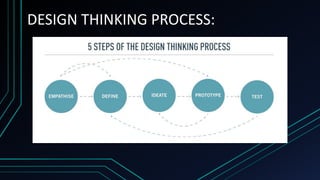
DESIGN THINKING PROCESS:
VALUE OF THE DESIGN
THINKING PROCESS
What is the value of the Design
Thinking process?
• The Design Thinking process teaches people how to innovate
and problem-solve: While most of us are programmed to solve
problems that readily present themselves, we’re not necessarily
inclined to go looking for problems.
Design Thinking encourages creative problem-solving; it pushes you
to redefine the problem space and seek out the challenge that’s really
worth solving. This is especially useful in a business context—
whether it’s designing a competitive digital product, optimizing internal
processes, or reinventing an entire business model.
What is the value of the Design
Thinking process?
• The Design Thinking process fosters teamwork and
collaboration: “innovations and answers to complex
questions are best generated in a heterogeneous team
of five to six people.” The Design Thinking process
brings multidisciplinary teams together, breaks down
silos, and encourages people to collaborate and
challenge their assumptions.
What is the value of the Design
Thinking process?
• The Design Thinking process offers a proven competitive
advantage: Design-led companies have been shown to
consistently outperform their competitors. As already
mentioned, the aim of the Design Thinking process is to come
up with solutions, products, or services that are desirable for the
user, economically viable from a business perspective, and
technologically feasible. This user-first approach coupled with
early and frequent testing helps to minimize risk, drive customer
engagement, and ultimately boost the bottom line.
1. Empathize
• The Design Thinking process starts with empathy. In order to create
desirable products and services, you need to understand who your
users are and what they need. What are their expectations in relation to
the product you’re designing? What challenges and pain-points do they
face within this context?
• During the empathize phase, you’ll spend time observing and
engaging with real users (or people who represent your target group)—
conducting interviews, seeing how they interact with an existing
product, and generally paying attention to facial expressions and body
language.
• As the first step in the Design Thinking process, the empathize phase
encourages you to set your assumptions aside. Armed with first-hand
insights, you’ll be able to design with real users in mind. That’s what
2. Define
• In the second stage of the Design Thinking process, you’ll define the
user problem that you want to solve. First, you’ll gather all of your
findings from the empathize phase and start piecing them together.
What common themes and patterns did you observe? What user needs
and challenges consistently came up?
• Once you’ve synthesized your findings, you’ll formulate what’s known
as a problem statement. A problem statement—sometimes called a
point of view (POV) statement—outlines the issue or challenge that you
will seek to address.
• By the end of the define phase, you will have a clear problem
statement which will guide you throughout the design process. This will
form the basis of your ideas and potential solutions.
3. Ideate
• The third stage in the Design Thinking process consists of ideation—or
generating ideas. By this point, you know who your target users are and
what they want from your product. You also have a clear problem statement
that you’re hoping to solve. Now it’s time to come up with possible
solutions.
• The ideation phase is a judgement-free zone where the group is
encouraged to venture away from the norm, to explore new angles, and to
think outside the box. You’ll hold ideation sessions in order to generate as
many ideas as possible—regardless of whether or not they’re feasible! For
maximum creativity, ideation sessions are often held in unusual locations.
• Throughout this stage of the Design Thinking process, you’ll continuously
refer back to your problem statement. As you prepare to move on to the
next phase, you’ll narrow it down to a few ideas which you’ll later turn into
4. Prototype
• In the fourth stage of the Design Thinking process, you’ll turn your
ideas from stage three into prototypes. A prototype is essentially a
scaled-down version of a product or feature—be it a simple paper model
or a more interactive digital representation.
• The aim of the prototyping stage is to turn your ideas into something
tangible which can be tested on real users. This is crucial in maintaining
a user-centric approach, allowing you to gather feedback before you go
ahead and develop the whole product. This ensures that the final design
actually solves the user’s problem and is a delight to use!
5. Test
• The fifth step in the Design Thinking process is dedicated to testing:
putting your prototypes in front of real users and seeing how they get on.
During the testing phase, you’ll observe your target users—or
representative users—as they interact with your prototype. You’ll also
gather feedback on how your users felt throughout the process.
• The testing phase will quickly highlight any design flaws that need to be
addressed. Based on what you learn through user testing, you’ll go back
and make improvements. Remember: The Design Thinking process is
iterative and non-linear. The results of the testing phase will often require
you to revisit the empathize stage or run through a few more ideation
sessions before you create that winning prototype.
OFFICE PRODUCTIVITY 2
FINAL EXAMINATION
PREPARATION
ASSIGNMENT
- CREATE 20 QUESTIONS COVERING:
- PROMOTIONAL DOCUMENTS
- PROMOTIONAL MATERIALS CREATION
- NEWSLETTER CREATION
- DESIGN CONCEPT
- DESIGN PHILOSOPHY
- DESIGN THINKING PROCESS
OFFICE PRODUCTIVITY 2
FINAL ACITIVITIES STATUS /
DESIGN THINKING PROCESS
MICHAEL NOEL TOLENTINO

FINAL PROJECT STATUS and DESIGN THINKING PROCESS.pptx

  • 1.
    OFFICE PRODUCTIVITY 2 FINALACTIVITIES STATUS / DESIGN THINKING PROCESS MICHAEL NOEL TOLENTINO
  • 2.
  • 3.
  • 4.
  • 5.
    The design thinkingprocess is a problem-solving methodology used by designers to approach complex problems and find innovative solutions DESIGN THINKING PROCESS
  • 6.
  • 7.
    VALUE OF THEDESIGN THINKING PROCESS
  • 8.
    What is thevalue of the Design Thinking process? • The Design Thinking process teaches people how to innovate and problem-solve: While most of us are programmed to solve problems that readily present themselves, we’re not necessarily inclined to go looking for problems. Design Thinking encourages creative problem-solving; it pushes you to redefine the problem space and seek out the challenge that’s really worth solving. This is especially useful in a business context— whether it’s designing a competitive digital product, optimizing internal processes, or reinventing an entire business model.
  • 9.
    What is thevalue of the Design Thinking process? • The Design Thinking process fosters teamwork and collaboration: “innovations and answers to complex questions are best generated in a heterogeneous team of five to six people.” The Design Thinking process brings multidisciplinary teams together, breaks down silos, and encourages people to collaborate and challenge their assumptions.
  • 10.
    What is thevalue of the Design Thinking process? • The Design Thinking process offers a proven competitive advantage: Design-led companies have been shown to consistently outperform their competitors. As already mentioned, the aim of the Design Thinking process is to come up with solutions, products, or services that are desirable for the user, economically viable from a business perspective, and technologically feasible. This user-first approach coupled with early and frequent testing helps to minimize risk, drive customer engagement, and ultimately boost the bottom line.
  • 11.
    1. Empathize • TheDesign Thinking process starts with empathy. In order to create desirable products and services, you need to understand who your users are and what they need. What are their expectations in relation to the product you’re designing? What challenges and pain-points do they face within this context? • During the empathize phase, you’ll spend time observing and engaging with real users (or people who represent your target group)— conducting interviews, seeing how they interact with an existing product, and generally paying attention to facial expressions and body language. • As the first step in the Design Thinking process, the empathize phase encourages you to set your assumptions aside. Armed with first-hand insights, you’ll be able to design with real users in mind. That’s what
  • 12.
    2. Define • Inthe second stage of the Design Thinking process, you’ll define the user problem that you want to solve. First, you’ll gather all of your findings from the empathize phase and start piecing them together. What common themes and patterns did you observe? What user needs and challenges consistently came up? • Once you’ve synthesized your findings, you’ll formulate what’s known as a problem statement. A problem statement—sometimes called a point of view (POV) statement—outlines the issue or challenge that you will seek to address. • By the end of the define phase, you will have a clear problem statement which will guide you throughout the design process. This will form the basis of your ideas and potential solutions.
  • 13.
    3. Ideate • Thethird stage in the Design Thinking process consists of ideation—or generating ideas. By this point, you know who your target users are and what they want from your product. You also have a clear problem statement that you’re hoping to solve. Now it’s time to come up with possible solutions. • The ideation phase is a judgement-free zone where the group is encouraged to venture away from the norm, to explore new angles, and to think outside the box. You’ll hold ideation sessions in order to generate as many ideas as possible—regardless of whether or not they’re feasible! For maximum creativity, ideation sessions are often held in unusual locations. • Throughout this stage of the Design Thinking process, you’ll continuously refer back to your problem statement. As you prepare to move on to the next phase, you’ll narrow it down to a few ideas which you’ll later turn into
  • 14.
    4. Prototype • Inthe fourth stage of the Design Thinking process, you’ll turn your ideas from stage three into prototypes. A prototype is essentially a scaled-down version of a product or feature—be it a simple paper model or a more interactive digital representation. • The aim of the prototyping stage is to turn your ideas into something tangible which can be tested on real users. This is crucial in maintaining a user-centric approach, allowing you to gather feedback before you go ahead and develop the whole product. This ensures that the final design actually solves the user’s problem and is a delight to use!
  • 15.
    5. Test • Thefifth step in the Design Thinking process is dedicated to testing: putting your prototypes in front of real users and seeing how they get on. During the testing phase, you’ll observe your target users—or representative users—as they interact with your prototype. You’ll also gather feedback on how your users felt throughout the process. • The testing phase will quickly highlight any design flaws that need to be addressed. Based on what you learn through user testing, you’ll go back and make improvements. Remember: The Design Thinking process is iterative and non-linear. The results of the testing phase will often require you to revisit the empathize stage or run through a few more ideation sessions before you create that winning prototype.
  • 16.
    OFFICE PRODUCTIVITY 2 FINALEXAMINATION PREPARATION
  • 17.
    ASSIGNMENT - CREATE 20QUESTIONS COVERING: - PROMOTIONAL DOCUMENTS - PROMOTIONAL MATERIALS CREATION - NEWSLETTER CREATION - DESIGN CONCEPT - DESIGN PHILOSOPHY - DESIGN THINKING PROCESS
  • 18.
    OFFICE PRODUCTIVITY 2 FINALACITIVITIES STATUS / DESIGN THINKING PROCESS MICHAEL NOEL TOLENTINO