Unit -6(b)
RAPID PROTOTYPING
Presented By
Dr. Sivasankara Raju R
Associate Professor
Dept. of Mechanical Engg.
AITAM, Tekkali-532201
Andhra Pradesh
CONTENTS
 What is Rapid Prototyping
 Basic process of RP
 Prototyping of processes:
1. Stereolithography
2. Fused Deposition Modeling
3. Laminated Object Manufacturing
 Advantages & disadvantages of above processes.
 Applications
 Future development
 Conclusion
 References
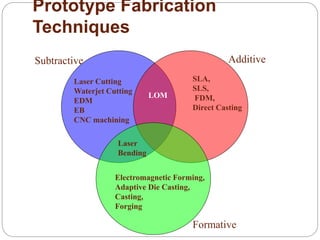
Prototype Fabrication
Techniques
Laser Cutting
Waterjet Cutting
EDM
EB
CNC machining
Subtractive Additive
SLA,
SLS,
FDM,
Direct Casting
LOM
Laser
Bending
Electromagnetic Forming,
Adaptive Die Casting,
Casting,
Forging
Formative
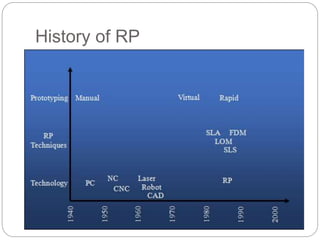
History of RP
What is Additive
Manufacturing?
• Additive Manufacturing is a method in which the part
is created by a layer- additive process.
• Using a specialized software, a 3-D CAD model is cut
into very thin layers or cross-sections.
• Then, depending on the specific method used
(sintering, fused deposition, etc), the AM machine
constructs the part layer by layer until a solid replica
of the CAD model is generated.
• The advantages of this process is clear: development
of physical models can be accomplished in
significantly less time as compared to the machining
process.
• Machining is a subtractive process, beginning with a
solid piece of stock. The machinist must carefully
remove material until the desired geometry is
achieved. For complex part geometries, this is an
exhaustive, time consuming, and expensive
Trends in manufacturing industries
emphasis the following
 Increasing the no of variants of
products.
 Increase in product complexity.
 Decrease in product lifetime before
obsolescence.
 Decrease in delivery time.
 Product development by Rapid
prototyping by enabling better
communication.
Conventional Machining
 Its not suitable for complex shapes because they
are difficult to machine.
 Time consuming
 Very costly
 Tedious or very laborious.
 Skilled operator is required.
 Accuracy will be less.
 Increased product development time.
Advantages of AM
 Rapid Prototyping can give with concept proof that
would be needed for attracting funds.
 The Prototype hints the user about the final product look
.
 It can increase early visibility.
 Easy to find design flaws in the early stages of
developmental.
 Active participation among the users and producer is
encouraged.
 It is cost effective,as development cost reduces.
 Any deficiency in the earlier prototypes can be detected
and rectified in time.
 There is better communication between the user and
Disadvantages Of Rapid
Prototyping
 It fails in exact replication of the real product or system.
 Some important developmental steps might get omitted
to get a quick and cheap working model. This turns out
to be one of the greatest disadvantages of rapid
prototyping.
 Another disadvantage is that many problems are
overlooked resulting in endless corrections and
revisions.
 Unsuitable for large sized applications.
 Compared to user’s high expectations, the prototype’s
performance and the designer are unable to deliver
these.
 The producer may produce an inadequate system that
is unable to meet the overall demands of the
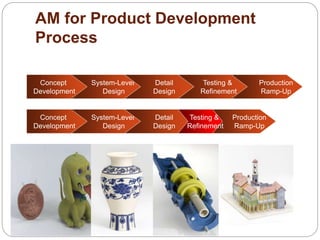
AM for Product Development
Process
Concept
Development
System-Level
Design
Detail
Design
Testing &
Refinement
Production
Ramp-Up
Concept
Development
System-Level
Design
Detail
Design
Production
Ramp-Up
Testing &
Refinement
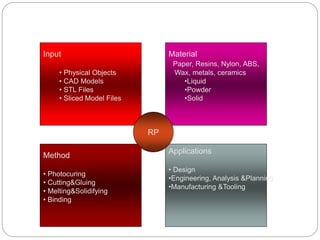
Input
• Physical Objects
• CAD Models
• STL Files
• Sliced Model Files
Material
Paper, Resins, Nylon, ABS,
Wax, metals, ceramics
•Liquid
•Powder
•Solid
Method
• Photocuring
• Cutting&Gluing
• Melting&Solidifying
• Binding
Applications
• Design
•Engineering, Analysis &Planning
•Manufacturing &Tooling
RP
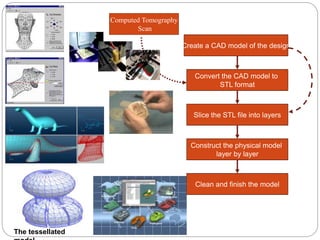
Create a CAD model of the design
Convert the CAD model to
STL format
Slice the STL file into layers
Construct the physical model
layer by layer
Clean and finish the model
Computed Tomography
Scan
The tessellated
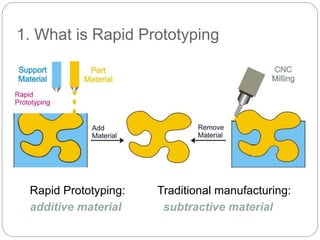
1. What is Rapid Prototyping
Rapid Prototyping: Traditional manufacturing:
additive material subtractive material
Build
Prototype
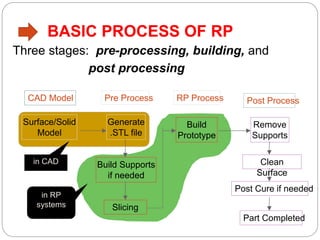
BASIC PROCESS OF RP
Three stages: pre-processing, building, and
post processing
RP Process Post Process
Pre Process
Generate
.STL file
Build Supports
if needed
Slicing
Remove
Supports
Clean
Surface
Post Cure if needed
Part Completed
CAD Model
Surface/Solid
Model
in RP
systems
in CAD
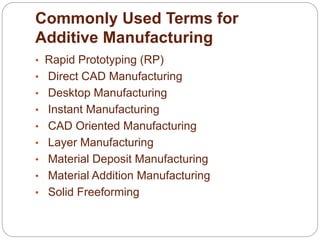
Commonly Used Terms for
Additive Manufacturing
• Rapid Prototyping (RP)
• Direct CAD Manufacturing
• Desktop Manufacturing
• Instant Manufacturing
• CAD Oriented Manufacturing
• Layer Manufacturing
• Material Deposit Manufacturing
• Material Addition Manufacturing
• Solid Freeforming
Advantages of AM
• Reduce product
development time and cost
• Get products to market
sooner
• Enhance communications
between marketing,
engineering,
manufacturing, and
purchasing
• Present physical model at
critical design reviews
• Perform functional
prototype testing before
committing to tooling
• Generate precise
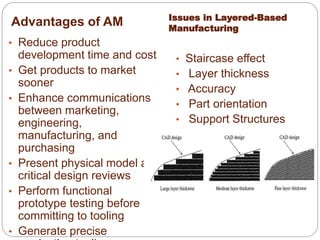
• Staircase effect
• Layer thickness
• Accuracy
• Part orientation
• Support Structures
Issues in Layered-Based
Manufacturing
PROTOTYPING PROCESSES
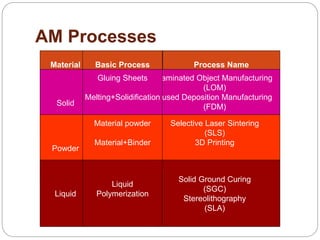
AM Processes
Material Basic Process Process Name
Solid
Laminated Object Manufacturing
(LOM)
Fused Deposition Manufacturing
(FDM)
Gluing Sheets
Melting+Solidification
Powder
Selective Laser Sintering
(SLS)
3D Printing
Material powder
Material+Binder
Liquid
Solid Ground Curing
(SGC)
Stereolithography
(SLA)
Liquid
Polymerization
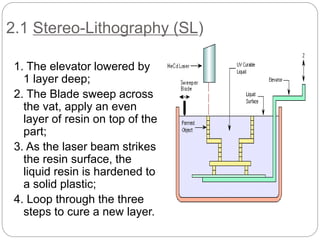
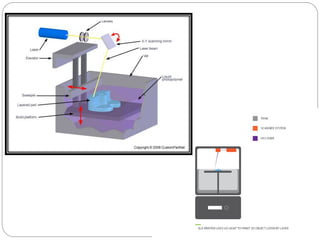
2.1 Stereo-Lithography (SL)
1. The elevator lowered by
1 layer deep;
2. The Blade sweep across
the vat, apply an even
layer of resin on top of the
part;
3. As the laser beam strikes
the resin surface, the
liquid resin is hardened to
a solid plastic;
4. Loop through the three
steps to cure a new layer.
Advantages Disadvantages
 Parts have best
surface quality
 High Accuracy
 High speed
 Finely detailed
features like thin
vertical walls, sharp
corners & tall
columns can be
fabricated with ease.
 It requires Post
Processing. i.e.
Post Curing.
 Careful handling of
raw materials
required.
 High cost of Photo
Curable Resin
Applications:
Investment Casting.
Wind Tunnel Modeling.
Tooling.
Injection Mould Tools.
Materials:
Photocurable resins:
 acrylate
 polyurethane
 Build Materials Used:
 Epoxy Resin, Acrylate
Resin
 Epoxy Resin has better
material properties and
less hazardous but
require large exposure
time for curing.
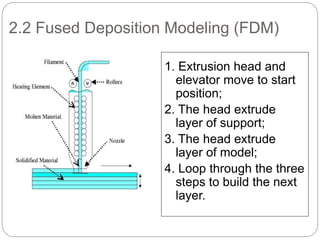
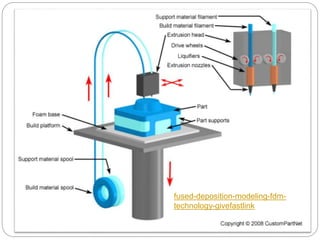
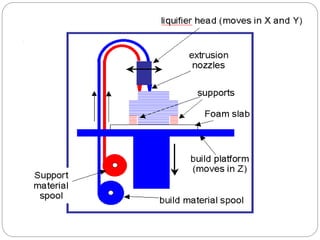
2.2 Fused Deposition Modeling (FDM)
1. Extrusion head and
elevator move to start
position;
2. The head extrude
layer of support;
3. The head extrude
layer of model;
4. Loop through the three
steps to build the next
layer.
fused-deposition-modeling-fdm-
technology-givefastlink
Materials:
thermoplastic material
 wax
 polycarbonate
 elastomer
-
Advantages:
•Strength and temperature
capability of build materials.
•Safe laser free operation.
•Easy Post Processing.
Disadvantages
•Process is slower than
laser based systems.
•Build Speed is low.
•Thin vertical column prove
difficult to build with FDM.
•Physical contact with
extrusion can sometimes
topple or at least shift thin
vertical columns and walls.
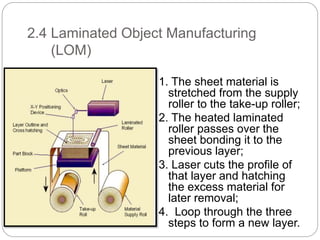
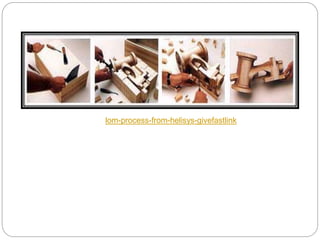
2.4 Laminated Object Manufacturing
(LOM)
1. The sheet material is
stretched from the supply
roller to the take-up roller;
2. The heated laminated
roller passes over the
sheet bonding it to the
previous layer;
3. Laser cuts the profile of
that layer and hatching
the excess material for
later removal;
4. Loop through the three
steps to form a new layer.
lom-process-from-helisys-givefastlink
Materials:
 Sheet material:
 paper
 plastic
 ceramic composite etc.
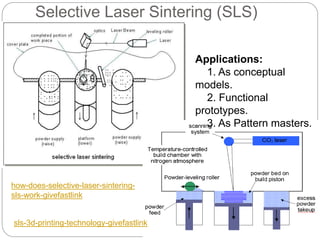
Selective Laser Sintering (SLS)
Applications:
1. As conceptual
models.
2. Functional
prototypes.
3. As Pattern masters.
sls-3d-printing-technology-givefastlink
how-does-selective-laser-sintering-
sls-work-givefastlink
 Advantages:
1. Wide range of build materials.
2. High throughput capabilities.
3. Self supporting build envelop.
4. Parts are completed faster.
5. Damage is less.
6. Less wastage of material.
Disadvantages:
1. Initial cost of system is high.
2. High operational and
maintenance cost.
3. Peripheral and facility
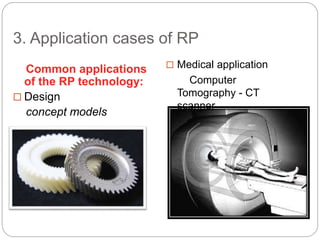
3. Application cases of RP
Common applications
of the RP technology:
 Design
concept models
 Medical application
Computer
Tomography - CT
scanner
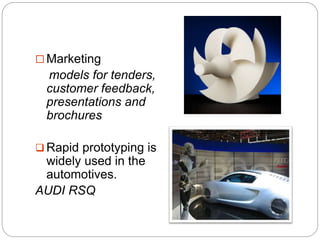
 Marketing
models for tenders,
customer feedback,
presentations and
brochures
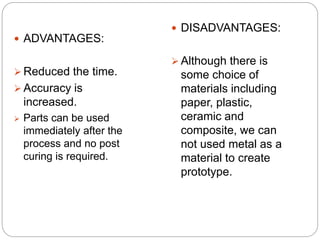
 Rapid prototyping is
widely used in the
automotives.
AUDI RSQ
 ADVANTAGES:
 Reduced the time.
 Accuracy is
increased.
 Parts can be used
immediately after the
process and no post
curing is required.
 DISADVANTAGES:
 Although there is
some choice of
materials including
paper, plastic,
ceramic and
composite, we can
not used metal as a
material to create
prototype.
Applications of AM
 Design
• CAD model verification
• Visualizing objects
• Proof of concept
• Market and
presentation application
 Manufacturing and Tooling
• Tooling mold parts (soft
tooling and hard tooling)
• Casting
• EDM electrodes
• Master models
Engineering Analysis and Planning
• Form and fit
• Stress analysis
• Mock-up parts
• Pre-production parts
• Diagnostic and surgical
operation planning
Industries
• Aerospace
• Jewelry
• Consumer electronics
• Automotive
• Biomedical
• Tableware
•One such improvement is increased speed of part building
“Rapid" prototyping machines.
• Another future development is improved accuracy and
surface finish.
•The introduction of non-polymeric materials, including metals,
ceramics, and composites, represents another much
anticipated development. These materials would allow RP
users to produce functional parts.
•Another important development is increased size capacity
Advances in computerized path planning, numeric control,
and machine dynamics are increasing the speed and
accuracy of machining.
Future development:
CONCLUSION
After studying the rapid prototyping we can
conclude that the process(RP) is really a
efficient , flexible process with better scope in
future as compared to old prototyping
techniques. It necessiates rapid production of
prototype in less time and cost.
Reference
www.wikipedia.in/rapidprototyping
 S.H. Ahn, M. Montero, D. Odell, S.
Roundy,
P.K. Wright, Anisotropic material
properties of
fused deposition modeling ABS,
Rapid
Prototyping J. 8 (4) (2002) 248–257.
 K. Thrimurthulu, P.M. Pandey,
N.Venkata
Reddy, Optimum part deposition
orientation in
Rapid Prototyping: Basic process of RP Prototyping of processes

Rapid Prototyping: Basic process of RP Prototyping of processes

  • 1.
    Unit -6(b) RAPID PROTOTYPING PresentedBy Dr. Sivasankara Raju R Associate Professor Dept. of Mechanical Engg. AITAM, Tekkali-532201 Andhra Pradesh
  • 2.
    CONTENTS  What isRapid Prototyping  Basic process of RP  Prototyping of processes: 1. Stereolithography 2. Fused Deposition Modeling 3. Laminated Object Manufacturing  Advantages & disadvantages of above processes.  Applications  Future development  Conclusion  References
  • 3.
    Prototype Fabrication Techniques Laser Cutting WaterjetCutting EDM EB CNC machining Subtractive Additive SLA, SLS, FDM, Direct Casting LOM Laser Bending Electromagnetic Forming, Adaptive Die Casting, Casting, Forging Formative
  • 4.
  • 5.
    What is Additive Manufacturing? •Additive Manufacturing is a method in which the part is created by a layer- additive process. • Using a specialized software, a 3-D CAD model is cut into very thin layers or cross-sections. • Then, depending on the specific method used (sintering, fused deposition, etc), the AM machine constructs the part layer by layer until a solid replica of the CAD model is generated. • The advantages of this process is clear: development of physical models can be accomplished in significantly less time as compared to the machining process. • Machining is a subtractive process, beginning with a solid piece of stock. The machinist must carefully remove material until the desired geometry is achieved. For complex part geometries, this is an exhaustive, time consuming, and expensive
  • 6.
    Trends in manufacturingindustries emphasis the following  Increasing the no of variants of products.  Increase in product complexity.  Decrease in product lifetime before obsolescence.  Decrease in delivery time.  Product development by Rapid prototyping by enabling better communication.
  • 7.
    Conventional Machining  Itsnot suitable for complex shapes because they are difficult to machine.  Time consuming  Very costly  Tedious or very laborious.  Skilled operator is required.  Accuracy will be less.  Increased product development time.
  • 8.
    Advantages of AM Rapid Prototyping can give with concept proof that would be needed for attracting funds.  The Prototype hints the user about the final product look .  It can increase early visibility.  Easy to find design flaws in the early stages of developmental.  Active participation among the users and producer is encouraged.  It is cost effective,as development cost reduces.  Any deficiency in the earlier prototypes can be detected and rectified in time.  There is better communication between the user and
  • 9.
    Disadvantages Of Rapid Prototyping It fails in exact replication of the real product or system.  Some important developmental steps might get omitted to get a quick and cheap working model. This turns out to be one of the greatest disadvantages of rapid prototyping.  Another disadvantage is that many problems are overlooked resulting in endless corrections and revisions.  Unsuitable for large sized applications.  Compared to user’s high expectations, the prototype’s performance and the designer are unable to deliver these.  The producer may produce an inadequate system that is unable to meet the overall demands of the
  • 10.
    AM for ProductDevelopment Process Concept Development System-Level Design Detail Design Testing & Refinement Production Ramp-Up Concept Development System-Level Design Detail Design Production Ramp-Up Testing & Refinement
  • 11.
    Input • Physical Objects •CAD Models • STL Files • Sliced Model Files Material Paper, Resins, Nylon, ABS, Wax, metals, ceramics •Liquid •Powder •Solid Method • Photocuring • Cutting&Gluing • Melting&Solidifying • Binding Applications • Design •Engineering, Analysis &Planning •Manufacturing &Tooling RP
  • 12.
    Create a CADmodel of the design Convert the CAD model to STL format Slice the STL file into layers Construct the physical model layer by layer Clean and finish the model Computed Tomography Scan The tessellated
  • 13.
    1. What isRapid Prototyping Rapid Prototyping: Traditional manufacturing: additive material subtractive material
  • 14.
    Build Prototype BASIC PROCESS OFRP Three stages: pre-processing, building, and post processing RP Process Post Process Pre Process Generate .STL file Build Supports if needed Slicing Remove Supports Clean Surface Post Cure if needed Part Completed CAD Model Surface/Solid Model in RP systems in CAD
  • 15.
    Commonly Used Termsfor Additive Manufacturing • Rapid Prototyping (RP) • Direct CAD Manufacturing • Desktop Manufacturing • Instant Manufacturing • CAD Oriented Manufacturing • Layer Manufacturing • Material Deposit Manufacturing • Material Addition Manufacturing • Solid Freeforming
  • 16.
    Advantages of AM •Reduce product development time and cost • Get products to market sooner • Enhance communications between marketing, engineering, manufacturing, and purchasing • Present physical model at critical design reviews • Perform functional prototype testing before committing to tooling • Generate precise • Staircase effect • Layer thickness • Accuracy • Part orientation • Support Structures Issues in Layered-Based Manufacturing
  • 17.
  • 18.
    AM Processes Material BasicProcess Process Name Solid Laminated Object Manufacturing (LOM) Fused Deposition Manufacturing (FDM) Gluing Sheets Melting+Solidification Powder Selective Laser Sintering (SLS) 3D Printing Material powder Material+Binder Liquid Solid Ground Curing (SGC) Stereolithography (SLA) Liquid Polymerization
  • 19.
    2.1 Stereo-Lithography (SL) 1.The elevator lowered by 1 layer deep; 2. The Blade sweep across the vat, apply an even layer of resin on top of the part; 3. As the laser beam strikes the resin surface, the liquid resin is hardened to a solid plastic; 4. Loop through the three steps to cure a new layer.
  • 21.
    Advantages Disadvantages  Partshave best surface quality  High Accuracy  High speed  Finely detailed features like thin vertical walls, sharp corners & tall columns can be fabricated with ease.  It requires Post Processing. i.e. Post Curing.  Careful handling of raw materials required.  High cost of Photo Curable Resin Applications: Investment Casting. Wind Tunnel Modeling. Tooling. Injection Mould Tools.
  • 22.
    Materials: Photocurable resins:  acrylate polyurethane  Build Materials Used:  Epoxy Resin, Acrylate Resin  Epoxy Resin has better material properties and less hazardous but require large exposure time for curing.
  • 23.
    2.2 Fused DepositionModeling (FDM) 1. Extrusion head and elevator move to start position; 2. The head extrude layer of support; 3. The head extrude layer of model; 4. Loop through the three steps to build the next layer.
  • 24.
  • 26.
    Materials: thermoplastic material  wax polycarbonate  elastomer - Advantages: •Strength and temperature capability of build materials. •Safe laser free operation. •Easy Post Processing. Disadvantages •Process is slower than laser based systems. •Build Speed is low. •Thin vertical column prove difficult to build with FDM. •Physical contact with extrusion can sometimes topple or at least shift thin vertical columns and walls.
  • 27.
    2.4 Laminated ObjectManufacturing (LOM) 1. The sheet material is stretched from the supply roller to the take-up roller; 2. The heated laminated roller passes over the sheet bonding it to the previous layer; 3. Laser cuts the profile of that layer and hatching the excess material for later removal; 4. Loop through the three steps to form a new layer.
  • 28.
  • 29.
    Materials:  Sheet material: paper  plastic  ceramic composite etc.
  • 30.
    Selective Laser Sintering(SLS) Applications: 1. As conceptual models. 2. Functional prototypes. 3. As Pattern masters. sls-3d-printing-technology-givefastlink how-does-selective-laser-sintering- sls-work-givefastlink
  • 31.
     Advantages: 1. Widerange of build materials. 2. High throughput capabilities. 3. Self supporting build envelop. 4. Parts are completed faster. 5. Damage is less. 6. Less wastage of material. Disadvantages: 1. Initial cost of system is high. 2. High operational and maintenance cost. 3. Peripheral and facility
  • 32.
    3. Application casesof RP Common applications of the RP technology:  Design concept models  Medical application Computer Tomography - CT scanner
  • 33.
     Marketing models fortenders, customer feedback, presentations and brochures  Rapid prototyping is widely used in the automotives. AUDI RSQ
  • 34.
     ADVANTAGES:  Reducedthe time.  Accuracy is increased.  Parts can be used immediately after the process and no post curing is required.  DISADVANTAGES:  Although there is some choice of materials including paper, plastic, ceramic and composite, we can not used metal as a material to create prototype.
  • 35.
    Applications of AM Design • CAD model verification • Visualizing objects • Proof of concept • Market and presentation application  Manufacturing and Tooling • Tooling mold parts (soft tooling and hard tooling) • Casting • EDM electrodes • Master models Engineering Analysis and Planning • Form and fit • Stress analysis • Mock-up parts • Pre-production parts • Diagnostic and surgical operation planning Industries • Aerospace • Jewelry • Consumer electronics • Automotive • Biomedical • Tableware
  • 36.
    •One such improvementis increased speed of part building “Rapid" prototyping machines. • Another future development is improved accuracy and surface finish. •The introduction of non-polymeric materials, including metals, ceramics, and composites, represents another much anticipated development. These materials would allow RP users to produce functional parts. •Another important development is increased size capacity Advances in computerized path planning, numeric control, and machine dynamics are increasing the speed and accuracy of machining. Future development:
  • 37.
    CONCLUSION After studying therapid prototyping we can conclude that the process(RP) is really a efficient , flexible process with better scope in future as compared to old prototyping techniques. It necessiates rapid production of prototype in less time and cost.
  • 38.
    Reference www.wikipedia.in/rapidprototyping  S.H. Ahn,M. Montero, D. Odell, S. Roundy, P.K. Wright, Anisotropic material properties of fused deposition modeling ABS, Rapid Prototyping J. 8 (4) (2002) 248–257.  K. Thrimurthulu, P.M. Pandey, N.Venkata Reddy, Optimum part deposition orientation in