Rapid Prototyping
      with
       Solr
    NFJS - Raleigh, August 2011
     Presented by Erik Hatcher
erik.hatcher@lucidimagination.com
         Lucid Imagination
 http://www.lucidimagination.com
About me...
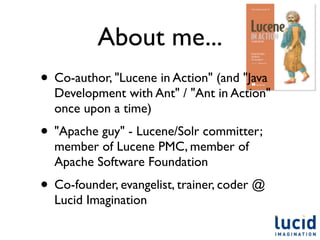
• Co-author, "Lucene in Action" (and "Java
  Development with Ant" / "Ant in Action"
  once upon a time)
• "Apache guy" - Lucene/Solr committer;
  member of Lucene PMC, member of
  Apache Software Foundation
• Co-founder, evangelist, trainer, coder @
  Lucid Imagination
About Lucid Imagination...
•   Lucid Imagination provides commercial-grade
    support, training, high-level consulting and value-
    added software for Lucene and Solr.

•   We make Lucene ‘enterprise-ready’ by offering:

    •   Free, certified, distributions and downloads.

    •   Support, training, and consulting.

    •   LucidWorks Enterprise, a commercial search
        platform built on top of Solr.
Abstract
Got data? Let's make it searchable! Rapid Prototyping with
Solr will demonstrate getting documents into Solr quickly,
provide some tips in adjusting Solr's schema to match your
needs better, and finally will discuss how to showcase your
  data in a flexible search user interface. We'll see how to
  rapidly leverage faceting, highlighting, spell checking, and
debugging. Even after all that, there will be enough time left
    to outline the next steps in developing your search
           application and taking it to production.
What is Lucene?
•   An open source Java-based IR library with best practice indexing
    and query capabilities, fast and lightweight search and indexing.

•   100% Java (.NET, Perl and other versions too).

•   Stable, mature API.

•   Continuously improved and tuned over more than 10 years.

•   Cleanly implemented, easy to embed in an application.

•   Compact, portable index representation.

•   Programmable text analyzers, spell checking and highlighting.

•   Not a crawler or a text extraction tool.
Lucene's History
•   Created by Doug Cutting in 1999

    •   built on ideas from search projects Doug created at Xerox PARC
        and Apple.

•   Donated to the Apache Software Foundation (ASF) in 2001.

•   Became an Apache top-level project in 2005.

•   Has grown and morphed through the years and is now both:

    •   A search library.

    •   An ASF Top-Level Project (TLP) encompassing several sub-projects.

•   Lucene and Solr "merged" development in early 2010.
What is Solr?
•   An open source search engine.

•   Indexes content sources, processes query requests, returns
    search results.

•   Uses Lucene as the "engine", but adds full enterprise search
    server features and capabilities.

•   A web-based application that processes HTTP requests and
    returns HTTP responses.

•   Initially started in 2004 and developed by CNET as an in-house
    project to add search capability for the company website.

•   Donated to ASF in 2006.
What Version of Solr?

•   There’s more than one answer!

•   The current, released, stable version is 3.3

•   The development release is referred to as “trunk”.

    •   This is where the new, less tested work goes on

    •   Also referred to as 4.0

•   LucidWorks Enterprise is built on a trunk snapshot +
    additional features.
Why prototype?

• Demonstrate Solr can handle your needs
• Stake/purse-holder buy-in
• It's quick, easy, and fun!
• The User Interface is the app
Workflow

• Ingest data
• Use
• Refine config/interactions, repeat
Got Data?
• Rich text files?
• Databases?
• Feeds (Atom/RSS/XML)?
• 3rd party repositories? (SharePoint,
  Documentum, ...)
• CSV!!!!
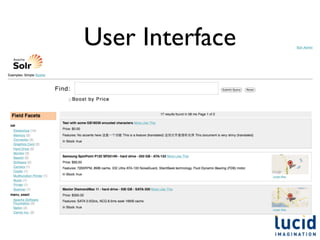
User Interface
Getting Started
• Download Solr
 • http://lucene.apache.org/solr
• "Install" it
 • unzip or tar -xvf
• Start it
 • cd example; java -jar start.jar
e.g. Conference
               Attendees

First Name,Last Name,Company,Title,Work Country

Erik,Hatcher,Lucid Imagination,"Member, Technical Staff", USA

.

.

.
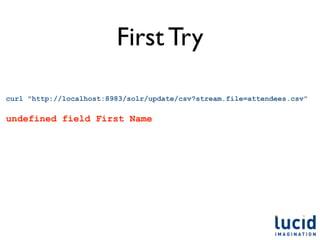
First Try

curl "http://localhost:8983/solr/update/csv?stream.file=attendees.csv"

undefined field First Name
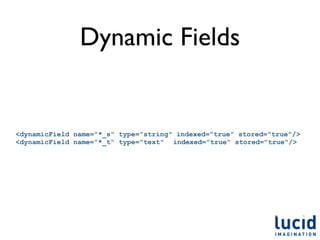
Dynamic Fields


<dynamicField name="*_s" type="string" indexed="true" stored="true"/>
<dynamicField name="*_t" type="text" indexed="true" stored="true"/>
Second try

curl "http://localhost:8983/solr/update/csv?
stream.file=attendees.csv
&fieldnames=first_s,last_s,company_s,title_t,country_s
&header=true"

Document [null] missing required field: id
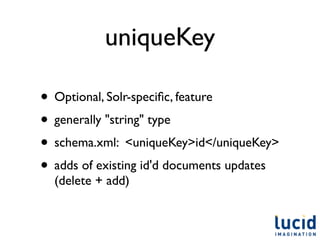
uniqueKey

• Optional, Solr-specific, feature
• generally "string" type
• schema.xml: <uniqueKey>id</uniqueKey>
• adds of existing id'd documents updates
  (delete + add)
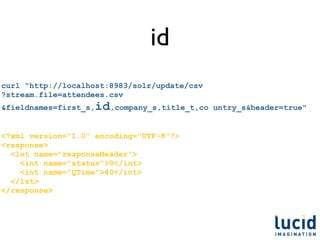
id
curl "http://localhost:8983/solr/update/csv
?stream.file=attendees.csv
&fieldnames=first_s,   id,company_s,title_t,co   untry_s&header=true"


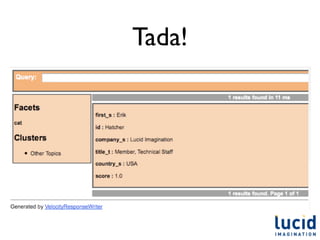
<?xml version="1.0" encoding="UTF-8"?>
<response>
  <lst name="responseHeader">
    <int name="status">0</int>
    <int name="QTime">40</int>
  </lst>
</response>
Tada!
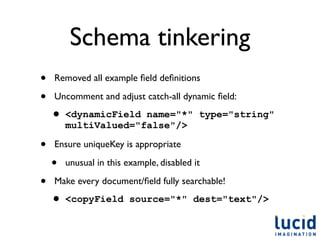
Schema tinkering
•   Removed all example field definitions

•   Uncomment and adjust catch-all dynamic field:

    • <dynamicField   name="*" type="string"
        multiValued="false"/>

•   Ensure uniqueKey is appropriate

    •   unusual in this example, disabled it

•   Make every document/field fully searchable!

    • <copyField         source="*" dest="text"/>
After adjusting config...


• Restart Solr
• Or... reload the core (when in multicore
  mode)
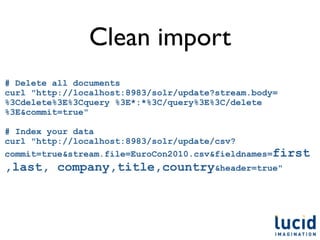
Clean import
# Delete all documents
curl "http://localhost:8983/solr/update?stream.body=
%3Cdelete%3E%3Cquery %3E*:*%3C/query%3E%3C/delete
%3E&commit=true"

# Index your data
curl "http://localhost:8983/solr/update/csv?
commit=true&stream.file=EuroCon2010.csv&fieldnames=first
,last, company,title,country&header=true"
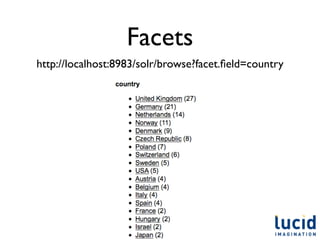
Facets
http://localhost:8983/solr/browse?facet.field=country
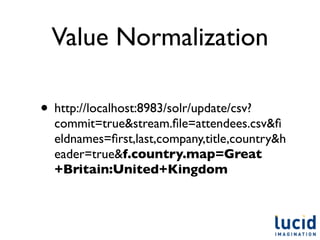
Value Normalization

• http://localhost:8983/solr/update/csv?
  commit=true&stream.file=attendees.csv&fi
  eldnames=first,last,company,title,country&h
  eader=true&f.country.map=Great
  +Britain:United+Kingdom
Polishing

• Customize request handler mappings
• Edit templates
 • hit display
 • header/footer
 • style
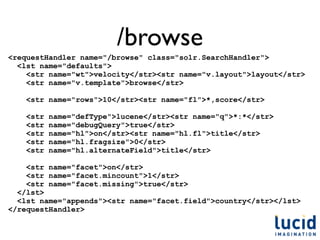
/browse
<requestHandler name="/browse" class="solr.SearchHandler">
  <lst name="defaults">
    <str name="wt">velocity</str><str name="v.layout">layout</str>
    <str name="v.template">browse</str>

    <str name="rows">10</str><str name="fl">*,score</str>

    <str   name="defType">lucene</str><str name="q">*:*</str>
    <str   name="debugQuery">true</str>
    <str   name="hl">on</str><str name="hl.fl">title</str>
    <str   name="hl.fragsize">0</str>
    <str   name="hl.alternateField">title</str>

    <str name="facet">on</str>
    <str name="facet.mincount">1</str>
    <str name="facet.missing">true</str>
  </lst>
  <lst name="appends"><str name="facet.field">country</str></lst>
</requestHandler>
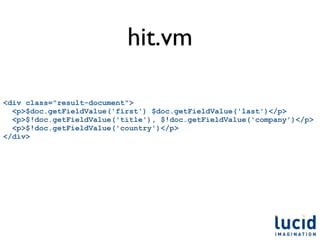
hit.vm

<div class="result-document">
  <p>$doc.getFieldValue('first') $doc.getFieldValue('last')</p>
  <p>$!doc.getFieldValue('title'), $!doc.getFieldValue('company')</p>
  <p>$!doc.getFieldValue('country')</p>
</div>
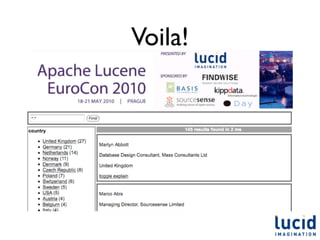
Voila!
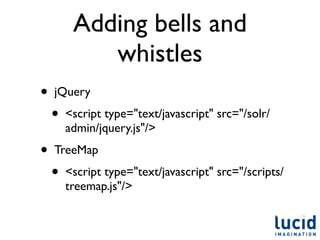
Adding bells and
            whistles
•   jQuery
    •   <script type="text/javascript" src="/solr/
        admin/jquery.js"/>
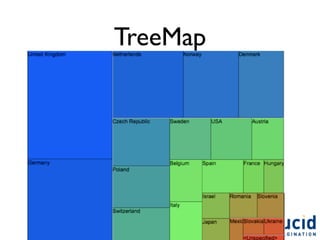
•   TreeMap
    •   <script type="text/javascript" src="/scripts/
        treemap.js"/>
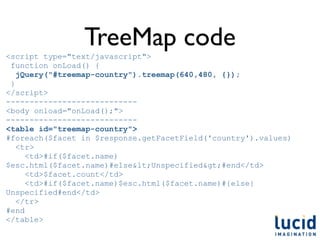
TreeMap code
<script type="text/javascript">
 function onLoad() {
   jQuery("#treemap-country").treemap(640,480, {});
 }
</script>
----------------------------
<body onload="onLoad();">
----------------------------
<table id="treemap-country">
#foreach($facet in $response.getFacetField('country').values)
   <tr>
     <td>#if($facet.name)
$esc.html($facet.name)#else&lt;Unspecified&gt;#end</td>
     <td>$facet.count</td>
     <td>#if($facet.name)$esc.html($facet.name)#{else}
Unspecified#end</td>
   </tr>
#end
</table>
TreeMap
Ajax fun: giveaways

• Add a "static" templated page
• jQuery Ajax request
• snippet templated output
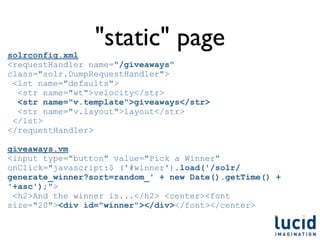
solrconfig.xml
                 "static" page
<requestHandler name="/giveaways"
class="solr.DumpRequestHandler">
 <lst name="defaults">
  <str name="wt">velocity</str>
  <str name="v.template">giveaways</str>
  <str name="v.layout">layout</str>
 </lst>
</requestHandler>

giveaways.vm
<input type="button" value="Pick a Winner"
onClick="javascript:$ ('#winner').load('/solr/
generate_winner?sort=random_' + new Date().getTime() +
'+asc');">
 <h2>And the winner is...</h2> <center><font
size="20"><div id="winner"></div></font></center>
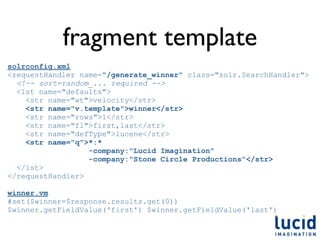
fragment template
solrconfig.xml
<requestHandler name="/generate_winner" class="solr.SearchHandler">
  <!-- sort=random_... required -->
  <lst name="defaults">
    <str name="wt">velocity</str>
    <str name="v.template">winner</str>
    <str name="rows">1</str>
    <str name="fl">first,last</str>
    <str name="defType">lucene</str>
    <str name="q">*:*
                  -company:"Lucid Imagination"
                  -company:"Stone Circle Productions"</str>
  </lst>
</requestHandler>

winner.vm
#set($winner=$response.results.get(0))
$winner.getFieldValue('first') $winner.getFieldValue('last')
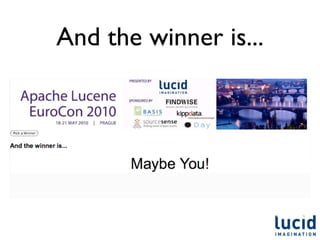
And the winner is...
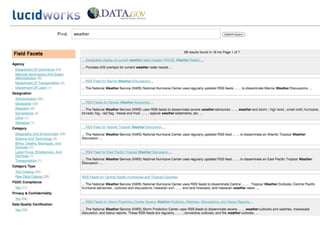
e.g. data.gov
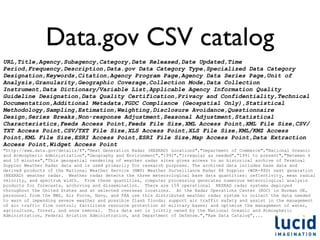
Data.gov CSV catalog
URL,Title,Agency,Subagency,Category,Date Released,Date Updated,Time
Period,Frequency,Description,Data.gov Data Category Type,Specialized Data Category
Designation,Keywords,Citation,Agency Program Page,Agency Data Series Page,Unit of
Analysis,Granularity,Geographic Coverage,Collection Mode,Data Collection
Instrument,Data Dictionary/Variable List,Applicable Agency Information Quality
Guideline Designation,Data Quality Certification,Privacy and Confidentiality,Technical
Documentation,Additional Metadata,FGDC Compliance (Geospatial Only),Statistical
Methodology,Sampling,Estimation,Weighting,Disclosure Avoidance,Questionnaire
Design,Series Breaks,Non-response Adjustment,Seasonal Adjustment,Statistical
Characteristics,Feeds Access Point,Feeds File Size,XML Access Point,XML File Size,CSV/
TXT Access Point,CSV/TXT File Size,XLS Access Point,XLS File Size,KML/KMZ Access
Point,KML File Size,ESRI Access Point,ESRI File Size,Map Access Point,Data Extraction
Access Point,Widget Access Point
"http://www.data.gov/details/4","Next Generation Radar (NEXRAD) Locations","Department of Commerce","National Oceanic
and Atmospheric Administration","Geography and Environment","1991","Irregular as needed","1991 to present","Between 4
and 10 minutes","This geospatial rendering of weather radar sites gives access to an historical archive of Terminal
Doppler Weather Radar data and is used primarily for research purposes. The archived data includes base data and
derived products of the National Weather Service (NWS) Weather Surveillance Radar 88 Doppler (WSR-88D) next generation
(NEXRAD) weather radar. Weather radar detects the three meteorological base data quantities: reflectivity, mean radial
velocity, and spectrum width. From these quantities, computer processing generates numerous meteorological analysis
products for forecasts, archiving and dissemination. There are 159 operational NEXRAD radar systems deployed
throughout the United States and at selected overseas locations. At the Radar Operations Center (ROC) in Norman OK,
personnel from the NWS, Air Force, Navy, and FAA use this distributed weather radar system to collect the data needed
to warn of impending severe weather and possible flash floods; support air traffic safety and assist in the management
of air traffic flow control; facilitate resource protection at military bases; and optimize the management of water,
agriculture, forest, and snow removal. This data set is jointly owned by the National Oceanic and Atmospheric
Administration, Federal Aviation Administration, and Department of Defense.","Raw Data Catalog",...
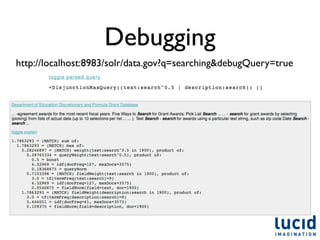
Debugging
http://localhost:8983/solr/data.gov?q=searching&debugQuery=true
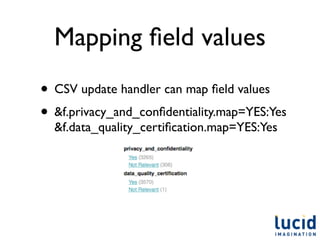
Mapping field values
• CSV update handler can map field values
• &f.privacy_and_confidentiality.map=YES:Yes
  &f.data_quality_certification.map=YES:Yes
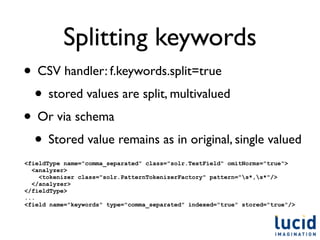
Splitting keywords
• CSV handler: f.keywords.split=true
 • stored values are split, multivalued
• Or via schema
 • Stored value remains as in original, single valued
<fieldType name="comma_separated" class="solr.TextField" omitNorms="true">
  <analyzer>
    <tokenizer class="solr.PatternTokenizerFactory" pattern="s*,s*"/>
  </analyzer>
</fieldType>
...
<field name="keywords" type="comma_separated" indexed="true" stored="true"/>
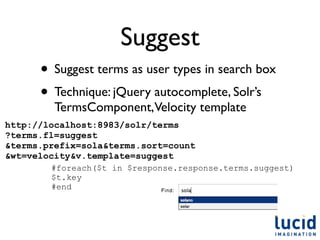
Suggest
      • Suggest terms as user types in search box
      • Technique: jQuery autocomplete, Solr’s
         TermsComponent,Velocity template
http://localhost:8983/solr/terms
?terms.fl=suggest
&terms.prefix=sola&terms.sort=count
&wt=velocity&v.template=suggest
        #foreach($t in $response.response.terms.suggest)
        $t.key
        #end
Suggest schema
<fieldType name="suggestable" class="solr.TextField"
positionIncrementGap="100">
  <analyzer>
    <tokenizer class="solr.StandardTokenizerFactory"/>
    <filter class="solr.LowerCaseFilterFactory"/>
    <filter class="solr.PatternReplaceFilterFactory"
             pattern="([^a-z])"
             replacement="" replace="all"/>
    <filter class="solr.StopFilterFactory"
             ignoreCase="true" words="stopwords.txt"
             enablePositionIncrements="true" />
  </analyzer>
</fieldType>

...

<field name="suggest" type="suggestable"
       indexed="true" stored="false" multiValued="true"/>
Custom pages


• Document detail page
• Multiple query intersection comparison
  with Venn visualization
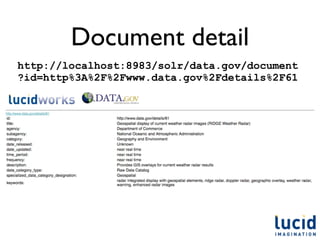
Document detail
http://localhost:8983/solr/data.gov/document
?id=http%3A%2F%2Fwww.data.gov%2Fdetails%2F61
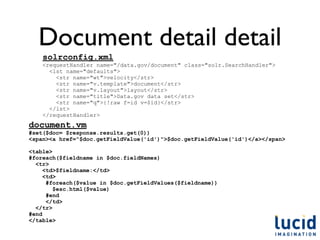
Document detail detail
    solrconfig.xml
    <requestHandler name="/data.gov/document" class="solr.SearchHandler">
      <lst name="defaults">
        <str name="wt">velocity</str>
        <str name="v.template">document</str>
        <str name="v.layout">layout</str>
        <str name="title">Data.gov data set</str>
        <str name="q">{!raw f=id v=$id}</str>
      </lst>
    </requestHandler>
document.vm
#set($doc= $response.results.get(0))
<span><a href="$doc.getFieldValue('id')">$doc.getFieldValue('id')</a></span>

<table>
#foreach($fieldname in $doc.fieldNames)
  <tr>
     <td>$fieldname:</td>
     <td>
      #foreach($value in $doc.getFieldValues($fieldname))
        $esc.html($value)
      #end
      </td>
  </tr>
#end
</table>
Query intersection

• Just showing off.... how easy it is to do
  something with a bit of visual impact
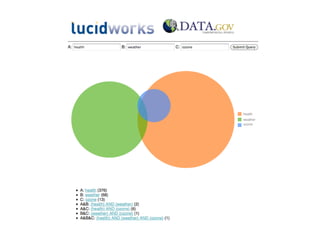
• Compare three independent queries,
  intersecting them in a Venn diagram
  visualization
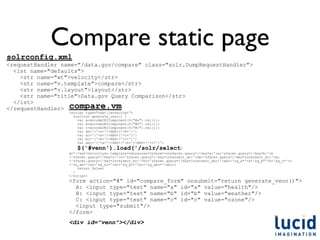
Compare static page
solrconfig.xml
<requestHandler name="/data.gov/compare" class="solr.DumpRequestHandler">
  <lst name="defaults">
    <str name="wt">velocity</str>
    <str name="v.template">compare</str>
    <str name="v.layout">layout</str>
    <str name="title">Data.gov Query Comparison</str>
  </lst>
</requestHandler> compare.vm
                  <script type="text/javascript">
                    function generate_venn() {
                      var a=encodeURIComponent($("#a").val());
                      var b=encodeURIComponent($("#b").val());
                      var c=encodeURIComponent($("#c").val());
                      var ab='('+a+')+AND+('+b+')';
                      var ac='('+a+')+AND+('+c+')';
                      var bc='('+b+')+AND+('+c+')';
                      var abc='('+a+')+AND+('+b+')+AND+('+c+')';
                     $('#venn').load('/solr/select?
                  q=*:*&wt=velocity&v.template=venn&rows=0&facet=on&facet.query={!key=a}'+a+'&facet.query={!key=b}'+b
                  +'&facet.query={!key=c}'+c+'&facet.query={!key=intersect_ab}'+ab+'&facet.query={!key=intersect_ac}'+ac
                  +'&facet.query={!key=intersect_bc}'+bc+'&facet.query={!key=intersect_abc}'+abc+'&q_a='+a+'&q_b='+b+'&q_c='+c
                  +'&q_ab='+ab+'&q_ac='+ac+'&q_bc='+bc+'&q_abc='+abc);
                      return false;
                    }
                  </script>
                  <form action="#" id="compare_form" onsubmit="return generate_venn()">
                    A: <input type="text" name="a" id="a" value="health"/>
                    B: <input type="text" name="b" id="b" value="weather"/>
                    C: <input type="text" name="c" id="c" value="ozone"/>
                    <input type="submit"/>
                  </form>
                  <div id="venn"></div>
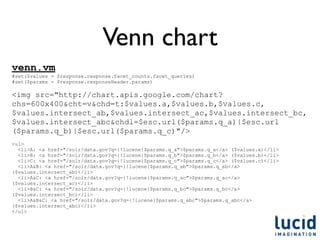
Venn chart
venn.vm
#set($values = $response.response.facet_counts.facet_queries)
#set($params = $response.responseHeader.params)

<img src="http://chart.apis.google.com/chart?
chs=600x400&cht=v&chd=t:$values.a,$values.b,$values.c,
$values.intersect_ab,$values.intersect_ac,$values.intersect_bc,
$values.intersect_abc&chdl=$esc.url($params.q_a)|$esc.url
($params.q_b)|$esc.url($params.q_c)"/>
<ul>
  <li>A: <a href="/solr/data.gov?q={!lucene}$params.q_a">$params.q_a</a> ($values.a)</li>
  <li>B: <a href="/solr/data.gov?q={!lucene}$params.q_b">$params.q_b</a> ($values.b)</li>
  <li>C: <a href="/solr/data.gov?q={!lucene}$params.q_c">$params.q_c</a> ($values.c)</li>
  <li>A&B: <a href="/solr/data.gov?q={!lucene}$params.q_ab">$params.q_ab</a>
($values.intersect_ab)</li>
  <li>A&C: <a href="/solr/data.gov?q={!lucene}$params.q_ac">$params.q_ac</a>
($values.intersect_ac)</li>
  <li>B&C: <a href="/solr/data.gov?q={!lucene}$params.q_bc">$params.q_bc</a>
($values.intersect_bc)</li>
  <li>A&B&C: <a href="/solr/data.gov?q={!lucene}$params.q_abc">$params.q_abc</a>
($values.intersect_abc)</li>
</ul>
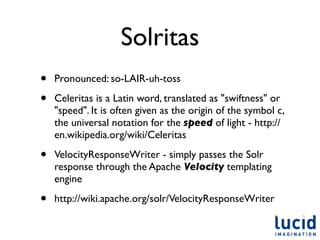
Solritas
•   Pronounced: so-LAIR-uh-toss

•   Celeritas is a Latin word, translated as "swiftness" or
    "speed". It is often given as the origin of the symbol c,
    the universal notation for the speed of light - http://
    en.wikipedia.org/wiki/Celeritas

•   VelocityResponseWriter - simply passes the Solr
    response through the Apache Velocity templating
    engine

•   http://wiki.apache.org/solr/VelocityResponseWriter
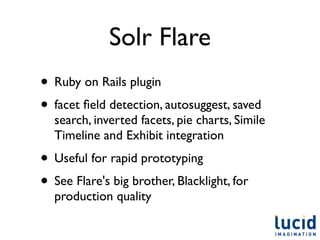
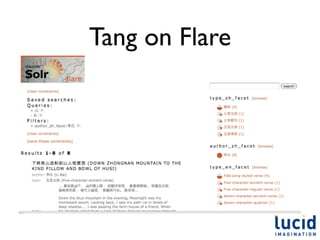
Solr Flare
• Ruby on Rails plugin
• facet field detection, autosuggest, saved
  search, inverted facets, pie charts, Simile
  Timeline and Exhibit integration
• Useful for rapid prototyping
• See Flare's big brother, Blacklight, for
  production quality
Tang on Flare
• UVA radiation = blacklight
• libraries are much more than books
• opinionated
  • Ruby on Rails: best choice for an
    extensible user interface development
    framework
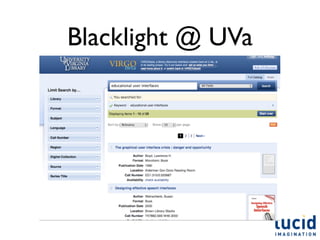
Blacklight @ UVa
Blacklight @ Stanford
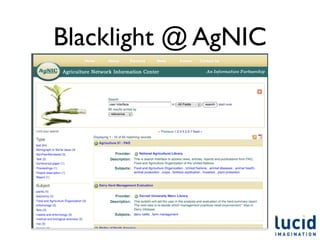
Blacklight @ AgNIC
Prototyping Tools

• CSV update handler - /update/csv
• Schema Browser
• Solritas, Flare, Blacklight, or...
 • just HTML+JavaScript (wt=json)
Test

• Performance
• Scalability
• Relevance
• Automate all of the above, start baselines
  early, avoid regressions
Then what?
•   Script the indexing process: full & delta
•   Work with real users on actual needs
•   Integrate with production systems
•   Iterate on schema enhancements,
    configuration tweaks such as caching
•   Deploy to staging/production environments
    and work at scale: collection size, real queries
    and performance, hardware and JVM settings
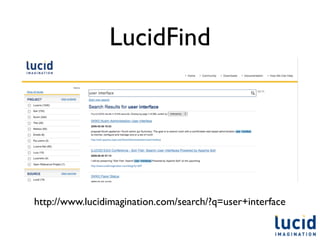
LucidFind


http://www.lucidimagination.com/search/?q=user+interface
For more information...
•   http://www.lucidimagination.com

•   LucidFind

    •   search Lucene ecosystem: mailing lists, wikis, JIRA, etc

    •   http://search.lucidimagination.com

•   Getting started with LucidWorks Enterprise:

    •   http://www.lucidimagination.com/products/
        lucidworks-search-platform/enterprise

•   http://lucene.apache.org/solr - wiki, e-mail lists
Thank You!

Rapid Prototyping with Solr

  • 1.
    Rapid Prototyping with Solr NFJS - Raleigh, August 2011 Presented by Erik Hatcher erik.hatcher@lucidimagination.com Lucid Imagination http://www.lucidimagination.com
  • 2.
    About me... • Co-author,"Lucene in Action" (and "Java Development with Ant" / "Ant in Action" once upon a time) • "Apache guy" - Lucene/Solr committer; member of Lucene PMC, member of Apache Software Foundation • Co-founder, evangelist, trainer, coder @ Lucid Imagination
  • 3.
    About Lucid Imagination... • Lucid Imagination provides commercial-grade support, training, high-level consulting and value- added software for Lucene and Solr. • We make Lucene ‘enterprise-ready’ by offering: • Free, certified, distributions and downloads. • Support, training, and consulting. • LucidWorks Enterprise, a commercial search platform built on top of Solr.
  • 4.
    Abstract Got data? Let'smake it searchable! Rapid Prototyping with Solr will demonstrate getting documents into Solr quickly, provide some tips in adjusting Solr's schema to match your needs better, and finally will discuss how to showcase your data in a flexible search user interface. We'll see how to rapidly leverage faceting, highlighting, spell checking, and debugging. Even after all that, there will be enough time left to outline the next steps in developing your search application and taking it to production.
  • 5.
    What is Lucene? • An open source Java-based IR library with best practice indexing and query capabilities, fast and lightweight search and indexing. • 100% Java (.NET, Perl and other versions too). • Stable, mature API. • Continuously improved and tuned over more than 10 years. • Cleanly implemented, easy to embed in an application. • Compact, portable index representation. • Programmable text analyzers, spell checking and highlighting. • Not a crawler or a text extraction tool.
  • 6.
    Lucene's History • Created by Doug Cutting in 1999 • built on ideas from search projects Doug created at Xerox PARC and Apple. • Donated to the Apache Software Foundation (ASF) in 2001. • Became an Apache top-level project in 2005. • Has grown and morphed through the years and is now both: • A search library. • An ASF Top-Level Project (TLP) encompassing several sub-projects. • Lucene and Solr "merged" development in early 2010.
  • 7.
    What is Solr? • An open source search engine. • Indexes content sources, processes query requests, returns search results. • Uses Lucene as the "engine", but adds full enterprise search server features and capabilities. • A web-based application that processes HTTP requests and returns HTTP responses. • Initially started in 2004 and developed by CNET as an in-house project to add search capability for the company website. • Donated to ASF in 2006.
  • 8.
    What Version ofSolr? • There’s more than one answer! • The current, released, stable version is 3.3 • The development release is referred to as “trunk”. • This is where the new, less tested work goes on • Also referred to as 4.0 • LucidWorks Enterprise is built on a trunk snapshot + additional features.
  • 9.
    Why prototype? • DemonstrateSolr can handle your needs • Stake/purse-holder buy-in • It's quick, easy, and fun! • The User Interface is the app
  • 10.
    Workflow • Ingest data •Use • Refine config/interactions, repeat
  • 11.
    Got Data? • Richtext files? • Databases? • Feeds (Atom/RSS/XML)? • 3rd party repositories? (SharePoint, Documentum, ...) • CSV!!!!
  • 12.
  • 13.
    Getting Started • DownloadSolr • http://lucene.apache.org/solr • "Install" it • unzip or tar -xvf • Start it • cd example; java -jar start.jar
  • 14.
    e.g. Conference Attendees First Name,Last Name,Company,Title,Work Country Erik,Hatcher,Lucid Imagination,"Member, Technical Staff", USA . . .
  • 15.
  • 16.
    Dynamic Fields <dynamicField name="*_s"type="string" indexed="true" stored="true"/> <dynamicField name="*_t" type="text" indexed="true" stored="true"/>
  • 17.
  • 18.
    uniqueKey • Optional, Solr-specific,feature • generally "string" type • schema.xml: <uniqueKey>id</uniqueKey> • adds of existing id'd documents updates (delete + add)
  • 19.
    id curl "http://localhost:8983/solr/update/csv ?stream.file=attendees.csv &fieldnames=first_s, id,company_s,title_t,co untry_s&header=true" <?xml version="1.0" encoding="UTF-8"?> <response> <lst name="responseHeader"> <int name="status">0</int> <int name="QTime">40</int> </lst> </response>
  • 20.
  • 21.
    Schema tinkering • Removed all example field definitions • Uncomment and adjust catch-all dynamic field: • <dynamicField name="*" type="string" multiValued="false"/> • Ensure uniqueKey is appropriate • unusual in this example, disabled it • Make every document/field fully searchable! • <copyField source="*" dest="text"/>
  • 22.
    After adjusting config... •Restart Solr • Or... reload the core (when in multicore mode)
  • 23.
    Clean import # Deleteall documents curl "http://localhost:8983/solr/update?stream.body= %3Cdelete%3E%3Cquery %3E*:*%3C/query%3E%3C/delete %3E&commit=true" # Index your data curl "http://localhost:8983/solr/update/csv? commit=true&stream.file=EuroCon2010.csv&fieldnames=first ,last, company,title,country&header=true"
  • 24.
  • 25.
    Value Normalization • http://localhost:8983/solr/update/csv? commit=true&stream.file=attendees.csv&fi eldnames=first,last,company,title,country&h eader=true&f.country.map=Great +Britain:United+Kingdom
  • 26.
    Polishing • Customize requesthandler mappings • Edit templates • hit display • header/footer • style
  • 27.
    /browse <requestHandler name="/browse" class="solr.SearchHandler"> <lst name="defaults"> <str name="wt">velocity</str><str name="v.layout">layout</str> <str name="v.template">browse</str> <str name="rows">10</str><str name="fl">*,score</str> <str name="defType">lucene</str><str name="q">*:*</str> <str name="debugQuery">true</str> <str name="hl">on</str><str name="hl.fl">title</str> <str name="hl.fragsize">0</str> <str name="hl.alternateField">title</str> <str name="facet">on</str> <str name="facet.mincount">1</str> <str name="facet.missing">true</str> </lst> <lst name="appends"><str name="facet.field">country</str></lst> </requestHandler>
  • 28.
    hit.vm <div class="result-document"> <p>$doc.getFieldValue('first') $doc.getFieldValue('last')</p> <p>$!doc.getFieldValue('title'), $!doc.getFieldValue('company')</p> <p>$!doc.getFieldValue('country')</p> </div>
  • 29.
  • 30.
    Adding bells and whistles • jQuery • <script type="text/javascript" src="/solr/ admin/jquery.js"/> • TreeMap • <script type="text/javascript" src="/scripts/ treemap.js"/>
  • 31.
    TreeMap code <script type="text/javascript"> function onLoad() { jQuery("#treemap-country").treemap(640,480, {}); } </script> ---------------------------- <body onload="onLoad();"> ---------------------------- <table id="treemap-country"> #foreach($facet in $response.getFacetField('country').values) <tr> <td>#if($facet.name) $esc.html($facet.name)#else&lt;Unspecified&gt;#end</td> <td>$facet.count</td> <td>#if($facet.name)$esc.html($facet.name)#{else} Unspecified#end</td> </tr> #end </table>
  • 32.
  • 33.
    Ajax fun: giveaways •Add a "static" templated page • jQuery Ajax request • snippet templated output
  • 34.
    solrconfig.xml "static" page <requestHandler name="/giveaways" class="solr.DumpRequestHandler"> <lst name="defaults"> <str name="wt">velocity</str> <str name="v.template">giveaways</str> <str name="v.layout">layout</str> </lst> </requestHandler> giveaways.vm <input type="button" value="Pick a Winner" onClick="javascript:$ ('#winner').load('/solr/ generate_winner?sort=random_' + new Date().getTime() + '+asc');"> <h2>And the winner is...</h2> <center><font size="20"><div id="winner"></div></font></center>
  • 35.
    fragment template solrconfig.xml <requestHandler name="/generate_winner"class="solr.SearchHandler"> <!-- sort=random_... required --> <lst name="defaults"> <str name="wt">velocity</str> <str name="v.template">winner</str> <str name="rows">1</str> <str name="fl">first,last</str> <str name="defType">lucene</str> <str name="q">*:* -company:"Lucid Imagination" -company:"Stone Circle Productions"</str> </lst> </requestHandler> winner.vm #set($winner=$response.results.get(0)) $winner.getFieldValue('first') $winner.getFieldValue('last')
  • 36.
  • 37.
  • 38.
    Data.gov CSV catalog URL,Title,Agency,Subagency,Category,DateReleased,Date Updated,Time Period,Frequency,Description,Data.gov Data Category Type,Specialized Data Category Designation,Keywords,Citation,Agency Program Page,Agency Data Series Page,Unit of Analysis,Granularity,Geographic Coverage,Collection Mode,Data Collection Instrument,Data Dictionary/Variable List,Applicable Agency Information Quality Guideline Designation,Data Quality Certification,Privacy and Confidentiality,Technical Documentation,Additional Metadata,FGDC Compliance (Geospatial Only),Statistical Methodology,Sampling,Estimation,Weighting,Disclosure Avoidance,Questionnaire Design,Series Breaks,Non-response Adjustment,Seasonal Adjustment,Statistical Characteristics,Feeds Access Point,Feeds File Size,XML Access Point,XML File Size,CSV/ TXT Access Point,CSV/TXT File Size,XLS Access Point,XLS File Size,KML/KMZ Access Point,KML File Size,ESRI Access Point,ESRI File Size,Map Access Point,Data Extraction Access Point,Widget Access Point "http://www.data.gov/details/4","Next Generation Radar (NEXRAD) Locations","Department of Commerce","National Oceanic and Atmospheric Administration","Geography and Environment","1991","Irregular as needed","1991 to present","Between 4 and 10 minutes","This geospatial rendering of weather radar sites gives access to an historical archive of Terminal Doppler Weather Radar data and is used primarily for research purposes. The archived data includes base data and derived products of the National Weather Service (NWS) Weather Surveillance Radar 88 Doppler (WSR-88D) next generation (NEXRAD) weather radar. Weather radar detects the three meteorological base data quantities: reflectivity, mean radial velocity, and spectrum width. From these quantities, computer processing generates numerous meteorological analysis products for forecasts, archiving and dissemination. There are 159 operational NEXRAD radar systems deployed throughout the United States and at selected overseas locations. At the Radar Operations Center (ROC) in Norman OK, personnel from the NWS, Air Force, Navy, and FAA use this distributed weather radar system to collect the data needed to warn of impending severe weather and possible flash floods; support air traffic safety and assist in the management of air traffic flow control; facilitate resource protection at military bases; and optimize the management of water, agriculture, forest, and snow removal. This data set is jointly owned by the National Oceanic and Atmospheric Administration, Federal Aviation Administration, and Department of Defense.","Raw Data Catalog",...
  • 40.
  • 41.
    Mapping field values •CSV update handler can map field values • &f.privacy_and_confidentiality.map=YES:Yes &f.data_quality_certification.map=YES:Yes
  • 42.
    Splitting keywords • CSVhandler: f.keywords.split=true • stored values are split, multivalued • Or via schema • Stored value remains as in original, single valued <fieldType name="comma_separated" class="solr.TextField" omitNorms="true"> <analyzer> <tokenizer class="solr.PatternTokenizerFactory" pattern="s*,s*"/> </analyzer> </fieldType> ... <field name="keywords" type="comma_separated" indexed="true" stored="true"/>
  • 43.
    Suggest • Suggest terms as user types in search box • Technique: jQuery autocomplete, Solr’s TermsComponent,Velocity template http://localhost:8983/solr/terms ?terms.fl=suggest &terms.prefix=sola&terms.sort=count &wt=velocity&v.template=suggest #foreach($t in $response.response.terms.suggest) $t.key #end
  • 44.
    Suggest schema <fieldType name="suggestable"class="solr.TextField" positionIncrementGap="100"> <analyzer> <tokenizer class="solr.StandardTokenizerFactory"/> <filter class="solr.LowerCaseFilterFactory"/> <filter class="solr.PatternReplaceFilterFactory" pattern="([^a-z])" replacement="" replace="all"/> <filter class="solr.StopFilterFactory" ignoreCase="true" words="stopwords.txt" enablePositionIncrements="true" /> </analyzer> </fieldType> ... <field name="suggest" type="suggestable" indexed="true" stored="false" multiValued="true"/>
  • 45.
    Custom pages • Documentdetail page • Multiple query intersection comparison with Venn visualization
  • 46.
  • 47.
    Document detail detail solrconfig.xml <requestHandler name="/data.gov/document" class="solr.SearchHandler"> <lst name="defaults"> <str name="wt">velocity</str> <str name="v.template">document</str> <str name="v.layout">layout</str> <str name="title">Data.gov data set</str> <str name="q">{!raw f=id v=$id}</str> </lst> </requestHandler> document.vm #set($doc= $response.results.get(0)) <span><a href="$doc.getFieldValue('id')">$doc.getFieldValue('id')</a></span> <table> #foreach($fieldname in $doc.fieldNames) <tr> <td>$fieldname:</td> <td> #foreach($value in $doc.getFieldValues($fieldname)) $esc.html($value) #end </td> </tr> #end </table>
  • 48.
    Query intersection • Justshowing off.... how easy it is to do something with a bit of visual impact • Compare three independent queries, intersecting them in a Venn diagram visualization
  • 50.
    Compare static page solrconfig.xml <requestHandlername="/data.gov/compare" class="solr.DumpRequestHandler"> <lst name="defaults"> <str name="wt">velocity</str> <str name="v.template">compare</str> <str name="v.layout">layout</str> <str name="title">Data.gov Query Comparison</str> </lst> </requestHandler> compare.vm <script type="text/javascript"> function generate_venn() { var a=encodeURIComponent($("#a").val()); var b=encodeURIComponent($("#b").val()); var c=encodeURIComponent($("#c").val()); var ab='('+a+')+AND+('+b+')'; var ac='('+a+')+AND+('+c+')'; var bc='('+b+')+AND+('+c+')'; var abc='('+a+')+AND+('+b+')+AND+('+c+')'; $('#venn').load('/solr/select? q=*:*&wt=velocity&v.template=venn&rows=0&facet=on&facet.query={!key=a}'+a+'&facet.query={!key=b}'+b +'&facet.query={!key=c}'+c+'&facet.query={!key=intersect_ab}'+ab+'&facet.query={!key=intersect_ac}'+ac +'&facet.query={!key=intersect_bc}'+bc+'&facet.query={!key=intersect_abc}'+abc+'&q_a='+a+'&q_b='+b+'&q_c='+c +'&q_ab='+ab+'&q_ac='+ac+'&q_bc='+bc+'&q_abc='+abc); return false; } </script> <form action="#" id="compare_form" onsubmit="return generate_venn()"> A: <input type="text" name="a" id="a" value="health"/> B: <input type="text" name="b" id="b" value="weather"/> C: <input type="text" name="c" id="c" value="ozone"/> <input type="submit"/> </form> <div id="venn"></div>
  • 51.
    Venn chart venn.vm #set($values =$response.response.facet_counts.facet_queries) #set($params = $response.responseHeader.params) <img src="http://chart.apis.google.com/chart? chs=600x400&cht=v&chd=t:$values.a,$values.b,$values.c, $values.intersect_ab,$values.intersect_ac,$values.intersect_bc, $values.intersect_abc&chdl=$esc.url($params.q_a)|$esc.url ($params.q_b)|$esc.url($params.q_c)"/> <ul> <li>A: <a href="/solr/data.gov?q={!lucene}$params.q_a">$params.q_a</a> ($values.a)</li> <li>B: <a href="/solr/data.gov?q={!lucene}$params.q_b">$params.q_b</a> ($values.b)</li> <li>C: <a href="/solr/data.gov?q={!lucene}$params.q_c">$params.q_c</a> ($values.c)</li> <li>A&B: <a href="/solr/data.gov?q={!lucene}$params.q_ab">$params.q_ab</a> ($values.intersect_ab)</li> <li>A&C: <a href="/solr/data.gov?q={!lucene}$params.q_ac">$params.q_ac</a> ($values.intersect_ac)</li> <li>B&C: <a href="/solr/data.gov?q={!lucene}$params.q_bc">$params.q_bc</a> ($values.intersect_bc)</li> <li>A&B&C: <a href="/solr/data.gov?q={!lucene}$params.q_abc">$params.q_abc</a> ($values.intersect_abc)</li> </ul>
  • 52.
    Solritas • Pronounced: so-LAIR-uh-toss • Celeritas is a Latin word, translated as "swiftness" or "speed". It is often given as the origin of the symbol c, the universal notation for the speed of light - http:// en.wikipedia.org/wiki/Celeritas • VelocityResponseWriter - simply passes the Solr response through the Apache Velocity templating engine • http://wiki.apache.org/solr/VelocityResponseWriter
  • 53.
    Solr Flare • Rubyon Rails plugin • facet field detection, autosuggest, saved search, inverted facets, pie charts, Simile Timeline and Exhibit integration • Useful for rapid prototyping • See Flare's big brother, Blacklight, for production quality
  • 54.
  • 55.
    • UVA radiation= blacklight • libraries are much more than books • opinionated • Ruby on Rails: best choice for an extensible user interface development framework
  • 56.
  • 57.
  • 58.
  • 59.
    Prototyping Tools • CSVupdate handler - /update/csv • Schema Browser • Solritas, Flare, Blacklight, or... • just HTML+JavaScript (wt=json)
  • 60.
    Test • Performance • Scalability •Relevance • Automate all of the above, start baselines early, avoid regressions
  • 61.
    Then what? • Script the indexing process: full & delta • Work with real users on actual needs • Integrate with production systems • Iterate on schema enhancements, configuration tweaks such as caching • Deploy to staging/production environments and work at scale: collection size, real queries and performance, hardware and JVM settings
  • 62.
  • 63.
    For more information... • http://www.lucidimagination.com • LucidFind • search Lucene ecosystem: mailing lists, wikis, JIRA, etc • http://search.lucidimagination.com • Getting started with LucidWorks Enterprise: • http://www.lucidimagination.com/products/ lucidworks-search-platform/enterprise • http://lucene.apache.org/solr - wiki, e-mail lists
  • 64.