IDCOM, University of Edinburgh


      Rank Aware Algorithms for Joint Sparse
                    Recovery


                               Mike Davies*
              Joint work with Yonina Eldar‡ and Jeff Blanchard†


         * Institute of Digital Communications, University of Edinburgh
              ‡ Technion, Israel           † Grinnell College, USA
IDCOM, University of Edinburgh

                                    Outline of Talk


•   Multiple Measurements vs Single Measurements
•   Nec.+suff. conditions for Joint Sparse Recovery
•   Reduced complexity combinatorial search
•   Classical approaches to sparse MMV problem
    – How good are SOMP and convex optimization?
• Rank Aware Pursuits
    – Evolution of the rank of residual matrices
    – A recovery guarantee
• Empirical simulations
IDCOM, University of Edinburgh
                  Sparse Single Measurement Vector
                               Problem

                        m x1          mxn          n x1


                   Measurements    Measurement
                                      Matrix


                                          Sparse Signal
                                       k nonzero elements


Given y ∈ Rm and Φ ∈ Rm×n with m < n find:

                    x = argmin | supp(x)| s.t. Φx = y.
                    ˆ
                               x
IDCOM, University of Edinburgh
                 Sparse Multiple Measurement Vector
                               Problem

                       m×l           m×n          n×l


                                  Measurement
                     Measurements    Matrix

                                                         row support

                                         Sparse Signal
                                        k nonzero rows


Given Y ∈ Rm×l and Φ ∈ Rm×n with m < n find:
                   ˆ
                   X = argmin | supp(X)| s.t. ΦX = Y.
                             X
IDCOM, University of Edinburgh

                                    MMV uniqueness
Worst Case
•   Uniqueness of solution for sparse MMV problem is equivalent to that for
    SMV problem. Simply replicate SMV problem:
                              X = {x, x, . . . , x}
    Hence nec. + suff. condition to uniquely determine each k-sparse vector x is
    given by SMV condition:
                                            spark(Φ)
                       | supp(X)| = k <
                                                2
Rank 'r' Case
•   If Rank(Y)=r then the necessary + sufficient conditions are less restrictive
    [Chen & Huo 2006, D. & Eldar 2010]:
                                spark(Φ) − 1 + rank(Y)
               | supp(X)| = k <
                                          2
    Equivalently we can replace rank(Y) with rank(X).

         More measurements (higher rank) makes recovery easier!
IDCOM, University of Edinburgh

                                 MMV uniqueness
Generic scenario:
Typical matrices achieve maximal spark:

                Φ ∈ Rm×n → spark(Φ) = m + 1

Typical matrices achieve maximal rank

            X ∈ Rk×l → rank(X) = r = min{k, l}

Hence generically we have uniqueness if

                m ≥ 2k − min{k, l} + 1 ≥ k + 1

When l ≥ k we typically only need k+1 measurements
IDCOM, University of Edinburgh

                        Exhaustive search solution

How does the rank change the exhaustive search?
SMV exhaustive search:


                 find    , | | = k s.t. ΦX = Y

 However since span(Y) ⊂ span(Φ ) and rank(Y) = r

     ∃γ⊂       , |γ| = k − r s.t. span([Φγ , Y ]) = span(Φ )

                                 n
In fact we have a reduced k−r+1      combinatorial search.
IDCOM, University of Edinburgh

                           Geometric Picture for MMV
                                  φ1              φ2             Y = ΦΛ XΛ,:


                                                         φ3


                                                       2−sparse vector ∈ span(Y )


                                                 span(Y )


If X is k-sparse and rank(Y) = r there exists a (k-r+1)-sparse vector in span(Y)
IDCOM, University of Edinburgh

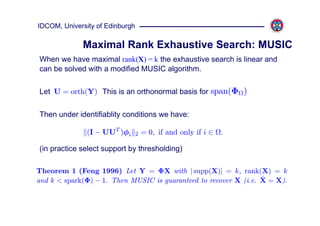
             Maximal Rank Exhaustive Search: MUSIC
When we have maximal rank(X) = k the exhaustive search is linear and
can be solved with a modified MUSIC algorithm.

Let U = orth(Y) This is an orthonormal basis for span(Φ )

Then under identifiablity conditions we have:

               (I − UUT )φi      2   = 0, if and only if i ∈ .

(in practice select support by thresholding)

Theorem 1 (Feng 1996) Let Y = ΦX with | supp(X)| = k, rank(X) = k
                                                                  ˆ
and k < spark(Φ) − 1. Then MUSIC is guaranteed to recover X (i.e. X = X).
IDCOM, University of Edinburgh


                 Maximal rank problem is not NP-hard
                 Furthermore there is no constraint on
                                  n!
IDCOM, University of Edinburgh


                           Popular MMV solutions
IDCOM, University of Edinburgh

               Popular MMV sparse recovery solutions
Two classes of MMV sparse recovery algorithm:
greedy, e.g.
   Algorithm 1 Simultaneous Orthogonal Matching Pursuit (SOMP)
    1: initialization: R(0) = Y, X(0) = 0, 0 = ∅
    2: for n = 1; n := n + 1 until stopping criterion do
    3:   in = argmaxi φT R(n−1) q
                           i
           n     n−1     n
    4:       =        ∪i
           (n)      †
    5:   X n ,: = Φ n Y
    6:   R(n) = P ⊥(n) Y where P ⊥(n) := (I − Φ (n) Φ† (n) )
    7: end for


and relaxed, e.g.

   Algorithm 2 ℓ1 /ℓq Minimization
                         ˆ
                         X = argmin ||X||1,q s.t. ΦX = Y
                                 X
IDCOM, University of Edinburgh
                  Do such MMV solutions exploit the
                               rank?
Answer: NO. [D. & Eldar 2010]
Theorem 2 (SOMP is not rank aware) Let τ be given such that 1 ≤ τ ≤ k
and suppose that
                       max ||Φ† φj ||1 > 1
                             j∈

for some support , | | = k. Then there exists an X with supp(X) =      and
rank(X) = τ that SOMP cannot recover.
                                                         SMV OMP Exact
                                                        Recovery condition

   Proof - Rank r perturbation of rank 1 problem approaches rank 1 recovery
property due to continuity norm.
IDCOM, University of Edinburgh
                  Do such MMV solutions exploit the
                               rank?
Answer: NO. [D. & Eldar 2010]
Theorem 3 (ℓ1 /ℓq minimization is not rank aware) Let τ be given such
that 1 ≤ τ ≤ k and suppose that there exists a z ∈ N (Φ) such that

                                 ||z ||1 > ||z c ||1

for some support , | | = k. Then there exists an X with supp(X) =         ,
rank(X) l=Null
   SMV 1 τ that the mixed norm solution cannot recover.
 Space Property


   Proof - Rank r perturbation of rank 1 problem approaches rank 1 recovery
property due to continuity of norm.
IDCOM, University of Edinburgh


                             Rank Aware Pursuits
IDCOM, University of Edinburgh

                            Rank Aware Selection
Aim: to select individual atoms in a similar manner to modified MUSIC

Rank Aware Selection [D. & Eldar 2010]
At the nth iteration make the following selection:

               (n)       (n−1)
                     =           ∪ argmax ||φT U(n−1) ||2
                                             i
                                      i

where U(n−1) = orth(R(n−1) )

Properties:
     1. Worst case behaviour does not approach SMV case.
     2. When rank(R) = k it always selects a correct atom as with
        MUSIC
IDCOM, University of Edinburgh

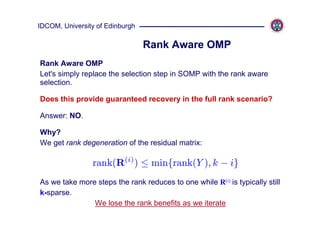
                                 Rank Aware OMP
Rank Aware OMP
Let's simply replace the selection step in SOMP with the rank aware
selection.

Does this provide guaranteed recovery in the full rank scenario?

Answer: NO.

Why?
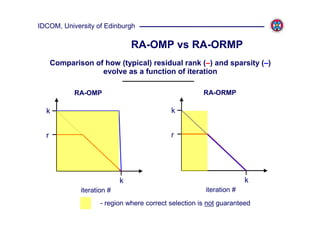
We get rank degeneration of the residual matrix:

                rank(R(i) ) ≤ min{rank(Y ), k − i}
As we take more steps the rank reduces to one while R(i) is typically still
k-sparse.
               We lose the rank benefits as we iterate
IDCOM, University of Edinburgh
               Rank Aware Order Recursive Matching
                             Pursuit
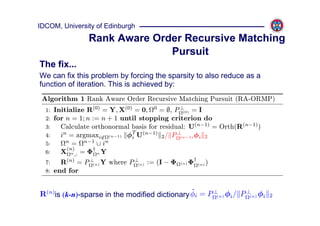
The fix...
We can fix this problem by forcing the sparsity to also reduce as a
function of iteration. This is achieved by:
 Algorithm 1 Rank Aware Order Recursive Matching Pursuit (RA-ORMP)
  1: Initialize R(0) = Y, X(0) = 0, 0 = ∅, P ⊥ = I
                                               (0)

  2: for n = 1; n := n + 1 until stopping criterion do
  3:   Calculate orthonormal basis for residual: U(n−1) = Orth(R(n−1) )
  4:   in = argmaxi∈ (n−1) φT U(n−1) 2 / P ⊥
                              i               (n−1) φi 2
         n
  5:       = n−1 ∪ in
         (n)
  6:   X n ,: = Φ† n Y
  7:   R(n) = P ⊥(n) Y where P ⊥ := (I − Φ
                                (n)          (n)   Φ† (n) )
  8: end for


                                               ˜
R(n)is (k-n)-sparse in the modified dictionary φi = P ⊥(n) φi / P ⊥(n) φi   2
IDCOM, University of Edinburgh

                                RA-OMP vs RA-ORMP
      Comparison of how (typical) residual rank (–) and sparsity (–)
                   evolve as a function of iteration

            RA-OMP                                     RA-ORMP

  k                                         k


  r                                         r


                            k                                         k
              iteration #                               iteration #
                     - region where correct selection is not guaranteed
IDCOM, University of Edinburgh
                                                               SOMP/RA-OMP/RA-ORMP
                                                                    Comparison

                                        SOMP                                                 RA−OMP                                               RA=ORMP
                             1                                                     1                                                     1
   Prob of Exact Recovery


                                                         Prob of Exact Recovery


                                                                                                               Prob of Exact Recovery
                            0.8                                                   0.8                                                   0.8

                            0.6                                                   0.6                                                   0.6

                            0.4                                                   0.4                                                   0.4

                            0.2                                                   0.2                                                   0.2

                             0                                                     0                                                     0
                                  0   10      20    30                                  0   10      20    30                                  0   10      20    30
                                       Sparsity k                                            Sparsity k                                            Sparsity k


n = 256, m = 32, l = 1,2,4,8,16,32. Dictionary ~ i.i.d. Gaussian and X
coefficients ~ Gaussian i.i.d. (note that this is beneficial to SOMP!)
IDCOM, University of Edinburgh

                                      Rank Aware OMP
Alternative Solutions
Recently two independent solutions have been proposed that are variations on
   a theme:
1. Compressive MUSIC [Kim et al 2010]
    i. perform SOMP for k-r-1 steps              but SOMP is rank blind
     ii.   apply modified MUSIC

2. Iterative MUSIC [Lee & Bresler 2010]
     1. orthogonalize: U = orth(Y )                orthogonalization is not
     2.    apply SOMP to {Φ, U } for k-r-1 steps   guaranteed beyond step 1
     3.    apply modified MUSIC

This motivates us to consider a minor modification of (2):

3 RA-OMP+MUSIC
     i.    perform RA-OMP for k-r-1 steps
     ii.   apply modified MUSIC
IDCOM, University of Edinburgh

                                 Recovery guarantee
Two nice rank aware solutions

a) Apply RA-OMP for k-r-1 steps then complete with modified MUSIC
b) Apply RA-ORMP for k steps (if first k-r steps make correct selection we
   have guaranteed recovery)

we now have the following recovery guarantee [Blanchard & D.]:
Theorem 4 (MMV CS recovery) Assume XΛ ∈ Rn×r is in general position
for some support set Λ, |Λ| = k > r and let Φ is a random matrix independent
of X, Φi,j ∼ N (0, m−1 ). Then (a) and (b) can recover X from Y with high
probability if:
                                        log N
                          m ≥ const.k          +1
                                           r

That is: as r increases the effect of the log N term diminishes
IDCOM, University of Edinburgh
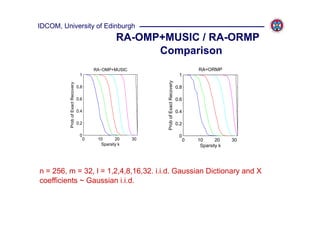
                                                       RA-OMP+MUSIC / RA-ORMP
                                                             Comparison
                                             RA−OMP+MUSIC                                           RA=ORMP
                                    1                                                      1


                                                                 Prob of Exact Recovery
          Prob of Exact Recovery


                                   0.8                                                    0.8

                                   0.6                                                    0.6

                                   0.4                                                    0.4

                                   0.2                                                    0.2

                                    0                                                      0
                                         0    10      20    30                                  0   10      20    30
                                               Sparsity k                                            Sparsity k


n = 256, m = 32, l = 1,2,4,8,16,32. i.i.d. Gaussian Dictionary and X
coefficients ~ Gaussian i.i.d.
IDCOM, University of Edinburgh

                             Empirical Phase Transitions
                                        RA−OMP+MUSIC 16 16
                                          RA−ORMPl l= 16=
                                           RA−OMP = 16 l
                                            SOMP l =
                    50

                    45

                    40

                    35

                    30
                m


                    25

                    20

                    15

                    10

                     5


                         5    10   15     20   25   30       35   40   45   50
                                                k


        Gaussian dictionary "phase transitions" with Gaussian
                       significant coefficients
IDCOM, University of Edinburgh
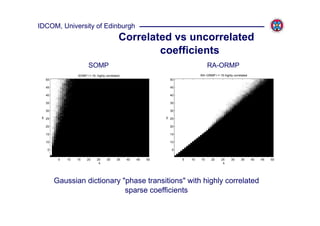
                                              Correlated vs uncorrelated
                                                      coefficients
                          SOMP                                                          RA-ORMP
                              SOMP l = 16                                                RA−ORMP l = 16
     50                                                              50

     45                                                              45

     40                                                              40

     35                                                              35

     30                                                              30
 m


                                                                 m
     25                                                              25

     20                                                              20

     15                                                              15

     10                                                              10

      5                                                               5


          5    10   15   20      25     30   35   40   45   50            5   10   15   20    25    30    35   40   45   50
                                  k                                                            k


              Gaussian dictionary "phase transitions" with uncorrelated
                                sparse coefficients
IDCOM, University of Edinburgh
                                                 Correlated vs uncorrelated
                                                         coefficients
                           SOMP                                                            RA-ORMP
                    SOMP l = 16, highly correlated                                    RA−ORMP l = 16 highly correlated
     50                                                                 50

     45                                                                 45

     40                                                                 40

     35                                                                 35

     30                                                                 30
 m


                                                                    m
     25                                                                 25

     20                                                                 20

     15                                                                 15

     10                                                                 10

      5                                                                  5


           5   10   15    20     25     30      35   40   45   50            5   10   15     20     25    30     35      40   45   50
                                  k                                                                  k


          Gaussian dictionary "phase transitions" with highly correlated
                               sparse coefficients
IDCOM, University of Edinburgh

                                  Summary


• MMV problem is easier than SMV problem in general
• Don't dismiss using exhaustive search (not always NP-hard!)
• Good rank aware greedy algorithms exist

Questions
• Can we extend these ideas to IHT or CoSaMP?
• How can we incorporate rank awareness into convex optimization?
IDCOM, University of Edinburgh

                 Workshop : Signal Processing with Adaptive Sparse
                       Structured Representations (SPARS '11)
                     June 27-30, 2011 - Edinburgh, (Scotland, UK)


                            Plenary speakers :

                 David L. Donoho, Stanford University, USA
                     Martin Vetterli, EPFL, Switzerland
              Stephen J. Wright, University of Wisconsin, USA
               David J. Brady, Duke University, Durham, USA
           Yi Ma, University of Illinois at Urbana-Champaign, USA
             Joel Tropp, California Institute of Technology, USA
        Remi Gribonval, Centre de Recherche INRIA Rennes, France
        Francis Bach, Laboratoire d'Informatique de l'E.N.S., France

Rank awarealgs small11

  • 1.
    IDCOM, University ofEdinburgh Rank Aware Algorithms for Joint Sparse Recovery Mike Davies* Joint work with Yonina Eldar‡ and Jeff Blanchard† * Institute of Digital Communications, University of Edinburgh ‡ Technion, Israel † Grinnell College, USA
  • 2.
    IDCOM, University ofEdinburgh Outline of Talk • Multiple Measurements vs Single Measurements • Nec.+suff. conditions for Joint Sparse Recovery • Reduced complexity combinatorial search • Classical approaches to sparse MMV problem – How good are SOMP and convex optimization? • Rank Aware Pursuits – Evolution of the rank of residual matrices – A recovery guarantee • Empirical simulations
  • 3.
    IDCOM, University ofEdinburgh Sparse Single Measurement Vector Problem m x1 mxn n x1 Measurements Measurement Matrix Sparse Signal k nonzero elements Given y ∈ Rm and Φ ∈ Rm×n with m < n find: x = argmin | supp(x)| s.t. Φx = y. ˆ x
  • 4.
    IDCOM, University ofEdinburgh Sparse Multiple Measurement Vector Problem m×l m×n n×l Measurement Measurements Matrix row support Sparse Signal k nonzero rows Given Y ∈ Rm×l and Φ ∈ Rm×n with m < n find: ˆ X = argmin | supp(X)| s.t. ΦX = Y. X
  • 5.
    IDCOM, University ofEdinburgh MMV uniqueness Worst Case • Uniqueness of solution for sparse MMV problem is equivalent to that for SMV problem. Simply replicate SMV problem: X = {x, x, . . . , x} Hence nec. + suff. condition to uniquely determine each k-sparse vector x is given by SMV condition: spark(Φ) | supp(X)| = k < 2 Rank 'r' Case • If Rank(Y)=r then the necessary + sufficient conditions are less restrictive [Chen & Huo 2006, D. & Eldar 2010]: spark(Φ) − 1 + rank(Y) | supp(X)| = k < 2 Equivalently we can replace rank(Y) with rank(X). More measurements (higher rank) makes recovery easier!
  • 6.
    IDCOM, University ofEdinburgh MMV uniqueness Generic scenario: Typical matrices achieve maximal spark: Φ ∈ Rm×n → spark(Φ) = m + 1 Typical matrices achieve maximal rank X ∈ Rk×l → rank(X) = r = min{k, l} Hence generically we have uniqueness if m ≥ 2k − min{k, l} + 1 ≥ k + 1 When l ≥ k we typically only need k+1 measurements
  • 7.
    IDCOM, University ofEdinburgh Exhaustive search solution How does the rank change the exhaustive search? SMV exhaustive search: find , | | = k s.t. ΦX = Y However since span(Y) ⊂ span(Φ ) and rank(Y) = r ∃γ⊂ , |γ| = k − r s.t. span([Φγ , Y ]) = span(Φ ) n In fact we have a reduced k−r+1 combinatorial search.
  • 8.
    IDCOM, University ofEdinburgh Geometric Picture for MMV φ1 φ2 Y = ΦΛ XΛ,: φ3 2−sparse vector ∈ span(Y ) span(Y ) If X is k-sparse and rank(Y) = r there exists a (k-r+1)-sparse vector in span(Y)
  • 9.
    IDCOM, University ofEdinburgh Maximal Rank Exhaustive Search: MUSIC When we have maximal rank(X) = k the exhaustive search is linear and can be solved with a modified MUSIC algorithm. Let U = orth(Y) This is an orthonormal basis for span(Φ ) Then under identifiablity conditions we have: (I − UUT )φi 2 = 0, if and only if i ∈ . (in practice select support by thresholding) Theorem 1 (Feng 1996) Let Y = ΦX with | supp(X)| = k, rank(X) = k ˆ and k < spark(Φ) − 1. Then MUSIC is guaranteed to recover X (i.e. X = X).
  • 10.
    IDCOM, University ofEdinburgh Maximal rank problem is not NP-hard Furthermore there is no constraint on n!
  • 11.
    IDCOM, University ofEdinburgh Popular MMV solutions
  • 12.
    IDCOM, University ofEdinburgh Popular MMV sparse recovery solutions Two classes of MMV sparse recovery algorithm: greedy, e.g. Algorithm 1 Simultaneous Orthogonal Matching Pursuit (SOMP) 1: initialization: R(0) = Y, X(0) = 0, 0 = ∅ 2: for n = 1; n := n + 1 until stopping criterion do 3: in = argmaxi φT R(n−1) q i n n−1 n 4: = ∪i (n) † 5: X n ,: = Φ n Y 6: R(n) = P ⊥(n) Y where P ⊥(n) := (I − Φ (n) Φ† (n) ) 7: end for and relaxed, e.g. Algorithm 2 ℓ1 /ℓq Minimization ˆ X = argmin ||X||1,q s.t. ΦX = Y X
  • 13.
    IDCOM, University ofEdinburgh Do such MMV solutions exploit the rank? Answer: NO. [D. & Eldar 2010] Theorem 2 (SOMP is not rank aware) Let τ be given such that 1 ≤ τ ≤ k and suppose that max ||Φ† φj ||1 > 1 j∈ for some support , | | = k. Then there exists an X with supp(X) = and rank(X) = τ that SOMP cannot recover. SMV OMP Exact Recovery condition Proof - Rank r perturbation of rank 1 problem approaches rank 1 recovery property due to continuity norm.
  • 14.
    IDCOM, University ofEdinburgh Do such MMV solutions exploit the rank? Answer: NO. [D. & Eldar 2010] Theorem 3 (ℓ1 /ℓq minimization is not rank aware) Let τ be given such that 1 ≤ τ ≤ k and suppose that there exists a z ∈ N (Φ) such that ||z ||1 > ||z c ||1 for some support , | | = k. Then there exists an X with supp(X) = , rank(X) l=Null SMV 1 τ that the mixed norm solution cannot recover. Space Property Proof - Rank r perturbation of rank 1 problem approaches rank 1 recovery property due to continuity of norm.
  • 15.
    IDCOM, University ofEdinburgh Rank Aware Pursuits
  • 16.
    IDCOM, University ofEdinburgh Rank Aware Selection Aim: to select individual atoms in a similar manner to modified MUSIC Rank Aware Selection [D. & Eldar 2010] At the nth iteration make the following selection: (n) (n−1) = ∪ argmax ||φT U(n−1) ||2 i i where U(n−1) = orth(R(n−1) ) Properties: 1. Worst case behaviour does not approach SMV case. 2. When rank(R) = k it always selects a correct atom as with MUSIC
  • 17.
    IDCOM, University ofEdinburgh Rank Aware OMP Rank Aware OMP Let's simply replace the selection step in SOMP with the rank aware selection. Does this provide guaranteed recovery in the full rank scenario? Answer: NO. Why? We get rank degeneration of the residual matrix: rank(R(i) ) ≤ min{rank(Y ), k − i} As we take more steps the rank reduces to one while R(i) is typically still k-sparse. We lose the rank benefits as we iterate
  • 18.
    IDCOM, University ofEdinburgh Rank Aware Order Recursive Matching Pursuit The fix... We can fix this problem by forcing the sparsity to also reduce as a function of iteration. This is achieved by: Algorithm 1 Rank Aware Order Recursive Matching Pursuit (RA-ORMP) 1: Initialize R(0) = Y, X(0) = 0, 0 = ∅, P ⊥ = I (0) 2: for n = 1; n := n + 1 until stopping criterion do 3: Calculate orthonormal basis for residual: U(n−1) = Orth(R(n−1) ) 4: in = argmaxi∈ (n−1) φT U(n−1) 2 / P ⊥ i (n−1) φi 2 n 5: = n−1 ∪ in (n) 6: X n ,: = Φ† n Y 7: R(n) = P ⊥(n) Y where P ⊥ := (I − Φ (n) (n) Φ† (n) ) 8: end for ˜ R(n)is (k-n)-sparse in the modified dictionary φi = P ⊥(n) φi / P ⊥(n) φi 2
  • 19.
    IDCOM, University ofEdinburgh RA-OMP vs RA-ORMP Comparison of how (typical) residual rank (–) and sparsity (–) evolve as a function of iteration RA-OMP RA-ORMP k k r r k k iteration # iteration # - region where correct selection is not guaranteed
  • 20.
    IDCOM, University ofEdinburgh SOMP/RA-OMP/RA-ORMP Comparison SOMP RA−OMP RA=ORMP 1 1 1 Prob of Exact Recovery Prob of Exact Recovery Prob of Exact Recovery 0.8 0.8 0.8 0.6 0.6 0.6 0.4 0.4 0.4 0.2 0.2 0.2 0 0 0 0 10 20 30 0 10 20 30 0 10 20 30 Sparsity k Sparsity k Sparsity k n = 256, m = 32, l = 1,2,4,8,16,32. Dictionary ~ i.i.d. Gaussian and X coefficients ~ Gaussian i.i.d. (note that this is beneficial to SOMP!)
  • 21.
    IDCOM, University ofEdinburgh Rank Aware OMP Alternative Solutions Recently two independent solutions have been proposed that are variations on a theme: 1. Compressive MUSIC [Kim et al 2010] i. perform SOMP for k-r-1 steps but SOMP is rank blind ii. apply modified MUSIC 2. Iterative MUSIC [Lee & Bresler 2010] 1. orthogonalize: U = orth(Y ) orthogonalization is not 2. apply SOMP to {Φ, U } for k-r-1 steps guaranteed beyond step 1 3. apply modified MUSIC This motivates us to consider a minor modification of (2): 3 RA-OMP+MUSIC i. perform RA-OMP for k-r-1 steps ii. apply modified MUSIC
  • 22.
    IDCOM, University ofEdinburgh Recovery guarantee Two nice rank aware solutions a) Apply RA-OMP for k-r-1 steps then complete with modified MUSIC b) Apply RA-ORMP for k steps (if first k-r steps make correct selection we have guaranteed recovery) we now have the following recovery guarantee [Blanchard & D.]: Theorem 4 (MMV CS recovery) Assume XΛ ∈ Rn×r is in general position for some support set Λ, |Λ| = k > r and let Φ is a random matrix independent of X, Φi,j ∼ N (0, m−1 ). Then (a) and (b) can recover X from Y with high probability if: log N m ≥ const.k +1 r That is: as r increases the effect of the log N term diminishes
  • 23.
    IDCOM, University ofEdinburgh RA-OMP+MUSIC / RA-ORMP Comparison RA−OMP+MUSIC RA=ORMP 1 1 Prob of Exact Recovery Prob of Exact Recovery 0.8 0.8 0.6 0.6 0.4 0.4 0.2 0.2 0 0 0 10 20 30 0 10 20 30 Sparsity k Sparsity k n = 256, m = 32, l = 1,2,4,8,16,32. i.i.d. Gaussian Dictionary and X coefficients ~ Gaussian i.i.d.
  • 24.
    IDCOM, University ofEdinburgh Empirical Phase Transitions RA−OMP+MUSIC 16 16 RA−ORMPl l= 16= RA−OMP = 16 l SOMP l = 50 45 40 35 30 m 25 20 15 10 5 5 10 15 20 25 30 35 40 45 50 k Gaussian dictionary "phase transitions" with Gaussian significant coefficients
  • 25.
    IDCOM, University ofEdinburgh Correlated vs uncorrelated coefficients SOMP RA-ORMP SOMP l = 16 RA−ORMP l = 16 50 50 45 45 40 40 35 35 30 30 m m 25 25 20 20 15 15 10 10 5 5 5 10 15 20 25 30 35 40 45 50 5 10 15 20 25 30 35 40 45 50 k k Gaussian dictionary "phase transitions" with uncorrelated sparse coefficients
  • 26.
    IDCOM, University ofEdinburgh Correlated vs uncorrelated coefficients SOMP RA-ORMP SOMP l = 16, highly correlated RA−ORMP l = 16 highly correlated 50 50 45 45 40 40 35 35 30 30 m m 25 25 20 20 15 15 10 10 5 5 5 10 15 20 25 30 35 40 45 50 5 10 15 20 25 30 35 40 45 50 k k Gaussian dictionary "phase transitions" with highly correlated sparse coefficients
  • 27.
    IDCOM, University ofEdinburgh Summary • MMV problem is easier than SMV problem in general • Don't dismiss using exhaustive search (not always NP-hard!) • Good rank aware greedy algorithms exist Questions • Can we extend these ideas to IHT or CoSaMP? • How can we incorporate rank awareness into convex optimization?
  • 28.
    IDCOM, University ofEdinburgh Workshop : Signal Processing with Adaptive Sparse Structured Representations (SPARS '11) June 27-30, 2011 - Edinburgh, (Scotland, UK) Plenary speakers : David L. Donoho, Stanford University, USA Martin Vetterli, EPFL, Switzerland Stephen J. Wright, University of Wisconsin, USA David J. Brady, Duke University, Durham, USA Yi Ma, University of Illinois at Urbana-Champaign, USA Joel Tropp, California Institute of Technology, USA Remi Gribonval, Centre de Recherche INRIA Rennes, France Francis Bach, Laboratoire d'Informatique de l'E.N.S., France