Conflict, Cooperation and
Negotiation
Conflict
&
Collaboration
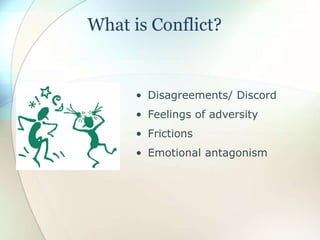
What is Conflict?
• Disagreements/ Discord
• Feelings of adversity
• Frictions
• Emotional antagonism
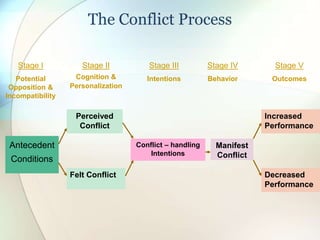
The Conflict Process
Perceived
Conflict
Antecedent
Conditions
Felt Conflict
Manifest
Conflict
Conflict – handling
Intentions
Increased
Performance
Decreased
Performance
Stage I
Potential
Opposition &
Incompatibility
Stage V
Outcomes
Stage II
Cognition &
Personalization
Stage III
Intentions
Stage IV
Behavior
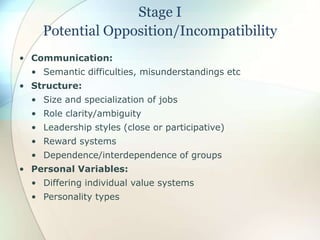
Stage I
Potential Opposition/Incompatibility
• Communication:
• Semantic difficulties, misunderstandings etc
• Structure:
• Size and specialization of jobs
• Role clarity/ambiguity
• Leadership styles (close or participative)
• Reward systems
• Dependence/interdependence of groups
• Personal Variables:
• Differing individual value systems
• Personality types
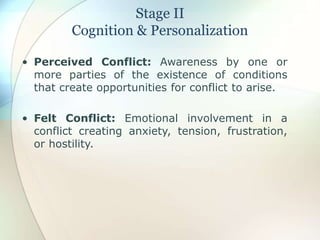
Stage II
Cognition & Personalization
• Perceived Conflict: Awareness by one or
more parties of the existence of conditions
that create opportunities for conflict to arise.
• Felt Conflict: Emotional involvement in a
conflict creating anxiety, tension, frustration,
or hostility.
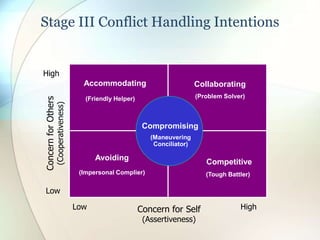
Stage III Conflict Handling Intentions
High
Low
High
Low
Concern
for
Others
(Cooperativeness)
Concern for Self
(Assertiveness)
Collaborating
(Problem Solver)
Competitive
(Tough Battler)
Avoiding
(Impersonal Complier)
Accommodating
(Friendly Helper)
Compromising
(Maneuvering
Conciliator)
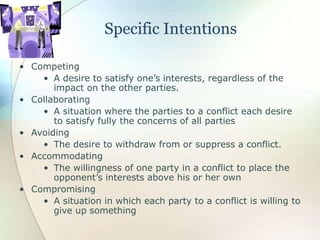
Specific Intentions
• Competing
• A desire to satisfy one’s interests, regardless of the
impact on the other parties.
• Collaborating
• A situation where the parties to a conflict each desire
to satisfy fully the concerns of all parties
• Avoiding
• The desire to withdraw from or suppress a conflict.
• Accommodating
• The willingness of one party in a conflict to place the
opponent’s interests above his or her own
• Compromising
• A situation in which each party to a conflict is willing to
give up something
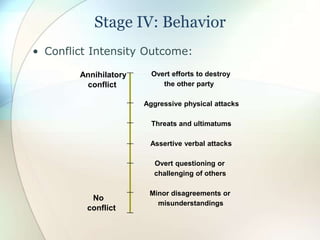
Stage IV: Behavior
• Conflict Intensity Outcome:
Annihilatory
conflict
No
conflict
Overt efforts to destroy
the other party
Aggressive physical attacks
Threats and ultimatums
Assertive verbal attacks
Overt questioning or
challenging of others
Minor disagreements or
misunderstandings
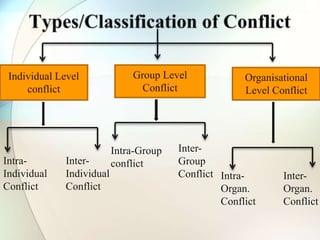
Individual Level
conflict
Group Level
Conflict
Organisational
Level Conflict
Intra-
Individual
Conflict
Inter-
Individual
Conflict
Intra-Group
conflict
Inter-
Group
Conflict Intra-
Organ.
Conflict
Inter-
Organ.
Conflict
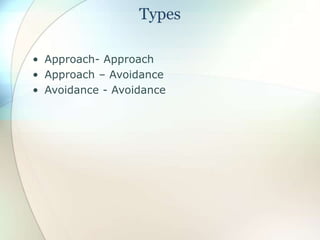
Types
• Approach- Approach
• Approach – Avoidance
• Avoidance - Avoidance
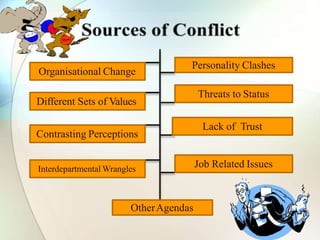
Organisational Change
Personality Clashes
Different Sets of Values
Threats to Status
Contrasting Perceptions
Lack of Trust
Interdepartmental Wrangles Job Related Issues
OtherAgendas
Conflict Management
• Conflict Management
The use of resolution and stimulation
techniques to achieve the desired level of
conflict.
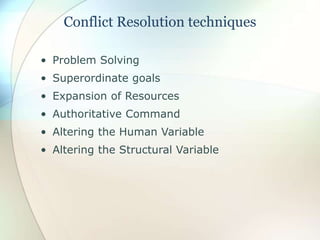
Conflict Resolution techniques
• Problem Solving
• Superordinate goals
• Expansion of Resources
• Authoritative Command
• Altering the Human Variable
• Altering the Structural Variable
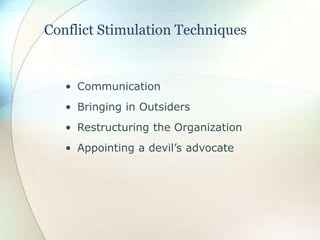
Conflict Stimulation Techniques
• Communication
• Bringing in Outsiders
• Restructuring the Organization
• Appointing a devil’s advocate
Outcomes of Conflict
• Conflicts can result in two
types of outcomes
• Functional: Supports
the goals of the group
and improves its
performance
• Dysfunctional: Hinders
group performance
Prentice Hall, 2001 17
Unit
Performance
High
Low Level of Conflict High
A B C
Situation
A
B
C
Conflict Level Conflict Type Internal Characteristics Outcomes
Low or none
Optimal
High
Dysfunctional
Functional
Dysfunctional
Apathetic, stagnant
Viable, innovative
Disruptive, chaotic
Low
High
Low
Conflict & Performance
Negotiation
“A process in which two or more parties attempt
to reach acceptable agreement in a situation
characterized by some level of disagreement.”
“A give-and-take decision-making process
involving interdependent parties with different
preferences.”
Distributive Bargaining
• Classical view that negotiations are a form of a
zero-sum game
• to whatever extent one party wins something, the
other party loses
• the process of “distributing” scarce resources
• Deal Focused
• Win – Lose Negotiation
Integrative Bargaining
• A positive-sum approach
• Situations where each party gains without a
corresponding loss for the other party
• Does not mean that everyone gets everything
they wanted
• An agreement has been achieved which leaves
all parties better off than they were prior to the
agreement
• Relationship focused
• Win- win Negotiation
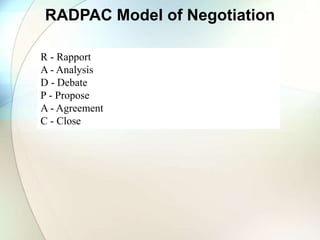
RADPAC Model of Negotiation
R - Rapport
A - Analysis
D - Debate
P - Propose
A - Agreement
C - Close
BARGAINING
• Bargaining is about focusing on who is right.
It is competitive and win-lose. Negotiation is about
focusing on what is right. It is cooperative and win-
win.
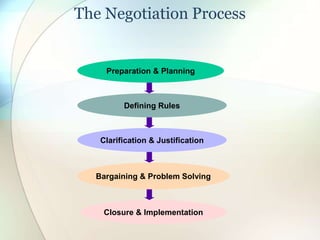
The Negotiation Process
Preparation & Planning
Defining Rules
Clarification & Justification
Bargaining & Problem Solving
Closure & Implementation
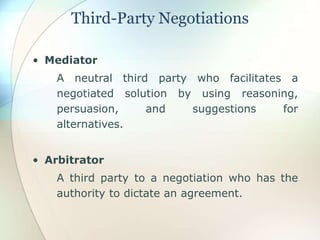
Third-Party Negotiations
• Mediator
A neutral third party who facilitates a
negotiated solution by using reasoning,
persuasion, and suggestions for
alternatives.
• Arbitrator
A third party to a negotiation who has the
authority to dictate an agreement.
Third-Party Negotiations (cont’d)
• Conciliator
A trusted third party who provides an
informal communication link between the
negotiator and the opponent.
• Consultant
An impartial third party, skilled in conflict
management, who attempts to facilitate
creative problem solving through
communication and analysis.

Lec Conflict, Cooperation and Negotiation.ppt

  • 1.
  • 2.
  • 3.
    What is Conflict? •Disagreements/ Discord • Feelings of adversity • Frictions • Emotional antagonism
  • 4.
    The Conflict Process Perceived Conflict Antecedent Conditions FeltConflict Manifest Conflict Conflict – handling Intentions Increased Performance Decreased Performance Stage I Potential Opposition & Incompatibility Stage V Outcomes Stage II Cognition & Personalization Stage III Intentions Stage IV Behavior
  • 5.
    Stage I Potential Opposition/Incompatibility •Communication: • Semantic difficulties, misunderstandings etc • Structure: • Size and specialization of jobs • Role clarity/ambiguity • Leadership styles (close or participative) • Reward systems • Dependence/interdependence of groups • Personal Variables: • Differing individual value systems • Personality types
  • 6.
    Stage II Cognition &Personalization • Perceived Conflict: Awareness by one or more parties of the existence of conditions that create opportunities for conflict to arise. • Felt Conflict: Emotional involvement in a conflict creating anxiety, tension, frustration, or hostility.
  • 7.
    Stage III ConflictHandling Intentions High Low High Low Concern for Others (Cooperativeness) Concern for Self (Assertiveness) Collaborating (Problem Solver) Competitive (Tough Battler) Avoiding (Impersonal Complier) Accommodating (Friendly Helper) Compromising (Maneuvering Conciliator)
  • 8.
    Specific Intentions • Competing •A desire to satisfy one’s interests, regardless of the impact on the other parties. • Collaborating • A situation where the parties to a conflict each desire to satisfy fully the concerns of all parties • Avoiding • The desire to withdraw from or suppress a conflict. • Accommodating • The willingness of one party in a conflict to place the opponent’s interests above his or her own • Compromising • A situation in which each party to a conflict is willing to give up something
  • 9.
    Stage IV: Behavior •Conflict Intensity Outcome: Annihilatory conflict No conflict Overt efforts to destroy the other party Aggressive physical attacks Threats and ultimatums Assertive verbal attacks Overt questioning or challenging of others Minor disagreements or misunderstandings
  • 10.
    Individual Level conflict Group Level Conflict Organisational LevelConflict Intra- Individual Conflict Inter- Individual Conflict Intra-Group conflict Inter- Group Conflict Intra- Organ. Conflict Inter- Organ. Conflict
  • 11.
    Types • Approach- Approach •Approach – Avoidance • Avoidance - Avoidance
  • 12.
    Organisational Change Personality Clashes DifferentSets of Values Threats to Status Contrasting Perceptions Lack of Trust Interdepartmental Wrangles Job Related Issues OtherAgendas
  • 13.
    Conflict Management • ConflictManagement The use of resolution and stimulation techniques to achieve the desired level of conflict.
  • 14.
    Conflict Resolution techniques •Problem Solving • Superordinate goals • Expansion of Resources • Authoritative Command • Altering the Human Variable • Altering the Structural Variable
  • 15.
    Conflict Stimulation Techniques •Communication • Bringing in Outsiders • Restructuring the Organization • Appointing a devil’s advocate
  • 16.
    Outcomes of Conflict •Conflicts can result in two types of outcomes • Functional: Supports the goals of the group and improves its performance • Dysfunctional: Hinders group performance
  • 17.
    Prentice Hall, 200117 Unit Performance High Low Level of Conflict High A B C Situation A B C Conflict Level Conflict Type Internal Characteristics Outcomes Low or none Optimal High Dysfunctional Functional Dysfunctional Apathetic, stagnant Viable, innovative Disruptive, chaotic Low High Low Conflict & Performance
  • 18.
    Negotiation “A process inwhich two or more parties attempt to reach acceptable agreement in a situation characterized by some level of disagreement.” “A give-and-take decision-making process involving interdependent parties with different preferences.”
  • 19.
    Distributive Bargaining • Classicalview that negotiations are a form of a zero-sum game • to whatever extent one party wins something, the other party loses • the process of “distributing” scarce resources • Deal Focused • Win – Lose Negotiation
  • 20.
    Integrative Bargaining • Apositive-sum approach • Situations where each party gains without a corresponding loss for the other party • Does not mean that everyone gets everything they wanted • An agreement has been achieved which leaves all parties better off than they were prior to the agreement • Relationship focused • Win- win Negotiation
  • 21.
    RADPAC Model ofNegotiation R - Rapport A - Analysis D - Debate P - Propose A - Agreement C - Close
  • 22.
    BARGAINING • Bargaining isabout focusing on who is right. It is competitive and win-lose. Negotiation is about focusing on what is right. It is cooperative and win- win.
  • 23.
    The Negotiation Process Preparation& Planning Defining Rules Clarification & Justification Bargaining & Problem Solving Closure & Implementation
  • 24.
    Third-Party Negotiations • Mediator Aneutral third party who facilitates a negotiated solution by using reasoning, persuasion, and suggestions for alternatives. • Arbitrator A third party to a negotiation who has the authority to dictate an agreement.
  • 25.
    Third-Party Negotiations (cont’d) •Conciliator A trusted third party who provides an informal communication link between the negotiator and the opponent. • Consultant An impartial third party, skilled in conflict management, who attempts to facilitate creative problem solving through communication and analysis.