Organizational Behavior
Nineteenth Edition
Chapter 18
Conflict and Negotiation
Copyright © 2023, 2019, 2017 Pearson Education, Inc. All Rights Reserved
Learning Objectives
14.1 Describe the three types of conflict and the three loci of
conflict.
14.2 Outline the conflict process.
14.3 Contrast distributive and integrative bargaining.
14.4 Apply the five steps of the negotiation process.
14.5 Show how individual differences influence negotiations.
14.6 Describe the social factors that influence negotiations.
14.7 Assess the roles and functions of third-party
negotiations.
Copyright © 2023, 2019, 2017 Pearson Education, Inc. All Rights Reserved
Three Types of Conflict and Three
Loci of Conflict (1 of 7)
• Conflict: a process that begins when one party perceives
that another party has negatively affected, or is about to
negatively affect, something that the first party cares
about.
– The absence of conflict altogether can be a signal that
perhaps important issues are not being discussed or
that controversial ideas are not be challenged.
Copyright © 2023, 2019, 2017 Pearson Education, Inc. All Rights Reserved
Three Types of Conflict and Three
Loci of Conflict (2 of 7)
• Contemporary perspectives differentiate types of conflict
based on their effects.
– Functional conflict supports the goals of the group
and improves its performance.
– Conflicts that hinder group performance are
dysfunctional or destructive forms of conflict.
Copyright © 2023, 2019, 2017 Pearson Education, Inc. All Rights Reserved
Three Types of Conflict and Three
Loci of Conflict (3 of 7)
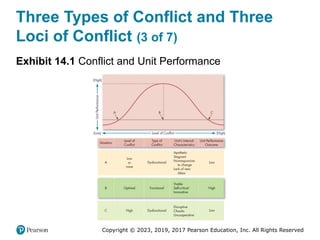
Exhibit 14.1 Conflict and Unit Performance
Copyright © 2023, 2019, 2017 Pearson Education, Inc. All Rights Reserved
Three Types of Conflict and Three
Loci of Conflict (4 of 7)
• Loci of Conflict
– Another way to understand conflict is to consider its
locus, or where the conflict occurs.
– There are three basic types:
 Dyadic conflict is conflict between two people.
 Intragroup conflict occurs within a group or team.
 Intergroup conflict is conflict between groups or
teams.
Copyright © 2023, 2019, 2017 Pearson Education, Inc. All Rights Reserved
Three Types of Conflict and Three
Loci of Conflict (5 of 7)
• Types of Conflict
– Researchers have classified conflicts into three
categories:
 Task conflict relates to the content and goals of the
work.
 Relationship conflict focuses on interpersonal
relationships.
 Process conflict is about how the work gets done.
Copyright © 2023, 2019, 2017 Pearson Education, Inc. All Rights Reserved
Three Types of Conflict and Three
Loci of Conflict (6 of 7)
• Cognition and Personalization
– Perceived conflict: Awareness by one or more
parties of the existence of or conditions that create
opportunities for conflict.
– Felt conflict: Emotional involvement in a conflict that
creates anxiety, tenseness, frustration, or hostility.
Copyright © 2023, 2019, 2017 Pearson Education, Inc. All Rights Reserved
Three Types of Conflict and Three
Loci of Conflict (7 of 7)
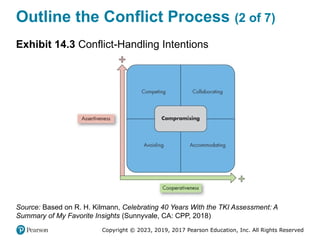
• Intentions: decisions to act in a given way.
– Competing
– Collaborating
– Avoiding
– Accommodating
– Compromising
Copyright © 2023, 2019, 2017 Pearson Education, Inc. All Rights Reserved
Outline the Conflict Process (1 of 7)
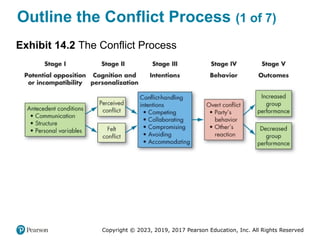
Exhibit 14.2 The Conflict Process
Copyright © 2023, 2019, 2017 Pearson Education, Inc. All Rights Reserved
Outline the Conflict Process (2 of 7)
Exhibit 14.3 Conflict-Handling Intentions
Source: Based on R. H. Kilmann, Celebrating 40 Years With the TKI Assessment: A
Summary of My Favorite Insights (Sunnyvale, CA: CPP, 2018)
Copyright © 2023, 2019, 2017 Pearson Education, Inc. All Rights Reserved
Outline the Conflict Process (3 of 7)
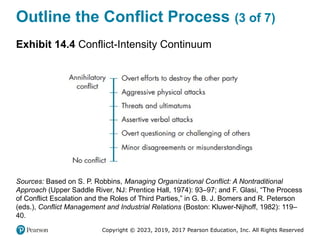
Exhibit 14.4 Conflict-Intensity Continuum
Sources: Based on S. P. Robbins, Managing Organizational Conflict: A Nontraditional
Approach (Upper Saddle River, NJ: Prentice Hall, 1974): 93–97; and F. Glasi, “The Process
of Conflict Escalation and the Roles of Third Parties,” in G. B. J. Bomers and R. Peterson
(eds.), Conflict Management and Industrial Relations (Boston: Kluwer-Nijhoff, 1982): 119–
40.
Copyright © 2023, 2019, 2017 Pearson Education, Inc. All Rights Reserved
Outline the Conflict Process (4 of 7)
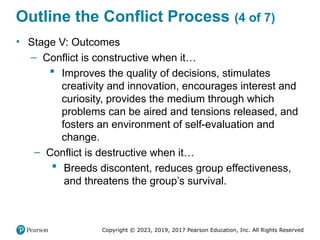
• Stage V: Outcomes
– Conflict is constructive when it…
 Improves the quality of decisions, stimulates
creativity and innovation, encourages interest and
curiosity, provides the medium through which
problems can be aired and tensions released, and
fosters an environment of self-evaluation and
change.
– Conflict is destructive when it…
 Breeds discontent, reduces group effectiveness,
and threatens the group’s survival.
Copyright © 2023, 2019, 2017 Pearson Education, Inc. All Rights Reserved
Outline the Conflict Process (5 of 7)
• Conflict management: the use of resolution and
stimulation techniques to achieve the desired level of
conflict.
• Minimizing counterproductive conflicts requires:
– Recognizing when there really is a disagreement.
 Many apparent conflicts are due to people using
different language to discuss the same general
course of action.
– Focusing on satisfying top needs.
 Neither side may get exactly what it wants, but each
side will achieve the most important parts of its
agenda.
Copyright © 2023, 2019, 2017 Pearson Education, Inc. All Rights Reserved
Outline the Conflict Process (6 of 7)
• Groups that resolve conflicts successfully discuss
differences of opinion openly.
– The most disruptive conflicts are those that are never
addressed directly.
• Managers need to emphasize shared interests in resolving
conflicts.
– Groups with cooperative conflict styles and an
underlying identification to group goals are more
effective than groups with a more competitive style.
Copyright © 2023, 2019, 2017 Pearson Education, Inc. All Rights Reserved
Outline the Conflict Process (7 of 7)
• Differences across countries in conflict resolution
strategies may be based on collectivistic tendencies and
motives.
– Collectivist cultures see people as deeply embedded in
social situations.
– They will avoid direct expression of conflicts, preferring
indirect methods for resolving differences of opinion.
Copyright © 2023, 2019, 2017 Pearson Education, Inc. All Rights Reserved
Contrast Distributive and Integrative
Bargaining (1 of 5)
• Negotiation is a process in which two or more parties
exchange goods or services and attempt to agree upon the
exchange rate for them.
– We use the terms negotiation and bargaining
interchangeably.
Copyright © 2023, 2019, 2017 Pearson Education, Inc. All Rights Reserved
Contrast Distributive and Integrative
Bargaining (2 of 5)
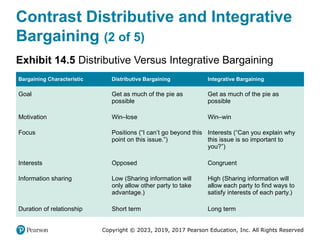
Exhibit 14.5 Distributive Versus Integrative Bargaining
Bargaining Characteristic Distributive Bargaining Integrative Bargaining
Goal Get as much of the pie as
possible
Get as much of the pie as
possible
Motivation Win–lose Win–win
Focus Positions (“I can’t go beyond this
point on this issue.”)
Interests (“Can you explain why
this issue is so important to
you?”)
Interests Opposed Congruent
Information sharing Low (Sharing information will
only allow other party to take
advantage.)
High (Sharing information will
allow each party to find ways to
satisfy interests of each party.)
Duration of relationship Short term Long term
Copyright © 2023, 2019, 2017 Pearson Education, Inc. All Rights Reserved
Contrast Distributive and Integrative
Bargaining (3 of 5)
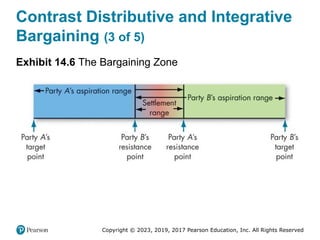
Exhibit 14.6 The Bargaining Zone
Copyright © 2023, 2019, 2017 Pearson Education, Inc. All Rights Reserved
Contrast Distributive and Integrative
Bargaining (4 of 5)
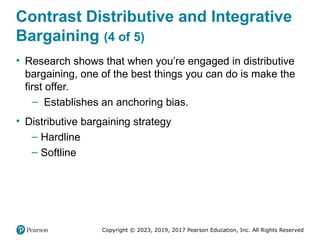
• Research shows that when you’re engaged in distributive
bargaining, one of the best things you can do is make the
first offer.
– Establishes an anchoring bias.
• Distributive bargaining strategy
– Hardline
– Softline
Copyright © 2023, 2019, 2017 Pearson Education, Inc. All Rights Reserved
Contrast Distributive and Integrative
Bargaining (5 of 5)
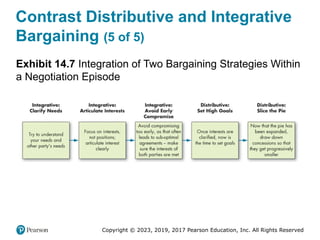
Exhibit 14.7 Integration of Two Bargaining Strategies Within
a Negotiation Episode
Copyright © 2023, 2019, 2017 Pearson Education, Inc. All Rights Reserved
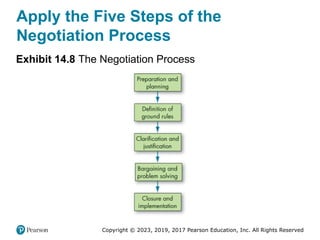
Apply the Five Steps of the
Negotiation Process
Exhibit 14.8 The Negotiation Process
Copyright © 2023, 2019, 2017 Pearson Education, Inc. All Rights Reserved
How Individual Differences Influence
Negotiations (1 of 4)
• Personality Traits in Negotiations
– Can you predict an opponent’s negotiating tactics if
you know something about his/her personality?
 The evidence says “sort of.”
• Moods/Emotions in Negotiations
– Influence negotiation, but the way they do appears to
depend on the type of negotiation.
Copyright © 2023, 2019, 2017 Pearson Education, Inc. All Rights Reserved
How Individual Differences Influence
Negotiations (2 of 4)
• Culture in Negotiations
– Do people from different cultures negotiate differently?
Yes, they do.
 People generally negotiate more effectively within
cultures than between them.
 In cross-cultural negotiations, it is especially
important that the negotiators be high in openness.
 People are more likely to use certain negotiation
strategies depending on what culture they belong to.
 Negotiators need to be especially aware of the
emotional dynamics in cross-cultural negotiation.
Copyright © 2023, 2019, 2017 Pearson Education, Inc. All Rights Reserved
How Individual Differences Influence
Negotiations (3 of 4)
• Gender in Negotiations
– Men and women negotiate differently, and these
differences affect outcomes.
 Compared to men, women tend to behave in a
slightly less assertive, less self-interested, more
cooperative and concessional manner.
Copyright © 2023, 2019, 2017 Pearson Education, Inc. All Rights Reserved
How Individual Differences Influence
Negotiations (4 of 4)
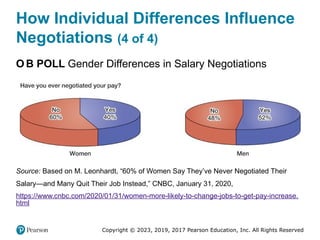
O B POLL Gender Differences in Salary Negotiations
Source: Based on M. Leonhardt, “60% of Women Say They’ve Never Negotiated Their
Salary—and Many Quit Their Job Instead,” CNBC, January 31, 2020,
https://www.cnbc.com/2020/01/31/women-more-likely-to-change-jobs-to-get-pay-increase.
html
Copyright © 2023, 2019, 2017 Pearson Education, Inc. All Rights Reserved
Social Factors Influencing
Negotiations
• Negotiating in a Social Context:
– Reputation: the way other people think and talk about
you.
 Develop a trustworthy reputation—competence and
integrity.
– Relationships: think about what’s best for the other
party and the relationship as a whole.
 Repeated negotiations built on trust provide more
options.
Copyright © 2023, 2019, 2017 Pearson Education, Inc. All Rights Reserved
Roles and Functions of Third-party
Negotiations
• When individuals or group representatives reach a
stalemate and are unable to resolve their differences
through direct negotiations, they may turn to a third party.
– A mediator
– An arbitrator
– A conciliator
Copyright © 2023, 2019, 2017 Pearson Education, Inc. All Rights Reserved
Implications for Managers (1 of 6)
• Do not try to discourage conflict at all costs—sometimes it
is beneficial, like when trying to brainstorm new ideas or
approaches for a new project.
• Communication skills training, efficient organizational
structures, skillful emotion regulation, and an openness to
others’ personalities and values are all key in averting
unproductive conflict.
• When choosing conflict-handling intentions or conflict
management strategies, competing and avoiding are rarely
effective. Try to take a collaborative, compromising, or
accommodating approach depending on your goals and
the situation.
Copyright © 2023, 2019, 2017 Pearson Education, Inc. All Rights Reserved
Implications for Managers (2 of 6)
• Conflict management is a strategic enterprise. It involves
perceiving conflict accurately through multiple lenses (e.g.,
awareness of cross-cultural perspectives), managing
others, highlighting shared interests, open discussion, and,
at times, instigating conflict.
• Integrative negotiation strategies often lead to desirable
outcomes, but can be integrated with distributed
negotiation strategies to reach even better outcomes.
• When both parties have agreed to a negotiation, you will
be at an advantage if you can anchor the negotiations by
making a precise first offer.
Copyright © 2023, 2019, 2017 Pearson Education, Inc. All Rights Reserved
Implications for Managers (3 of 6)
• Although both hardline and softline negotiation strategies
have their benefits, softline strategies are often better in
the long run if the relationship needs to be preserved.
• Softline strategies can show your negotiation partner that
you are flexible (e.g., giving multiple offers that are of
equal value) and giving concessions (e.g., communicating
phantom anchors; in other words, you were going to ask
for more, but you are going to ask for less to preserve the
relationship).
Copyright © 2023, 2019, 2017 Pearson Education, Inc. All Rights Reserved
Implications for Managers (4 of 6)
• Preparation and planning is the most crucial part of the
negotiation process. Before going into the negotiation, it is
often essential to establish your (and guess your
negotiation partners’) best alternative to a negotiated
agreement (BATN A). This is the least you (or your partner)
would accept from the negotiation. This establishes how
much you or your partner is willing to lose.
Copyright © 2023, 2019, 2017 Pearson Education, Inc. All Rights Reserved
Implications for Managers (5 of 6)
• Keep in mind that many personality traits and individual
differences influence negotiation effectiveness. These
have important implications for who to select as
negotiators (e.g., personality), what to train for negotiation
effectiveness (e.g., communication skills and emotion
regulation), and what your organization can do from a
diversity, equity, and inclusion (DE I) standpoint to foster
equitable negotiations.
Copyright © 2023, 2019, 2017 Pearson Education, Inc. All Rights Reserved
Implications for Managers (6 of 6)
• Always keep in mind that negotiation is a social activity—it
is critical to be aware of your actions’ effect on your
reputation and relationships with others.
• When negotiation is unsuccessful and when conflict
persists, it may be of use to bring in a third party (e.g., a
mediator, arbitrator, conciliator).
Copyright © 2023, 2019, 2017 Pearson Education, Inc. All Rights Reserved
Discussion Questions
1. Conflict often has negative connotations. Can you think
of any situations where conflict in the workplace can be
viewed in a positive light?
2. The number of gig workers has risen sharply over the
past few years. Discuss the relationship between gig
workers and their employers. Who has the upper hand
when it comes to negotiation? Explain.
3. Do you think the #MeToo movement could lead to greater
gender equity in workplace negotiations? Explain. As a
manager, how can you support gender equity in the
workplace?
Copyright © 2023, 2019, 2017 Pearson Education, Inc. All Rights Reserved
Copyright
This work is protected by United States copyright laws and is
provided solely for the use of instructors in teaching their
courses and assessing student learning. Dissemination or
sale of any part of this work (including on the World Wide
Web) will destroy the integrity of the work and is not
permitted. The work and materials from it should never be
made available to students except by instructors using the
accompanying text in their classes. All recipients of this work
are expected to abide by these restrictions and to honor the
intended pedagogical purposes and the needs of other
instructors who rely on these materials.

Chap number 18 power point presentation.pptx

  • 1.
    Organizational Behavior Nineteenth Edition Chapter18 Conflict and Negotiation Copyright © 2023, 2019, 2017 Pearson Education, Inc. All Rights Reserved
  • 2.
    Copyright © 2023,2019, 2017 Pearson Education, Inc. All Rights Reserved Learning Objectives 14.1 Describe the three types of conflict and the three loci of conflict. 14.2 Outline the conflict process. 14.3 Contrast distributive and integrative bargaining. 14.4 Apply the five steps of the negotiation process. 14.5 Show how individual differences influence negotiations. 14.6 Describe the social factors that influence negotiations. 14.7 Assess the roles and functions of third-party negotiations.
  • 3.
    Copyright © 2023,2019, 2017 Pearson Education, Inc. All Rights Reserved Three Types of Conflict and Three Loci of Conflict (1 of 7) • Conflict: a process that begins when one party perceives that another party has negatively affected, or is about to negatively affect, something that the first party cares about. – The absence of conflict altogether can be a signal that perhaps important issues are not being discussed or that controversial ideas are not be challenged.
  • 4.
    Copyright © 2023,2019, 2017 Pearson Education, Inc. All Rights Reserved Three Types of Conflict and Three Loci of Conflict (2 of 7) • Contemporary perspectives differentiate types of conflict based on their effects. – Functional conflict supports the goals of the group and improves its performance. – Conflicts that hinder group performance are dysfunctional or destructive forms of conflict.
  • 5.
    Copyright © 2023,2019, 2017 Pearson Education, Inc. All Rights Reserved Three Types of Conflict and Three Loci of Conflict (3 of 7) Exhibit 14.1 Conflict and Unit Performance
  • 6.
    Copyright © 2023,2019, 2017 Pearson Education, Inc. All Rights Reserved Three Types of Conflict and Three Loci of Conflict (4 of 7) • Loci of Conflict – Another way to understand conflict is to consider its locus, or where the conflict occurs. – There are three basic types:  Dyadic conflict is conflict between two people.  Intragroup conflict occurs within a group or team.  Intergroup conflict is conflict between groups or teams.
  • 7.
    Copyright © 2023,2019, 2017 Pearson Education, Inc. All Rights Reserved Three Types of Conflict and Three Loci of Conflict (5 of 7) • Types of Conflict – Researchers have classified conflicts into three categories:  Task conflict relates to the content and goals of the work.  Relationship conflict focuses on interpersonal relationships.  Process conflict is about how the work gets done.
  • 8.
    Copyright © 2023,2019, 2017 Pearson Education, Inc. All Rights Reserved Three Types of Conflict and Three Loci of Conflict (6 of 7) • Cognition and Personalization – Perceived conflict: Awareness by one or more parties of the existence of or conditions that create opportunities for conflict. – Felt conflict: Emotional involvement in a conflict that creates anxiety, tenseness, frustration, or hostility.
  • 9.
    Copyright © 2023,2019, 2017 Pearson Education, Inc. All Rights Reserved Three Types of Conflict and Three Loci of Conflict (7 of 7) • Intentions: decisions to act in a given way. – Competing – Collaborating – Avoiding – Accommodating – Compromising
  • 10.
    Copyright © 2023,2019, 2017 Pearson Education, Inc. All Rights Reserved Outline the Conflict Process (1 of 7) Exhibit 14.2 The Conflict Process
  • 11.
    Copyright © 2023,2019, 2017 Pearson Education, Inc. All Rights Reserved Outline the Conflict Process (2 of 7) Exhibit 14.3 Conflict-Handling Intentions Source: Based on R. H. Kilmann, Celebrating 40 Years With the TKI Assessment: A Summary of My Favorite Insights (Sunnyvale, CA: CPP, 2018)
  • 12.
    Copyright © 2023,2019, 2017 Pearson Education, Inc. All Rights Reserved Outline the Conflict Process (3 of 7) Exhibit 14.4 Conflict-Intensity Continuum Sources: Based on S. P. Robbins, Managing Organizational Conflict: A Nontraditional Approach (Upper Saddle River, NJ: Prentice Hall, 1974): 93–97; and F. Glasi, “The Process of Conflict Escalation and the Roles of Third Parties,” in G. B. J. Bomers and R. Peterson (eds.), Conflict Management and Industrial Relations (Boston: Kluwer-Nijhoff, 1982): 119– 40.
  • 13.
    Copyright © 2023,2019, 2017 Pearson Education, Inc. All Rights Reserved Outline the Conflict Process (4 of 7) • Stage V: Outcomes – Conflict is constructive when it…  Improves the quality of decisions, stimulates creativity and innovation, encourages interest and curiosity, provides the medium through which problems can be aired and tensions released, and fosters an environment of self-evaluation and change. – Conflict is destructive when it…  Breeds discontent, reduces group effectiveness, and threatens the group’s survival.
  • 14.
    Copyright © 2023,2019, 2017 Pearson Education, Inc. All Rights Reserved Outline the Conflict Process (5 of 7) • Conflict management: the use of resolution and stimulation techniques to achieve the desired level of conflict. • Minimizing counterproductive conflicts requires: – Recognizing when there really is a disagreement.  Many apparent conflicts are due to people using different language to discuss the same general course of action. – Focusing on satisfying top needs.  Neither side may get exactly what it wants, but each side will achieve the most important parts of its agenda.
  • 15.
    Copyright © 2023,2019, 2017 Pearson Education, Inc. All Rights Reserved Outline the Conflict Process (6 of 7) • Groups that resolve conflicts successfully discuss differences of opinion openly. – The most disruptive conflicts are those that are never addressed directly. • Managers need to emphasize shared interests in resolving conflicts. – Groups with cooperative conflict styles and an underlying identification to group goals are more effective than groups with a more competitive style.
  • 16.
    Copyright © 2023,2019, 2017 Pearson Education, Inc. All Rights Reserved Outline the Conflict Process (7 of 7) • Differences across countries in conflict resolution strategies may be based on collectivistic tendencies and motives. – Collectivist cultures see people as deeply embedded in social situations. – They will avoid direct expression of conflicts, preferring indirect methods for resolving differences of opinion.
  • 17.
    Copyright © 2023,2019, 2017 Pearson Education, Inc. All Rights Reserved Contrast Distributive and Integrative Bargaining (1 of 5) • Negotiation is a process in which two or more parties exchange goods or services and attempt to agree upon the exchange rate for them. – We use the terms negotiation and bargaining interchangeably.
  • 18.
    Copyright © 2023,2019, 2017 Pearson Education, Inc. All Rights Reserved Contrast Distributive and Integrative Bargaining (2 of 5) Exhibit 14.5 Distributive Versus Integrative Bargaining Bargaining Characteristic Distributive Bargaining Integrative Bargaining Goal Get as much of the pie as possible Get as much of the pie as possible Motivation Win–lose Win–win Focus Positions (“I can’t go beyond this point on this issue.”) Interests (“Can you explain why this issue is so important to you?”) Interests Opposed Congruent Information sharing Low (Sharing information will only allow other party to take advantage.) High (Sharing information will allow each party to find ways to satisfy interests of each party.) Duration of relationship Short term Long term
  • 19.
    Copyright © 2023,2019, 2017 Pearson Education, Inc. All Rights Reserved Contrast Distributive and Integrative Bargaining (3 of 5) Exhibit 14.6 The Bargaining Zone
  • 20.
    Copyright © 2023,2019, 2017 Pearson Education, Inc. All Rights Reserved Contrast Distributive and Integrative Bargaining (4 of 5) • Research shows that when you’re engaged in distributive bargaining, one of the best things you can do is make the first offer. – Establishes an anchoring bias. • Distributive bargaining strategy – Hardline – Softline
  • 21.
    Copyright © 2023,2019, 2017 Pearson Education, Inc. All Rights Reserved Contrast Distributive and Integrative Bargaining (5 of 5) Exhibit 14.7 Integration of Two Bargaining Strategies Within a Negotiation Episode
  • 22.
    Copyright © 2023,2019, 2017 Pearson Education, Inc. All Rights Reserved Apply the Five Steps of the Negotiation Process Exhibit 14.8 The Negotiation Process
  • 23.
    Copyright © 2023,2019, 2017 Pearson Education, Inc. All Rights Reserved How Individual Differences Influence Negotiations (1 of 4) • Personality Traits in Negotiations – Can you predict an opponent’s negotiating tactics if you know something about his/her personality?  The evidence says “sort of.” • Moods/Emotions in Negotiations – Influence negotiation, but the way they do appears to depend on the type of negotiation.
  • 24.
    Copyright © 2023,2019, 2017 Pearson Education, Inc. All Rights Reserved How Individual Differences Influence Negotiations (2 of 4) • Culture in Negotiations – Do people from different cultures negotiate differently? Yes, they do.  People generally negotiate more effectively within cultures than between them.  In cross-cultural negotiations, it is especially important that the negotiators be high in openness.  People are more likely to use certain negotiation strategies depending on what culture they belong to.  Negotiators need to be especially aware of the emotional dynamics in cross-cultural negotiation.
  • 25.
    Copyright © 2023,2019, 2017 Pearson Education, Inc. All Rights Reserved How Individual Differences Influence Negotiations (3 of 4) • Gender in Negotiations – Men and women negotiate differently, and these differences affect outcomes.  Compared to men, women tend to behave in a slightly less assertive, less self-interested, more cooperative and concessional manner.
  • 26.
    Copyright © 2023,2019, 2017 Pearson Education, Inc. All Rights Reserved How Individual Differences Influence Negotiations (4 of 4) O B POLL Gender Differences in Salary Negotiations Source: Based on M. Leonhardt, “60% of Women Say They’ve Never Negotiated Their Salary—and Many Quit Their Job Instead,” CNBC, January 31, 2020, https://www.cnbc.com/2020/01/31/women-more-likely-to-change-jobs-to-get-pay-increase. html
  • 27.
    Copyright © 2023,2019, 2017 Pearson Education, Inc. All Rights Reserved Social Factors Influencing Negotiations • Negotiating in a Social Context: – Reputation: the way other people think and talk about you.  Develop a trustworthy reputation—competence and integrity. – Relationships: think about what’s best for the other party and the relationship as a whole.  Repeated negotiations built on trust provide more options.
  • 28.
    Copyright © 2023,2019, 2017 Pearson Education, Inc. All Rights Reserved Roles and Functions of Third-party Negotiations • When individuals or group representatives reach a stalemate and are unable to resolve their differences through direct negotiations, they may turn to a third party. – A mediator – An arbitrator – A conciliator
  • 29.
    Copyright © 2023,2019, 2017 Pearson Education, Inc. All Rights Reserved Implications for Managers (1 of 6) • Do not try to discourage conflict at all costs—sometimes it is beneficial, like when trying to brainstorm new ideas or approaches for a new project. • Communication skills training, efficient organizational structures, skillful emotion regulation, and an openness to others’ personalities and values are all key in averting unproductive conflict. • When choosing conflict-handling intentions or conflict management strategies, competing and avoiding are rarely effective. Try to take a collaborative, compromising, or accommodating approach depending on your goals and the situation.
  • 30.
    Copyright © 2023,2019, 2017 Pearson Education, Inc. All Rights Reserved Implications for Managers (2 of 6) • Conflict management is a strategic enterprise. It involves perceiving conflict accurately through multiple lenses (e.g., awareness of cross-cultural perspectives), managing others, highlighting shared interests, open discussion, and, at times, instigating conflict. • Integrative negotiation strategies often lead to desirable outcomes, but can be integrated with distributed negotiation strategies to reach even better outcomes. • When both parties have agreed to a negotiation, you will be at an advantage if you can anchor the negotiations by making a precise first offer.
  • 31.
    Copyright © 2023,2019, 2017 Pearson Education, Inc. All Rights Reserved Implications for Managers (3 of 6) • Although both hardline and softline negotiation strategies have their benefits, softline strategies are often better in the long run if the relationship needs to be preserved. • Softline strategies can show your negotiation partner that you are flexible (e.g., giving multiple offers that are of equal value) and giving concessions (e.g., communicating phantom anchors; in other words, you were going to ask for more, but you are going to ask for less to preserve the relationship).
  • 32.
    Copyright © 2023,2019, 2017 Pearson Education, Inc. All Rights Reserved Implications for Managers (4 of 6) • Preparation and planning is the most crucial part of the negotiation process. Before going into the negotiation, it is often essential to establish your (and guess your negotiation partners’) best alternative to a negotiated agreement (BATN A). This is the least you (or your partner) would accept from the negotiation. This establishes how much you or your partner is willing to lose.
  • 33.
    Copyright © 2023,2019, 2017 Pearson Education, Inc. All Rights Reserved Implications for Managers (5 of 6) • Keep in mind that many personality traits and individual differences influence negotiation effectiveness. These have important implications for who to select as negotiators (e.g., personality), what to train for negotiation effectiveness (e.g., communication skills and emotion regulation), and what your organization can do from a diversity, equity, and inclusion (DE I) standpoint to foster equitable negotiations.
  • 34.
    Copyright © 2023,2019, 2017 Pearson Education, Inc. All Rights Reserved Implications for Managers (6 of 6) • Always keep in mind that negotiation is a social activity—it is critical to be aware of your actions’ effect on your reputation and relationships with others. • When negotiation is unsuccessful and when conflict persists, it may be of use to bring in a third party (e.g., a mediator, arbitrator, conciliator).
  • 35.
    Copyright © 2023,2019, 2017 Pearson Education, Inc. All Rights Reserved Discussion Questions 1. Conflict often has negative connotations. Can you think of any situations where conflict in the workplace can be viewed in a positive light? 2. The number of gig workers has risen sharply over the past few years. Discuss the relationship between gig workers and their employers. Who has the upper hand when it comes to negotiation? Explain. 3. Do you think the #MeToo movement could lead to greater gender equity in workplace negotiations? Explain. As a manager, how can you support gender equity in the workplace?
  • 36.
    Copyright © 2023,2019, 2017 Pearson Education, Inc. All Rights Reserved Copyright This work is protected by United States copyright laws and is provided solely for the use of instructors in teaching their courses and assessing student learning. Dissemination or sale of any part of this work (including on the World Wide Web) will destroy the integrity of the work and is not permitted. The work and materials from it should never be made available to students except by instructors using the accompanying text in their classes. All recipients of this work are expected to abide by these restrictions and to honor the intended pedagogical purposes and the needs of other instructors who rely on these materials.

Editor's Notes

  • #1 If this PowerPoint presentation contains mathematical equations, you may need to check that your computer has the following installed: 1) MathType Plugin 2) Math Player (free versions available) 3) NVDA Reader (free versions available) Welcome to this Organizational Behavior course that uses the 19th edition of the textbook, Organizational Behavior by Robbins and Judge. This is considered among the most widely used OB textbooks in the world. Robbins and Judge are recognized as definitive aggregators of OB concepts, applications, and practices. The course and this book will provide you with a resource that will benefit you throughout your degree program and your professional life.
  • #2 After studying this chapter, you should be able to: Describe the three types of conflict and the two loci of conflict. Outline the conflict process. Contrast distributive and integrative bargaining. Apply the five steps of the negotiation process. Show how individual differences influence negotiations. Describe the social factors that influence negotiations. Assess the roles and functions of third-party negotiations.
  • #3 We define conflict as a process that begins when one party perceives that another party has negatively affected, or is about to negatively affect, something that the first party cares about. Conflict can arise in a number of different organizational arenas and that even the absence of conflict altogether can be a signal that perhaps important issues are not being discussed or that controversial ideas are not being challenged.
  • #4 Contemporary perspectives differentiate types of conflict based on their effects. Functional conflict supports the goals of the group and improves its performance. Conflicts that hinder group performance are dysfunctional or destructive forms of conflict.
  • #5 Exhibit 14.1 provides an overview of the effect of levels of conflict. Next, we’ll discuss the types of conflict and the loci of conflict. Long Description: Graph: the horizontal axis is labeled with the level of conflict and ranges from low to high. The vertical axis is labeled unit performance and ranges from low to high. The line is a bell shaped curve and it cuts a horizontal line at a point A which has low conflict and performance, point B which has optimal conflict and high performance, and at a point C which has high conflict and low performance. The details from the table is as follows. It consists of five columns: situation, level of conflict, type of conflict, unit’s internal characteristics, and unit performance outcome. The row data in the format situation: level of conflict; type of conflict; unit’s internal characteristics; unit performance outcome is as follows. Row 1. Situation A: low or none; dysfunctional; apathetic, stagnant, nonresponsive to change, and lack of new ideas; low. Row 2. Situation B: optimal; functional; viable, self-critical, and innovative; high. Row 3. Situation C: high; dysfunctional; disruptive, chaotic, and uncooperative; and low.
  • #6 Another way to understand conflict is to consider its locus, or where the conflict occurs. Here, too, there are three basic types: dyadic conflict is conflict between two people; intragroup conflict occurs within a group or team; and intergroup conflict is conflict between groups or teams. Nearly all the research on conflict considers intragroup conflict (within the group). However, it doesn’t necessarily tell us about the other loci of conflict. Another intriguing question about loci is whether conflicts interact or buffer one another. Intense intergroup conflict can be quite stressful to group members and might well affect the way they interact. Thus, understanding functional and dysfunctional conflict requires not only that we identify the type of conflict; we also need to know where it occurs.
  • #7 Researchers have classified conflicts into three categories: task, relationship, or process. Task conflict relates to the content and goals of the work. Relationship conflict focuses on interpersonal relationships. Process conflict is about how the work gets done. Studies demonstrate that relationship conflicts, at least in work settings, are almost always dysfunctional. It appears that the friction and interpersonal hostilities inherent in relationship conflicts increase personality clashes and decrease mutual understanding, which hinders the completion of organizational tasks. Of the three types, relationship conflicts also appear to be the most psychologically exhausting to individuals. This type of conflict can also be very problematic for employees who are new to the organization, since newcomers rely on coworkers to learn information about the job. While scholars agree that relationship conflict is dysfunctional, there is considerably less agreement as to whether task and process conflicts are functional. It also appears to matter whether other types of conflict occur at the same time. If task and relationship conflict occur together, task conflict is more likely to have a negative effect, whereas if task conflict occurs by itself, it is more likely to have a positive effect.
  • #8 In Stage II, the potential for opposition or incompatibility becomes actualized. Because a disagreement is a perceived conflict, however, does not mean it is personalized. It is at the felt conflict level, when individuals become emotionally involved, that they experience anxiety, tension, frustration, or hostility. Stage II is important for two reasons: because it’s where conflict issues tend to be defined, where the parties decide what the conflict is about; and because emotions play a major role in shaping perceptions and therefore our reactions to the conflict.
  • #9 Stage III involves intention. Intentions intervene between people’s perceptions and emotions, and their overt behavior. They are decisions to act in a particular way. Although we may decide to act in a certain way, our intentions do not always line up with what we actually do. Furthermore, intentions are not always fixed. During a conflict, intentions might change if a party is able to see the other’s point of view or to respond emotionally to the other’s behavior. Five conflict-handling intentions can be identified: competing, collaborating, avoiding, accommodating, and compromising. Keep in mind that intentions are not always fixed. They might change because of reconceptualization or because of an emotional reaction. However, individuals have preferences among the five conflict-handling intentions.
  • #10 The conflict process has five stages: potential opposition or incompatibility, cognition and personalization, intentions, behavior, and outcomes. As shown in Exhibit 14.2, in Stage I, potential opposition or incompatibility is present. Here, communication as a source of conflict represents those opposing forces that arise from semantic difficulties, misunderstandings, and “noise” in the communication channels. The potential for conflict increases when either too little or too much communication takes place. The term structure includes variables such as size, degree of specialization, jurisdictional clarity, member-goal compatibility, leadership styles, reward systems, and the degree of dependence. Personal variables include personality, emotions, and values. People high in the personality traits of disagreeableness, neuroticism, or self-monitoring are prone to tangle with other people more often, and to react poorly when conflicts occur. Emotions can also cause conflict even when they are not directed at others. Long Description: The stages are as follows. Stage I: potential opposition or incompatibility consists of antecedent conditions which are communication, structure, and personal variables. Stage II: cognition and personalization consists of perceived conflict and felt conflict. Stage III: intentions consists of conflict-handling intentions like competing, collaborating, compromising, avoiding, and accommodating. Stage IV: behavior consists of overt conflict like party’s behavior and other’s reaction. Stage V: outcomes are increased group performance and decreased group performance.
  • #11 Long Description: The horizontal axis is labeled cooperativeness and increases from the left to right. The vertical axis is labeled assertiveness and increases from the bottom to top. The data from the graph is as follows. Avoiding is plotted when both cooperativeness and assertiveness are less and is placed at the bottom left corner. Competing happens when cooperativeness is low and assertiveness is high and is placed at the top left corner. Accommodating happens when cooperativeness is high and assertiveness is less and is placed at the bottom right corner. Collaborating happens when both cooperativeness and assertiveness are high and is placed at the top right corner. Compromising happens when both cooperativeness and assertiveness and moderate and is placed at the centre.
  • #12 Long Description: The data from the bottom to top is as follows. Minor disagreements or misunderstandings. Overt questions or challenging of others. Assertive verbal attacks. Threats and ultimatums. Aggressive physical attacks. Overt efforts to destroy the other party.
  • #13 Outcomes, which is Stage V of Exhibit 14.1, may be functional, that is, improving group performance, or dysfunctional in hindering it. Conflict is constructive when it improves the quality of decisions, when it stimulates creativity and innovation, when it encourages interest and curiosity, when it provides the medium through which problems can be aired and tensions released, and when it fosters an environment of self-evaluation and change. Conflict can improve the quality of decision making. Conflict is an antidote for groupthink. Conflict challenges the status quo, furthers the creation of new ideas, promotes reassessment of group goals and activities, and increases the probability that the group will respond to change. The destructive consequences of conflict on the performance of a group or an organization are generally well known: Uncontrolled opposition breeds discontent, which acts to dissolve common ties and eventually leads to the destruction of the group. And, of course, a substantial body of literature documents how dysfunctional conflicts can reduce group effectiveness. Among the undesirable consequences are poor communication, reductions in group cohesiveness, and subordination of group goals to the primacy of infighting among members. All forms of conflict—even the functional varieties—appear to reduce group member satisfaction and trust. When active discussions turn into open conflicts between members, information sharing between members decreases significantly. At the extreme, conflict can bring group functioning to a halt and threaten the group’s survival.
  • #14 Managing functional conflict isn’t easy. But, if managers recognize that in some situations conflict can be beneficial, what can they do to manage conflict effectively in their organizations? One of the keys to minimizing counterproductive conflicts is recognizing when there really is a disagreement. Many apparent conflicts are due to people using different language to discuss the same general course of action. Successful conflict management recognizes these different approaches and attempts to resolve them by encouraging open, frank discussion focused on interests rather than issues (we’ll have more to say about this when we contrast distributive and integrative bargaining styles).
  • #15 Groups that resolve conflicts successfully discuss differences of opinion openly and are prepared to manage conflict when it arises. The most disruptive conflicts are those that are never addressed directly. An open discussion makes it much easier to develop a shared perception of the problems at hand; it also allows groups to work toward a mutually acceptable solution. Managers need to emphasize shared interests in resolving conflicts, so groups that disagree with one another don’t become too entrenched in their points of view and start to take the conflicts personally. Groups with cooperative conflict styles and a strong underlying identification to the overall group goals are more effective than groups with a more competitive style.
  • #16 Differences across countries in conflict resolution strategies may be based on collectivistic tendencies and motives. Collectivist cultures see people as deeply embedded in social situations, whereas individualist cultures see them as autonomous. As a result, collectivists are more likely to seek to preserve relationships and promote the good of the group as a whole. They will avoid direct expression of conflicts, preferring indirect methods for resolving differences of opinion. Collectivists may also be more interested in demonstrations of concern and working through third parties to resolve disputes, whereas individualists will be more likely to confront differences of opinion directly and openly. Some research does support this theory. Compared to collectivist Japanese negotiators, their more individualist U.S. counterparts are more likely to see offers from their counterparts as unfair and to reject them. Another study revealed that whereas U.S. managers were more likely to use competing tactics in the face of conflicts, compromising and avoiding are the most preferred methods of conflict management in China. Interview data, however, suggests top management teams in Chinese high-technology firms prefer collaboration even more than compromising and avoiding.
  • #17 Negotiation is a process in which two or more parties exchange goods or services and attempt to agree upon the exchange rate for them. We use the terms negotiation and bargaining interchangeably. Although we commonly think of the outcomes of negotiation in one-shot economic terms, every negotiation in organizations also affects the relationship between the negotiators and the way the negotiators feel about themselves. Depending on how much the parties are going to interact with one another, sometimes maintaining the social relationship and behaving ethically will be just as important as achieving an immediate outcome of bargaining.
  • #18 There are two general approaches to negotiation—distributive bargaining and integrative bargaining. Exhibit 14.5 shows that the two types of bargaining differ in their goals, motivation, focus, interests, information sharing, and duration.
  • #19 An example of distributive bargaining is buying a car. You go out to see the car. It is great and you want it. The owner tells you the asking price. You do not want to pay that much. The two of you then negotiate over the price. The most identifying feature of distributive bargaining is that it operates under zero-sum conditions. Exhibit 14.6 shows that the essence of distributive bargaining is negotiating over who gets what share of a fixed pie. By fixed pie, we mean a set amount of goods or services to be divvied up. When the pie is fixed, or the parties believe it is, they tend to bargain distributively. In contrast to distributive bargaining, integrative bargaining assumes that one or more of the possible settlements can create a win–win solution. Integrative bargaining is preferable to distributive bargaining because the former builds long-term relationships. Integrative bargaining bonds negotiators and allows them to leave the bargaining table feeling they have achieved a victory. Distributive bargaining, however, leaves one party a loser. It tends to build animosity and deepen divisions when people have to work together on an ongoing basis. Long Description: The bargaining zone is from party A's target point to part B's target point. The range starts on the left, from Party A's target point. Party A’s aspiration range is between Party A’s target point and Party A’s resistance point, and Party B’s aspiration range is between Party B’s target point and Party B’s resistance point. Party B's resistance point is to the left of Party A's resistance point. The settlement range is between the party B’s resistance point and party A’s resistance point.
  • #20 When engaged in distributive bargaining, research consistently shows one of the best things you can do is make the first offer. The reason for this is the anchoring bias, mentioned in the chapter on perception and decision making. People tend to fixate on initial information. A savvy negotiator sets an anchor with the initial offer, and scores of negotiation studies show that such anchors greatly favor the person who sets it. In distributive bargaining, should you engage in hardline strategies in which you minimize your own concessions and make extreme offers, or should you engage in softline strategies, where you elicit concessions from the other party through your own concessions? One review suggests that it depends on the outcome you want: If it is important to preserve the relationship, softline strategies might be better. If you want a higher economic return, than hardline strategies might be better. When is each strategy most effective? The hardline approach tends to be most effective if you are physically interacting with the other negotiator, when the other party is male, when both are motivated to maximize individual outcomes, and when they know what they can and cannot bargain (although people’s perception of the bargaining zone itself is often distorted). The softline approach is more effective only when you are able to adequately give concessions to the other party.
  • #21 Exhibit 14.7 illustrates how the two bargaining strategies can be utilized within the same negotiation episode. Early on in the episode, integrative strategies can be used, while later in the episode, distributive strategies can be used. Why don’t we see more integrative bargaining in organizations? The answer lies in the conditions necessary for this type of negotiation to succeed, including: parties who are open with information and candid about their concerns; a sensitivity by both parties to the other’s needs; the ability to trust one another; and a willingness by both parties to maintain flexibility. These conditions don’t exist in most organizations. Employees’ personal characteristics and perceived accountability also play a role in whether negotiators come to an integrative solution. The use and effectiveness of negotiation strategies may depend on regulatory focus of the parties involved and accountability to a third party, such as a supervisor. Individuals are also more likely to use integrative bargaining when the other party expresses emotional ambivalence. Long Description: The stages are as follows. Integrative: clarify needs and the notes read, try to understand your needs and other party’s needs. Integrative: articulate interests and the notes read, focus on interests; not positions, articulate interest clearly. Integrative: avoid early compromise and the notes read, avoid compromising too early, as that often leads to sub-optimal agreements, make sure the interests of both parties are met. Distributive: set high goals and the notes read, once interests are clarifies, now is the time to set goals. Distributive: slice the pie and the notes read, now that the pie has been expanded, draw down concessions so that they get progressively smaller.
  • #22 Exhibit 14.8 shows a simplified model of the negotiation process as made up of five steps: (1) preparation and planning, (2) definition of ground rules, (3) clarification and justification, (4) bargaining and problem-solving, and (5) closure and implementation. When it comes to preparation and planning, first, do your homework. What is the nature of the conflict? What is the history leading up to this negotiation? Who is involved, and what are their perceptions of the conflict? What do you want from the negotiation? What are your goals? You also want to assess what you think are the other party’s goals. Once you have gathered your information, use it to develop a strategy. Determine your and the other side’s Best Alternative To a Negotiated Agreement, or BATNA. Your BATNA determines the lowest value acceptable to you for a negotiated agreement. Any offer you receive that is higher than your BATNA is better than an impasse. Next, define the ground rules. Who will do the negotiating? Where will it take place? What time constraints, if any, will apply? To what issues will negotiation be limited? Will there be a specific procedure to follow if an impasse is reached? During this phase, the parties will also exchange their initial proposals or demands. When initial positions have been exchanged, explain, amplify, clarify, bolster, and justify your original demands. This need not be confrontational. You might want to provide the other party with any documentation that helps support your position. The essence of the negotiation process takes place in the bargaining and problem solving phase. This is the actual give-and-take in trying to hash out an agreement. Concessions will undoubtedly need to be made by both parties. The final step is formalizing the agreement that has been worked out and developing any procedures that are necessary for implementation and monitoring. Major negotiations will require hammering out the specifics in a formal contract. For most cases, however, closure of the negotiation process is nothing more formal than a handshake.
  • #23 Can you predict an opponent’s negotiating tactics if you know something about his or her personality? The evidence says “sort of.” Studies of marketing managers, lawyers, and construction supervisors suggest that when it comes to negotiation effectiveness, people who are ambitious and likeable tend to fare the best. Moods and emotions influence negotiation, but the way they do appears to depend on the type of negotiation. It appears that negotiators in a position of power or equal status who show anger negotiate better outcomes because their anger induces concessions from their opponents. Anxiety also appears to have an impact on negotiation. For example, one study found that individuals who experienced more anxiety about a negotiation used more deceptions in dealing with others. Another study found that anxious negotiators expect lower outcomes from negotiations, respond to offers more quickly, and exit the bargaining process more quickly, which leads them to obtain worse outcomes.
  • #24 Do people from different cultures negotiate differently? The simple answer is the obvious one: yes, they do. First, it appears that people generally negotiate more effectively within cultures than between them. For example, a Colombian is apt to do better negotiating with a Colombian than with a Sri Lankan. Second, it appears that in cross-cultural negotiations, it is especially important that the negotiators be high in openness. Third, people are more likely to use certain negotiation strategies depending on what culture they belong to. For example, people from China and Qatar are more likely to use a competitive negotiation strategy than people from the United States. Finally, because emotions are culturally sensitive, negotiators need to be especially aware of the emotional dynamics in cross-cultural negotiation.
  • #25 Men and women negotiate differently and these differences affect outcomes. Compared to men, women tend to behave in a slightly less assertive, less self-interested, more cooperative and concessional manner. However, these differences are reduced when there are restrictions on communication. The research also suggests that women can actually be more competitive than men when the other negotiator engages in a “tit-for-tat” strategy. Furthermore, men actually behave more unethically in negotiations than women, behaving more opportunistically and morally disengaging from the negotiation. However, when it comes to initiating negotiations, women are less likely to initiate than men, especially when the situation was ambiguous and when gender role reinforcing information is present in the situational context. So what can be done to change this troublesome state of affairs? First, organizational culture plays a role here. Men and women need to know that it is acceptable for each to show a full range of negotiating behaviors. Second, other researchers argue that what can best benefit women is to break down gender stereotypes for the individuals who hold them.
  • #26 Long Description: It is titled: have you ever negotiated your pay? The details from the pie chart for women is 60 percent of no and 40 percent of yes. The details from the pie chart for men is 52 percent of yes and 48 percent of no.
  • #27 To really understand negotiations in practice, then, we must consider the social factors of reputation and relationships. Your reputation is the way other people think and talk about you. When it comes to negotiation, having a reputation for being trustworthy matters. In short, trust in a negotiation process opens the door to many forms of integrative negotiation strategies that benefit both parties. The most effective way to build trust is to behave in an honest way across repeated interactions. Then, others feel more comfortable making open-ended offers with many different outcomes. This helps to achieve win–win outcomes, since both parties can work to achieve what is most important to themselves while still benefitting the other party. What type of characteristics help a person develop a trustworthy reputation? A combination of competence and integrity. Negotiators higher in self-confidence and cognitive ability are seen as more competent by negotiation partners. They are also considered better able to accurately describe a situation and their own resources, and more credible when they make suggestions for creative solutions to impasses. Individuals who have a reputation for integrity can also be more effective in negotiations. They are seen as more likely to keep their promises and present information accurately, so others are more willing to accept their promises as part of a bargain. Finally, individuals who have higher reputations are better liked and have more friends and allies—in other words, they have more social resources, which may give them more understood power in negotiations.
  • #28 When individuals or group representatives reach a stalemate and are unable to resolve their differences through direct negotiations, they may turn to a third party. A mediator is a neutral third party who facilitates a negotiated solution by using reasoning and persuasion, suggesting alternatives, and the like. They are widely used in labor-management negotiations and in civil court disputes. Their settlement rate is approximately 72%. The key to success—the conflicting parties must be motivated to bargain and resolve their conflict, intensity cannot be too high, and the mediator must be perceived as neutral and non-coercive. An arbitrator is a third party with the authority to dictate an agreement. It can be voluntary (requested) or compulsory (forced on the parties by law or contract). The big plus of arbitration over mediation is that it always results in a settlement. A conciliator is a trusted third party who provides an informal communication link among parties. This role was made famous by Robert Duval in the first Godfather film. Comparing its effectiveness to mediation has proven difficult. Conciliators engage in fact-finding, interpreting messages, and persuading disputants to develop agreements.
  • #29 Do not try to discourage conflict at all costs—sometimes it is beneficial, like when trying to brainstorm new ideas or approaches for a new project. Communication skills training, efficient organizational structures, skillful emotion regulation, and an openness to others’ personalities and values are all key in averting unproductive conflict. When choosing conflict-handling intentions or conflict management strategies, competing and avoiding are rarely effective. Try to take a collaborative, compromising, or accommodating approach depending on your goals and the situation.
  • #30 In addition, Conflict management is a strategic enterprise. It involves perceiving conflict accurately through multiple (e.g., awareness of cross-cultural perspectives), managing others, highlighting shared interests, open discussion, and, at times, instigating conflict. Integrative negotiation strategies often lead to desirable outcomes, but can be integrated with distributed negotiation strategies to reach even better outcomes. When both parties have agreed to a negotiation, you will be at an advantage if you can anchor the negotiations by making a precise first offer.
  • #31 Furthermore, Although both hardline and softline negotiation strategies have their benefits, softline strategies are often better in the long run if the relationship needs to be preserved. Softline strategies can show your negotiation partner that you are flexible (e.g., giving multiple offers that are of equal value) and giving concessions (e.g., communicating phantom anchors; in other words, you were going to ask for more, but you are going to ask for less to preserve the relationship).
  • #32 In addition, Preparation and planning is the most crucial part of the negotiation process. Before going into the negotiation, it is often essential to establish your (and guess your negotiation partners’) best alternative to a negotiated agreement (BATNA). This is the least you (or your partner) would accept from the negotiation. This establishes how much you or your partner is willing to lose.
  • #33 Furthermore, Keep in mind that many personality traits and individual differences influence negotiation effectiveness. These have important implications for who to select as negotiators (e.g., personality), what to train for negotiation effectiveness (e.g., communication skills and emotion regulation), and what your organization can do from a diversity, equity, and inclusion (DEI) standpoint to foster equitable negotiations.
  • #34 Finally, Always keep in mind that negotiation is a social activity—it is critical to be aware of your actions’ effect on your reputation and relationships with others. When negotiation is unsuccessful and when conflict persists, it may be of use to bring in a third party (e.g., a mediator, arbitrator, conciliator).