Erwin Abad
Department of Health




A process that begins when one party
perceives that another party has negatively
affected, or is about to negatively affect,
something that the first party cares about.
Arises from disagreements over the goals to
attain or methods to be used to accomplish
those goals.






Traditional – early approach that assumes all
conflict is bad.
Human Relations – argues that conflict is a natural
occurrence in all groups and organizations.
Interactionist – encourages conflict on the
grounds that a harmonious, peaceful, tranquil and
cooperative group is prone to becoming static and
non-responsive to needs for change and
innovation.






Task Conflict – relates to the content and goals of
the work.
Relationship Conflict – focuses on interpersonal
relationships.
Process Conflict – relates to how the work gets
done.
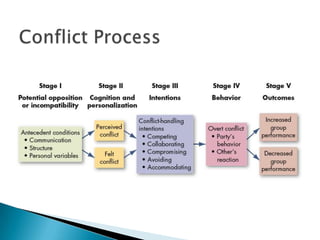
Stage I: Potential Opposition or Incompatibility

Presence of conditions that create
opportunities for conflict to arise.
Sources of Conflict
1. Structural Factors
2. Personal Factors
3. Communication
Structural
◦
◦
◦
◦
◦
◦

Size and specialization of jobs
Jurisdictional clarity/ambiguity
Member/goal incompatibility
Leadership styles (close or participative)
Reward systems (win-lose)
Dependence/interdependence of groups

Personal Variables

◦ Differing individual value systems
◦ Personality types

Communication

◦ Semantic difficulties, misunderstandings, and “noise”
Stage II: Cognition and Personalization
If the conditions in Stage I affect
something that one party cares about, then
the potential for opposition or incompatibility
becomes actualized.
Perceived Conflict
Awareness by one or more parties of the
existence of conditions that create opportunities
for conflict to arise.

Felt Conflict
Emotional involvement in a conflict creating
anxiety, tenseness, frustration, or hostility.
Stage III: Intentions
Intervene between people perceptions and
emotions and their behavior.
5 Conflict handling Intentions
1 Competing ( assertive and uncooperative)
2 Collaborating ( assertive and cooperative)
3 Avoiding (unassertive and uncooperative)
4 Accommodating (unassertive and cooperative)
5 Compromising (midrange on both assertiveness
and cooperativeness)
Competing


A desire to satisfy one’s interests, regardless of the impact on the other
party to the conflict.

Collaborating


A situation in which the parties to a conflict each desire to satisfy fully the
concerns of all parties.

Avoiding


The desire to withdraw from or suppress a conflict.

Accommodating


The willingness of one party in a conflict to place the opponent’s interests
above his or her own.

Compromising


A situation in which each party to a conflict is willing to give up something.
Direct conflict management approaches are based on
the relative emphasis that a person places on
assertiveness and cooperativeness.

Assertiveness
◦ Attempting to satisfy one’s own concerns.

Cooperativeness
◦ Attempting to satisfy the other party’s concern.
The issue of “who wins?”
Lose-lose conflict
◦ Occurs when nobody gets what he or she wants.
◦ Avoidance, accommodation or smoothing, and
compromise are forms of lose-lose conflict.
Win-lose conflict
◦ One part achieves its desires at the expense and to
the exclusion of the other party’s desires.
◦ Competition and authoritative command are forms of
win-lose conflict.
Win-win conflict
◦ Both parties achieve their desires.
◦ Collaboration or problem solving are forms of winwin conflict.
Stage IV: Behavior
where conflicts become visible and statements,
actions and reactions made by the conflicting
parties.
Conflict Resolution Techniques
Problem solving
• Superordinate goals
• Expansion of resources
• Avoidance
• Smoothing
• Compromise
• Authoritative command
• Altering the human variable
• Altering the structural variables
• Communication
• Bringing in outsiders
• Restructuring the organization
• Appointing a devil’s advocate
•
Stage V: Outcomes
The action-reaction interplay between
conflicting parties results in consequences.
Outcomes may be functional in that conflict
results in improvement in groups
performance, or dysfunctional in that it
hinders group performance.
Functional Outcomes from Conflict
◦ Increased group performance
◦ Improved quality of decisions

◦ Stimulation of creativity and innovation
◦ Encouragement of interest and curiosity
◦ Provision of a medium for problem-solving

◦ Creation of an environment for self-evaluation and
change
Creating Functional Conflict

◦ Reward dissent and punish conflict avoiders.
Dysfunctional Outcomes from Conflict
◦ Development of discontent
◦ Reduced group effectiveness
◦ Retarded communication
◦ Reduced group cohesiveness
◦ Infighting among group members overcomes group
goals




Process in which two or more parties
exchange goods or services and attempt to
agree on the exchange rate for them.
Process in which two or more parties attempt
to reach an acceptable agreement in a
situation characterized by some level of
disagreement.
Distributive – negotiation that seeks to divide
up a fixed amount of resource; win-lose
situation.
Integrative – negotiation that seeks one or
more settlements that can create a win-win
solution.
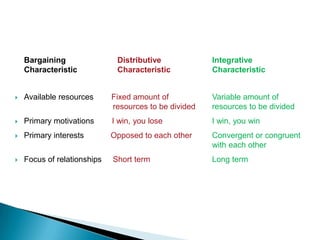
Bargaining
Characteristic

Distributive
Characteristic

Integrative
Characteristic



Available resources

Fixed amount of
resources to be divided

Variable amount of
resources to be divided



Primary motivations

I win, you lose

I win, you win



Primary interests

Opposed to each other

Convergent or congruent
with each other



Focus of relationships

Short term

Long term
What are the different strategies involved in
negotiation?
Distributive negotiation
 Focuses on positions staked out or declared by
the conflicting parties.
 Parties try to claim certain portions of the
existing pie.
Integrative negotiation
 Sometimes called principled negotiation.
 Focuses on the merits of the issues.
 Parties try to enlarge the available pie.
BATNA
The Best Alternative To a
Negotiated Agreement; the
lowest acceptable value
(outcome) to an individual
for a negotiated agreement.
The Role of Personality Traits in Negotiation
◦ Traits do not appear to have a significantly direct
effect on the outcomes of either bargaining or
negotiating processes.

Gender Differences in Negotiations
◦ Women negotiate no differently from men, although
men apparently negotiate slightly better outcomes.
◦ Men and women with similar power bases use the
same negotiating styles.
◦ Women’s attitudes toward negotiation and their
success as negotiators are less favorable than
men’s.
Mediator
A neutral third party who facilitates a negotiated solution by using
reasoning, persuasion, and suggestions for alternatives.
Arbitrator


A third party to a negotiation who has the authority to dictate an
agreement.
Conciliator


A trusted third party who provides an informal communication link
between the negotiator and the opponent.
Consultant




An impartial third party, skilled in conflict management, who
attempts to facilitate creative problem solving through
communication and analysis.
References:
- Robbins, Stephen, Organizational Behavior, 11th Edition
- Medina, Robert, PhD, Human Behavior in Organization
- Newstrom, John, Organizational Behavior – Human Behavior at
Work
- Santos, Emmanuel, Organization and Management
Thank you!!!

Conflict presentation

  • 1.
  • 2.
      A process thatbegins when one party perceives that another party has negatively affected, or is about to negatively affect, something that the first party cares about. Arises from disagreements over the goals to attain or methods to be used to accomplish those goals.
  • 3.
       Traditional – earlyapproach that assumes all conflict is bad. Human Relations – argues that conflict is a natural occurrence in all groups and organizations. Interactionist – encourages conflict on the grounds that a harmonious, peaceful, tranquil and cooperative group is prone to becoming static and non-responsive to needs for change and innovation.
  • 4.
       Task Conflict –relates to the content and goals of the work. Relationship Conflict – focuses on interpersonal relationships. Process Conflict – relates to how the work gets done.
  • 6.
    Stage I: PotentialOpposition or Incompatibility Presence of conditions that create opportunities for conflict to arise. Sources of Conflict 1. Structural Factors 2. Personal Factors 3. Communication
  • 7.
    Structural ◦ ◦ ◦ ◦ ◦ ◦ Size and specializationof jobs Jurisdictional clarity/ambiguity Member/goal incompatibility Leadership styles (close or participative) Reward systems (win-lose) Dependence/interdependence of groups Personal Variables ◦ Differing individual value systems ◦ Personality types Communication ◦ Semantic difficulties, misunderstandings, and “noise”
  • 8.
    Stage II: Cognitionand Personalization If the conditions in Stage I affect something that one party cares about, then the potential for opposition or incompatibility becomes actualized.
  • 9.
    Perceived Conflict Awareness byone or more parties of the existence of conditions that create opportunities for conflict to arise. Felt Conflict Emotional involvement in a conflict creating anxiety, tenseness, frustration, or hostility.
  • 10.
    Stage III: Intentions Intervenebetween people perceptions and emotions and their behavior. 5 Conflict handling Intentions 1 Competing ( assertive and uncooperative) 2 Collaborating ( assertive and cooperative) 3 Avoiding (unassertive and uncooperative) 4 Accommodating (unassertive and cooperative) 5 Compromising (midrange on both assertiveness and cooperativeness)
  • 12.
    Competing  A desire tosatisfy one’s interests, regardless of the impact on the other party to the conflict. Collaborating  A situation in which the parties to a conflict each desire to satisfy fully the concerns of all parties. Avoiding  The desire to withdraw from or suppress a conflict. Accommodating  The willingness of one party in a conflict to place the opponent’s interests above his or her own. Compromising  A situation in which each party to a conflict is willing to give up something.
  • 13.
    Direct conflict managementapproaches are based on the relative emphasis that a person places on assertiveness and cooperativeness. Assertiveness ◦ Attempting to satisfy one’s own concerns. Cooperativeness ◦ Attempting to satisfy the other party’s concern.
  • 14.
    The issue of“who wins?” Lose-lose conflict ◦ Occurs when nobody gets what he or she wants. ◦ Avoidance, accommodation or smoothing, and compromise are forms of lose-lose conflict. Win-lose conflict ◦ One part achieves its desires at the expense and to the exclusion of the other party’s desires. ◦ Competition and authoritative command are forms of win-lose conflict. Win-win conflict ◦ Both parties achieve their desires. ◦ Collaboration or problem solving are forms of winwin conflict.
  • 15.
    Stage IV: Behavior whereconflicts become visible and statements, actions and reactions made by the conflicting parties.
  • 16.
    Conflict Resolution Techniques Problemsolving • Superordinate goals • Expansion of resources • Avoidance • Smoothing • Compromise • Authoritative command • Altering the human variable • Altering the structural variables • Communication • Bringing in outsiders • Restructuring the organization • Appointing a devil’s advocate •
  • 17.
    Stage V: Outcomes Theaction-reaction interplay between conflicting parties results in consequences. Outcomes may be functional in that conflict results in improvement in groups performance, or dysfunctional in that it hinders group performance.
  • 18.
    Functional Outcomes fromConflict ◦ Increased group performance ◦ Improved quality of decisions ◦ Stimulation of creativity and innovation ◦ Encouragement of interest and curiosity ◦ Provision of a medium for problem-solving ◦ Creation of an environment for self-evaluation and change Creating Functional Conflict ◦ Reward dissent and punish conflict avoiders.
  • 19.
    Dysfunctional Outcomes fromConflict ◦ Development of discontent ◦ Reduced group effectiveness ◦ Retarded communication ◦ Reduced group cohesiveness ◦ Infighting among group members overcomes group goals
  • 20.
      Process in whichtwo or more parties exchange goods or services and attempt to agree on the exchange rate for them. Process in which two or more parties attempt to reach an acceptable agreement in a situation characterized by some level of disagreement.
  • 21.
    Distributive – negotiationthat seeks to divide up a fixed amount of resource; win-lose situation. Integrative – negotiation that seeks one or more settlements that can create a win-win solution.
  • 22.
    Bargaining Characteristic Distributive Characteristic Integrative Characteristic  Available resources Fixed amountof resources to be divided Variable amount of resources to be divided  Primary motivations I win, you lose I win, you win  Primary interests Opposed to each other Convergent or congruent with each other  Focus of relationships Short term Long term
  • 23.
    What are thedifferent strategies involved in negotiation? Distributive negotiation  Focuses on positions staked out or declared by the conflicting parties.  Parties try to claim certain portions of the existing pie. Integrative negotiation  Sometimes called principled negotiation.  Focuses on the merits of the issues.  Parties try to enlarge the available pie.
  • 24.
    BATNA The Best AlternativeTo a Negotiated Agreement; the lowest acceptable value (outcome) to an individual for a negotiated agreement.
  • 25.
    The Role ofPersonality Traits in Negotiation ◦ Traits do not appear to have a significantly direct effect on the outcomes of either bargaining or negotiating processes. Gender Differences in Negotiations ◦ Women negotiate no differently from men, although men apparently negotiate slightly better outcomes. ◦ Men and women with similar power bases use the same negotiating styles. ◦ Women’s attitudes toward negotiation and their success as negotiators are less favorable than men’s.
  • 26.
    Mediator A neutral thirdparty who facilitates a negotiated solution by using reasoning, persuasion, and suggestions for alternatives. Arbitrator  A third party to a negotiation who has the authority to dictate an agreement. Conciliator  A trusted third party who provides an informal communication link between the negotiator and the opponent. Consultant   An impartial third party, skilled in conflict management, who attempts to facilitate creative problem solving through communication and analysis.
  • 28.
    References: - Robbins, Stephen,Organizational Behavior, 11th Edition - Medina, Robert, PhD, Human Behavior in Organization - Newstrom, John, Organizational Behavior – Human Behavior at Work - Santos, Emmanuel, Organization and Management
  • 29.