CAUVERY INSTITUTE OFTECHNOLOGY
Topic on: “IBM- BLUE GENE
TECHNOLOGY”.
PRESENTED BY:
ANUSHA .N
[4CA21CS010]
2.
INTRODUCTION:
The word“supercomputer”, entered the mainstream lexicon in 1996
and 1997 when IBMs deep blue supercomputer challenged the world
chess champion in two tournaments broadcast around the world.
Since then, IBM has been busy improving its supercomputer technology
and tackling much deeper problems.
Their latest project ,code named blue gene ,is poised to shatter all
records for computer and network performance.
3.
WHAT IS ASUPER COMPUTER
A supercomputer is a computer that is at
the frontline of current processing capacity
, particularly speed of calculation.
Today , supercomputer are typically one-
of-a kind custom designs produced by
“traditional” companies such as cray ,
IBM and Hewlett-Packard, who had
purchased many of the 1980’s companies
to gain their experience.
4.
WHY WE NEEDSUPER COMPUTERS?
Supercomputer are very useful in highly calculation-intensive takes such as
Problems involving quantum physics,
Weather forecasting
Climate research
Molecular modeling (computing the structures and properties of chemical
compounds, biological macromolecules ,polymers, and crystals)
Physical simulations(such as simulation of airplanes in wind
tunnels ,simulation of the detonation of nuclear weapons, and research
into nuclear fusion).
Also, they are useful for a particular class of problems ,known as grand
challenge problems, full solution for such problems require semi-infinite
computing resources.
5.
WHY SUPERCOMPUTERS AREFAST?
Several elements of a supercomputer contribute
to its high level of performance:
Numerous high-performance processors(CPUs)
for parallel processing.
Specially –designed high-speed internal
networks.
Specially –designed or tuned operating systems.
6.
WHAT IS BLUEGENE?
Blue gene is a computer architecture project designed to produce
several supercomputers that are designed to reach operating speeds
in the PFLOPS(petaFLOPS=10^12).
It is a cooperative project among IBM(particularly IBM Rochester
and the Thomas J. Watson research center), the Lawrence livemore
national laboratory , the united states department of energy (which
is partially funding the project ), and academia.
7.
WHY BLUE GENE?
Blue brain is an IBM research project dedicated to exploring the frontiers in supercomputing:
In computer architecture,
In the software required to program and control massively parallel systems .
In the use of computation to advanced the understanding of important biological
processes such as protein folding.
Learning more about biomolecular mechanisms is expected to give medical researches
better understanding of diseases, as well as potential cures.
8.
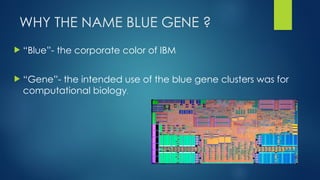
WHY THE NAMEBLUE GENE ?
“Blue”- the corporate color of IBM
“Gene”- the intended use of the blue gene clusters was for
computational biology.
9.
BLUE GENE PROJECT:
Thereare four blue gene projects in development:
Blue gene /L
Blue gene/C
Blue gene/P
Blue gene/Q
10.
BLUE GENE/L :
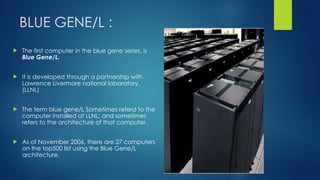
The first computer in the blue gene series, is
Blue Gene/L.
It is developed through a partnership with
Lawrence Livermore national laboratory.
(LLNL)
The term blue gene/L Sometimes referd to the
computer installed at LLNL; and sometimes
refers to the architecture of that computer.
As of November 2006, there are 27 computers
on the top500 list using the Blue Gene/L
architecture.
11.
HISTORY OF BLUEGENE/L:
In December 1999,IBM announced a $100 million research initiative for a five –
year effort to built a massively parallel computer , to be applied to the study of
biomolecular phenomena.
The project has two main goals:
To advanced understanding of the biomolecular mechanisms via large-scale
simulation.
To explore novel ideas in massively parallel machine architecture and
software.
BLUE GENE/L ARCHITECTURE:
Compute nodes are packaged two per
compute card, with 16 compute cards plus up
to 21/O nodes per node board.
There are 32 nodes boards per cabinet/rack.
By integration of all essential sub-systems on a
single chip, each compute or I/O node
dissipates low power (about 17 watts,
including DRAMs).
14.
BLUE GENE/C (Cyclops64)
Cyclops64 exposes much of the underlying hardware to the
programmer, allowing the programmer to write very high
performance , finely tuned software.
One negative consequence is that efficiently programming
cyclops64 is difficult.
The theoretical peak performance of a cyclops64 chip is 80
gigaflops.
15.
BLUE GENE /P:
On June 26,2007 , IBM unveiled Blue Gene/P, the second generation of the
blue gene supercomputer.
Designed to run continuously at 1PFLOPS ( peta FLOPS), it can be configured
to reach speeds in excess of 3 PFLOPS.
It is at least seven times more energy efficient than any other
supercomputer ,accomplished by using many small, low-power chips
connected through five specialized networks.
16.
CONCLUSION:
President Obamarecognized IBM and its blue gene family of supercomputers
with the national medal of technology and innovation.
The influence of the blue gene supercomputers energy-efficient design and
computing model can be seen today across the information technology
industry .
Today ,18 of the top 20 most energy efficient supercomputer in the world are built
on IBM high performance computing technology.
Blue gene has some unusual features, but IBM has tired as much as possible to
anchor the system to more mainstream technology.
Blue gene would influence the way in which mainstream computers of the future
are built.
![CAUVERY INSTITUTE OF TECHNOLOGY
Topic on: “IBM- BLUE GENE
TECHNOLOGY”.
PRESENTED BY:
ANUSHA .N
[4CA21CS010]](https://image.slidesharecdn.com/bluegeneppt-250414105710-2585ccdb/85/blue-gene-ppt-pptx-engineering-presentation-1-320.jpg)