Systems and Technology Group
1 Cell Broadband Engine - An Introduction
Future Commodity Chip
Called CELL for HPC
Piotr Pietrzak
Systems Architect
IBM Systems & Technology Group
Systems and Technology Group
Cell Broadband Engine - An Introduction
2
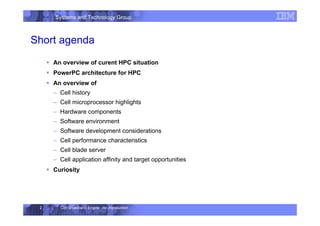
Short agenda
ƒ An overview of curent HPC situation
ƒ PowerPC architecture for HPC
ƒ An overview of
– Cell history
– Cell microprocessor highlights
– Hardware components
– Software environment
– Software development considerations
– Cell performance characteristics
– Cell blade server
– Cell application affinity and target opportunities
ƒ Curiosity
IBM System p5
I
3 © 2006 IBM Corporation IBM Systems
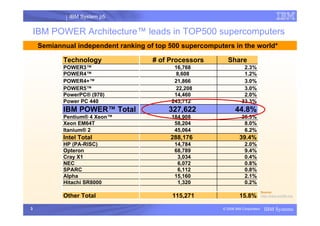
IBM POWER Architecture™ leads in TOP500 supercomputers
25.3%
184,908
Pentium® 4 Xeon™
8.0%
58,204
Xeon EM64T
6.2%
45,064
Itanium® 2
39.4%
288,176
Intel Total
15.8%
115,271
Other Total
0.2%
1,320
Hitachi SR8000
2.1%
15,160
Alpha
0.8%
6,112
SPARC
0.8%
6,072
NEC
0.4%
3,034
Cray X1
9.4%
68,789
Opteron
2.0%
14,784
HP (PA-RISC)
44.8%
327,622
IBM POWER™ Total
33.3%
243,712
Power PC 440
2.0%
14,460
PowerPC® (970)
3.0%
22,208
POWER5™
3.0%
21,866
POWER4+™
1.2%
8,608
POWER4™
2.3%
16,768
POWER3™
Share
# of Processors
Technology
Source:
http://www.top500.org
Semiannual independent ranking of top 500 supercomputers in the world*
IBM System p5
I
4 © 2006 IBM Corporation IBM Systems
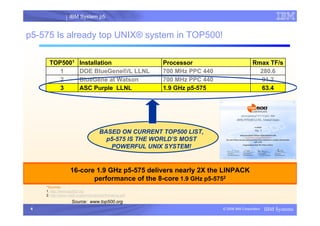
p5-575 Is already top UNIX® system in TOP500!
63.4
1.9 GHz p5-575
ASC Purple LLNL
3
91.2
700 MHz PPC 440
BlueGene at Watson
2
280.6
700 MHz PPC 440
DOE BlueGene®/L LLNL
1
Processor Rmax TF/s
Installation
TOP5001
Source: www.top500.org
16-core 1.9 GHz p5-575 delivers nearly 2X the LINPACK
performance of the 8-core 1.9 GHz p5-5752
*Sources:
1. http://www.top500.org
2. http://www.netlib.org/benchmark/performance.pdf
BASED ON CURRENT TOP500 LIST,
p5-575 IS THE WORLD’S MOST
POWERFUL UNIX SYSTEM!
IBM System p5
I
5 © 2006 IBM Corporation IBM Systems
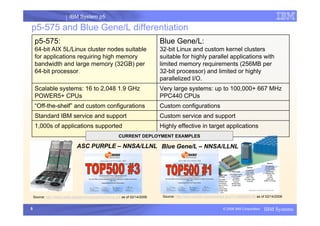
p5-575 and Blue Gene/L differentiation
Blue Gene/L:
32-bit Linux and custom kernel clusters
suitable for highly parallel applications with
limited memory requirements (256MB per
32-bit processor) and limited or highly
parallelized I/O.
p5-575:
64-bit AIX 5L/Linux cluster nodes suitable
for applications requiring high memory
bandwidth and large memory (32GB) per
64-bit processor.
Highly effective in target applications
1,000s of applications supported
Custom service and support
Standard IBM service and support
Custom configurations
“Off-the-shelf” and custom configurations
Very large systems: up to 100,000+ 667 MHz
PPC440 CPUs
Scalable systems: 16 to 2,048 1.9 GHz
POWER5+ CPUs
Source: http://www.top500.org/lists/plists.php?Y=2005&M=06 as of 02/14/2006
ASC PURPLE – NNSA/LLNL
Source: http://www.netlib.org/benchmark/performance.pdf as of 02/14/2006
Blue Gene/L – NNSA/LLNL
CURRENT DEPLOYMENT EXAMPLES
IBM System p5
I
6 © 2006 IBM Corporation IBM Systems
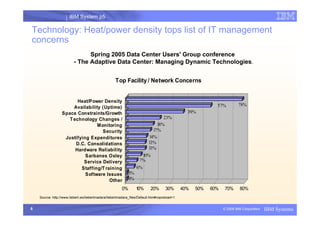
Technology: Heat/power density tops list of IT management
concerns
1%
1%
6%
7%
10%
13%
13%
14%
17%
18%
23%
39%
57% 78%
0% 1
0% 20% 30% 40% 50% 60% 70% 80%
Heat/Power Density
Availability (Uptime)
Space Constraints/Growth
Technology Changes /
Monitoring
Security
Justifying Expenditures
D.C. Consolidations
Hardware Reliability
Sarbanes Oxley
Service Delivery
Staffing/Training
Software Issues
Other
Top Facility / Network Concerns
Spring 2005 Data Center Users' Group conference
- The Adaptive Data Center: Managing Dynamic Technologies.
Source: http://www.liebert.ws/liebertmadara/liebertmadara_files/Default.htm#nopreload=1
IBM System p5
I
7 © 2006 IBM Corporation IBM Systems
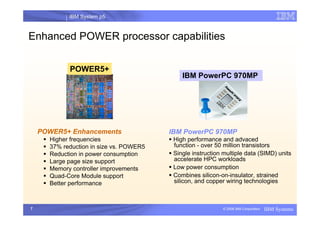
Enhanced POWER processor capabilities
POWER5+
POWER5+ Enhancements
ƒ Higher frequencies
ƒ 37% reduction in size vs. POWER5
ƒ Reduction in power consumption
ƒ Large page size support
ƒ Memory controller improvements
ƒ Quad-Core Module support
ƒ Better performance
IBM PowerPC 970MP
IBM PowerPC 970MP
ƒ High performance and advaced
function - over 50 million transistors
ƒ Single instruction multiple data (SIMD) units
accelerate HPC workloads
ƒ Low power consumption
ƒ Combines silicon-on-insulator, strained
silicon, and copper wiring technologies
IBM System p5
I
8 © 2006 IBM Corporation IBM Systems
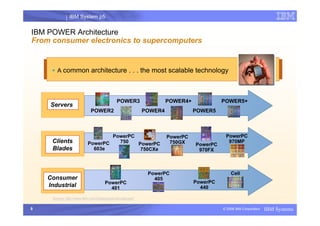
ƒ A common architecture . . . the most scalable technology
POWER2
Servers
POWER4+
POWER4
POWER3
PowerPC
603e
POWER5
IBM POWER Architecture
From consumer electronics to supercomputers
POWER5+
Clients
Blades
Consumer
Industrial
PowerPC
750 PowerPC
750CXe
PowerPC
750GX PowerPC
970FX
PowerPC
401
PowerPC
405
PowerPC
440
Source: http://www.ibm.com/chips/power/aboutpower/
PowerPC
970MP
Cell
IBM System p5
I
9 © 2006 IBM Corporation IBM Systems
IBM System p5 575: THE CRUNCHER!
New 8-core
DATA CRUNCHER
p5-575 [8-core] 2.2 GHz
66.4 GFLOPS/node
LINPACK HPC
100.5 GB/sec
STREAM Traid (Tuned)
Sources: http://www.cs.virginia.edu/stream/ submitted February 14, 2006
http://www.netlib.org/benchmark/performance.pdf submitted February 14,2006
New 16-core
NUMBER CRUNCHER
p5-575 [16-core] 1.9 GHz
111.4 GFLOPS/node
LINPACK HPC
86.3 GB/sec
STREAM Triad (Tuned)
NEW!
1: Node hardware only, 1GB memory 2: Node hardware only, 16GB memory
NEW!
I
10 © 2004 IBM Corporation
IBM eServer pSeries
Cell Broadband Engine - An Introduction
© 2006 IBM Corporation
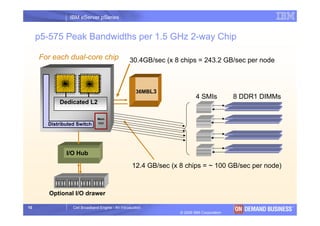
p5-575 Peak Bandwidths per 1.5 GHz 2-way Chip
30.4GB/sec (x 8 chips = 243.2 GB/sec per node
12.4 GB/sec (x 8 chips = ~ 100 GB/sec per node)
8 DDR1 DIMMs
4 SMIs
36MBL3
For each dual-core chip
I/O Hub
Optional I/O drawer
Distributed Switch
Mem
Ctrl
Dedicated L2
Engineering & Technology Services
© 2006 IBM Corporation
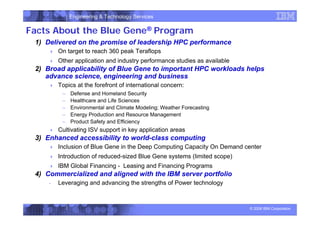
Facts About the Blue Gene® Program
1) Delivered on the promise of leadership HPC performance
 On target to reach 360 peak Teraflops
 Other application and industry performance studies as available
2) Broad applicability of Blue Gene to important HPC workloads helps
advance science, engineering and business
 Topics at the forefront of international concern:
– Defense and Homeland Security
– Healthcare and Life Sciences
– Environmental and Climate Modeling; Weather Forecasting
– Energy Production and Resource Management
– Product Safety and Efficiency
 Cultivating ISV support in key application areas
3) Enhanced accessibility to world-class computing
 Inclusion of Blue Gene in the Deep Computing Capacity On Demand center
 Introduction of reduced-sized Blue Gene systems (limited scope)
 IBM Global Financing - Leasing and Financing Programs
4) Commercialized and aligned with the IBM server portfolio
- Leveraging and advancing the strengths of Power technology
© 2006 IBM Corporation
Engineering  Technology Services
®
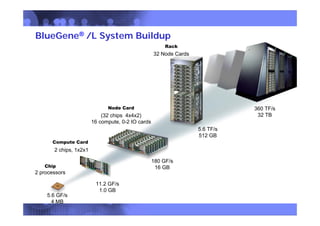
BlueGene® /L System Buildup
5.6 GF/s
4 MB
2 processors
2 chips, 1x2x1
11.2 GF/s
1.0 GB
(32 chips 4x4x2)
16 compute, 0-2 IO cards
180 GF/s
16 GB
32 Node Cards
5.6 TF/s
512 GB
64 Racks, 64x32x32
360 TF/s
32 TB
Rack
System
Node Card
Compute Card
Chip
Engineering  Technology Services
© 2006 IBM Corporation
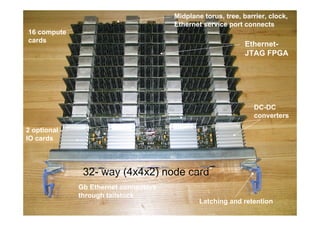
32- way (4x4x2) node card
DC-DC
converters
Gb Ethernet connectors
through tailstock
Latching and retention
Midplane torus, tree, barrier, clock,
Ethernet service port connects
16 compute
cards
2 optional
IO cards
Ethernet-
JTAG FPGA
Engineering  Technology Services
© 2006 IBM Corporation
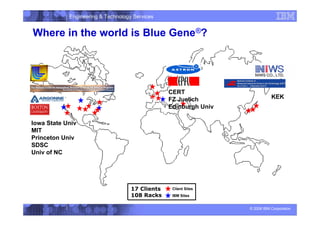
Where in the world is Blue Gene®?
17 Clients
108 Racks
Client Sites
IBM Sites
UNC
SDSC
Princeton
MIT
ISU
Iowa State Univ
MIT
Princeton Univ
SDSC
Univ of NC
KEK
CERT
FZ Juelich
Edinburgh Univ
Engineering  Technology Services
© 2006 IBM Corporation
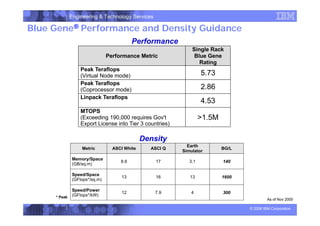
Blue Gene® Performance and Density Guidance
Performance Metric
Single Rack
Blue Gene
Rating
Peak Teraflops
(Virtual Node mode) 5.73
Peak Teraflops
(Coprocessor mode) 2.86
Linpack Teraflops
4.53
MTOPS
(Exceeding 190,000 requires Gov't
Export License into Tier 3 countries)
1.5M
Performance
Metric ASCI White ASCI Q
Earth
Simulator
BG/L
Memory/Space
(GB/sq.m)
8.6 17 3.1 140
Speed/Space
(GFlops*/sq.m)
13 16 13 1600
Speed/Power
(GFlops*/kW)
12 7.9 4 300
Density
* Peak
As of Nov 2005
Engineering  Technology Services
© 2006 IBM Corporation
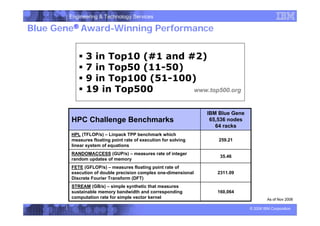
Blue Gene® Award-Winning Performance
ƒ 3 in Top10 (#1 and #2)
ƒ 7 in Top50 (11-50)
ƒ 9 in Top100 (51-100)
ƒ 19 in Top500 www.top500.org
160,064
STREAM (GB/s) – simple synthetic that measures
sustainable memory bandwidth and corresponding
computation rate for simple vector kernel
2311.09
FETE (GFLOP/s) – measures floating point rate of
execution of double precision complex one-dimensional
Discrete Fourier Transform (DFT)
35.46
RANDOMACCESS (GUP/s) – measures rate of integer
random updates of memory
259.21
HPL (TFLOP/s) – Linpack TPP benchmark which
measures floating point rate of execution for solving
linear system of equations
IBM Blue Gene
65,536 nodes
64 racks
HPC Challenge Benchmarks
As of Nov 2006
Systems and Technology Group
Cell Broadband Engine - An Introduction
17
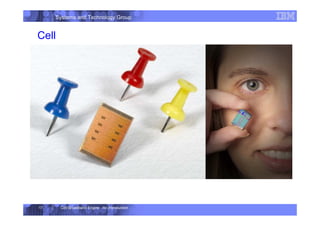
Cell
Systems and Technology Group
Cell Broadband Engine - An Introduction
18
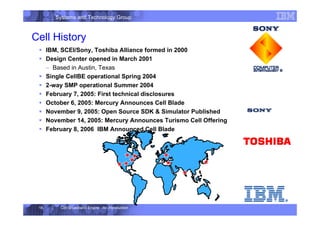
Cell History
ƒ IBM, SCEI/Sony, Toshiba Alliance formed in 2000
ƒ Design Center opened in March 2001
– Based in Austin, Texas
ƒ Single CellBE operational Spring 2004
ƒ 2-way SMP operational Summer 2004
ƒ February 7, 2005: First technical disclosures
ƒ October 6, 2005: Mercury Announces Cell Blade
ƒ November 9, 2005: Open Source SDK  Simulator Published
ƒ November 14, 2005: Mercury Announces Turismo Cell Offering
ƒ February 8, 2006 IBM Announced Cell Blade
Systems and Technology Group
Cell Broadband Engine - An Introduction
19
Cell Basic Design Concept
Systems and Technology Group
Cell Broadband Engine - An Introduction
20
Cell Basic Concept
ƒ Compatibility with 64b Power Architecture™
– Builds on and leverages IBM investment and community
ƒ Increased efficiency and performance
– Attacks on the “Power Wall”
• Non Homogenous Coherent Multiprocessor
• High design frequency @ a low operating voltage with advanced power management
– Attacks on the “Memory Wall”
• Streaming DMA architecture
• 3-level Memory Model: Main Storage, Local Storage, Register Files
– Attacks on the “Frequency Wall”
• Highly optimized implementation
• Large shared register files and software controlled branching to allow deeper pipelines
ƒ Interface between user and networked world
– Image rich information, virtual reality
– Flexibility and security
ƒ Multi-OS support, including RTOS / non-RTOS
– Combine real-time and non-real time worlds
Systems and Technology Group
Cell Broadband Engine - An Introduction
21
Cell Design Goals
ƒ Cell is an accelerator extension to Power
– Built on a Power ecosystem
– Used best know system practices for processor design
ƒ Sets a new performance standard
– Exploits parallelism while achieving high frequency
– Supercomputer attributes with extreme floating point capabilities
– Sustains high memory bandwidth with smart DMA controllers
ƒ Designed for natural human interaction
– Photo-realistic effects
– Predictable real-time response
– Virtualized resources for concurrent activities
ƒ Designed for flexibility
– Wide variety of application domains
– Highly abstracted to highly exploitable programming models
– Reconfigurable I/O interfaces
– Virtual trusted computing environment for security
Systems and Technology Group
Cell Broadband Engine - An Introduction
22
Cell Synergy
ƒ Cell is not a collection of different processors, but a synergistic
whole
– Operation paradigms, data formats and semantics consistent
– Share address translation and memory protection model
ƒ PPE for operating systems and program control
ƒ SPE optimized for efficient data processing
– SPEs share Cell system functions provided by Power Architecture
– MFC implements interface to memory
• Copy in/copy out to local storage
ƒ PowerPC provides system functions
– Virtualization
– Address translation and protection
– External exception handling
ƒ EIB integrates system as data transport hub
Systems and Technology Group
Cell Broadband Engine - An Introduction
23
Cell Hardware Components
Systems and Technology Group
Cell Broadband Engine - An Introduction
24
Systems and Technology Group
Cell Broadband Engine - An Introduction
25
Cell Software Environment
Systems and Technology Group
Cell Broadband Engine - An Introduction
26
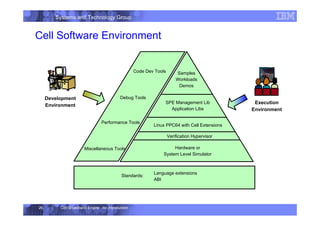
Programmer
Experience
Development
Tools Stack
Hardware or
System Level Simulator
Linux PPC64 with Cell Extensions
SPE Management Lib
Application Libs
Samples
Workloads
Demos
Code Dev Tools
Debug Tools
Performance Tools
Standards:
Language extensions
ABI
Verification Hypervisor
Development
Environment
End-User
Experience
Execution
Environment
Miscellaneous Tools
Cell Software Environment
Systems and Technology Group
© 2006 IBM Corporation
Cell Broadband Engine - An Introduction
27
CBE Standards
ƒ Application Binary Interface Specifications
– Defines such things as data types, register usage, calling conventions,
and object formats to ensure compatibility of code generators and
portability of code.
• SPE ABI
• Linux for CBE Reference Implementation ABI
ƒ SPE C/C++ Language Extensions
– Defines standardized data types, compiler directives, and language
intrinsics used to exploit SIMD capabilities in the core.
– Data types and Intrinsics styled to be similar to Altivec/VMX.
ƒ SPE Assembly Language Specification
Standards
Systems and Technology Group
© 2006 IBM Corporation
Cell Broadband Engine - An Introduction
28
System Level Simulator
ƒ Cell BE – full system simulator
– Uni-Cell and multi-Cell simulation
– User Interfaces – TCL and GUI
– Cycle accurate SPU simulation (pipeline mode)
– Emitter facility for tracing and viewing simulation events
Execution Environment
Systems and Technology Group
© 2006 IBM Corporation
Cell Broadband Engine - An Introduction
29
SPE Management Library
ƒ SPEs are exposed as threads
– SPE thread model interface is similar to POSIX threads.
– SPE thread consists of the local store, register file, program counter,
and MFC-DMA queue.
– Associated with a single Linux task.
– Features include:
• Threads - create, groups, wait, kill, set affinity, set context
• Thread Queries - get local store pointer, get problem state area pointer, get
affinity, get context
• Groups - create, set group defaults, destroy, memory map/unmap, madvise.
• Group Queries - get priority, get policy, get threads, get max threads per
group, get events.
• SPE image files - opening and closing
ƒ SPE Executable
– Standalone SPE program managed by a PPE executive.
– Executive responsible for loading and executing SPE program. It also
services assisted requests for I/O (eg, fopen, fwrite, fprintf) and
memory requests (eg, mmap, shmat, …).
Execution Environment
Systems and Technology Group
© 2006 IBM Corporation
Cell Broadband Engine - An Introduction
30
Optimized SPE and Multimedia Extension Libraries
Execution Environment
ƒ Standard SPE C library subset
– optimized SPE C99 functions including stdlib c lib, math and etc.
– subset of POSIX.1 Functions – PPE assisted
ƒ Audio resample - resampling audio signals
ƒ FFT - 1D and 2D fft functions
ƒ gmath - mathematic functions optimized for gaming environment
ƒ image - convolution functions
ƒ intrinsics - generic intrinsic conversion functions
ƒ large-matrix - functions performing large matrix operations
ƒ matrix - basic matrix operations
ƒ mpm - multi-precision math functions
ƒ noise - noise generation functions
ƒ oscillator - basic sound generation functions
ƒ sim – simulator only function including print, profile checkpoint, socket I/O, etc …
ƒ surface - a set of bezier curve and surface functions
ƒ sync - synchronization library
ƒ vector - vector operation functions
Systems and Technology Group
© 2006 IBM Corporation
Cell Broadband Engine - An Introduction
31
ƒ cesof - the samples for the CBE embedded SPU object format usage
ƒ spu_clean - cleans the SPU register and local store
ƒ spu_entry - sample SPU entry function (crt0)
ƒ spu_interrupt - SPU first level interrupt handler sample
ƒ spulet - direct invocation of a spu program from Linux shell
ƒ sync
ƒ simpleDMA / DMA
ƒ tutorial - example source code from the tutorial
ƒ SDK test suite
Sample Source
Execution Environment
Systems and Technology Group
© 2006 IBM Corporation
Cell Broadband Engine - An Introduction
32
ƒ FFT16M – optimized 16 M point complex FFT
ƒ Oscillator - audio signal generator
ƒ Matrix Multiply – matrix multiplication workload
ƒ VSE_subdiv - variable sharpness subdivision algorithm
Workloads
Execution Environment
Systems and Technology Group
© 2006 IBM Corporation
Cell Broadband Engine - An Introduction
33
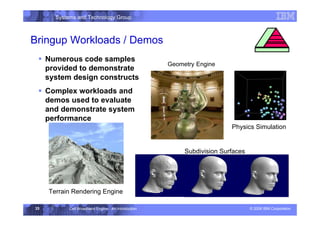
Bringup Workloads / Demos
ƒ Numerous code samples
provided to demonstrate
system design constructs
ƒ Complex workloads and
demos used to evaluate
and demonstrate system
performance
Terrain Rendering Engine
Subdivision Surfaces
Physics Simulation
Geometry Engine
Execution Environment
Systems and Technology Group
© 2006 IBM Corporation
Cell Broadband Engine - An Introduction
34
Code Development Tools
ƒ GNU based binutils
– From Sony Computer Entertainment
– gas SPE assembler
– gld SPE ELF object linker
• ppu-embedspu script for embedding SPE object modules in PPE executables
– misc bin utils (ar, nm, ...) targeting SPE modules
ƒ GNU based C/C++ compiler targeting SPE
– From Sony Computer Entertainment
– retargeted compiler to SPE
– Supports common SPE Language Extensions and ABI (ELF/Dwarf2)
ƒ Cell Broadband Engine Optimizing Compiler (executable)
– IBM XLC C/C++ for PowerPC (Tobey)
– IBM XLC C retargeted to SPE assembler (including vector intrinsics) - highly optimizing
– Prototype CBE Programmer Productivity Aids
• Auto-Vectorization (auto-SIMD) for SPE and PPE Multimedia Extension code
– spu_timing Timing Analysis Tool
Development Environment
Systems and Technology Group
© 2006 IBM Corporation
Cell Broadband Engine - An Introduction
35
Bringup Debug Tools
• GNU gdb
– Multi-core Application source level debugger supporting
PPE multithreading, SPE multithreading, interacting PPE
and SPE threads
– Three modes of debugging SPU threads
• Standalone SPE debugging
• Attach to SPE thread
– Thread ID output when SPU_DEBUG_START=1
Development Environment
Systems and Technology Group
© 2006 IBM Corporation
Cell Broadband Engine - An Introduction
36
SPE Performance Tools (executables)
ƒ Static analysis (spu_timing)
– Annotates assembly source with instruction pipeline
state
ƒ Dynamic analysis (CBE System Simulator)
– Generates statistical data on SPE execution
• Cycles, instructions, and CPI
• Single/Dual issue rates
• Stall statistics
• Register usage
• Instruction histogram
Development Environment
Systems and Technology Group
Cell Broadband Engine - An Introduction
37
Cell Performance Characteristics
Systems and Technology Group
Cell Broadband Engine - An Introduction
38
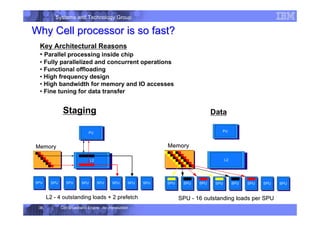
SPU SPU SPU SPU SPU SPU SPU SPU
PU
L2
Memory
Memory
SPU - 16 outstanding loads per SPU
SPU SPU SPU SPU SPU SPU SPU SPU
PU
L2
Memory
Memory
L2 - 4 outstanding loads + 2 prefetch
PU Data Staging via L2 SPU Data Staging
Key Architectural Reasons
• Parallel processing inside chip
• Fully parallelized and concurrent operations
• Functional offloading
• High frequency design
• High bandwidth for memory and IO accesses
• Fine tuning for data transfer
Why Cell processor is so fast?
Systems and Technology Group
Cell Broadband Engine - An Introduction
39
Systems and Technology Group
Cell Broadband Engine - An Introduction
40
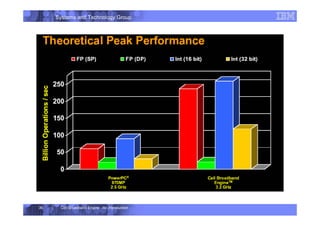
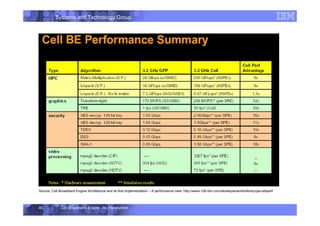
Source: Cell Broadband Engine Architecture and its first implementation – A performance view, http://www-128.ibm.com/developerworks/library/pa-cellperf/
Systems and Technology Group
Cell Broadband Engine - An Introduction
41
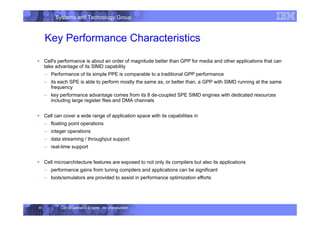
Key Performance Characteristics
ƒ Cell's performance is about an order of magnitude better than GPP for media and other applications that can
take advantage of its SIMD capability
– Performance of its simple PPE is comparable to a traditional GPP performance
– its each SPE is able to perform mostly the same as, or better than, a GPP with SIMD running at the same
frequency
– key performance advantage comes from its 8 de-coupled SPE SIMD engines with dedicated resources
including large register files and DMA channels
ƒ Cell can cover a wide range of application space with its capabilities in
– floating point operations
– integer operations
– data streaming / throughput support
– real-time support
ƒ Cell microarchitecture features are exposed to not only its compilers but also its applications
– performance gains from tuning compilers and applications can be significant
– tools/simulators are provided to assist in performance optimization efforts
Systems and Technology Group
Cell Broadband Engine - An Introduction
42
Cell Blade
Systems and Technology Group
Cell Broadband Engine - An Introduction
43
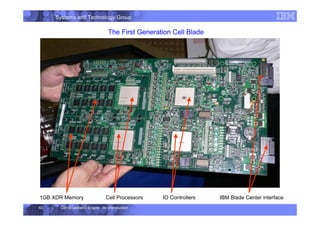
The First Generation Cell Blade
Cell Processors
1GB XDR Memory IO Controllers IBM Blade Center interface
Systems and Technology Group
Cell Broadband Engine - An Introduction
44
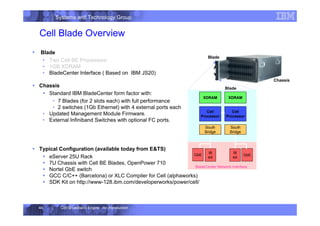
Cell Blade Overview
Chassis
Blade
ƒ Blade
• Two Cell BE Processors
• 1GB XDRAM
• BladeCenter Interface ( Based on IBM JS20)
ƒ Chassis
ƒ Standard IBM BladeCenter form factor with:
• 7 Blades (for 2 slots each) with full performance
• 2 switches (1Gb Ethernet) with 4 external ports each
• Updated Management Module Firmware.
• External Infiniband Switches with optional FC ports.
ƒ Typical Configuration (available today from ETS)
ƒ eServer 25U Rack
ƒ 7U Chassis with Cell BE Blades, OpenPower 710
ƒ Nortel GbE switch
ƒ GCC C/C++ (Barcelona) or XLC Compiler for Cell (alphaworks)
ƒ SDK Kit on http://www-128.ibm.com/developerworks/power/cell/
Blade
BladeCenter Network Interface
Cell
Processor
South
Bridge
XDRAM
Cell
Processor
South
Bridge
XDRAM
IB
4X
IB
4X
GbE GbE
Systems and Technology Group
Cell Broadband Engine - An Introduction
45
Cell Application Affinity
Systems and Technology Group
Cell Broadband Engine - An Introduction
46
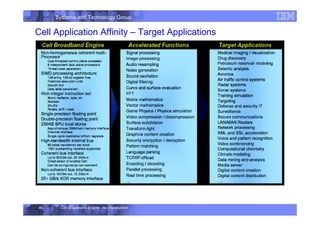
Cell Application Affinity – Target Applications
Systems and Technology Group
Cell Broadband Engine - An Introduction
47
Cell Processor
Cell Processor
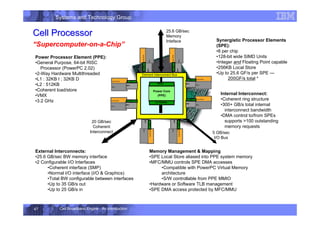
Power Processor Element (PPE):
•General Purpose, 64-bit RISC
Processor (PowerPC 2.02)
•2-Way Hardware Multithreaded
•L1 : 32KB I ; 32KB D
•L2 : 512KB
•Coherent load/store
•VMX
•3.2 GHz
Internal Interconnect:
•Coherent ring structure
•300+ GB/s total internal
interconnect bandwidth
•DMA control to/from SPEs
supports 100 outstanding
memory requests
Synergistic Processor Elements
(SPE):
•8 per chip
•128-bit wide SIMD Units
•Integer and Floating Point capable
•256KB Local Store
•Up to 25.6 GF/s per SPE ---
200GF/s total *
External Interconnects:
•25.6 GB/sec BW memory interface
•2 Configurable I/O Interfaces
•Coherent interface (SMP)
•Normal I/O interface (I/O  Graphics)
•Total BW configurable between interfaces
•Up to 35 GB/s out
•Up to 25 GB/s in
Memory Management  Mapping
•SPE Local Store aliased into PPE system memory
•MFC/MMU controls SPE DMA accesses
•Compatible with PowerPC Virtual Memory
architecture
•S/W controllable from PPE MMIO
•Hardware or Software TLB management
•SPE DMA access protected by MFC/MMU
“
“Supercomputer-on-a-Chip”
* At clock speed of 3.2GHz
Element Interconnect Bus
MFC
Local Store
SPU
N
AUC
MFC
Local Store
SPU
N
AUC
Power Core
(PPE)
L2 Cache
NCU
Local Store
SPU
MFC
N
AUC
Local Store
SPU
MFC
N
AUC
N
N
N N
MFC
Local
Store
SPU
N
AUC
MFC
Local
Store
SPU
N
AUC
MFC
Local
Store
SPU
N
AUC
MFC
Local
Store
SPU
N
AUC
20 GB/sec
Coherent
Interconnect
25.6 GB/sec
Memory
Inteface
5 GB/sec
I/O Bus
Systems and Technology Group
Cell Broadband Engine - An Introduction
48
Power Processor Element
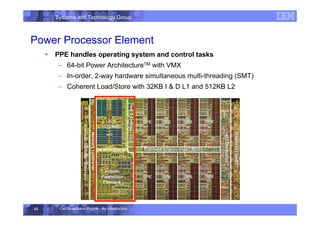
ƒ PPE handles operating system and control tasks
– 64-bit Power ArchitectureTM with VMX
– In-order, 2-way hardware simultaneous multi-threading (SMT)
– Coherent Load/Store with 32KB I  D L1 and 512KB L2
Systems and Technology Group
Cell Broadband Engine - An Introduction
49
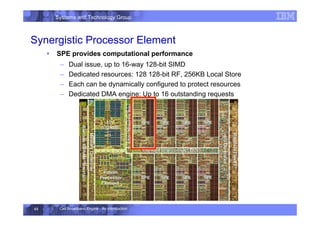
Synergistic Processor Element
ƒ SPE provides computational performance
– Dual issue, up to 16-way 128-bit SIMD
– Dedicated resources: 128 128-bit RF, 256KB Local Store
– Each can be dynamically configured to protect resources
– Dedicated DMA engine: Up to 16 outstanding requests
Systems and Technology Group
© 2006 IBM Corporation
Cell Broadband Engine - An Introduction
50
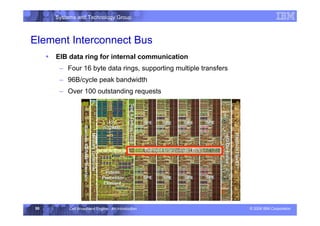
Element Interconnect Bus
ƒ EIB data ring for internal communication
– Four 16 byte data rings, supporting multiple transfers
– 96B/cycle peak bandwidth
– Over 100 outstanding requests
Systems and Technology Group
© 2006 IBM Corporation
Cell Broadband Engine - An Introduction
51
Internal Bandwidth Capability
ƒ Each EIB Bus data port supports 25.6GBytes/sec* in each
direction
ƒ The EIB Command Bus streams commands fast enough to
support 102.4 GB/sec for coherent commands, and 204.8
GB/sec for non-coherent commands.
ƒ The EIB data rings can sustain 204.8GB/sec for certain
workloads, with transient rates as high as 307.2GB/sec
between bus units
Despite all that available bandwidth…
* The above numbers assume a 3.2GHz core frequency – internal bandwidth scales with core frequency
Systems and Technology Group
© 2006 IBM Corporation
Cell Broadband Engine - An Introduction
52
Why IBM for HPC
Advanced processor technologies, innovative
system designs, and elegant packaging
Leadership performance and top positioning in
worldwide supercomputing*
A continuum of granular solution platforms that
scale from the desktop to the world’s highest
performance HPC systems*
Select the system sized to your needs and designed with features for:
ƒMeeting the challenges
ƒHigh performance and versatility
of your most demanding applications *http://www.top500.org
Systems and Technology Group
© 2006 IBM Corporation
Cell Broadband Engine - An Introduction
53
Questions... ?
piotr.pietrzak@pl.ibm.com
Systems and Technology Group
© 2006 IBM Corporation
Cell Broadband Engine - An Introduction
54
This document was developed for IBM offerings in the United States as of the date of publication. IBM may not make these offerings available in
other countries, and the information is subject to change without notice. Consult your local IBM business contact for information on the IBM
offerings available in your area.
Information in this document concerning non-IBM products was obtained from the suppliers of these products or other public sources. Questions
on the capabilities of non-IBM products should be addressed to the suppliers of those products.
IBM may have patents or pending patent applications covering subject matter in this document. The furnishing of this document does not give
you any license to these patents. Send license inquires, in writing, to IBM Director of Licensing, IBM Corporation, New Castle Drive, Armonk, NY
10504-1785 USA.
All statements regarding IBM future direction and intent are subject to change or withdrawal without notice, and represent goals and objectives
only.
The information contained in this document has not been submitted to any formal IBM test and is provided AS IS with no warranties or
guarantees either expressed or implied.
All examples cited or described in this document are presented as illustrations of the manner in which some IBM products can be used and the
results that may be achieved. Actual environmental costs and performance characteristics will vary depending on individual client configurations
and conditions.
IBM Global Financing offerings are provided through IBM Credit Corporation in the United States and other IBM subsidiaries and divisions
worldwide to qualified commercial and government clients. Rates are based on a client's credit rating, financing terms, offering type, equipment
type and options, and may vary by country. Other restrictions may apply. Rates and offerings are subject to change, extension or withdrawal
without notice.
IBM is not responsible for printing errors in this document that result in pricing or information inaccuracies.
All prices shown are IBM's United States suggested list prices and are subject to change without notice; reseller prices may vary.
IBM hardware products are manufactured from new parts, or new and serviceable used parts. Regardless, our warranty terms apply.
Many of the features described in this document are operating system dependent and may not be available on Linux. For more information,
please check: http://www.ibm.com/systems/p/software/whitepapers/linux_overview.html
Any performance data contained in this document was determined in a controlled environment. Actual results may vary significantly and are
dependent on many factors including system hardware configuration and software design and configuration. Some measurements quoted in this
document may have been made on development-level systems. There is no guarantee these measurements will be the same on generally-
available systems. Some measurements quoted in this document may have been estimated through extrapolation. Users of this document
should verify the applicable data for their specific environment.
Revised January 19, 2006
Special notices
Systems and Technology Group
© 2006 IBM Corporation
Cell Broadband Engine - An Introduction
55
The following terms are registered trademarks of International Business Machines Corporation in the United States and/or other countries: AIX, AIX/L,
AIX/L(logo), alphaWorks, AS/400, BladeCenter, Blue Gene, Blue Lightning, C Set++, CICS, CICS/6000, ClusterProven, CT/2, DataHub, DataJoiner, DB2,
DEEP BLUE, developerWorks, DirectTalk, Domino, DYNIX, DYNIX/ptx, e business(logo), e(logo)business, e(logo)server, Enterprise Storage Server,
ESCON, FlashCopy, GDDM, i5/OS, IBM, IBM(logo), ibm.com, IBM Business Partner (logo), Informix, IntelliStation, IQ-Link, LANStreamer, LoadLeveler,
Lotus, Lotus Notes, Lotusphere, Magstar, MediaStreamer, Micro Channel, MQSeries, Net.Data, Netfinity, NetView, Network Station, Notes, NUMA-Q,
Operating System/2, Operating System/400, OS/2, OS/390, OS/400, Parallel Sysplex, PartnerLink, PartnerWorld, Passport Advantage, POWERparallel,
Power PC 603, Power PC 604, PowerPC, PowerPC(logo), PowerPC 601, Predictive Failure Analysis, pSeries, PTX, ptx/ADMIN, RETAIN, RISC
System/6000, RS/6000, RT Personal Computer, S/390, Scalable POWERparallel Systems, SecureWay, Sequent, ServerProven, SpaceBall, System/390,
The Engines of e-business, THINK, Tivoli, Tivoli(logo), Tivoli Management Environment, Tivoli Ready(logo), TME, TotalStorage, TURBOWAYS, VisualAge,
WebSphere, xSeries, z/OS, zSeries.
The following terms are trademarks of International Business Machines Corporation in the United States and/or other countries: Advanced Micro-
Partitioning, AIX 5L, AIX PVMe, AS/400e, Chipkill, Chiphopper, Cloudscape, DB2 OLAP Server, DB2 Universal Database, DFDSM, DFSORT, e-
business(logo), e-business on demand, eServer, Express Middleware, Express Portfolio, Express Servers, Express Servers and Storage, GigaProcessor,
HACMP, HACMP/6000, I5/OS (logo), IBMLink, IBM TotalStorage Proven, IMS, Intelligent Miner, iSeries, Micro-Partitioning, NUMACenter, ON DEMAND
BUSINESS logo, OpenPower, POWER, Power Architecture, Power Everywhere, Power Family, Power PC, PowerPC Architecture, PowerPC 603, PowerPC
603e, PowerPC 604, PowerPC 750, POWER2, POWER2 Architecture, POWER3, POWER4, POWER4+, POWER5, POWER5+, POWER6, POWER6+,
Redbooks, Sequent (logo), SequentLINK, Server Advantage, ServeRAID, Service Director, SmoothStart, SP, System i, System i5, System p, System p5,
System Storage, System z, System z9, S/390 Parallel Enterprise Server, Tivoli Enterprise, TME 10, TotalStorage Proven, Ultramedia, VideoCharger,
Virtualization Engine, Visualization Data Explorer, X-Architecture, z/Architecture, z/9.
A full list of U.S. trademarks owned by IBM may be found at: http://www.ibm.com/legal/copytrade.shtml.
UNIX is a registered trademark in the United States, other countries or both.
Linux is a trademark of Linus Torvalds in the United States, other countries or both.
Microsoft, Windows, Windows NT and the Windows logo are registered trademarks of Microsoft Corporation in the United States and/or other countries.
Intel, Intel Xeon, Itanium and Pentium are registered trademarks or trademarks of Intel Corporation in the United States and/or other countries.
AMD Opteron is a trademark of Advanced Micro Devices, Inc.
Java and all Java-based trademarks and logos are trademarks of Sun Microsystems, Inc. in the United States and/or other countries.
TPC-C and TPC-H are trademarks of the Transaction Performance Processing Council (TPPC).
SPECint, SPECfp, SPECjbb, SPECweb, SPECjAppServer, SPEC OMP, SPECviewperf, SPECapc, SPEChpc, SPECjvm, SPECmail, SPECimap and
SPECsfs are trademarks of the Standard Performance Evaluation Corp (SPEC).
NetBench is a registered trademark of Ziff Davis Media in the United States, other countries or both.
AltiVec is a trademark of Freescale Semiconductor, Inc.
Other company, product and service names may be trademarks or service marks of others.
Revised January 19, 2006
Special notices (cont.)
Systems and Technology Group
© 2006 IBM Corporation
Cell Broadband Engine - An Introduction
56
The IBM benchmarks results shown herein were derived using particular, well configured, development-level and generally-available computer systems. Buyers should
consult other sources of information to evaluate the performance of systems they are considering buying and should consider conducting application oriented testing. For
additional information about the benchmarks, values and systems tested, contact your local IBM office or IBM authorized reseller or access the Web site of the benchmark
consortium or benchmark vendor.
IBM benchmark results can be found in the IBM System p5, ~ p5, pSeries, OpenPower and IBM RS/6000 Performance Report at
http://www.ibm.com/servers/systems/p/hardware/system_perf.html.
All performance measurements were made with AIX or AIX 5L operating systems unless otherwise indicated to have used Linux. For new and upgraded systems, AIX
Version 4.3 or AIX 5L were used. All other systems used previous versions of AIX. The SPEC CPU2000, LINPACK, and Technical Computing benchmarks were compiled
using IBM's high performance C, C++, and FORTRAN compilers for AIX 5L and Linux. For new and upgraded systems, the latest versions of these compilers were used: XL
C Enterprise Edition V7.0 for AIX, XL C/C++ Enterprise Edition V7.0 for AIX, XL FORTRAN Enterprise Edition V9.1 for AIX, XL C/C++ Advanced Edition V7.0 for Linux, and
XL FORTRAN Advanced Edition V9.1 for Linux. The SPEC CPU95 (retired in 2000) tests used preprocessors, KAP 3.2 for FORTRAN and KAP/C 1.4.2 from Kuck 
Associates and VAST-2 v4.01X8 from Pacific-Sierra Research. The preprocessors were purchased separately from these vendors. Other software packages like IBM ESSL
for AIX, MASS for AIX and Kazushige Goto’s BLAS Library for Linux were also used in some benchmarks.
For a definition/explanation of each benchmark and the full list of detailed results, visit the Web site of the benchmark consortium or benchmark vendor.
TPC http://www.tpc.org
SPEC http://www.spec.org
LINPACK http://www.netlib.org/benchmark/performance.pdf
Pro/E http://www.proe.com
GPC http://www.spec.org/gpc
NotesBench http://www.notesbench.org
VolanoMark http://www.volano.com
STREAM http://www.cs.virginia.edu/stream/
SAP http://www.sap.com/benchmark/
Oracle Applications http://www.oracle.com/apps_benchmark/
PeopleSoft - To get information on PeopleSoft benchmarks, contact PeopleSoft directly
Siebel http://www.siebel.com/crm/performance_benchmark/index.shtm
Baan http://www.ssaglobal.com
Microsoft Exchange http://www.microsoft.com/exchange/evaluation/performance/default.asp
Veritest http://www.veritest.com/clients/reports
Fluent http://www.fluent.com/software/fluent/index.htm
TOP500 Supercomputers http://www.top500.org/
Ideas International http://www.ideasinternational.com/benchmark/bench.html
Storage Performance Council http://www.storageperformance.org/results
Revised January 19, 2006
Notes on benchmarks and values

Future Commodity Chip Called CELL for HPC

  • 1.
    Systems and TechnologyGroup 1 Cell Broadband Engine - An Introduction Future Commodity Chip Called CELL for HPC Piotr Pietrzak Systems Architect IBM Systems & Technology Group
  • 2.
    Systems and TechnologyGroup Cell Broadband Engine - An Introduction 2 Short agenda ƒ An overview of curent HPC situation ƒ PowerPC architecture for HPC ƒ An overview of – Cell history – Cell microprocessor highlights – Hardware components – Software environment – Software development considerations – Cell performance characteristics – Cell blade server – Cell application affinity and target opportunities ƒ Curiosity
  • 3.
    IBM System p5 I 3© 2006 IBM Corporation IBM Systems IBM POWER Architecture™ leads in TOP500 supercomputers 25.3% 184,908 Pentium® 4 Xeon™ 8.0% 58,204 Xeon EM64T 6.2% 45,064 Itanium® 2 39.4% 288,176 Intel Total 15.8% 115,271 Other Total 0.2% 1,320 Hitachi SR8000 2.1% 15,160 Alpha 0.8% 6,112 SPARC 0.8% 6,072 NEC 0.4% 3,034 Cray X1 9.4% 68,789 Opteron 2.0% 14,784 HP (PA-RISC) 44.8% 327,622 IBM POWER™ Total 33.3% 243,712 Power PC 440 2.0% 14,460 PowerPC® (970) 3.0% 22,208 POWER5™ 3.0% 21,866 POWER4+™ 1.2% 8,608 POWER4™ 2.3% 16,768 POWER3™ Share # of Processors Technology Source: http://www.top500.org Semiannual independent ranking of top 500 supercomputers in the world*
  • 4.
    IBM System p5 I 4© 2006 IBM Corporation IBM Systems p5-575 Is already top UNIX® system in TOP500! 63.4 1.9 GHz p5-575 ASC Purple LLNL 3 91.2 700 MHz PPC 440 BlueGene at Watson 2 280.6 700 MHz PPC 440 DOE BlueGene®/L LLNL 1 Processor Rmax TF/s Installation TOP5001 Source: www.top500.org 16-core 1.9 GHz p5-575 delivers nearly 2X the LINPACK performance of the 8-core 1.9 GHz p5-5752 *Sources: 1. http://www.top500.org 2. http://www.netlib.org/benchmark/performance.pdf BASED ON CURRENT TOP500 LIST, p5-575 IS THE WORLD’S MOST POWERFUL UNIX SYSTEM!
  • 5.
    IBM System p5 I 5© 2006 IBM Corporation IBM Systems p5-575 and Blue Gene/L differentiation Blue Gene/L: 32-bit Linux and custom kernel clusters suitable for highly parallel applications with limited memory requirements (256MB per 32-bit processor) and limited or highly parallelized I/O. p5-575: 64-bit AIX 5L/Linux cluster nodes suitable for applications requiring high memory bandwidth and large memory (32GB) per 64-bit processor. Highly effective in target applications 1,000s of applications supported Custom service and support Standard IBM service and support Custom configurations “Off-the-shelf” and custom configurations Very large systems: up to 100,000+ 667 MHz PPC440 CPUs Scalable systems: 16 to 2,048 1.9 GHz POWER5+ CPUs Source: http://www.top500.org/lists/plists.php?Y=2005&M=06 as of 02/14/2006 ASC PURPLE – NNSA/LLNL Source: http://www.netlib.org/benchmark/performance.pdf as of 02/14/2006 Blue Gene/L – NNSA/LLNL CURRENT DEPLOYMENT EXAMPLES
  • 6.
    IBM System p5 I 6© 2006 IBM Corporation IBM Systems Technology: Heat/power density tops list of IT management concerns 1% 1% 6% 7% 10% 13% 13% 14% 17% 18% 23% 39% 57% 78% 0% 1 0% 20% 30% 40% 50% 60% 70% 80% Heat/Power Density Availability (Uptime) Space Constraints/Growth Technology Changes / Monitoring Security Justifying Expenditures D.C. Consolidations Hardware Reliability Sarbanes Oxley Service Delivery Staffing/Training Software Issues Other Top Facility / Network Concerns Spring 2005 Data Center Users' Group conference - The Adaptive Data Center: Managing Dynamic Technologies. Source: http://www.liebert.ws/liebertmadara/liebertmadara_files/Default.htm#nopreload=1
  • 7.
    IBM System p5 I 7© 2006 IBM Corporation IBM Systems Enhanced POWER processor capabilities POWER5+ POWER5+ Enhancements ƒ Higher frequencies ƒ 37% reduction in size vs. POWER5 ƒ Reduction in power consumption ƒ Large page size support ƒ Memory controller improvements ƒ Quad-Core Module support ƒ Better performance IBM PowerPC 970MP IBM PowerPC 970MP ƒ High performance and advaced function - over 50 million transistors ƒ Single instruction multiple data (SIMD) units accelerate HPC workloads ƒ Low power consumption ƒ Combines silicon-on-insulator, strained silicon, and copper wiring technologies
  • 8.
    IBM System p5 I 8© 2006 IBM Corporation IBM Systems ƒ A common architecture . . . the most scalable technology POWER2 Servers POWER4+ POWER4 POWER3 PowerPC 603e POWER5 IBM POWER Architecture From consumer electronics to supercomputers POWER5+ Clients Blades Consumer Industrial PowerPC 750 PowerPC 750CXe PowerPC 750GX PowerPC 970FX PowerPC 401 PowerPC 405 PowerPC 440 Source: http://www.ibm.com/chips/power/aboutpower/ PowerPC 970MP Cell
  • 9.
    IBM System p5 I 9© 2006 IBM Corporation IBM Systems IBM System p5 575: THE CRUNCHER! New 8-core DATA CRUNCHER p5-575 [8-core] 2.2 GHz 66.4 GFLOPS/node LINPACK HPC 100.5 GB/sec STREAM Traid (Tuned) Sources: http://www.cs.virginia.edu/stream/ submitted February 14, 2006 http://www.netlib.org/benchmark/performance.pdf submitted February 14,2006 New 16-core NUMBER CRUNCHER p5-575 [16-core] 1.9 GHz 111.4 GFLOPS/node LINPACK HPC 86.3 GB/sec STREAM Triad (Tuned) NEW! 1: Node hardware only, 1GB memory 2: Node hardware only, 16GB memory NEW!
  • 10.
    I 10 © 2004IBM Corporation IBM eServer pSeries Cell Broadband Engine - An Introduction © 2006 IBM Corporation p5-575 Peak Bandwidths per 1.5 GHz 2-way Chip 30.4GB/sec (x 8 chips = 243.2 GB/sec per node 12.4 GB/sec (x 8 chips = ~ 100 GB/sec per node) 8 DDR1 DIMMs 4 SMIs 36MBL3 For each dual-core chip I/O Hub Optional I/O drawer Distributed Switch Mem Ctrl Dedicated L2
  • 11.
    Engineering & TechnologyServices © 2006 IBM Corporation Facts About the Blue Gene® Program 1) Delivered on the promise of leadership HPC performance On target to reach 360 peak Teraflops Other application and industry performance studies as available 2) Broad applicability of Blue Gene to important HPC workloads helps advance science, engineering and business Topics at the forefront of international concern: – Defense and Homeland Security – Healthcare and Life Sciences – Environmental and Climate Modeling; Weather Forecasting – Energy Production and Resource Management – Product Safety and Efficiency Cultivating ISV support in key application areas 3) Enhanced accessibility to world-class computing Inclusion of Blue Gene in the Deep Computing Capacity On Demand center Introduction of reduced-sized Blue Gene systems (limited scope) IBM Global Financing - Leasing and Financing Programs 4) Commercialized and aligned with the IBM server portfolio - Leveraging and advancing the strengths of Power technology
  • 12.
    © 2006 IBMCorporation Engineering Technology Services ® BlueGene® /L System Buildup 5.6 GF/s 4 MB 2 processors 2 chips, 1x2x1 11.2 GF/s 1.0 GB (32 chips 4x4x2) 16 compute, 0-2 IO cards 180 GF/s 16 GB 32 Node Cards 5.6 TF/s 512 GB 64 Racks, 64x32x32 360 TF/s 32 TB Rack System Node Card Compute Card Chip
  • 13.
    Engineering TechnologyServices © 2006 IBM Corporation 32- way (4x4x2) node card DC-DC converters Gb Ethernet connectors through tailstock Latching and retention Midplane torus, tree, barrier, clock, Ethernet service port connects 16 compute cards 2 optional IO cards Ethernet- JTAG FPGA
  • 14.
    Engineering TechnologyServices © 2006 IBM Corporation Where in the world is Blue Gene®? 17 Clients 108 Racks Client Sites IBM Sites UNC SDSC Princeton MIT ISU Iowa State Univ MIT Princeton Univ SDSC Univ of NC KEK CERT FZ Juelich Edinburgh Univ
  • 15.
    Engineering TechnologyServices © 2006 IBM Corporation Blue Gene® Performance and Density Guidance Performance Metric Single Rack Blue Gene Rating Peak Teraflops (Virtual Node mode) 5.73 Peak Teraflops (Coprocessor mode) 2.86 Linpack Teraflops 4.53 MTOPS (Exceeding 190,000 requires Gov't Export License into Tier 3 countries) 1.5M Performance Metric ASCI White ASCI Q Earth Simulator BG/L Memory/Space (GB/sq.m) 8.6 17 3.1 140 Speed/Space (GFlops*/sq.m) 13 16 13 1600 Speed/Power (GFlops*/kW) 12 7.9 4 300 Density * Peak As of Nov 2005
  • 16.
    Engineering TechnologyServices © 2006 IBM Corporation Blue Gene® Award-Winning Performance ƒ 3 in Top10 (#1 and #2) ƒ 7 in Top50 (11-50) ƒ 9 in Top100 (51-100) ƒ 19 in Top500 www.top500.org 160,064 STREAM (GB/s) – simple synthetic that measures sustainable memory bandwidth and corresponding computation rate for simple vector kernel 2311.09 FETE (GFLOP/s) – measures floating point rate of execution of double precision complex one-dimensional Discrete Fourier Transform (DFT) 35.46 RANDOMACCESS (GUP/s) – measures rate of integer random updates of memory 259.21 HPL (TFLOP/s) – Linpack TPP benchmark which measures floating point rate of execution for solving linear system of equations IBM Blue Gene 65,536 nodes 64 racks HPC Challenge Benchmarks As of Nov 2006
  • 17.
    Systems and TechnologyGroup Cell Broadband Engine - An Introduction 17 Cell Systems and Technology Group
  • 18.
    Systems and TechnologyGroup Cell Broadband Engine - An Introduction 18 Cell History ƒ IBM, SCEI/Sony, Toshiba Alliance formed in 2000 ƒ Design Center opened in March 2001 – Based in Austin, Texas ƒ Single CellBE operational Spring 2004 ƒ 2-way SMP operational Summer 2004 ƒ February 7, 2005: First technical disclosures ƒ October 6, 2005: Mercury Announces Cell Blade ƒ November 9, 2005: Open Source SDK Simulator Published ƒ November 14, 2005: Mercury Announces Turismo Cell Offering ƒ February 8, 2006 IBM Announced Cell Blade Systems and Technology Group
  • 19.
    Systems and TechnologyGroup Cell Broadband Engine - An Introduction 19 Cell Basic Design Concept
  • 20.
    Systems and TechnologyGroup Cell Broadband Engine - An Introduction 20 Cell Basic Concept ƒ Compatibility with 64b Power Architecture™ – Builds on and leverages IBM investment and community ƒ Increased efficiency and performance – Attacks on the “Power Wall” • Non Homogenous Coherent Multiprocessor • High design frequency @ a low operating voltage with advanced power management – Attacks on the “Memory Wall” • Streaming DMA architecture • 3-level Memory Model: Main Storage, Local Storage, Register Files – Attacks on the “Frequency Wall” • Highly optimized implementation • Large shared register files and software controlled branching to allow deeper pipelines ƒ Interface between user and networked world – Image rich information, virtual reality – Flexibility and security ƒ Multi-OS support, including RTOS / non-RTOS – Combine real-time and non-real time worlds
  • 21.
    Systems and TechnologyGroup Cell Broadband Engine - An Introduction 21 Cell Design Goals ƒ Cell is an accelerator extension to Power – Built on a Power ecosystem – Used best know system practices for processor design ƒ Sets a new performance standard – Exploits parallelism while achieving high frequency – Supercomputer attributes with extreme floating point capabilities – Sustains high memory bandwidth with smart DMA controllers ƒ Designed for natural human interaction – Photo-realistic effects – Predictable real-time response – Virtualized resources for concurrent activities ƒ Designed for flexibility – Wide variety of application domains – Highly abstracted to highly exploitable programming models – Reconfigurable I/O interfaces – Virtual trusted computing environment for security
  • 22.
    Systems and TechnologyGroup Cell Broadband Engine - An Introduction 22 Cell Synergy ƒ Cell is not a collection of different processors, but a synergistic whole – Operation paradigms, data formats and semantics consistent – Share address translation and memory protection model ƒ PPE for operating systems and program control ƒ SPE optimized for efficient data processing – SPEs share Cell system functions provided by Power Architecture – MFC implements interface to memory • Copy in/copy out to local storage ƒ PowerPC provides system functions – Virtualization – Address translation and protection – External exception handling ƒ EIB integrates system as data transport hub
  • 23.
    Systems and TechnologyGroup Cell Broadband Engine - An Introduction 23 Cell Hardware Components
  • 24.
    Systems and TechnologyGroup Cell Broadband Engine - An Introduction 24
  • 25.
    Systems and TechnologyGroup Cell Broadband Engine - An Introduction 25 Cell Software Environment
  • 26.
    Systems and TechnologyGroup Cell Broadband Engine - An Introduction 26 Programmer Experience Development Tools Stack Hardware or System Level Simulator Linux PPC64 with Cell Extensions SPE Management Lib Application Libs Samples Workloads Demos Code Dev Tools Debug Tools Performance Tools Standards: Language extensions ABI Verification Hypervisor Development Environment End-User Experience Execution Environment Miscellaneous Tools Cell Software Environment
  • 27.
    Systems and TechnologyGroup © 2006 IBM Corporation Cell Broadband Engine - An Introduction 27 CBE Standards ƒ Application Binary Interface Specifications – Defines such things as data types, register usage, calling conventions, and object formats to ensure compatibility of code generators and portability of code. • SPE ABI • Linux for CBE Reference Implementation ABI ƒ SPE C/C++ Language Extensions – Defines standardized data types, compiler directives, and language intrinsics used to exploit SIMD capabilities in the core. – Data types and Intrinsics styled to be similar to Altivec/VMX. ƒ SPE Assembly Language Specification Standards
  • 28.
    Systems and TechnologyGroup © 2006 IBM Corporation Cell Broadband Engine - An Introduction 28 System Level Simulator ƒ Cell BE – full system simulator – Uni-Cell and multi-Cell simulation – User Interfaces – TCL and GUI – Cycle accurate SPU simulation (pipeline mode) – Emitter facility for tracing and viewing simulation events Execution Environment
  • 29.
    Systems and TechnologyGroup © 2006 IBM Corporation Cell Broadband Engine - An Introduction 29 SPE Management Library ƒ SPEs are exposed as threads – SPE thread model interface is similar to POSIX threads. – SPE thread consists of the local store, register file, program counter, and MFC-DMA queue. – Associated with a single Linux task. – Features include: • Threads - create, groups, wait, kill, set affinity, set context • Thread Queries - get local store pointer, get problem state area pointer, get affinity, get context • Groups - create, set group defaults, destroy, memory map/unmap, madvise. • Group Queries - get priority, get policy, get threads, get max threads per group, get events. • SPE image files - opening and closing ƒ SPE Executable – Standalone SPE program managed by a PPE executive. – Executive responsible for loading and executing SPE program. It also services assisted requests for I/O (eg, fopen, fwrite, fprintf) and memory requests (eg, mmap, shmat, …). Execution Environment
  • 30.
    Systems and TechnologyGroup © 2006 IBM Corporation Cell Broadband Engine - An Introduction 30 Optimized SPE and Multimedia Extension Libraries Execution Environment ƒ Standard SPE C library subset – optimized SPE C99 functions including stdlib c lib, math and etc. – subset of POSIX.1 Functions – PPE assisted ƒ Audio resample - resampling audio signals ƒ FFT - 1D and 2D fft functions ƒ gmath - mathematic functions optimized for gaming environment ƒ image - convolution functions ƒ intrinsics - generic intrinsic conversion functions ƒ large-matrix - functions performing large matrix operations ƒ matrix - basic matrix operations ƒ mpm - multi-precision math functions ƒ noise - noise generation functions ƒ oscillator - basic sound generation functions ƒ sim – simulator only function including print, profile checkpoint, socket I/O, etc … ƒ surface - a set of bezier curve and surface functions ƒ sync - synchronization library ƒ vector - vector operation functions
  • 31.
    Systems and TechnologyGroup © 2006 IBM Corporation Cell Broadband Engine - An Introduction 31 ƒ cesof - the samples for the CBE embedded SPU object format usage ƒ spu_clean - cleans the SPU register and local store ƒ spu_entry - sample SPU entry function (crt0) ƒ spu_interrupt - SPU first level interrupt handler sample ƒ spulet - direct invocation of a spu program from Linux shell ƒ sync ƒ simpleDMA / DMA ƒ tutorial - example source code from the tutorial ƒ SDK test suite Sample Source Execution Environment
  • 32.
    Systems and TechnologyGroup © 2006 IBM Corporation Cell Broadband Engine - An Introduction 32 ƒ FFT16M – optimized 16 M point complex FFT ƒ Oscillator - audio signal generator ƒ Matrix Multiply – matrix multiplication workload ƒ VSE_subdiv - variable sharpness subdivision algorithm Workloads Execution Environment
  • 33.
    Systems and TechnologyGroup © 2006 IBM Corporation Cell Broadband Engine - An Introduction 33 Bringup Workloads / Demos ƒ Numerous code samples provided to demonstrate system design constructs ƒ Complex workloads and demos used to evaluate and demonstrate system performance Terrain Rendering Engine Subdivision Surfaces Physics Simulation Geometry Engine Execution Environment
  • 34.
    Systems and TechnologyGroup © 2006 IBM Corporation Cell Broadband Engine - An Introduction 34 Code Development Tools ƒ GNU based binutils – From Sony Computer Entertainment – gas SPE assembler – gld SPE ELF object linker • ppu-embedspu script for embedding SPE object modules in PPE executables – misc bin utils (ar, nm, ...) targeting SPE modules ƒ GNU based C/C++ compiler targeting SPE – From Sony Computer Entertainment – retargeted compiler to SPE – Supports common SPE Language Extensions and ABI (ELF/Dwarf2) ƒ Cell Broadband Engine Optimizing Compiler (executable) – IBM XLC C/C++ for PowerPC (Tobey) – IBM XLC C retargeted to SPE assembler (including vector intrinsics) - highly optimizing – Prototype CBE Programmer Productivity Aids • Auto-Vectorization (auto-SIMD) for SPE and PPE Multimedia Extension code – spu_timing Timing Analysis Tool Development Environment
  • 35.
    Systems and TechnologyGroup © 2006 IBM Corporation Cell Broadband Engine - An Introduction 35 Bringup Debug Tools • GNU gdb – Multi-core Application source level debugger supporting PPE multithreading, SPE multithreading, interacting PPE and SPE threads – Three modes of debugging SPU threads • Standalone SPE debugging • Attach to SPE thread – Thread ID output when SPU_DEBUG_START=1 Development Environment
  • 36.
    Systems and TechnologyGroup © 2006 IBM Corporation Cell Broadband Engine - An Introduction 36 SPE Performance Tools (executables) ƒ Static analysis (spu_timing) – Annotates assembly source with instruction pipeline state ƒ Dynamic analysis (CBE System Simulator) – Generates statistical data on SPE execution • Cycles, instructions, and CPI • Single/Dual issue rates • Stall statistics • Register usage • Instruction histogram Development Environment
  • 37.
    Systems and TechnologyGroup Cell Broadband Engine - An Introduction 37 Cell Performance Characteristics
  • 38.
    Systems and TechnologyGroup Cell Broadband Engine - An Introduction 38 SPU SPU SPU SPU SPU SPU SPU SPU PU L2 Memory Memory SPU - 16 outstanding loads per SPU SPU - 16 outstanding loads per SPU SPU SPU SPU SPU SPU SPU SPU SPU PU L2 Memory Memory L2 - 4 outstanding loads + 2 prefetch L2 - 4 outstanding loads + 2 prefetch PU Data Staging via L2 SPU Data Staging Key Architectural Reasons • Parallel processing inside chip • Fully parallelized and concurrent operations • Functional offloading • High frequency design • High bandwidth for memory and IO accesses • Fine tuning for data transfer Why Cell processor is so fast? Why Cell processor is so fast?
  • 39.
    Systems and TechnologyGroup Cell Broadband Engine - An Introduction 39
  • 40.
    Systems and TechnologyGroup Cell Broadband Engine - An Introduction 40 Source: Cell Broadband Engine Architecture and its first implementation – A performance view, http://www-128.ibm.com/developerworks/library/pa-cellperf/
  • 41.
    Systems and TechnologyGroup Cell Broadband Engine - An Introduction 41 Key Performance Characteristics ƒ Cell's performance is about an order of magnitude better than GPP for media and other applications that can take advantage of its SIMD capability – Performance of its simple PPE is comparable to a traditional GPP performance – its each SPE is able to perform mostly the same as, or better than, a GPP with SIMD running at the same frequency – key performance advantage comes from its 8 de-coupled SPE SIMD engines with dedicated resources including large register files and DMA channels ƒ Cell can cover a wide range of application space with its capabilities in – floating point operations – integer operations – data streaming / throughput support – real-time support ƒ Cell microarchitecture features are exposed to not only its compilers but also its applications – performance gains from tuning compilers and applications can be significant – tools/simulators are provided to assist in performance optimization efforts
  • 42.
    Systems and TechnologyGroup Cell Broadband Engine - An Introduction 42 Cell Blade
  • 43.
    Systems and TechnologyGroup Cell Broadband Engine - An Introduction 43 The First Generation Cell Blade Cell Processors 1GB XDR Memory IO Controllers IBM Blade Center interface
  • 44.
    Systems and TechnologyGroup Cell Broadband Engine - An Introduction 44 Cell Blade Overview Chassis Blade ƒ Blade • Two Cell BE Processors • 1GB XDRAM • BladeCenter Interface ( Based on IBM JS20) ƒ Chassis ƒ Standard IBM BladeCenter form factor with: • 7 Blades (for 2 slots each) with full performance • 2 switches (1Gb Ethernet) with 4 external ports each • Updated Management Module Firmware. • External Infiniband Switches with optional FC ports. ƒ Typical Configuration (available today from ETS) ƒ eServer 25U Rack ƒ 7U Chassis with Cell BE Blades, OpenPower 710 ƒ Nortel GbE switch ƒ GCC C/C++ (Barcelona) or XLC Compiler for Cell (alphaworks) ƒ SDK Kit on http://www-128.ibm.com/developerworks/power/cell/ Blade BladeCenter Network Interface Cell Processor South Bridge XDRAM Cell Processor South Bridge XDRAM IB 4X IB 4X GbE GbE
  • 45.
    Systems and TechnologyGroup Cell Broadband Engine - An Introduction 45 Cell Application Affinity
  • 46.
    Systems and TechnologyGroup Cell Broadband Engine - An Introduction 46 Cell Application Affinity – Target Applications
  • 47.
    Systems and TechnologyGroup Cell Broadband Engine - An Introduction 47 Cell Processor Cell Processor Power Processor Element (PPE): •General Purpose, 64-bit RISC Processor (PowerPC 2.02) •2-Way Hardware Multithreaded •L1 : 32KB I ; 32KB D •L2 : 512KB •Coherent load/store •VMX •3.2 GHz Internal Interconnect: •Coherent ring structure •300+ GB/s total internal interconnect bandwidth •DMA control to/from SPEs supports 100 outstanding memory requests Synergistic Processor Elements (SPE): •8 per chip •128-bit wide SIMD Units •Integer and Floating Point capable •256KB Local Store •Up to 25.6 GF/s per SPE --- 200GF/s total * External Interconnects: •25.6 GB/sec BW memory interface •2 Configurable I/O Interfaces •Coherent interface (SMP) •Normal I/O interface (I/O Graphics) •Total BW configurable between interfaces •Up to 35 GB/s out •Up to 25 GB/s in Memory Management Mapping •SPE Local Store aliased into PPE system memory •MFC/MMU controls SPE DMA accesses •Compatible with PowerPC Virtual Memory architecture •S/W controllable from PPE MMIO •Hardware or Software TLB management •SPE DMA access protected by MFC/MMU “ “Supercomputer-on-a-Chip” * At clock speed of 3.2GHz Element Interconnect Bus MFC Local Store SPU N AUC MFC Local Store SPU N AUC Power Core (PPE) L2 Cache NCU Local Store SPU MFC N AUC Local Store SPU MFC N AUC N N N N MFC Local Store SPU N AUC MFC Local Store SPU N AUC MFC Local Store SPU N AUC MFC Local Store SPU N AUC 20 GB/sec Coherent Interconnect 25.6 GB/sec Memory Inteface 5 GB/sec I/O Bus
  • 48.
    Systems and TechnologyGroup Cell Broadband Engine - An Introduction 48 Power Processor Element ƒ PPE handles operating system and control tasks – 64-bit Power ArchitectureTM with VMX – In-order, 2-way hardware simultaneous multi-threading (SMT) – Coherent Load/Store with 32KB I D L1 and 512KB L2
  • 49.
    Systems and TechnologyGroup Cell Broadband Engine - An Introduction 49 Synergistic Processor Element ƒ SPE provides computational performance – Dual issue, up to 16-way 128-bit SIMD – Dedicated resources: 128 128-bit RF, 256KB Local Store – Each can be dynamically configured to protect resources – Dedicated DMA engine: Up to 16 outstanding requests
  • 50.
    Systems and TechnologyGroup © 2006 IBM Corporation Cell Broadband Engine - An Introduction 50 Element Interconnect Bus ƒ EIB data ring for internal communication – Four 16 byte data rings, supporting multiple transfers – 96B/cycle peak bandwidth – Over 100 outstanding requests
  • 51.
    Systems and TechnologyGroup © 2006 IBM Corporation Cell Broadband Engine - An Introduction 51 Internal Bandwidth Capability ƒ Each EIB Bus data port supports 25.6GBytes/sec* in each direction ƒ The EIB Command Bus streams commands fast enough to support 102.4 GB/sec for coherent commands, and 204.8 GB/sec for non-coherent commands. ƒ The EIB data rings can sustain 204.8GB/sec for certain workloads, with transient rates as high as 307.2GB/sec between bus units Despite all that available bandwidth… * The above numbers assume a 3.2GHz core frequency – internal bandwidth scales with core frequency
  • 52.
    Systems and TechnologyGroup © 2006 IBM Corporation Cell Broadband Engine - An Introduction 52 Why IBM for HPC Advanced processor technologies, innovative system designs, and elegant packaging Leadership performance and top positioning in worldwide supercomputing* A continuum of granular solution platforms that scale from the desktop to the world’s highest performance HPC systems* Select the system sized to your needs and designed with features for: ƒMeeting the challenges ƒHigh performance and versatility of your most demanding applications *http://www.top500.org
  • 53.
    Systems and TechnologyGroup © 2006 IBM Corporation Cell Broadband Engine - An Introduction 53 Questions... ? piotr.pietrzak@pl.ibm.com
  • 54.
    Systems and TechnologyGroup © 2006 IBM Corporation Cell Broadband Engine - An Introduction 54 This document was developed for IBM offerings in the United States as of the date of publication. IBM may not make these offerings available in other countries, and the information is subject to change without notice. Consult your local IBM business contact for information on the IBM offerings available in your area. Information in this document concerning non-IBM products was obtained from the suppliers of these products or other public sources. Questions on the capabilities of non-IBM products should be addressed to the suppliers of those products. IBM may have patents or pending patent applications covering subject matter in this document. The furnishing of this document does not give you any license to these patents. Send license inquires, in writing, to IBM Director of Licensing, IBM Corporation, New Castle Drive, Armonk, NY 10504-1785 USA. All statements regarding IBM future direction and intent are subject to change or withdrawal without notice, and represent goals and objectives only. The information contained in this document has not been submitted to any formal IBM test and is provided AS IS with no warranties or guarantees either expressed or implied. All examples cited or described in this document are presented as illustrations of the manner in which some IBM products can be used and the results that may be achieved. Actual environmental costs and performance characteristics will vary depending on individual client configurations and conditions. IBM Global Financing offerings are provided through IBM Credit Corporation in the United States and other IBM subsidiaries and divisions worldwide to qualified commercial and government clients. Rates are based on a client's credit rating, financing terms, offering type, equipment type and options, and may vary by country. Other restrictions may apply. Rates and offerings are subject to change, extension or withdrawal without notice. IBM is not responsible for printing errors in this document that result in pricing or information inaccuracies. All prices shown are IBM's United States suggested list prices and are subject to change without notice; reseller prices may vary. IBM hardware products are manufactured from new parts, or new and serviceable used parts. Regardless, our warranty terms apply. Many of the features described in this document are operating system dependent and may not be available on Linux. For more information, please check: http://www.ibm.com/systems/p/software/whitepapers/linux_overview.html Any performance data contained in this document was determined in a controlled environment. Actual results may vary significantly and are dependent on many factors including system hardware configuration and software design and configuration. Some measurements quoted in this document may have been made on development-level systems. There is no guarantee these measurements will be the same on generally- available systems. Some measurements quoted in this document may have been estimated through extrapolation. Users of this document should verify the applicable data for their specific environment. Revised January 19, 2006 Special notices
  • 55.
    Systems and TechnologyGroup © 2006 IBM Corporation Cell Broadband Engine - An Introduction 55 The following terms are registered trademarks of International Business Machines Corporation in the United States and/or other countries: AIX, AIX/L, AIX/L(logo), alphaWorks, AS/400, BladeCenter, Blue Gene, Blue Lightning, C Set++, CICS, CICS/6000, ClusterProven, CT/2, DataHub, DataJoiner, DB2, DEEP BLUE, developerWorks, DirectTalk, Domino, DYNIX, DYNIX/ptx, e business(logo), e(logo)business, e(logo)server, Enterprise Storage Server, ESCON, FlashCopy, GDDM, i5/OS, IBM, IBM(logo), ibm.com, IBM Business Partner (logo), Informix, IntelliStation, IQ-Link, LANStreamer, LoadLeveler, Lotus, Lotus Notes, Lotusphere, Magstar, MediaStreamer, Micro Channel, MQSeries, Net.Data, Netfinity, NetView, Network Station, Notes, NUMA-Q, Operating System/2, Operating System/400, OS/2, OS/390, OS/400, Parallel Sysplex, PartnerLink, PartnerWorld, Passport Advantage, POWERparallel, Power PC 603, Power PC 604, PowerPC, PowerPC(logo), PowerPC 601, Predictive Failure Analysis, pSeries, PTX, ptx/ADMIN, RETAIN, RISC System/6000, RS/6000, RT Personal Computer, S/390, Scalable POWERparallel Systems, SecureWay, Sequent, ServerProven, SpaceBall, System/390, The Engines of e-business, THINK, Tivoli, Tivoli(logo), Tivoli Management Environment, Tivoli Ready(logo), TME, TotalStorage, TURBOWAYS, VisualAge, WebSphere, xSeries, z/OS, zSeries. The following terms are trademarks of International Business Machines Corporation in the United States and/or other countries: Advanced Micro- Partitioning, AIX 5L, AIX PVMe, AS/400e, Chipkill, Chiphopper, Cloudscape, DB2 OLAP Server, DB2 Universal Database, DFDSM, DFSORT, e- business(logo), e-business on demand, eServer, Express Middleware, Express Portfolio, Express Servers, Express Servers and Storage, GigaProcessor, HACMP, HACMP/6000, I5/OS (logo), IBMLink, IBM TotalStorage Proven, IMS, Intelligent Miner, iSeries, Micro-Partitioning, NUMACenter, ON DEMAND BUSINESS logo, OpenPower, POWER, Power Architecture, Power Everywhere, Power Family, Power PC, PowerPC Architecture, PowerPC 603, PowerPC 603e, PowerPC 604, PowerPC 750, POWER2, POWER2 Architecture, POWER3, POWER4, POWER4+, POWER5, POWER5+, POWER6, POWER6+, Redbooks, Sequent (logo), SequentLINK, Server Advantage, ServeRAID, Service Director, SmoothStart, SP, System i, System i5, System p, System p5, System Storage, System z, System z9, S/390 Parallel Enterprise Server, Tivoli Enterprise, TME 10, TotalStorage Proven, Ultramedia, VideoCharger, Virtualization Engine, Visualization Data Explorer, X-Architecture, z/Architecture, z/9. A full list of U.S. trademarks owned by IBM may be found at: http://www.ibm.com/legal/copytrade.shtml. UNIX is a registered trademark in the United States, other countries or both. Linux is a trademark of Linus Torvalds in the United States, other countries or both. Microsoft, Windows, Windows NT and the Windows logo are registered trademarks of Microsoft Corporation in the United States and/or other countries. Intel, Intel Xeon, Itanium and Pentium are registered trademarks or trademarks of Intel Corporation in the United States and/or other countries. AMD Opteron is a trademark of Advanced Micro Devices, Inc. Java and all Java-based trademarks and logos are trademarks of Sun Microsystems, Inc. in the United States and/or other countries. TPC-C and TPC-H are trademarks of the Transaction Performance Processing Council (TPPC). SPECint, SPECfp, SPECjbb, SPECweb, SPECjAppServer, SPEC OMP, SPECviewperf, SPECapc, SPEChpc, SPECjvm, SPECmail, SPECimap and SPECsfs are trademarks of the Standard Performance Evaluation Corp (SPEC). NetBench is a registered trademark of Ziff Davis Media in the United States, other countries or both. AltiVec is a trademark of Freescale Semiconductor, Inc. Other company, product and service names may be trademarks or service marks of others. Revised January 19, 2006 Special notices (cont.)
  • 56.
    Systems and TechnologyGroup © 2006 IBM Corporation Cell Broadband Engine - An Introduction 56 The IBM benchmarks results shown herein were derived using particular, well configured, development-level and generally-available computer systems. Buyers should consult other sources of information to evaluate the performance of systems they are considering buying and should consider conducting application oriented testing. For additional information about the benchmarks, values and systems tested, contact your local IBM office or IBM authorized reseller or access the Web site of the benchmark consortium or benchmark vendor. IBM benchmark results can be found in the IBM System p5, ~ p5, pSeries, OpenPower and IBM RS/6000 Performance Report at http://www.ibm.com/servers/systems/p/hardware/system_perf.html. All performance measurements were made with AIX or AIX 5L operating systems unless otherwise indicated to have used Linux. For new and upgraded systems, AIX Version 4.3 or AIX 5L were used. All other systems used previous versions of AIX. The SPEC CPU2000, LINPACK, and Technical Computing benchmarks were compiled using IBM's high performance C, C++, and FORTRAN compilers for AIX 5L and Linux. For new and upgraded systems, the latest versions of these compilers were used: XL C Enterprise Edition V7.0 for AIX, XL C/C++ Enterprise Edition V7.0 for AIX, XL FORTRAN Enterprise Edition V9.1 for AIX, XL C/C++ Advanced Edition V7.0 for Linux, and XL FORTRAN Advanced Edition V9.1 for Linux. The SPEC CPU95 (retired in 2000) tests used preprocessors, KAP 3.2 for FORTRAN and KAP/C 1.4.2 from Kuck Associates and VAST-2 v4.01X8 from Pacific-Sierra Research. The preprocessors were purchased separately from these vendors. Other software packages like IBM ESSL for AIX, MASS for AIX and Kazushige Goto’s BLAS Library for Linux were also used in some benchmarks. For a definition/explanation of each benchmark and the full list of detailed results, visit the Web site of the benchmark consortium or benchmark vendor. TPC http://www.tpc.org SPEC http://www.spec.org LINPACK http://www.netlib.org/benchmark/performance.pdf Pro/E http://www.proe.com GPC http://www.spec.org/gpc NotesBench http://www.notesbench.org VolanoMark http://www.volano.com STREAM http://www.cs.virginia.edu/stream/ SAP http://www.sap.com/benchmark/ Oracle Applications http://www.oracle.com/apps_benchmark/ PeopleSoft - To get information on PeopleSoft benchmarks, contact PeopleSoft directly Siebel http://www.siebel.com/crm/performance_benchmark/index.shtm Baan http://www.ssaglobal.com Microsoft Exchange http://www.microsoft.com/exchange/evaluation/performance/default.asp Veritest http://www.veritest.com/clients/reports Fluent http://www.fluent.com/software/fluent/index.htm TOP500 Supercomputers http://www.top500.org/ Ideas International http://www.ideasinternational.com/benchmark/bench.html Storage Performance Council http://www.storageperformance.org/results Revised January 19, 2006 Notes on benchmarks and values