Heiko J Schick – IBM Deutschland R&D GmbH
November 2010


QPACE
QCD Parallel Computing on the Cell Broadband Engine™ (Cell/B.E.)


                                                                   © 2009 IBM Corporation
Agenda


 Chapter 1: Overview


 Chapter 2: Application optimized supercomputers


 Chapter 3: QPACE


 Chapter 4: Review and Summary


 Chapter 5: Unforgettable Impressions ;-)


2                                                   © 2009 IBM Corporation
Chapter 1: Overview


Building Blocks of Matter


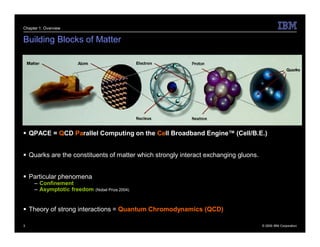
 QPACE = QCD Parallel Computing on the Cell Broadband Engine™ (Cell/B.E.)


 Quarks are the constituents of matter which strongly interact exchanging gluons.


 Particular phenomena
     – Confinement
     – Asymptotic freedom   (Nobel Prize 2004)


 Theory of strong interactions = Quantum Chromodynamics (QCD)

3                                                                                    © 2009 IBM Corporation
Chapter 1: Overview


Computing Resource Requests


 Lattice QCD community aims for O(1−3) PFlops/s sustained beyond 2010.


 Europe
   – “The computational requirements voiced by these European groups sum up to more than
     1 sustained Petaflop/s by 2009.” [HPC in Europe Taskforce (HET), 2006]


 US (USQCD)
   – Hope for O(1) PFlops/s sustained in 2010-11. “A goal with very substantial scientific
     rewards.” [USQCD SciDAC-2 proposal, 2006]


 Similar requests from Japan.


4                                                                                   © 2009 IBM Corporation
Chapter 2: Application optimized supercomputers


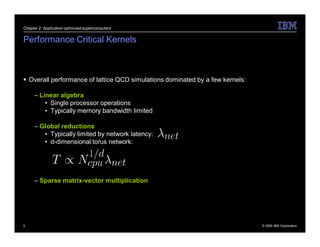
Performance Critical Kernels


 Overall performance of lattice QCD simulations dominated by a few kernels:

     – Linear algebra
         • Single processor operations
         • Typically memory bandwidth limited

     – Global reductions
        • Typically limited by network latency:
        • d-dimensional torus network:


     – Sparse matrix-vector multiplication


5                                                                              © 2009 IBM Corporation
Chapter 2: Application optimized supercomputers


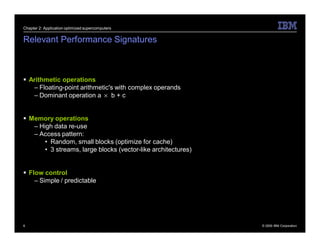
Relevant Performance Signatures


 Arithmetic operations
   – Floating-point arithmetic's with complex operands
   – Dominant operation a × b + c


 Memory operations
   – High data re-use
   – Access pattern:
       • Random, small blocks (optimize for cache)
       • 3 streams, large blocks (vector-like architectures)


 Flow control
    – Simple / predictable


6                                                              © 2009 IBM Corporation
Chapter 2: Application optimized supercomputers


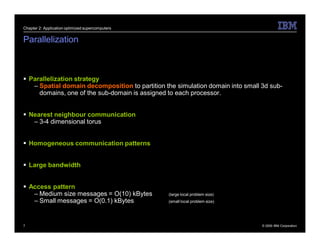
Parallelization


 Parallelization strategy
   – Spatial domain decomposition to partition the simulation domain into small 3d sub-
     domains, one of the sub-domain is assigned to each processor.


 Nearest neighbour communication
   – 3-4 dimensional torus


 Homogeneous communication patterns


 Large bandwidth


 Access pattern
   – Medium size messages = O(10) kBytes          (large local problem size)
   – Small messages = O(0.1) kBytes               (small local problem size)


7                                                                               © 2009 IBM Corporation
Chapter 2: Application optimized supercomputers


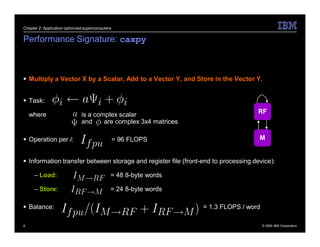
Performance Signature: caxpy


 Multiply a Vector X by a Scalar, Add to a Vector Y, and Store in the Vector Y.


 Task:

    where                      is a complex scalar                                 RF
                               and     are complex 3x4 matrices

 Operation per i:                                = 96 FLOPS                        M


 Information transfer between storage and register file (front-end to processing device):

     – Load:                                  = 48 8-byte words

     – Store:                                 = 24 8-byte words

 Balance:                                                        = 1.3 FLOPS / word

8                                                                                      © 2009 IBM Corporation
Chapter 2: Application optimized supercomputers


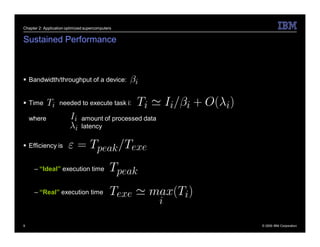
Sustained Performance


 Bandwidth/throughput of a device:


 Time             needed to execute task i:

    where                      amount of processed data
                               latency

 Efficiency is


     – “Ideal” execution time


     – “Real” execution time


9                                                         © 2009 IBM Corporation
Chapter 2: Application optimized supercomputers


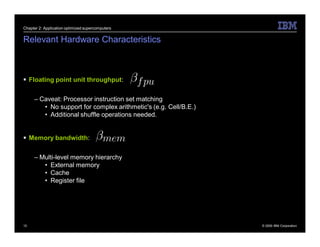
Relevant Hardware Characteristics


 Floating point unit throughput:

     – Caveat: Processor instruction set matching
        • No support for complex arithmetic's (e.g. Cell/B.E.)
        • Additional shuffle operations needed.


 Memory bandwidth:

     – Multi-level memory hierarchy
        • External memory
        • Cache
        • Register file


10                                                               © 2009 IBM Corporation
Chapter 2: Application optimized supercomputers


Balanced Hardware


 Example caxpy:


 Processor                                 FPU throughput     Memory bandwidth


                                            [FLOPS / cycle]    [words / cycle]   [FLOPS / word]

 apeNEXT                                            8                 2                4
 QCDOC (MM)                                         2               0.63              3.2
 QCDOC (LS)                                         2                 2                1
 Xeon                                               2               0.29               7
 GPU                                              128 x 2          17.3 (*)           14.8
 Cell/B.E. (MM)                                    8x4                1               32
 Cell/B.E. (LS)                                    8x4              8x4                2


11                                                                                     © 2009 IBM Corporation
Chapter 2: Application optimized supercomputers


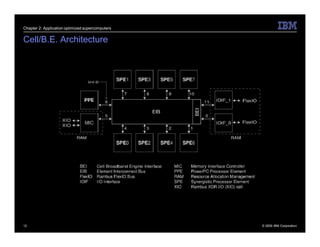
Cell/B.E. Architecture


12                                                © 2009 IBM Corporation
Chapter 2: Application optimized supercomputers


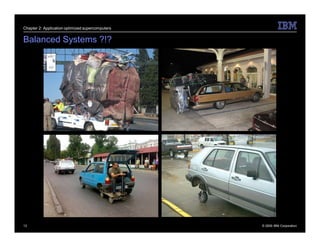
Balanced Systems ?!?


13                                                © 2009 IBM Corporation
Chapter 2: Application optimized supercomputers


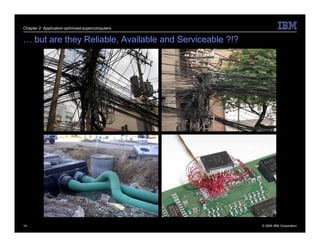
… but are they Reliable, Available and Serviceable ?!?


14                                                       © 2009 IBM Corporation
Chapter 3: QPACE


Collaboration and Credits


 QPACE = QCD Parallel Computing on the Cell Broadband Engine™ (Cell/B.E.)


 Academic Partners
     –   University Regensburg       S. Heybrock, D. Hierl, T. Maurer, N. Meyer, A. Nobile, A. Schaefer, S. Solbrig, T. Streuer, T. Wettig
     –   University Wuppertal        Z. Fodor, A. Frommer, M. Huesken
     –   University Ferrara          M. Pivanti, F. Schifano, R. Tripiccione
     –   University Milano           H. Simma
     –   DESY Zeuthen                D.Pleiter, K.-H. Sulanke, F. Winter
     –   Research Lab Juelich        M. Drochner, N. Eicker, T. Lippert

 Industrial Partner
     – IBM   (DE, US, FR)            H. Baier, H. Boettiger, A. Castellane, J.-F. Fauh, U. Fischer, G. Goldrian, C. Gomez, T. Huth, B. Krill,
                                     J. Lauritsen, J. McFadden, I. Ouda, M. Ries, H.J. Schick, J.-S. Vogt

 Main Funding
   – DFG (SFB TR55), IBM
 Support by Others
     – Eurotech (IT) , Knuerr (DE), Xilinx (US)


15                                                                                                                           © 2009 IBM Corporation
Project Timetable


 01/08       Official project start
 06/08       Node card bring-up
 10/08       Fully populated backplane
 01/09       Hardware integration tests
 02-03/09    Release to manufacturing
 05/09       Integration of 1st rack
 07/09       Deployment of 2 racks at JSC
 08/09       Deployment of 4 racks at JSC and
              4 racks at University Wuppertal complete


16                                                       © 2009 IBM Corporation
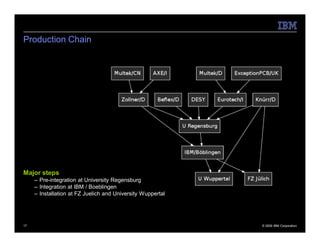
Production Chain


Major steps
     – Pre-integration at University Regensburg
     – Integration at IBM / Boeblingen
     – Installation at FZ Juelich and University Wuppertal


17                                                           © 2009 IBM Corporation
Chapter 3: QPACE


Concept


 System
     – Node card with IBM® PowerXCell™ 8i processor and network processor (NWP)
         • Important feature: fast double precision arithmetic's
     – Commodity processor interconnected by a custom network
     – Custom system design
     – Liquid cooling system


 Rack parameters
     – 256 node cards
         • 26 TFLOPS peak (double precision)
         • 1 TB Memory
     – O(35) kWatt power consumption


 Applications
     – Target sustained performance of 20-30%
     – Optimized for calculations in theoretical particle physics:
       Simulation of Quantum Chromodynamics


18                                                                                © 2009 IBM Corporation
Chapter 3: QPACE


Networks


 Torus network
     – Nearest-neighbor communication, 3-dimensional torus topology
     – Aggregate bandwidth 6 GByte/s per node and direction
     – Remote DMA communication (local store to local store)


 Interrupt tree network
     – Evaluation of global conditions and synchronization
     – Global Exceptions
     – 2 signals per direction


 Ethernet network
     –   1 Gigabit Ethernet link per node card to rack-level switches (switched network)
     –   I/O to parallel file system (user input / output)
     –   Linux network boot
     –   Aim of O(10) GB bandwidth per rack


19                                                                                         © 2009 IBM Corporation
Chapter 3: QPACE


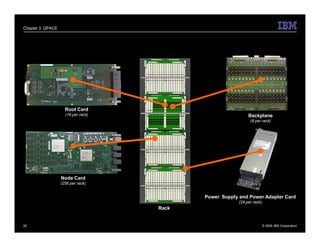
                     Root Card
                     (16 per rack)                            Backplane
                                                               (8 per rack)


                   Node Card
                   (256 per rack)


                                            Power Supply and Power Adapter Card
                                                         (24 per rack)
                                     Rack


20                                                                       © 2009 IBM Corporation
Chapter 3: QPACE


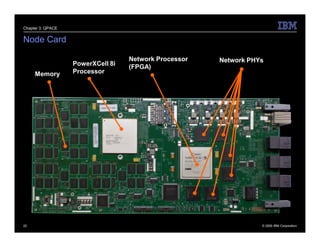
Node Card


 Components
     –   IBM PowerXCell 8i processor 3.2 GHZ
     –   4 Gigabyte DDR2 memory 800 MHZ with ECC
     –   Network processor (NWP) Xilinx FPGA LX110T FPGA
     –   Ethernet PHY
     –   6 x 1GB/s external links using PCI Express physical layer
     –   Service Processor (SP) Freescale 52211
     –   FLASH (firmware and FPGA configuration)
     –   Power subsystem
     –   Clocking


 Network Processor
     –   FLEXIO interface to PowerXCell 8i processor, 2 bytes with 3 GHZ bit rate
     –   Gigabit Ethernet
     –   UART FW Linux console
     –   UART SP communication
     –   SPI Master (boot flash)
     –   SPI Slave for training and configuration
     –   GPIO


21                                                                                  © 2009 IBM Corporation
Chapter 3: QPACE


Node Card

                                   Network Processor   Network PHYs
                   PowerXCell 8i   (FPGA)
     Memory        Processor


22                                                                © 2009 IBM Corporation
Chapter 3: QPACE


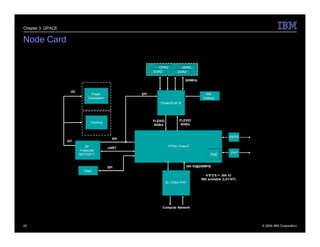
Node Card

                                                             DDR2           DDR2
                                                          DDR2            DDR2

                                                                              800MHz


                     I2C
                                  Power             SPI                                   RW
                                Subsystem                                               (Debug)
                                                              PowerXCell 8i


                                                          FLEXIO           FLEXIO
                                 Clocking
                                                           6GB/s            6GB/s


                                                                                                        RS232
                                              SPI
                   I2C
                              SP                                    FPGA Virtex-5
                                            UART
                           Freescale
                           MCF52211                                                         GigE         PHY


                                            SPI                                384 IO@250MHZ
                             Flash
                                                                                          4*8*2*6 = 384 IO
                                                                                       680 available (LX110T)
                                                                   6x 1GB/s PHY


                                                               Compute Network


23                                                                                                              © 2009 IBM Corporation
Chapter 3: QPACE


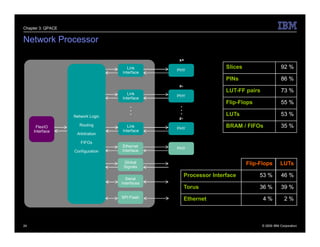
Network Processor

                                                x+
                                      Link
                                                PHY
                                                                    Slices                     92 %
                                   Interface
                                                                    PINs                       86 %
                                                x-
                                      Link
                                                                    LUT-FF pairs               73 %
                                                PHY
                                   Interface
                                                                    Flip-Flops                 55 %
                                                
                                                
                   Network Logic
                                                                  LUTs                       53 %
                                                z-

      FlexIO         Routing          Link                          BRAM / FIFOs               35 %
                                                PHY
     Interface                     Interface
                    Arbitration

                      FIFOs
                                   Ethernet
                                                PHY
                   Configuration   Interface

                                    Global                                   Flip-Flops       LUTs
                                    Signals

                                                     Processor Interface          53 %         46 %
                                     Serial
                                   Interfaces
                                                     Torus                        36 %         39 %
                                   SPI Flash         Ethernet                      4%            2%


24                                                                                 © 2009 IBM Corporation
Chapter 3: QPACE


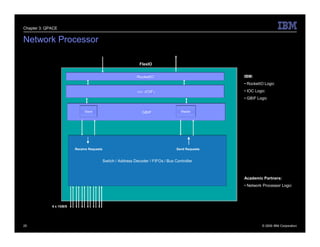
Network Processor

                                                                FlexIO


                                                              RocketIO                              IBM:
                                                                                                    • RocketIO Logic
                                                                IOC IOIF
                                                               IOC ((IOIF) )
                                                                 FELX iO                            • IOC Logic
                                                                                                    • GBIF Logic


                              Slave                               GBIF                Master


                         Receive Requests                                           Send Requests


                                            Switch / Address Decoder / FIFOs / Bus Controller


                                                                                                    Academic Partners:
                                                                                                    • Network Processor Logic


             6 x 1GB/S


25                                                                                                           © 2009 IBM Corporation
Chapter 3: QPACE


Processor Bus Interface


 FlexIO Interface
     –   High bandwidth interface between IBM PowerXCell 8i processor and Xilinx Viretx-5 FPGA
     –   Implementation from Rambus Inc
     –   Optimized for intra-board environments
     –   Uses RocketIO GPT transceiver features
     –   Requires link training after power-on
           • Phase calibration                 (aligns the data for optimal sampling point)
           • Parallel calibration              (synchronizes the receive deserializer with the transmit serializer)
           • Levelization calibration          (aligns all data lanes)


 Challenges
   – Speed, Latency, Bandwidth and Timing (Clock)
     – 3 Gbyte/sec communication channel
     – 2 Byte link wide


26                                                                                                                    © 2009 IBM Corporation
Chapter 3: QPACE


Torus Network Physical Layer


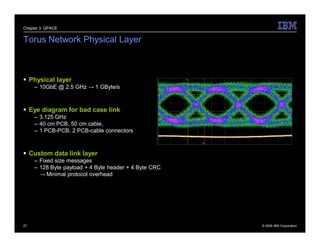
 Physical layer
     – 10GbE @ 2.5 GHz → 1 GByte/s


 Eye diagram for bad case link
     – 3.125 GHz
     – 40 cm PCB, 50 cm cable,
     – 1 PCB-PCB, 2 PCB-cable connectors


 Custom data link layer
     – Fixed size messages
     – 128 Byte payload + 4 Byte header + 4 Byte CRC
       → Minimal protocol overhead


27                                                     © 2009 IBM Corporation
Torus Network Architecture


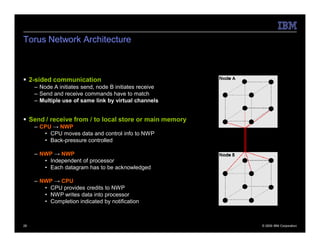
 2-sided communication
     – Node A initiates send, node B initiates receive
     – Send and receive commands have to match
     – Multiple use of same link by virtual channels


 Send / receive from / to local store or main memory
     – CPU → NWP
        • CPU moves data and control info to NWP
        • Back-pressure controlled

     – NWP → NWP
        • Independent of processor
        • Each datagram has to be acknowledged

     – NWP → CPU
        • CPU provides credits to NWP
        • NWP writes data into processor
        • Completion indicated by notification


28                                                       © 2009 IBM Corporation
Chapter 3: QPACE


Torus Network Reconfiguration


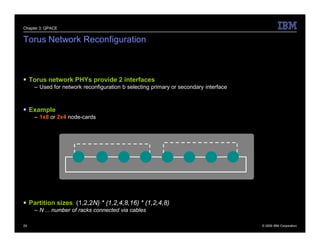
 Torus network PHYs provide 2 interfaces
     – Used for network reconfiguration b selecting primary or secondary interface


 Example
     – 1x8 or 2x4 node-cards


 Partition sizes (1,2,2N) * (1,2,4,8,16) * (1,2,4,8)
     – N ... number of racks connected via cables

29                                                                                   © 2009 IBM Corporation
Chapter 3: QPACE


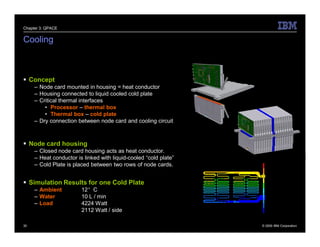
Cooling


 Concept
     – Node card mounted in housing = heat conductor
     – Housing connected to liquid cooled cold plate
     – Critical thermal interfaces
         • Processor – thermal box
         • Thermal box – cold plate
     – Dry connection between node card and cooling circuit


 Node card housing
     – Closed node card housing acts as heat conductor.
     – Heat conductor is linked with liquid-cooled “cold plate”
     – Cold Plate is placed between two rows of node cards.


 Simulation Results for one Cold Plate
     – Ambient          12°C
     – Water            10 L / min
     – Load             4224 Watt
                        2112 Watt / side

30                                                                © 2009 IBM Corporation
Chapter 3: QPACE


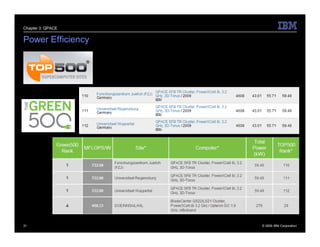
Power Efficiency


31                 © 2009 IBM Corporation
Chapter 4: Review and Summary


Project Review


 Hardware design
     – Almost all critical problems solved in time
     – Network Processor implementation still a challenge
     – No serious problems due to wrong design decisions


 Hardware status
     – Manufacturing quality good: Small bone pile, few defects during operation.


 Time schedule
     – Essentially stayed within planned schedule
     – Implementation of system / application software delayed


32                                                                                  © 2009 IBM Corporation
Chapter 4: Review and Summary


Summary


 QPACE is a new, scalable LQCD machine based on the PowerXCell 8i processor.


 Design highlights
      –   FPGA directly attached to processor
      –   LQCD optimized, low latency torus network
      –   Novel, cost-efficient liquid cooling system
      –   High packaging density
      –   Very power efficient architecture


 O(20-30%) sustained performance for key LQCD kernels is reached / feasible

     → O(10-16) TFLOPS / rack (SP)


33                                                                             © 2009 IBM Corporation
Chapter 5: Unforgettable Impressions ;-)


34                                         © 2009 IBM Corporation
Chapter 5: Unforgettable Impressions ;-)


35                                         © 2009 IBM Corporation
Chapter 5: Unforgettable Impressions ;-)


36                                         © 2009 IBM Corporation
Chapter 5: Unforgettable Impressions ;-)


37                                         © 2009 IBM Corporation
Chapter 5: Unforgettable Impressions ;-)


38                                         © 2009 IBM Corporation
Chapter 5: Unforgettable Impressions ;-)


39                                         © 2009 IBM Corporation
Chapter 5: Unforgettable Impressions ;-)


40                                         © 2009 IBM Corporation
Chapter 5: Unforgettable Impressions ;-)


41                                         © 2009 IBM Corporation
Chapter 5: Unforgettable Impressions ;-)


42                                         © 2009 IBM Corporation
Chapter 5: Unforgettable Impressions ;-)


43                                         © 2009 IBM Corporation
Chapter 5: Unforgettable Impressions ;-)


44                                         © 2009 IBM Corporation
45   © 2009 IBM Corporation
Thank you very much for your attention.
46                                       © 2009 IBM Corporation
Disclaimer


 IBM®, DB2®, MVS/ESA, AIX®, S/390®, AS/400®, OS/390®, OS/400®, iSeries, pSeries,
  xSeries, zSeries, z/OS, AFP, Intelligent Miner, WebSphere®, Netfinity®, Tivoli®, Informix
  und Informix® Dynamic ServerTM, IBM, BladeCenter and POWER and others are
  trademarks of the IBM Corporation in US and/or other countries.


 Cell Broadband Engine is a trademark of Sony Computer Entertainment, Inc. in the United
  States, other countries, or both and is used under license there from. Linux is a trademark of
  Linus Torvalds in the United States, other countries or both.


 Other company, product, or service names may be trademarks or service marks of others.
  The information and materials are provided on an "as is" basis and are subject to change.


47                                                                                   © 2009 IBM Corporation

QPACE - QCD Parallel Computing on the Cell Broadband Engine™ (Cell/B.E.)

  • 1.
    Heiko J Schick– IBM Deutschland R&D GmbH November 2010 QPACE QCD Parallel Computing on the Cell Broadband Engine™ (Cell/B.E.) © 2009 IBM Corporation
  • 2.
    Agenda  Chapter 1:Overview  Chapter 2: Application optimized supercomputers  Chapter 3: QPACE  Chapter 4: Review and Summary  Chapter 5: Unforgettable Impressions ;-) 2 © 2009 IBM Corporation
  • 3.
    Chapter 1: Overview BuildingBlocks of Matter  QPACE = QCD Parallel Computing on the Cell Broadband Engine™ (Cell/B.E.)  Quarks are the constituents of matter which strongly interact exchanging gluons.  Particular phenomena – Confinement – Asymptotic freedom (Nobel Prize 2004)  Theory of strong interactions = Quantum Chromodynamics (QCD) 3 © 2009 IBM Corporation
  • 4.
    Chapter 1: Overview ComputingResource Requests  Lattice QCD community aims for O(1−3) PFlops/s sustained beyond 2010.  Europe – “The computational requirements voiced by these European groups sum up to more than 1 sustained Petaflop/s by 2009.” [HPC in Europe Taskforce (HET), 2006]  US (USQCD) – Hope for O(1) PFlops/s sustained in 2010-11. “A goal with very substantial scientific rewards.” [USQCD SciDAC-2 proposal, 2006]  Similar requests from Japan. 4 © 2009 IBM Corporation
  • 5.
    Chapter 2: Applicationoptimized supercomputers Performance Critical Kernels  Overall performance of lattice QCD simulations dominated by a few kernels: – Linear algebra • Single processor operations • Typically memory bandwidth limited – Global reductions • Typically limited by network latency: • d-dimensional torus network: – Sparse matrix-vector multiplication 5 © 2009 IBM Corporation
  • 6.
    Chapter 2: Applicationoptimized supercomputers Relevant Performance Signatures  Arithmetic operations – Floating-point arithmetic's with complex operands – Dominant operation a × b + c  Memory operations – High data re-use – Access pattern: • Random, small blocks (optimize for cache) • 3 streams, large blocks (vector-like architectures)  Flow control – Simple / predictable 6 © 2009 IBM Corporation
  • 7.
    Chapter 2: Applicationoptimized supercomputers Parallelization  Parallelization strategy – Spatial domain decomposition to partition the simulation domain into small 3d sub- domains, one of the sub-domain is assigned to each processor.  Nearest neighbour communication – 3-4 dimensional torus  Homogeneous communication patterns  Large bandwidth  Access pattern – Medium size messages = O(10) kBytes (large local problem size) – Small messages = O(0.1) kBytes (small local problem size) 7 © 2009 IBM Corporation
  • 8.
    Chapter 2: Applicationoptimized supercomputers Performance Signature: caxpy  Multiply a Vector X by a Scalar, Add to a Vector Y, and Store in the Vector Y.  Task: where is a complex scalar RF and are complex 3x4 matrices  Operation per i: = 96 FLOPS M  Information transfer between storage and register file (front-end to processing device): – Load: = 48 8-byte words – Store: = 24 8-byte words  Balance: = 1.3 FLOPS / word 8 © 2009 IBM Corporation
  • 9.
    Chapter 2: Applicationoptimized supercomputers Sustained Performance  Bandwidth/throughput of a device:  Time needed to execute task i: where amount of processed data latency  Efficiency is – “Ideal” execution time – “Real” execution time 9 © 2009 IBM Corporation
  • 10.
    Chapter 2: Applicationoptimized supercomputers Relevant Hardware Characteristics  Floating point unit throughput: – Caveat: Processor instruction set matching • No support for complex arithmetic's (e.g. Cell/B.E.) • Additional shuffle operations needed.  Memory bandwidth: – Multi-level memory hierarchy • External memory • Cache • Register file 10 © 2009 IBM Corporation
  • 11.
    Chapter 2: Applicationoptimized supercomputers Balanced Hardware  Example caxpy: Processor FPU throughput Memory bandwidth [FLOPS / cycle] [words / cycle] [FLOPS / word] apeNEXT 8 2 4 QCDOC (MM) 2 0.63 3.2 QCDOC (LS) 2 2 1 Xeon 2 0.29 7 GPU 128 x 2 17.3 (*) 14.8 Cell/B.E. (MM) 8x4 1 32 Cell/B.E. (LS) 8x4 8x4 2 11 © 2009 IBM Corporation
  • 12.
    Chapter 2: Applicationoptimized supercomputers Cell/B.E. Architecture 12 © 2009 IBM Corporation
  • 13.
    Chapter 2: Applicationoptimized supercomputers Balanced Systems ?!? 13 © 2009 IBM Corporation
  • 14.
    Chapter 2: Applicationoptimized supercomputers … but are they Reliable, Available and Serviceable ?!? 14 © 2009 IBM Corporation
  • 15.
    Chapter 3: QPACE Collaborationand Credits  QPACE = QCD Parallel Computing on the Cell Broadband Engine™ (Cell/B.E.)  Academic Partners – University Regensburg S. Heybrock, D. Hierl, T. Maurer, N. Meyer, A. Nobile, A. Schaefer, S. Solbrig, T. Streuer, T. Wettig – University Wuppertal Z. Fodor, A. Frommer, M. Huesken – University Ferrara M. Pivanti, F. Schifano, R. Tripiccione – University Milano H. Simma – DESY Zeuthen D.Pleiter, K.-H. Sulanke, F. Winter – Research Lab Juelich M. Drochner, N. Eicker, T. Lippert  Industrial Partner – IBM (DE, US, FR) H. Baier, H. Boettiger, A. Castellane, J.-F. Fauh, U. Fischer, G. Goldrian, C. Gomez, T. Huth, B. Krill, J. Lauritsen, J. McFadden, I. Ouda, M. Ries, H.J. Schick, J.-S. Vogt  Main Funding – DFG (SFB TR55), IBM  Support by Others – Eurotech (IT) , Knuerr (DE), Xilinx (US) 15 © 2009 IBM Corporation
  • 16.
    Project Timetable  01/08 Official project start  06/08 Node card bring-up  10/08 Fully populated backplane  01/09 Hardware integration tests  02-03/09 Release to manufacturing  05/09 Integration of 1st rack  07/09 Deployment of 2 racks at JSC  08/09 Deployment of 4 racks at JSC and 4 racks at University Wuppertal complete 16 © 2009 IBM Corporation
  • 17.
    Production Chain Major steps – Pre-integration at University Regensburg – Integration at IBM / Boeblingen – Installation at FZ Juelich and University Wuppertal 17 © 2009 IBM Corporation
  • 18.
    Chapter 3: QPACE Concept System – Node card with IBM® PowerXCell™ 8i processor and network processor (NWP) • Important feature: fast double precision arithmetic's – Commodity processor interconnected by a custom network – Custom system design – Liquid cooling system  Rack parameters – 256 node cards • 26 TFLOPS peak (double precision) • 1 TB Memory – O(35) kWatt power consumption  Applications – Target sustained performance of 20-30% – Optimized for calculations in theoretical particle physics: Simulation of Quantum Chromodynamics 18 © 2009 IBM Corporation
  • 19.
    Chapter 3: QPACE Networks Torus network – Nearest-neighbor communication, 3-dimensional torus topology – Aggregate bandwidth 6 GByte/s per node and direction – Remote DMA communication (local store to local store)  Interrupt tree network – Evaluation of global conditions and synchronization – Global Exceptions – 2 signals per direction  Ethernet network – 1 Gigabit Ethernet link per node card to rack-level switches (switched network) – I/O to parallel file system (user input / output) – Linux network boot – Aim of O(10) GB bandwidth per rack 19 © 2009 IBM Corporation
  • 20.
    Chapter 3: QPACE Root Card (16 per rack) Backplane (8 per rack) Node Card (256 per rack) Power Supply and Power Adapter Card (24 per rack) Rack 20 © 2009 IBM Corporation
  • 21.
    Chapter 3: QPACE NodeCard  Components – IBM PowerXCell 8i processor 3.2 GHZ – 4 Gigabyte DDR2 memory 800 MHZ with ECC – Network processor (NWP) Xilinx FPGA LX110T FPGA – Ethernet PHY – 6 x 1GB/s external links using PCI Express physical layer – Service Processor (SP) Freescale 52211 – FLASH (firmware and FPGA configuration) – Power subsystem – Clocking  Network Processor – FLEXIO interface to PowerXCell 8i processor, 2 bytes with 3 GHZ bit rate – Gigabit Ethernet – UART FW Linux console – UART SP communication – SPI Master (boot flash) – SPI Slave for training and configuration – GPIO 21 © 2009 IBM Corporation
  • 22.
    Chapter 3: QPACE NodeCard Network Processor Network PHYs PowerXCell 8i (FPGA) Memory Processor 22 © 2009 IBM Corporation
  • 23.
    Chapter 3: QPACE NodeCard DDR2 DDR2 DDR2 DDR2 800MHz I2C Power SPI RW Subsystem (Debug) PowerXCell 8i FLEXIO FLEXIO Clocking 6GB/s 6GB/s RS232 SPI I2C SP FPGA Virtex-5 UART Freescale MCF52211 GigE PHY SPI 384 IO@250MHZ Flash 4*8*2*6 = 384 IO 680 available (LX110T) 6x 1GB/s PHY Compute Network 23 © 2009 IBM Corporation
  • 24.
    Chapter 3: QPACE NetworkProcessor x+ Link PHY Slices 92 % Interface PINs 86 % x- Link LUT-FF pairs 73 % PHY Interface Flip-Flops 55 %     Network Logic   LUTs 53 % z- FlexIO Routing Link BRAM / FIFOs 35 % PHY Interface Interface Arbitration FIFOs Ethernet PHY Configuration Interface Global Flip-Flops LUTs Signals Processor Interface 53 % 46 % Serial Interfaces Torus 36 % 39 % SPI Flash Ethernet 4% 2% 24 © 2009 IBM Corporation
  • 25.
    Chapter 3: QPACE NetworkProcessor FlexIO RocketIO IBM: • RocketIO Logic IOC IOIF IOC ((IOIF) ) FELX iO • IOC Logic • GBIF Logic Slave GBIF Master Receive Requests Send Requests Switch / Address Decoder / FIFOs / Bus Controller Academic Partners: • Network Processor Logic 6 x 1GB/S 25 © 2009 IBM Corporation
  • 26.
    Chapter 3: QPACE ProcessorBus Interface  FlexIO Interface – High bandwidth interface between IBM PowerXCell 8i processor and Xilinx Viretx-5 FPGA – Implementation from Rambus Inc – Optimized for intra-board environments – Uses RocketIO GPT transceiver features – Requires link training after power-on • Phase calibration (aligns the data for optimal sampling point) • Parallel calibration (synchronizes the receive deserializer with the transmit serializer) • Levelization calibration (aligns all data lanes)  Challenges – Speed, Latency, Bandwidth and Timing (Clock) – 3 Gbyte/sec communication channel – 2 Byte link wide 26 © 2009 IBM Corporation
  • 27.
    Chapter 3: QPACE TorusNetwork Physical Layer  Physical layer – 10GbE @ 2.5 GHz → 1 GByte/s  Eye diagram for bad case link – 3.125 GHz – 40 cm PCB, 50 cm cable, – 1 PCB-PCB, 2 PCB-cable connectors  Custom data link layer – Fixed size messages – 128 Byte payload + 4 Byte header + 4 Byte CRC → Minimal protocol overhead 27 © 2009 IBM Corporation
  • 28.
    Torus Network Architecture 2-sided communication – Node A initiates send, node B initiates receive – Send and receive commands have to match – Multiple use of same link by virtual channels  Send / receive from / to local store or main memory – CPU → NWP • CPU moves data and control info to NWP • Back-pressure controlled – NWP → NWP • Independent of processor • Each datagram has to be acknowledged – NWP → CPU • CPU provides credits to NWP • NWP writes data into processor • Completion indicated by notification 28 © 2009 IBM Corporation
  • 29.
    Chapter 3: QPACE TorusNetwork Reconfiguration  Torus network PHYs provide 2 interfaces – Used for network reconfiguration b selecting primary or secondary interface  Example – 1x8 or 2x4 node-cards  Partition sizes (1,2,2N) * (1,2,4,8,16) * (1,2,4,8) – N ... number of racks connected via cables 29 © 2009 IBM Corporation
  • 30.
    Chapter 3: QPACE Cooling Concept – Node card mounted in housing = heat conductor – Housing connected to liquid cooled cold plate – Critical thermal interfaces • Processor – thermal box • Thermal box – cold plate – Dry connection between node card and cooling circuit  Node card housing – Closed node card housing acts as heat conductor. – Heat conductor is linked with liquid-cooled “cold plate” – Cold Plate is placed between two rows of node cards.  Simulation Results for one Cold Plate – Ambient 12°C – Water 10 L / min – Load 4224 Watt 2112 Watt / side 30 © 2009 IBM Corporation
  • 31.
    Chapter 3: QPACE PowerEfficiency 31 © 2009 IBM Corporation
  • 32.
    Chapter 4: Reviewand Summary Project Review  Hardware design – Almost all critical problems solved in time – Network Processor implementation still a challenge – No serious problems due to wrong design decisions  Hardware status – Manufacturing quality good: Small bone pile, few defects during operation.  Time schedule – Essentially stayed within planned schedule – Implementation of system / application software delayed 32 © 2009 IBM Corporation
  • 33.
    Chapter 4: Reviewand Summary Summary  QPACE is a new, scalable LQCD machine based on the PowerXCell 8i processor.  Design highlights – FPGA directly attached to processor – LQCD optimized, low latency torus network – Novel, cost-efficient liquid cooling system – High packaging density – Very power efficient architecture  O(20-30%) sustained performance for key LQCD kernels is reached / feasible → O(10-16) TFLOPS / rack (SP) 33 © 2009 IBM Corporation
  • 34.
    Chapter 5: UnforgettableImpressions ;-) 34 © 2009 IBM Corporation
  • 35.
    Chapter 5: UnforgettableImpressions ;-) 35 © 2009 IBM Corporation
  • 36.
    Chapter 5: UnforgettableImpressions ;-) 36 © 2009 IBM Corporation
  • 37.
    Chapter 5: UnforgettableImpressions ;-) 37 © 2009 IBM Corporation
  • 38.
    Chapter 5: UnforgettableImpressions ;-) 38 © 2009 IBM Corporation
  • 39.
    Chapter 5: UnforgettableImpressions ;-) 39 © 2009 IBM Corporation
  • 40.
    Chapter 5: UnforgettableImpressions ;-) 40 © 2009 IBM Corporation
  • 41.
    Chapter 5: UnforgettableImpressions ;-) 41 © 2009 IBM Corporation
  • 42.
    Chapter 5: UnforgettableImpressions ;-) 42 © 2009 IBM Corporation
  • 43.
    Chapter 5: UnforgettableImpressions ;-) 43 © 2009 IBM Corporation
  • 44.
    Chapter 5: UnforgettableImpressions ;-) 44 © 2009 IBM Corporation
  • 45.
    45 © 2009 IBM Corporation
  • 46.
    Thank you verymuch for your attention. 46 © 2009 IBM Corporation
  • 47.
    Disclaimer  IBM®, DB2®,MVS/ESA, AIX®, S/390®, AS/400®, OS/390®, OS/400®, iSeries, pSeries, xSeries, zSeries, z/OS, AFP, Intelligent Miner, WebSphere®, Netfinity®, Tivoli®, Informix und Informix® Dynamic ServerTM, IBM, BladeCenter and POWER and others are trademarks of the IBM Corporation in US and/or other countries.  Cell Broadband Engine is a trademark of Sony Computer Entertainment, Inc. in the United States, other countries, or both and is used under license there from. Linux is a trademark of Linus Torvalds in the United States, other countries or both.  Other company, product, or service names may be trademarks or service marks of others. The information and materials are provided on an "as is" basis and are subject to change. 47 © 2009 IBM Corporation