Blue Gene Technology
PRESENTED BY: MOHAMMED TALHA TABREZ (20K81A0596)
Content Layout
• Introduction
• What is Blue Gene Technology
• Key features
• Applications
• Blue Gene/L
• Blue Gene/P
• Blue Gene/Q
• Performance Achievements
• Challenges and Future Decisions
Introduction to Blue Gene
Technology
Blue Gene Technology is a project by IBM
aimed at designing supercomputers that can
reach operating speeds in petaFLOPS range
with low power consumption.
In December 1999, IBM announced $100
million research initiative for a five year
effort to build a massively parallel computer
to be applied to study of biomolecular
phenomena such as protein folding.
What is Blue Gene Technology?
• The name Blue Gene comes from what it was originally designed to do,
help biologists understand the processes of protein folding and gene
development.
• Blue is a traditional moniker that IBM uses for many of its products and
the company itself.
• L stands for ‘light’. P stands for ‘Petascale design’. Q stands for nothing
but the letter after P.
Key features of Blue Gene Technology:
 Massive parallelism: Blue Gene systems consist of thousands or
even millions of processors working together
 Low power consumption: Designed to be energy-efficient
 Exceptional performance: High-speed computation and data
processing capabilities
Applications of Blue
Gene Technology
• Scientific research: used in fields related to physics, biology, chemistry and
climate modelling
• Drug discovery: used in pharmaceutical industries for drug discovery and
development.
• Weather forecasting and climate modelling: used for weather
forecasting due to massive computational powers.
• Computational biology and genomics: plays a very important role in
genomics research and computational biology
• Nuclear fusion: used in the field of plasma physics
• Material science: it is employed in material science research for studying the
behaviour and properties of various materials at the atomic and molecular levels.
Blue
Gene/L
 It was delivered on March, 2005.
 It was named ‘frost’ because it ran cooler than
most micro-processor based high end systems.
 Original plan was to run this system for 3 years
but it was in operation for more than 7 years
continuously.
 It took 6% of electricity as required by the
BlueSky.
 One cabinet consisted of 2048 processors.
Blue
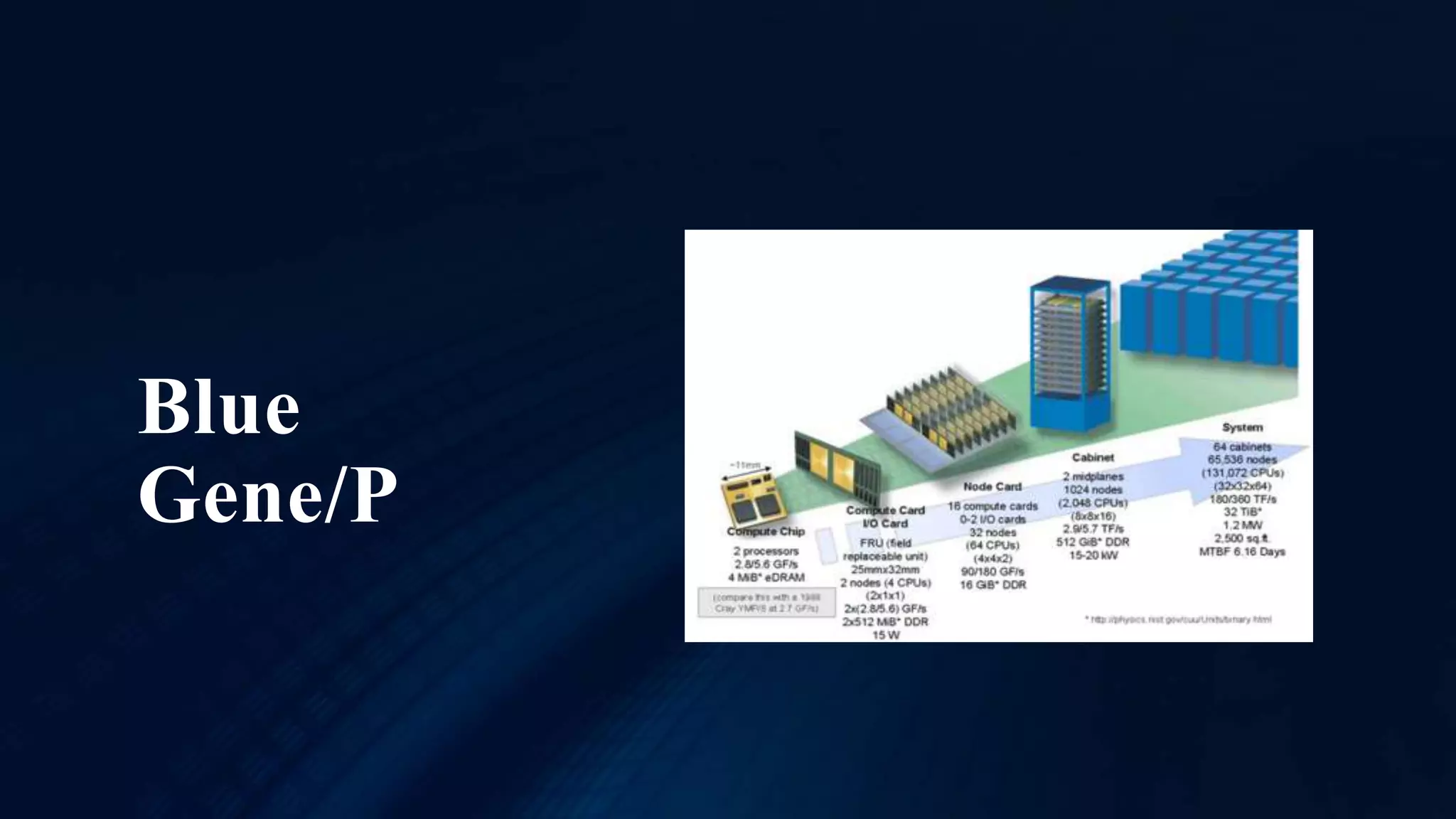
Gene/P
 IBM Blue Gene/P is a modular hybrid
parallel system.
 Its basic module is called a “rack” and a
certain configuration can have from 1 to 72
racks.
 In the full 72 racks configuration, the
theoretical peak performance of the system is
around 1 PFLOPS.
 When it was put into operation in 2008, it was
ranked 126-th in the world in the
http://top500.org list.
Blue
Gene/Q
 The Blue Gene/Q Compute chip is an 18-core chip.
The 64-bit A2 processor cores are 4-way simultaneously
multithreaded, and run at 1.6 GHz.
 Each processor core has a SIMD quad-vector double-
precision floating-point unit (IBM QPX).
 A Blue Gene/Q system called Sequoia was delivered to
the Lawrence Livermore National Laboratory (LLNL)
beginning in 2011 and was fully deployed in June 2012.
Performance
Achievements.
• It's worth noting that Blue Gene technology has made
significant contributions to high-performance computing and
has been used in various research fields. However, it's
important to consider that technological advancements
continue to improve computing capabilities, and newer
systems have surpassed the performance achieved by Blue
Gene technology.
Challenges and future
decisions of Blue Gene
Technology.
The future of Blue Gene technology relies on
addressing power consumption, improving scalability,
embracing heterogeneous computing, optimizing
memory and storage, advancing software and
programming models, adapting to the evolving
technology landscape, and exploring cost-effective
solutions. By addressing these challenges and making
informed decisions, Blue Gene technology can
continue to contribute to scientific research and high-
performance computing advancements.
Conclusion:
THEREFORE WE CAN CONCLUDE FROM THIS PRESENTATION THAT
BLUE GENE TECHNOLOGY IS A VERY MUCH EMERGING
TECHNOLOGY IN THE ADVANCEMENTS OF SUPER COMPUTERS.
WE CAN ALSO ASSUME THAT THE FORTHCOMING GENERATIONS
OF BLUE GENE TECHNOLOGY WILL BE ASSURING OF HIGHER
SPEEDS IN THE TECHNOLOGICAL ADVANCEMENTS.
THANK YOU SO
MUCH!

BlueGeneTechnology.pptx

  • 1.
    Blue Gene Technology PRESENTEDBY: MOHAMMED TALHA TABREZ (20K81A0596)
  • 2.
    Content Layout • Introduction •What is Blue Gene Technology • Key features • Applications • Blue Gene/L • Blue Gene/P • Blue Gene/Q • Performance Achievements • Challenges and Future Decisions
  • 3.
    Introduction to BlueGene Technology
  • 4.
    Blue Gene Technologyis a project by IBM aimed at designing supercomputers that can reach operating speeds in petaFLOPS range with low power consumption. In December 1999, IBM announced $100 million research initiative for a five year effort to build a massively parallel computer to be applied to study of biomolecular phenomena such as protein folding.
  • 5.
    What is BlueGene Technology? • The name Blue Gene comes from what it was originally designed to do, help biologists understand the processes of protein folding and gene development. • Blue is a traditional moniker that IBM uses for many of its products and the company itself. • L stands for ‘light’. P stands for ‘Petascale design’. Q stands for nothing but the letter after P.
  • 7.
    Key features ofBlue Gene Technology:  Massive parallelism: Blue Gene systems consist of thousands or even millions of processors working together  Low power consumption: Designed to be energy-efficient  Exceptional performance: High-speed computation and data processing capabilities
  • 8.
  • 9.
    • Scientific research:used in fields related to physics, biology, chemistry and climate modelling • Drug discovery: used in pharmaceutical industries for drug discovery and development. • Weather forecasting and climate modelling: used for weather forecasting due to massive computational powers. • Computational biology and genomics: plays a very important role in genomics research and computational biology • Nuclear fusion: used in the field of plasma physics • Material science: it is employed in material science research for studying the behaviour and properties of various materials at the atomic and molecular levels.
  • 10.
  • 11.
     It wasdelivered on March, 2005.  It was named ‘frost’ because it ran cooler than most micro-processor based high end systems.  Original plan was to run this system for 3 years but it was in operation for more than 7 years continuously.  It took 6% of electricity as required by the BlueSky.  One cabinet consisted of 2048 processors.
  • 12.
  • 13.
     IBM BlueGene/P is a modular hybrid parallel system.  Its basic module is called a “rack” and a certain configuration can have from 1 to 72 racks.  In the full 72 racks configuration, the theoretical peak performance of the system is around 1 PFLOPS.  When it was put into operation in 2008, it was ranked 126-th in the world in the http://top500.org list.
  • 14.
  • 15.
     The BlueGene/Q Compute chip is an 18-core chip. The 64-bit A2 processor cores are 4-way simultaneously multithreaded, and run at 1.6 GHz.  Each processor core has a SIMD quad-vector double- precision floating-point unit (IBM QPX).  A Blue Gene/Q system called Sequoia was delivered to the Lawrence Livermore National Laboratory (LLNL) beginning in 2011 and was fully deployed in June 2012.
  • 16.
  • 17.
    • It's worthnoting that Blue Gene technology has made significant contributions to high-performance computing and has been used in various research fields. However, it's important to consider that technological advancements continue to improve computing capabilities, and newer systems have surpassed the performance achieved by Blue Gene technology.
  • 18.
    Challenges and future decisionsof Blue Gene Technology.
  • 19.
    The future ofBlue Gene technology relies on addressing power consumption, improving scalability, embracing heterogeneous computing, optimizing memory and storage, advancing software and programming models, adapting to the evolving technology landscape, and exploring cost-effective solutions. By addressing these challenges and making informed decisions, Blue Gene technology can continue to contribute to scientific research and high- performance computing advancements.
  • 20.
    Conclusion: THEREFORE WE CANCONCLUDE FROM THIS PRESENTATION THAT BLUE GENE TECHNOLOGY IS A VERY MUCH EMERGING TECHNOLOGY IN THE ADVANCEMENTS OF SUPER COMPUTERS. WE CAN ALSO ASSUME THAT THE FORTHCOMING GENERATIONS OF BLUE GENE TECHNOLOGY WILL BE ASSURING OF HIGHER SPEEDS IN THE TECHNOLOGICAL ADVANCEMENTS.
  • 21.