Types of Memories used in computer


         http://improvec.blogspot.in/   1
Objective
 On completion of this period, you would be
 able to learn:

 Functions of Memory.

 Types of Memory.


              http://improvec.blogspot.in/    2
Recap

 Blocks in CPU
    Control Unit & Arithmetic and Logical Unit.

 Functions of CPU
    Performs calculations, takes decisions, and
    controls all the units.


                  http://improvec.blogspot.in/    3
Memory


 A space to keep computer’s data.

 It stores program, data, results or any kind of
  intermediate results.


                   http://improvec.blogspot.in/     4
Memory (contd...)


 Memory stores binary data i.e. 0’s and 1’s.


                  http://improvec.blogspot.in/   5
Types of Memory

 Primary memory (Semiconductor memory).

 Secondary memory (magnetic memory).

 Optical memory.


                    http://improvec.blogspot.in/   6
Primary memory:
 The semiconductor memory is employed as the
  main memory (or primary memory).

 It stores programs and data which are currently
  needed by the CPU.

 RAM and ROM ICs are used as the main
  memory of the computer


                   http://improvec.blogspot.in/     7
Primary Memory (contd...)

 The storage type is temporary

 It is volatile memory

 Storage capacity is limited


                   http://improvec.blogspot.in/   8
Primary memory (contd):

 It is part of CPU.

 Used for storing a little volume of data at the
  time of processing.


                       http://improvec.blogspot.in/   9
Secondary memory


The magnetic memory is called as the secondary
memory (auxiliary memory).


The information which is needed by the CPU for
current processing is transferred from the
secondary memory to the main memory.


                 http://improvec.blogspot.in/   10
Secondary memory (contd)


 This is non-volatile memory, i.e., data is stored
  permanently.

 The secondary memory is used for bulk storage
  (mass storage) of programs, data and other
  information.


                   http://improvec.blogspot.in/       11
Secondary memory (contd)
 Storage capacity is enlarged.

 Used for preserving high volume of data for
  future use

 The magnetic memories such as hard disk and
  floppy disk are the most commonly used.


                  http://improvec.blogspot.in/   12
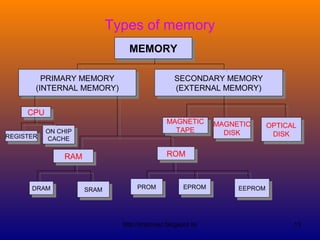
Types of memory
                                 MEMORY
                                 MEMORY

         PRIMARY MEMORY
          PRIMARY MEMORY                          SECONDARY MEMORY
                                                   SECONDARY MEMORY
       (INTERNAL MEMORY)
        (INTERNAL MEMORY)                         (EXTERNAL MEMORY)
                                                   (EXTERNAL MEMORY)

     CPU
     CPU
                                               MAGNETIC MAGNETIC
                                               MAGNETIC MAGNETIC       OPTICAL
                                                                       OPTICAL
            ON CHIP                              TAPE
                                                  TAPE    DISK
REGISTER     ON CHIP                                       DISK         DISK
                                                                         DISK
 REGISTER   CACHE
             CACHE

                 RAM                           ROM
                                               ROM
                 RAM


      DRAM             SRAM         PROM
                                     PROM            EPROM
                                                      EPROM   EEPROM
       DRAM             SRAM                                   EEPROM


                               http://improvec.blogspot.in/                 13
Random Access Memory (RAM)


 It is volatile memory i.e. temporary memory.

 Performs both read and write operations.

 Usually hidden to users.


                   http://improvec.blogspot.in/   14
TYPES OF RAM

Storage capacity is limited.


 DRAM


 SRAM


                   http://improvec.blogspot.in/   15
Static RAM


 Static RAM retains stored information only as
  long as power supply is on.

 Static RAMs are costlier and consume more
  power.


                  http://improvec.blogspot.in/    16
Static RAM (contd..)


 Static RAM is faster.
 It is used as cache memory.

 Static RAMs hold information in flip-flop,
  consisting of two cross coupled inverters.


                   http://improvec.blogspot.in/   17
Dynamic RAM

 Dynamic RAM loses its stored information in a
  very short time even though the power supply is
  on.

 Only one transistor is needed to form a memory
  cell and result in high packing density and
  moderate speed.


                  http://improvec.blogspot.in/   18
Dynamic RAM (contd)


 They consume less power.

 They are used where large capacity of memory
  is needed.

 Dynamic RAM is cheaper.

 It is used as main memory.


                 http://improvec.blogspot.in/    19
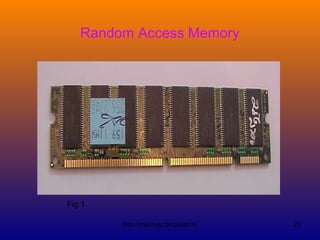
Random Access Memory


Fig 1

        http://improvec.blogspot.in/   20
Read Only Memory (ROM)

 It is non-volatile memory .i.e. permanent storage.

 Performs only read operations.

 Limited storage capacity.


                   http://improvec.blogspot.in/   21
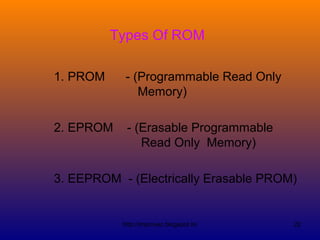
Types Of ROM

1. PROM     - (Programmable Read Only
               Memory)

2. EPROM    - (Erasable Programmable
               Read Only Memory)

3. EEPROM - (Electrically Erasable PROM)


           http://improvec.blogspot.in/   22
Cache Memory

 Cache memory is placed between the CPU and
  the main memory.

 It stores instructions and data which are to be
  immediately executed.


                    http://improvec.blogspot.in/    23
Cache Memory (contd...)

It is not accessible to users i.e. information
cannot be written into cache memory by users.

It increases the performance of the computer
up to 15%.


                  http://improvec.blogspot.in/    24
Summary

In this class, we have learnt about

            Functions of memory.

           Types of memory.


                   http://improvec.blogspot.in/   25
Frequently Asked Questions

1. Explain the types of memories?


2. Explain the functions of memory?


                 http://improvec.blogspot.in/   26
Quiz

1. Is RAM a Volatile memory?
  a. No
  b. Yes


                 http://improvec.blogspot.in/   27
Quiz:

2. Is ROM a Non volatile memory?
  a. Yes
  b. No


                 http://improvec.blogspot.in/   28
Quiz

3. What is the form of data in the memory?
  a. Decimal
  b. Binary
  c. Octal
  d. Hexadecimal


                   http://improvec.blogspot.in/   29