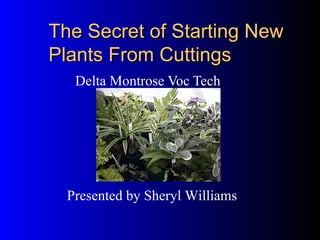
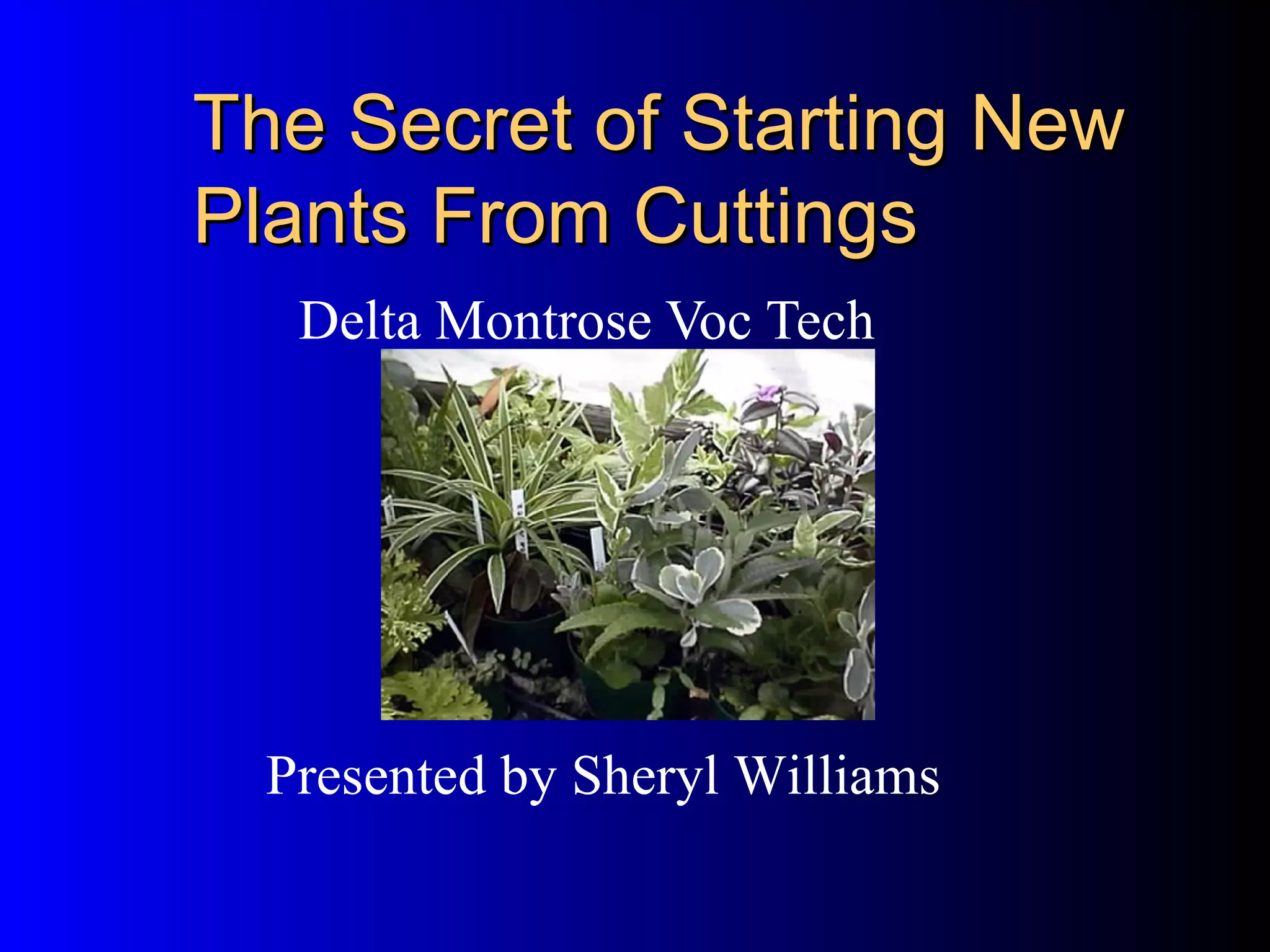
The Secret of Starting New Plants From Cuttings Delta Montrose Voc Tech Presented by Sheryl Williams
Introduction Growing a piece of a plant and inducing it to grow it’s own roots Cuttings are the most successful way of propagating many plants Cuttings are an exact replica of the parent – genetically identical
Secret to Success Timing & Technique Taking cuttings is pretty easy Timing is critical Based on How a Plant Grows
Agenda How a plant grows How to take different kinds of cuttings Tools and Equipment Cutting Care How it works – scientifically Suggested plants for fall cuttings Where to get more information
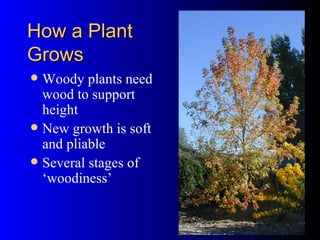
How a Plant Grows Woody plants need wood to support height New growth is soft and pliable Several stages of ‘woodiness’
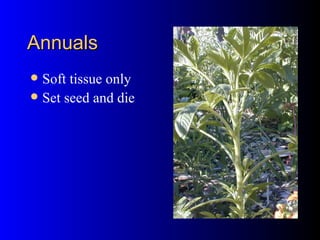
Annuals Soft tissue only Set seed and die
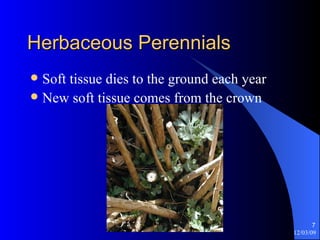
Herbaceous Perennials Soft tissue dies to the ground each year New soft tissue comes from the crown
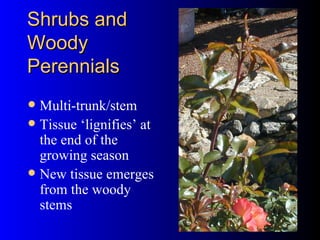
Shrubs and Woody Perennials Multi-trunk/stem Tissue ‘lignifies’ at the end of the growing season New tissue emerges from the woody stems
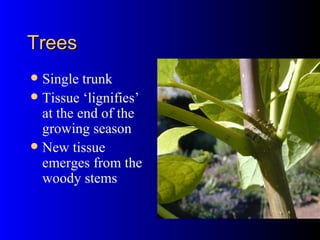
Trees Single trunk  Tissue ‘lignifies’ at the end of the growing season New tissue emerges from the woody stems
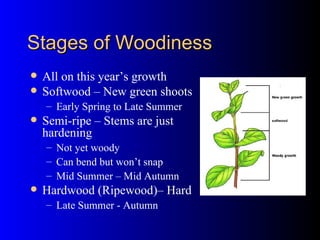
Stages of Woodiness All on this year’s growth Softwood – New green shoots Early Spring to Late Summer Semi-ripe – Stems are just hardening Not yet woody Can bend but won’t snap Mid Summer – Mid Autumn Hardwood (Ripewood)– Hard Late Summer - Autumn
Lab 1 – Examine stages of Growth/Woodiness Take a grape vine and and elm branch Cut into:  Softwood Semi-ripe Hardwood
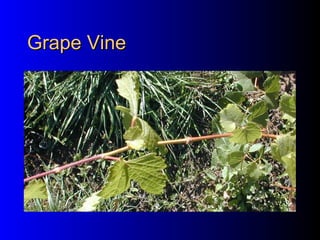
Grape Vine
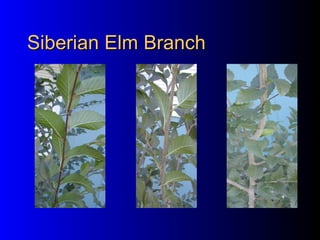
Siberian Elm Branch
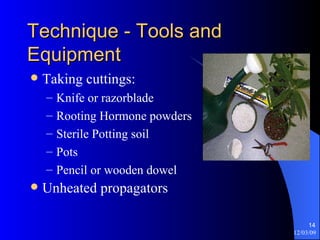
Technique - Tools and Equipment Taking cuttings: Knife or razorblade Rooting Hormone powders Sterile Potting soil Pots Pencil or wooden dowel Unheated propagators
Softwood (Stem Tip) Cuttings Usually in late spring and early summer from young shoots before they start to become “ripe” or woody Soft and fleshy and easily lose moisture Need to be kept in a close, damp atmosphere Need a bit of bottom heat 65-70 deg F
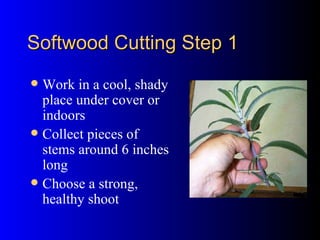
Softwood Cutting Step 1 Work in a cool, shady place under cover or indoors Collect pieces of stems around 6 inches long Choose a strong, healthy shoot
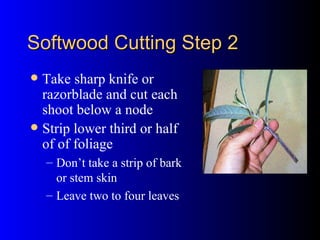
Softwood Cutting Step 2 Take sharp knife or razorblade and cut each shoot below a node Strip lower third or half of of foliage Don’t take a strip of bark or stem skin  Leave two to four leaves
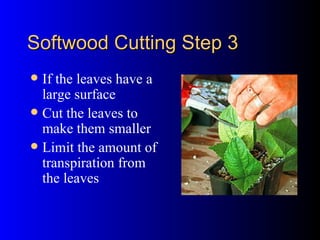
Softwood Cutting Step 3 If the leaves have a large surface Cut the leaves to make them smaller Limit the amount of transpiration from the leaves
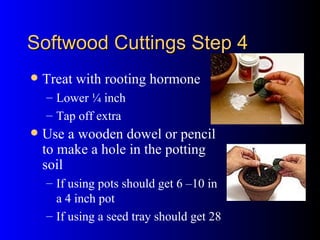
Softwood Cuttings Step 4 Treat with rooting hormone Lower ¼ inch Tap off extra Use a wooden dowel or pencil to make a hole in the potting soil If using pots should get 6 –10 in a 4 inch pot If using a seed tray should get 28
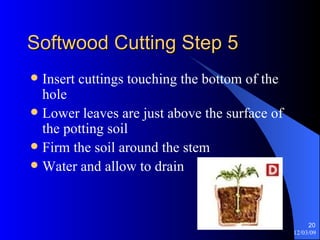
Softwood Cutting Step 5 Insert cuttings touching the bottom of the hole Lower leaves are just above the surface of the potting soil Firm the soil around the stem Water and allow to drain
Lab 2 – Softwood Cuttings Scented geraniums Coleus Hoya Plectranthus Swedish ivy Cuban oregano Alternatherna
Semi-ripe Cuttings Taken mid summer to mid autumn When plant is becoming woody at the base and tops are still soft  Be sure no pests or diseases
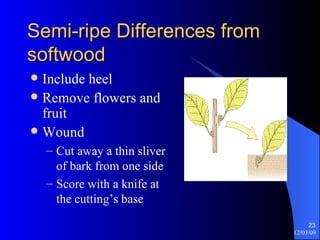
Semi-ripe Differences from softwood Include heel Remove flowers and fruit Wound  Cut away a thin sliver of bark from one side Score with a knife at the cutting’s base
Semi-ripe Differences from softwood Add a layer of fine sand on the soil  improve drainage immediately around each cutting Keep in high humidity for the first few days Ventilate if temperature over 75deg F Will take 5 to 25 weeks, more growth in spring
Lab 3 – Semi-ripe Cuttings Rosemary Lavender Lemon verbena Sages Hyssop Helichrysum (curry)
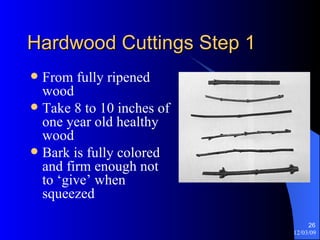
Hardwood Cuttings Step 1 From fully ripened wood Take 8 to 10 inches of one year old healthy wood Bark is fully colored and firm enough not to ‘give’ when squeezed
Hardwood Cuttings Step 2 Bottom - Straight cut below a bud or leaf joint Top - Sloping cut just above a bud at the top This will let you know the top from the bottom Any tissue above the bud will die back to the top node Dip in rooting hormone and tap off excess
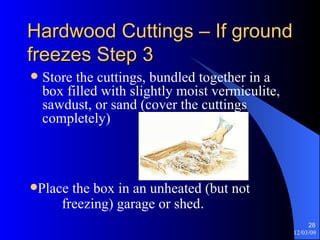
Hardwood Cuttings – If ground freezes Step 3 Store the cuttings, bundled together in a box filled with slightly moist vermiculite, sawdust, or sand (cover the cuttings completely) Place the box in an unheated (but not  freezing) garage or shed .

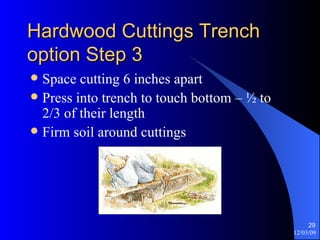
Hardwood Cuttings Trench option Step 3 Space cutting 6 inches apart Press into trench to touch bottom – ½ to 2/3 of their length Firm soil around cuttings
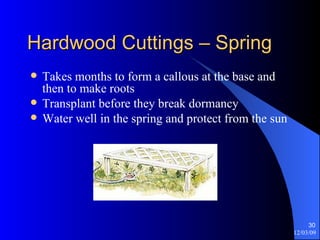
Hardwood Cuttings – Spring Takes months to form a callous at the base and then to make roots Transplant before they break dormancy Water well in the spring and protect from the sun
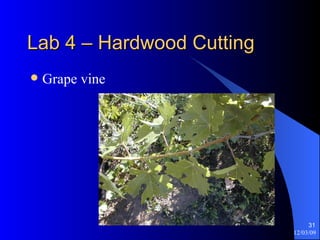
Lab 4 – Hardwood Cutting Grape vine
Whole-Leaf Cuttings Step 1 Cut a healthy, mature leaf  Close to the base of the leaf stalk Insert in posts of equal parts peat and coarse sand Base of leaf just touches the surface
Whole-Leaf Cuttings Step 2 Water the cuttings Allow to drain Label Cover to prevent moisture loss Shade from direct sunlight
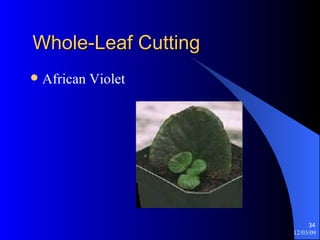
Whole-Leaf Cutting African Violet
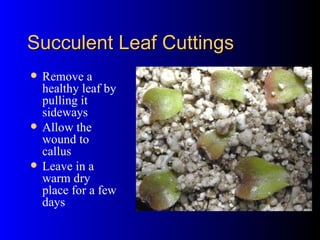
Succulent Leaf Cuttings Remove a healthy leaf by pulling it sideways Allow the wound to callus Leave in a warm dry place for a few days
Succulent Leaf Cuttings Push the based of each leaf deep enough into grit for the leaf to stand up Label and place in a bright warm, airy position Keep slightly moist
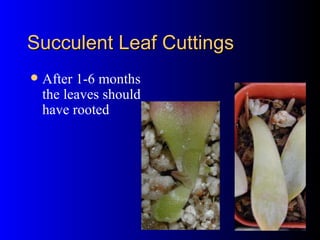
Succulent Leaf Cuttings After 1-6 months the leaves should have rooted
Lab 6 – Succulent Leaf Cutting Practice even though the leaves have not yet callused
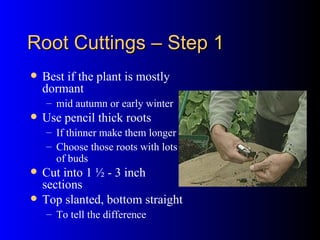
Root Cuttings – Step 1 Best if the plant is mostly dormant mid autumn or early winter Use pencil thick roots If thinner make them longer Choose those roots with lots of buds Cut into 1 ½ - 3 inch sections Top slanted, bottom straight To tell the difference
Root Cuttings – Step 2 Make holes in a pot 1 inch apart Insert the cuttings vertically  Cover with ½ inch of medium Firm and water
Root Cuttings – Step 3 Place cuttings in a warm bright area About 50 degrees or more Not in direct sunlight Will take 2 to 3 weeks to show growth As growth starts water with liquid fertilizer Often get shoots before new roots
Root Cuttings Oriental poppies Crambe cordifolia Verbascum  Horseradish Mint
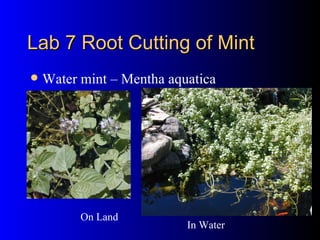
Lab 7 Root Cutting of Mint Water mint – Mentha aquatica On Land In Water
Lab 7 Water Mint Roots in water
Roses – Softwood Cuttings Best for Miniatures, Climbing Early to midsummer Cut just above a node Cut each shoot into sections Cut above each node along the stem Retain one leaf at the top Discard growing tip
Roses – Softwood Cuttings Trim the leaflets to reduce moisture loss Immerse cutting in fungicidal solution Dip in hormone rooting powder Tent in plastic bag Provide bottom heat of 80 degrees Reduce heat to 65-70 after 4 weeks
Roses – Hardwood Cuttings Method 1 For Miniature, Groundcover, Climbing, Modern Shrub, Old Garden and Species roses Late summer or autumn Prepare a trench in semi-shade 8 in deep Take well-ripened woody shoots from the current season’s growth  12-24 in long
Roses – Hardwood Cuttings Method 2 For Miniature and ground cover roses Late summer or autumn Place 3” cuttings in rooting medium  3” pots under cover Bottom heat of 70 degrees
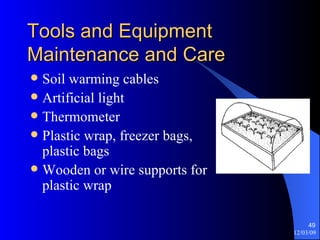
Tools and Equipment Maintenance and Care Soil warming cables Artificial light Thermometer Plastic wrap, freezer bags, plastic bags Wooden or wire supports for plastic wrap
Tools and Equipment optional Anti-transpirant – to inhibit transpiration Wilt Pruf No Wilt – cloning wax Willow Water ?
Potting Mix Sphagnum peat and horticultural sand Fill to ½ inch of rim Moisten thoroughly, but not too wet or the cuttings will rot
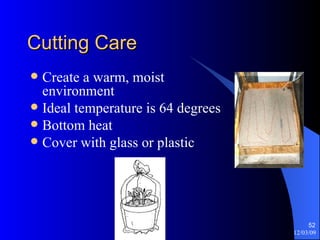
Cutting Care Create a warm, moist environment Ideal temperature is 64 degrees  Bottom heat Cover with glass or plastic
Cutting Care Open plastic daily to vent If drops of water on the plastic, punch a few small air holes Remove any dropped leaves to prevent disease Remove any cutting that has dried up
How to tell when roots have formed When tips start to grow rapidly rooting has probably taken place Look for roots through bottom of the pots Don’t pull them out yet Remove plastic covers and allow the plants to harden off
Scientific side – How it works
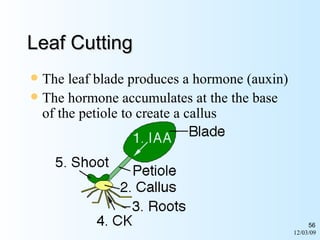
06/07/09 Leaf Cutting The leaf blade produces a hormone (auxin) The hormone accumulates at the the base of the petiole to create a callus
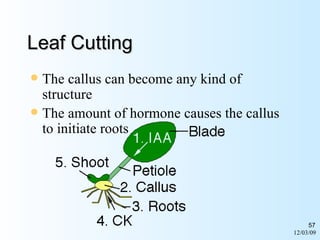
06/07/09 Leaf Cutting The callus can become any kind of structure The amount of hormone causes the callus to initiate roots
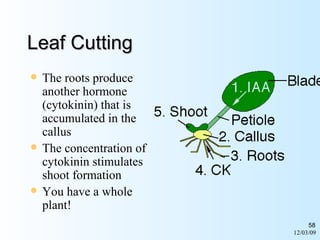
06/07/09 Leaf Cutting The roots produce another hormone (cytokinin) that is accumulated in the callus The concentration of cytokinin stimulates shoot formation You have a whole plant!
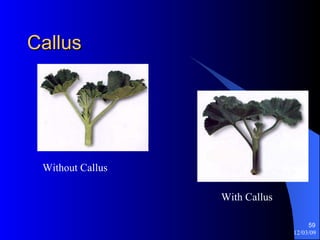
Callus Without Callus With Callus
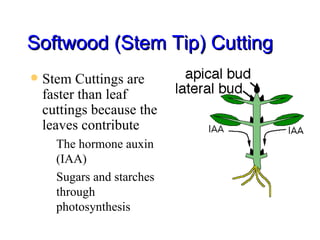
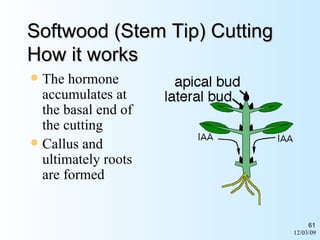
Softwood (Stem Tip) Cutting Stem Cuttings are faster than leaf cuttings because the leaves contribute The hormone auxin (IAA) Sugars and starches through photosynthesis
06/07/09 Softwood (Stem Tip) Cutting How it works The hormone accumulates at the basal end of the cutting Callus and ultimately roots are formed
Early Fall Cuttings - Softwood Tender Perennials Softwood Coleus Rue Veronica Alternatherna
Early Fall Semi-Ripe Rosemary Lavender Santolina Pelargoniums (Geraniums) Lemon Verbena Dianthus Lupine Verbena Artemisia
Suggested Plants for Late Fall Cuttings Hardwood Rose Arctic Willow Butterfly Bush Softwood Persian Shield
Where to Get More Information Gardening Indoors with Cuttings George F. Van Patten and Alyssa F. Bust The Complete Book of Plant propagation by Graham Clarke & Alan Toogood http://www.freeplants.com/ by Mike McGroarty

Raising New Plants Through Cuttings 2002

  • 1.
    The Secret ofStarting New Plants From Cuttings Delta Montrose Voc Tech Presented by Sheryl Williams
  • 2.
    Introduction Growing apiece of a plant and inducing it to grow it’s own roots Cuttings are the most successful way of propagating many plants Cuttings are an exact replica of the parent – genetically identical
  • 3.
    Secret to SuccessTiming & Technique Taking cuttings is pretty easy Timing is critical Based on How a Plant Grows
  • 4.
    Agenda How aplant grows How to take different kinds of cuttings Tools and Equipment Cutting Care How it works – scientifically Suggested plants for fall cuttings Where to get more information
  • 5.
    How a PlantGrows Woody plants need wood to support height New growth is soft and pliable Several stages of ‘woodiness’
  • 6.
    Annuals Soft tissueonly Set seed and die
  • 7.
    Herbaceous Perennials Softtissue dies to the ground each year New soft tissue comes from the crown
  • 8.
    Shrubs and WoodyPerennials Multi-trunk/stem Tissue ‘lignifies’ at the end of the growing season New tissue emerges from the woody stems
  • 9.
    Trees Single trunk Tissue ‘lignifies’ at the end of the growing season New tissue emerges from the woody stems
  • 10.
    Stages of WoodinessAll on this year’s growth Softwood – New green shoots Early Spring to Late Summer Semi-ripe – Stems are just hardening Not yet woody Can bend but won’t snap Mid Summer – Mid Autumn Hardwood (Ripewood)– Hard Late Summer - Autumn
  • 11.
    Lab 1 –Examine stages of Growth/Woodiness Take a grape vine and and elm branch Cut into: Softwood Semi-ripe Hardwood
  • 12.
  • 13.
  • 14.
    Technique - Toolsand Equipment Taking cuttings: Knife or razorblade Rooting Hormone powders Sterile Potting soil Pots Pencil or wooden dowel Unheated propagators
  • 15.
    Softwood (Stem Tip)Cuttings Usually in late spring and early summer from young shoots before they start to become “ripe” or woody Soft and fleshy and easily lose moisture Need to be kept in a close, damp atmosphere Need a bit of bottom heat 65-70 deg F
  • 16.
    Softwood Cutting Step1 Work in a cool, shady place under cover or indoors Collect pieces of stems around 6 inches long Choose a strong, healthy shoot
  • 17.
    Softwood Cutting Step2 Take sharp knife or razorblade and cut each shoot below a node Strip lower third or half of of foliage Don’t take a strip of bark or stem skin Leave two to four leaves
  • 18.
    Softwood Cutting Step3 If the leaves have a large surface Cut the leaves to make them smaller Limit the amount of transpiration from the leaves
  • 19.
    Softwood Cuttings Step4 Treat with rooting hormone Lower ¼ inch Tap off extra Use a wooden dowel or pencil to make a hole in the potting soil If using pots should get 6 –10 in a 4 inch pot If using a seed tray should get 28
  • 20.
    Softwood Cutting Step5 Insert cuttings touching the bottom of the hole Lower leaves are just above the surface of the potting soil Firm the soil around the stem Water and allow to drain
  • 21.
    Lab 2 –Softwood Cuttings Scented geraniums Coleus Hoya Plectranthus Swedish ivy Cuban oregano Alternatherna
  • 22.
    Semi-ripe Cuttings Takenmid summer to mid autumn When plant is becoming woody at the base and tops are still soft Be sure no pests or diseases
  • 23.
    Semi-ripe Differences fromsoftwood Include heel Remove flowers and fruit Wound Cut away a thin sliver of bark from one side Score with a knife at the cutting’s base
  • 24.
    Semi-ripe Differences fromsoftwood Add a layer of fine sand on the soil improve drainage immediately around each cutting Keep in high humidity for the first few days Ventilate if temperature over 75deg F Will take 5 to 25 weeks, more growth in spring
  • 25.
    Lab 3 –Semi-ripe Cuttings Rosemary Lavender Lemon verbena Sages Hyssop Helichrysum (curry)
  • 26.
    Hardwood Cuttings Step1 From fully ripened wood Take 8 to 10 inches of one year old healthy wood Bark is fully colored and firm enough not to ‘give’ when squeezed
  • 27.
    Hardwood Cuttings Step2 Bottom - Straight cut below a bud or leaf joint Top - Sloping cut just above a bud at the top This will let you know the top from the bottom Any tissue above the bud will die back to the top node Dip in rooting hormone and tap off excess
  • 28.
    Hardwood Cuttings –If ground freezes Step 3 Store the cuttings, bundled together in a box filled with slightly moist vermiculite, sawdust, or sand (cover the cuttings completely) Place the box in an unheated (but not freezing) garage or shed .
  • 29.
    Hardwood Cuttings Trenchoption Step 3 Space cutting 6 inches apart Press into trench to touch bottom – ½ to 2/3 of their length Firm soil around cuttings
  • 30.
    Hardwood Cuttings –Spring Takes months to form a callous at the base and then to make roots Transplant before they break dormancy Water well in the spring and protect from the sun
  • 31.
    Lab 4 –Hardwood Cutting Grape vine
  • 32.
    Whole-Leaf Cuttings Step1 Cut a healthy, mature leaf Close to the base of the leaf stalk Insert in posts of equal parts peat and coarse sand Base of leaf just touches the surface
  • 33.
    Whole-Leaf Cuttings Step2 Water the cuttings Allow to drain Label Cover to prevent moisture loss Shade from direct sunlight
  • 34.
  • 35.
    Succulent Leaf CuttingsRemove a healthy leaf by pulling it sideways Allow the wound to callus Leave in a warm dry place for a few days
  • 36.
    Succulent Leaf CuttingsPush the based of each leaf deep enough into grit for the leaf to stand up Label and place in a bright warm, airy position Keep slightly moist
  • 37.
    Succulent Leaf CuttingsAfter 1-6 months the leaves should have rooted
  • 38.
    Lab 6 –Succulent Leaf Cutting Practice even though the leaves have not yet callused
  • 39.
    Root Cuttings –Step 1 Best if the plant is mostly dormant mid autumn or early winter Use pencil thick roots If thinner make them longer Choose those roots with lots of buds Cut into 1 ½ - 3 inch sections Top slanted, bottom straight To tell the difference
  • 40.
    Root Cuttings –Step 2 Make holes in a pot 1 inch apart Insert the cuttings vertically Cover with ½ inch of medium Firm and water
  • 41.
    Root Cuttings –Step 3 Place cuttings in a warm bright area About 50 degrees or more Not in direct sunlight Will take 2 to 3 weeks to show growth As growth starts water with liquid fertilizer Often get shoots before new roots
  • 42.
    Root Cuttings Orientalpoppies Crambe cordifolia Verbascum Horseradish Mint
  • 43.
    Lab 7 RootCutting of Mint Water mint – Mentha aquatica On Land In Water
  • 44.
    Lab 7 WaterMint Roots in water
  • 45.
    Roses – SoftwoodCuttings Best for Miniatures, Climbing Early to midsummer Cut just above a node Cut each shoot into sections Cut above each node along the stem Retain one leaf at the top Discard growing tip
  • 46.
    Roses – SoftwoodCuttings Trim the leaflets to reduce moisture loss Immerse cutting in fungicidal solution Dip in hormone rooting powder Tent in plastic bag Provide bottom heat of 80 degrees Reduce heat to 65-70 after 4 weeks
  • 47.
    Roses – HardwoodCuttings Method 1 For Miniature, Groundcover, Climbing, Modern Shrub, Old Garden and Species roses Late summer or autumn Prepare a trench in semi-shade 8 in deep Take well-ripened woody shoots from the current season’s growth 12-24 in long
  • 48.
    Roses – HardwoodCuttings Method 2 For Miniature and ground cover roses Late summer or autumn Place 3” cuttings in rooting medium 3” pots under cover Bottom heat of 70 degrees
  • 49.
    Tools and EquipmentMaintenance and Care Soil warming cables Artificial light Thermometer Plastic wrap, freezer bags, plastic bags Wooden or wire supports for plastic wrap
  • 50.
    Tools and Equipmentoptional Anti-transpirant – to inhibit transpiration Wilt Pruf No Wilt – cloning wax Willow Water ?
  • 51.
    Potting Mix Sphagnumpeat and horticultural sand Fill to ½ inch of rim Moisten thoroughly, but not too wet or the cuttings will rot
  • 52.
    Cutting Care Createa warm, moist environment Ideal temperature is 64 degrees Bottom heat Cover with glass or plastic
  • 53.
    Cutting Care Openplastic daily to vent If drops of water on the plastic, punch a few small air holes Remove any dropped leaves to prevent disease Remove any cutting that has dried up
  • 54.
    How to tellwhen roots have formed When tips start to grow rapidly rooting has probably taken place Look for roots through bottom of the pots Don’t pull them out yet Remove plastic covers and allow the plants to harden off
  • 55.
    Scientific side –How it works
  • 56.
    06/07/09 Leaf CuttingThe leaf blade produces a hormone (auxin) The hormone accumulates at the the base of the petiole to create a callus
  • 57.
    06/07/09 Leaf CuttingThe callus can become any kind of structure The amount of hormone causes the callus to initiate roots
  • 58.
    06/07/09 Leaf CuttingThe roots produce another hormone (cytokinin) that is accumulated in the callus The concentration of cytokinin stimulates shoot formation You have a whole plant!
  • 59.
  • 60.
    Softwood (Stem Tip)Cutting Stem Cuttings are faster than leaf cuttings because the leaves contribute The hormone auxin (IAA) Sugars and starches through photosynthesis
  • 61.
    06/07/09 Softwood (StemTip) Cutting How it works The hormone accumulates at the basal end of the cutting Callus and ultimately roots are formed
  • 62.
    Early Fall Cuttings- Softwood Tender Perennials Softwood Coleus Rue Veronica Alternatherna
  • 63.
    Early Fall Semi-RipeRosemary Lavender Santolina Pelargoniums (Geraniums) Lemon Verbena Dianthus Lupine Verbena Artemisia
  • 64.
    Suggested Plants forLate Fall Cuttings Hardwood Rose Arctic Willow Butterfly Bush Softwood Persian Shield
  • 65.
    Where to GetMore Information Gardening Indoors with Cuttings George F. Van Patten and Alyssa F. Bust The Complete Book of Plant propagation by Graham Clarke & Alan Toogood http://www.freeplants.com/ by Mike McGroarty