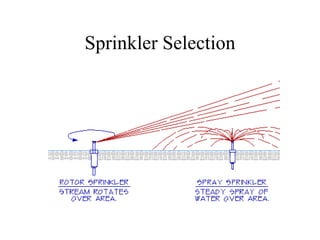
Sprinkler Selection
Sprinkler Selection Spray Pop-up Shrub spray Rotating Impulse or Impact Pop-up Gear driven Bubblers and drip irrigation
Considerations Goal – select the type that will cover the area properly using the least number of sprinklers Windy – low angle Arid climate – higher flow or multiple irrigation cycles Slopes Soil
Precipitation Rate Don’t mix on one valve circuit Matched Precipitation Rate Sprinklers (MPR) See Rainbird Catalog 18-22 MPR Series (Stryker) Look for this feature
Spray Heads For smaller areas For areas with enclosed borders Require tightly controlled spray Dense tree growth that would get in the way of rotor spray Mixed plantings needing different amounts of water
Spray Heads Fixed spray heads Fan shaped pattern of water Spaced up to 18 feet apart Need between 20 and 30 PSI to operate properly
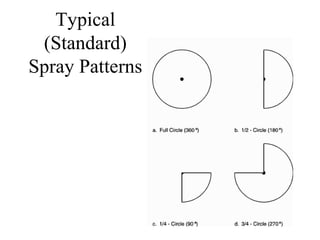
Typical (Standard) Spray Patterns
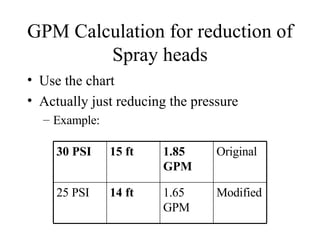
GPM Calculation for reduction of Spray heads Use the chart Actually just reducing the pressure Example: Modified 1.65 GPM 14 ft 25 PSI Original 1.85 GPM 15 ft 30 PSI
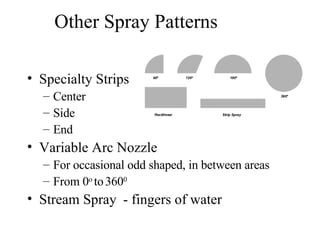
Other Spray Patterns Specialty Strips Center  Side End Variable Arc Nozzle For occasional odd shaped, in between areas From 0 o  to   360 0 Stream Spray - fingers of water
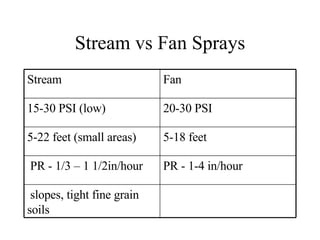
Stream vs Fan Sprays slopes, tight fine grain soils PR - 1-4 in/hour PR - 1/3 – 1 1/2in/hour 5-18 feet 5-22 feet (small areas) 20-30 PSI 15-30 PSI (low) Fan Stream
Rotors Rotating streams of water Impact rotors – fire bursts of water Gear Driven rotors  very quiet lower maintenance smaller in size Multi-stream rotors – expensive, much higher maintenance
Rotors Spacing – 18 – 55 feet apart 5 – 100 gpm PR – ¼ - 2 in/hour Require more water pressure to operate than spray heads (Stryker) water pressure at the head must exceed the distance between heads If you want 35 feet apart, be sure 35 PSI
Rotors - warning (Stryker) Don’t rely on manufacturers’ radius on charts If less than 6 GPM, maximum spacing should  never  be more than  35’  between sprinklers (Stryker) They don’t test with wind
Rotor selection Select the appropriate Nozzle size for each rotor to match the precipitation rates The rotation speed is the same regardless of whether the rotor is adjusted to a full circle or a quarter circle If a quarter circle, passing over the same area 4 times in the same amount of time as 1 full circle
Rotor Precipitation Rates If the nozzle is the same the quarter circle will put down 4 times as much water on the area as a full circle To match: change the nozzle to cut the amount of water to ¼ Half circle – nozzle with ½ amount of the water of a full circle, etc. See Rainbird catalog pg. 74 & 75
Rotor adjustment If you adjust the radius you need to adjust the nozzle too (Stryker) Don’t use rotors with nozzle flows less than 2.5 GPM except in corners (1/4 circle)
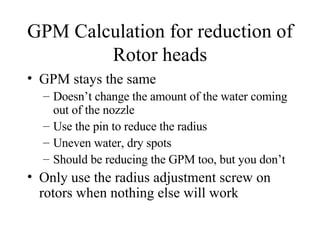
GPM Calculation for reduction of Rotor heads GPM stays the same Doesn’t change the amount of the water coming out of the nozzle Use the pin to reduce the radius Uneven water, dry spots Should be reducing the GPM too, but you don’t Only use the radius adjustment screw on rotors when nothing else will work
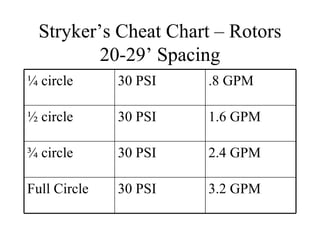
Stryker’s Cheat Chart – Rotors 20-29’ Spacing 3.2 GPM 30 PSI Full Circle 2.4 GPM 30 PSI ¾ circle 1.6 GPM 30 PSI ½ circle .8 GPM 30 PSI ¼ circle
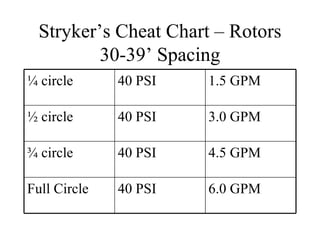
Stryker’s Cheat Chart – Rotors 30-39’ Spacing 6.0 GPM 40 PSI Full Circle 4.5 GPM 40 PSI ¾ circle 3.0 GPM 40 PSI ½ circle 1.5 GPM 40 PSI ¼ circle
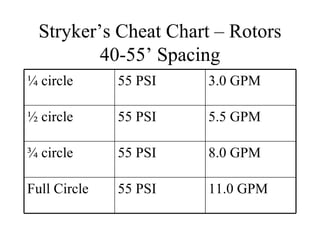
Stryker’s Cheat Chart – Rotors 40-55’ Spacing 11.0 GPM 55 PSI Full Circle 8.0 GPM 55 PSI ¾ circle 5.5 GPM 55 PSI ½ circle 3.0 GPM 55 PSI ¼ circle
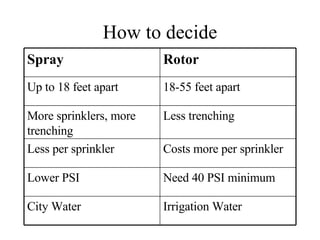
How to decide Irrigation Water City Water Need 40 PSI minimum Lower PSI Costs more per sprinkler Less per sprinkler Less trenching More sprinklers, more trenching 18-55 feet apart Up to 18 feet apart Rotor Spray
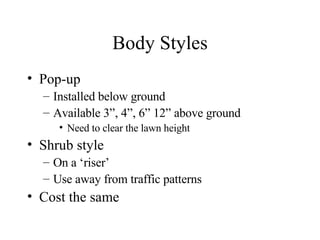
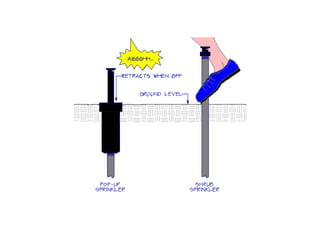
Body Styles Pop-up Installed below ground Available 3”, 4”, 6” 12” above ground Need to clear the lawn height Shrub style On a ‘riser’ Use away from traffic patterns Cost the same
 
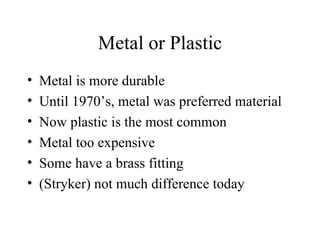
Metal or Plastic Metal is more durable Until 1970’s, metal was preferred material Now plastic is the most common Metal too expensive Some have a brass fitting (Stryker) not much difference today
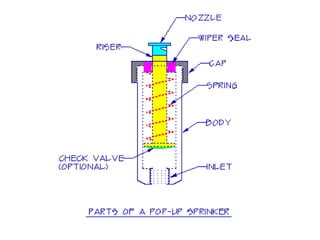
What to look for Spring retraction Use a spring to pull the pop-up riser down into the case Stay away from gravity retraction Wiper Seal – soft plastic seal around the pop-up riser stem that seals the riser wo it won’t leak Keeps the dirt out 3” pop-up height or higher Most pros use 4” in lawn areas and 6”-12” in shrub areas
 
Pressure Requirements Spray Type  (Stryker) When designing, use 30 PSI unless you know that it is lower  If the pressure is lower, place sprinklers closer together Rotor Type Won’t work well with less than 30 PSI Drip Emitters Usually best at around 20 PSI
Mix and Match Don’t mix and match on the same valve Special valve to reduce the pressure for the lower pressure sprinklers Design for the high pressure
Trajectory of Water As water comes out of the sprinkler head, it travels in a curved path through the air to the ground.. Trajectories of spray include:  0 degree trajectory  -- this flat spray can be used for throwing water under low shrubs  10 degree trajectory  -- this low angle spray can be used in a high wind situation and for shrub and groundcover beds  22-26 degree of trajectory  -- this is the standard trajectory thrown by most sprinklers  30-35 degree trajectory  -- this is a special trajectory used for throwing water over plant material such as groundcovers and gardens

Sprinkler Selection (2)

  • 1.
  • 2.
    Sprinkler Selection SprayPop-up Shrub spray Rotating Impulse or Impact Pop-up Gear driven Bubblers and drip irrigation
  • 3.
    Considerations Goal –select the type that will cover the area properly using the least number of sprinklers Windy – low angle Arid climate – higher flow or multiple irrigation cycles Slopes Soil
  • 4.
    Precipitation Rate Don’tmix on one valve circuit Matched Precipitation Rate Sprinklers (MPR) See Rainbird Catalog 18-22 MPR Series (Stryker) Look for this feature
  • 5.
    Spray Heads Forsmaller areas For areas with enclosed borders Require tightly controlled spray Dense tree growth that would get in the way of rotor spray Mixed plantings needing different amounts of water
  • 6.
    Spray Heads Fixedspray heads Fan shaped pattern of water Spaced up to 18 feet apart Need between 20 and 30 PSI to operate properly
  • 7.
  • 8.
    GPM Calculation forreduction of Spray heads Use the chart Actually just reducing the pressure Example: Modified 1.65 GPM 14 ft 25 PSI Original 1.85 GPM 15 ft 30 PSI
  • 9.
    Other Spray PatternsSpecialty Strips Center Side End Variable Arc Nozzle For occasional odd shaped, in between areas From 0 o to 360 0 Stream Spray - fingers of water
  • 10.
    Stream vs FanSprays slopes, tight fine grain soils PR - 1-4 in/hour PR - 1/3 – 1 1/2in/hour 5-18 feet 5-22 feet (small areas) 20-30 PSI 15-30 PSI (low) Fan Stream
  • 11.
    Rotors Rotating streamsof water Impact rotors – fire bursts of water Gear Driven rotors very quiet lower maintenance smaller in size Multi-stream rotors – expensive, much higher maintenance
  • 12.
    Rotors Spacing –18 – 55 feet apart 5 – 100 gpm PR – ¼ - 2 in/hour Require more water pressure to operate than spray heads (Stryker) water pressure at the head must exceed the distance between heads If you want 35 feet apart, be sure 35 PSI
  • 13.
    Rotors - warning(Stryker) Don’t rely on manufacturers’ radius on charts If less than 6 GPM, maximum spacing should never be more than 35’ between sprinklers (Stryker) They don’t test with wind
  • 14.
    Rotor selection Selectthe appropriate Nozzle size for each rotor to match the precipitation rates The rotation speed is the same regardless of whether the rotor is adjusted to a full circle or a quarter circle If a quarter circle, passing over the same area 4 times in the same amount of time as 1 full circle
  • 15.
    Rotor Precipitation RatesIf the nozzle is the same the quarter circle will put down 4 times as much water on the area as a full circle To match: change the nozzle to cut the amount of water to ¼ Half circle – nozzle with ½ amount of the water of a full circle, etc. See Rainbird catalog pg. 74 & 75
  • 16.
    Rotor adjustment Ifyou adjust the radius you need to adjust the nozzle too (Stryker) Don’t use rotors with nozzle flows less than 2.5 GPM except in corners (1/4 circle)
  • 17.
    GPM Calculation forreduction of Rotor heads GPM stays the same Doesn’t change the amount of the water coming out of the nozzle Use the pin to reduce the radius Uneven water, dry spots Should be reducing the GPM too, but you don’t Only use the radius adjustment screw on rotors when nothing else will work
  • 18.
    Stryker’s Cheat Chart– Rotors 20-29’ Spacing 3.2 GPM 30 PSI Full Circle 2.4 GPM 30 PSI ¾ circle 1.6 GPM 30 PSI ½ circle .8 GPM 30 PSI ¼ circle
  • 19.
    Stryker’s Cheat Chart– Rotors 30-39’ Spacing 6.0 GPM 40 PSI Full Circle 4.5 GPM 40 PSI ¾ circle 3.0 GPM 40 PSI ½ circle 1.5 GPM 40 PSI ¼ circle
  • 20.
    Stryker’s Cheat Chart– Rotors 40-55’ Spacing 11.0 GPM 55 PSI Full Circle 8.0 GPM 55 PSI ¾ circle 5.5 GPM 55 PSI ½ circle 3.0 GPM 55 PSI ¼ circle
  • 21.
    How to decideIrrigation Water City Water Need 40 PSI minimum Lower PSI Costs more per sprinkler Less per sprinkler Less trenching More sprinklers, more trenching 18-55 feet apart Up to 18 feet apart Rotor Spray
  • 22.
    Body Styles Pop-upInstalled below ground Available 3”, 4”, 6” 12” above ground Need to clear the lawn height Shrub style On a ‘riser’ Use away from traffic patterns Cost the same
  • 23.
  • 24.
    Metal or PlasticMetal is more durable Until 1970’s, metal was preferred material Now plastic is the most common Metal too expensive Some have a brass fitting (Stryker) not much difference today
  • 25.
    What to lookfor Spring retraction Use a spring to pull the pop-up riser down into the case Stay away from gravity retraction Wiper Seal – soft plastic seal around the pop-up riser stem that seals the riser wo it won’t leak Keeps the dirt out 3” pop-up height or higher Most pros use 4” in lawn areas and 6”-12” in shrub areas
  • 26.
  • 27.
    Pressure Requirements SprayType (Stryker) When designing, use 30 PSI unless you know that it is lower If the pressure is lower, place sprinklers closer together Rotor Type Won’t work well with less than 30 PSI Drip Emitters Usually best at around 20 PSI
  • 28.
    Mix and MatchDon’t mix and match on the same valve Special valve to reduce the pressure for the lower pressure sprinklers Design for the high pressure
  • 29.
    Trajectory of WaterAs water comes out of the sprinkler head, it travels in a curved path through the air to the ground.. Trajectories of spray include: 0 degree trajectory -- this flat spray can be used for throwing water under low shrubs 10 degree trajectory -- this low angle spray can be used in a high wind situation and for shrub and groundcover beds 22-26 degree of trajectory -- this is the standard trajectory thrown by most sprinklers 30-35 degree trajectory -- this is a special trajectory used for throwing water over plant material such as groundcovers and gardens