PROPAGATION BY DIVISION Presented by Sheryl Williams  Spring 2002
What is Division? Separation of the crown of a plant into smaller pieces for propagation or to rejuvenate a plant Each piece must have at least one bud (or eye) for new growth and Some roots
Benefits of Division Rejuvenate mature plants Acquire several small portions complete with Roots Shoots Can immediately be planted as new plants
What Cannot be divided? Species that do not form a crown or have underground stems. Candytuft,  Iberis , grows entirely from a single stem, like a little tree. Lavender and rosemary are the same.
When to Divide Rule is: If it blooms in Spring, divide in Fall If it blooms in Fall, divide in Spring When the plants are not in active growth If flower in spring, wait until they have bloomed Avoid extreme heat or cold
How do we know if a plant needs to be divided? Has the plant outgrown it’s allotted space? Has the number of flowers decreased over the last few years? Does the plant flop open? Does the plant have an open center?
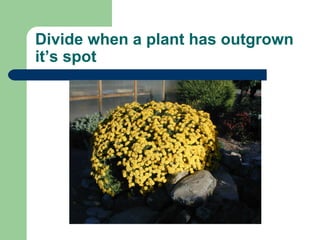
Divide when a plant has outgrown it’s spot
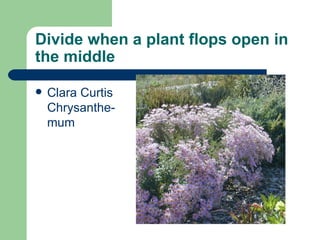
Divide when a plant flops open in the middle Clara Curtis Chrysanthe-mum
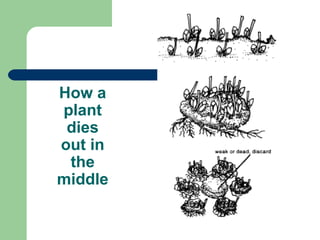
Why does this happen? Perennials are non woody plants Majority make their new growth from the base, or crown Majority roots or rhizomes spread Plants form clumps
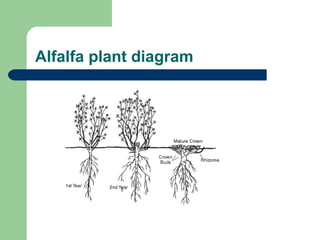
How plants grow – example Alfalfa crown The crown is the over wintering stem tissue The crown and root tissue store carbohydrates (food) produced through photosynthesis  Crown buds produce the vegetative regrowth following harvest or Produce branch rhizomes.
Alfalfa crown 2 Branch rhizome is the structure from which new growth will initiate in the spring  The Branch rhizomes grow outward and upward increasing the circumference of the plant The crown increases in size each year.
Alfalfa plant diagram
Lab 1 – Examine the samples What kind of structure do you have? Spreading Clumping Fleshy Rhizome
How a plant dies out in the middle
Prepare to Divide Prepare beds for the new plants ahead of time, adding organic matter and fertilizer If you can’t replant immediately,  heel in your divisions while you are preparing the beds Replant as soon as possible
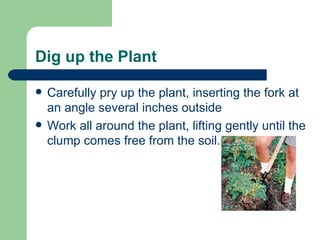
Dig up the Plant Carefully pry up the plant, inserting the fork at an angle several inches outside  Work all around the plant, lifting gently until the clump comes free from the soil.
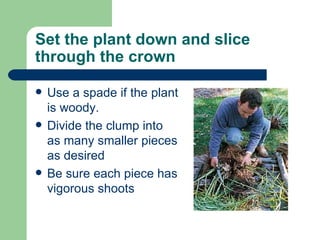
Set the plant down and slice through the crown Use a spade if the plant is woody. Divide the clump into as many smaller pieces as desired Be sure each piece has vigorous shoots
How to Divide Cut away the woody or hard, unproductive center of the old plant, using shoots only from the outer part of the clump Shake or wash them free of soil You can see the natural lines of division Avoid damaging the roots, buds or shoots
Prune Back Any dead or damaged foliage Trim some of the top if the top is too lush for the roots Plant divisions at the same depth as the original plant
Don’t let the roots dry out Heel the cuttings in Either moist soil mix or peat Plastic storage crates are great
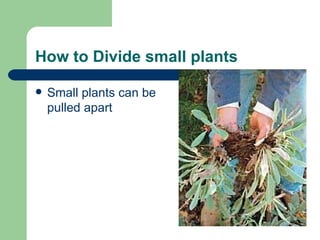
How to Divide small plants Small plants can be pulled apart
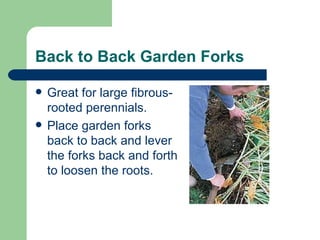
Back to Back Garden Forks Great for large fibrous-rooted perennials.  Place garden forks back to back and lever the forks back and forth to loosen the roots.
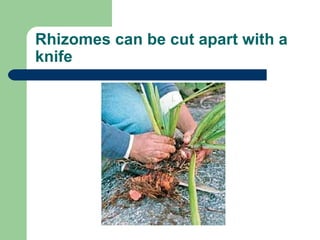
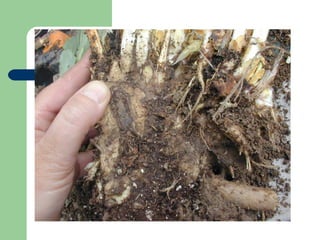
Rhizomes can be cut apart with a knife
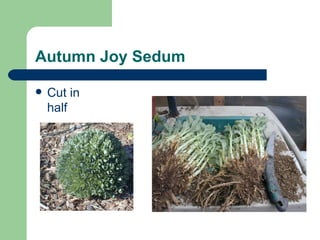
Autumn Joy Sedum Cut in half
 
Techniques for Dividing Perennials List courtesy of Fine Gardening Magazine http://Taunton.com/finegardening/pages/g00022.asp Chart of which tool to use to divide which perennial Also includes some perennials to leave alone
How to Plant your new divisions Cover plants with sun protection Burlap Boxes Paper pots Apply mulch
Where to get more information American Horticultural Society, Plant Propagation, Alan Toogood Editor in Chief The Well Tended Perennial Garden; Planting and Pruning Techniques by Tracy DiSabato-Aust
Helpful websites http://ag.arizona.edu/pubs/garden/mg/botany/plantparts.html  plant botany for lay people http://www.savvygardener.com/Features/when_to_didvide_perennials.html  (yes it is spelled incorrectly) chart of when to divide plants http://behnke.com/Library/perenniallibrary.htmlDifferent methods of propagating plants
 

Propagation by Division

  • 1.
    PROPAGATION BY DIVISIONPresented by Sheryl Williams Spring 2002
  • 2.
    What is Division?Separation of the crown of a plant into smaller pieces for propagation or to rejuvenate a plant Each piece must have at least one bud (or eye) for new growth and Some roots
  • 3.
    Benefits of DivisionRejuvenate mature plants Acquire several small portions complete with Roots Shoots Can immediately be planted as new plants
  • 4.
    What Cannot bedivided? Species that do not form a crown or have underground stems. Candytuft, Iberis , grows entirely from a single stem, like a little tree. Lavender and rosemary are the same.
  • 5.
    When to DivideRule is: If it blooms in Spring, divide in Fall If it blooms in Fall, divide in Spring When the plants are not in active growth If flower in spring, wait until they have bloomed Avoid extreme heat or cold
  • 6.
    How do weknow if a plant needs to be divided? Has the plant outgrown it’s allotted space? Has the number of flowers decreased over the last few years? Does the plant flop open? Does the plant have an open center?
  • 7.
    Divide when aplant has outgrown it’s spot
  • 8.
    Divide when aplant flops open in the middle Clara Curtis Chrysanthe-mum
  • 9.
    Why does thishappen? Perennials are non woody plants Majority make their new growth from the base, or crown Majority roots or rhizomes spread Plants form clumps
  • 10.
    How plants grow– example Alfalfa crown The crown is the over wintering stem tissue The crown and root tissue store carbohydrates (food) produced through photosynthesis Crown buds produce the vegetative regrowth following harvest or Produce branch rhizomes.
  • 11.
    Alfalfa crown 2Branch rhizome is the structure from which new growth will initiate in the spring The Branch rhizomes grow outward and upward increasing the circumference of the plant The crown increases in size each year.
  • 12.
  • 13.
    Lab 1 –Examine the samples What kind of structure do you have? Spreading Clumping Fleshy Rhizome
  • 14.
    How a plantdies out in the middle
  • 15.
    Prepare to DividePrepare beds for the new plants ahead of time, adding organic matter and fertilizer If you can’t replant immediately, heel in your divisions while you are preparing the beds Replant as soon as possible
  • 16.
    Dig up thePlant Carefully pry up the plant, inserting the fork at an angle several inches outside Work all around the plant, lifting gently until the clump comes free from the soil.
  • 17.
    Set the plantdown and slice through the crown Use a spade if the plant is woody. Divide the clump into as many smaller pieces as desired Be sure each piece has vigorous shoots
  • 18.
    How to DivideCut away the woody or hard, unproductive center of the old plant, using shoots only from the outer part of the clump Shake or wash them free of soil You can see the natural lines of division Avoid damaging the roots, buds or shoots
  • 19.
    Prune Back Anydead or damaged foliage Trim some of the top if the top is too lush for the roots Plant divisions at the same depth as the original plant
  • 20.
    Don’t let theroots dry out Heel the cuttings in Either moist soil mix or peat Plastic storage crates are great
  • 21.
    How to Dividesmall plants Small plants can be pulled apart
  • 22.
    Back to BackGarden Forks Great for large fibrous-rooted perennials. Place garden forks back to back and lever the forks back and forth to loosen the roots.
  • 23.
    Rhizomes can becut apart with a knife
  • 24.
    Autumn Joy SedumCut in half
  • 25.
  • 26.
    Techniques for DividingPerennials List courtesy of Fine Gardening Magazine http://Taunton.com/finegardening/pages/g00022.asp Chart of which tool to use to divide which perennial Also includes some perennials to leave alone
  • 27.
    How to Plantyour new divisions Cover plants with sun protection Burlap Boxes Paper pots Apply mulch
  • 28.
    Where to getmore information American Horticultural Society, Plant Propagation, Alan Toogood Editor in Chief The Well Tended Perennial Garden; Planting and Pruning Techniques by Tracy DiSabato-Aust
  • 29.
    Helpful websites http://ag.arizona.edu/pubs/garden/mg/botany/plantparts.html plant botany for lay people http://www.savvygardener.com/Features/when_to_didvide_perennials.html (yes it is spelled incorrectly) chart of when to divide plants http://behnke.com/Library/perenniallibrary.htmlDifferent methods of propagating plants
  • 30.