Irrigation Management    and Water-Wise Gardening HCC100 -- Horticultural Science, The Science of Gardening
7 Principles of  Water-Wise Gardening
Planning and designing for water conservation, beauty, and utility
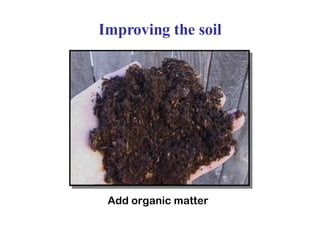
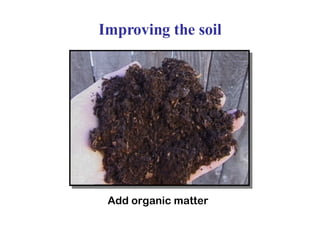
Improving the soil Add organic matter
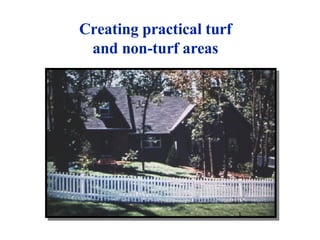
Creating practical turf  and non-turf areas
Watering efficiently  with appropriate irrigation methods Irrigation efficiency has greatest water savings potential for most home gardeners.
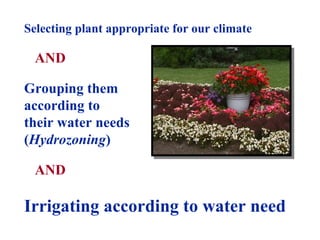
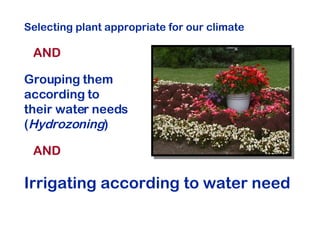
Selecting plant appropriate for our climate AND Grouping them  according to  their water needs  ( Hydrozoning ) AND Irrigating according to water need
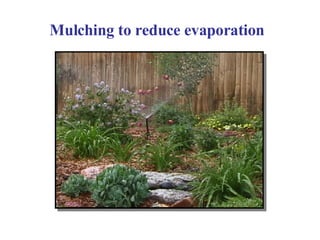
Mulching to reduce evaporation
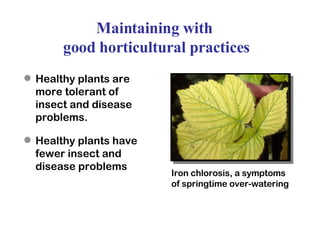
Maintaining with  good horticultural practices Healthy plants are more tolerant of insect and disease problems. Healthy plants have fewer insect and disease problems Iron chlorosis, a symptoms  of springtime over-watering
7 Principles of Water-Wise Gardening Planning and design for water conservation, beauty, and utility Improving the soil  Creating practical turf and  non-turf areas Watering efficiently with  appropriate irrigation methods Selecting plants and grouping  them according to water need Mulching to reduce evaporation Maintaining with good horticultural practices
Planning and designing for water conservation, beauty, and utility
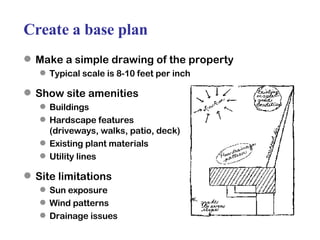
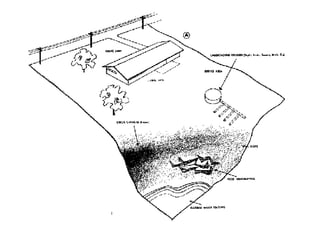
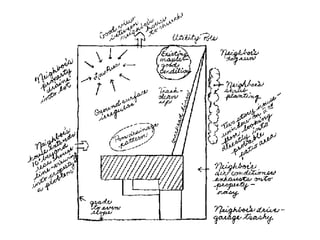
Create a base plan Make a simple drawing of the property Typical scale is 8-10 feet per inch Show site amenities Buildings Hardscape features  (driveways, walks, patio, deck) Existing plant materials Utility lines Site limitations Sun exposure Wind patterns Drainage issues
 
 
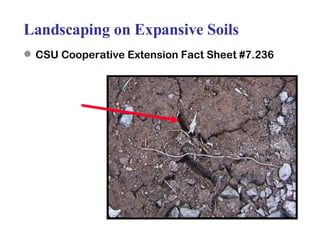
Landscaping on Expansive Soils CSU Cooperative Extension Fact Sheet #7.236
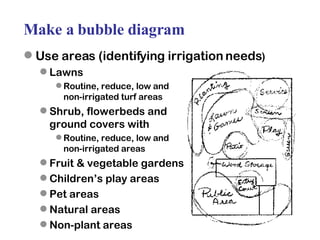
Make a bubble diagram Use areas (identifying irrigation needs ) Lawns  Routine, reduce, low and  non-irrigated turf areas Shrub, flowerbeds and  ground covers with  Routine, reduce, low and  non-irrigated areas Fruit & vegetable gardens Children’s play areas Pet areas Natural areas Non-plant areas
 
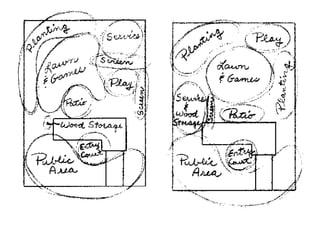
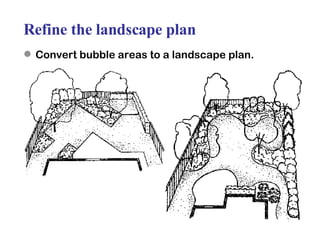
Refine the landscape plan Convert bubble areas to a landscape plan.
Planning and designing for water conservation, beauty, and utility Take home message:
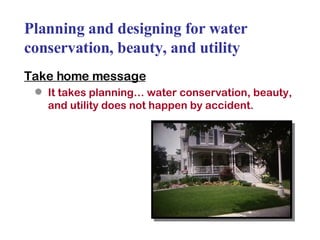
Planning and designing for water conservation, beauty, and utility Take home message It takes planning… water conservation, beauty, and utility does not happen by accident.
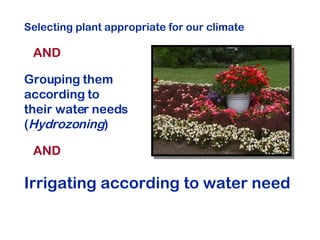
Selecting plant appropriate for our climate AND Grouping them  according to  their water needs  ( Hydrozoning ) AND Irrigating according to water need
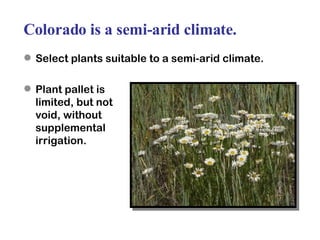
Colorado is a semi-arid climate. Select plants suitable to a semi-arid climate. Plant pallet is  limited, but not  void, without  supplemental  irrigation.
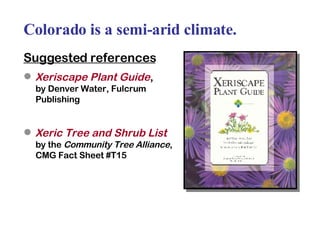
Colorado is a semi-arid climate. Suggested references Xeriscape Plant Guide ,  by Denver Water, Fulcrum Publishing Xeric Tree and Shrub List   by the  Community Tree Alliance , CMG Fact Sheet #T15
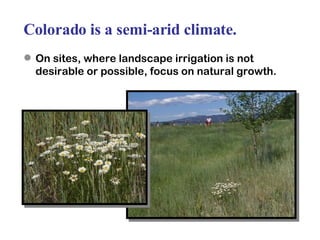
Colorado is a semi-arid climate. On sites, where landscape irrigation is not desirable or possible, focus on natural growth.
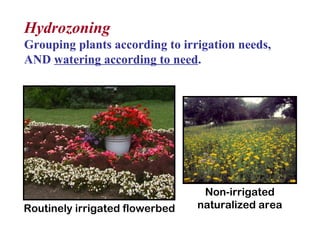
Hydrozoning   Grouping plants according to irrigation needs, AND  watering according to need . Routinely irrigated flowerbed Non-irrigated naturalized area
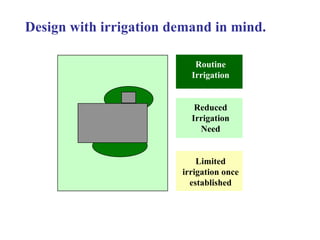
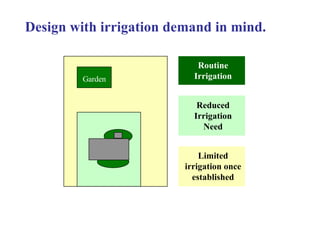
Design with irrigation demand in mind. Routine Irrigation Reduced Irrigation Need Limited irrigation once established non-irrigated
Design with irrigation demand in mind. Routine Irrigation Reduced Irrigation Need Limited irrigation once established
Design with irrigation demand in mind. Garden Routine Irrigation Reduced Irrigation Need Limited irrigation once established
Design with irrigation demand in mind. Routine Irrigation Reduced Irrigation Need Limited irrigation once established non-irrigated
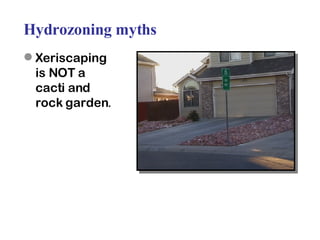
Hydrozoning myths Xeriscaping is NOT a cacti and rock garden .
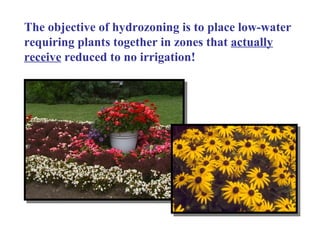
The objective of hydrozoning is to place low-water requiring plants together in zones that  actually receive  reduced to no irrigation!
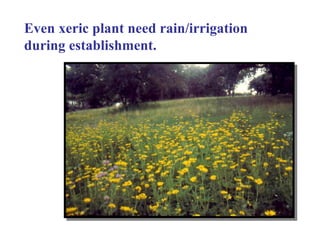
Even xeric plant need rain/irrigation during establishment.
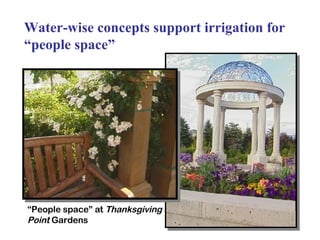
Water-wise concepts support irrigation for “people space” “ People space” at  Thanksgiving Point  Gardens
Selecting plant appropriate for our climate AND Grouping them  according to  their water needs  ( Hydrozoning ) AND Irrigating according to water need
Improving the soil Add organic matter
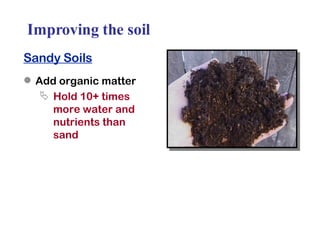
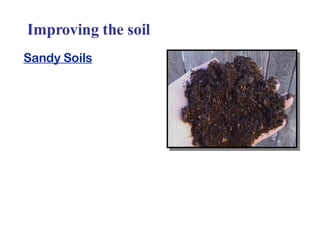
Improving the soil Sandy Soils
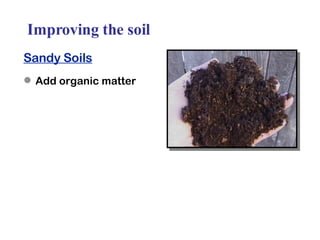
Improving the soil Sandy Soils Add organic matter
Improving the soil Sandy Soils Add organic matter Hold 10+ times more water and nutrients than sand
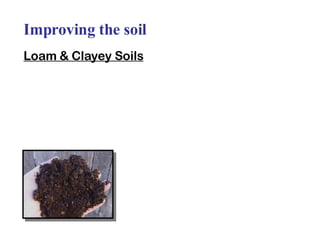
Improving the soil Loam & Clayey Soils
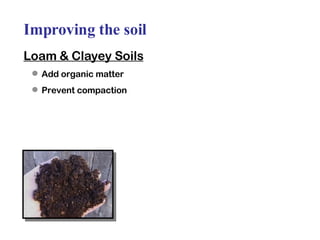
Improving the soil Loam & Clayey Soils Add organic matter Prevent compaction
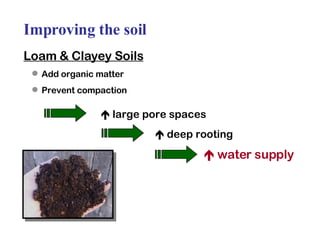
Improving the soil Loam & Clayey Soils Add organic matter Prevent compaction     large pore spaces    deep rooting    water supply
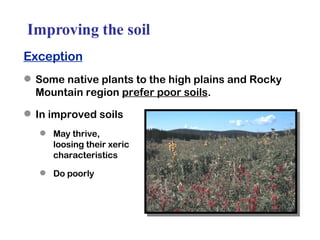
Improving the soil Exception Some native plants to the high plains and Rocky Mountain region  prefer poor soils . In improved soils May thrive,  loosing their xeric  characteristics Do poorly
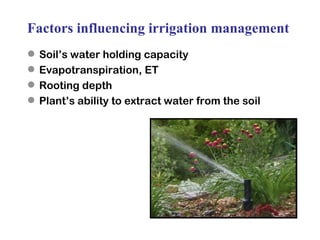
Factors influencing irrigation management Soil’s water holding capacity Evapotranspiration, ET Rooting depth Plant’s ability to extract water from the soil
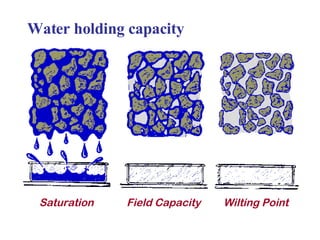
Water holding capacity Pore spaces Texture and structure Large pore spaces Air  Water moves down with gravitational pull Small pore spaces Water Water moves in all directions by capillary action
Water holding capacity   Saturation  Field Capacity Wilting Point
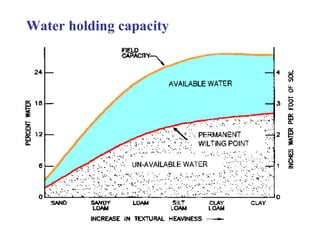
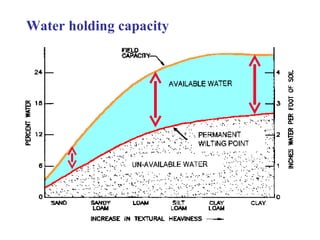
Water holding capacity
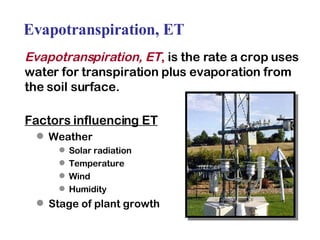
Evapotranspiration, ET Evapotranspiration, ET ,  is the rate a crop uses water for transpiration plus evaporation from the soil surface. Factors influencing ET Weather Solar radiation Temperature Wind Humidity Stage of plant growth
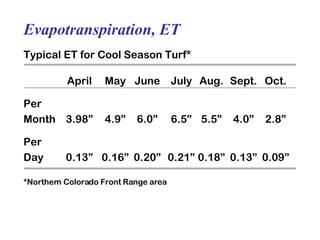
Evapotranspiration, ET Typical ET for Cool Season Turf* April May June July Aug. Sept. Oct. Per Month 3.98” 4.9” 6.0” 6.5” 5.5” 4.0” 2.8” Per Day 0.13” 0.16” 0.20” 0.21” 0.18” 0.13” 0.09” *Northern Colorado Front Range area
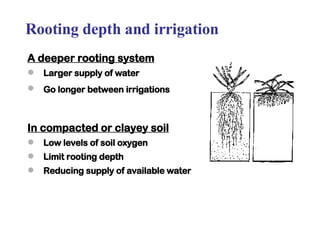
Rooting depth and irrigation A deeper rooting system   Larger supply of water  Go longer between irrigations   In compacted or clayey soil Low levels of soil oxygen Limit rooting depth Reducing supply of available water
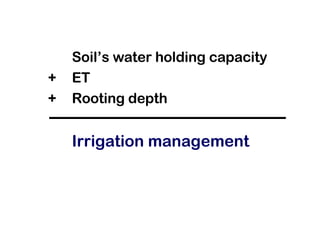
Soil’s water holding capacity + ET +  Rooting depth Irrigation management
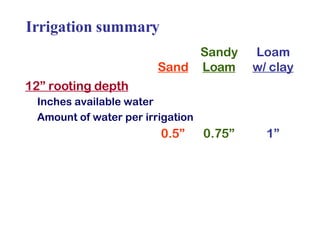
Sandy Loam Sand Loam w/ clay 12” rooting depth   Inches available water Amount of water per irrigation   0.5” 0.75” 1” Irrigation summary
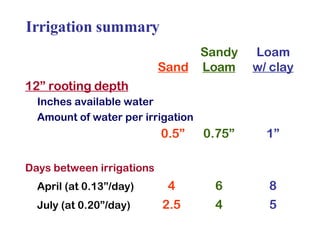
Sandy Loam Sand Loam w/ clay 12” rooting depth   Inches available water Amount of water per irrigation   0.5” 0.75” 1” Days between irrigations April (at 0.13”/day) 4  6 8 July (at 0.20”/day) 2.5   4 5 Irrigation summary
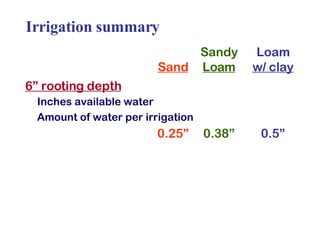
Sandy Loam Sand Loam w/ clay 6” rooting depth   Inches available water Amount of water per irrigation   0.25” 0.38” 0.5” Irrigation summary
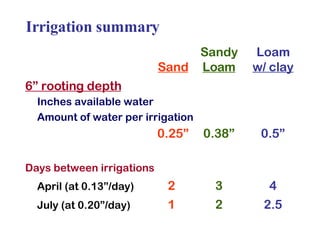
Sandy Loam Sand Loam w/ clay 6” rooting depth   Inches available water Amount of water per irrigation   0.25” 0.38” 0.5” Days between irrigations April (at 0.13”/day) 2  3 4 July (at 0.20”/day) 1   2 2.5 Irrigation summary
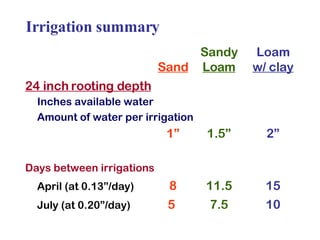
Sandy Loam Sand Loam w/ clay 24 inch rooting depth   Inches available water Amount of water per irrigation   1” 1.5” 2” Days between irrigations April (at 0.13”/day) 8 11.5 15 July (at 0.20”/day) 5   7.5 10 Irrigation summary
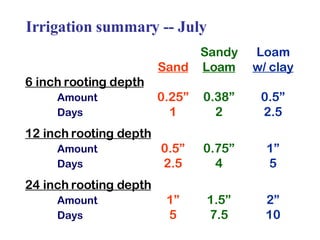
Sandy Loam Sand Loam w/ clay 6 inch rooting depth   Amount 0.25” 0.38” 0.5” Days 1 2 2.5 12 inch rooting depth   Amount 0.5” 0.75” 1” Days 2.5 4 5 24 inch rooting depth   Amount 1” 1.5” 2” Days 5 7.5 10 Irrigation summary -- July
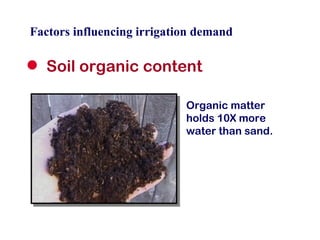
Factors influencing irrigation demand Soil organic content Organic matter holds 10X more water than sand.
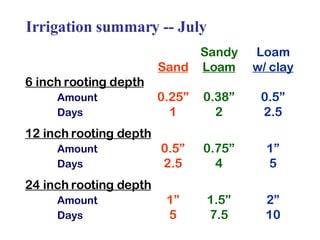
Sandy Loam Sand Loam w/ clay 6 inch rooting depth   Amount 0.25” 0.38” 0.5” Days 1 2 2.5 12 inch rooting depth   Amount 0.5” 0.75” 1” Days 2.5 4 5 24 inch rooting depth   Amount 1” 1.5” 2” Days 5 7.5 10 Irrigation summary -- July
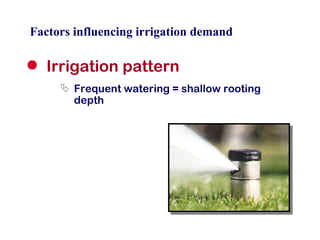
Factors influencing irrigation demand Irrigation pattern Frequent watering = shallow rooting depth
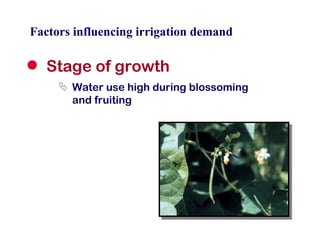
Factors influencing irrigation demand Stage of growth Water use high during blossoming  and fruiting
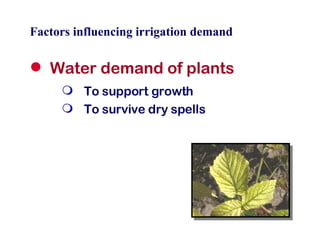
Factors influencing irrigation demand Water demand of plants To support growth To survive dry spells
Fine-tune the irrigation management
Fine-tune the irrigation management In the  normal  June/July days IF a lawn goes 5 days on 1”
Fine-tune the irrigation management In the  normal  June/July days IF a lawn goes 5 days on 1” Apply  1.0” every 5 days Additional amounts would leach below root zone. 0.8” every 4 days 0.6” every 3 days 0.4” every 2 days 0.2” every day
Fine-tune the irrigation management In the  normal  June/July days IF a lawn goes 4 days on 0.8 ”
Fine-tune the irrigation management In the  normal  June/July days IF a lawn goes 4 days on 0.8 ” Apply  0.8” every 4 days Additional amounts would leach below root zone. 0.6” every 3 days 0.4” every 2 days 0.2” every day
Fine-tune the irrigation management In the  normal  June/July days IF a lawn only goes 2 days on 0.4”
Fine-tune the irrigation management In the  normal  June/July days IF a lawn only goes 2 days on 0.4” Apply   0.4” every 2 days Additional amounts would leach below root zone. 0.2” every day
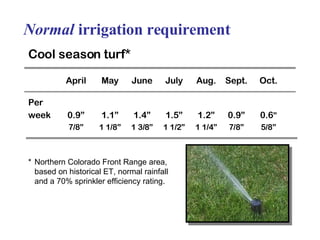
Normal  irrigation requirement Cool season turf* April May June July Aug. Sept. Oct. Per week 0.9” 1.1” 1.4” 1.5” 1.2” 0.9” 0.6 ” 7/8” 1 1/8” 1 3/8” 1 1/2” 1 1/4” 7/8” 5/8” * Northern Colorado Front Range area,  based on historical ET, normal rainfall  and a 70% sprinkler efficiency rating.
What do you advise the gardener about, “How much and how often to water the lawn?”
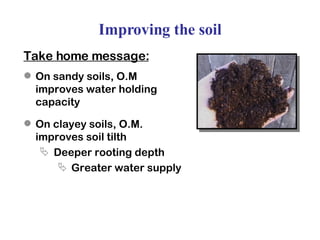
Improving the soil Take home message: On sandy soils, O.M improves water holding capacity On clayey soils, O.M. improves soil tilth Deeper rooting depth Greater water supply

2 Wwg2 Soil Hydrozone Irrigation

  • 1.
  • 2.
    Irrigation Management and Water-Wise Gardening HCC100 -- Horticultural Science, The Science of Gardening
  • 3.
    7 Principles of Water-Wise Gardening
  • 4.
    Planning and designingfor water conservation, beauty, and utility
  • 5.
    Improving the soilAdd organic matter
  • 6.
    Creating practical turf and non-turf areas
  • 7.
    Watering efficiently with appropriate irrigation methods Irrigation efficiency has greatest water savings potential for most home gardeners.
  • 8.
    Selecting plant appropriatefor our climate AND Grouping them according to their water needs ( Hydrozoning ) AND Irrigating according to water need
  • 9.
    Mulching to reduceevaporation
  • 10.
    Maintaining with good horticultural practices Healthy plants are more tolerant of insect and disease problems. Healthy plants have fewer insect and disease problems Iron chlorosis, a symptoms of springtime over-watering
  • 11.
    7 Principles ofWater-Wise Gardening Planning and design for water conservation, beauty, and utility Improving the soil Creating practical turf and non-turf areas Watering efficiently with appropriate irrigation methods Selecting plants and grouping them according to water need Mulching to reduce evaporation Maintaining with good horticultural practices
  • 12.
    Planning and designingfor water conservation, beauty, and utility
  • 13.
    Create a baseplan Make a simple drawing of the property Typical scale is 8-10 feet per inch Show site amenities Buildings Hardscape features (driveways, walks, patio, deck) Existing plant materials Utility lines Site limitations Sun exposure Wind patterns Drainage issues
  • 14.
  • 15.
  • 16.
    Landscaping on ExpansiveSoils CSU Cooperative Extension Fact Sheet #7.236
  • 17.
    Make a bubblediagram Use areas (identifying irrigation needs ) Lawns Routine, reduce, low and non-irrigated turf areas Shrub, flowerbeds and ground covers with Routine, reduce, low and non-irrigated areas Fruit & vegetable gardens Children’s play areas Pet areas Natural areas Non-plant areas
  • 18.
  • 19.
    Refine the landscapeplan Convert bubble areas to a landscape plan.
  • 20.
    Planning and designingfor water conservation, beauty, and utility Take home message:
  • 21.
    Planning and designingfor water conservation, beauty, and utility Take home message It takes planning… water conservation, beauty, and utility does not happen by accident.
  • 22.
    Selecting plant appropriatefor our climate AND Grouping them according to their water needs ( Hydrozoning ) AND Irrigating according to water need
  • 23.
    Colorado is asemi-arid climate. Select plants suitable to a semi-arid climate. Plant pallet is limited, but not void, without supplemental irrigation.
  • 24.
    Colorado is asemi-arid climate. Suggested references Xeriscape Plant Guide , by Denver Water, Fulcrum Publishing Xeric Tree and Shrub List by the Community Tree Alliance , CMG Fact Sheet #T15
  • 25.
    Colorado is asemi-arid climate. On sites, where landscape irrigation is not desirable or possible, focus on natural growth.
  • 26.
    Hydrozoning Grouping plants according to irrigation needs, AND watering according to need . Routinely irrigated flowerbed Non-irrigated naturalized area
  • 27.
    Design with irrigationdemand in mind. Routine Irrigation Reduced Irrigation Need Limited irrigation once established non-irrigated
  • 28.
    Design with irrigationdemand in mind. Routine Irrigation Reduced Irrigation Need Limited irrigation once established
  • 29.
    Design with irrigationdemand in mind. Garden Routine Irrigation Reduced Irrigation Need Limited irrigation once established
  • 30.
    Design with irrigationdemand in mind. Routine Irrigation Reduced Irrigation Need Limited irrigation once established non-irrigated
  • 31.
    Hydrozoning myths Xeriscapingis NOT a cacti and rock garden .
  • 32.
    The objective ofhydrozoning is to place low-water requiring plants together in zones that actually receive reduced to no irrigation!
  • 33.
    Even xeric plantneed rain/irrigation during establishment.
  • 34.
    Water-wise concepts supportirrigation for “people space” “ People space” at Thanksgiving Point Gardens
  • 35.
    Selecting plant appropriatefor our climate AND Grouping them according to their water needs ( Hydrozoning ) AND Irrigating according to water need
  • 36.
    Improving the soilAdd organic matter
  • 37.
    Improving the soilSandy Soils
  • 38.
    Improving the soilSandy Soils Add organic matter
  • 39.
    Improving the soilSandy Soils Add organic matter Hold 10+ times more water and nutrients than sand
  • 40.
    Improving the soilLoam & Clayey Soils
  • 41.
    Improving the soilLoam & Clayey Soils Add organic matter Prevent compaction
  • 42.
    Improving the soilLoam & Clayey Soils Add organic matter Prevent compaction  large pore spaces  deep rooting  water supply
  • 43.
    Improving the soilException Some native plants to the high plains and Rocky Mountain region prefer poor soils . In improved soils May thrive, loosing their xeric characteristics Do poorly
  • 44.
    Factors influencing irrigationmanagement Soil’s water holding capacity Evapotranspiration, ET Rooting depth Plant’s ability to extract water from the soil
  • 45.
    Water holding capacityPore spaces Texture and structure Large pore spaces Air Water moves down with gravitational pull Small pore spaces Water Water moves in all directions by capillary action
  • 46.
    Water holding capacity Saturation Field Capacity Wilting Point
  • 47.
  • 48.
  • 49.
    Evapotranspiration, ET Evapotranspiration,ET , is the rate a crop uses water for transpiration plus evaporation from the soil surface. Factors influencing ET Weather Solar radiation Temperature Wind Humidity Stage of plant growth
  • 50.
    Evapotranspiration, ET TypicalET for Cool Season Turf* April May June July Aug. Sept. Oct. Per Month 3.98” 4.9” 6.0” 6.5” 5.5” 4.0” 2.8” Per Day 0.13” 0.16” 0.20” 0.21” 0.18” 0.13” 0.09” *Northern Colorado Front Range area
  • 51.
    Rooting depth andirrigation A deeper rooting system Larger supply of water Go longer between irrigations In compacted or clayey soil Low levels of soil oxygen Limit rooting depth Reducing supply of available water
  • 52.
    Soil’s water holdingcapacity + ET + Rooting depth Irrigation management
  • 53.
    Sandy Loam SandLoam w/ clay 12” rooting depth Inches available water Amount of water per irrigation 0.5” 0.75” 1” Irrigation summary
  • 54.
    Sandy Loam SandLoam w/ clay 12” rooting depth Inches available water Amount of water per irrigation 0.5” 0.75” 1” Days between irrigations April (at 0.13”/day) 4 6 8 July (at 0.20”/day) 2.5 4 5 Irrigation summary
  • 55.
    Sandy Loam SandLoam w/ clay 6” rooting depth Inches available water Amount of water per irrigation 0.25” 0.38” 0.5” Irrigation summary
  • 56.
    Sandy Loam SandLoam w/ clay 6” rooting depth Inches available water Amount of water per irrigation 0.25” 0.38” 0.5” Days between irrigations April (at 0.13”/day) 2 3 4 July (at 0.20”/day) 1 2 2.5 Irrigation summary
  • 57.
    Sandy Loam SandLoam w/ clay 24 inch rooting depth Inches available water Amount of water per irrigation 1” 1.5” 2” Days between irrigations April (at 0.13”/day) 8 11.5 15 July (at 0.20”/day) 5 7.5 10 Irrigation summary
  • 58.
    Sandy Loam SandLoam w/ clay 6 inch rooting depth Amount 0.25” 0.38” 0.5” Days 1 2 2.5 12 inch rooting depth Amount 0.5” 0.75” 1” Days 2.5 4 5 24 inch rooting depth Amount 1” 1.5” 2” Days 5 7.5 10 Irrigation summary -- July
  • 59.
    Factors influencing irrigationdemand Soil organic content Organic matter holds 10X more water than sand.
  • 60.
    Sandy Loam SandLoam w/ clay 6 inch rooting depth Amount 0.25” 0.38” 0.5” Days 1 2 2.5 12 inch rooting depth Amount 0.5” 0.75” 1” Days 2.5 4 5 24 inch rooting depth Amount 1” 1.5” 2” Days 5 7.5 10 Irrigation summary -- July
  • 61.
    Factors influencing irrigationdemand Irrigation pattern Frequent watering = shallow rooting depth
  • 62.
    Factors influencing irrigationdemand Stage of growth Water use high during blossoming and fruiting
  • 63.
    Factors influencing irrigationdemand Water demand of plants To support growth To survive dry spells
  • 64.
  • 65.
    Fine-tune the irrigationmanagement In the normal June/July days IF a lawn goes 5 days on 1”
  • 66.
    Fine-tune the irrigationmanagement In the normal June/July days IF a lawn goes 5 days on 1” Apply 1.0” every 5 days Additional amounts would leach below root zone. 0.8” every 4 days 0.6” every 3 days 0.4” every 2 days 0.2” every day
  • 67.
    Fine-tune the irrigationmanagement In the normal June/July days IF a lawn goes 4 days on 0.8 ”
  • 68.
    Fine-tune the irrigationmanagement In the normal June/July days IF a lawn goes 4 days on 0.8 ” Apply 0.8” every 4 days Additional amounts would leach below root zone. 0.6” every 3 days 0.4” every 2 days 0.2” every day
  • 69.
    Fine-tune the irrigationmanagement In the normal June/July days IF a lawn only goes 2 days on 0.4”
  • 70.
    Fine-tune the irrigationmanagement In the normal June/July days IF a lawn only goes 2 days on 0.4” Apply 0.4” every 2 days Additional amounts would leach below root zone. 0.2” every day
  • 71.
    Normal irrigationrequirement Cool season turf* April May June July Aug. Sept. Oct. Per week 0.9” 1.1” 1.4” 1.5” 1.2” 0.9” 0.6 ” 7/8” 1 1/8” 1 3/8” 1 1/2” 1 1/4” 7/8” 5/8” * Northern Colorado Front Range area, based on historical ET, normal rainfall and a 70% sprinkler efficiency rating.
  • 72.
    What do youadvise the gardener about, “How much and how often to water the lawn?”
  • 73.
    Improving the soilTake home message: On sandy soils, O.M improves water holding capacity On clayey soils, O.M. improves soil tilth Deeper rooting depth Greater water supply