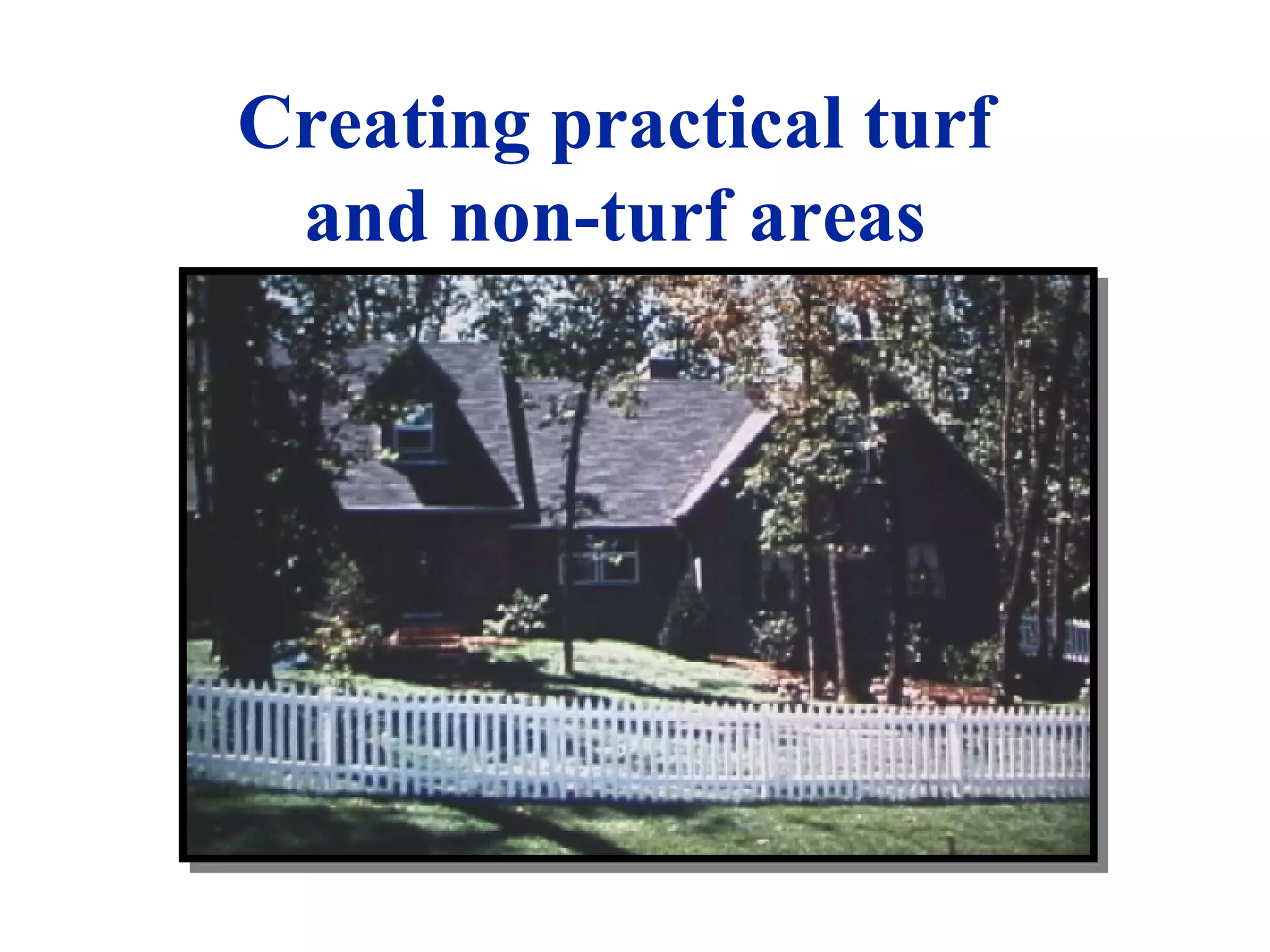
Creating practical turf  and non-turf areas
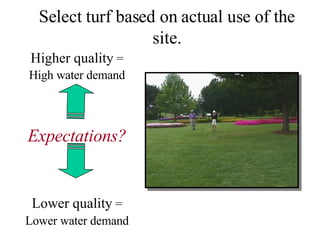
Select turf based on actual use of the site. Higher quality  = High water demand Expectations? Lower quality  = Lower water demand
Water-wise lawn care Higher quality  = High water demand Expectations? Lower quality  = Lower water demand Routine irrigation High performance Bluegrass varieties and turf-type tall fescue Reduced irrigation Reduced inputs Bluegrass varieties and  turf-type tall fescue Non-irrigated Buffalograss Blue Grama
Water-wise lawn care High water demand Expectations? Low water demand Increased drought tolerance with 3”- 4” mowing height. Spring fertilization decreases drought tolerance. Any grass is intolerant of traffic when under water stress.
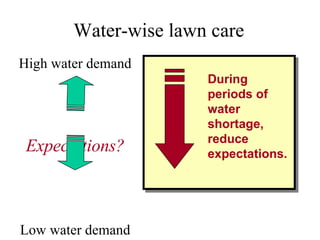
Water-wise lawn care High water demand Expectations? Low water demand During periods of water shortage, reduce expectations.
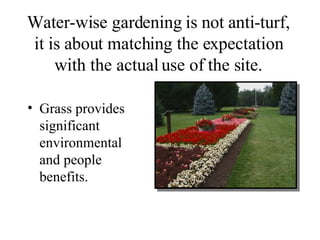
Water-wise gardening is not anti-turf, it is about matching the expectation with the actual use of the site. Grass provides significant environmental and people benefits.
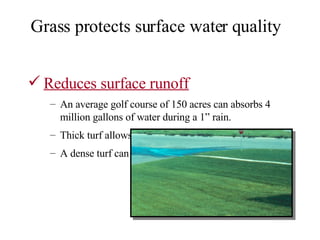
Reduces surface runoff An average golf course of 150 acres can absorbs 4 million gallons of water during a 1” rain. Thick turf allows  15 times  less runoff than a thin turf. A dense turf can reduce runoff to almost zero. Grass protects surface water quality
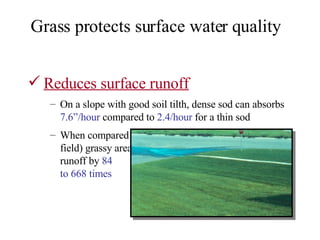
Reduces surface runoff On a slope with good soil tilth, dense sod can absorbs  7.6”/hour  compared to  2.4/hour  for a thin sod When compared to a non-grass area (like a garden or field) grassy areas reduce soil erosion caused by  runoff by  84  to 668 times Grass protects surface water quality
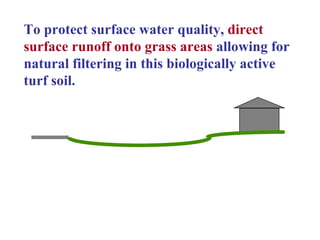
To protect surface water quality,  direct surface runoff onto grass areas   allowing for natural filtering in this biologically active turf soil.
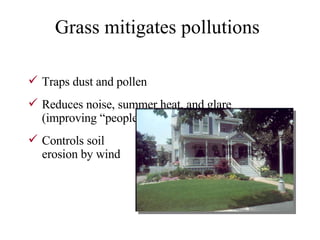
Traps dust and pollen Reduces noise, summer heat, and glare   (improving “people space”) Controls soil  erosion by wind Grass mitigates pollutions
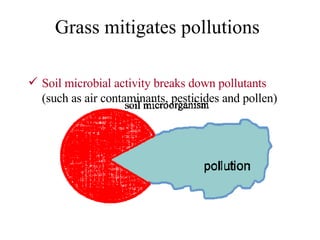
Soil microbial activity breaks down pollutants   (such as air contaminants, pesticides and pollen)   Grass mitigates pollutions
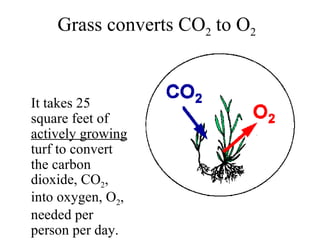
It takes 25 square feet of  actively growing  turf to convert the carbon dioxide, CO 2 , into oxygen, O 2 , needed per person per day. Grass converts CO 2  to O 2
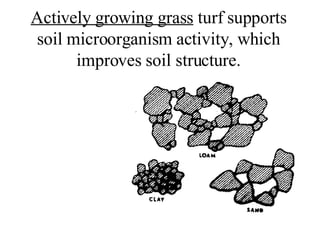
Actively growing grass  turf supports soil microorganism activity, which improves soil structure.
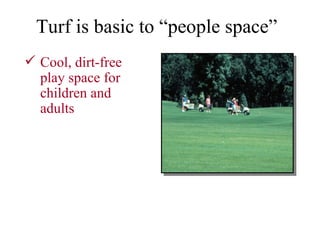
Cool, dirt-free play space for children and adults Turf is basic to “people space”
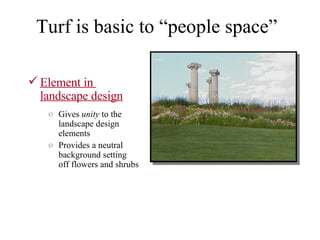
Element in  landscape design Gives  unity  to the  landscape design elements Provides a neutral  background setting  off flowers and shrubs Turf is basic to “people space”
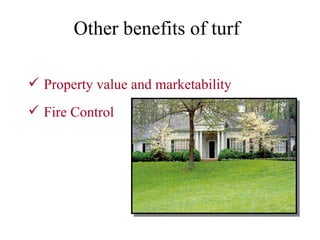
Property value and marketability Fire Control Other benefits of turf
Objective:  Match turf with needs of site! Expectations?
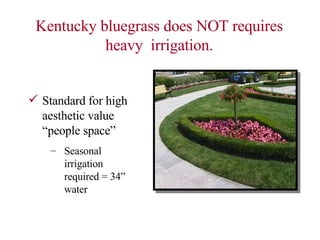
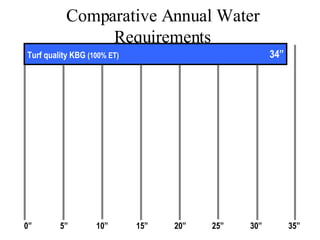
Kentucky bluegrass does NOT requires heavy  irrigation. Standard for high aesthetic value “people space”  Seasonal irrigation required = 34” water
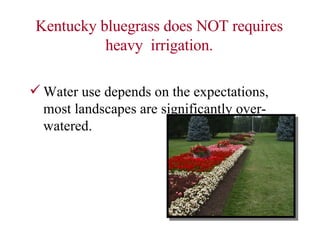
Kentucky bluegrass does NOT requires heavy  irrigation. Water use depends on the expectations, most landscapes are significantly over-watered.
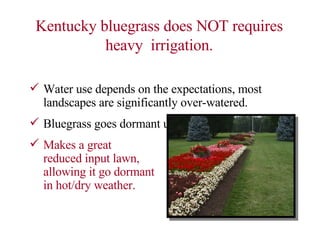
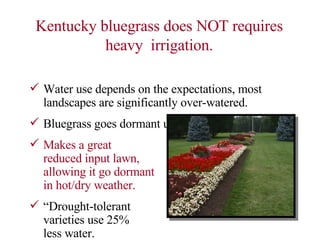
Kentucky bluegrass does NOT requires heavy  irrigation. Water use depends on the expectations, most landscapes are significantly over-watered. Bluegrass goes dormant under water stress. Makes a great  reduced input lawn,  allowing it go dormant  in hot/dry weather.
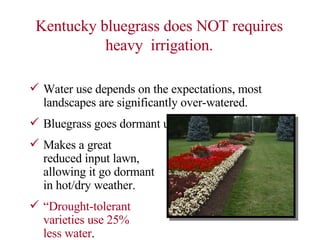
Kentucky bluegrass does NOT requires heavy  irrigation. Water use depends on the expectations, most landscapes are significantly over-watered. Bluegrass goes dormant under water stress. Makes a great  reduced input lawn,  allowing it go dormant  in hot/dry weather. “ Drought-tolerant  varieties use 25%  less water .
Kentucky bluegrass does NOT requires heavy  irrigation. Water use depends on the expectations, most landscapes are significantly over-watered. Bluegrass goes dormant under water stress. Makes a great  reduced input lawn,  allowing it go dormant  in hot/dry weather. “ Drought-tolerant  varieties use 25%  less water.
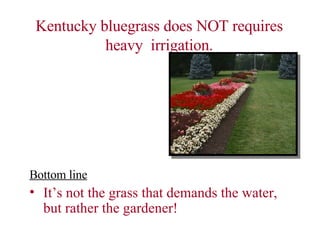
Kentucky bluegrass does NOT requires heavy  irrigation. Bottom line It’s not the grass that demands the water, but rather the gardener!
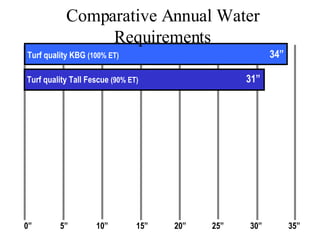
Turf-type tall fescue requires irrigation Actual irrigation requirement depends on soil conditions, precipitation, and management style. Actual water use of turf-quality tall fescue is 10% less than turf-quality bluegrass. If conditions allow deeper rooting, it will maintain green color longer between irrigation. Will also require longer irrigation period Tall fescue does not tolerate long-term drought, as it can not go dormant.
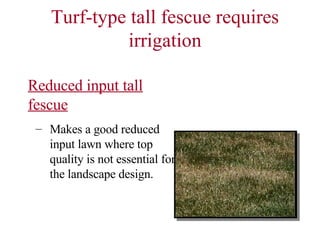
Turf-type tall fescue requires irrigation Reduced input tall fescue Makes a good reduced input lawn where top quality is not essential for the landscape design.
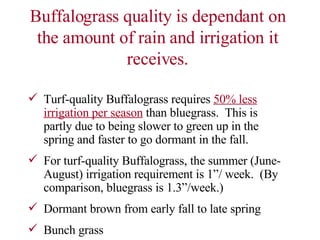
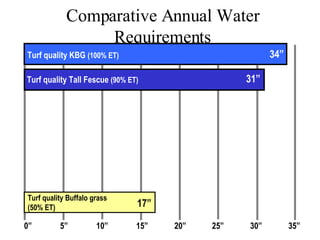
Buffalograss quality is dependant on the amount of rain and irrigation it receives. Turf-quality Buffalograss requires  50% less   irrigation per season  than bluegrass.  This is partly due to being slower to green up in the spring and faster to go dormant in the fall. For turf-quality Buffalograss, the summer (June-August) irrigation requirement is 1”/ week.  (By comparison, bluegrass is 1.3”/week.) Dormant brown from early fall to late spring Bunch grass
Comparative Annual Water Requirements 0” 5” 10” 15” 20” 25” 30” 35” Turf quality KBG  (100% ET) 34”
Comparative Annual Water Requirements 0” 5” 10” 15” 20” 25” 30” 35” Turf quality KBG  (100% ET) 34” Turf quality Tall Fescue  (90% ET) 31”
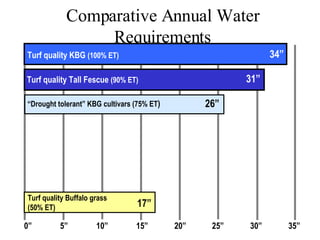
Comparative Annual Water Requirements 0” 5” 10” 15” 20” 25” 30” 35” Turf quality KBG  (100% ET) 34” Turf quality Tall Fescue  (90% ET) 31” Turf quality Buffalo grass (50% ET) 17”
Comparative Annual Water Requirements 0” 5” 10” 15” 20” 25” 30” 35” Turf quality KBG  (100% ET) 34” Turf quality Tall Fescue  (90% ET) 31” 26” “ Drought tolerant” KBG cultivars (75% ET ) Turf quality Buffalo grass (50% ET) 17”
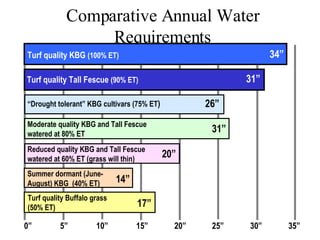
Comparative Annual Water Requirements Turf quality KBG  (100% ET) 34” Turf quality Tall Fescue  (90% ET) 31” 26” “ Drought tolerant” KBG cultivars (75% ET ) Turf quality Buffalo grass (50% ET) 17” 20” Reduced quality KBG and Tall Fescue watered at 60% ET (grass will thin) 31” Moderate quality KBG and Tall Fescue  watered at 80% ET Summer dormant (June-August) KBG  (40% ET) 14” 0” 5” 10” 15” 20” 25” 30” 35”
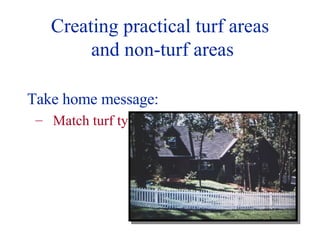
Creating practical turf areas  and non-turf areas Take home message: Match turf type with use of site.
 

Creating Practical Turf Areas C Su

  • 1.
    Creating practical turf and non-turf areas
  • 2.
    Select turf basedon actual use of the site. Higher quality = High water demand Expectations? Lower quality = Lower water demand
  • 3.
    Water-wise lawn careHigher quality = High water demand Expectations? Lower quality = Lower water demand Routine irrigation High performance Bluegrass varieties and turf-type tall fescue Reduced irrigation Reduced inputs Bluegrass varieties and turf-type tall fescue Non-irrigated Buffalograss Blue Grama
  • 4.
    Water-wise lawn careHigh water demand Expectations? Low water demand Increased drought tolerance with 3”- 4” mowing height. Spring fertilization decreases drought tolerance. Any grass is intolerant of traffic when under water stress.
  • 5.
    Water-wise lawn careHigh water demand Expectations? Low water demand During periods of water shortage, reduce expectations.
  • 6.
    Water-wise gardening isnot anti-turf, it is about matching the expectation with the actual use of the site. Grass provides significant environmental and people benefits.
  • 7.
    Reduces surface runoffAn average golf course of 150 acres can absorbs 4 million gallons of water during a 1” rain. Thick turf allows 15 times less runoff than a thin turf. A dense turf can reduce runoff to almost zero. Grass protects surface water quality
  • 8.
    Reduces surface runoffOn a slope with good soil tilth, dense sod can absorbs 7.6”/hour compared to 2.4/hour for a thin sod When compared to a non-grass area (like a garden or field) grassy areas reduce soil erosion caused by runoff by 84 to 668 times Grass protects surface water quality
  • 9.
    To protect surfacewater quality, direct surface runoff onto grass areas allowing for natural filtering in this biologically active turf soil.
  • 10.
    Traps dust andpollen Reduces noise, summer heat, and glare (improving “people space”) Controls soil erosion by wind Grass mitigates pollutions
  • 11.
    Soil microbial activitybreaks down pollutants (such as air contaminants, pesticides and pollen) Grass mitigates pollutions
  • 12.
    It takes 25square feet of actively growing turf to convert the carbon dioxide, CO 2 , into oxygen, O 2 , needed per person per day. Grass converts CO 2 to O 2
  • 13.
    Actively growing grass turf supports soil microorganism activity, which improves soil structure.
  • 14.
    Cool, dirt-free playspace for children and adults Turf is basic to “people space”
  • 15.
    Element in landscape design Gives unity to the landscape design elements Provides a neutral background setting off flowers and shrubs Turf is basic to “people space”
  • 16.
    Property value andmarketability Fire Control Other benefits of turf
  • 17.
    Objective: Matchturf with needs of site! Expectations?
  • 18.
    Kentucky bluegrass doesNOT requires heavy irrigation. Standard for high aesthetic value “people space” Seasonal irrigation required = 34” water
  • 19.
    Kentucky bluegrass doesNOT requires heavy irrigation. Water use depends on the expectations, most landscapes are significantly over-watered.
  • 20.
    Kentucky bluegrass doesNOT requires heavy irrigation. Water use depends on the expectations, most landscapes are significantly over-watered. Bluegrass goes dormant under water stress. Makes a great reduced input lawn, allowing it go dormant in hot/dry weather.
  • 21.
    Kentucky bluegrass doesNOT requires heavy irrigation. Water use depends on the expectations, most landscapes are significantly over-watered. Bluegrass goes dormant under water stress. Makes a great reduced input lawn, allowing it go dormant in hot/dry weather. “ Drought-tolerant varieties use 25% less water .
  • 22.
    Kentucky bluegrass doesNOT requires heavy irrigation. Water use depends on the expectations, most landscapes are significantly over-watered. Bluegrass goes dormant under water stress. Makes a great reduced input lawn, allowing it go dormant in hot/dry weather. “ Drought-tolerant varieties use 25% less water.
  • 23.
    Kentucky bluegrass doesNOT requires heavy irrigation. Bottom line It’s not the grass that demands the water, but rather the gardener!
  • 24.
    Turf-type tall fescuerequires irrigation Actual irrigation requirement depends on soil conditions, precipitation, and management style. Actual water use of turf-quality tall fescue is 10% less than turf-quality bluegrass. If conditions allow deeper rooting, it will maintain green color longer between irrigation. Will also require longer irrigation period Tall fescue does not tolerate long-term drought, as it can not go dormant.
  • 25.
    Turf-type tall fescuerequires irrigation Reduced input tall fescue Makes a good reduced input lawn where top quality is not essential for the landscape design.
  • 26.
    Buffalograss quality isdependant on the amount of rain and irrigation it receives. Turf-quality Buffalograss requires 50% less irrigation per season than bluegrass. This is partly due to being slower to green up in the spring and faster to go dormant in the fall. For turf-quality Buffalograss, the summer (June-August) irrigation requirement is 1”/ week. (By comparison, bluegrass is 1.3”/week.) Dormant brown from early fall to late spring Bunch grass
  • 27.
    Comparative Annual WaterRequirements 0” 5” 10” 15” 20” 25” 30” 35” Turf quality KBG (100% ET) 34”
  • 28.
    Comparative Annual WaterRequirements 0” 5” 10” 15” 20” 25” 30” 35” Turf quality KBG (100% ET) 34” Turf quality Tall Fescue (90% ET) 31”
  • 29.
    Comparative Annual WaterRequirements 0” 5” 10” 15” 20” 25” 30” 35” Turf quality KBG (100% ET) 34” Turf quality Tall Fescue (90% ET) 31” Turf quality Buffalo grass (50% ET) 17”
  • 30.
    Comparative Annual WaterRequirements 0” 5” 10” 15” 20” 25” 30” 35” Turf quality KBG (100% ET) 34” Turf quality Tall Fescue (90% ET) 31” 26” “ Drought tolerant” KBG cultivars (75% ET ) Turf quality Buffalo grass (50% ET) 17”
  • 31.
    Comparative Annual WaterRequirements Turf quality KBG (100% ET) 34” Turf quality Tall Fescue (90% ET) 31” 26” “ Drought tolerant” KBG cultivars (75% ET ) Turf quality Buffalo grass (50% ET) 17” 20” Reduced quality KBG and Tall Fescue watered at 60% ET (grass will thin) 31” Moderate quality KBG and Tall Fescue watered at 80% ET Summer dormant (June-August) KBG (40% ET) 14” 0” 5” 10” 15” 20” 25” 30” 35”
  • 32.
    Creating practical turfareas and non-turf areas Take home message: Match turf type with use of site.
  • 33.