www.energ.co.uk/CHP
BIOGAS FROM FOOD WASTE: BY NUMBERS
A summary of the key figures – financial and environmental – involved
in the production of biogas from food waste via anaerobic digestion.
RENEWABLE ENERGY
FROM FOOD WASTE
www.energ.co.uk/CHP
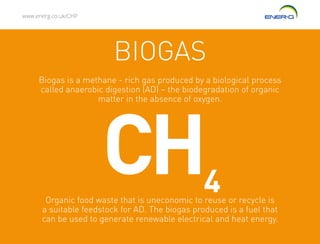
Organic food waste that is uneconomic to reuse or recycle is
a suitable feedstock for AD. The biogas produced is a fuel that
can be used to generate renewable electrical and heat energy.
Biogas is a methane - rich gas produced by a biological process
called anaerobic digestion (AD) – the biodegradation of organic
matter in the absence of oxygen.
CH4
BIOGAS
www.energ.co.uk/CHP
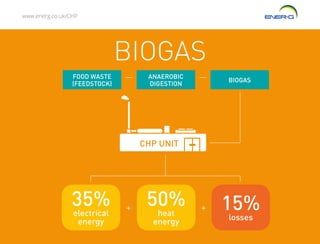
35%electrical
energy
50%heat
energy
15%losses
+ +
FOOD WASTE
(FEEDSTOCK)
ANAEROBIC
DIGESTION
BIOGAS
CHP UNIT
BIOGAS
www.energ.co.uk/CHP
BIOGAS
CH4
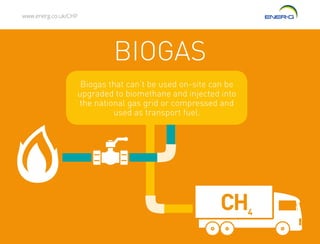
Biogas that can’t be used on-site can be
upgraded to biomethane and injected into
the national gas grid or compressed and
used as transport fuel.
www.energ.co.uk/CHP
BIOGAS
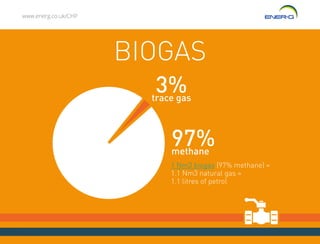
1 Nm3 biogas (97% methane) =
1.1 Nm3 natural gas =
1.1 litres of petrol
3%trace gas
97%methane
www.energ.co.uk/CHP
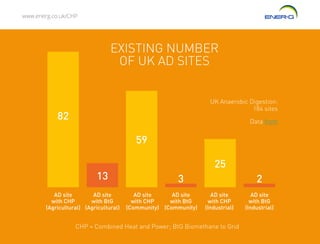
82
13
59
25
3 2
UK Anaerobic Digestion:
184 sites
CHP = Combined Heat and Power; BtG Biomethane to Grid
Data from
AD site
with CHP
(Agricultural)
AD site
with CHP
(Community)
AD site
with CHP
(Industrial)
AD site
with BtG
(Agricultural)
AD site
with BtG
(Community)
AD site
with BtG
(Industrial)
EXISTING NUMBER
OF UK AD SITES
www.energ.co.uk/CHP
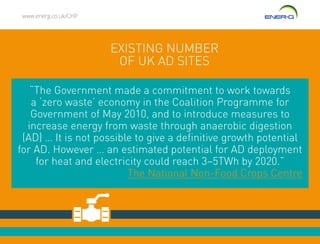
EXISTING NUMBER
OF UK AD SITES
“The Government made a commitment to work towards
a ‘zero waste’ economy in the Coalition Programme for
Government of May 2010, and to introduce measures to
increase energy from waste through anaerobic digestion
(AD) … It is not possible to give a definitive growth potential
for AD. However … an estimated potential for AD deployment
for heat and electricity could reach 3–5TWh by 2020.”
The National Non-Food Crops Centre
www.energ.co.uk/CHP
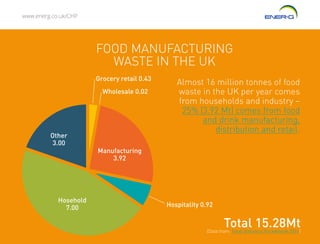
Grocery retail 0.43
Wholesale 0.02
Hospitality 0.92
Manufacturing
3.92
Other
3.00
Hosehold
7.00
Total 15.28Mt(Data from: Food Statistics Pocketbook 2014)
FOOD MANUFACTURING
WASTE IN THE UK
Almost 16 million tonnes of food
waste in the UK per year comes
from households and industry –
25% (3.92 Mt) comes from food
and drink manufacturing,
distribution and retail.
www.energ.co.uk/CHP
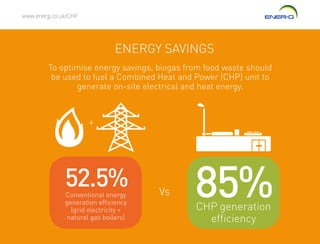
ENERGY SAVINGS
To optimise energy savings, biogas from food waste should
be used to fuel a Combined Heat and Power (CHP) unit to
generate on-site electrical and heat energy.
Conventional energy
generation efficiency
(grid electricity +
natural gas boilers)
CHP generation
efficiency
85%52.5%
+
Vs
www.energ.co.uk/CHP
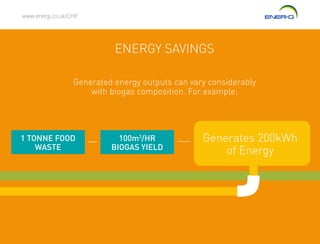
ENERGY SAVINGS
Generated energy outputs can vary considerably
with biogas composition. For example:
1 TONNE FOOD
WASTE
100m3
/HR
BIOGAS YIELD
Generates 200kWh
of Energy
www.energ.co.uk/CHP
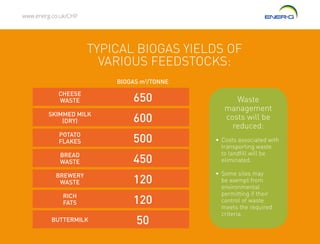
TYPICAL BIOGAS YIELDS OF
VARIOUS FEEDSTOCKS:
Waste
management
costs will be
reduced:
•	Costs associated with
transporting waste
to landfill will be
eliminated.
•	Some sites may
be exempt from
environmental
permitting if their
control of waste
meets the required
criteria.
CHEESE
WASTE
BIOGAS m3
/TONNE
POTATO
FLAKES
RICH
FATS
SKIMMED MILK
(DRY)
BREWERY
WASTE
BREAD
WASTE
BUTTERMILK 50
120
120
450
500
600
650
www.energ.co.uk/CHP
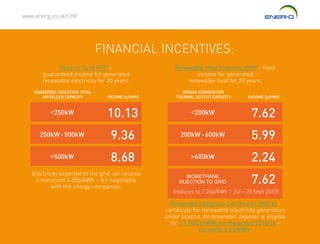
FINANCIAL INCENTIVES:
<250kW <200kW
>500kW >600kW
BIOMETHANE
INJECTION TO GRID
250kW-500kW 200kW-600kW
INCOME (p/kWh) INCOME (p/kWh)
ANAEROBIC DIGESTION TOTAL
INSTALLED CAPACITY
BIOGAS COMBUSTION
THERMAL OUTPUT CAPACITY
8.68 2.24
7.62
9.36 5.99
10.13 7.62
Renewable Obligation Certificates (ROCs) –
certificate for renewable electricity generation
under licence. An anaerobic digester is eligible
for 1.9 ROCs/MWh for the period 2015/16 –
currently 9.6 p/kWh.
Renewable Heat Incentive (RHI) – fixed
income for generated
renewable heat for 20 years.
Electricity exported to the grid can receive
a minimum 4.85p/kWh – it’s negotiable
with the energy companies.
(reduces to 7.24p/kWh 1 Jul – 30 Sept 2015)
Feed-in Tariff (FiT) –
guaranteed income for generated
renewable electricity for 20 years.
www.energ.co.uk/CHP
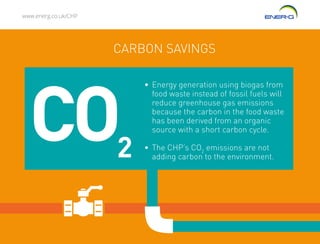
CARBON SAVINGS
•	Energy generation using biogas from
food waste instead of fossil fuels will
reduce greenhouse gas emissions
because the carbon in the food waste
has been derived from an organic
source with a short carbon cycle.
•	The CHP’s CO2
emissions are not
adding carbon to the environment.
CO2
www.energ.co.uk/CHP
TAKEAWAYS:
1.	Anaerobic digestion produces biogas from food waste and residues.
2.	Biogas is used to produce renewable energy with a CHP unit.
3.	CHP provides 30% energy savings over fossil fuels.
4.	Take advantage of the tariffs and incentives for renewable energy.
5.	Save energy and improve your carbon footprint.
www.energ.co.uk/CHP
Download Now
Discover how your food waste can decrease your business’s energy
bills, carbon footprint, and provide additional revenue streams
Get your free eGuide now:
An Introduction to Biogas
for the Energy Manager

Biogas from Food Waste: By Numbers

  • 1.
    www.energ.co.uk/CHP BIOGAS FROM FOODWASTE: BY NUMBERS A summary of the key figures – financial and environmental – involved in the production of biogas from food waste via anaerobic digestion. RENEWABLE ENERGY FROM FOOD WASTE
  • 2.
    www.energ.co.uk/CHP Organic food wastethat is uneconomic to reuse or recycle is a suitable feedstock for AD. The biogas produced is a fuel that can be used to generate renewable electrical and heat energy. Biogas is a methane - rich gas produced by a biological process called anaerobic digestion (AD) – the biodegradation of organic matter in the absence of oxygen. CH4 BIOGAS
  • 3.
  • 4.
    www.energ.co.uk/CHP BIOGAS CH4 Biogas that can’tbe used on-site can be upgraded to biomethane and injected into the national gas grid or compressed and used as transport fuel.
  • 5.
    www.energ.co.uk/CHP BIOGAS 1 Nm3 biogas(97% methane) = 1.1 Nm3 natural gas = 1.1 litres of petrol 3%trace gas 97%methane
  • 6.
    www.energ.co.uk/CHP 82 13 59 25 3 2 UK AnaerobicDigestion: 184 sites CHP = Combined Heat and Power; BtG Biomethane to Grid Data from AD site with CHP (Agricultural) AD site with CHP (Community) AD site with CHP (Industrial) AD site with BtG (Agricultural) AD site with BtG (Community) AD site with BtG (Industrial) EXISTING NUMBER OF UK AD SITES
  • 7.
    www.energ.co.uk/CHP EXISTING NUMBER OF UKAD SITES “The Government made a commitment to work towards a ‘zero waste’ economy in the Coalition Programme for Government of May 2010, and to introduce measures to increase energy from waste through anaerobic digestion (AD) … It is not possible to give a definitive growth potential for AD. However … an estimated potential for AD deployment for heat and electricity could reach 3–5TWh by 2020.” The National Non-Food Crops Centre
  • 8.
    www.energ.co.uk/CHP Grocery retail 0.43 Wholesale0.02 Hospitality 0.92 Manufacturing 3.92 Other 3.00 Hosehold 7.00 Total 15.28Mt(Data from: Food Statistics Pocketbook 2014) FOOD MANUFACTURING WASTE IN THE UK Almost 16 million tonnes of food waste in the UK per year comes from households and industry – 25% (3.92 Mt) comes from food and drink manufacturing, distribution and retail.
  • 9.
    www.energ.co.uk/CHP ENERGY SAVINGS To optimiseenergy savings, biogas from food waste should be used to fuel a Combined Heat and Power (CHP) unit to generate on-site electrical and heat energy. Conventional energy generation efficiency (grid electricity + natural gas boilers) CHP generation efficiency 85%52.5% + Vs
  • 10.
    www.energ.co.uk/CHP ENERGY SAVINGS Generated energyoutputs can vary considerably with biogas composition. For example: 1 TONNE FOOD WASTE 100m3 /HR BIOGAS YIELD Generates 200kWh of Energy
  • 11.
    www.energ.co.uk/CHP TYPICAL BIOGAS YIELDSOF VARIOUS FEEDSTOCKS: Waste management costs will be reduced: • Costs associated with transporting waste to landfill will be eliminated. • Some sites may be exempt from environmental permitting if their control of waste meets the required criteria. CHEESE WASTE BIOGAS m3 /TONNE POTATO FLAKES RICH FATS SKIMMED MILK (DRY) BREWERY WASTE BREAD WASTE BUTTERMILK 50 120 120 450 500 600 650
  • 12.
    www.energ.co.uk/CHP FINANCIAL INCENTIVES: <250kW <200kW >500kW>600kW BIOMETHANE INJECTION TO GRID 250kW-500kW 200kW-600kW INCOME (p/kWh) INCOME (p/kWh) ANAEROBIC DIGESTION TOTAL INSTALLED CAPACITY BIOGAS COMBUSTION THERMAL OUTPUT CAPACITY 8.68 2.24 7.62 9.36 5.99 10.13 7.62 Renewable Obligation Certificates (ROCs) – certificate for renewable electricity generation under licence. An anaerobic digester is eligible for 1.9 ROCs/MWh for the period 2015/16 – currently 9.6 p/kWh. Renewable Heat Incentive (RHI) – fixed income for generated renewable heat for 20 years. Electricity exported to the grid can receive a minimum 4.85p/kWh – it’s negotiable with the energy companies. (reduces to 7.24p/kWh 1 Jul – 30 Sept 2015) Feed-in Tariff (FiT) – guaranteed income for generated renewable electricity for 20 years.
  • 13.
    www.energ.co.uk/CHP CARBON SAVINGS • Energy generationusing biogas from food waste instead of fossil fuels will reduce greenhouse gas emissions because the carbon in the food waste has been derived from an organic source with a short carbon cycle. • The CHP’s CO2 emissions are not adding carbon to the environment. CO2
  • 14.
    www.energ.co.uk/CHP TAKEAWAYS: 1. Anaerobic digestion producesbiogas from food waste and residues. 2. Biogas is used to produce renewable energy with a CHP unit. 3. CHP provides 30% energy savings over fossil fuels. 4. Take advantage of the tariffs and incentives for renewable energy. 5. Save energy and improve your carbon footprint.
  • 15.
    www.energ.co.uk/CHP Download Now Discover howyour food waste can decrease your business’s energy bills, carbon footprint, and provide additional revenue streams Get your free eGuide now: An Introduction to Biogas for the Energy Manager