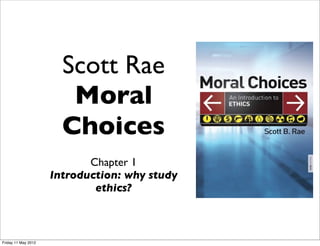
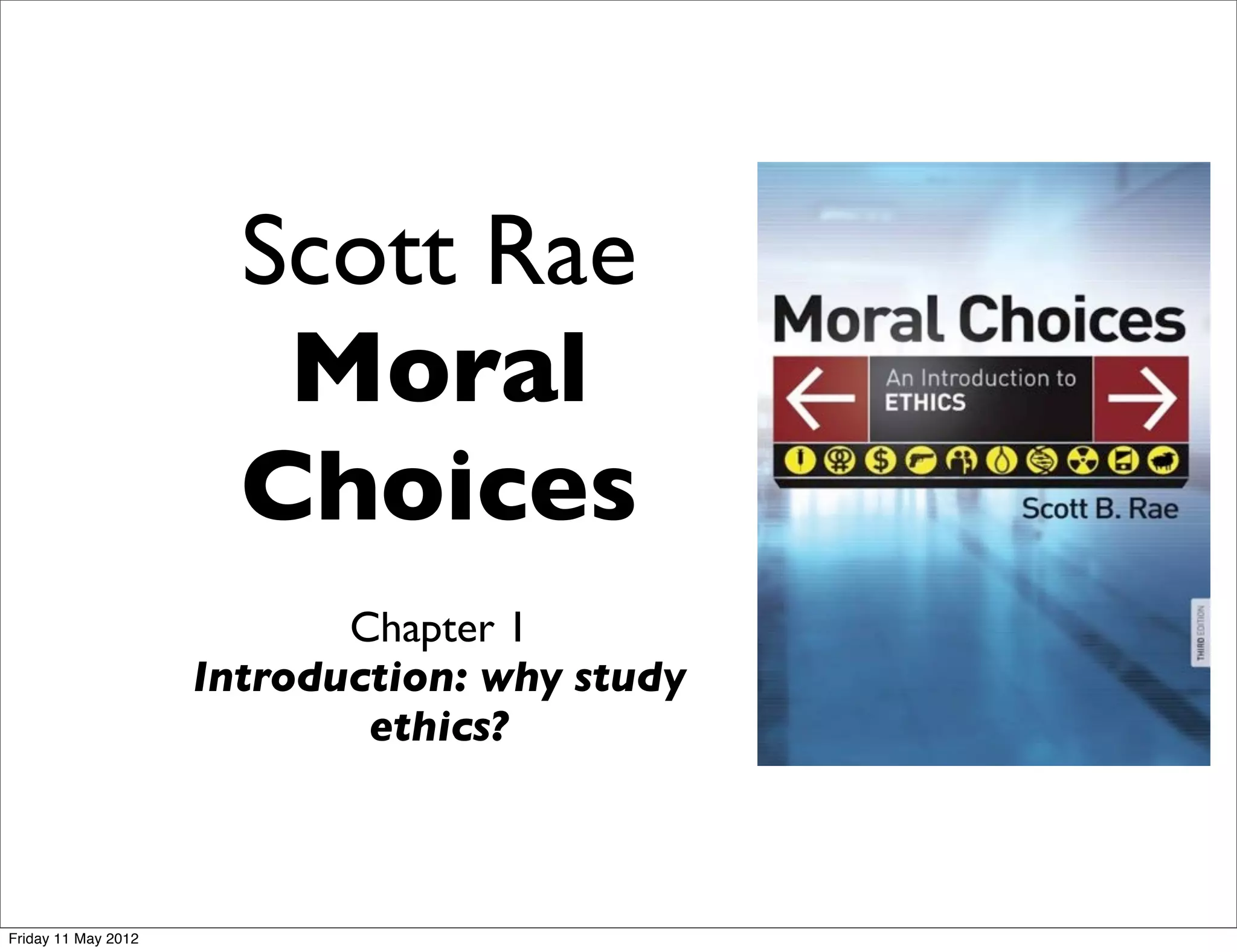
Scott Rae
                        Moral
                       Choices
                            Chapter 1
                     Introduction: why study
                             ethics?


Friday 11 May 2012
Why be moral?
 Websters dictionary has a
 number of definitions for moral
 including:
 - of or relating to principles of right
 and wrong in behavior
 - conforming to a standard of right
 behavior
 This is an important question for
 a course on ethics - is being
 moral important to you, why (or
 why not)?
 Most people think doing well in
 life is associated with being
 “good”
Friday 11 May 2012
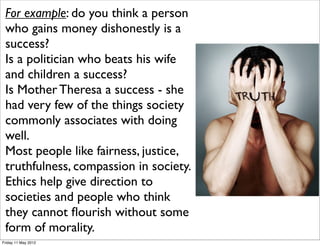
For example: do you think a person
 who gains money dishonestly is a
 success?
 Is a politician who beats his wife
 and children a success?
 Is Mother Theresa a success - she
 had very few of the things society
 commonly associates with doing
 well.
 Most people like fairness, justice,
 truthfulness, compassion in society.
 Ethics help give direction to
 societies and people who think
 they cannot flourish without some
 form of morality.
Friday 11 May 2012
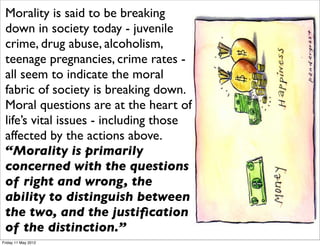
Morality is said to be breaking
 down in society today - juvenile
 crime, drug abuse, alcoholism,
 teenage pregnancies, crime rates -
 all seem to indicate the moral
 fabric of society is breaking down.
 Moral questions are at the heart of
 life’s vital issues - including those
 affected by the actions above.
 “Morality is primarily
 concerned with the questions
 of right and wrong, the
 ability to distinguish between
 the two, and the justification
 of the distinction.”
Friday 11 May 2012
Morality is said to be breaking
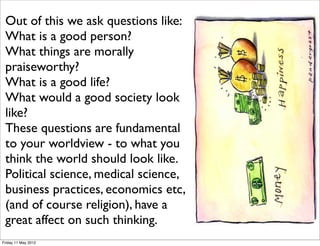
 Out of this we ask questions like:
 down in society today - juvenile
 What is a good person?
 crime, drug abuse, alcoholism,
 What things are morally
 teenage pregnancies, crime rates -
 praiseworthy?
 all seem to indicate the moral
 What is a good life?
 fabric of society is breaking down.
 What would a good society look
 Moral questions are at the heart of
 like?
 life’s vital issues - including those
 These questions are fundamental
 affected by the actions above.
 to your worldview - to what you
 “Morality is primarily
 think the world should look like.
 concerned with the questions
 Political science, medical science,
 of right and wrong, the
 business practices, economics etc,
 ability to distinguish between
 (and of course religion), have a
 the two, and the justification
 great affect on such thinking.
 of the distinction.”
Friday 11 May 2012
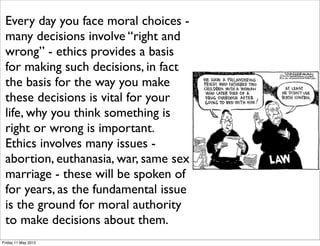
Every day you face moral choices -
 many decisions involve “right and
 wrong” - ethics provides a basis
 for making such decisions, in fact
 the basis for the way you make
 these decisions is vital for your
 life, why you think something is
 right or wrong is important.
 Ethics involves many issues -
 abortion, euthanasia, war, same sex
 marriage - these will be spoken of
 for years, as the fundamental issue
 is the ground for moral authority
 to make decisions about them.
Friday 11 May 2012
Every day you face moral choices -
 many decisions involve “right and
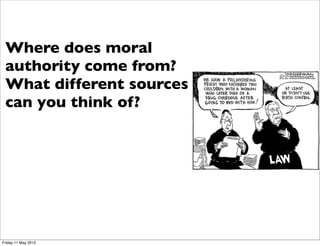
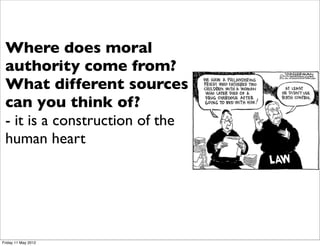
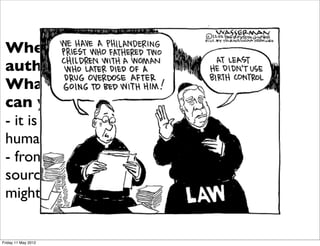
 Where does moral
 wrong” - ethics provides a basis
 authority come from?
 for making such decisions, in fact
 the basis different sources
 What for the way you make
 these you think of? your
 can    decisions is vital for
 life, why you think something is
 right or wrong is important.
 Ethics involves many issues -
 abortion, euthanasia, war, same sex
 marriage - these will be spoken of
 for years, as the fundamental issue
 is the ground for moral authority
 to make decisions about them.
Friday 11 May 2012
Every day you face moral choices -
 many decisions involve “right and
 Where does moral
 wrong” - ethics provides a basis
 authority come from?
 for making such decisions, in fact
 the basis different sources
 What for the way you make
 these you think of? your
 can    decisions is vital for
 life, why you think something is
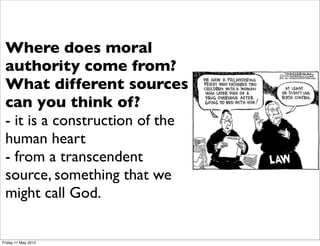
 - it is a wrong is important.the
 right or
           construction of
 human heartmany issues -
 Ethics involves
 abortion, euthanasia, war, same sex
 marriage - these will be spoken of
 for years, as the fundamental issue
 is the ground for moral authority
 to make decisions about them.
Friday 11 May 2012
Every day you face moral choices -
 many decisions involve “right and
 Where does moral
 wrong” - ethics provides a basis
 authority come from?
 for making such decisions, in fact
 the basis different sources
 What for the way you make
 these you think of? your
 can    decisions is vital for
 life, why you think something is
 - it is a wrong is important.the
 right or
           construction of
 human heartmany issues -
 Ethics involves
 - from aeuthanasia, war, same sex
 abortion, transcendent
 marriage somethingbe spoken of
 source, - these will that we
 for years, as God.
 might call    the fundamental issue
 is the ground for moral authority
 to make decisions about them.
Friday 11 May 2012
Every day you face moral choices -
 many decisions involve “right and
 Where does moral
 wrong” - ethics provides a basis
 authority come from?
 for making such decisions, in fact
 the basis different sources
 What for the way you make
 these you think of? your
 can    decisions is vital for
 life, why you think something is
 - it is a wrong is important.the
 right or
           construction of
 human heartmany issues -
 Ethics involves
 - from aeuthanasia, war, same sex
 abortion, transcendent
 marriage somethingbe spoken of
 source, - these will that we
 for years, as God.
 might call    the fundamental issue
 is the ground for moral authority
 to make decisions about them.
Friday 11 May 2012
The debate over these issues rages
 on and seems no closer to being
 resolved than 10 years ago. Now
 we increasingly add technology to
 the debate - the use of genetic
 testing for diseases, of stem cells
 for treatments. The need for moral
 parameters for their use is
 obvious, but making such decisions
 is hard as the issues are very
 complex.
 Values are taught and character
 emphasised more in some areas of
 society like education and
 business.
Friday 11 May 2012
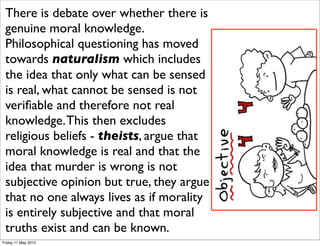
There is debate these issues there
 The debate overover whetherrages is
 genuine moral knowledge.
 on and seems no closer to being
 Philosophical 10 years ago. Now
 resolved than questioning has moved
 towards naturalism which includes
 we increasingly add technology to
 the debate - the use of genetic sensed
      idea that only what can be
 testing what cannot be stem cells not
 is real, for diseases, of sensed is
 for treatments. The need forreal
 verifiable and therefore not moral
 parameters Thistheir use is
 knowledge. for then excludes
 obvious, but making such decisions
 religious beliefs - theists, argue that
 is hardknowledge is real very that the
 moral as the issues are and
 complex. murder is wrong is not
 idea that
 Values are opinionand character argue
 subjective taught but true, they
 emphasised more in some areas of
 that no one always lives as if morality
 society like education and
 is entirely subjective and that moral
 business. and can be known.
 truths exist
Friday 11 May 2012
Introducing key terms and
                        distinctions in ethics
 “Morality refers to the actual
 content of right and wrong, and
 ethics refers to the process of
 determining right and wrong -
 morality deals with knowledge and
 ethics deals with reasoning.
 Ethics is therefore an art and a
 science - it involves some precision
 like sciences, but also it can be an
 inexact and intuitive discipline.
 Morality is the end of ethical
 deliberation - the determining of
 right and wrong.”
Friday 11 May 2012
Major categories


 Traditionally ethics has had four
 broad categories:
 1. Descriptive ethics
 A sociological discipline describing
 the morals of a society, often by
 studying other cultures. Often used
 by anthropologists in their field
 work describing the moral
 distinctives of other cultures.


Friday 11 May 2012
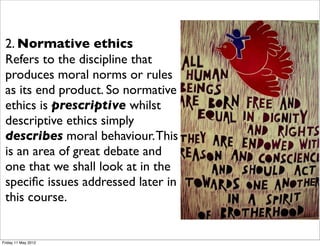
2. Normative ethics
 Refers to the discipline that
 produces moral norms or rules
 as its end product. So normative
 ethics is prescriptive whilst
 descriptive ethics simply
 describes moral behaviour. This
 is an area of great debate and
 one that we shall look at in the
 specific issues addressed later in
 this course.


Friday 11 May 2012
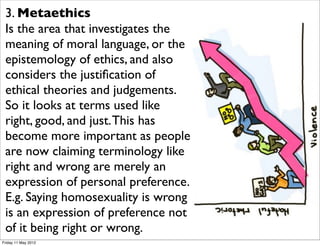
3. Metaethics
 Is the area that investigates the
 meaning of moral language, or the
 epistemology of ethics, and also
 considers the justification of
 ethical theories and judgements.
 So it looks at terms used like
 right, good, and just. This has
 become more important as people
 are now claiming terminology like
 right and wrong are merely an
 expression of personal preference.
 E.g. Saying homosexuality is wrong
 is an expression of preference not
 of it being right or wrong.
Friday 11 May 2012
4. Aretaic ethics
 Focusses on the virtues produced
 in individuals not on the morality
 of specific acts.it is also called
 virtue theory and is growing in
 popularity today. In seeing that
 there is more to a moral life than
 simply making the right decisions,
 many people believe that matters
 of virtue and character are of
 equal, if not greater, importance
 than the way we resolve moral
 dilemmas.

Friday 11 May 2012
Rae suggests four guidelines for
       making moral decisions:
       1. Consider the action itself -
       evaluate it before you judge it
       2. Evaluate the motive for the
       action - two identical actions can
       be taken for very differing reasons
       - what is the difference between a
       gift and a bribe?


Friday 11 May 2012
3. Evaluate the consequences of
  your decisions and actions - an action
  can be inherently wrong regardless of
  the consequences - you might benefit
  economically from slavery but that
  can never make it right
  4. Harder to do, is to evaluate the
  character of the moral actor
  (person doing the thing) - Rae defines
  character as “the tendency of a person
  to act in predictable ways over time”
  This removes ethics from being solely
  about actions - in fact we often judge
  character, e.g. who we trust
Friday 11 May 2012
Ethical systems

 Are classified as action-oriented
 or virtue-based. There are then 3
 categories within each classification:
 1. Deontological - based on
 principles in which actions (or
 character or intentions) are
 inherently right or wrong. Within
 this there are 3 deontological
 systems;
 a. Divine command theory
 b. Natural law
 c. Ethical rationalism
Friday 11 May 2012
Ethical systems


 Christians naturally tend to be more
 deontological as they look to the
 absolutes of the commands of God
 for moral absolutes and guiding
 principles. However there is also
 strong weight given to virtue based
 ethics as we value character, like the
 fruit of the Spirit


Friday 11 May 2012
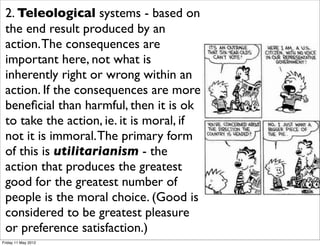
2. Teleological systems - based on
 the end result produced by an
 action. The consequences are
 important here, not what is
 inherently right or wrong within an
 action. If the consequences are more
 beneficial than harmful, then it is ok
 to take the action, ie. it is moral, if
 not it is immoral. The primary form
 of this is utilitarianism - the
 action that produces the greatest
 good for the greatest number of
 people is the moral choice. (Good is
 considered to be greatest pleasure
 or preference satisfaction.)
Friday 11 May 2012
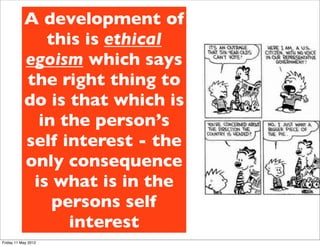
A development of
              this is ethical
           egoism which says
           the right thing to
           do is that which is
             in the person’s
           self interest - the
           only consequence
            is what is in the
               persons self
                 interest
Friday 11 May 2012
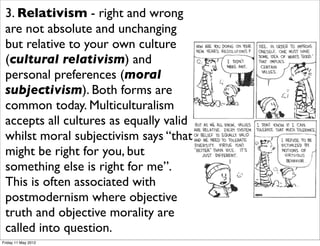
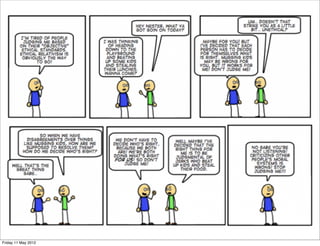
3. Relativism - right and wrong
 are not absolute and unchanging
 but relative to your own culture
 (cultural relativism) and
 personal preferences (moral
 subjectivism). Both forms are
 common today. Multiculturalism
 accepts all cultures as equally valid
 whilst moral subjectivism says “that
 might be right for you, but
 something else is right for me”.
 This is often associated with
 postmodernism where objective
 truth and objective morality are
 called into question.
Friday 11 May 2012
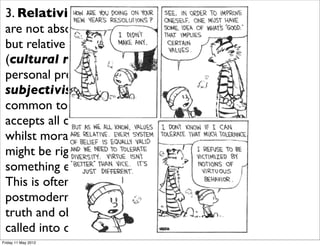
3. Relativism - right and wrong
 are not absolute and unchanging
 but relative to your own culture
 (cultural relativism) and
 personal preferences (moral
 subjectivism). Both forms are
 common today. Multiculturalism
 accepts all cultures as equally valid
 whilst moral subjectivism says “that
 might be right for you, but
 something else is right for me”.
 This is often associated with
 postmodernism where objective
 truth and objective morality are
 called into question.
Friday 11 May 2012
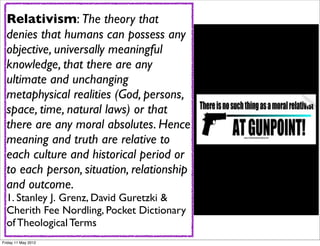
Relativism: The theory that
  Philosopher Peter Kreeft said
  denies that humans can possess any
  that"No culture in history has
  objective, universally meaningful
  ever embraced moral relativism
  knowledge, that there are any
  and survived."
  ultimate and unchanging
  What's the problem (God, persons,
  metaphysical realities with moral
  space, time, Greg Koukl gives 7
  relativism? natural laws) or that
  there are You Can't Do asHence
  Things       any moral absolutes. a
  meaning and truth are relative to
  Moral Relativist:
  each culture and historical period or
  Relativists Can’t situation, relationship
  to each person, Accuse Others of
  and outcome.
  Wrong-Doing
  1. Stanley J. Grenz, David Guretzki &
  Relativists Can’t Complain About the
  Cherith Fee Nordling, Pocket Dictionary
  Problem of Evil
  of Theological Terms
Friday 11 May 2012
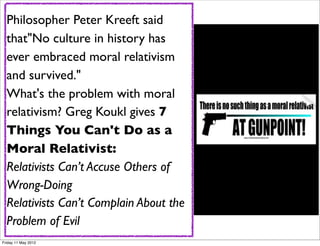
Philosopher Peter Kreeft said
  that"No culture in history has
  ever embraced moral relativism
  and survived."
  What's the problem with moral
  relativism? Greg Koukl gives 7
  Things You Can't Do as a
  Moral Relativist:
  Relativists Can’t Accuse Others of
  Wrong-Doing
  Relativists Can’t Complain About the
  Problem of Evil
Friday 11 May 2012
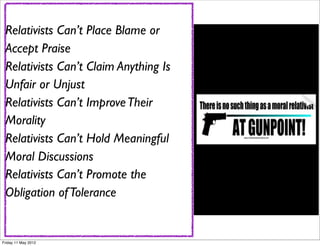
Relativists Can’t Place Blame or
 Accept Praise
 Relativists Can’t Claim Anything Is
 Unfair or Unjust
 Relativists Can’t Improve Their
 Morality
 Relativists Can’t Hold Meaningful
 Moral Discussions
 Relativists Can’t Promote the
 Obligation of Tolerance


Friday 11 May 2012
Friday 11 May 2012
Morality and the law

      There is a great area of overlapping between what is
      legal and what is moral. Laws about driving on one side
      of the road have an element of respect for people and
      property. Most people think valid laws hold to some
      common element of shared moral principles.


Friday 11 May 2012
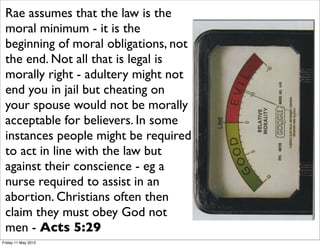
Rae assumes that the law is the
 moral minimum - it is the
 beginning of moral obligations, not
 the end. Not all that is legal is
 morally right - adultery might not
 end you in jail but cheating on
 your spouse would not be morally
 acceptable for believers. In some
 instances people might be required
 to act in line with the law but
 against their conscience - eg a
 nurse required to assist in an
 abortion. Christians often then
 claim they must obey God not
 men - Acts 5:29
Friday 11 May 2012
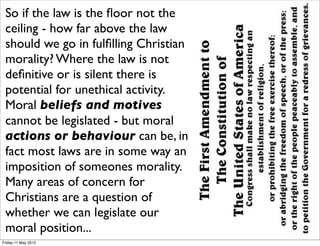
So if the law is the floor not the
 ceiling - how far above the law
 should we go in fulfilling Christian
 morality? Where the law is not
 definitive or is silent there is
 potential for unethical activity.
 Moral beliefs and motives
 cannot be legislated - but moral
 actions or behaviour can be, in
 fact most laws are in some way an
 imposition of someones morality.
 Many areas of concern for
 Christians are a question of
 whether we can legislate our
 moral position...
Friday 11 May 2012
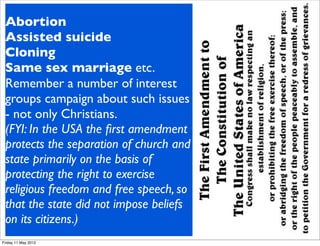
So if the law is the floor not the
 Abortion far above the law
 ceiling - how
 Assisted go in fulfilling Christian
               suicide
 should we
 CloningWhere the law is not
 morality?
 Same sex marriage etc.
 definitive or is silent there is
 Remember a unethicalof interest
 potential for    number activity.
 groupsbeliefs and motives
 Moral     campaign about such issues
 - not only Christians. but moral
 cannot be legislated -
 (FYI: In the USA the first amendment
 actions or behaviour can be, in
 protects the separation of church and
 fact most laws are in some way an
 state primarily on the basis of
 imposition of someones morality.
 protecting the right to exercise
 Many areas of concern for
 religious freedom and free speech, so
 Christians are a question of
 that the state did not impose beliefs
 whether we can legislate our
 on its citizens.)
 moral position...
Friday 11 May 2012
Review questions

 1. How are ethics important in
 business, politics and medicine?
 2. How would you distinguish
 between ethics and morality?
 3. What are descriptive, normative,
 metaethics and aretaic ethics?
 4. When a moral assessment is
 made what should be considered?
 5. How would you describe the
 relationship of morality and the law?
Friday 11 May 2012
Review questions

 1. How are ethics important in
 business, politics and medicine?
 2. How would you distinguish
 between ethics and morality?
 3. What are descriptive, normative,
 metaethics and aretaic ethics?
 4. When a moral assessment is
 made what should be considered?
 5. How would you describe the
 relationship of morality and the law?
Friday 11 May 2012

Rae, Moral Choices: Ch1 - why study ethics

  • 1.
    Scott Rae Moral Choices Chapter 1 Introduction: why study ethics? Friday 11 May 2012
  • 2.
    Why be moral? Websters dictionary has a number of definitions for moral including: - of or relating to principles of right and wrong in behavior - conforming to a standard of right behavior This is an important question for a course on ethics - is being moral important to you, why (or why not)? Most people think doing well in life is associated with being “good” Friday 11 May 2012
  • 3.
    For example: doyou think a person who gains money dishonestly is a success? Is a politician who beats his wife and children a success? Is Mother Theresa a success - she had very few of the things society commonly associates with doing well. Most people like fairness, justice, truthfulness, compassion in society. Ethics help give direction to societies and people who think they cannot flourish without some form of morality. Friday 11 May 2012
  • 4.
    Morality is saidto be breaking down in society today - juvenile crime, drug abuse, alcoholism, teenage pregnancies, crime rates - all seem to indicate the moral fabric of society is breaking down. Moral questions are at the heart of life’s vital issues - including those affected by the actions above. “Morality is primarily concerned with the questions of right and wrong, the ability to distinguish between the two, and the justification of the distinction.” Friday 11 May 2012
  • 5.
    Morality is saidto be breaking Out of this we ask questions like: down in society today - juvenile What is a good person? crime, drug abuse, alcoholism, What things are morally teenage pregnancies, crime rates - praiseworthy? all seem to indicate the moral What is a good life? fabric of society is breaking down. What would a good society look Moral questions are at the heart of like? life’s vital issues - including those These questions are fundamental affected by the actions above. to your worldview - to what you “Morality is primarily think the world should look like. concerned with the questions Political science, medical science, of right and wrong, the business practices, economics etc, ability to distinguish between (and of course religion), have a the two, and the justification great affect on such thinking. of the distinction.” Friday 11 May 2012
  • 6.
    Every day youface moral choices - many decisions involve “right and wrong” - ethics provides a basis for making such decisions, in fact the basis for the way you make these decisions is vital for your life, why you think something is right or wrong is important. Ethics involves many issues - abortion, euthanasia, war, same sex marriage - these will be spoken of for years, as the fundamental issue is the ground for moral authority to make decisions about them. Friday 11 May 2012
  • 7.
    Every day youface moral choices - many decisions involve “right and Where does moral wrong” - ethics provides a basis authority come from? for making such decisions, in fact the basis different sources What for the way you make these you think of? your can decisions is vital for life, why you think something is right or wrong is important. Ethics involves many issues - abortion, euthanasia, war, same sex marriage - these will be spoken of for years, as the fundamental issue is the ground for moral authority to make decisions about them. Friday 11 May 2012
  • 8.
    Every day youface moral choices - many decisions involve “right and Where does moral wrong” - ethics provides a basis authority come from? for making such decisions, in fact the basis different sources What for the way you make these you think of? your can decisions is vital for life, why you think something is - it is a wrong is important.the right or construction of human heartmany issues - Ethics involves abortion, euthanasia, war, same sex marriage - these will be spoken of for years, as the fundamental issue is the ground for moral authority to make decisions about them. Friday 11 May 2012
  • 9.
    Every day youface moral choices - many decisions involve “right and Where does moral wrong” - ethics provides a basis authority come from? for making such decisions, in fact the basis different sources What for the way you make these you think of? your can decisions is vital for life, why you think something is - it is a wrong is important.the right or construction of human heartmany issues - Ethics involves - from aeuthanasia, war, same sex abortion, transcendent marriage somethingbe spoken of source, - these will that we for years, as God. might call the fundamental issue is the ground for moral authority to make decisions about them. Friday 11 May 2012
  • 10.
    Every day youface moral choices - many decisions involve “right and Where does moral wrong” - ethics provides a basis authority come from? for making such decisions, in fact the basis different sources What for the way you make these you think of? your can decisions is vital for life, why you think something is - it is a wrong is important.the right or construction of human heartmany issues - Ethics involves - from aeuthanasia, war, same sex abortion, transcendent marriage somethingbe spoken of source, - these will that we for years, as God. might call the fundamental issue is the ground for moral authority to make decisions about them. Friday 11 May 2012
  • 11.
    The debate overthese issues rages on and seems no closer to being resolved than 10 years ago. Now we increasingly add technology to the debate - the use of genetic testing for diseases, of stem cells for treatments. The need for moral parameters for their use is obvious, but making such decisions is hard as the issues are very complex. Values are taught and character emphasised more in some areas of society like education and business. Friday 11 May 2012
  • 12.
    There is debatethese issues there The debate overover whetherrages is genuine moral knowledge. on and seems no closer to being Philosophical 10 years ago. Now resolved than questioning has moved towards naturalism which includes we increasingly add technology to the debate - the use of genetic sensed idea that only what can be testing what cannot be stem cells not is real, for diseases, of sensed is for treatments. The need forreal verifiable and therefore not moral parameters Thistheir use is knowledge. for then excludes obvious, but making such decisions religious beliefs - theists, argue that is hardknowledge is real very that the moral as the issues are and complex. murder is wrong is not idea that Values are opinionand character argue subjective taught but true, they emphasised more in some areas of that no one always lives as if morality society like education and is entirely subjective and that moral business. and can be known. truths exist Friday 11 May 2012
  • 13.
    Introducing key termsand distinctions in ethics “Morality refers to the actual content of right and wrong, and ethics refers to the process of determining right and wrong - morality deals with knowledge and ethics deals with reasoning. Ethics is therefore an art and a science - it involves some precision like sciences, but also it can be an inexact and intuitive discipline. Morality is the end of ethical deliberation - the determining of right and wrong.” Friday 11 May 2012
  • 14.
    Major categories Traditionallyethics has had four broad categories: 1. Descriptive ethics A sociological discipline describing the morals of a society, often by studying other cultures. Often used by anthropologists in their field work describing the moral distinctives of other cultures. Friday 11 May 2012
  • 15.
    2. Normative ethics Refers to the discipline that produces moral norms or rules as its end product. So normative ethics is prescriptive whilst descriptive ethics simply describes moral behaviour. This is an area of great debate and one that we shall look at in the specific issues addressed later in this course. Friday 11 May 2012
  • 16.
    3. Metaethics Isthe area that investigates the meaning of moral language, or the epistemology of ethics, and also considers the justification of ethical theories and judgements. So it looks at terms used like right, good, and just. This has become more important as people are now claiming terminology like right and wrong are merely an expression of personal preference. E.g. Saying homosexuality is wrong is an expression of preference not of it being right or wrong. Friday 11 May 2012
  • 17.
    4. Aretaic ethics Focusses on the virtues produced in individuals not on the morality of specific acts.it is also called virtue theory and is growing in popularity today. In seeing that there is more to a moral life than simply making the right decisions, many people believe that matters of virtue and character are of equal, if not greater, importance than the way we resolve moral dilemmas. Friday 11 May 2012
  • 18.
    Rae suggests fourguidelines for making moral decisions: 1. Consider the action itself - evaluate it before you judge it 2. Evaluate the motive for the action - two identical actions can be taken for very differing reasons - what is the difference between a gift and a bribe? Friday 11 May 2012
  • 19.
    3. Evaluate theconsequences of your decisions and actions - an action can be inherently wrong regardless of the consequences - you might benefit economically from slavery but that can never make it right 4. Harder to do, is to evaluate the character of the moral actor (person doing the thing) - Rae defines character as “the tendency of a person to act in predictable ways over time” This removes ethics from being solely about actions - in fact we often judge character, e.g. who we trust Friday 11 May 2012
  • 20.
    Ethical systems Areclassified as action-oriented or virtue-based. There are then 3 categories within each classification: 1. Deontological - based on principles in which actions (or character or intentions) are inherently right or wrong. Within this there are 3 deontological systems; a. Divine command theory b. Natural law c. Ethical rationalism Friday 11 May 2012
  • 21.
    Ethical systems Christiansnaturally tend to be more deontological as they look to the absolutes of the commands of God for moral absolutes and guiding principles. However there is also strong weight given to virtue based ethics as we value character, like the fruit of the Spirit Friday 11 May 2012
  • 22.
    2. Teleological systems- based on the end result produced by an action. The consequences are important here, not what is inherently right or wrong within an action. If the consequences are more beneficial than harmful, then it is ok to take the action, ie. it is moral, if not it is immoral. The primary form of this is utilitarianism - the action that produces the greatest good for the greatest number of people is the moral choice. (Good is considered to be greatest pleasure or preference satisfaction.) Friday 11 May 2012
  • 23.
    A development of this is ethical egoism which says the right thing to do is that which is in the person’s self interest - the only consequence is what is in the persons self interest Friday 11 May 2012
  • 24.
    3. Relativism -right and wrong are not absolute and unchanging but relative to your own culture (cultural relativism) and personal preferences (moral subjectivism). Both forms are common today. Multiculturalism accepts all cultures as equally valid whilst moral subjectivism says “that might be right for you, but something else is right for me”. This is often associated with postmodernism where objective truth and objective morality are called into question. Friday 11 May 2012
  • 25.
    3. Relativism -right and wrong are not absolute and unchanging but relative to your own culture (cultural relativism) and personal preferences (moral subjectivism). Both forms are common today. Multiculturalism accepts all cultures as equally valid whilst moral subjectivism says “that might be right for you, but something else is right for me”. This is often associated with postmodernism where objective truth and objective morality are called into question. Friday 11 May 2012
  • 26.
    Relativism: The theorythat Philosopher Peter Kreeft said denies that humans can possess any that"No culture in history has objective, universally meaningful ever embraced moral relativism knowledge, that there are any and survived." ultimate and unchanging What's the problem (God, persons, metaphysical realities with moral space, time, Greg Koukl gives 7 relativism? natural laws) or that there are You Can't Do asHence Things any moral absolutes. a meaning and truth are relative to Moral Relativist: each culture and historical period or Relativists Can’t situation, relationship to each person, Accuse Others of and outcome. Wrong-Doing 1. Stanley J. Grenz, David Guretzki & Relativists Can’t Complain About the Cherith Fee Nordling, Pocket Dictionary Problem of Evil of Theological Terms Friday 11 May 2012
  • 27.
    Philosopher Peter Kreeftsaid that"No culture in history has ever embraced moral relativism and survived." What's the problem with moral relativism? Greg Koukl gives 7 Things You Can't Do as a Moral Relativist: Relativists Can’t Accuse Others of Wrong-Doing Relativists Can’t Complain About the Problem of Evil Friday 11 May 2012
  • 28.
    Relativists Can’t PlaceBlame or Accept Praise Relativists Can’t Claim Anything Is Unfair or Unjust Relativists Can’t Improve Their Morality Relativists Can’t Hold Meaningful Moral Discussions Relativists Can’t Promote the Obligation of Tolerance Friday 11 May 2012
  • 29.
  • 30.
    Morality and thelaw There is a great area of overlapping between what is legal and what is moral. Laws about driving on one side of the road have an element of respect for people and property. Most people think valid laws hold to some common element of shared moral principles. Friday 11 May 2012
  • 31.
    Rae assumes thatthe law is the moral minimum - it is the beginning of moral obligations, not the end. Not all that is legal is morally right - adultery might not end you in jail but cheating on your spouse would not be morally acceptable for believers. In some instances people might be required to act in line with the law but against their conscience - eg a nurse required to assist in an abortion. Christians often then claim they must obey God not men - Acts 5:29 Friday 11 May 2012
  • 32.
    So if thelaw is the floor not the ceiling - how far above the law should we go in fulfilling Christian morality? Where the law is not definitive or is silent there is potential for unethical activity. Moral beliefs and motives cannot be legislated - but moral actions or behaviour can be, in fact most laws are in some way an imposition of someones morality. Many areas of concern for Christians are a question of whether we can legislate our moral position... Friday 11 May 2012
  • 33.
    So if thelaw is the floor not the Abortion far above the law ceiling - how Assisted go in fulfilling Christian suicide should we CloningWhere the law is not morality? Same sex marriage etc. definitive or is silent there is Remember a unethicalof interest potential for number activity. groupsbeliefs and motives Moral campaign about such issues - not only Christians. but moral cannot be legislated - (FYI: In the USA the first amendment actions or behaviour can be, in protects the separation of church and fact most laws are in some way an state primarily on the basis of imposition of someones morality. protecting the right to exercise Many areas of concern for religious freedom and free speech, so Christians are a question of that the state did not impose beliefs whether we can legislate our on its citizens.) moral position... Friday 11 May 2012
  • 34.
    Review questions 1.How are ethics important in business, politics and medicine? 2. How would you distinguish between ethics and morality? 3. What are descriptive, normative, metaethics and aretaic ethics? 4. When a moral assessment is made what should be considered? 5. How would you describe the relationship of morality and the law? Friday 11 May 2012
  • 35.
    Review questions 1.How are ethics important in business, politics and medicine? 2. How would you distinguish between ethics and morality? 3. What are descriptive, normative, metaethics and aretaic ethics? 4. When a moral assessment is made what should be considered? 5. How would you describe the relationship of morality and the law? Friday 11 May 2012