Applied Research Collaborations
and Pilot Projects
- March 26, 2012
     Phoenix, Arizona
Working Group Members
•   Bob Boscamp, Strategic Solar Energy
•   Justin Elliott, RehNu
•   Mayor Kenny Evans, Town of Payson
•   Deborah Galbraith, Town of Payson
•   Michael Neary – AriSEIA
•   Brian Quinn, RehNu
•   Anne Reichman, ASU, Sustainable Cities Network
•   Jerry Witt – CVH Power
•   Jennifer Woolwich, PV Recycling
•   Co-Chairs AZ Solar Summit ARCPP Working Group
    Ardeth Barnhart – University of Arizona
    Sayfe Kiaei – Arizona State University
Background
• Integrate Solar Energy into Multiple Sectors:
  residential, commercial, industrial and utility-
  scale systems through:
   – Explorations of innovative technologies
   – Integration and testing of technology and systems
   – Development of real-world applications
• Outcome:
   – Arizona as a center for advanced R&D testing,
     evaluation and manufacturing
      • for integrated solar energy technology systems at all scales
      • sustainable solar energy solutions for hot/arid regions
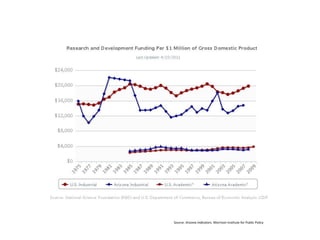
Source: Arizona Indicators. Morrison Institute for Public Policy
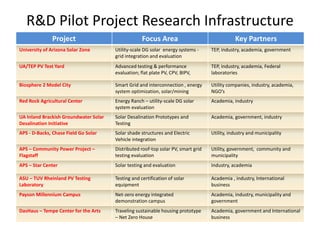
R&D Pilot Project Research Infrastructure
              Project                               Focus Area                                Key Partners
University of Arizona Solar Zone       Utility-scale DG solar energy systems -     TEP, industry, academia, government
                                       grid integration and evaluation
UA/TEP PV Test Yard                    Advanced testing & performance              TEP, industry, academia, Federal
                                       evaluation; flat plate PV, CPV, BIPV,       laboratories

Biosphere 2 Model City                 Smart Grid and interconnection , energy     Utility companies, industry, academia,
                                       system optimization, solar/mining           NGO’s
Red Rock Agricultural Center           Energy Ranch – utility-scale DG solar       Academia, industry
                                       system evaluation
UA Inland Brackish Groundwater Solar   Solar Desalination Prototypes and           Academia, government, industry
Desalination Initiative                Testing
APS - D-Backs, Chase Field Go Solar    Solar shade structures and Electric         Utility, industry and municipality
                                       Vehicle integration
APS – Community Power Project –        Distributed roof-top solar PV, smart grid   Utility, government, community and
Flagstaff                              testing evaluation                          municipality
APS – Star Center                      Solar testing and evaluation                Industry, academia

ASU – TUV Rheinland PV Testing         Testing and certification of solar          Academia , industry, International
Laboratory                             equipment                                   business
Payson Millennium Campus               Net-zero energy integrated                  Academia, industry, municipality and
                                       demonstration campus                        government
DasHaus – Tempe Center for the Arts    Traveling sustainable housing prototype     Academia, government and International
                                       – Net Zero House                            business
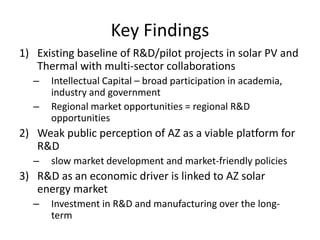
Key Findings
1) Existing baseline of R&D/pilot projects in solar PV and
   Thermal with multi-sector collaborations
  –   Intellectual Capital – broad participation in academia,
      industry and government
  –   Regional market opportunities = regional R&D
      opportunities
2) Weak public perception of AZ as a viable platform for
   R&D
  –   slow market development and market-friendly policies
3) R&D as an economic driver is linked to AZ solar
   energy market
  –   Investment in R&D and manufacturing over the long-
      term
Objectives
• Develop a long-term strategy for R&D that will
  establish research, development and
  manufacturing of solar energy technologies as a
  sustainably viable option for the environmental
  and economic future of Arizona.
• It is based upon an integrated approach to
  provide specific environments for collaboration
  between public and private organizations to
  optimize investment, testing and assessment, and
  training and communication.
Strategic Areas for R&D
•   Cross-cutting, enabling technologies
    »   Electrical management and performance of PV
        systems (BOS)
    »   System-level integration and optimization with
        storage
    »   Resource modeling and prediction
    »   Life-cycle assessment, operations and
        maintenance optimization
    »   Accelerated testing and reliability
        standardization
    »   Green building and energy management
    »   Materials and other innovations for energy
        efficiency
    »   Distributed generation systems – solar/battery,
        solar/water treatment
•   Research and Demonstration
    Infrastructure
    »   Database of performance criteria and output
        for solar energy
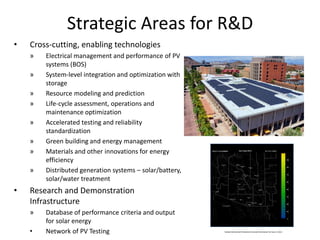
    •   Network of PV Testing                             Global Horizontal Irradiance Forecast Animation for July 5, 2011
Strategic Areas for R&D
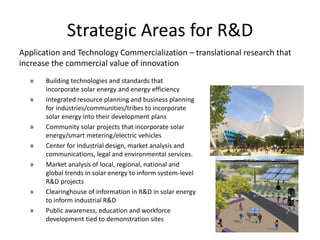
Application and Technology Commercialization – translational research that
increase the commercial value of innovation
  »    Building technologies and standards that
       incorporate solar energy and energy efficiency
  »    Integrated resource planning and business planning
       for industries/communities/tribes to incorporate
       solar energy into their development plans
  »    Community solar projects that incorporate solar
       energy/smart metering/electric vehicles
  »    Center for industrial design, market analysis and
       communications, legal and environmental services.
  »    Market analysis of local, regional, national and
       global trends in solar energy to inform system-level
       R&D projects
  »    Clearinghouse of information in R&D in solar energy
       to inform industrial R&D
  »    Public awareness, education and workforce
       development tied to demonstration sites
Recommendation #1
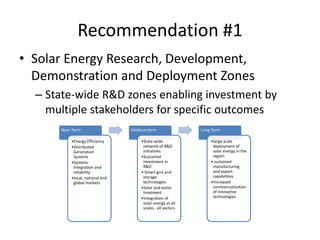
• Solar Energy Research, Development,
  Demonstration and Deployment Zones
  – State-wide R&D zones enabling investment by
    multiple stakeholders for specific outcomes
      Near-Term                  Medium-term                 Long-Term

          •Energy Efficiency         •State-wide                 •large-scale
          •Distributed                network of R&D              deployment of
           Generation                 initiatives                 solar energy in the
           Systems                   •Sustained                   region
          •Systems                    investment in              • sustained
           integration and            R&D                         manufacturing
           reliability               • Smart-grid and             and export
          •local, national and        storage                     capabilities
           global markets             technologies               •Increased
                                     •Solar and water             commercialization
                                      treatment                   of innovative
                                     •Integration of              technologies
                                      solar energy at all
                                      scales , all sectors
Recommendation #2
                  State-wide Innovation Initiative
   – Solar Energy Research Infrastructure
• Provide broad research capabilities through private and public
  partnerships
   – Reduce development costs and time
   – Mitigate technology risks – investors
• Applied R&D for solar energy
• Develop policy and infrastructure for deployment by industry
   –   Oversight and responsibilities for outcomes of the Roadmap
   –   Represents multiple stakeholders
   –   Identify best practices
   –   Promote collaborative R&D, shared costs and benefits
   –   Consensus on standards
   –   Specialized and shared facilities to carry-out advanced R&D collaboration
   –   Connects organizations with common research needs
   –   Develop cost/share strategies
   –   Navigates the complexity of the PV value chain and confidentiality/IP
Next Steps
• Enhance participation in the working group to
  better define the R&D strategy and roadmap
  for solar energy

Applied Research Collaborations and Pilot Projects

  • 1.
    Applied Research Collaborations andPilot Projects - March 26, 2012 Phoenix, Arizona
  • 2.
    Working Group Members • Bob Boscamp, Strategic Solar Energy • Justin Elliott, RehNu • Mayor Kenny Evans, Town of Payson • Deborah Galbraith, Town of Payson • Michael Neary – AriSEIA • Brian Quinn, RehNu • Anne Reichman, ASU, Sustainable Cities Network • Jerry Witt – CVH Power • Jennifer Woolwich, PV Recycling • Co-Chairs AZ Solar Summit ARCPP Working Group Ardeth Barnhart – University of Arizona Sayfe Kiaei – Arizona State University
  • 3.
    Background • Integrate SolarEnergy into Multiple Sectors: residential, commercial, industrial and utility- scale systems through: – Explorations of innovative technologies – Integration and testing of technology and systems – Development of real-world applications • Outcome: – Arizona as a center for advanced R&D testing, evaluation and manufacturing • for integrated solar energy technology systems at all scales • sustainable solar energy solutions for hot/arid regions
  • 4.
    Source: Arizona Indicators.Morrison Institute for Public Policy
  • 5.
    R&D Pilot ProjectResearch Infrastructure Project Focus Area Key Partners University of Arizona Solar Zone Utility-scale DG solar energy systems - TEP, industry, academia, government grid integration and evaluation UA/TEP PV Test Yard Advanced testing & performance TEP, industry, academia, Federal evaluation; flat plate PV, CPV, BIPV, laboratories Biosphere 2 Model City Smart Grid and interconnection , energy Utility companies, industry, academia, system optimization, solar/mining NGO’s Red Rock Agricultural Center Energy Ranch – utility-scale DG solar Academia, industry system evaluation UA Inland Brackish Groundwater Solar Solar Desalination Prototypes and Academia, government, industry Desalination Initiative Testing APS - D-Backs, Chase Field Go Solar Solar shade structures and Electric Utility, industry and municipality Vehicle integration APS – Community Power Project – Distributed roof-top solar PV, smart grid Utility, government, community and Flagstaff testing evaluation municipality APS – Star Center Solar testing and evaluation Industry, academia ASU – TUV Rheinland PV Testing Testing and certification of solar Academia , industry, International Laboratory equipment business Payson Millennium Campus Net-zero energy integrated Academia, industry, municipality and demonstration campus government DasHaus – Tempe Center for the Arts Traveling sustainable housing prototype Academia, government and International – Net Zero House business
  • 6.
    Key Findings 1) Existingbaseline of R&D/pilot projects in solar PV and Thermal with multi-sector collaborations – Intellectual Capital – broad participation in academia, industry and government – Regional market opportunities = regional R&D opportunities 2) Weak public perception of AZ as a viable platform for R&D – slow market development and market-friendly policies 3) R&D as an economic driver is linked to AZ solar energy market – Investment in R&D and manufacturing over the long- term
  • 7.
    Objectives • Develop along-term strategy for R&D that will establish research, development and manufacturing of solar energy technologies as a sustainably viable option for the environmental and economic future of Arizona. • It is based upon an integrated approach to provide specific environments for collaboration between public and private organizations to optimize investment, testing and assessment, and training and communication.
  • 8.
    Strategic Areas forR&D • Cross-cutting, enabling technologies » Electrical management and performance of PV systems (BOS) » System-level integration and optimization with storage » Resource modeling and prediction » Life-cycle assessment, operations and maintenance optimization » Accelerated testing and reliability standardization » Green building and energy management » Materials and other innovations for energy efficiency » Distributed generation systems – solar/battery, solar/water treatment • Research and Demonstration Infrastructure » Database of performance criteria and output for solar energy • Network of PV Testing Global Horizontal Irradiance Forecast Animation for July 5, 2011
  • 9.
    Strategic Areas forR&D Application and Technology Commercialization – translational research that increase the commercial value of innovation » Building technologies and standards that incorporate solar energy and energy efficiency » Integrated resource planning and business planning for industries/communities/tribes to incorporate solar energy into their development plans » Community solar projects that incorporate solar energy/smart metering/electric vehicles » Center for industrial design, market analysis and communications, legal and environmental services. » Market analysis of local, regional, national and global trends in solar energy to inform system-level R&D projects » Clearinghouse of information in R&D in solar energy to inform industrial R&D » Public awareness, education and workforce development tied to demonstration sites
  • 10.
    Recommendation #1 • SolarEnergy Research, Development, Demonstration and Deployment Zones – State-wide R&D zones enabling investment by multiple stakeholders for specific outcomes Near-Term Medium-term Long-Term •Energy Efficiency •State-wide •large-scale •Distributed network of R&D deployment of Generation initiatives solar energy in the Systems •Sustained region •Systems investment in • sustained integration and R&D manufacturing reliability • Smart-grid and and export •local, national and storage capabilities global markets technologies •Increased •Solar and water commercialization treatment of innovative •Integration of technologies solar energy at all scales , all sectors
  • 11.
    Recommendation #2 State-wide Innovation Initiative – Solar Energy Research Infrastructure • Provide broad research capabilities through private and public partnerships – Reduce development costs and time – Mitigate technology risks – investors • Applied R&D for solar energy • Develop policy and infrastructure for deployment by industry – Oversight and responsibilities for outcomes of the Roadmap – Represents multiple stakeholders – Identify best practices – Promote collaborative R&D, shared costs and benefits – Consensus on standards – Specialized and shared facilities to carry-out advanced R&D collaboration – Connects organizations with common research needs – Develop cost/share strategies – Navigates the complexity of the PV value chain and confidentiality/IP
  • 12.
    Next Steps • Enhanceparticipation in the working group to better define the R&D strategy and roadmap for solar energy