Ethics: Discovering Right and Wrong Louis J.  Pojman and James Fieser Seventh Edition
Chapter One: What is Ethics? What is it to be a moral person? What is the nature of morality? Why do we need morality? What function does morality play? How do I know what is the good?
What is Ethics? Are moral principles absolute? Are moral principles relative to social groups or individual decisions? Is morality only in the view of the person being moral? Is there a time for me to act immorally? How can I justify my moral beliefs?
What  is Ethics? What is the basis of morality? Which ethical theory best justifies and explains moral life? What is morality’s relationship with religion? law? social etiquette?
“ Moral” vs. “Ethical” Terms “moral” and “ethical” are often used interchangeably but both derive their meaning from the idea of “custom” The term “moral” comes from the Latin (meaning “mores”) and the Greek (meaning “ethos”)
“ Morality”  refers to Certain Customs Certain Precepts Certain Practices of Peoples and Cultures Positive or Descriptive Morality:  is used to describe actual beliefs and customs of a culture
“ Moral Philosophy” Refers to philosophical or theoretical reflection on morality Your author terms these theories “ Ethical Theories” These theories come from moral philosophical reflections.
“ Ethics” Refers to the whole domain of morality and moral philosophy Both areas are connected by common concerns in different ways through: Values, Virtues, Principles And Practices
Ethics and its Subdivisions (1) Descriptive morality (2) Moral philosophy (ethical theory) (3) Applied ethics
(1)Descriptive Morality Refers to actual beliefs, customs, principles, and practices of people and cultures. Example: Sociologists pay attention to moral practices of social groups and treat them as cultural “facts”
The systematic effort to understand moral concepts and justify moral principles and theories. Moral Philosophy analyzes key ethical  concepts such as “right”, “wrong”,  and “permissible”. (2) Moral Philosophy
(2) Moral Philosophy Explores possible sources of moral obligation such as God, human reason, or the desire to be happy Seeks to establish principles of right behavior that may serve as action  guides for individuals and groups
(3) Applied Ethics Deals with controversial moral problems such as abortion, premarital sex, capital punishment, euthanasia, and civil disobedience
Morality as Compared with Other Normative Subjects Morality has a distinct action-guiding, or  normative , aspect which is also shared with other practices such as religion, law and etiquette. Morality differs from religion, law and etiquette.
Morality and Religion Moral behavior is usually essential to religion’s practice Neither the practices nor principles of morality should be identified with religion Practice of morality need not be motivated by religious considerations Moral principles need not be grounded in revelation or divine authority
Morality and Religion Religious ethics grounded in revelation or divine authority Ethics is characterized by its grounding in reason and human experience Some versions of religious ethics hold that reason can discover what is right or wrong even apart from divine revelation
Morality and Law Many laws are instituted in order to: promote well-being resolve conflicts of interest promote social harmony
Morality and Law Morality also does all of these three. Ethics may judge that some laws are immoral without denying that they have legal authority
Law and Morality Differ Some aspects of morality are not covered by law, ie. Lying in general Intention  plays a role in determining legal character of an act, once the act has been committed but bad intentions themselves are not illegal but can be immoral
Morality and Etiquette Etiquette determines what is  polite  behavior Morality determines what is  right  behavior in a deeper sense To disregard or defy etiquette in some cases can be considered immoral
Limitations of Religion, Law, & Etiquette Religion –Rests on authority that may lack certainty or agreement on authority credentials or how authority would rule in new cases. Reason may not be able to persuade. Law – Every social ill cannot have a law and not all rules can be enforced Etiquette – Does not go to the heart of what is important for existence
Traits of Moral Principles Central to morality are moral principles which have have these five traits: Prescriptivity Universalizability Overridingness Publicity Practicability
Prescriptivity The practical or action-guiding, nature of morality. Moral principles generally put forth as commands or imperatives Intended for use: to advise and influence action Used to appraise behavior, assign praise and blame, and produce feelings of satisfaction or guilt
Universalizability Moral principles must apply to all people who are in a relevantly similar situation. Exemplified in the Golden Rule Applies to all evaluative judgments. An extension of the  principle of consistentcy
Overridingness Moral principles have predominant authority and override other kinds of principles Take precedence over considerations including aesthetic, prudential, and legal ones Religion is a special case where a command may override a normal moral rule
Publicity Moral Principles must be made public in order to guide our actions Necessary because principles are used to prescribe behavior, give advice, and assign praise and blame Keeping a moral principle secret would be self-defeating
Practicability A Moral Principle must be workable and its rules must not lay a heavy burden on us when we follow them Rules must take human limitations into consideration so as to prevent moral despair, deep or undue moral guilt, and ineffective action
Domains of Ethical Assessment Most ethical analysis falls into one or more of the following domains: Action Consequences Character Motive
Action Actions are usually termed right or wrong. ‘ Right’ can be an ambiguous term. Right  can mean Obligatory or Permissible
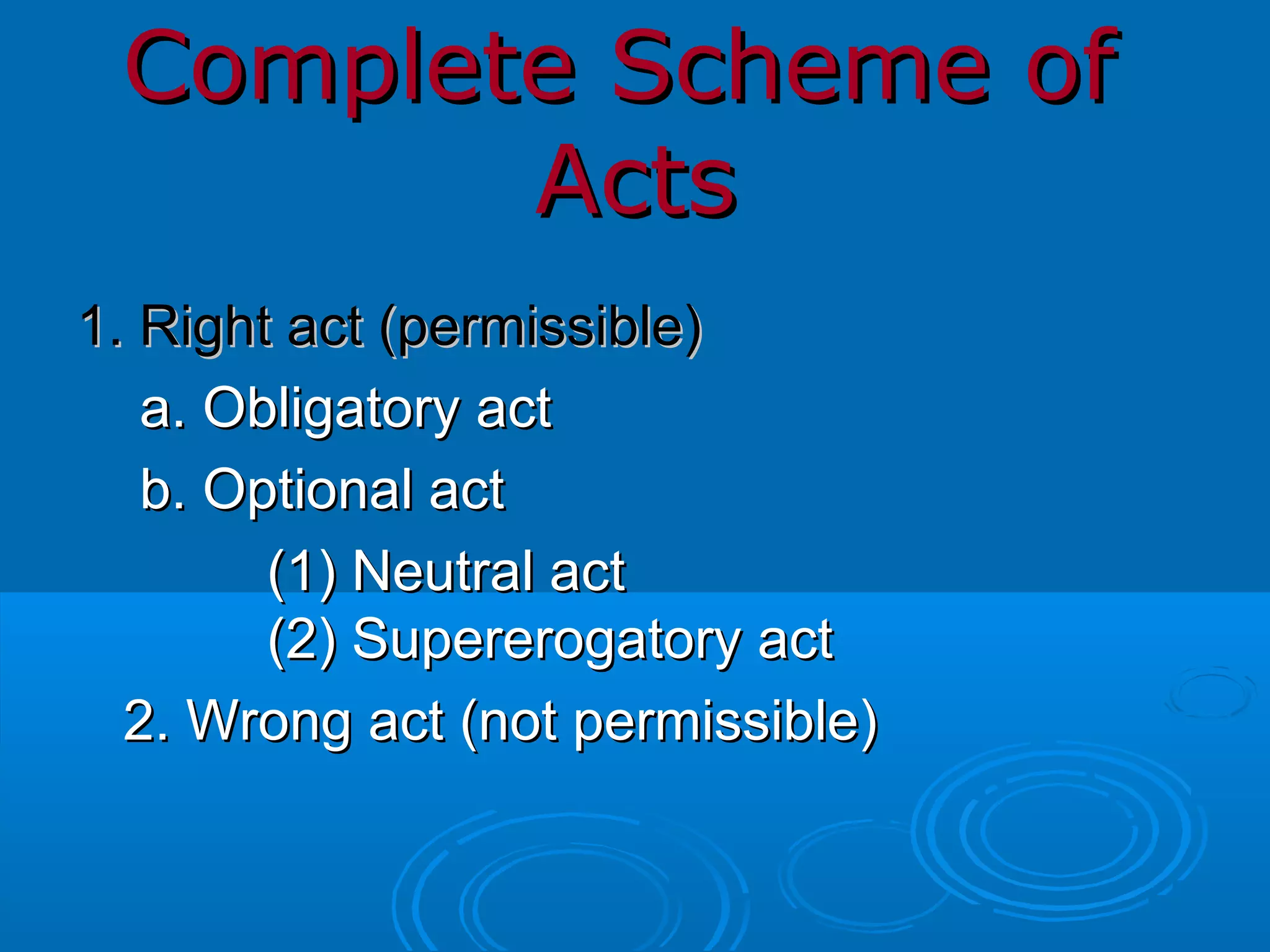
Right Action 1. A  right act  is an act that is permissible for you to do.  It may be either: a.  An  obligatory act  –  is one that morality requires you to do; it is not permissible for you to refrain from doing it b.  An   optional act   – An act not obligatory or wrong to do; not your duty to do or not to do
Wrong Action 2.  A  wrong act  is one you have an obligation, or a duty, to refrain from doing: It is an act you ought not to do; it is not permissible to do it.
Supererogatory Acts These actions are within the range of permissible acts. Also known as highly altruistic acts. These acts are neither required nor obligatory They exceed what morality requires. They go beyond ‘the call of duty.’
Complete Scheme of  Acts 1. Right act (permissible) a. Obligatory act b. Optional act (1) Neutral act (2) Supererogatory act 2. Wrong act (not permissible)
Deontological Theories Emphasize the nature of the act Some acts are inherently good or right and some acts are inherently wrong or bad Kant defended a principle of moral duty he calls the categorical imperative Deontological theories have in common the view that we have an inherent duty to perform right actions and avoid bad actions
Consequences Actions based on the foreseeable outcome of a course of decision Ethical theories that focus primarily on consequences in determining moral rightness or wrongness are called:  Teleological Ethics Utilitarianism is the most famous of these and requires us to do what is likeliest to have the best consequences
Character Ethical theories that emphasize  character , or virtue are  virtue theories Good character traits are  virtues Bad character traits are  vices Aristotle maintained that the development of virtuous character traits is needed to ensure that we habitually act rightly Vital to empower our character with the tendency to do good
Motive Ethically assess situations by examining the motive of the people involved Virtually all ethical systems recognize the importance of motives For a full assessment of any action it is important to take the agent's motive into account Seemingly identical acts may differ morally due to a difference of motives
Conclusion Ethics has enormous practical benefits: Can free us from prejudice and dogmatism Has comprehensive systems from which to orient individual judgments Helps us to think more clearly about moral problems Shows how principles and values relate to one another Gives us some guidance in how to live
Answering Initial Questions What is the nature of morality, and why do we need it? What is the good, and how will I know it? Is it in my interest to be moral? What is the relationship between: morality and religion? morality and the law? morality and etiquette?

Chapter 1

  • 1.
    Ethics: Discovering Rightand Wrong Louis J. Pojman and James Fieser Seventh Edition
  • 2.
    Chapter One: Whatis Ethics? What is it to be a moral person? What is the nature of morality? Why do we need morality? What function does morality play? How do I know what is the good?
  • 3.
    What is Ethics?Are moral principles absolute? Are moral principles relative to social groups or individual decisions? Is morality only in the view of the person being moral? Is there a time for me to act immorally? How can I justify my moral beliefs?
  • 4.
    What isEthics? What is the basis of morality? Which ethical theory best justifies and explains moral life? What is morality’s relationship with religion? law? social etiquette?
  • 5.
    “ Moral” vs.“Ethical” Terms “moral” and “ethical” are often used interchangeably but both derive their meaning from the idea of “custom” The term “moral” comes from the Latin (meaning “mores”) and the Greek (meaning “ethos”)
  • 6.
    “ Morality” refers to Certain Customs Certain Precepts Certain Practices of Peoples and Cultures Positive or Descriptive Morality: is used to describe actual beliefs and customs of a culture
  • 7.
    “ Moral Philosophy”Refers to philosophical or theoretical reflection on morality Your author terms these theories “ Ethical Theories” These theories come from moral philosophical reflections.
  • 8.
    “ Ethics” Refersto the whole domain of morality and moral philosophy Both areas are connected by common concerns in different ways through: Values, Virtues, Principles And Practices
  • 9.
    Ethics and itsSubdivisions (1) Descriptive morality (2) Moral philosophy (ethical theory) (3) Applied ethics
  • 10.
    (1)Descriptive Morality Refersto actual beliefs, customs, principles, and practices of people and cultures. Example: Sociologists pay attention to moral practices of social groups and treat them as cultural “facts”
  • 11.
    The systematic effortto understand moral concepts and justify moral principles and theories. Moral Philosophy analyzes key ethical concepts such as “right”, “wrong”, and “permissible”. (2) Moral Philosophy
  • 12.
    (2) Moral PhilosophyExplores possible sources of moral obligation such as God, human reason, or the desire to be happy Seeks to establish principles of right behavior that may serve as action guides for individuals and groups
  • 13.
    (3) Applied EthicsDeals with controversial moral problems such as abortion, premarital sex, capital punishment, euthanasia, and civil disobedience
  • 14.
    Morality as Comparedwith Other Normative Subjects Morality has a distinct action-guiding, or normative , aspect which is also shared with other practices such as religion, law and etiquette. Morality differs from religion, law and etiquette.
  • 15.
    Morality and ReligionMoral behavior is usually essential to religion’s practice Neither the practices nor principles of morality should be identified with religion Practice of morality need not be motivated by religious considerations Moral principles need not be grounded in revelation or divine authority
  • 16.
    Morality and ReligionReligious ethics grounded in revelation or divine authority Ethics is characterized by its grounding in reason and human experience Some versions of religious ethics hold that reason can discover what is right or wrong even apart from divine revelation
  • 17.
    Morality and LawMany laws are instituted in order to: promote well-being resolve conflicts of interest promote social harmony
  • 18.
    Morality and LawMorality also does all of these three. Ethics may judge that some laws are immoral without denying that they have legal authority
  • 19.
    Law and MoralityDiffer Some aspects of morality are not covered by law, ie. Lying in general Intention plays a role in determining legal character of an act, once the act has been committed but bad intentions themselves are not illegal but can be immoral
  • 20.
    Morality and EtiquetteEtiquette determines what is polite behavior Morality determines what is right behavior in a deeper sense To disregard or defy etiquette in some cases can be considered immoral
  • 21.
    Limitations of Religion,Law, & Etiquette Religion –Rests on authority that may lack certainty or agreement on authority credentials or how authority would rule in new cases. Reason may not be able to persuade. Law – Every social ill cannot have a law and not all rules can be enforced Etiquette – Does not go to the heart of what is important for existence
  • 22.
    Traits of MoralPrinciples Central to morality are moral principles which have have these five traits: Prescriptivity Universalizability Overridingness Publicity Practicability
  • 23.
    Prescriptivity The practicalor action-guiding, nature of morality. Moral principles generally put forth as commands or imperatives Intended for use: to advise and influence action Used to appraise behavior, assign praise and blame, and produce feelings of satisfaction or guilt
  • 24.
    Universalizability Moral principlesmust apply to all people who are in a relevantly similar situation. Exemplified in the Golden Rule Applies to all evaluative judgments. An extension of the principle of consistentcy
  • 25.
    Overridingness Moral principleshave predominant authority and override other kinds of principles Take precedence over considerations including aesthetic, prudential, and legal ones Religion is a special case where a command may override a normal moral rule
  • 26.
    Publicity Moral Principlesmust be made public in order to guide our actions Necessary because principles are used to prescribe behavior, give advice, and assign praise and blame Keeping a moral principle secret would be self-defeating
  • 27.
    Practicability A MoralPrinciple must be workable and its rules must not lay a heavy burden on us when we follow them Rules must take human limitations into consideration so as to prevent moral despair, deep or undue moral guilt, and ineffective action
  • 28.
    Domains of EthicalAssessment Most ethical analysis falls into one or more of the following domains: Action Consequences Character Motive
  • 29.
    Action Actions areusually termed right or wrong. ‘ Right’ can be an ambiguous term. Right can mean Obligatory or Permissible
  • 30.
    Right Action 1.A right act is an act that is permissible for you to do. It may be either: a. An obligatory act – is one that morality requires you to do; it is not permissible for you to refrain from doing it b. An optional act – An act not obligatory or wrong to do; not your duty to do or not to do
  • 31.
    Wrong Action 2. A wrong act is one you have an obligation, or a duty, to refrain from doing: It is an act you ought not to do; it is not permissible to do it.
  • 32.
    Supererogatory Acts Theseactions are within the range of permissible acts. Also known as highly altruistic acts. These acts are neither required nor obligatory They exceed what morality requires. They go beyond ‘the call of duty.’
  • 33.
    Complete Scheme of Acts 1. Right act (permissible) a. Obligatory act b. Optional act (1) Neutral act (2) Supererogatory act 2. Wrong act (not permissible)
  • 34.
    Deontological Theories Emphasizethe nature of the act Some acts are inherently good or right and some acts are inherently wrong or bad Kant defended a principle of moral duty he calls the categorical imperative Deontological theories have in common the view that we have an inherent duty to perform right actions and avoid bad actions
  • 35.
    Consequences Actions basedon the foreseeable outcome of a course of decision Ethical theories that focus primarily on consequences in determining moral rightness or wrongness are called: Teleological Ethics Utilitarianism is the most famous of these and requires us to do what is likeliest to have the best consequences
  • 36.
    Character Ethical theoriesthat emphasize character , or virtue are virtue theories Good character traits are virtues Bad character traits are vices Aristotle maintained that the development of virtuous character traits is needed to ensure that we habitually act rightly Vital to empower our character with the tendency to do good
  • 37.
    Motive Ethically assesssituations by examining the motive of the people involved Virtually all ethical systems recognize the importance of motives For a full assessment of any action it is important to take the agent's motive into account Seemingly identical acts may differ morally due to a difference of motives
  • 38.
    Conclusion Ethics hasenormous practical benefits: Can free us from prejudice and dogmatism Has comprehensive systems from which to orient individual judgments Helps us to think more clearly about moral problems Shows how principles and values relate to one another Gives us some guidance in how to live
  • 39.
    Answering Initial QuestionsWhat is the nature of morality, and why do we need it? What is the good, and how will I know it? Is it in my interest to be moral? What is the relationship between: morality and religion? morality and the law? morality and etiquette?

Editor's Notes

  • #3 These are the questions posed by the author in the introductory Chapter One.
  • #16 Religious and Secular ethics have two different orientations which often generate different moral principles and evaluation standings. However, they need not do this. Both religious and secular ethics can and do agree.
  • #17 Religious and Secular ethics have two different orientations which often generate different moral principles and evaluation standings. However, they need not do this. Both religious and secular ethics can and do agree.
  • #19 Some aspects of morality are not covered by law. For example: There is no general law against lying except in certain situations like perjury when one is under oath in a court of law.
  • #20 English law of 1351 against treason made it a crime to think about killing the king, but there was no way the law could enforce or fathom a person’s thoughts or intent. Morality can hold an individual responsible for their intent and a person can suffer punishment for their intent even if they never commit the action.
  • #21 Social etiquette deals with the customs people in each culture habitually use and term acceptable. These behaviors help our society to flow smoothly. None of the social rituals claim any moral superiority over another. However, once a social custom is adopted, the practice of that custom appears as a moral rule that defers respect to all people in that society. Not obeying the social customs could be termed in some cases immoral by society.
  • #26 Moral principles must have authority to take precedence over other considerations and have the hegemonic authority to do so at any time.
  • #27 It is necessary for moral principles to be made public so that they are known by all, used and known to prescribe behavior in society, can be used to give advice, and can be used to assign praise or blame.
  • #29 The rules of right conduct are evaluated and from this decisions are made.
  • #31 In the optional act, if you did it or did not do it, neither would be wrong.
  • #39 “ State of Nature” according to Hobbes means that people in society are insecure because they have reason to fear one another due to the fact of human equality and ability to harm one another and our human desire to fulfill our personal goals. Hobbes emphasized that humans create a ‘social contract or covenant’ and agree to give up personal liberty in order to set up rules over us that we know we must obey. These rules we agree are to be enforced by the might of the ruler or the state. Where there is no enforceable law, there is neither right or wrong, justice or injustice.
  • #40 Rules formed over time become internalized and hopefully hold us back from violent animal impulse and responses.