Introduction To Ethics
Ed Horowicz
1
 To gain an understanding of the concept of ethics.
 Introduction to contrasting theoretical ethical approaches.
 Introduction to the application and scope of BIOETHICS.
 Introduction to key bioethical principles.
 To gain a basic understanding of the relationship between
ethics and law in healthcare.
 Gain an understanding of how ethics relates to
professional practice.
2
Objectives
 Ethics is the concept of interpreting morality.
 How should we behave?
 What choices should we make about how we live our
lives?
 What do we consider acceptable in our society?
However!!!
3
What is Ethics?
 Religions
 Intuitive Feelings
 Cultural Norms
 Laws and Policies
 Professional Codes of Conduct
 Coercion
4
What Factors Affect How We Find
Answers?
 Looks beyond intuition and the ‘unquestionable
notion’ of influential factors.
 Critical evaluation of ethical arguments in order to
come to a conclusion based on reason.
 Considered as a discipline of moral philosophy
supported by sociology, theology, law, anthropology
and economics.
5
The Academic Discipline of Ethics
 “Ethics is the enterprise of disciplined
reflection on the moral intuitions and
moral choices that people make”
(Veatch, 1989, p1).
6
 Should termination of pregnancy be
morally permissible?
 You will have strong feelings over whether this is
ethically acceptable.
 A ‘gut feeling’ based on many influences.
 Through a critically evaluative approach you can move
beyond this to provide a reasoned argument and
rationale for rejecting an alternative position through
the study of ethics.
7
Consider…
 Consequentialism looks at whether an action is
ethically right or wrong by the consequences it
produces.
 If we are faced with two courses of action then we
should choose the one with the best overall
consequences.
 Considered the ‘common sense’ approach but we
have to consider what is the best or a good overall
consequence. Who decides?
 What happens when we do not know what the
consequences will be? 8
Consequentialism V Deontology
Consequentialism
 Utilitarianism is a consequentialist approach which
looks at human happiness.
 The action that leads to the greatest amount of
human happiness is the preferred action.
 Consider resource allocation-
Should we give one person a very expensive treatment
or fund treatment for twenty other people?
Should we open one more ITU bed or two HDU beds?
9
Consequentialism-Utilitarianism
 Deontology- Holds that certain things are right or
wrong regardless of the consequences.
 Eg- Telling the truth may cause happiness or upset but
is considered the right thing to do.
 Often deontological principles are absolute rights and
fundamental principles, for example the ECHR.
 Key principle is that you cannot justify the breach of a
fundamental or absolute principal just by the
consequences.
10
Consequentialism V Deontology
Deontology
 Virtue Ethics considers the moral character of the
person performing the act.
 This approach is not concerned with the consequence
or whether the act is carried out in accordance with
moral duties.
 What matters is whether the person carrying out the
act does so in accordance with qualities that are
considered to be virtuous, in other words good moral
intentions.
11
Virtue Ethics
 Identify the basic consequentialist and deontological
approaches to the following scenario;
 A twelve year old requires a bone marrow transplant
for any chance of survival but the only compatible
match is a thirty year old male who is in prison for
violent offences and refuses to donate his bone
marrow.
12
Task
 Bioethics is the investigation of ethical issues that arise in
life sciences by applying moral philosophy principles.
Bioethics covers;
 Medicine
 Healthcare
 Genetics
 Biology
 Research
 Pharmacology
13
Bioethics
 Bioethics is a form of applied ethics. Contemporary
issues include;
 Abortion
 Euthanasia
 Cloning
 Stem Cell Research
 Xenotransplantation
 Genetic Engineering for ‘designer babies’
14
Bioethics
 Beauchamp and Childress (2008) describe four
principles that should be applied for bioethical issues.
 Autonomy
 Beneficence
 Non-maleficence
 Justice
15
Key Bioethical Principles
 What does autonomy mean?
 There is no single definition of autonomy.
 Broadly it is the recognised fundamental right that a
person has to self-determination with respect to
choices they make.
 In summary Harris defines it as,
“a form of ‘self government’, where a person should be
able to control their own lives, including their own bodies,
by exercise of their own faculties”(Harris, 1985, at p195).
16
Autonomy
 Respect for autonomy does present us with ethical
dilemmas.
 What if a decision will cause harm?
 What if that person is mentally incompetent to make
a decision?
 How autonomous should children be?
17
Autonomy
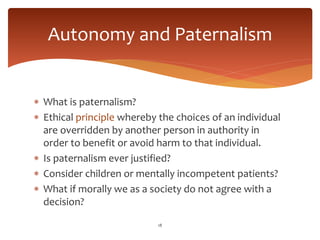
 What is paternalism?
 Ethical principle whereby the choices of an individual
are overridden by another person in authority in
order to benefit or avoid harm to that individual.
 Is paternalism ever justified?
 Consider children or mentally incompetent patients?
 What if morally we as a society do not agree with a
decision?
18
Autonomy and Paternalism
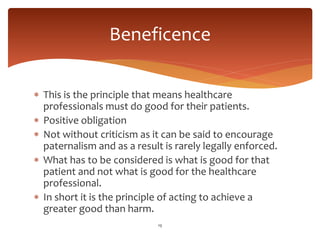
 This is the principle that means healthcare
professionals must do good for their patients.
 Positive obligation
 Not without criticism as it can be said to encourage
paternalism and as a result is rarely legally enforced.
 What has to be considered is what is good for that
patient and not what is good for the healthcare
professional.
 In short it is the principle of acting to achieve a
greater good than harm.
19
Beneficence
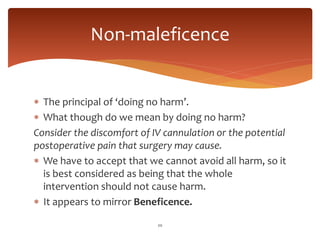
 The principal of ‘doing no harm’.
 What though do we mean by doing no harm?
Consider the discomfort of IV cannulation or the potential
postoperative pain that surgery may cause.
 We have to accept that we cannot avoid all harm, so it
is best considered as being that the whole
intervention should not cause harm.
 It appears to mirror Beneficence.
20
Non-maleficence
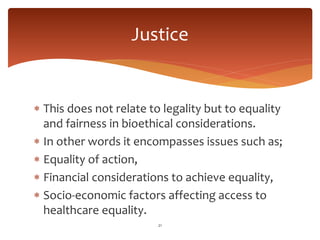
 This does not relate to legality but to equality
and fairness in bioethical considerations.
 In other words it encompasses issues such as;
 Equality of action,
 Financial considerations to achieve equality,
 Socio-economic factors affecting access to
healthcare equality.
21
Justice
 The study of bioethics affects how healthcare evolves
and is delivered.
 Healthcare, medicine and research are regulated by
law. Consider the consequences of research without
ethics in the second world war.
 Often the outcome of medical advancement can be
unknown.
 It is essential to recognise that law and bioethics are
not always a reflection of each other.
22
Relationship Between Law and
Bioethics
 Simply because something is illegal does not
always mean it is morally wrong.
 Consider the arguments for euthanasia.
 Likewise, because something is legal does not
mean that it is morally right.
 Consider the opposition arguments to abortion
and cosmetic surgery
23
Law and Bioethics
 Why are ethics part of professional practice?
 Professional codes of conduct exist as a result of the
ethical and legal duties and responsibilities expected
of practitioners.
 Through ethically reasoned argument we establish
what is considered right and a positive obligation, or
what is considered wrong and prohibited.
 Provides a moral standard that patients and staff can
expect from us.
24
Ethics and Professional Practice
 How do the principals of bioethics apply to advocacy
within your role as an ODP?
 Autonomy
 Beneficence
 Non-maleficence
 Justice
25
Task
?
26
Questions
 Beauchamp.T. and Childress.J. Principles of Biomedical
Ethics. 2009. 6th Edition. Oxford: Oxford University
Press.
 Harris.J. (Ed). 2001. Bioethics. Oxford: Oxford
University Press.
 Mason.J. and Laurie.G. 2013. 13th Edition. Law and
Medical Ethics. Oxford: Oxford University Press.
 Pattinson.S. 2011. 12th Edition. Medical Law and Ethics.
London: Sweet and Maxwell.
 Veatch.R. 1989. Medical Ethics. New York: Jones and
Bartlett.
27
References

Introduction to Healthcare Ethics

  • 1.
  • 2.
     To gainan understanding of the concept of ethics.  Introduction to contrasting theoretical ethical approaches.  Introduction to the application and scope of BIOETHICS.  Introduction to key bioethical principles.  To gain a basic understanding of the relationship between ethics and law in healthcare.  Gain an understanding of how ethics relates to professional practice. 2 Objectives
  • 3.
     Ethics isthe concept of interpreting morality.  How should we behave?  What choices should we make about how we live our lives?  What do we consider acceptable in our society? However!!! 3 What is Ethics?
  • 4.
     Religions  IntuitiveFeelings  Cultural Norms  Laws and Policies  Professional Codes of Conduct  Coercion 4 What Factors Affect How We Find Answers?
  • 5.
     Looks beyondintuition and the ‘unquestionable notion’ of influential factors.  Critical evaluation of ethical arguments in order to come to a conclusion based on reason.  Considered as a discipline of moral philosophy supported by sociology, theology, law, anthropology and economics. 5 The Academic Discipline of Ethics
  • 6.
     “Ethics isthe enterprise of disciplined reflection on the moral intuitions and moral choices that people make” (Veatch, 1989, p1). 6
  • 7.
     Should terminationof pregnancy be morally permissible?  You will have strong feelings over whether this is ethically acceptable.  A ‘gut feeling’ based on many influences.  Through a critically evaluative approach you can move beyond this to provide a reasoned argument and rationale for rejecting an alternative position through the study of ethics. 7 Consider…
  • 8.
     Consequentialism looksat whether an action is ethically right or wrong by the consequences it produces.  If we are faced with two courses of action then we should choose the one with the best overall consequences.  Considered the ‘common sense’ approach but we have to consider what is the best or a good overall consequence. Who decides?  What happens when we do not know what the consequences will be? 8 Consequentialism V Deontology Consequentialism
  • 9.
     Utilitarianism isa consequentialist approach which looks at human happiness.  The action that leads to the greatest amount of human happiness is the preferred action.  Consider resource allocation- Should we give one person a very expensive treatment or fund treatment for twenty other people? Should we open one more ITU bed or two HDU beds? 9 Consequentialism-Utilitarianism
  • 10.
     Deontology- Holdsthat certain things are right or wrong regardless of the consequences.  Eg- Telling the truth may cause happiness or upset but is considered the right thing to do.  Often deontological principles are absolute rights and fundamental principles, for example the ECHR.  Key principle is that you cannot justify the breach of a fundamental or absolute principal just by the consequences. 10 Consequentialism V Deontology Deontology
  • 11.
     Virtue Ethicsconsiders the moral character of the person performing the act.  This approach is not concerned with the consequence or whether the act is carried out in accordance with moral duties.  What matters is whether the person carrying out the act does so in accordance with qualities that are considered to be virtuous, in other words good moral intentions. 11 Virtue Ethics
  • 12.
     Identify thebasic consequentialist and deontological approaches to the following scenario;  A twelve year old requires a bone marrow transplant for any chance of survival but the only compatible match is a thirty year old male who is in prison for violent offences and refuses to donate his bone marrow. 12 Task
  • 13.
     Bioethics isthe investigation of ethical issues that arise in life sciences by applying moral philosophy principles. Bioethics covers;  Medicine  Healthcare  Genetics  Biology  Research  Pharmacology 13 Bioethics
  • 14.
     Bioethics isa form of applied ethics. Contemporary issues include;  Abortion  Euthanasia  Cloning  Stem Cell Research  Xenotransplantation  Genetic Engineering for ‘designer babies’ 14 Bioethics
  • 15.
     Beauchamp andChildress (2008) describe four principles that should be applied for bioethical issues.  Autonomy  Beneficence  Non-maleficence  Justice 15 Key Bioethical Principles
  • 16.
     What doesautonomy mean?  There is no single definition of autonomy.  Broadly it is the recognised fundamental right that a person has to self-determination with respect to choices they make.  In summary Harris defines it as, “a form of ‘self government’, where a person should be able to control their own lives, including their own bodies, by exercise of their own faculties”(Harris, 1985, at p195). 16 Autonomy
  • 17.
     Respect forautonomy does present us with ethical dilemmas.  What if a decision will cause harm?  What if that person is mentally incompetent to make a decision?  How autonomous should children be? 17 Autonomy
  • 18.
     What ispaternalism?  Ethical principle whereby the choices of an individual are overridden by another person in authority in order to benefit or avoid harm to that individual.  Is paternalism ever justified?  Consider children or mentally incompetent patients?  What if morally we as a society do not agree with a decision? 18 Autonomy and Paternalism
  • 19.
     This isthe principle that means healthcare professionals must do good for their patients.  Positive obligation  Not without criticism as it can be said to encourage paternalism and as a result is rarely legally enforced.  What has to be considered is what is good for that patient and not what is good for the healthcare professional.  In short it is the principle of acting to achieve a greater good than harm. 19 Beneficence
  • 20.
     The principalof ‘doing no harm’.  What though do we mean by doing no harm? Consider the discomfort of IV cannulation or the potential postoperative pain that surgery may cause.  We have to accept that we cannot avoid all harm, so it is best considered as being that the whole intervention should not cause harm.  It appears to mirror Beneficence. 20 Non-maleficence
  • 21.
     This doesnot relate to legality but to equality and fairness in bioethical considerations.  In other words it encompasses issues such as;  Equality of action,  Financial considerations to achieve equality,  Socio-economic factors affecting access to healthcare equality. 21 Justice
  • 22.
     The studyof bioethics affects how healthcare evolves and is delivered.  Healthcare, medicine and research are regulated by law. Consider the consequences of research without ethics in the second world war.  Often the outcome of medical advancement can be unknown.  It is essential to recognise that law and bioethics are not always a reflection of each other. 22 Relationship Between Law and Bioethics
  • 23.
     Simply becausesomething is illegal does not always mean it is morally wrong.  Consider the arguments for euthanasia.  Likewise, because something is legal does not mean that it is morally right.  Consider the opposition arguments to abortion and cosmetic surgery 23 Law and Bioethics
  • 24.
     Why areethics part of professional practice?  Professional codes of conduct exist as a result of the ethical and legal duties and responsibilities expected of practitioners.  Through ethically reasoned argument we establish what is considered right and a positive obligation, or what is considered wrong and prohibited.  Provides a moral standard that patients and staff can expect from us. 24 Ethics and Professional Practice
  • 25.
     How dothe principals of bioethics apply to advocacy within your role as an ODP?  Autonomy  Beneficence  Non-maleficence  Justice 25 Task
  • 26.
  • 27.
     Beauchamp.T. andChildress.J. Principles of Biomedical Ethics. 2009. 6th Edition. Oxford: Oxford University Press.  Harris.J. (Ed). 2001. Bioethics. Oxford: Oxford University Press.  Mason.J. and Laurie.G. 2013. 13th Edition. Law and Medical Ethics. Oxford: Oxford University Press.  Pattinson.S. 2011. 12th Edition. Medical Law and Ethics. London: Sweet and Maxwell.  Veatch.R. 1989. Medical Ethics. New York: Jones and Bartlett. 27 References