RADIOPHARMACEUTICALS
Alan Mathew
3rd year BSc MIT
Moderator : Omkar Gaonkar
10/10/2022
CONTENTS
• RADIOPHARMACEUTICALS
• EQUIPMENTS
• TRACER COMPARTMENTS ANDTRANSPORT
• COLD KITS
• TYPES &PREPARATION OFTECHENTIUM KITS
• IDEAL RADIOPHARMACEUTICAL
• REFERENCES
RADIOPHARMACEUTICALS
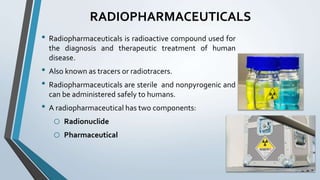
• Radiopharmaceuticals is radioactive compound used for
the diagnosis and therapeutic treatment of human
disease.
• Also known as tracers or radiotracers.
• Radiopharmaceuticals are sterile and nonpyrogenic and
can be administered safely to humans.
• A radiopharmaceutical has two components:
o Radionuclide
o Pharmaceutical
EQUIPMENTS
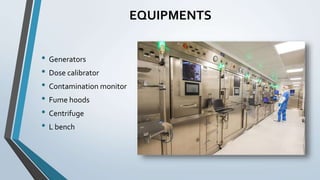
• Generators
• Dose calibrator
• Contamination monitor
• Fume hoods
• Centrifuge
• L bench
GENERATORS
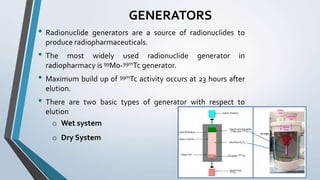
• Radionuclide generators are a source of radionuclides to
produce radiopharmaceuticals.
• The most widely used radionuclide generator in
radiopharmacy is 99Mo-99mTc generator.
• Maximum build up of 99mTc activity occurs at 23 hours after
elution.
• There are two basic types of generator with respect to
elution
o Wet system
o Dry System
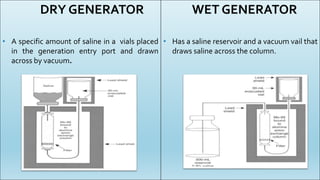
DRY GENERATOR
• A specific amount of saline in a vials placed
in the generation entry port and drawn
across by vacuum.
WET GENERATOR
• Has a saline reservoir and a vacuum vail that
draws saline across the column.
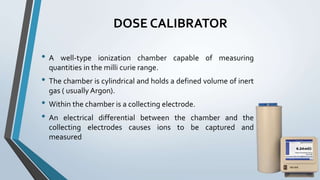
DOSE CALIBRATOR
• A well-type ionization chamber capable of measuring
quantities in the milli curie range.
• The chamber is cylindrical and holds a defined volume of inert
gas ( usually Argon).
• Within the chamber is a collecting electrode.
• An electrical differential between the chamber and the
collecting electrodes causes ions to be captured and
measured
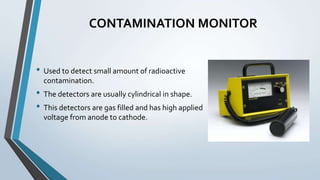
CONTAMINATION MONITOR
• Used to detect small amount of radioactive
contamination.
• The detectors are usually cylindrical in shape.
• This detectors are gas filled and has high applied
voltage from anode to cathode.
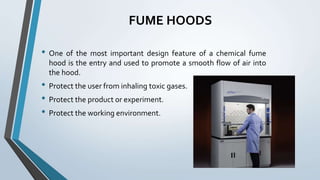
FUME HOODS
• One of the most important design feature of a chemical fume
hood is the entry and used to promote a smooth flow of air into
the hood.
• Protect the user from inhaling toxic gases.
• Protect the product or experiment.
• Protect the working environment.
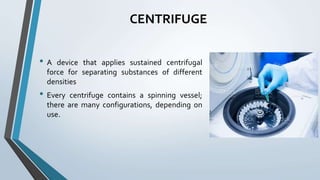
CENTRIFUGE
• A device that applies sustained centrifugal
force for separating substances of different
densities
• Every centrifuge contains a spinning vessel;
there are many configurations, depending on
use.
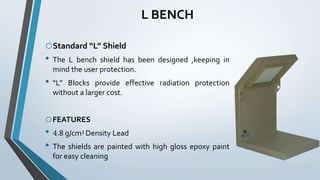
L BENCH
oStandard “L” Shield
• The L bench shield has been designed ,keeping in
mind the user protection.
• “L” Blocks provide effective radiation protection
without a larger cost.
oFEATURES
• 4.8 g/cm3 Density Lead
• The shields are painted with high gloss epoxy paint
for easy cleaning
TRACER COMPARTMENTS ANDTRANSPORT
• Tracer is a substance that follows a physiologic or
biochemical process.
• A compartment is a volume or space within which
the tracer rapidly becomes uniformly distributed
• Specific requirements for an ideal tracer
i. Behavior of tracer should be identical to the
physiological process
ii. Mass of tracer should not alter the physiological
process being studied
TRANSPORT
• Two mechanism exist for the transport of substances across a membrane or
capillary wall
1. Active transport
2. Passive transport
ACTIVE TRANSPORT – Energy requires to move substances against
concentration gradient.
PASSIVE TRANSPORT – Transport of molecules across the membrane
through a concentration gradient without use of cellular energy
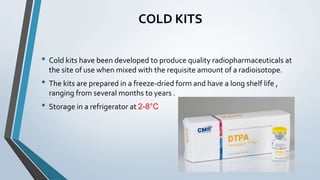
COLD KITS
• Cold kits have been developed to produce quality radiopharmaceuticals at
the site of use when mixed with the requisite amount of a radioisotope.
• The kits are prepared in a freeze-dried form and have a long shelf life ,
ranging from several months to years .
• Storage in a refrigerator at 2-8°C
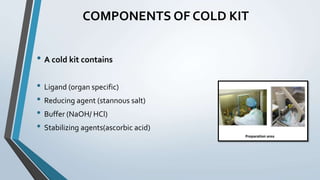
COMPONENTS OF COLD KIT
• A cold kit contains
• Ligand (organ specific)
• Reducing agent (stannous salt)
• Buffer (NaOH/ HCl)
• Stabilizing agents(ascorbic acid)
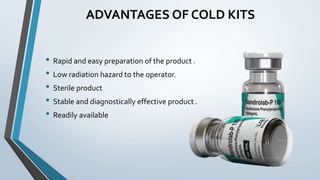
ADVANTAGES OF COLD KITS
• Rapid and easy preparation of the product .
• Low radiation hazard to the operator.
• Sterile product
• Stable and diagnostically effective product .
• Readily available
TYPES &PREPARATION
OFTECHENTIUM KITS
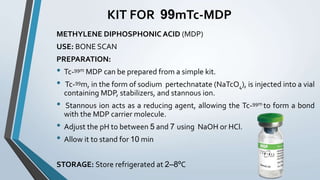
METHYLENE DIPHOSPHONIC ACID (MDP)
USE: BONE SCAN
PREPARATION:
• Tc-99m MDP can be prepared from a simple kit.
• Tc-99m, in the form of sodium pertechnatate (NaTcO4), is injected into a vial
containing MDP, stabilizers, and stannous ion.
• Stannous ion acts as a reducing agent, allowing the Tc-99m to form a bond
with the MDP carrier molecule.
• Adjust the pH to between 5 and 7 using NaOH or HCl.
• Allow it to stand for 10 min
STORAGE: Store refrigerated at 2–8ºC
KIT FOR 99mTc-MDP
KIT FOR 99mTc- DTPA
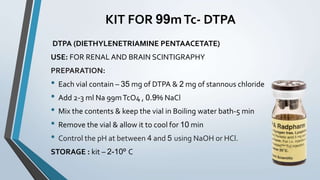
DTPA (DIETHYLENETRIAMINE PENTAACETATE)
USE: FOR RENAL AND BRAIN SCINTIGRAPHY
PREPARATION:
• Each vial contain – 35 mg of DTPA & 2 mg of stannous chloride
• Add 2-3 ml Na 99mTcO4 , 0.9% NaCl
• Mix the contents & keep the vial in Boiling water bath-5 min
• Remove the vial & allow it to cool for 10 min
• Control the pH at between 4 and 5 using NaOH or HCl.
STORAGE : kit – 2-10º C
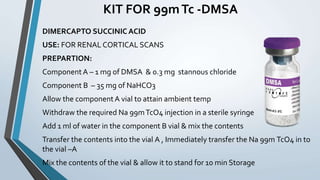
KIT FOR 99mTc -DMSA
DIMERCAPTO SUCCINIC ACID
USE: FOR RENAL CORTICAL SCANS
PREPARTION:
Component A – 1 mg of DMSA & 0.3 mg stannous chloride
Component B – 35 mg of NaHCO3
Allow the componentA vial to attain ambient temp
Withdraw the required Na 99mTcO4 injection in a sterile syringe
Add 1 ml of water in the component B vial & mix the contents
Transfer the contents into the vial A , Immediately transfer the Na 99m TcO4 in to
the vial –A
Mix the contents of the vial & allow it to stand for 10 min Storage
KIT FOR [Tc]-BRIDA
BROMO-IMINODIACETIC ACID[Tc]-BRIDA
USE: STUDY OF LIVER &GALLBLADDER
PREPARTION:
• 20–30 mCi of TcO4 prepared in 1 ml of 0.9% saline
and introduced into the BRIDA kit
• Shaken and kept at room temperature for 30 min.
• The pH of the reconstituted product is 4.2 to 5.7
STORAGE : 2-80C
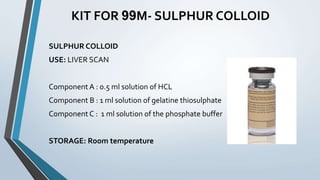
KIT FOR 99M- SULPHUR COLLOID
SULPHUR COLLOID
USE: LIVER SCAN
Component A : 0.5 ml solution of HCL
Component B : 1 ml solution of gelatine thiosulphate
Component C : 1 ml solution of the phosphate buffer
STORAGE: Room temperature
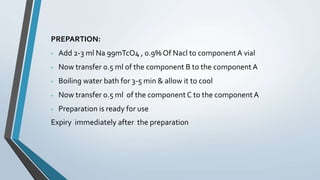
PREPARTION:
 Add 2-3 ml Na 99mTcO4 , 0.9% Of Nacl to componentA vial
 Now transfer 0.5 ml of the component B to the component A
 Boiling water bath for 3-5 min & allow it to cool
 Now transfer 0.5 ml of the component C to the component A
 Preparation is ready for use
Expiry immediately after the preparation
IDEAL RADIOPHARMACEUTICAL
• Easily availability.
• Short effective half –life.
• Particle emission.
• High target to non target activity ratio.
• Nontoxic and contain no chemical or radionuclide
contamination.
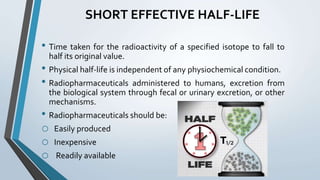
SHORT EFFECTIVE HALF-LIFE
• Time taken for the radioactivity of a specified isotope to fall to
half its original value.
• Physical half-life is independent of any physiochemical condition.
• Radiopharmaceuticals administered to humans, excretion from
the biological system through fecal or urinary excretion, or other
mechanisms.
• Radiopharmaceuticals should be:
o Easily produced
o Inexpensive
o Readily available
HIGHTARGETTO NONTARGET RATIO
• It is desirable that the radiopharmaceutical should be
localized in the organ.
• Since the activity from the non target areas can obscure the
structural details of the target organ.
• The target to non target ratio should be large.
TYPE OF SCAN RADIOPHARMACEUTICAL
Bone Scan MDP
FOR RENAL AND BRAIN
SCINTIGRAPHY
DTPA
FOR RENAL CORTICAL SCANS DMSA
STUDY OF LIVER
&GALLBLADDER
[Tc]-BRIDA
LIVER SCAN SULPHUR COLLOID
THYROID SCAN TC 99M
REFERENCES
Nuclear medicine
Author: Harney A Zeistmen & James HThrall
Physics in nuclear medicine
Author: Simon R Cherry
RADIOPHARMACEUTICALS

RADIOPHARMACEUTICALS

  • 1.
    RADIOPHARMACEUTICALS Alan Mathew 3rd yearBSc MIT Moderator : Omkar Gaonkar 10/10/2022
  • 2.
    CONTENTS • RADIOPHARMACEUTICALS • EQUIPMENTS •TRACER COMPARTMENTS ANDTRANSPORT • COLD KITS • TYPES &PREPARATION OFTECHENTIUM KITS • IDEAL RADIOPHARMACEUTICAL • REFERENCES
  • 3.
    RADIOPHARMACEUTICALS • Radiopharmaceuticals isradioactive compound used for the diagnosis and therapeutic treatment of human disease. • Also known as tracers or radiotracers. • Radiopharmaceuticals are sterile and nonpyrogenic and can be administered safely to humans. • A radiopharmaceutical has two components: o Radionuclide o Pharmaceutical
  • 4.
    EQUIPMENTS • Generators • Dosecalibrator • Contamination monitor • Fume hoods • Centrifuge • L bench
  • 5.
    GENERATORS • Radionuclide generatorsare a source of radionuclides to produce radiopharmaceuticals. • The most widely used radionuclide generator in radiopharmacy is 99Mo-99mTc generator. • Maximum build up of 99mTc activity occurs at 23 hours after elution. • There are two basic types of generator with respect to elution o Wet system o Dry System
  • 6.
    DRY GENERATOR • Aspecific amount of saline in a vials placed in the generation entry port and drawn across by vacuum. WET GENERATOR • Has a saline reservoir and a vacuum vail that draws saline across the column.
  • 7.
    DOSE CALIBRATOR • Awell-type ionization chamber capable of measuring quantities in the milli curie range. • The chamber is cylindrical and holds a defined volume of inert gas ( usually Argon). • Within the chamber is a collecting electrode. • An electrical differential between the chamber and the collecting electrodes causes ions to be captured and measured
  • 8.
    CONTAMINATION MONITOR • Usedto detect small amount of radioactive contamination. • The detectors are usually cylindrical in shape. • This detectors are gas filled and has high applied voltage from anode to cathode.
  • 9.
    FUME HOODS • Oneof the most important design feature of a chemical fume hood is the entry and used to promote a smooth flow of air into the hood. • Protect the user from inhaling toxic gases. • Protect the product or experiment. • Protect the working environment.
  • 10.
    CENTRIFUGE • A devicethat applies sustained centrifugal force for separating substances of different densities • Every centrifuge contains a spinning vessel; there are many configurations, depending on use.
  • 11.
    L BENCH oStandard “L”Shield • The L bench shield has been designed ,keeping in mind the user protection. • “L” Blocks provide effective radiation protection without a larger cost. oFEATURES • 4.8 g/cm3 Density Lead • The shields are painted with high gloss epoxy paint for easy cleaning
  • 12.
    TRACER COMPARTMENTS ANDTRANSPORT •Tracer is a substance that follows a physiologic or biochemical process. • A compartment is a volume or space within which the tracer rapidly becomes uniformly distributed • Specific requirements for an ideal tracer i. Behavior of tracer should be identical to the physiological process ii. Mass of tracer should not alter the physiological process being studied
  • 13.
    TRANSPORT • Two mechanismexist for the transport of substances across a membrane or capillary wall 1. Active transport 2. Passive transport ACTIVE TRANSPORT – Energy requires to move substances against concentration gradient. PASSIVE TRANSPORT – Transport of molecules across the membrane through a concentration gradient without use of cellular energy
  • 14.
    COLD KITS • Coldkits have been developed to produce quality radiopharmaceuticals at the site of use when mixed with the requisite amount of a radioisotope. • The kits are prepared in a freeze-dried form and have a long shelf life , ranging from several months to years . • Storage in a refrigerator at 2-8°C
  • 15.
    COMPONENTS OF COLDKIT • A cold kit contains • Ligand (organ specific) • Reducing agent (stannous salt) • Buffer (NaOH/ HCl) • Stabilizing agents(ascorbic acid)
  • 16.
    ADVANTAGES OF COLDKITS • Rapid and easy preparation of the product . • Low radiation hazard to the operator. • Sterile product • Stable and diagnostically effective product . • Readily available
  • 17.
  • 18.
    METHYLENE DIPHOSPHONIC ACID(MDP) USE: BONE SCAN PREPARATION: • Tc-99m MDP can be prepared from a simple kit. • Tc-99m, in the form of sodium pertechnatate (NaTcO4), is injected into a vial containing MDP, stabilizers, and stannous ion. • Stannous ion acts as a reducing agent, allowing the Tc-99m to form a bond with the MDP carrier molecule. • Adjust the pH to between 5 and 7 using NaOH or HCl. • Allow it to stand for 10 min STORAGE: Store refrigerated at 2–8ºC KIT FOR 99mTc-MDP
  • 19.
    KIT FOR 99mTc-DTPA DTPA (DIETHYLENETRIAMINE PENTAACETATE) USE: FOR RENAL AND BRAIN SCINTIGRAPHY PREPARATION: • Each vial contain – 35 mg of DTPA & 2 mg of stannous chloride • Add 2-3 ml Na 99mTcO4 , 0.9% NaCl • Mix the contents & keep the vial in Boiling water bath-5 min • Remove the vial & allow it to cool for 10 min • Control the pH at between 4 and 5 using NaOH or HCl. STORAGE : kit – 2-10º C
  • 20.
    KIT FOR 99mTc-DMSA DIMERCAPTO SUCCINIC ACID USE: FOR RENAL CORTICAL SCANS PREPARTION: Component A – 1 mg of DMSA & 0.3 mg stannous chloride Component B – 35 mg of NaHCO3 Allow the componentA vial to attain ambient temp Withdraw the required Na 99mTcO4 injection in a sterile syringe Add 1 ml of water in the component B vial & mix the contents Transfer the contents into the vial A , Immediately transfer the Na 99m TcO4 in to the vial –A Mix the contents of the vial & allow it to stand for 10 min Storage
  • 21.
    KIT FOR [Tc]-BRIDA BROMO-IMINODIACETICACID[Tc]-BRIDA USE: STUDY OF LIVER &GALLBLADDER PREPARTION: • 20–30 mCi of TcO4 prepared in 1 ml of 0.9% saline and introduced into the BRIDA kit • Shaken and kept at room temperature for 30 min. • The pH of the reconstituted product is 4.2 to 5.7 STORAGE : 2-80C
  • 22.
    KIT FOR 99M-SULPHUR COLLOID SULPHUR COLLOID USE: LIVER SCAN Component A : 0.5 ml solution of HCL Component B : 1 ml solution of gelatine thiosulphate Component C : 1 ml solution of the phosphate buffer STORAGE: Room temperature
  • 23.
    PREPARTION:  Add 2-3ml Na 99mTcO4 , 0.9% Of Nacl to componentA vial  Now transfer 0.5 ml of the component B to the component A  Boiling water bath for 3-5 min & allow it to cool  Now transfer 0.5 ml of the component C to the component A  Preparation is ready for use Expiry immediately after the preparation
  • 24.
    IDEAL RADIOPHARMACEUTICAL • Easilyavailability. • Short effective half –life. • Particle emission. • High target to non target activity ratio. • Nontoxic and contain no chemical or radionuclide contamination.
  • 25.
    SHORT EFFECTIVE HALF-LIFE •Time taken for the radioactivity of a specified isotope to fall to half its original value. • Physical half-life is independent of any physiochemical condition. • Radiopharmaceuticals administered to humans, excretion from the biological system through fecal or urinary excretion, or other mechanisms. • Radiopharmaceuticals should be: o Easily produced o Inexpensive o Readily available
  • 26.
    HIGHTARGETTO NONTARGET RATIO •It is desirable that the radiopharmaceutical should be localized in the organ. • Since the activity from the non target areas can obscure the structural details of the target organ. • The target to non target ratio should be large.
  • 27.
    TYPE OF SCANRADIOPHARMACEUTICAL Bone Scan MDP FOR RENAL AND BRAIN SCINTIGRAPHY DTPA FOR RENAL CORTICAL SCANS DMSA STUDY OF LIVER &GALLBLADDER [Tc]-BRIDA LIVER SCAN SULPHUR COLLOID THYROID SCAN TC 99M
  • 28.
    REFERENCES Nuclear medicine Author: HarneyA Zeistmen & James HThrall Physics in nuclear medicine Author: Simon R Cherry