RADIOPHARMACY: AN
INTRODUCTION TO ITS CLINICAL
APPLICATIONS
Presenter: Dr. Emejulu Jacinta
Moderator: Dr. Ozolua Nkiru
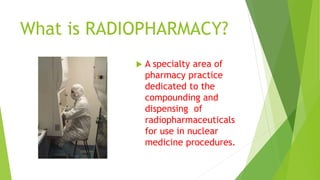
What is RADIOPHARMACY?
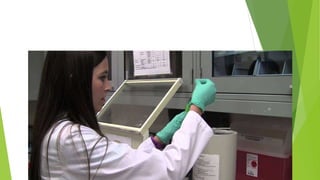
 A specialty area of
pharmacy practice
dedicated to the
compounding and
dispensing of
radiopharmaceuticals
for use in nuclear
medicine procedures.
What is radiopharmacy (contd)
 COMPOUNDING: FORMULATION OF PHARMACEUTICAL REAGENT
KITS FROM RAW INGREDIENTS FOR THE PREPARATION OF
RADIOPHARMACEUTICALS BY THE ADDITION OF RADIOISOTOPES.
 CRITICAL TO THE IMPLEMENTATION OF AREAS OF NUCLEAR
MEDICINE.
 radiodiagnosis
 pretargeted radioimmunotherapy of cancer
 Molecular imaging
 radioimmunoassay.
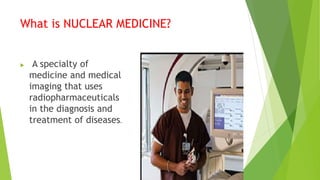
What is NUCLEAR MEDICINE?
 A specialty of
medicine and medical
imaging that uses
radiopharmaceuticals
in the diagnosis and
treatment of diseases.
What is NUCLEAR MEDICINE?
 Nuclear medicine tests differ from most other imaging
modalities in that its diagnostic tests primarily shows the
physiological/functions of the system being investigated
as opposed to traditional anatomical imaging such as CT
or MRI.
 The most intensively used radioisotope is technetium -
99m.
 RADIOTHERAPY: Radiation used to treat cancer
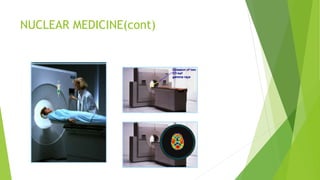
NUCLEAR MEDICINE(cont)
HISTORY OF NUCLEAR PHARMACY
PRACTICE
 The development of
nuclear pharmacy as a
specialty area
followed the
development of
nuclear medicine as a
recognized specialty
by the American
Medical Association in
the early 1970's.
 in 1970 W.Eckelmen and P.
Richards developed Tc-99m
“instant kit”
radiopharmaceuticals. The
first one was Tc-99m-DTPA.
 In 1896 Henri Becquerel
diccovered mysterious “rays”
from uranium.
 In 1969 C. L. Edwards
reported the accumulation of
gallium-67 in cancer.
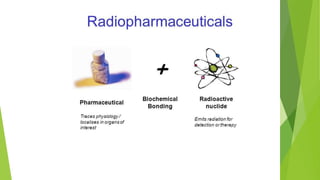
RADIOPHARMACEUTICALS
 MAY BE A RADIONUCLIDE OR
LABELLED COMPOUND
 STERILE AND NON PYROGENIC
 MINIMAL PHARMACOLOGIC EFFECT.
 PREPARED AS UNIT DOSES
CONTAINING THE RIGHT AMOUNT
OF RADIOACTIVITY PREPARED FOR
INDIVIDUAL PATIENTS.
 95% USED FOR DIAGNOSTIC
PURPOSES USED IN TRACER
QUANTITES
 RADIO PHARMACIES GENERALLY
PRODUCE FROM 2,000 TO OVER
10,000 DOSES EVERY YEAR.
 MUST UNDERGO QUALITY CONTROL
MEASURES REQUIRED OF A
PHARMACEUTICAL .
 SUBJECT TO LICENSING
 PHARMACEUTICAL REGULATIONS
 REGULATIONS GOVERNING
RADIOACTIVE MATERIALS.
 ADDITIONAL REGULATIONS MAY APPLY
FOR ISSUES SUCH AS
TRANSPORTATION OR DISPENSING OF
RADIOPHARMACEUTICALS
IDEAL RADIOPHARMACEUTICAL
 PHARMACEUTICAL
 PREFERENTIAL
LOCALISATION IN A GIVEN
ORGAN
 HIGH TARGET TO NON
TARGET ACTIVITY RATIO
 SAFE NON TOXIC FOR
HUMAN ADMINISTRATION
 RADIONUCLIDE
 EMMISSION OF
DETECTABLE RADIATION
 SHORT AND EFFECTIVE
HALF LIFE
 DECAY BY ELECTRON
CAPTURE
 EASY AVAILABILITY
Steps for targeted radio nuclei use in cancer
therapy.
 Identification of the biological target on the tumour
exclusively expressed by the tumour.
 A radiopharmaceutical is then designed to target the
tumour expressed biological maker.
 The radio nuclei emit beta and alpha rays capable of
causing DNA damage and leading to death of the
tumour.
 Examination of off-target distribution of the agent.
 Monitoring response to treatment after targeted radio
nuclei therapy.
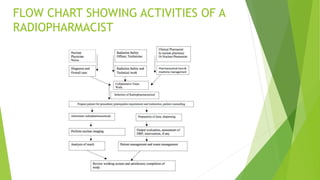
FLOW CHART SHOWING ACTIVITIES OF A
RADIOPHARMACIST
What are the clinical applications of
Radiopharmacy ?
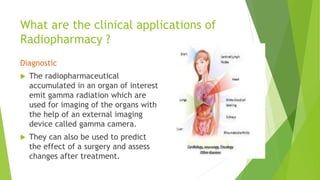
Diagnostic
 The radiopharmaceutical
accumulated in an organ of interest
emit gamma radiation which are
used for imaging of the organs with
the help of an external imaging
device called gamma camera.
 They can also be used to predict
the effect of a surgery and assess
changes after treatment.
Applications of Radiopharmacy Contd.
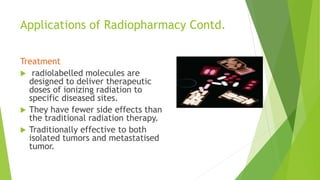
Treatment
 radiolabelled molecules are
designed to deliver therapeutic
doses of ionizing radiation to
specific diseased sites.
 They have fewer side effects than
the traditional radiation therapy.
 Traditionally effective to both
isolated tumors and metastatised
tumor.
Applications of Radiopharmacy Contd.
 Research
They are administered to track
metabolic reaction and kinetics
including biodistribution, bio
avaliabilityu ete.
They can also be used to study and
detect water resourses and detect
the presence of pollution by use of
harmless radioactive tracers.
MAIN RESPONSIBILITIES OF A
RADIOPHARMACIST
 PREPARATION AND
DISPENSING OF
RADIOPHARMACEUTICALS
 QUALITY
CONTROL/QUALITY
ASSURANCE.
 QUALITY AUDITS OF
RADIOPHARMACY SERVICES
 MAINTENANCE AND
MONITORING OF
FACILITIES AND
EQUIPMENT
 IMPROVING COST
EFFECTIVENESS OF
DIAGNOSTIC TESTS
 RESEARCH AND
DEVELOPMENT OF NEW
RADIO-PHARMACEUTICALS,
INCLUDING CLINICAL
TRIALS
 DEVELOPMENT OF NEW
DISPENSING TECHNIQUES
 PROVIDING CLINICAL
INFORMATION ON NEW
PRODUCTS
CLINICAL ROLES OF A RADIOPHARMACIST
ADVISING ON
 POSSIBLE CAUSES OF
ABNORMAL
BIODISTRIBUTIONS.
 USE OF MEDICINES THAT
WILL INTERFERE WITH SCAN
QUALITY OR RESULTS.
 STABILITY AND
FORMULATION OF
RADIOPHARMACEUTICALS.
 SPECIAL DOSAGE
FORMULATIONS
 HEALTH AND SAFETY FOR
INDIVIDUALS WHILE USING
RADIOPHARMACEUTICALS
 USE OF
RADIOPHARMACEUTICALS IN
ANIMALS.
 REPORTING ADVERSE DRUG
REACTIONS
RADIOPHARMACY STAFF AND TRAINING
 ANATOMY,
 HAEMATOLOGY
 LAW
 COMPUTER SKILLS
 UNDERSTANDING OF
MANDATORY LEGISLATION
AND GUIDANCE.
 NUCLEAR PHYSICS
 RADIATION
PROTECTION
 CHEMISTRY,
 BIOCHEMISTRY,
 RADIOCHEMISTRY,
 IMMUNOLOGY,
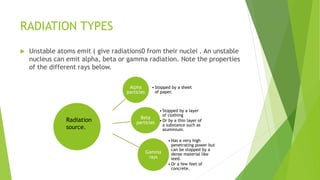
RADIATION TYPES
 Unstable atoms emit ( give radiations0 from their nuclei . An unstable
nucleus can emit alpha, beta or gamma radiation. Note the properties
of the different rays below.
Alpha
particles
• Stopped by a sheet
of paper.
Beta
particles
• Stopped by a layer
of clothing
• Or by a thin layer of
a substance such as
aluminium.
Gamma
rays
• Has a very high
penetrating power but
can be stopped by a
dense material like
leed.
• Or a few feet of
concrete.
Radiation
source.
RADIOISOTOPES USED IN NUCLEAR
MEDICINE
1. ARTIFICIAL
2. PRODUCED FROM
 CYCLOTRON
 NUCLEAR REACTOR
TYPE OF RADIONUCLIDE
DEPENDS ON
 IRRADIATING PARTICLE
 ENERGY
 TARGET NUCLEI
PRODUCTION OF RADIONUCLIDES
 CYCLOTRON PRODUCED
 GALLIUM-67
 IODINE123
 INDIUM-111
 CARBON-11
 FLUORINE-18
 OXYGEN-15
 REACTOR PRODUCED
 IODINE-131
 MOLYBDENUM-99
 CHROMIUM-50
 XENIUM-133
 CEASIUM-137
Production of radioisotopes
The production of radioisotopes is expensive!
 It is based on four different methods:
• nuclear fission (reactor breeding
• neutron activation processes
• charged particle induced reactions
• radionuclide generator (chemical method)
Each method provides useful isotopes with differing
characteristics for nuclear imaging.
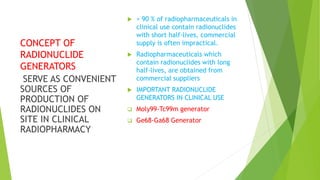
CONCEPT OF
RADIONUCLIDE
GENERATORS
 > 90 % of radiopharmaceuticals in
clinical use contain radionuclides
with short half-lives, commercial
supply is often impractical.
 Radiopharmaceuticals which
contain radionuclides with long
half-lives, are obtained from
commercial suppliers
 IMPORTANT RADIONUCLIDE
GENERATORS IN CLINICAL USE
 Moly99-Tc99m generator
 Ge68-Ga68 Generator
SERVE AS CONVENIENT
SOURCES OF
PRODUCTION OF
RADIONUCLIDES ON
SITE IN CLINICAL
RADIOPHARMACY
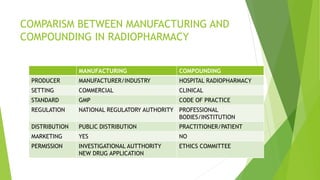
COMPARISM BETWEEN MANUFACTURING AND
COMPOUNDING IN RADIOPHARMACY
MANUFACTURING COMPOUNDING
PRODUCER MANUFACTURER/INDUSTRY HOSPITAL RADIOPHARMACY
SETTING COMMERCIAL CLINICAL
STANDARD GMP CODE OF PRACTICE
REGULATION NATIONAL REGULATORY AUTHORITY PROFESSIONAL
BODIES/INSTITUTION
DISTRIBUTION PUBLIC DISTRIBUTION PRACTITIONER/PATIENT
MARKETING YES NO
PERMISSION INVESTIGATIONAL AUTTHORITY
NEW DRUG APPLICATION
ETHICS COMMITTEE
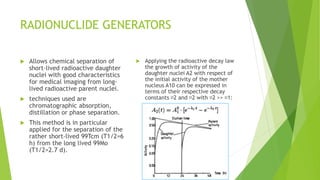
RADIONUCLIDE GENERATORS
 Allows chemical separation of
short-lived radioactive daughter
nuclei with good characteristics
for medical imaging from long-
lived radioactive parent nuclei.
 techniques used are
chromatographic absorption,
distillation or phase separation.
 This method is in particular
applied for the separation of the
rather short-lived 99Tcm (T1/2=6
h) from the long lived 99Mo
(T1/2=2.7 d).
 Applying the radioactive decay law
the growth of activity of the
daughter nuclei A2 with respect of
the initial activity of the mother
nucleus A10 can be expressed in
terms of their respective decay
constants 2 and 2 with 2 >> 1:
99Tcm
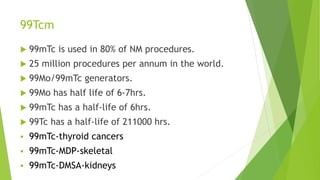
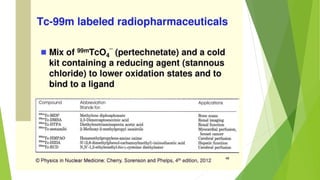
 99mTc is used in 80% of NM procedures.
 25 million procedures per annum in the world.
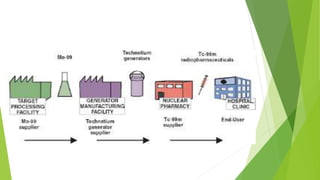
 99Mo/99mTc generators.
 99Mo has half life of 6-7hrs.
 99mTc has a half-life of 6hrs.
 99Tc has a half-life of 211000 hrs.
 99mTc-thyroid cancers
 99mTc-MDP-skeletal
 99mTc-DMSA-kidneys
Molybdenum99-Technetium99m generator-
workhorse of nuclear medicine
 the half-life of the mother nuclide
is much longer than that of the
daughter nuclide,
 50% of equilibrium activity is
reached within one daughter half-
life,
 75% within two daughter half-lives.
 removing the daughter nuclide
Tc99m from the generator
("milking" the generator) is
reasonably done every 6 hours or at
most every daughter half life
 commercial Mo-99/Tc-99m
generators use column
chromatography in which Mo-99 is
adsorbed onto alumina.
 Pulling normal saline through the
column of immobilized Mo-99 elutes
the soluble Tc-99m, resulting in a
saline solution containing the Tc-
99m.
 The useful life of a Mo-99/Tc-99m
generator is about 3 half lives or
approximately one week.
 Hence, any clinical nuclear medicine
units purchase at least one such
generator per week or order several
in a staggered fashion.
Factors that affect the biodistribution of
radiopharmaceutical.
 Radiopharmaceutical preparation and formulation
problem. E.g the basic shape, size and solubility of
molecule.
 Administration technique and procedure problems.
 Changes in biochemical and pathophysiological e.g
avaliability of compound to tissue, or the proportion of
the tracer that is bound to proteins in the blood.
 Previous medical procedures like surgery or radiation
therapy.
 Drug interactions.
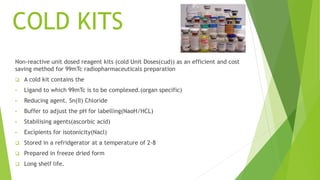
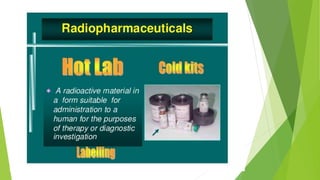
COLD KITS
Non-reactive unit dosed reagent kits (cold Unit Doses(cud)) as an efficient and cost
saving method for 99mTc radiopharmaceuticals preparation
 A cold kit contains the
• Ligand to which 99mTc is to be complexed.(organ specific)
• Reducing agent. Sn(II) Chloride
• Buffer to adjust the pH for labelling(NaoH/HCL)
• Stabilising agents(ascorbic acid)
• Excipients for isotonicity(Nacl)
 Stored in a refridgerator at a temperature of 2-8
 Prepared in freeze dried form
 Long shelf life.
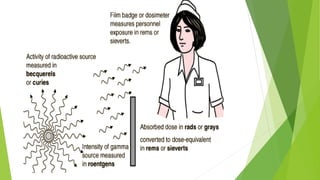
RADIATION PROTECTION PRINCIPLES
 TIME:
Minimize the amount of time during exposure.
 DISTANCE:
Maximize the distance from the radiation source. The inverse-square law state
that as you double the distance from the radiation source, you reduce the
exposure level by one fouth (1/4th).
 SHIELDING:
Utilize shielding to avoid direct exposure to the radiation source.
PRECAUTIONS TO BE TAKEN IN HANDLINGT
RADIOPHARMACEUTICALS.
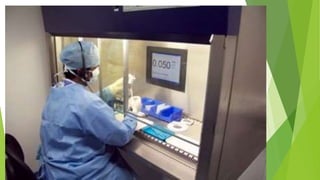
 The working areas should not get contaminated with radioactive material.
 If the radioactive liquid has to be handled, it must be carried in trays having absorbent
tissue paper so that any spillage will be absorbed by the paper.
 Rubber gloves have to be used when working on the radioactive liquids.
 Pipettes operated by mouth should never be used.
 The radioactive emitter should be handled with forceps and never by hand.
 Sufficient shielding device should be used.
 The radiopharmaceutical materials are stored in suitable labelled containers, shielding
by bricks and preferably in a remote corner.
 Great care has to be applied for disposal of radioactive materials.
 A regular monitoring of radioactivity be done in area where radioactive materials are
stored.
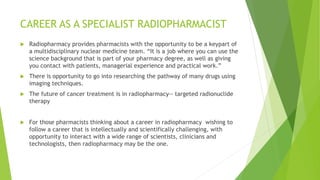
CAREER AS A SPECIALIST RADIOPHARMACIST
 Radiopharmacy provides pharmacists with the opportunity to be a keypart of
a multidisciplinary nuclear medicine team. “It is a job where you can use the
science background that is part of your pharmacy degree, as well as giving
you contact with patients, managerial experience and practical work.”
 There is opportunity to go into researching the pathway of many drugs using
imaging techniques.
 The future of cancer treatment is in radiopharmacy-- targeted radionuclide
therapy
 For those pharmacists thinking about a career in radiopharmacy wishing to
follow a career that is intellectually and scientifically challenging, with
opportunity to interact with a wide range of scientists, clinicians and
technologists, then radiopharmacy may be the one.
REFERENCES
1. Connolly M, Frier M, Lazarus CR, Maltby P, Thom J. Guidelines for the provision of
Radiopharmacy support to Nuclear Medicine. Nuclear Medicine Communications 2003;24:429–33
2. Sampson CB, Sharpe S. The role of the pharmacist as a member of the nuclear medicine team,
and ethics, responsibility, standards of practice and audit. In: Sampson CB. Textbook of
Radiopharmacy. 3rd ed.
3. The Netherlands: Gordon and Breach; 1999. pp271–813. THE RADIOPHARMACY: A
TECHNOLOGISTS GUIDE,EANM PUBLICATION
4. RADIOPHARMACEUTICALS: Final text for addition to The International Pharmacopoeia
5. TOMORROW,S PHARMACIST : A CAREER AS A RADIOPHARMACIST.UKRG PUBLICATION.
6.POSITION PAPER ON NATIONAL CANCER CONTROL PROGRAM LAWAL I OGOPAL B SAHA
FUNDAMENTALS ON NUCLEAR PHARMACY FIFTH EDITION
8. OPERATIONAL GUIDANCE ON HOSPITAL RADIOPHARMACY, A SAFE AND EFFECTIVE APPROACH.
IAEA PUBLICATION.
9 NUCLEAR MEDICINE POCKET HANDBOOK: ROYAL LIVERPOOL UNIVERSITY HOSPITAL,NUCLEAR
MEDICINE DEPARTMENT
10.FRIEDLANDER G,.KENNEDY JW,MILLER JM. NUCLEAR AND RADIOCHEMISTRY 3RD EDITION
RADIOPHARMACY-PRESENTATION FOR  WORKSHOP NEW.ppt

RADIOPHARMACY-PRESENTATION FOR WORKSHOP NEW.ppt

  • 1.
    RADIOPHARMACY: AN INTRODUCTION TOITS CLINICAL APPLICATIONS Presenter: Dr. Emejulu Jacinta Moderator: Dr. Ozolua Nkiru
  • 2.
    What is RADIOPHARMACY? A specialty area of pharmacy practice dedicated to the compounding and dispensing of radiopharmaceuticals for use in nuclear medicine procedures.
  • 3.
    What is radiopharmacy(contd)  COMPOUNDING: FORMULATION OF PHARMACEUTICAL REAGENT KITS FROM RAW INGREDIENTS FOR THE PREPARATION OF RADIOPHARMACEUTICALS BY THE ADDITION OF RADIOISOTOPES.  CRITICAL TO THE IMPLEMENTATION OF AREAS OF NUCLEAR MEDICINE.  radiodiagnosis  pretargeted radioimmunotherapy of cancer  Molecular imaging  radioimmunoassay.
  • 4.
    What is NUCLEARMEDICINE?  A specialty of medicine and medical imaging that uses radiopharmaceuticals in the diagnosis and treatment of diseases.
  • 5.
    What is NUCLEARMEDICINE?  Nuclear medicine tests differ from most other imaging modalities in that its diagnostic tests primarily shows the physiological/functions of the system being investigated as opposed to traditional anatomical imaging such as CT or MRI.  The most intensively used radioisotope is technetium - 99m.  RADIOTHERAPY: Radiation used to treat cancer
  • 6.
  • 7.
    HISTORY OF NUCLEARPHARMACY PRACTICE  The development of nuclear pharmacy as a specialty area followed the development of nuclear medicine as a recognized specialty by the American Medical Association in the early 1970's.  in 1970 W.Eckelmen and P. Richards developed Tc-99m “instant kit” radiopharmaceuticals. The first one was Tc-99m-DTPA.  In 1896 Henri Becquerel diccovered mysterious “rays” from uranium.  In 1969 C. L. Edwards reported the accumulation of gallium-67 in cancer.
  • 8.
    RADIOPHARMACEUTICALS  MAY BEA RADIONUCLIDE OR LABELLED COMPOUND  STERILE AND NON PYROGENIC  MINIMAL PHARMACOLOGIC EFFECT.  PREPARED AS UNIT DOSES CONTAINING THE RIGHT AMOUNT OF RADIOACTIVITY PREPARED FOR INDIVIDUAL PATIENTS.  95% USED FOR DIAGNOSTIC PURPOSES USED IN TRACER QUANTITES  RADIO PHARMACIES GENERALLY PRODUCE FROM 2,000 TO OVER 10,000 DOSES EVERY YEAR.  MUST UNDERGO QUALITY CONTROL MEASURES REQUIRED OF A PHARMACEUTICAL .  SUBJECT TO LICENSING  PHARMACEUTICAL REGULATIONS  REGULATIONS GOVERNING RADIOACTIVE MATERIALS.  ADDITIONAL REGULATIONS MAY APPLY FOR ISSUES SUCH AS TRANSPORTATION OR DISPENSING OF RADIOPHARMACEUTICALS
  • 10.
    IDEAL RADIOPHARMACEUTICAL  PHARMACEUTICAL PREFERENTIAL LOCALISATION IN A GIVEN ORGAN  HIGH TARGET TO NON TARGET ACTIVITY RATIO  SAFE NON TOXIC FOR HUMAN ADMINISTRATION  RADIONUCLIDE  EMMISSION OF DETECTABLE RADIATION  SHORT AND EFFECTIVE HALF LIFE  DECAY BY ELECTRON CAPTURE  EASY AVAILABILITY
  • 11.
    Steps for targetedradio nuclei use in cancer therapy.  Identification of the biological target on the tumour exclusively expressed by the tumour.  A radiopharmaceutical is then designed to target the tumour expressed biological maker.  The radio nuclei emit beta and alpha rays capable of causing DNA damage and leading to death of the tumour.  Examination of off-target distribution of the agent.  Monitoring response to treatment after targeted radio nuclei therapy.
  • 12.
    FLOW CHART SHOWINGACTIVITIES OF A RADIOPHARMACIST
  • 13.
    What are theclinical applications of Radiopharmacy ? Diagnostic  The radiopharmaceutical accumulated in an organ of interest emit gamma radiation which are used for imaging of the organs with the help of an external imaging device called gamma camera.  They can also be used to predict the effect of a surgery and assess changes after treatment.
  • 14.
    Applications of RadiopharmacyContd. Treatment  radiolabelled molecules are designed to deliver therapeutic doses of ionizing radiation to specific diseased sites.  They have fewer side effects than the traditional radiation therapy.  Traditionally effective to both isolated tumors and metastatised tumor.
  • 15.
    Applications of RadiopharmacyContd.  Research They are administered to track metabolic reaction and kinetics including biodistribution, bio avaliabilityu ete. They can also be used to study and detect water resourses and detect the presence of pollution by use of harmless radioactive tracers.
  • 16.
    MAIN RESPONSIBILITIES OFA RADIOPHARMACIST  PREPARATION AND DISPENSING OF RADIOPHARMACEUTICALS  QUALITY CONTROL/QUALITY ASSURANCE.  QUALITY AUDITS OF RADIOPHARMACY SERVICES  MAINTENANCE AND MONITORING OF FACILITIES AND EQUIPMENT  IMPROVING COST EFFECTIVENESS OF DIAGNOSTIC TESTS  RESEARCH AND DEVELOPMENT OF NEW RADIO-PHARMACEUTICALS, INCLUDING CLINICAL TRIALS  DEVELOPMENT OF NEW DISPENSING TECHNIQUES  PROVIDING CLINICAL INFORMATION ON NEW PRODUCTS
  • 17.
    CLINICAL ROLES OFA RADIOPHARMACIST ADVISING ON  POSSIBLE CAUSES OF ABNORMAL BIODISTRIBUTIONS.  USE OF MEDICINES THAT WILL INTERFERE WITH SCAN QUALITY OR RESULTS.  STABILITY AND FORMULATION OF RADIOPHARMACEUTICALS.  SPECIAL DOSAGE FORMULATIONS  HEALTH AND SAFETY FOR INDIVIDUALS WHILE USING RADIOPHARMACEUTICALS  USE OF RADIOPHARMACEUTICALS IN ANIMALS.  REPORTING ADVERSE DRUG REACTIONS
  • 18.
    RADIOPHARMACY STAFF ANDTRAINING  ANATOMY,  HAEMATOLOGY  LAW  COMPUTER SKILLS  UNDERSTANDING OF MANDATORY LEGISLATION AND GUIDANCE.  NUCLEAR PHYSICS  RADIATION PROTECTION  CHEMISTRY,  BIOCHEMISTRY,  RADIOCHEMISTRY,  IMMUNOLOGY,
  • 19.
    RADIATION TYPES  Unstableatoms emit ( give radiations0 from their nuclei . An unstable nucleus can emit alpha, beta or gamma radiation. Note the properties of the different rays below. Alpha particles • Stopped by a sheet of paper. Beta particles • Stopped by a layer of clothing • Or by a thin layer of a substance such as aluminium. Gamma rays • Has a very high penetrating power but can be stopped by a dense material like leed. • Or a few feet of concrete. Radiation source.
  • 20.
    RADIOISOTOPES USED INNUCLEAR MEDICINE 1. ARTIFICIAL 2. PRODUCED FROM  CYCLOTRON  NUCLEAR REACTOR TYPE OF RADIONUCLIDE DEPENDS ON  IRRADIATING PARTICLE  ENERGY  TARGET NUCLEI
  • 21.
    PRODUCTION OF RADIONUCLIDES CYCLOTRON PRODUCED  GALLIUM-67  IODINE123  INDIUM-111  CARBON-11  FLUORINE-18  OXYGEN-15  REACTOR PRODUCED  IODINE-131  MOLYBDENUM-99  CHROMIUM-50  XENIUM-133  CEASIUM-137
  • 22.
    Production of radioisotopes Theproduction of radioisotopes is expensive!  It is based on four different methods: • nuclear fission (reactor breeding • neutron activation processes • charged particle induced reactions • radionuclide generator (chemical method) Each method provides useful isotopes with differing characteristics for nuclear imaging.
  • 23.
    CONCEPT OF RADIONUCLIDE GENERATORS  >90 % of radiopharmaceuticals in clinical use contain radionuclides with short half-lives, commercial supply is often impractical.  Radiopharmaceuticals which contain radionuclides with long half-lives, are obtained from commercial suppliers  IMPORTANT RADIONUCLIDE GENERATORS IN CLINICAL USE  Moly99-Tc99m generator  Ge68-Ga68 Generator SERVE AS CONVENIENT SOURCES OF PRODUCTION OF RADIONUCLIDES ON SITE IN CLINICAL RADIOPHARMACY
  • 24.
    COMPARISM BETWEEN MANUFACTURINGAND COMPOUNDING IN RADIOPHARMACY MANUFACTURING COMPOUNDING PRODUCER MANUFACTURER/INDUSTRY HOSPITAL RADIOPHARMACY SETTING COMMERCIAL CLINICAL STANDARD GMP CODE OF PRACTICE REGULATION NATIONAL REGULATORY AUTHORITY PROFESSIONAL BODIES/INSTITUTION DISTRIBUTION PUBLIC DISTRIBUTION PRACTITIONER/PATIENT MARKETING YES NO PERMISSION INVESTIGATIONAL AUTTHORITY NEW DRUG APPLICATION ETHICS COMMITTEE
  • 25.
    RADIONUCLIDE GENERATORS  Allowschemical separation of short-lived radioactive daughter nuclei with good characteristics for medical imaging from long- lived radioactive parent nuclei.  techniques used are chromatographic absorption, distillation or phase separation.  This method is in particular applied for the separation of the rather short-lived 99Tcm (T1/2=6 h) from the long lived 99Mo (T1/2=2.7 d).  Applying the radioactive decay law the growth of activity of the daughter nuclei A2 with respect of the initial activity of the mother nucleus A10 can be expressed in terms of their respective decay constants 2 and 2 with 2 >> 1:
  • 26.
    99Tcm  99mTc isused in 80% of NM procedures.  25 million procedures per annum in the world.  99Mo/99mTc generators.  99Mo has half life of 6-7hrs.  99mTc has a half-life of 6hrs.  99Tc has a half-life of 211000 hrs.  99mTc-thyroid cancers  99mTc-MDP-skeletal  99mTc-DMSA-kidneys
  • 27.
    Molybdenum99-Technetium99m generator- workhorse ofnuclear medicine  the half-life of the mother nuclide is much longer than that of the daughter nuclide,  50% of equilibrium activity is reached within one daughter half- life,  75% within two daughter half-lives.  removing the daughter nuclide Tc99m from the generator ("milking" the generator) is reasonably done every 6 hours or at most every daughter half life  commercial Mo-99/Tc-99m generators use column chromatography in which Mo-99 is adsorbed onto alumina.  Pulling normal saline through the column of immobilized Mo-99 elutes the soluble Tc-99m, resulting in a saline solution containing the Tc- 99m.  The useful life of a Mo-99/Tc-99m generator is about 3 half lives or approximately one week.  Hence, any clinical nuclear medicine units purchase at least one such generator per week or order several in a staggered fashion.
  • 29.
    Factors that affectthe biodistribution of radiopharmaceutical.  Radiopharmaceutical preparation and formulation problem. E.g the basic shape, size and solubility of molecule.  Administration technique and procedure problems.  Changes in biochemical and pathophysiological e.g avaliability of compound to tissue, or the proportion of the tracer that is bound to proteins in the blood.  Previous medical procedures like surgery or radiation therapy.  Drug interactions.
  • 30.
    COLD KITS Non-reactive unitdosed reagent kits (cold Unit Doses(cud)) as an efficient and cost saving method for 99mTc radiopharmaceuticals preparation  A cold kit contains the • Ligand to which 99mTc is to be complexed.(organ specific) • Reducing agent. Sn(II) Chloride • Buffer to adjust the pH for labelling(NaoH/HCL) • Stabilising agents(ascorbic acid) • Excipients for isotonicity(Nacl)  Stored in a refridgerator at a temperature of 2-8  Prepared in freeze dried form  Long shelf life.
  • 36.
    RADIATION PROTECTION PRINCIPLES TIME: Minimize the amount of time during exposure.  DISTANCE: Maximize the distance from the radiation source. The inverse-square law state that as you double the distance from the radiation source, you reduce the exposure level by one fouth (1/4th).  SHIELDING: Utilize shielding to avoid direct exposure to the radiation source.
  • 37.
    PRECAUTIONS TO BETAKEN IN HANDLINGT RADIOPHARMACEUTICALS.  The working areas should not get contaminated with radioactive material.  If the radioactive liquid has to be handled, it must be carried in trays having absorbent tissue paper so that any spillage will be absorbed by the paper.  Rubber gloves have to be used when working on the radioactive liquids.  Pipettes operated by mouth should never be used.  The radioactive emitter should be handled with forceps and never by hand.  Sufficient shielding device should be used.  The radiopharmaceutical materials are stored in suitable labelled containers, shielding by bricks and preferably in a remote corner.  Great care has to be applied for disposal of radioactive materials.  A regular monitoring of radioactivity be done in area where radioactive materials are stored.
  • 39.
    CAREER AS ASPECIALIST RADIOPHARMACIST  Radiopharmacy provides pharmacists with the opportunity to be a keypart of a multidisciplinary nuclear medicine team. “It is a job where you can use the science background that is part of your pharmacy degree, as well as giving you contact with patients, managerial experience and practical work.”  There is opportunity to go into researching the pathway of many drugs using imaging techniques.  The future of cancer treatment is in radiopharmacy-- targeted radionuclide therapy  For those pharmacists thinking about a career in radiopharmacy wishing to follow a career that is intellectually and scientifically challenging, with opportunity to interact with a wide range of scientists, clinicians and technologists, then radiopharmacy may be the one.
  • 40.
    REFERENCES 1. Connolly M,Frier M, Lazarus CR, Maltby P, Thom J. Guidelines for the provision of Radiopharmacy support to Nuclear Medicine. Nuclear Medicine Communications 2003;24:429–33 2. Sampson CB, Sharpe S. The role of the pharmacist as a member of the nuclear medicine team, and ethics, responsibility, standards of practice and audit. In: Sampson CB. Textbook of Radiopharmacy. 3rd ed. 3. The Netherlands: Gordon and Breach; 1999. pp271–813. THE RADIOPHARMACY: A TECHNOLOGISTS GUIDE,EANM PUBLICATION 4. RADIOPHARMACEUTICALS: Final text for addition to The International Pharmacopoeia 5. TOMORROW,S PHARMACIST : A CAREER AS A RADIOPHARMACIST.UKRG PUBLICATION. 6.POSITION PAPER ON NATIONAL CANCER CONTROL PROGRAM LAWAL I OGOPAL B SAHA FUNDAMENTALS ON NUCLEAR PHARMACY FIFTH EDITION 8. OPERATIONAL GUIDANCE ON HOSPITAL RADIOPHARMACY, A SAFE AND EFFECTIVE APPROACH. IAEA PUBLICATION. 9 NUCLEAR MEDICINE POCKET HANDBOOK: ROYAL LIVERPOOL UNIVERSITY HOSPITAL,NUCLEAR MEDICINE DEPARTMENT 10.FRIEDLANDER G,.KENNEDY JW,MILLER JM. NUCLEAR AND RADIOCHEMISTRY 3RD EDITION

Editor's Notes

  • #3 THE TERM RADIOPHARMACY IS ALSO USED FOR THE PLACE WHERE THESE ACTIVITIES TAKE PLACE
  • #4  STAND-ALONE SERVICE BY A RADIOPHARMACY DEPARTMENT OR A RADIOPHARMACY SECTION OF A NUCLEAR MEDICINE DEPARTMENT
  • #5  CHARACTERIZATION OF PHYSIOLOGIC PROCESSES INSIDE THE BODY, DOWN TO THE MOLECULAR LEVEL POTENTIAL TO IDENTIFY DISEASES AT EARLY STAGES AND TO ASSESS THE RESPONSE TO THERAPEUTIC INTERVENTIONS
  • #6  CHARACTERIZATION OF PHYSIOLOGIC PROCESSES INSIDE THE BODY, DOWN TO THE MOLECULAR LEVEL POTENTIAL TO IDENTIFY DISEASES AT EARLY STAGES AND TO ASSESS THE RESPONSE TO THERAPEUTIC INTERVENTIONS
  • #8 INTERNATIONAL STANDARD CLASSIFICATION OF OCCUPATIONS 2018
  • #12  STAND-ALONE SERVICE BY A RADIOPHARMACY DEPARTMENT OR A RADIOPHARMACY SECTION OF A NUCLEAR MEDICINE DEPARTMENT
  • #17 SO WHAT DO RADIOPHARMACISTS DO IN PRACTICE
  • #19 SINCE RADIOPHARMACEUTICALS ARE CONTROLLED AS BOTH MEDICINES AND RADIOACTIVE SUBSTANCES