RADIOPHARMACEUTICALS
BY
Dr. Laraib Jamil Rph
M.PHIL Registered scholar
Department of Pharmaceutis
University Of Balochistan
RADIOPHARMACEUTICALS
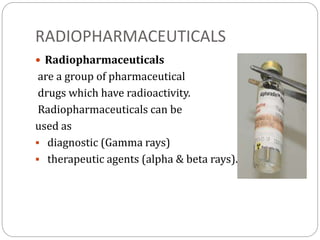
 Radiopharmaceuticals
are a group of pharmaceutical
drugs which have radioactivity.
Radiopharmaceuticals can be
used as
 diagnostic (Gamma rays)
 therapeutic agents (alpha & beta rays).
Introduction
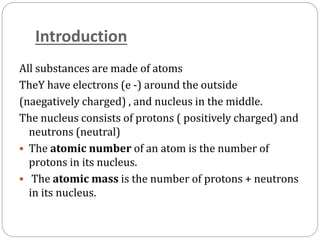
All substances are made of atoms
TheY have electrons (e -) around the outside
(naegatively charged) , and nucleus in the middle.
The nucleus consists of protons ( positively charged) and
neutrons (neutral)
 The atomic number of an atom is the number of
protons in its nucleus.
 The atomic mass is the number of protons + neutrons
in its nucleus.
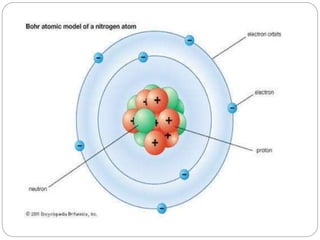
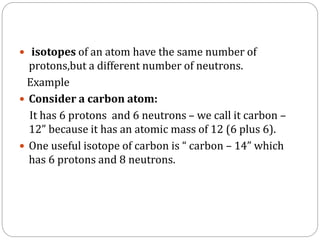
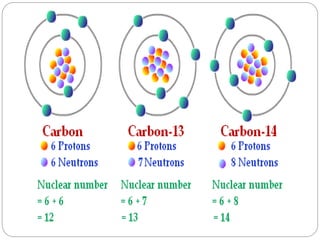
 isotopes of an atom have the same number of
protons,but a different number of neutrons.
Example
 Consider a carbon atom:
It has 6 protons and 6 neutrons – we call it carbon –
12” because it has an atomic mass of 12 (6 plus 6).
 One useful isotope of carbon is “ carbon – 14” which
has 6 protons and 8 neutrons.
Radioisotopes , Radionuclides :
An atom with an unstable nucleus ,which is a nucleus
characterized by excess energy available to be
imparted wether to a newly created radiation particle
within the nucleus or to an atomic electron . the
radionuclide, in this process, undergoes radioactive
decay , and emits gamma ray(S) and /or subatomic
particles.
Radioactivity :
 The process in which an
unstable isotope undergoes
changes until a stable state is
reached and in the
transformation emits energy
in the form of radiation (alpha
particles , beta particles and
gamma rays)
Types of radiocativity
 Natural radioactivity
Nuclear reactions occur spontaneously
 Artificial radioactivity
The property of radioactivity produced by particle
bombardment or electmagnetic radiation.
How to produce radioactive nuclide
a) Charged particle reaction:
(e.g) Protons
Deutrons (A=2)
Alpha particles
b) Photon induced reaction:
The source of electromegnatic energy may be gamma
emitting radionuclide or high voltage x-ray generator
c) Neutron induced reaction:
Most widely used method. It is bombardment of
nonradioactive target nucleus with a source of
thermal neutrons
Radioactive decay:
 Radioactive decay is the process in which unstable
atomic nucleus spontaneously loses energy by emitting
ionizing particles and radiation.
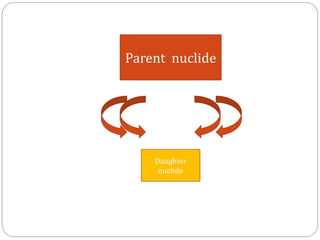
 This decay, or loss of energy , results in an atom of one
type ,called the parent nuclide transforming to an
atom of a different type, named the daughter nuclide.
Parent nuclide
Daughter
nuclide
 Half life (t ½): the time taken for the activity of a
given amount of a radioactive substance to decay to
half of its initial value
 Total activity (A): number of decays an object
undergoes per second.
 Radionuclidic purity: is that percentage of the total
radioactivity that is peresent in the form of the stated
radionuclide.
Mode of radioactive decay :
When an unstable nuclide decays, it may give out
1- Alpha particles
2- Beta particles
3- Gamma rays
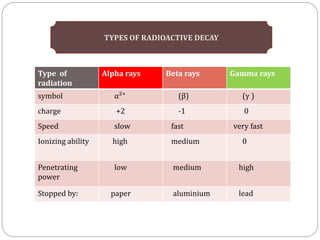
Type of
radiation
Alpha rays Beta rays Gamma rays
symbol α²⁺ (β) (γ )
charge +2 -1 0
Speed slow fast very fast
Ionizing ability high medium 0
Penetrating
power
low medium high
Stopped by: paper aluminium lead
TYPES OF RADIOACTIVE DECAY
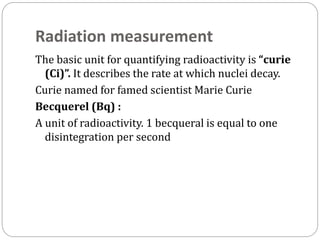
Radiation measurement
The basic unit for quantifying radioactivity is “curie
(Ci)”. It describes the rate at which nuclei decay.
Curie named for famed scientist Marie Curie
Becquerel (Bq) :
A unit of radioactivity. 1 becqueral is equal to one
disintegration per second
PRODUCTION OF
RADIONUCLIDES
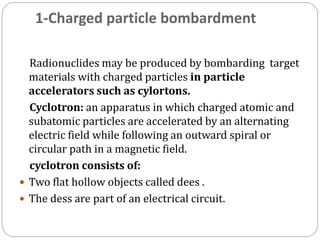
1-Charged particle bombardment
Radionuclides may be produced by bombarding target
materials with charged particles in particle
accelerators such as cylortons.
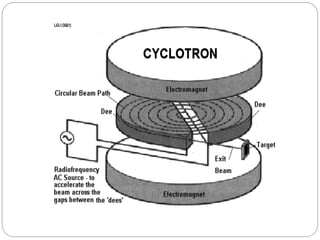
Cyclotron: an apparatus in which charged atomic and
subatomic particles are accelerated by an alternating
electric field while following an outward spiral or
circular path in a magnetic field.
cyclotron consists of:
 Two flat hollow objects called dees .
 The dess are part of an electrical circuit.
 on the other side of the dees are large magnets that
steer (drive) the injected charged particles
(protons, deutrons, alpha and hellium ) in a circular
path.
 the charged particle follows a circular path untlil
the particle has sufficient energy that it passes out
of the field and interact with the target nucleus.
2-Neutron bombardment
Radionuclides may be produced by bombarding
target materials with neutrons in nuclear reactors.
 The majority of radiopharmaceuticals are
produced by this process.
3-Radionuclide generator systems
 Principle:
A long – lived parent radionuclide is allowed to
decay to its short- lived daughter radionuclide and
the latter is chemically separated in physiological
solution.
 Example
Technetium – 99m, obtained from a generator
constructed of molybdenum-99 absorbed to an
alumina column.
PREPARATION OF
RADIOPHARMACEUTICALS
Compounding:
 Can be as simple as :
Adding a radioacitive liquid to a commercially
available reagent kit
 Can be as complex as :
The creation of a multi – component reagent kit
Kit for radiopharmaceutical preparation: Means a
sterile and pyrogen- free reaction vial containing
the non radioctive chemicals {e.g ,complexing
agent(ligand), reducing agent, stabilizer, or
disepersing agent} that are required to produce a
specific radiopharmaceutical after reaction with a
radioactive component.
Caution
 The process of compounding
radiopharmaceuticals must be
under the supervision of recognized
nuclear physician or a radio
pharmacist.
Sterilization:
Radiopharmaceutical prepartions intended for
parenteral admininstration are sterilized by a
suitabled method.
 Terminal sterilization by outoclaving is
recommended for heat stable products.
 For heat labile products , the filtration method is
recommended.
Stability of compounded
Preparation
 All extmporaneously compounded parenteral
radiopharmaceutical prepartations should be used not
more than 24 hours post cmpounding process unless
data are available to support longer storage.
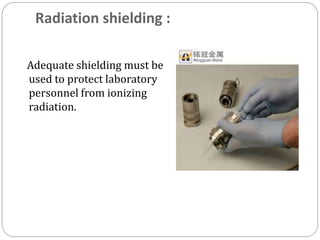
Radiation shielding :
Adequate shielding must be
used to protect laboratory
personnel from ionizing
radiation.
RADIOPHARMACEUTICA
L’S
QUALITY CONTROL
 Visual inspection of product
Visual inspection of the compounded
radiopharmaceutical shall be conducted to ensure the
absence of foregin matter and also to establish product
identitiy by confirming that
 A liquid product is solution, a colloid , or a suspension.
 A solid product has defined properties that identify it.
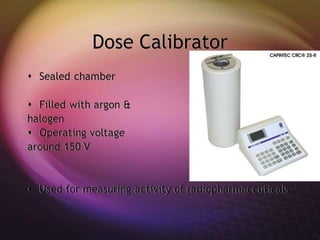
 Assessment of radioactivity
the amount of radioactivity each compounded
radiopharmaceutical should be verified and
documented prior to dispenisng, using a proper
standardized radionuclide (dose) calibrator.
 Radionuclidic purity
Radionuclidic purity can be determined with the use of a
suitables counting device
 The gamma-ray spectrum, sholuld not be signifcantly
different from that of standardized solution of the
radionclide.
 Radiochemical purity
Radiochemical purity is assessed by a variety of
analytical techniques such as:
 Liquid chromagraphy
 Paper chromatagraphy
 Thin- layer chromagraphy
 Electophoresis
 The distibution of radioactivity on the chromatogram is
determined.
 Ph
 Microbiological control (sterilitly test) and
bacterial
Endotoxin testing
 Labeling
 The label on the outer package should inclulde:
 a statement that the product is radioactive or the
international symbol of radioactivity.
 The name of the radiopharmaceutical preparation:
The perparation is for diagnostic for therapeutic use
 The total radioactivity present (for example , in
MBq per ml of the solution)
 Route of administration
 The expiry date
 The batch (lot) number
 For Solutions, the total volume:
 Any special storage requirements with respect to
temperature and light:
 The name and Concentration of any added
microbial preservative
THANK
YOU

Radiopharmaceutical presentation

  • 1.
  • 2.
    M.PHIL Registered scholar Departmentof Pharmaceutis University Of Balochistan
  • 3.
    RADIOPHARMACEUTICALS  Radiopharmaceuticals are agroup of pharmaceutical drugs which have radioactivity. Radiopharmaceuticals can be used as  diagnostic (Gamma rays)  therapeutic agents (alpha & beta rays).
  • 5.
    Introduction All substances aremade of atoms TheY have electrons (e -) around the outside (naegatively charged) , and nucleus in the middle. The nucleus consists of protons ( positively charged) and neutrons (neutral)  The atomic number of an atom is the number of protons in its nucleus.  The atomic mass is the number of protons + neutrons in its nucleus.
  • 7.
     isotopes ofan atom have the same number of protons,but a different number of neutrons. Example  Consider a carbon atom: It has 6 protons and 6 neutrons – we call it carbon – 12” because it has an atomic mass of 12 (6 plus 6).  One useful isotope of carbon is “ carbon – 14” which has 6 protons and 8 neutrons.
  • 9.
    Radioisotopes , Radionuclides: An atom with an unstable nucleus ,which is a nucleus characterized by excess energy available to be imparted wether to a newly created radiation particle within the nucleus or to an atomic electron . the radionuclide, in this process, undergoes radioactive decay , and emits gamma ray(S) and /or subatomic particles.
  • 10.
    Radioactivity :  Theprocess in which an unstable isotope undergoes changes until a stable state is reached and in the transformation emits energy in the form of radiation (alpha particles , beta particles and gamma rays)
  • 11.
    Types of radiocativity Natural radioactivity Nuclear reactions occur spontaneously  Artificial radioactivity The property of radioactivity produced by particle bombardment or electmagnetic radiation.
  • 12.
    How to produceradioactive nuclide a) Charged particle reaction: (e.g) Protons Deutrons (A=2) Alpha particles b) Photon induced reaction: The source of electromegnatic energy may be gamma emitting radionuclide or high voltage x-ray generator c) Neutron induced reaction: Most widely used method. It is bombardment of nonradioactive target nucleus with a source of thermal neutrons
  • 13.
    Radioactive decay:  Radioactivedecay is the process in which unstable atomic nucleus spontaneously loses energy by emitting ionizing particles and radiation.  This decay, or loss of energy , results in an atom of one type ,called the parent nuclide transforming to an atom of a different type, named the daughter nuclide.
  • 14.
  • 15.
     Half life(t ½): the time taken for the activity of a given amount of a radioactive substance to decay to half of its initial value  Total activity (A): number of decays an object undergoes per second.  Radionuclidic purity: is that percentage of the total radioactivity that is peresent in the form of the stated radionuclide.
  • 16.
    Mode of radioactivedecay : When an unstable nuclide decays, it may give out 1- Alpha particles 2- Beta particles 3- Gamma rays
  • 17.
    Type of radiation Alpha raysBeta rays Gamma rays symbol α²⁺ (β) (γ ) charge +2 -1 0 Speed slow fast very fast Ionizing ability high medium 0 Penetrating power low medium high Stopped by: paper aluminium lead TYPES OF RADIOACTIVE DECAY
  • 18.
    Radiation measurement The basicunit for quantifying radioactivity is “curie (Ci)”. It describes the rate at which nuclei decay. Curie named for famed scientist Marie Curie Becquerel (Bq) : A unit of radioactivity. 1 becqueral is equal to one disintegration per second

  • 19.
  • 20.
    1-Charged particle bombardment Radionuclidesmay be produced by bombarding target materials with charged particles in particle accelerators such as cylortons. Cyclotron: an apparatus in which charged atomic and subatomic particles are accelerated by an alternating electric field while following an outward spiral or circular path in a magnetic field. cyclotron consists of:  Two flat hollow objects called dees .  The dess are part of an electrical circuit.
  • 21.
     on theother side of the dees are large magnets that steer (drive) the injected charged particles (protons, deutrons, alpha and hellium ) in a circular path.  the charged particle follows a circular path untlil the particle has sufficient energy that it passes out of the field and interact with the target nucleus.
  • 23.
    2-Neutron bombardment Radionuclides maybe produced by bombarding target materials with neutrons in nuclear reactors.  The majority of radiopharmaceuticals are produced by this process.
  • 24.
    3-Radionuclide generator systems Principle: A long – lived parent radionuclide is allowed to decay to its short- lived daughter radionuclide and the latter is chemically separated in physiological solution.  Example Technetium – 99m, obtained from a generator constructed of molybdenum-99 absorbed to an alumina column.
  • 25.
  • 26.
    Compounding:  Can beas simple as : Adding a radioacitive liquid to a commercially available reagent kit  Can be as complex as : The creation of a multi – component reagent kit Kit for radiopharmaceutical preparation: Means a sterile and pyrogen- free reaction vial containing the non radioctive chemicals {e.g ,complexing agent(ligand), reducing agent, stabilizer, or disepersing agent} that are required to produce a specific radiopharmaceutical after reaction with a radioactive component.
  • 27.
    Caution  The processof compounding radiopharmaceuticals must be under the supervision of recognized nuclear physician or a radio pharmacist.
  • 28.
    Sterilization: Radiopharmaceutical prepartions intendedfor parenteral admininstration are sterilized by a suitabled method.  Terminal sterilization by outoclaving is recommended for heat stable products.  For heat labile products , the filtration method is recommended.
  • 29.
    Stability of compounded Preparation All extmporaneously compounded parenteral radiopharmaceutical prepartations should be used not more than 24 hours post cmpounding process unless data are available to support longer storage.
  • 30.
    Radiation shielding : Adequateshielding must be used to protect laboratory personnel from ionizing radiation.
  • 31.
  • 32.
     Visual inspectionof product Visual inspection of the compounded radiopharmaceutical shall be conducted to ensure the absence of foregin matter and also to establish product identitiy by confirming that  A liquid product is solution, a colloid , or a suspension.  A solid product has defined properties that identify it.  Assessment of radioactivity the amount of radioactivity each compounded radiopharmaceutical should be verified and documented prior to dispenisng, using a proper standardized radionuclide (dose) calibrator.
  • 34.
     Radionuclidic purity Radionuclidicpurity can be determined with the use of a suitables counting device  The gamma-ray spectrum, sholuld not be signifcantly different from that of standardized solution of the radionclide.  Radiochemical purity Radiochemical purity is assessed by a variety of analytical techniques such as:  Liquid chromagraphy  Paper chromatagraphy  Thin- layer chromagraphy  Electophoresis  The distibution of radioactivity on the chromatogram is determined.
  • 35.
     Ph  Microbiologicalcontrol (sterilitly test) and bacterial Endotoxin testing  Labeling  The label on the outer package should inclulde:  a statement that the product is radioactive or the international symbol of radioactivity.  The name of the radiopharmaceutical preparation: The perparation is for diagnostic for therapeutic use  The total radioactivity present (for example , in MBq per ml of the solution)
  • 36.
     Route ofadministration  The expiry date  The batch (lot) number  For Solutions, the total volume:  Any special storage requirements with respect to temperature and light:  The name and Concentration of any added microbial preservative
  • 37.