Tom Yeager Owner/Certified Inspector NEHA Radon Measurement Cert. # 104169 RT 303-464-9090 www.tyeagerinspects.com
Radon A Practical Guide To Radon Detection and Remediation
Purpose & Disclaimer Purpose Provide  BASIC  information related to radon definition, detection and remediation Disclaimer Not intended to be all-inclusive or to be used for decision making purposes.  Please refer to the “ Additional Resources ” slide for more information.
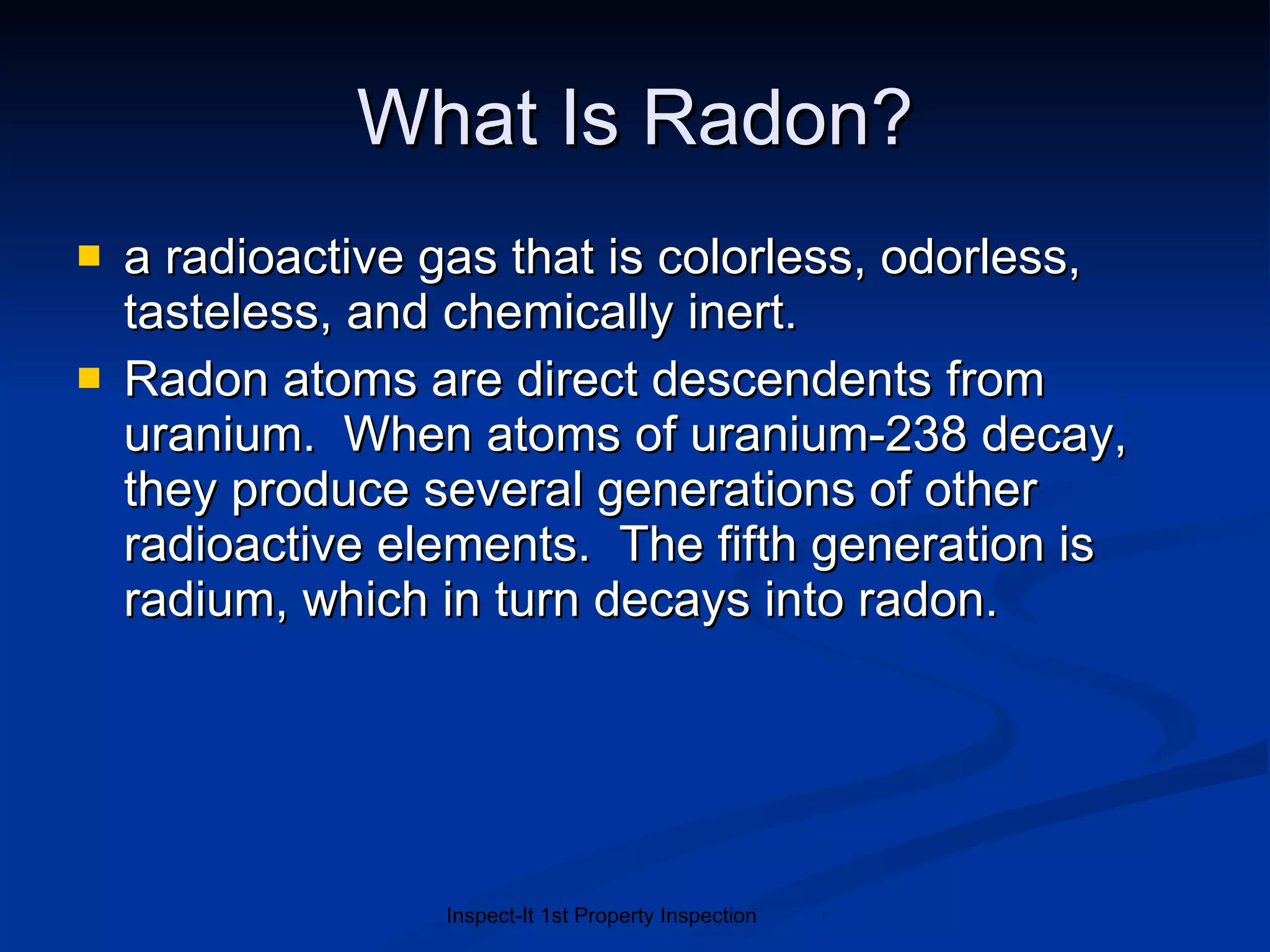
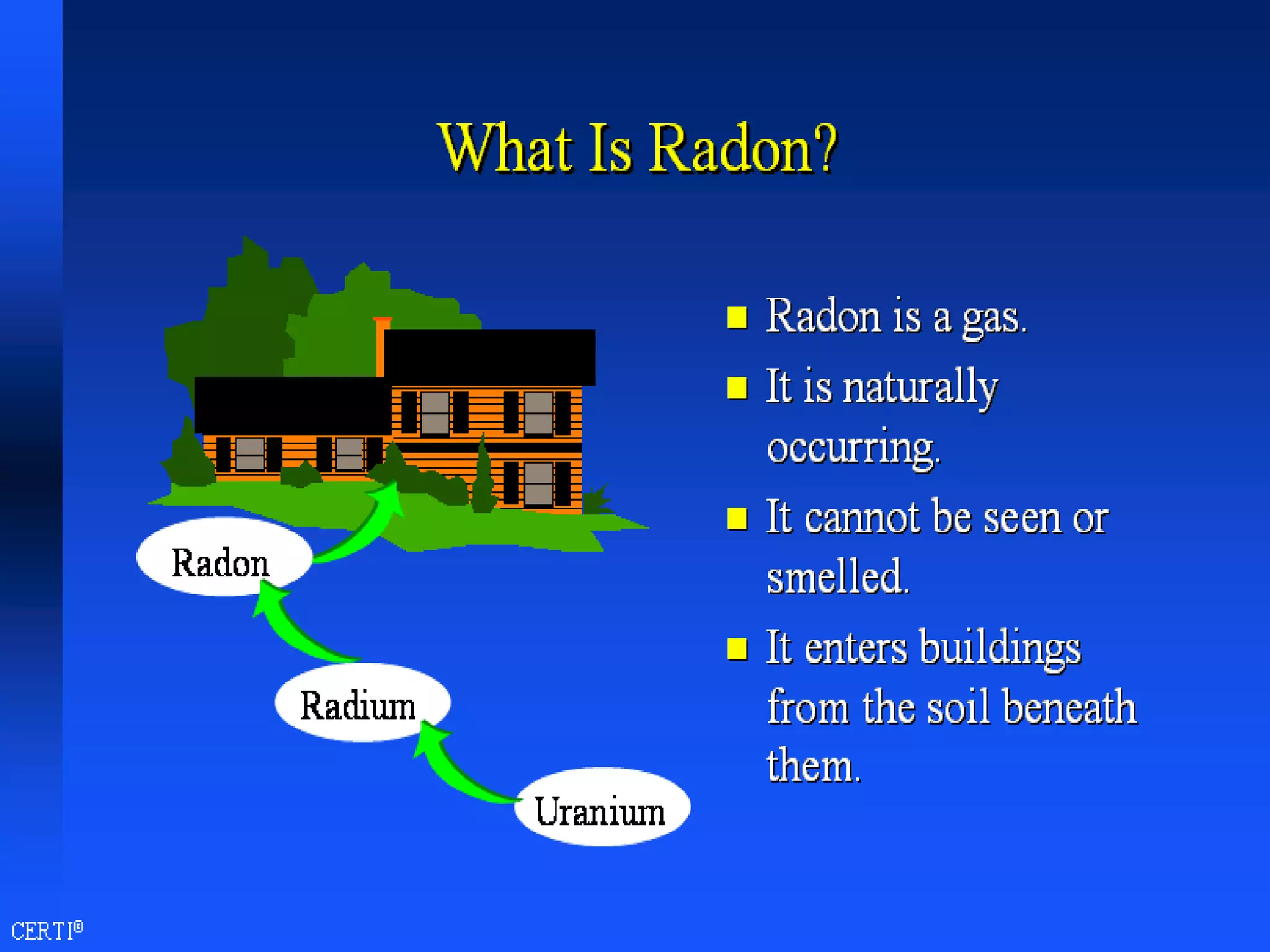
What Is Radon? a radioactive gas that is colorless, odorless, tasteless, and chemically inert.  Radon atoms are direct descendents from uranium.  When atoms of uranium-238 decay, they produce several generations of other radioactive elements.  The fifth generation is radium, which in turn decays into radon.
 
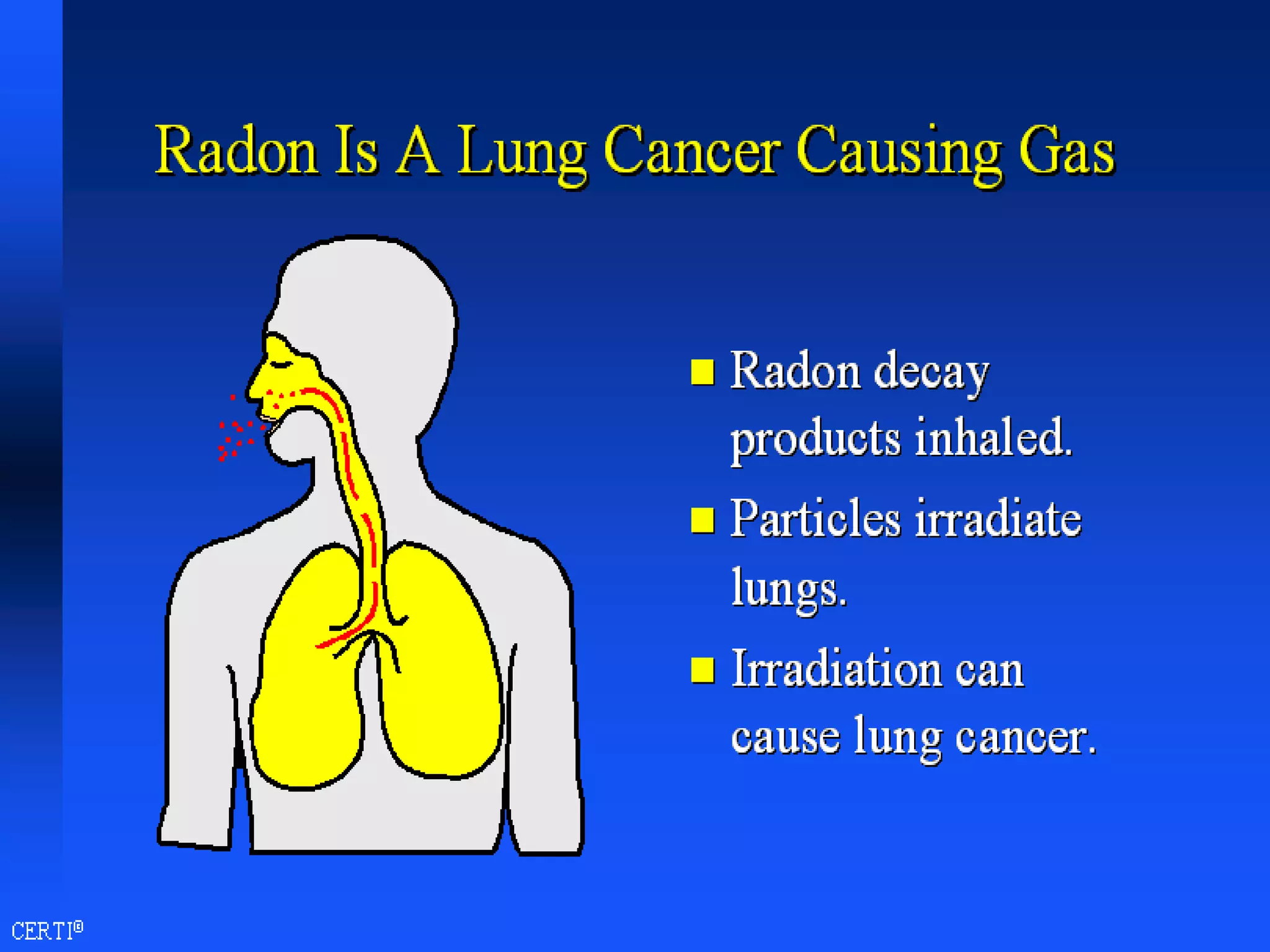
What Is Radon? Radon breaks down into decay products Decay products can be inhaled and have electrostatic charges causing them to sick to lung tissue Further decay releases particles that can damage lung tissue
 
 
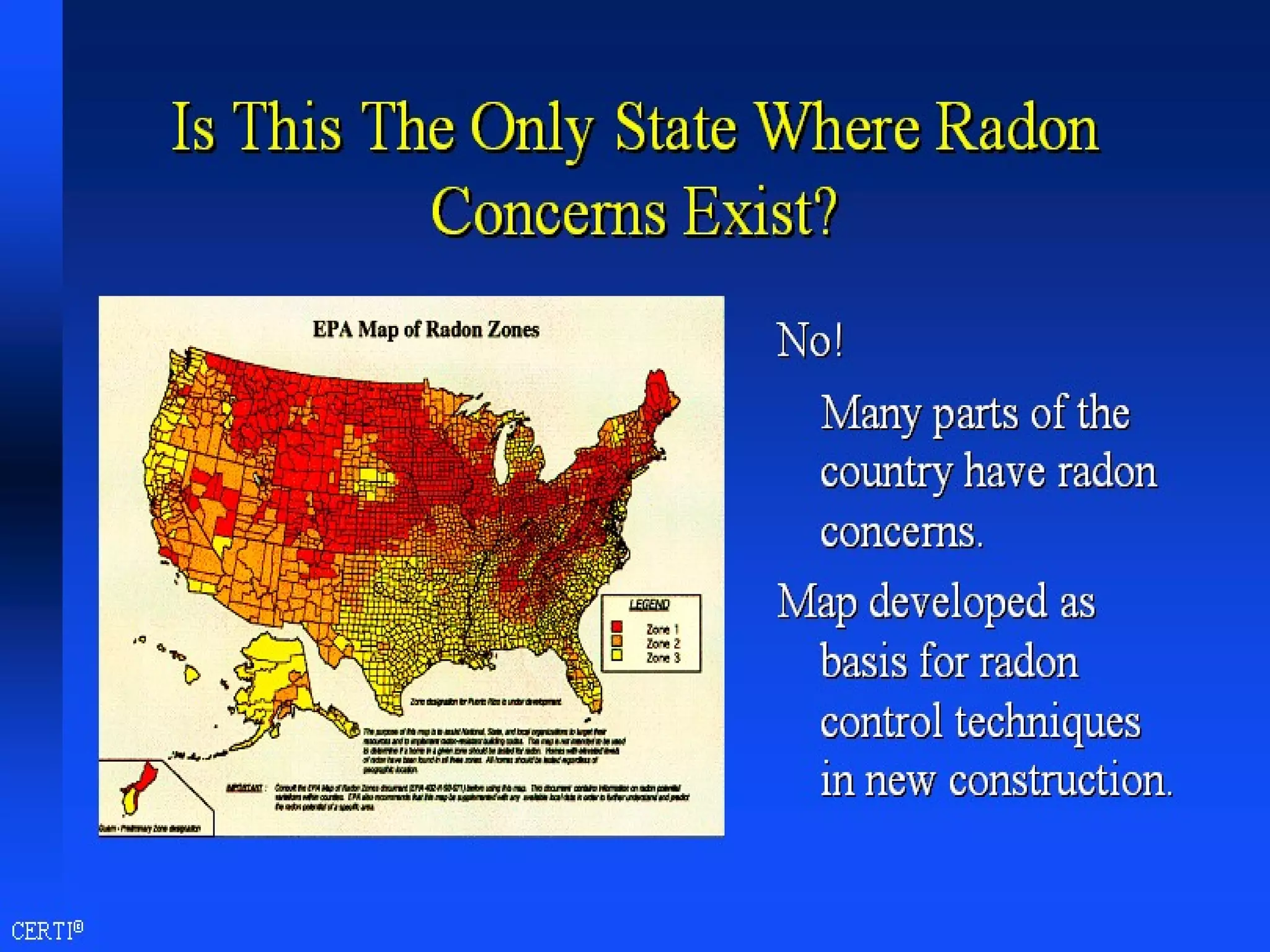
Where is Radon Found? Though great concentrations of uranium are rare, traces of it are common in ordinary rock and soil throughout much of the United States.   Zone Maps
 
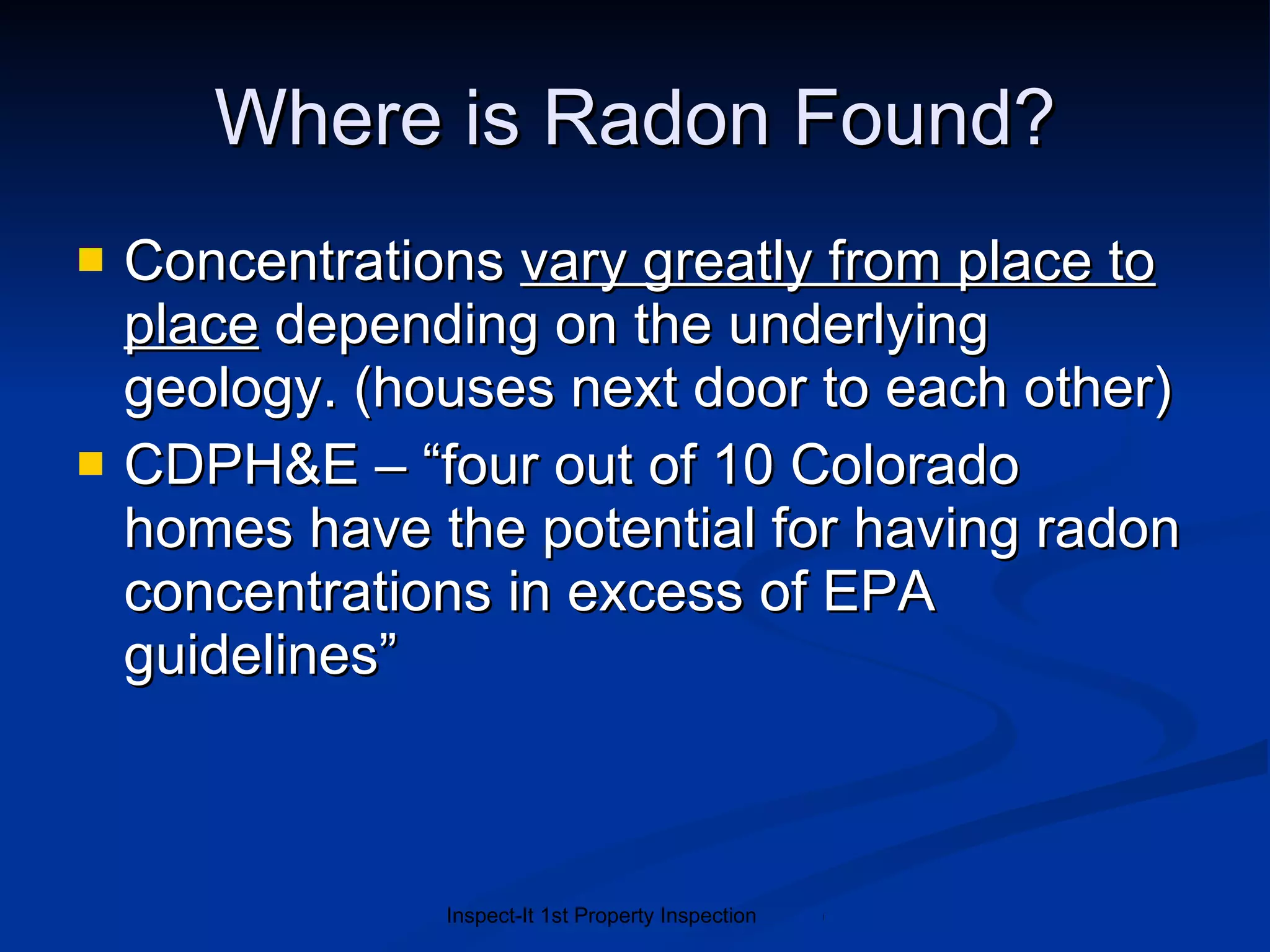
Where is Radon Found? Concentrations  vary greatly from place to place  depending on the underlying geology. (houses next door to each other) CDPH&E – “four out of 10 Colorado homes have the potential for having radon concentrations in excess of EPA guidelines”
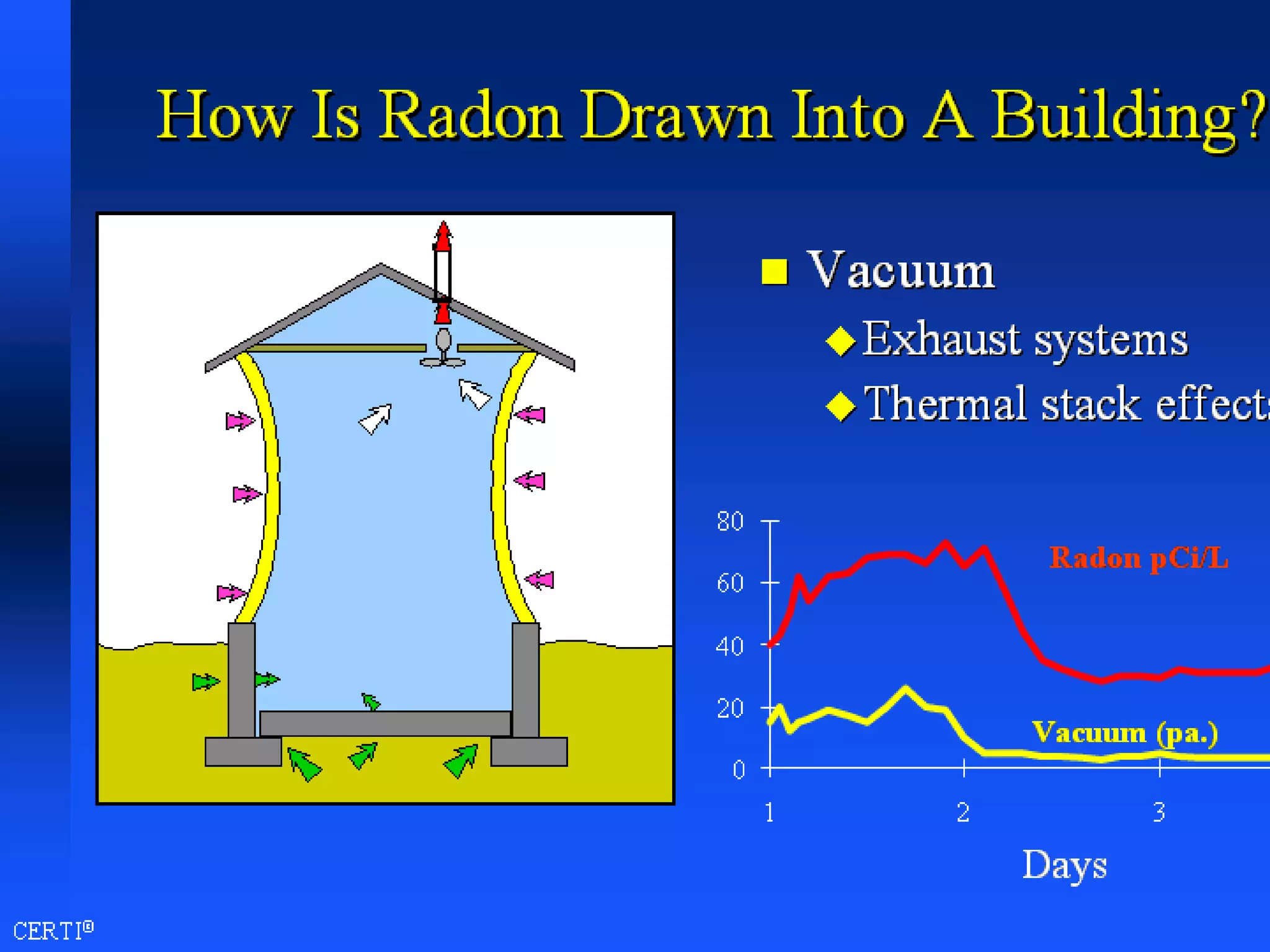
How Does Radon Invade Homes? Radon is a gas, which means it is very mobile.  It is also a single atom, therefore small.  It can get into a home via  cracks, gaps and openings in floors and walls . Negative pressure in the home or pressures in the underlying soil
 
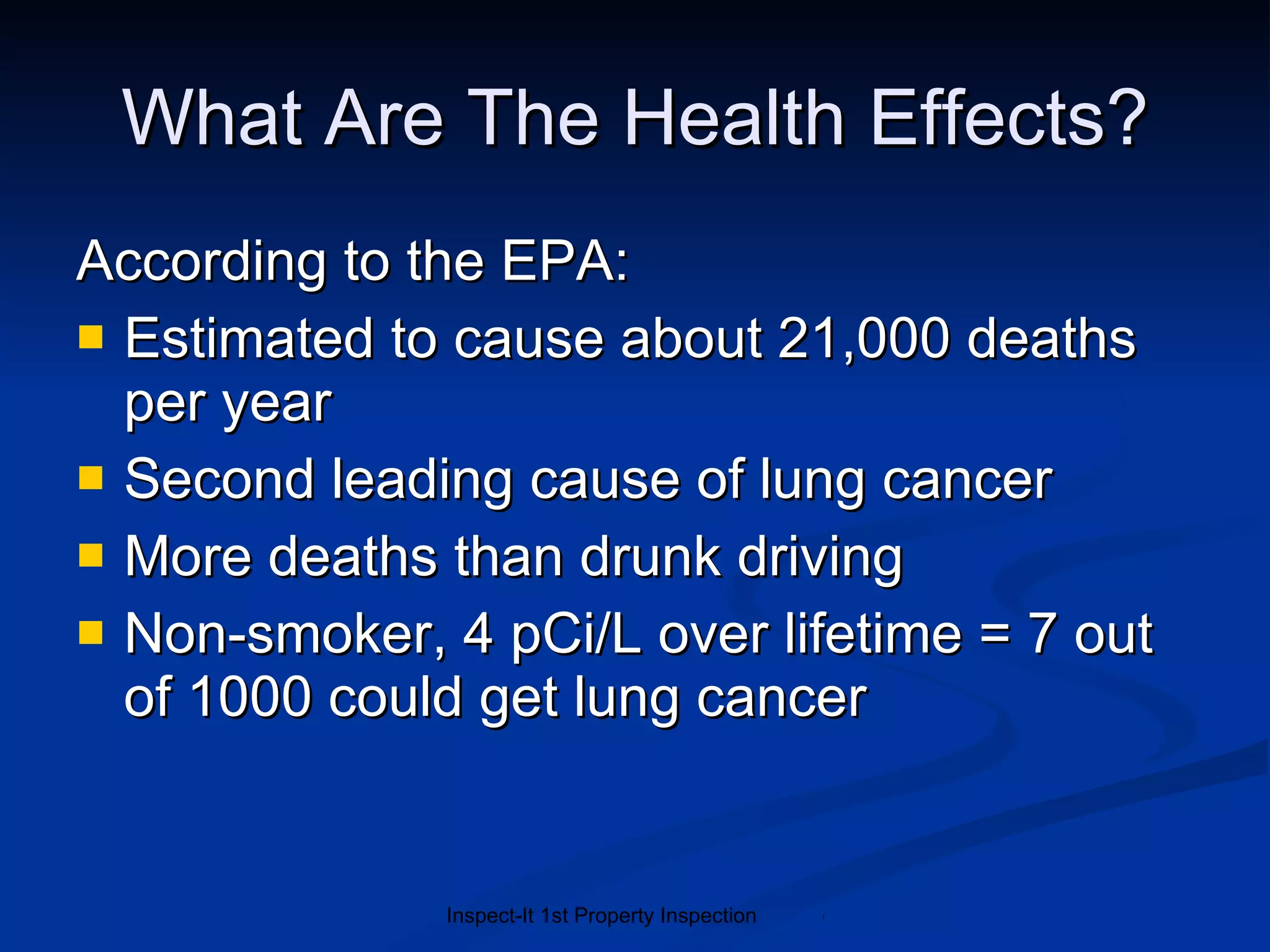
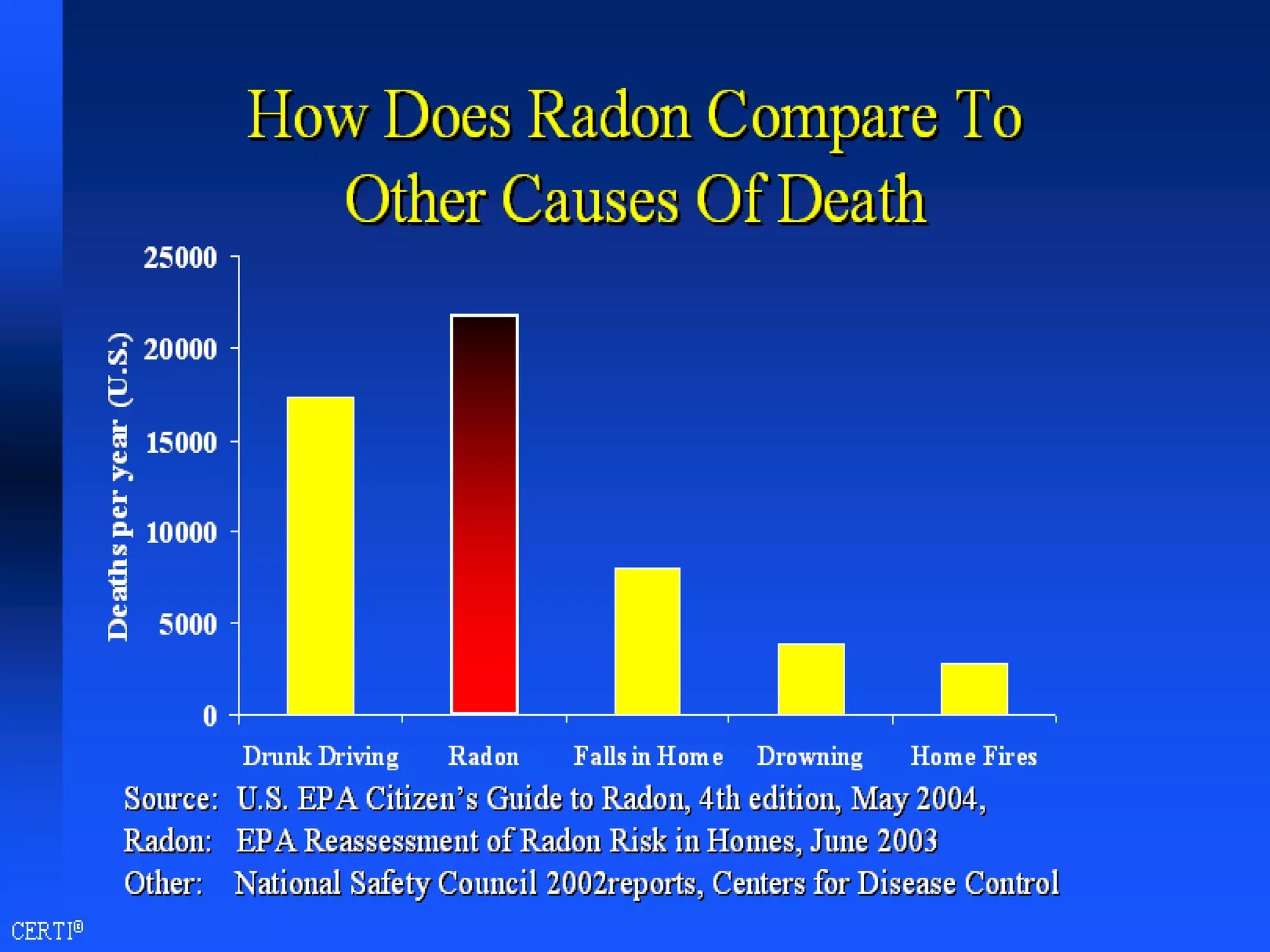
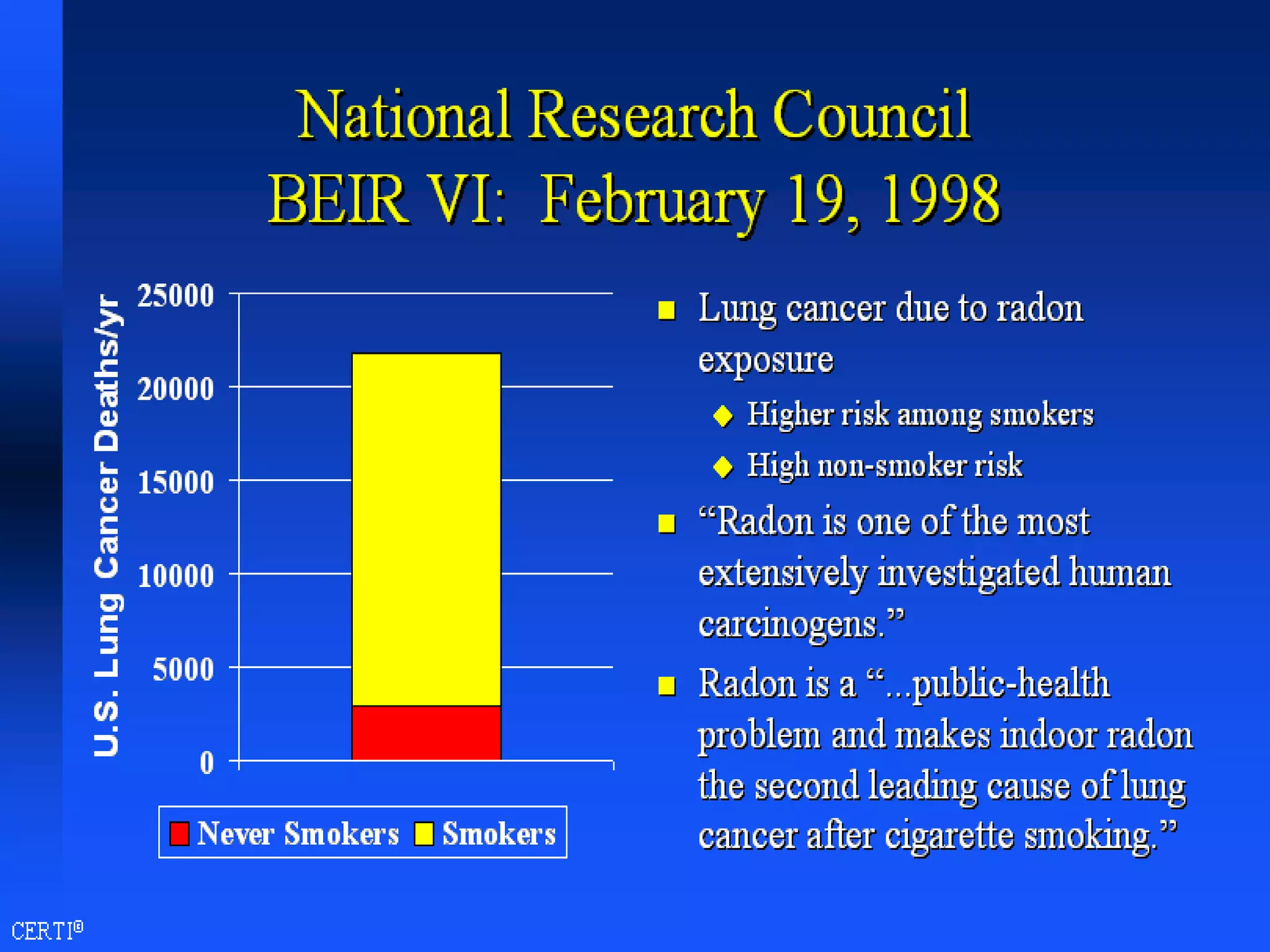
What Are The Health Effects? According to the EPA: Estimated to cause about 21,000 deaths per year Second leading cause of lung cancer More deaths than drunk driving Non-smoker, 4 pCi/L over lifetime = 7 out of 1000 could get lung cancer
 
 
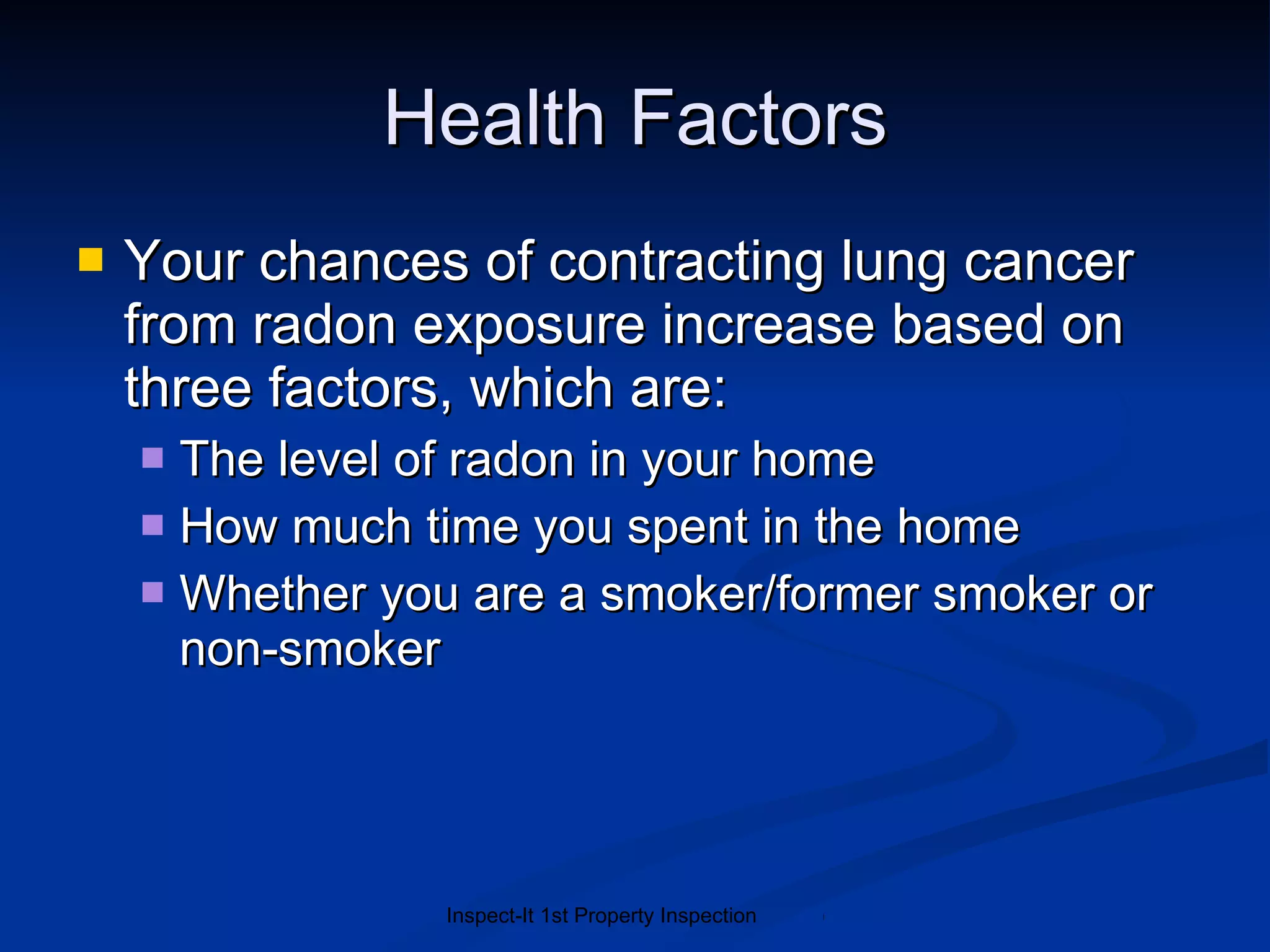
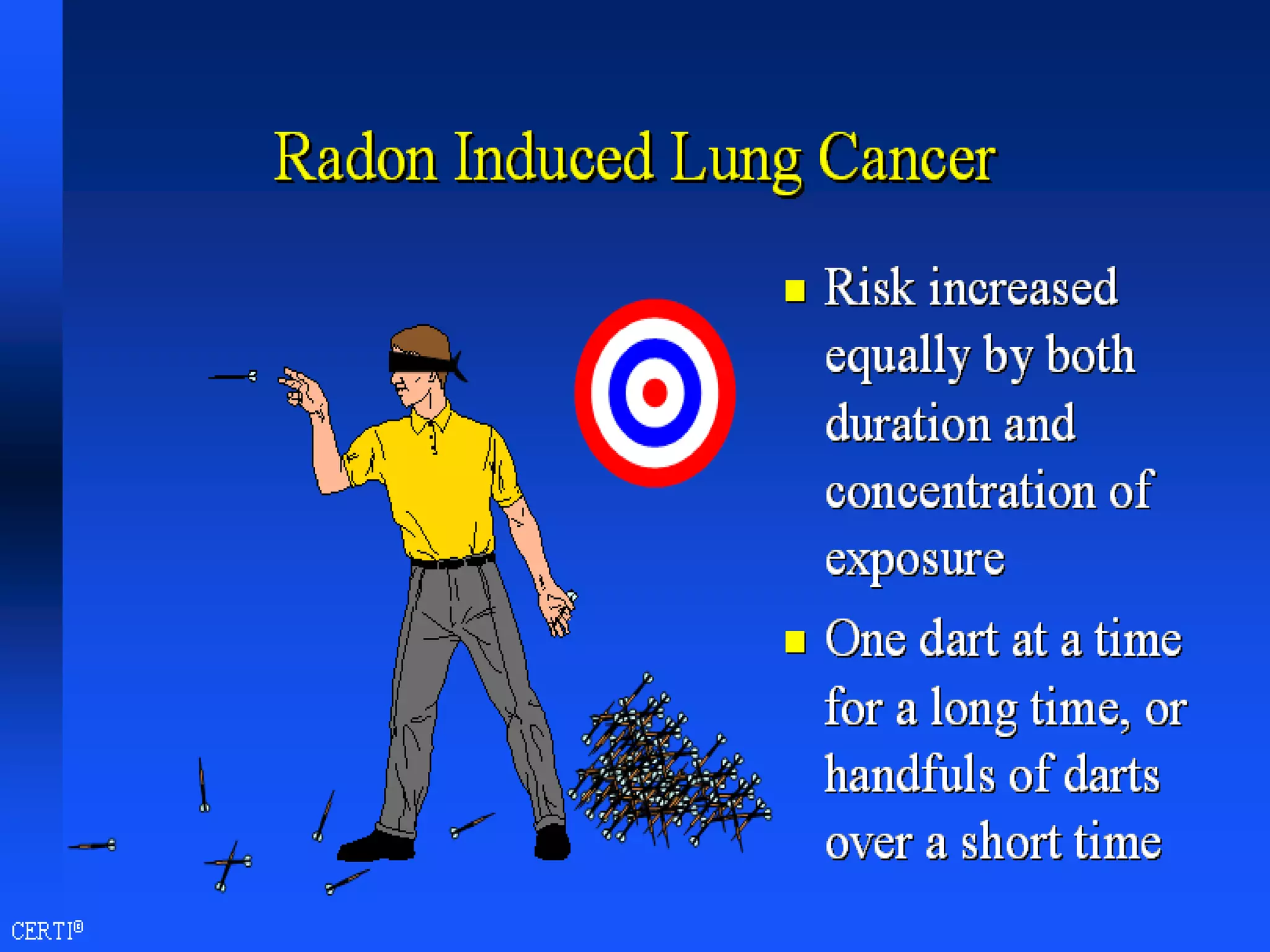
Health Factors Your chances of contracting lung cancer from radon exposure increase based on three factors, which are: The level of radon in your home How much time you spent in the home Whether you are a smoker/former smoker or non-smoker
 
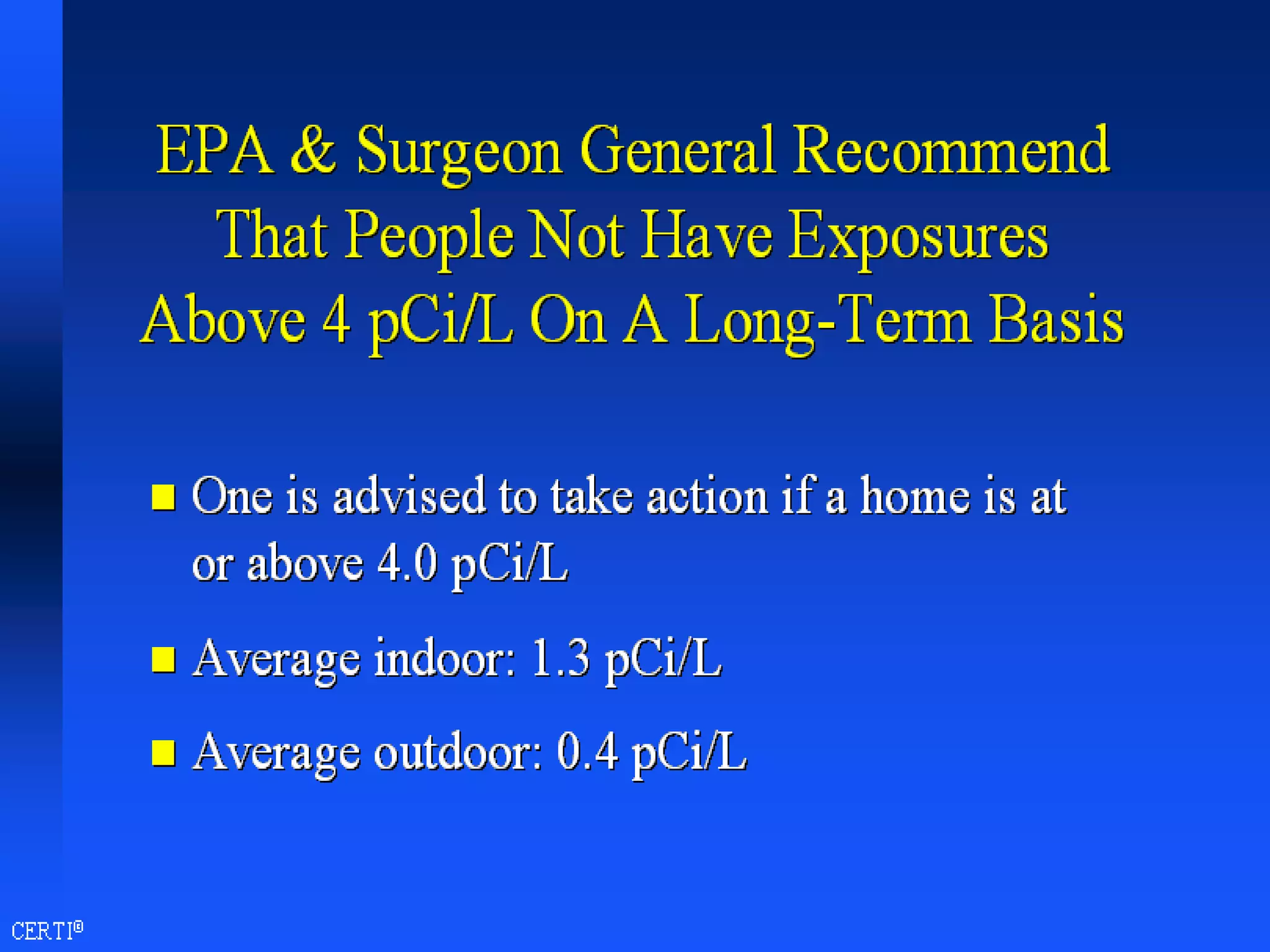
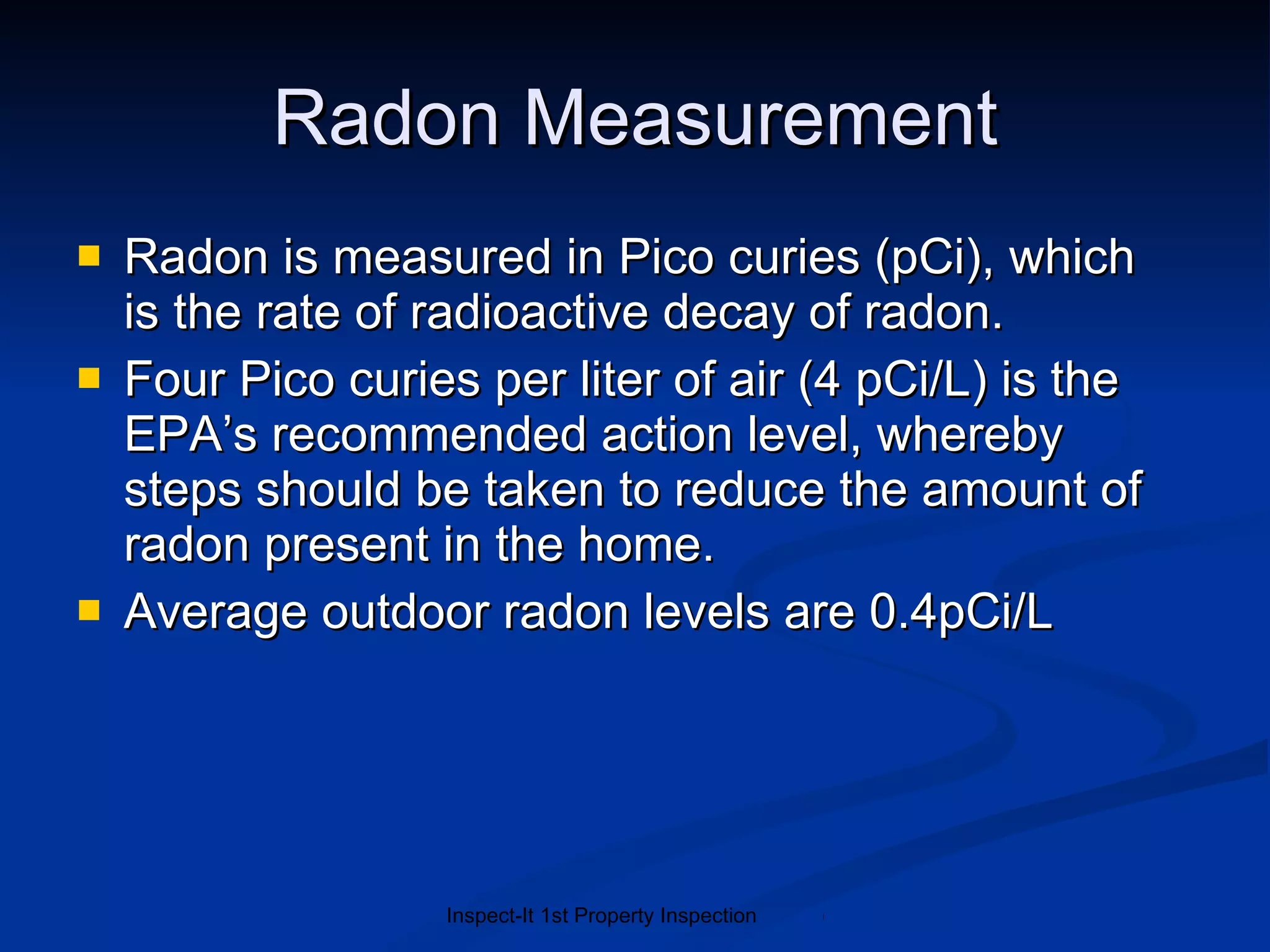
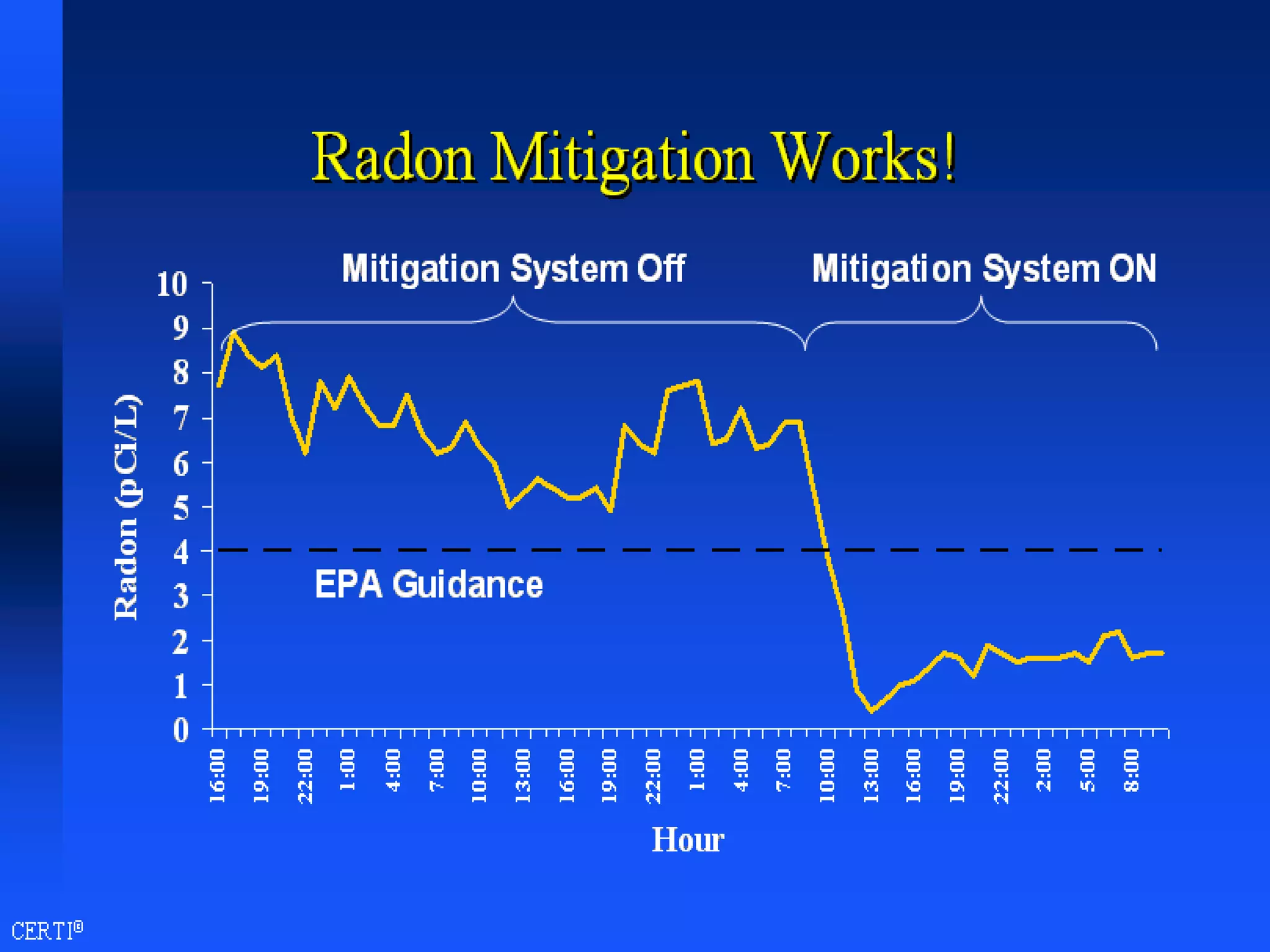
Radon Measurement Radon is measured in Pico curies (pCi), which  is the rate of radioactive decay of radon.   Four Pico curies per liter of air (4 pCi/L) is the EPA’s recommended action level, whereby steps should be taken to reduce the amount of radon present in the home. Average outdoor radon levels are 0.4pCi/L
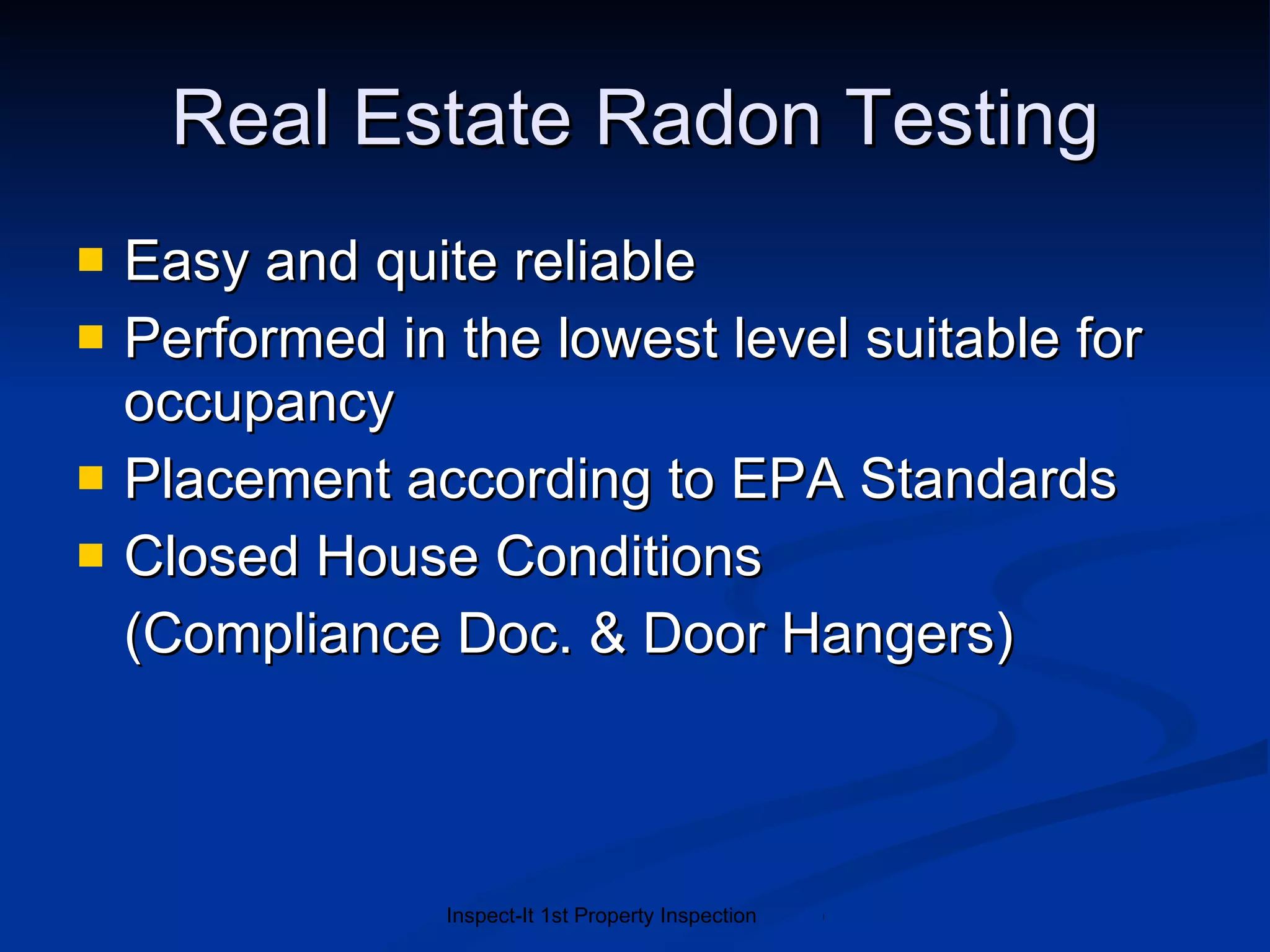
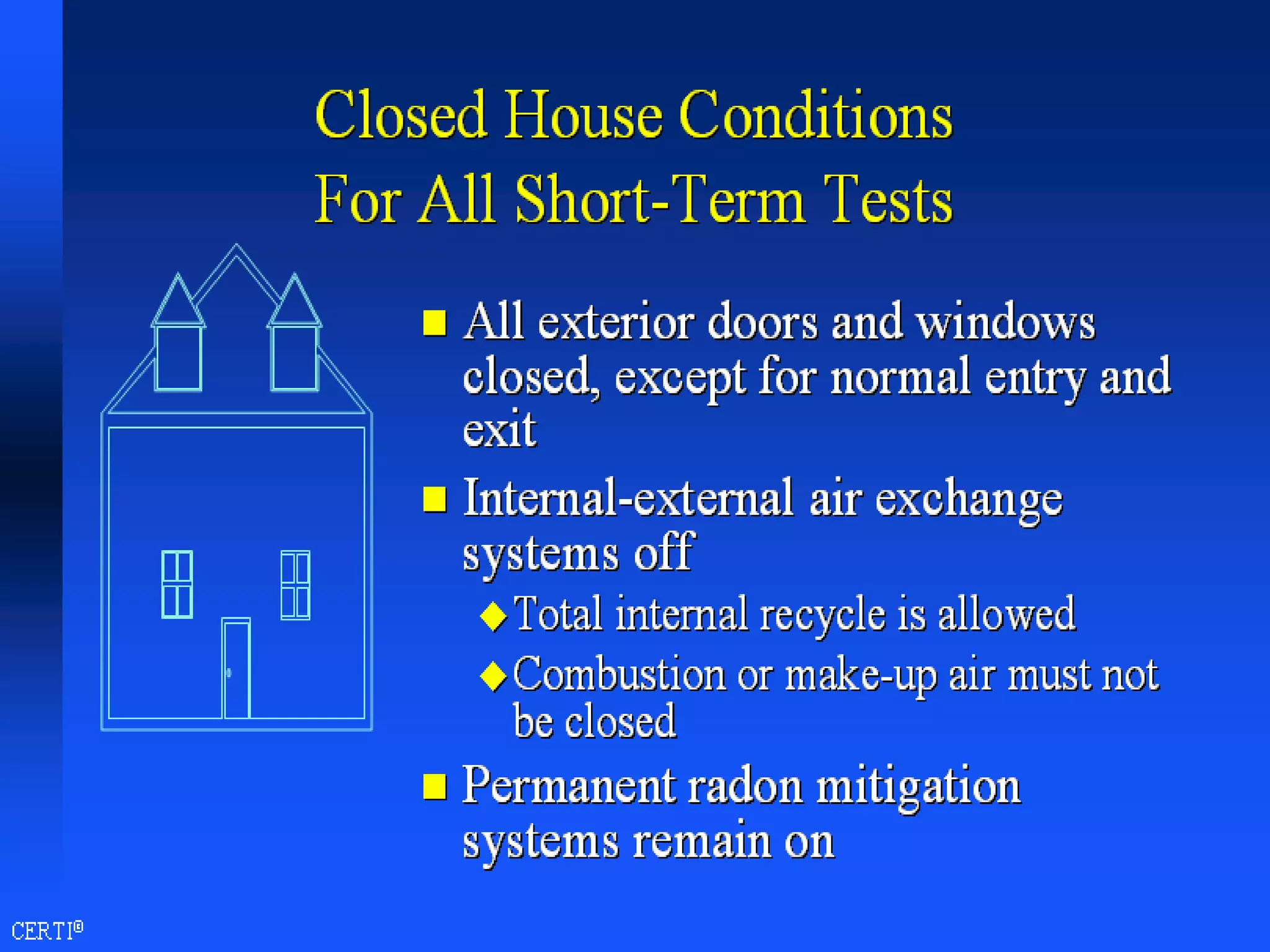
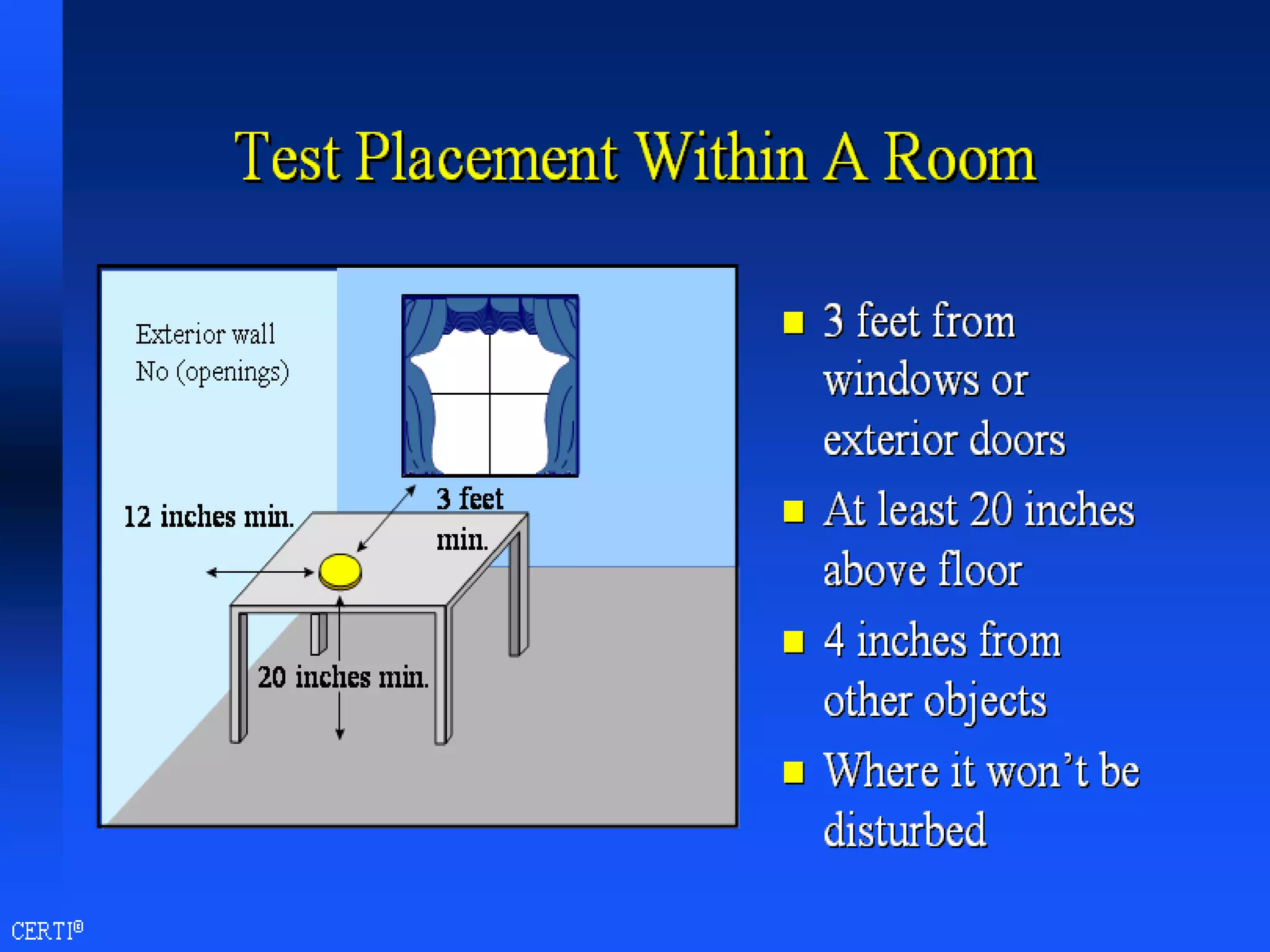
Real Estate Radon Testing Easy and quite reliable Performed in the lowest level suitable for occupancy Placement according to EPA Standards Closed House Conditions (Compliance Doc. & Door Hangers)
 
 
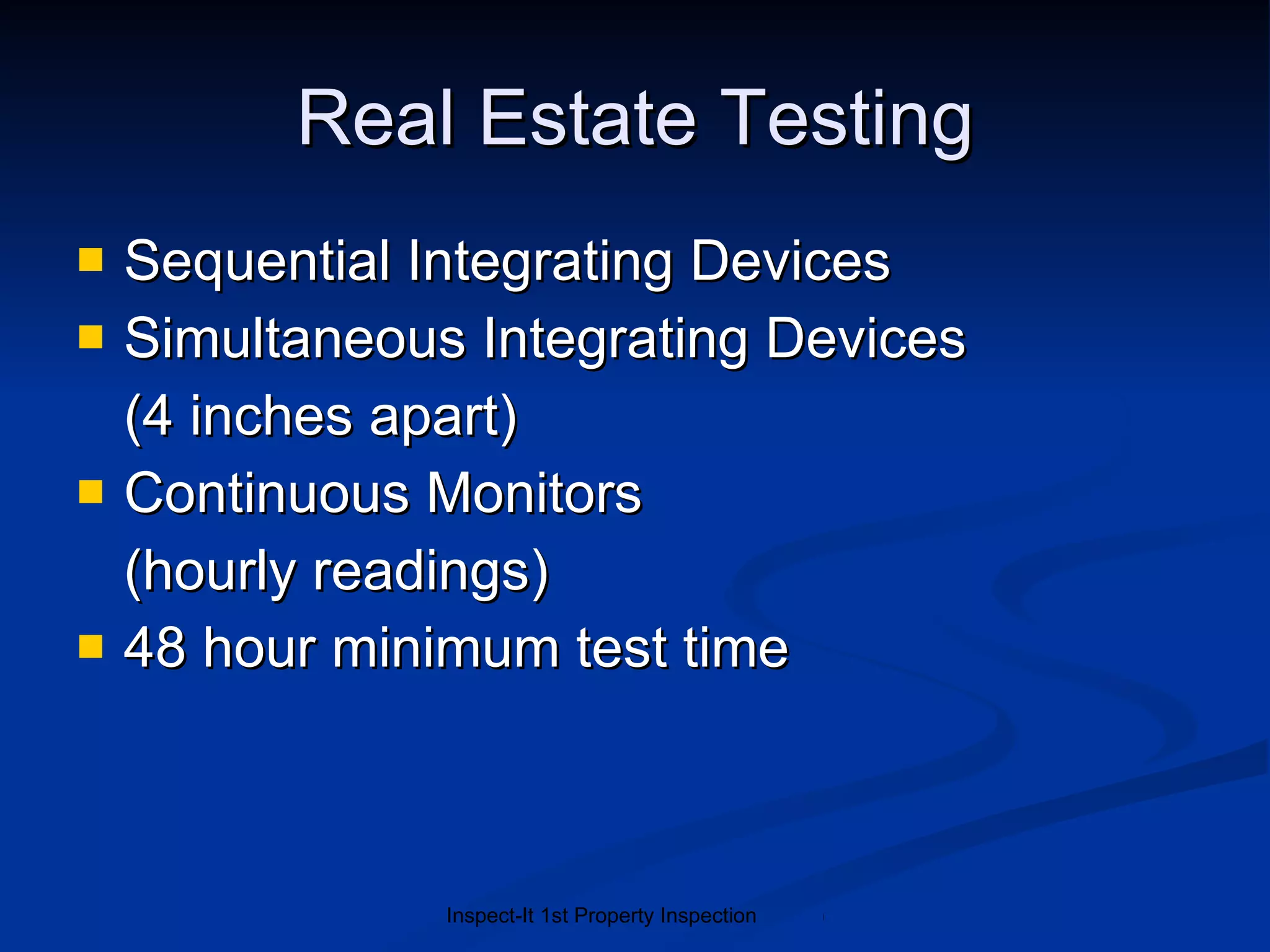
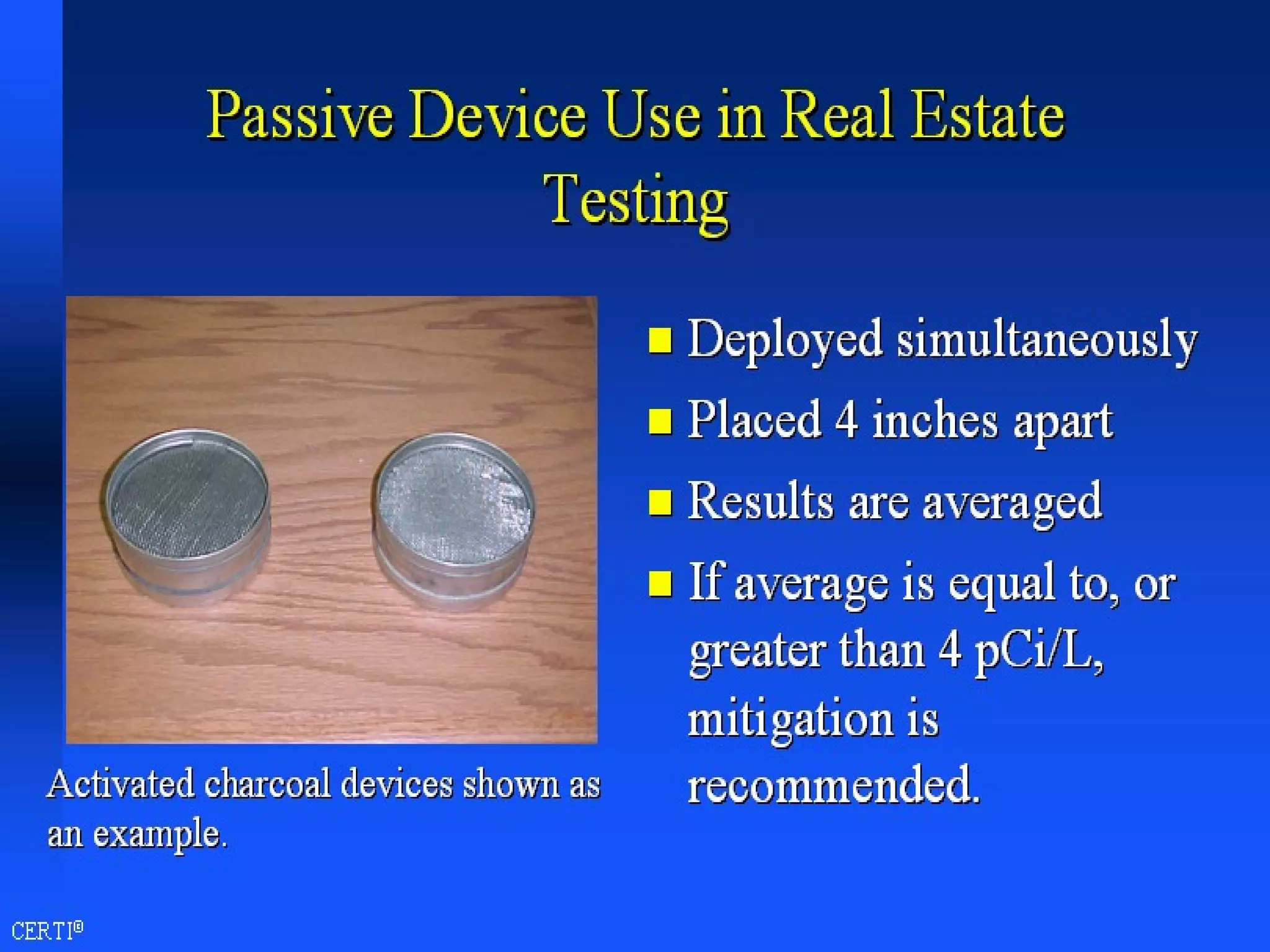
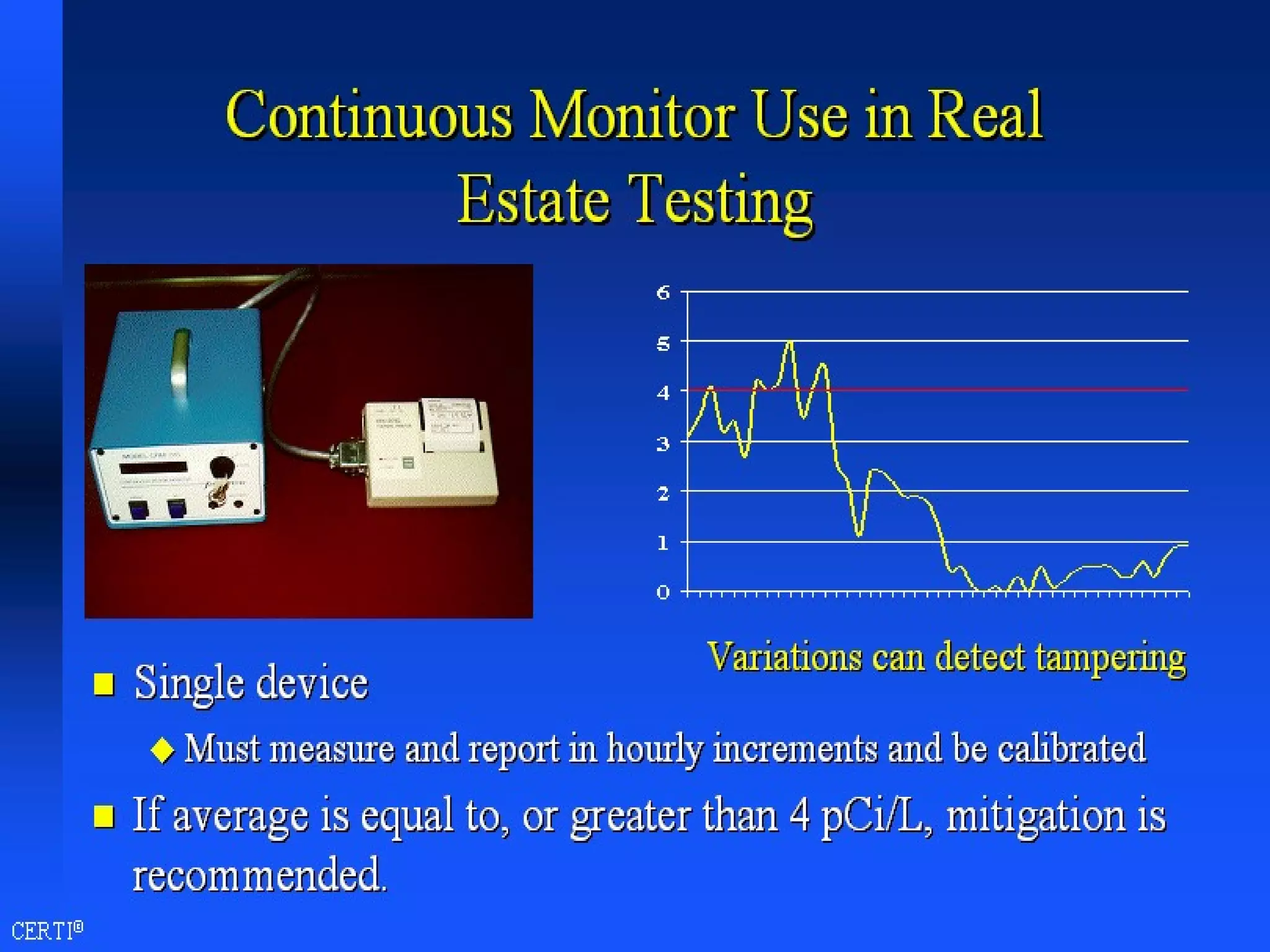
Real Estate Testing Sequential Integrating Devices Simultaneous Integrating Devices (4 inches apart) Continuous Monitors (hourly readings) 48 hour minimum test time
 
 
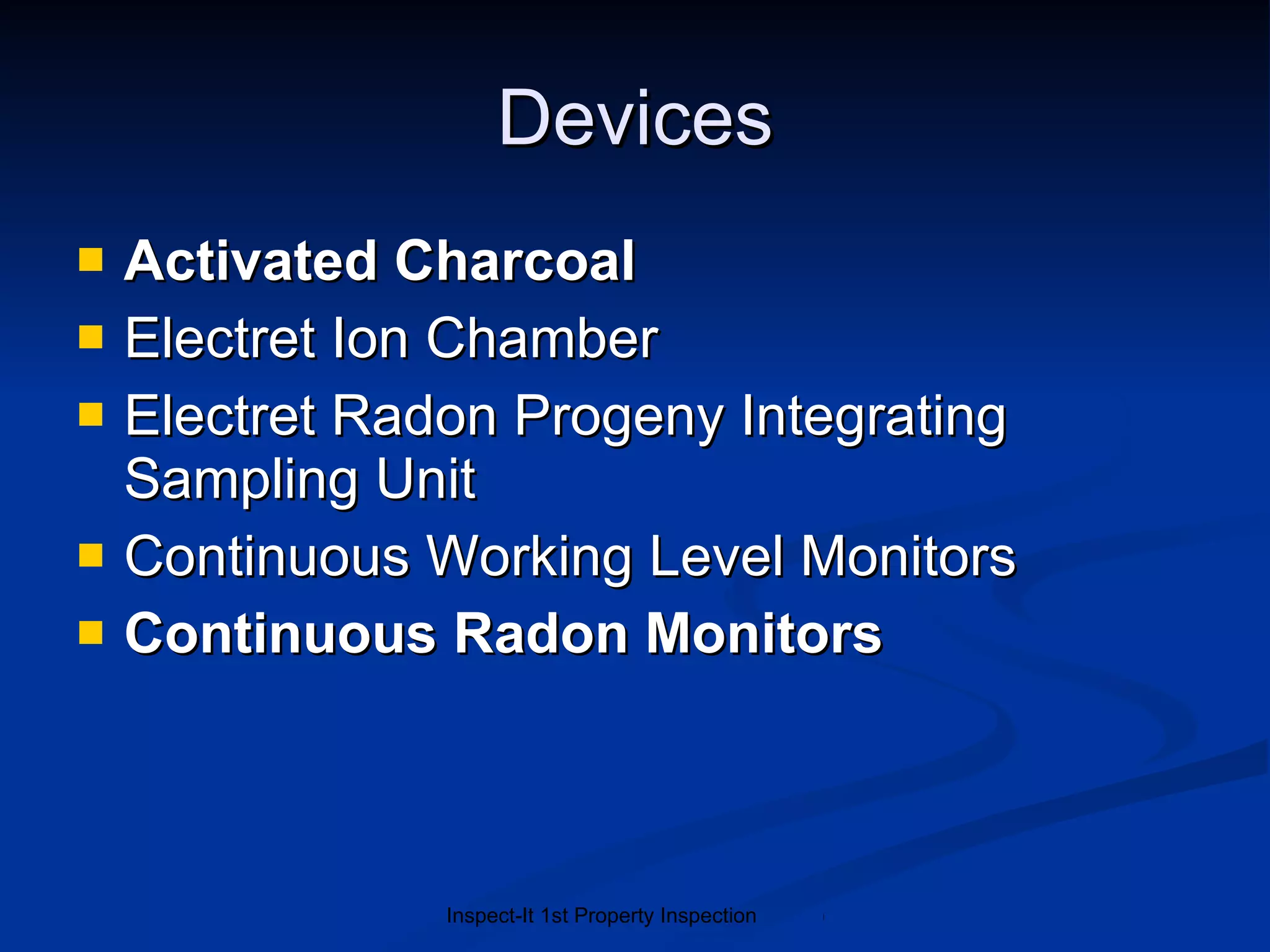
Devices Activated Charcoal Electret Ion Chamber Electret Radon Progeny Integrating Sampling Unit Continuous Working Level Monitors Continuous Radon Monitors
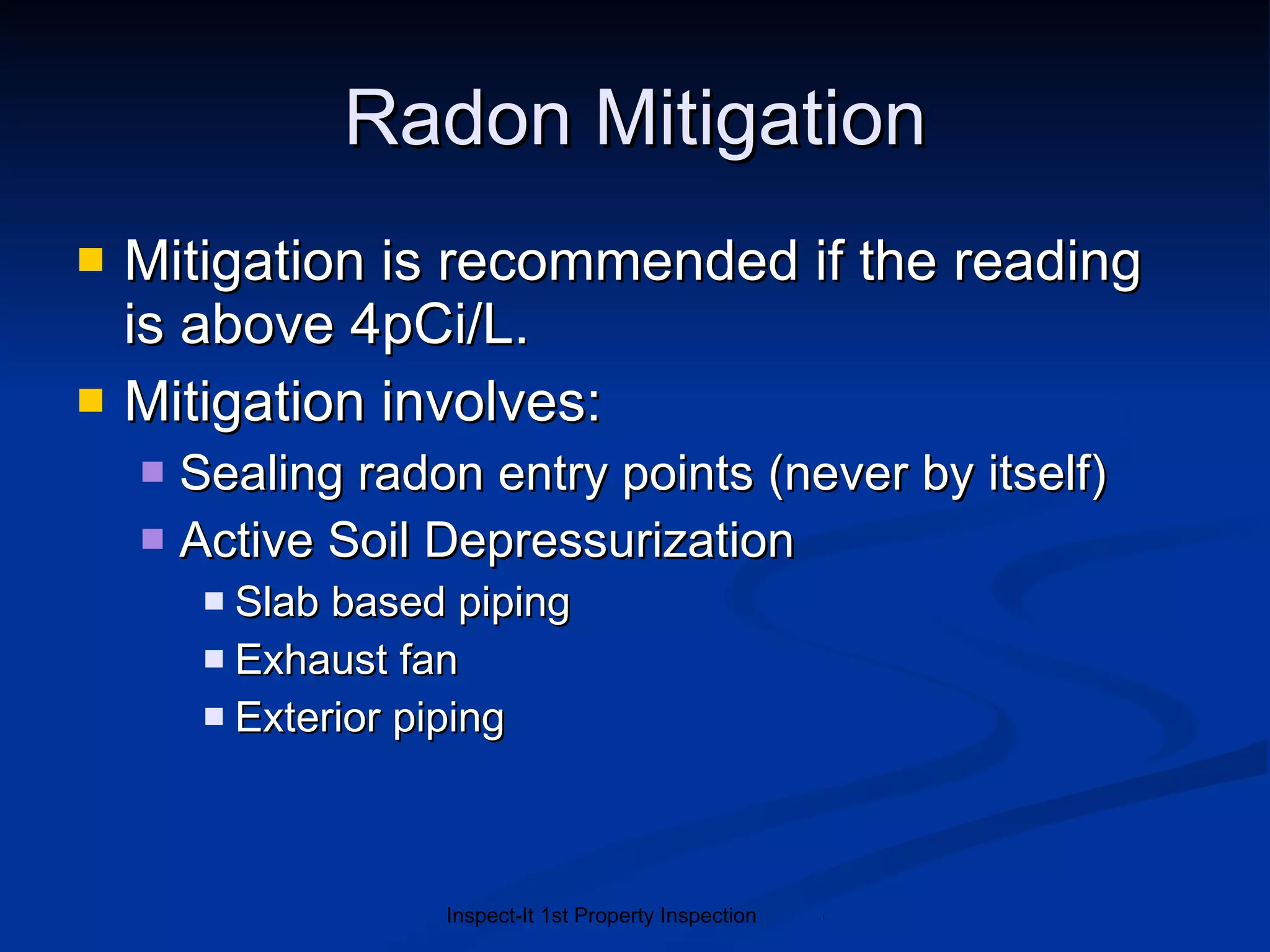
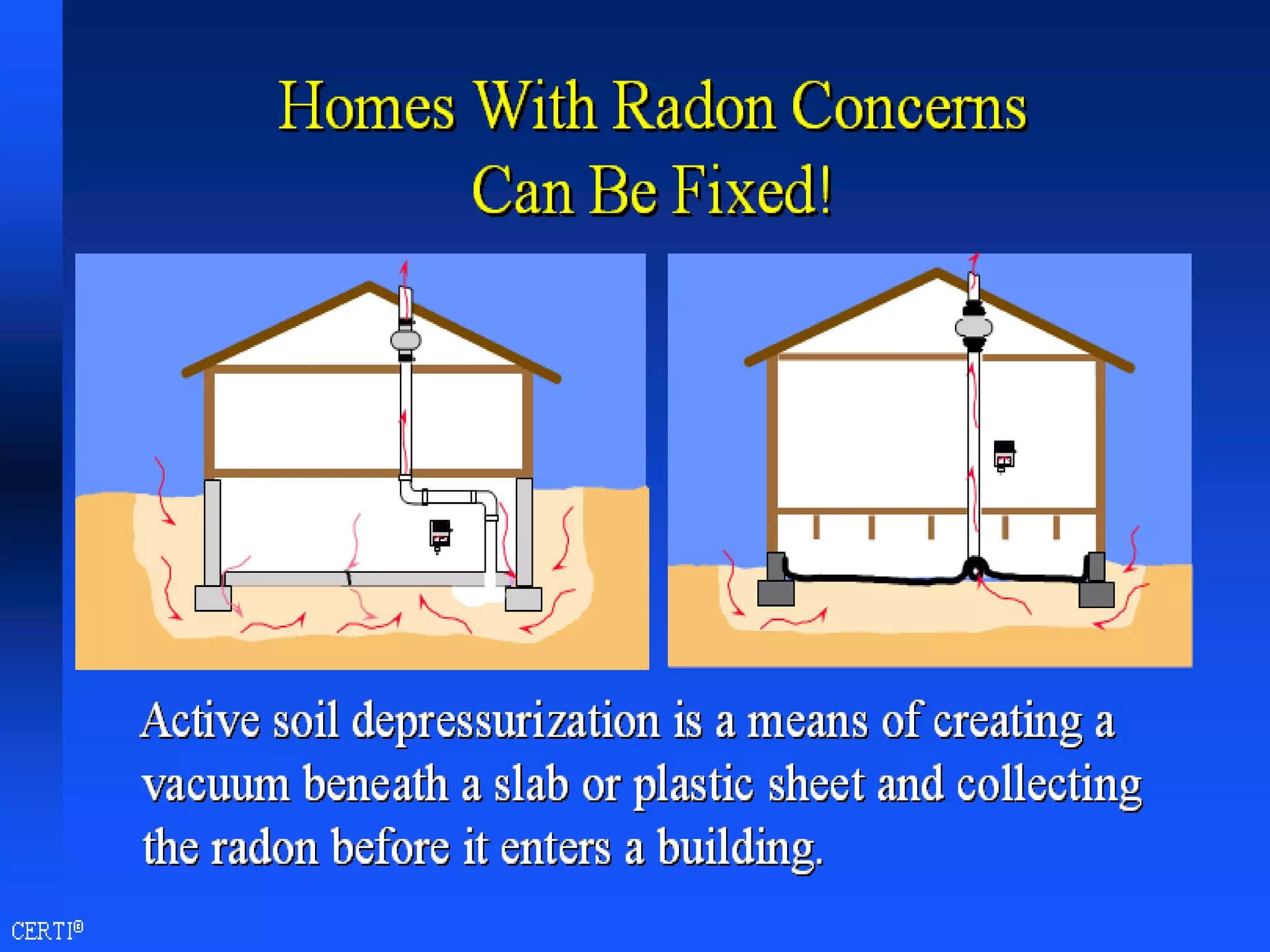
Radon Mitigation Mitigation is recommended if the reading is above 4pCi/L.  Mitigation involves: Sealing radon entry points (never by itself) Active Soil Depressurization Slab based piping Exhaust fan Exterior piping
 
 
Additional Resources Environmental Protection Agency epa.gov Colorado Department of Public Health and Environment http://www.cdphe.state.co.us/hm/rad/radon/index.htm www.tyeagerinspects.com

Radon Presentation

  • 1.
    Tom Yeager Owner/CertifiedInspector NEHA Radon Measurement Cert. # 104169 RT 303-464-9090 www.tyeagerinspects.com
  • 2.
    Radon A PracticalGuide To Radon Detection and Remediation
  • 3.
    Purpose & DisclaimerPurpose Provide BASIC information related to radon definition, detection and remediation Disclaimer Not intended to be all-inclusive or to be used for decision making purposes. Please refer to the “ Additional Resources ” slide for more information.
  • 4.
    What Is Radon?a radioactive gas that is colorless, odorless, tasteless, and chemically inert. Radon atoms are direct descendents from uranium.  When atoms of uranium-238 decay, they produce several generations of other radioactive elements.  The fifth generation is radium, which in turn decays into radon.
  • 5.
  • 6.
    What Is Radon?Radon breaks down into decay products Decay products can be inhaled and have electrostatic charges causing them to sick to lung tissue Further decay releases particles that can damage lung tissue
  • 7.
  • 8.
  • 9.
    Where is RadonFound? Though great concentrations of uranium are rare, traces of it are common in ordinary rock and soil throughout much of the United States.  Zone Maps
  • 10.
  • 11.
    Where is RadonFound? Concentrations vary greatly from place to place depending on the underlying geology. (houses next door to each other) CDPH&E – “four out of 10 Colorado homes have the potential for having radon concentrations in excess of EPA guidelines”
  • 12.
    How Does RadonInvade Homes? Radon is a gas, which means it is very mobile. It is also a single atom, therefore small. It can get into a home via cracks, gaps and openings in floors and walls . Negative pressure in the home or pressures in the underlying soil
  • 13.
  • 14.
    What Are TheHealth Effects? According to the EPA: Estimated to cause about 21,000 deaths per year Second leading cause of lung cancer More deaths than drunk driving Non-smoker, 4 pCi/L over lifetime = 7 out of 1000 could get lung cancer
  • 15.
  • 16.
  • 17.
    Health Factors Yourchances of contracting lung cancer from radon exposure increase based on three factors, which are: The level of radon in your home How much time you spent in the home Whether you are a smoker/former smoker or non-smoker
  • 18.
  • 19.
    Radon Measurement Radonis measured in Pico curies (pCi), which  is the rate of radioactive decay of radon.  Four Pico curies per liter of air (4 pCi/L) is the EPA’s recommended action level, whereby steps should be taken to reduce the amount of radon present in the home. Average outdoor radon levels are 0.4pCi/L
  • 20.
    Real Estate RadonTesting Easy and quite reliable Performed in the lowest level suitable for occupancy Placement according to EPA Standards Closed House Conditions (Compliance Doc. & Door Hangers)
  • 21.
  • 22.
  • 23.
    Real Estate TestingSequential Integrating Devices Simultaneous Integrating Devices (4 inches apart) Continuous Monitors (hourly readings) 48 hour minimum test time
  • 24.
  • 25.
  • 26.
    Devices Activated CharcoalElectret Ion Chamber Electret Radon Progeny Integrating Sampling Unit Continuous Working Level Monitors Continuous Radon Monitors
  • 27.
    Radon Mitigation Mitigationis recommended if the reading is above 4pCi/L. Mitigation involves: Sealing radon entry points (never by itself) Active Soil Depressurization Slab based piping Exhaust fan Exterior piping
  • 28.
  • 29.
  • 30.
    Additional Resources EnvironmentalProtection Agency epa.gov Colorado Department of Public Health and Environment http://www.cdphe.state.co.us/hm/rad/radon/index.htm www.tyeagerinspects.com

Editor's Notes

  • #3 It is a lie made up by the EPA to scare people and give inspectors another revenue stream. What do you know about Radon?
  • #4 CERTIFIED measurement and mitigators Hours of education CERTI slides
  • #15 Show EPA Citizens Guide
  • #18 Coach clients on basement use, Long Term tests, who pays
  • #19 Being exposed to radon does not mean that you will contract lung cancer. To develop lung cancer from radon the radiation released from its decay has to strike a lung cell and within that lung cell it has to strike a specific location. Since the radiation is released in a random manner, the potential for lung cancer increases with exposure, whether that be exposure to a small amount of radon for a long period of time or a high amount of radon for a short period of time. The probability of contracting lung cancer is like a blind folded person tossing darts at dartboard. If the person tosses a single dart at a time, it is probable that it will take a considerable period of time before the person strikes the bulls eye. On the other hand, if the person throws a handful of darts at a time, it is likely that less time will pass before the person strikes the bulls eye.
  • #22 “Voluntary” Compliance How YOU, the agent, can help
  • #23 Why we are CERTIFIED
  • #26 Show Report Certified on CRMs I am the lab