Applications of Nuclear Energy


 Electric Power Generation
 Medicine
 Scientific Research
 Food & Agriculture
 Consumer Products
 Industrial Applications
 Space


Page  2
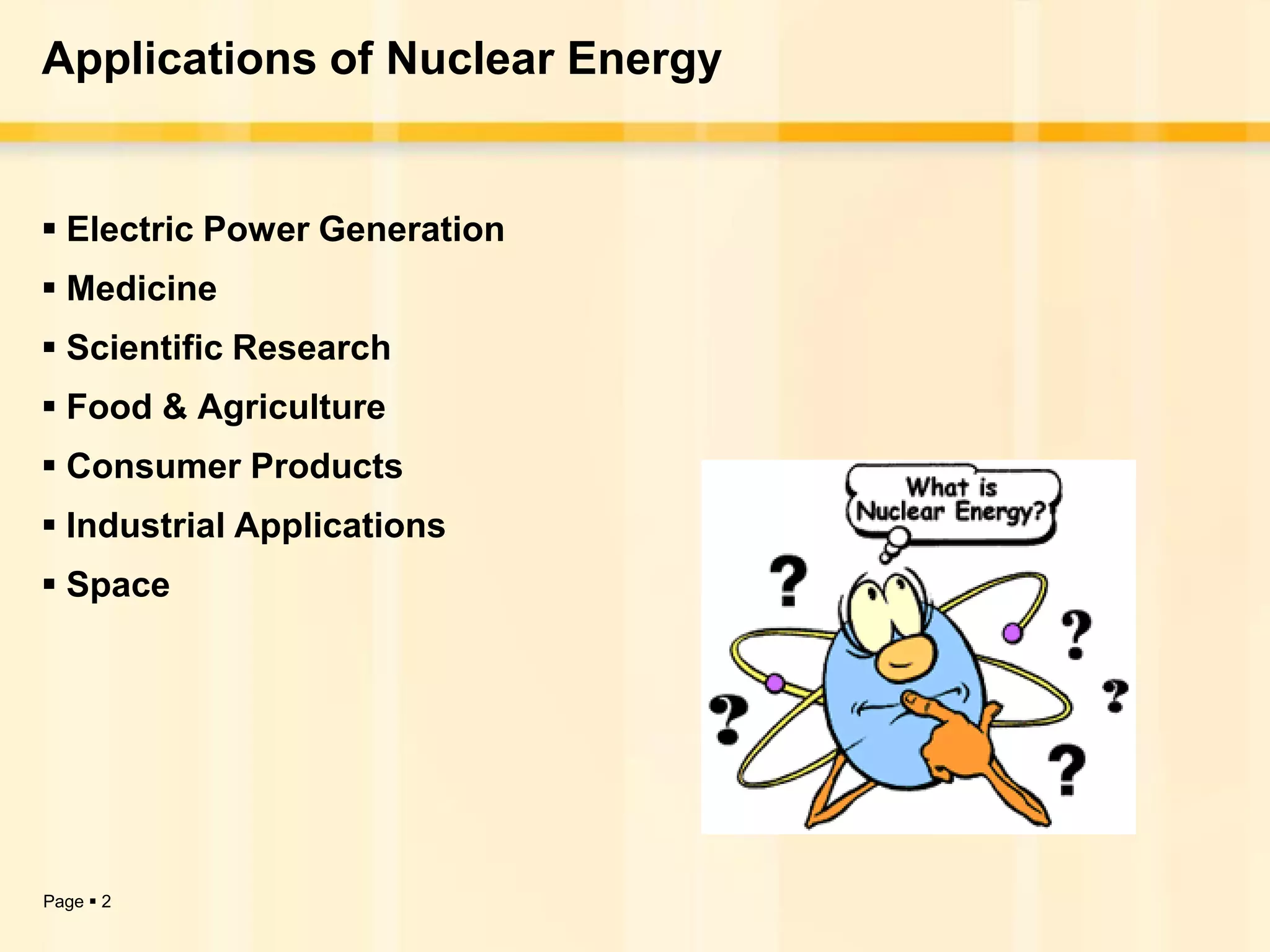
Nuclear Fission


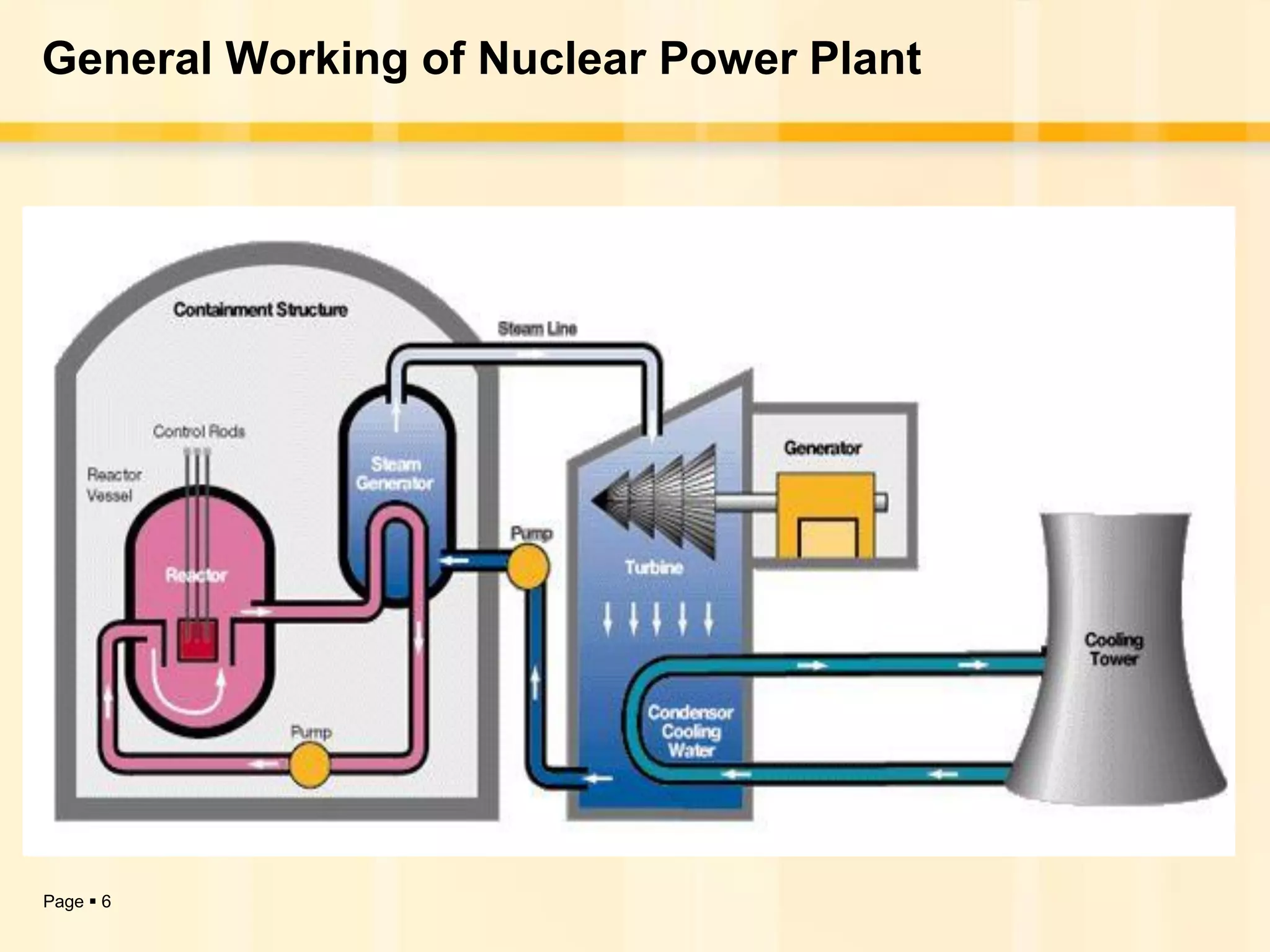
 Nuclear plants produce electricity by boiling water into steam.


 This steam then turns turbines to produce electricity.


 The difference is that nuclear plants do not burn anything.


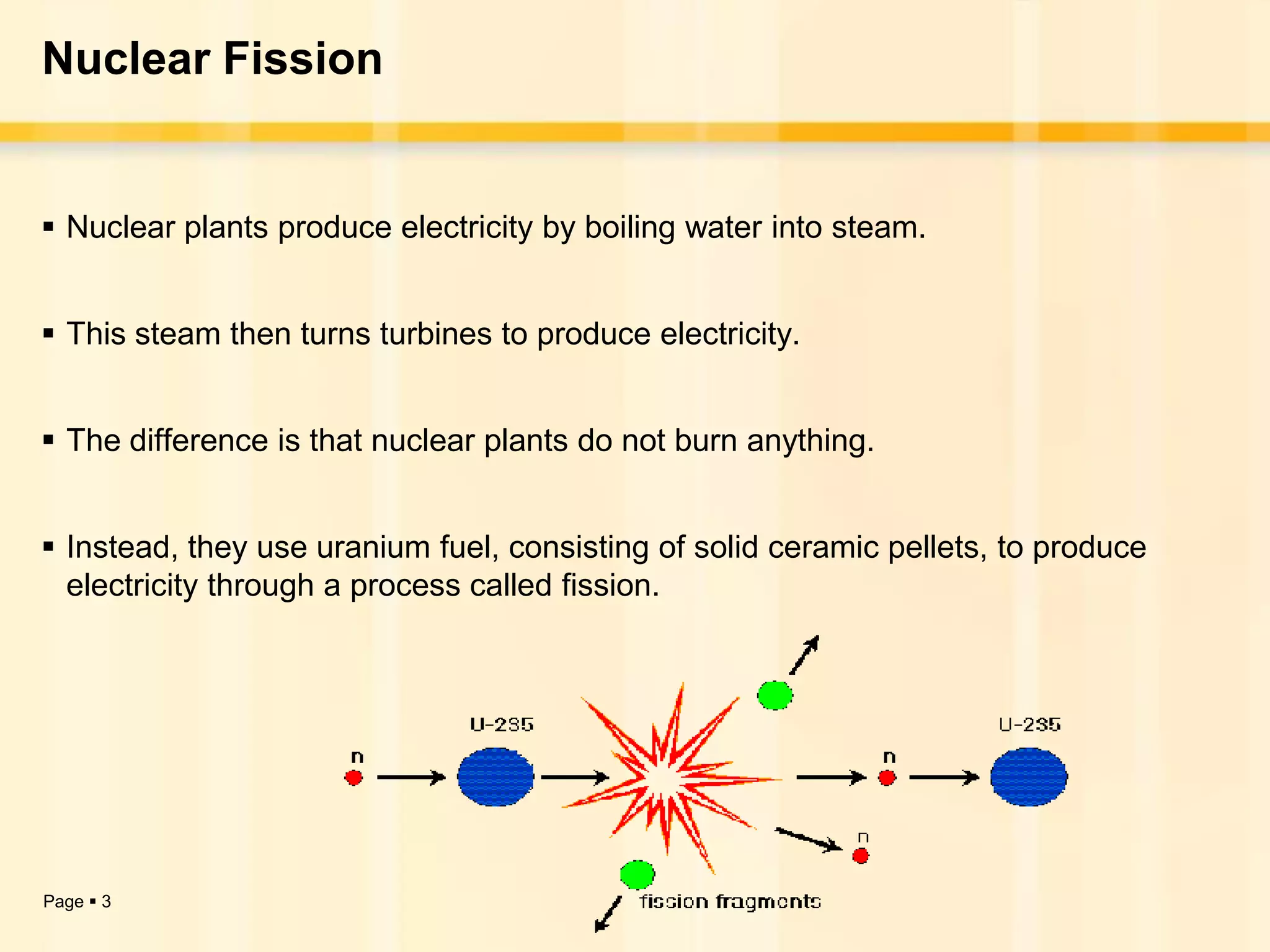
 Instead, they use uranium fuel, consisting of solid ceramic pellets, to produce
  electricity through a process called fission.


Page  3
Nuclear Fusion Process


 It is called 'fusion' because it is based on fusing light nuclei such as hydrogen
  isotopes to release energy, similar to that which powers the sun and other stars.
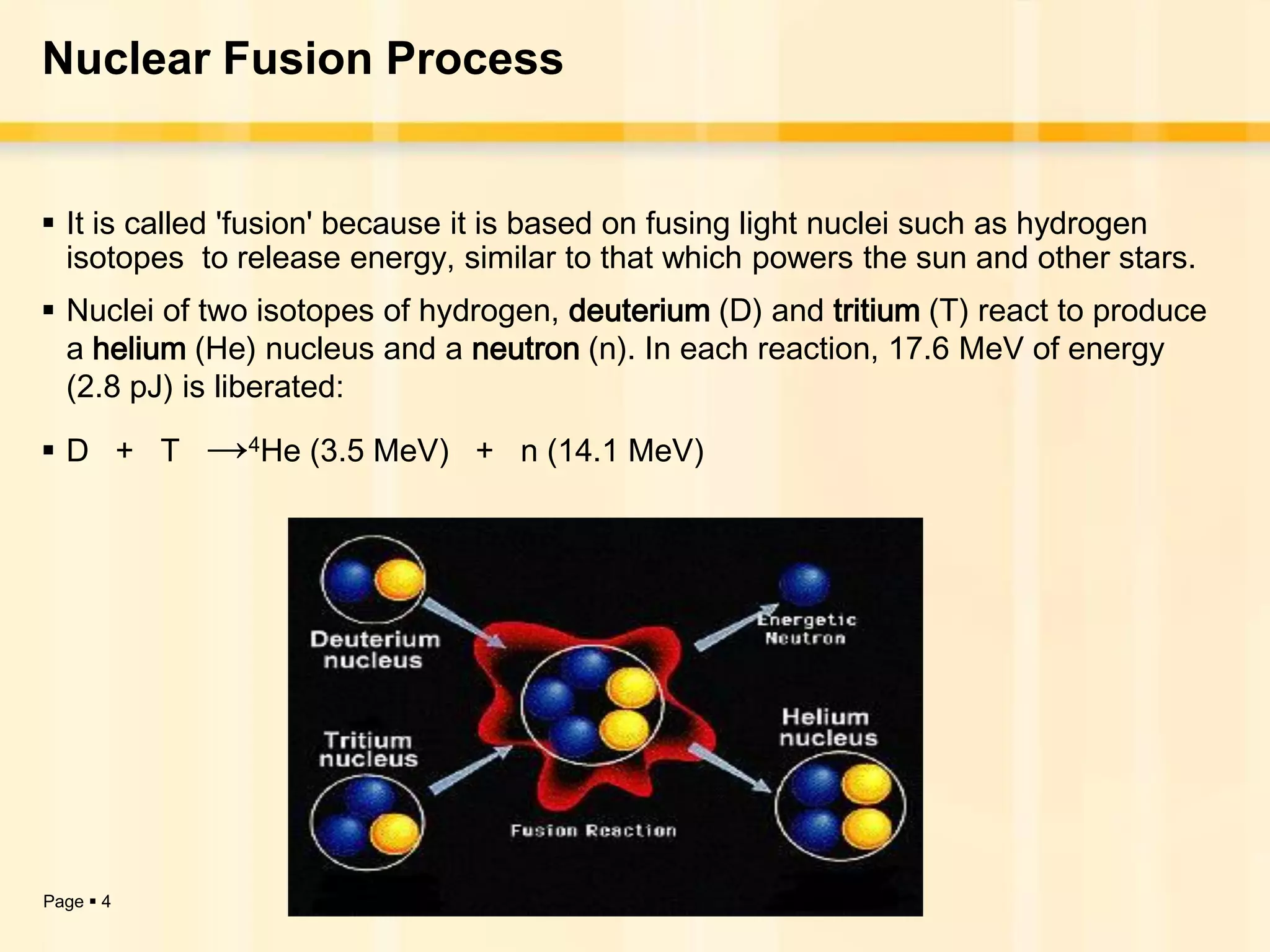
 Nuclei of two isotopes of hydrogen, deuterium (D) and tritium (T) react to produce
  a helium (He) nucleus and a neutron (n). In each reaction, 17.6 MeV of energy
  (2.8 pJ) is liberated:

D + T     →4He (3.5 MeV)      + n (14.1 MeV)


Page  4
Nuclear Energy Scenario

 435 Nuclear Power plants worldwide

 1/6 of the worlds power is nuclear

 France 76%, Belgium 56%, South Korea 36%, Switzerland 40%, Sweden 47%,
  Finland 30%, Japan 33%, United Kingdom 25%, Bulgaria 46%, Hungry 42%,
  United States 20%

 WEC energy consumption doubled by 2050

 World will turn to Fission Energy

 Produces very small amount of spent fuel

 6yrs of operation, 4-meter cube

 Recyclable
Page  5
General Working of Nuclear Power Plant


Page  6
Medical


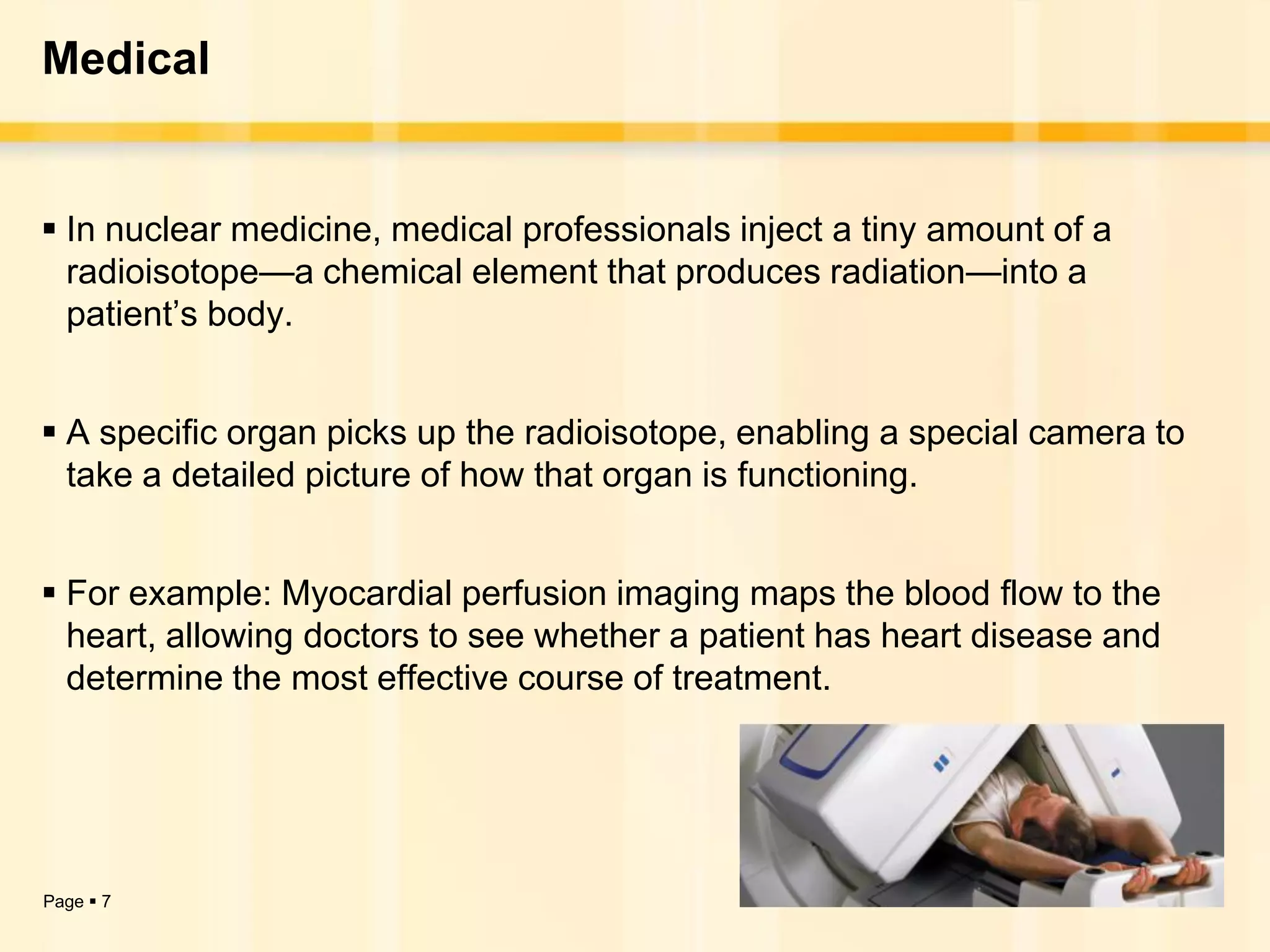
 In nuclear medicine, medical professionals inject a tiny amount of a
  radioisotope—a chemical element that produces radiation—into a
  patient’s body.


 A specific organ picks up the radioisotope, enabling a special camera to
  take a detailed picture of how that organ is functioning.


 For example: Myocardial perfusion imaging maps the blood flow to the
  heart, allowing doctors to see whether a patient has heart disease and
  determine the most effective course of treatment.


Page  7
Medical


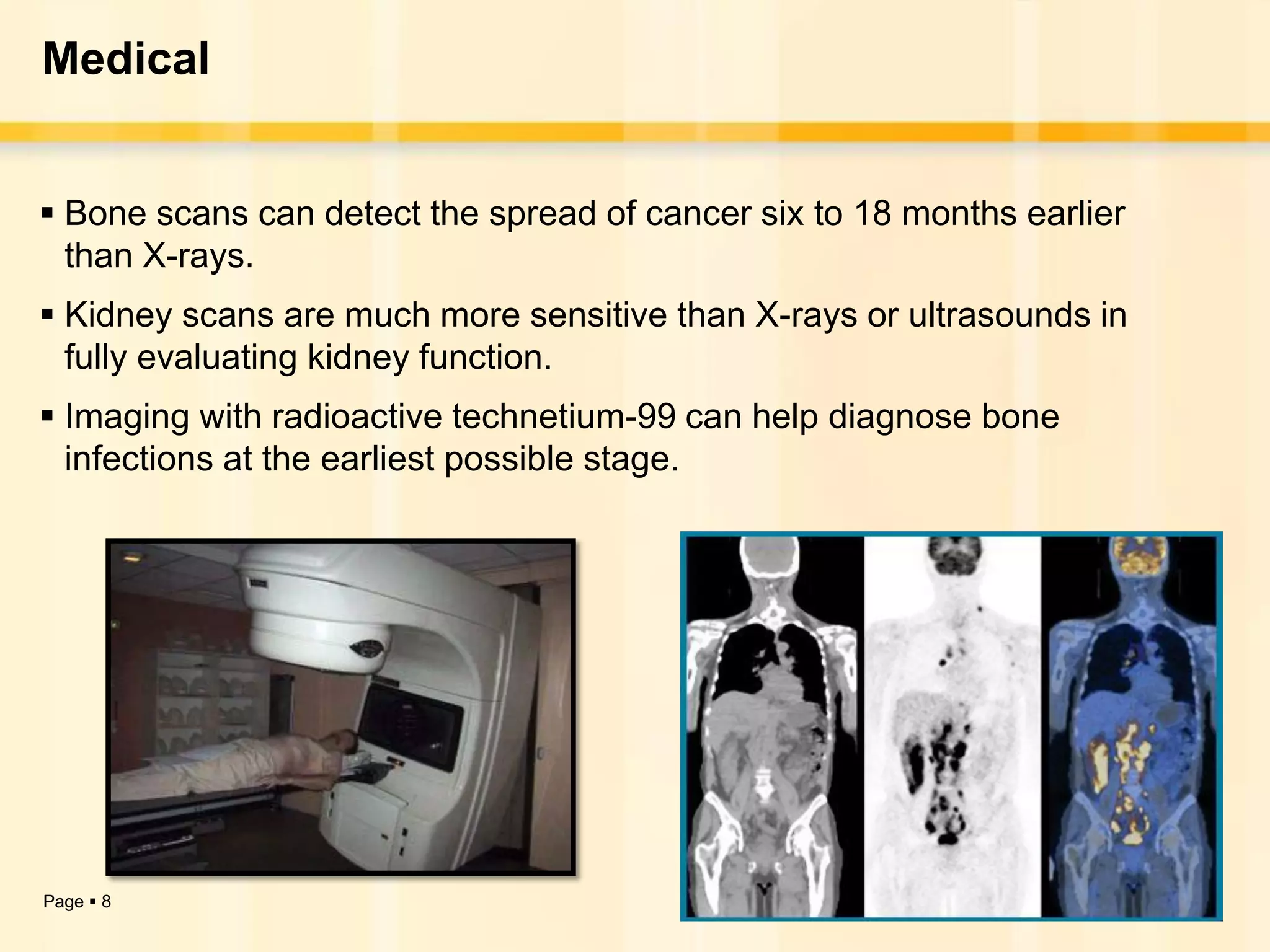
 Bone scans can detect the spread of cancer six to 18 months earlier
  than X-rays.
 Kidney scans are much more sensitive than X-rays or ultrasounds in
  fully evaluating kidney function.
 Imaging with radioactive technetium-99 can help diagnose bone
  infections at the earliest possible stage.


Page  8
Research


 The U.S. Food and Drug Administration requires all new drugs to be
  tested for safety and effectiveness. More than 80 percent of those drugs
  are tested with radioisotopes.


 Radioisotopes also are essential to the biomedical research that seeks
  causes and cures for diseases such as AIDS, Cancer and Alzheimer’s
  disease.


 Researchers also use radioisotopes in metabolic studies, genetic
  engineering and environmental protection studies.


 Carbon-14, a naturally occurring, long-lived radioactive substance, allows
  archaeologists to determine when artefacts containing plant or animal
  material were alive, created or used.
Page  9
Food & Agriculture


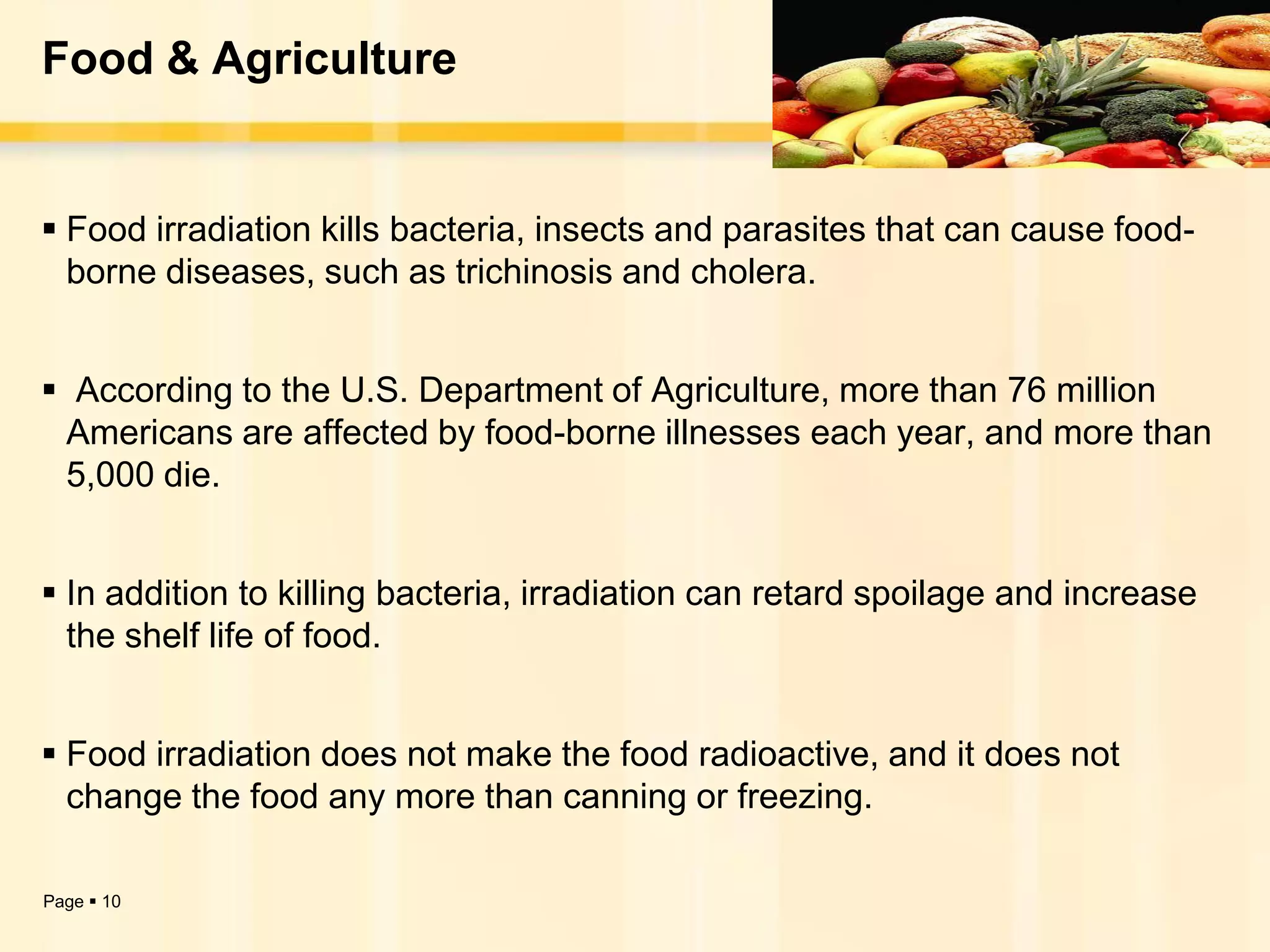
 Food irradiation kills bacteria, insects and parasites that can cause food-
  borne diseases, such as trichinosis and cholera.


 According to the U.S. Department of Agriculture, more than 76 million
 Americans are affected by food-borne illnesses each year, and more than
 5,000 die.


 In addition to killing bacteria, irradiation can retard spoilage and increase
  the shelf life of food.


 Food irradiation does not make the food radioactive, and it does not
  change the food any more than canning or freezing.

Page  10
Food & Agriculture


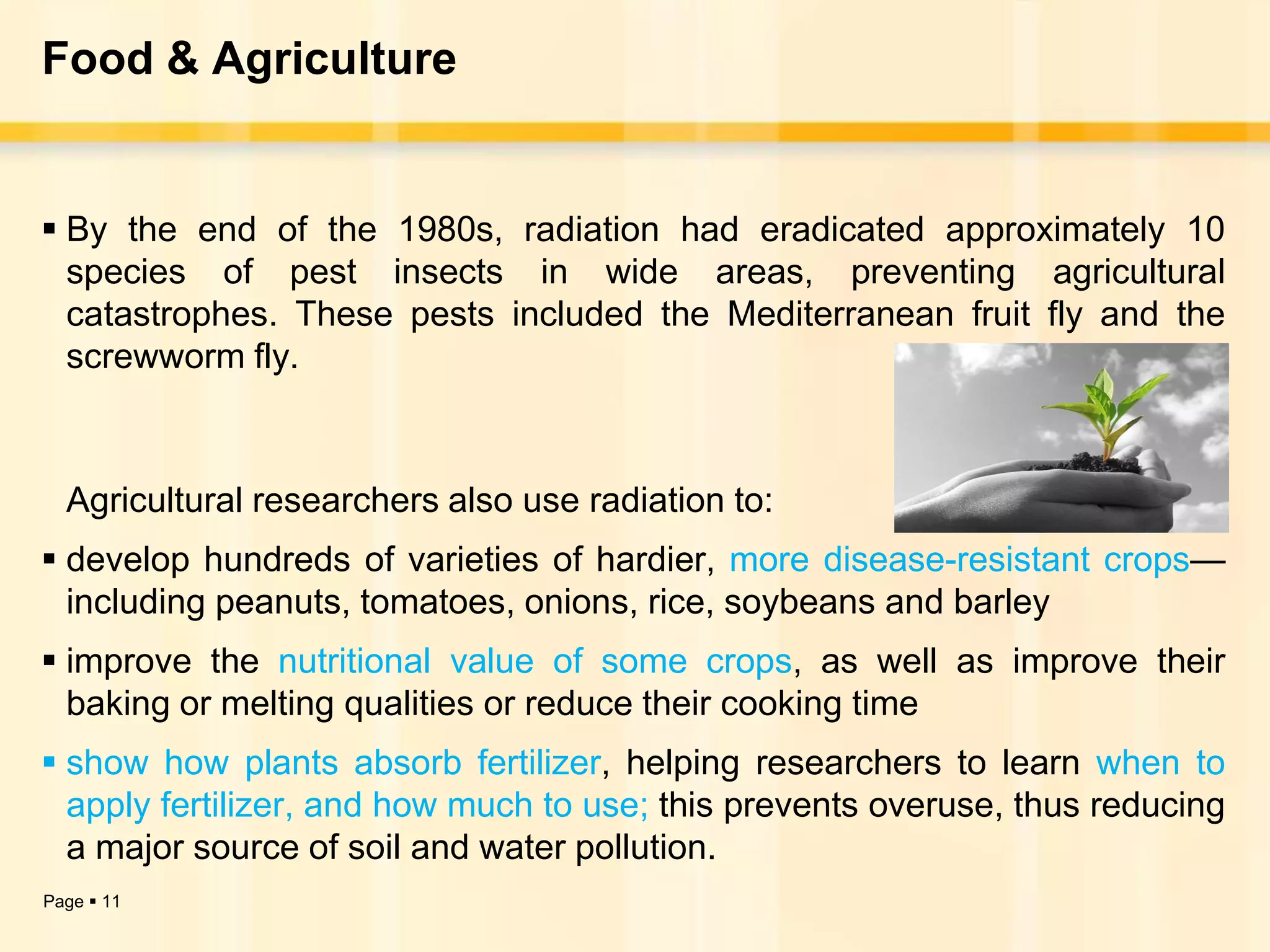
 By the end of the 1980s, radiation had eradicated approximately 10
  species of pest insects in wide areas, preventing agricultural
  catastrophes. These pests included the Mediterranean fruit fly and the
  screwworm fly.


  Agricultural researchers also use radiation to:
 develop hundreds of varieties of hardier, more disease-resistant crops—
  including peanuts, tomatoes, onions, rice, soybeans and barley
 improve the nutritional value of some crops, as well as improve their
  baking or melting qualities or reduce their cooking time
 show how plants absorb fertilizer, helping researchers to learn when to
  apply fertilizer, and how much to use; this prevents overuse, thus reducing
  a major source of soil and water pollution.
Page  11
Consumer Products


Smoke Detector
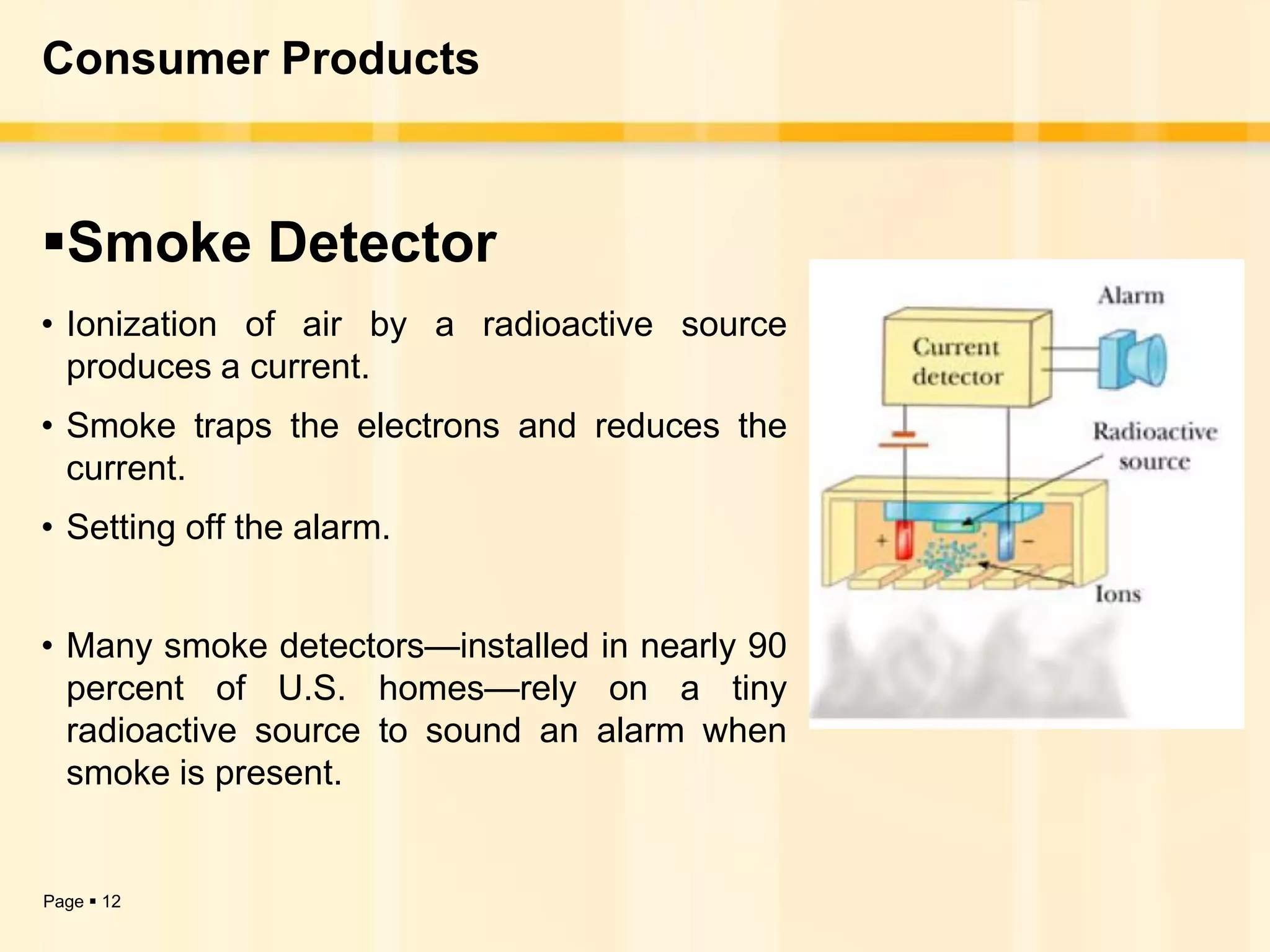
• Ionization of air by a radioactive source
  produces a current.
• Smoke traps the electrons and reduces the
  current.
• Setting off the alarm.


• Many smoke detectors—installed in nearly 90
  percent of U.S. homes—rely on a tiny
  radioactive source to sound an alarm when
  smoke is present.


Page  12
Consumer Products


 Watches and clocks that “glow in the dark” use a small quantity of a radioisotope
  as a source of light.


 Computer disks “remember” data better when treated with radioisotopes


 Treating nonstick pans with radiation ensures that the coating will stick to the
  surface


 Photocopiers use small amounts of radiation to eliminate static and prevent paper
  from sticking together and jamming the machine


 Radiation sterilizes cosmetics, hair products and contact lens solutions, removing
  irritants and allergens Radiation sterilizes medical bandages and a variety of
  personal health and hygiene products.
Page  13
Industrial Applications


 The industries that use radioisotopes include:
  ―The automobile industry, to test the quality of steel in vehicles
  ―Aircraft manufacturers, to check for flaws in jet engines
  ―Mining and petroleum companies, to locate and quantify oil,
   natural gas and mineral deposits
  ―Can manufacturers, to obtain the proper thickness of tin and
   aluminum
  ―Pipeline companies, to look for defects in welds
  ―Construction crews, to gauge the density of road surfaces and
   subsurfaces.


Page  14
Space


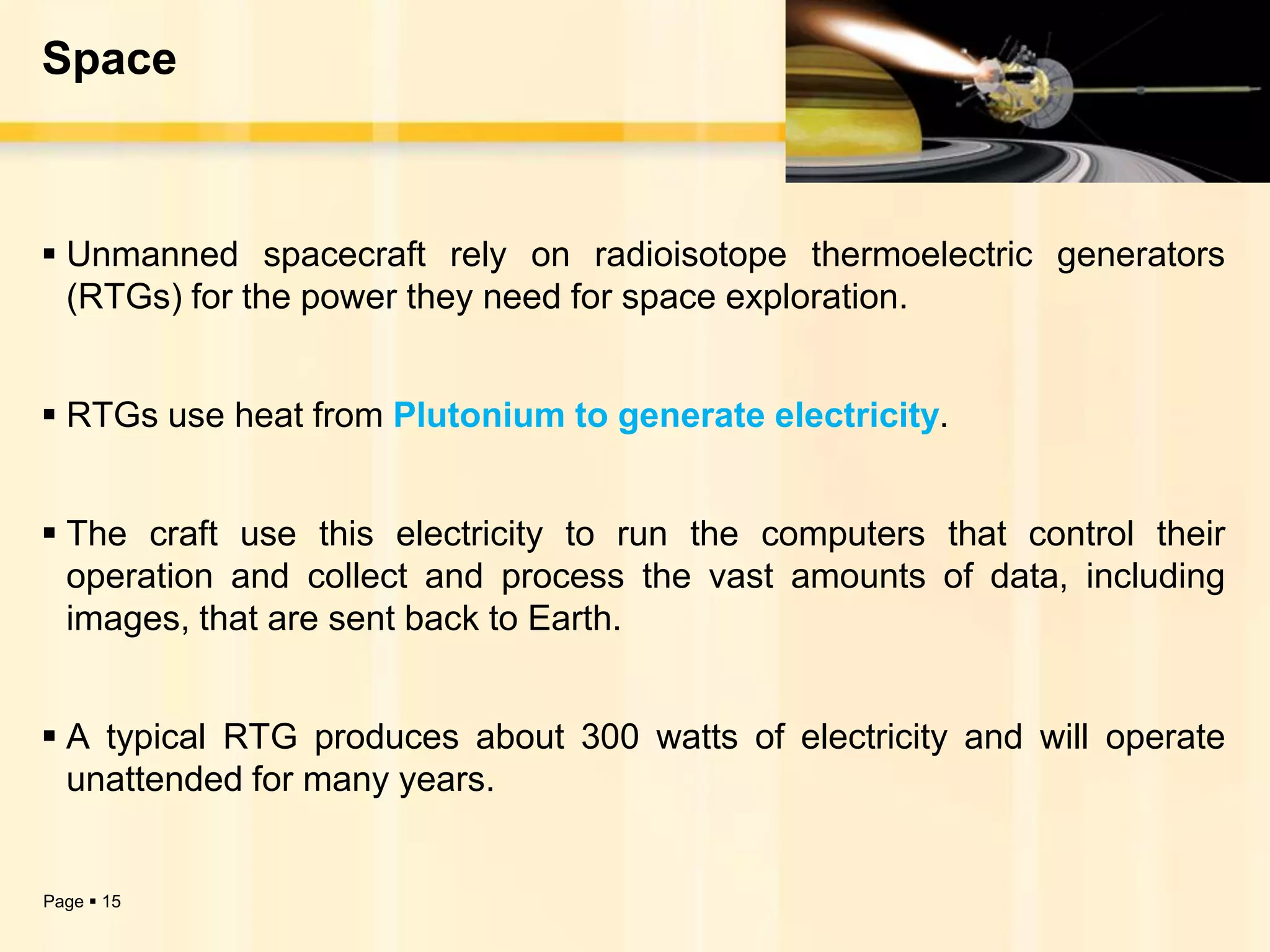
 Unmanned spacecraft rely on radioisotope thermoelectric generators
  (RTGs) for the power they need for space exploration.


 RTGs use heat from Plutonium to generate electricity.


 The craft use this electricity to run the computers that control their
  operation and collect and process the vast amounts of data, including
  images, that are sent back to Earth.


 A typical RTG produces about 300 watts of electricity and will operate
  unattended for many years.


Page  15
Page  16

Nuclear Energy Applications

  • 2.
    Applications of NuclearEnergy  Electric Power Generation  Medicine  Scientific Research  Food & Agriculture  Consumer Products  Industrial Applications  Space Page  2
  • 3.
    Nuclear Fission  Nuclearplants produce electricity by boiling water into steam.  This steam then turns turbines to produce electricity.  The difference is that nuclear plants do not burn anything.  Instead, they use uranium fuel, consisting of solid ceramic pellets, to produce electricity through a process called fission. Page  3
  • 4.
    Nuclear Fusion Process It is called 'fusion' because it is based on fusing light nuclei such as hydrogen isotopes to release energy, similar to that which powers the sun and other stars.  Nuclei of two isotopes of hydrogen, deuterium (D) and tritium (T) react to produce a helium (He) nucleus and a neutron (n). In each reaction, 17.6 MeV of energy (2.8 pJ) is liberated: D + T →4He (3.5 MeV) + n (14.1 MeV) Page  4
  • 5.
    Nuclear Energy Scenario 435 Nuclear Power plants worldwide  1/6 of the worlds power is nuclear  France 76%, Belgium 56%, South Korea 36%, Switzerland 40%, Sweden 47%, Finland 30%, Japan 33%, United Kingdom 25%, Bulgaria 46%, Hungry 42%, United States 20%  WEC energy consumption doubled by 2050  World will turn to Fission Energy  Produces very small amount of spent fuel  6yrs of operation, 4-meter cube  Recyclable Page  5
  • 6.
    General Working ofNuclear Power Plant Page  6
  • 7.
    Medical  In nuclearmedicine, medical professionals inject a tiny amount of a radioisotope—a chemical element that produces radiation—into a patient’s body.  A specific organ picks up the radioisotope, enabling a special camera to take a detailed picture of how that organ is functioning.  For example: Myocardial perfusion imaging maps the blood flow to the heart, allowing doctors to see whether a patient has heart disease and determine the most effective course of treatment. Page  7
  • 8.
    Medical  Bone scanscan detect the spread of cancer six to 18 months earlier than X-rays.  Kidney scans are much more sensitive than X-rays or ultrasounds in fully evaluating kidney function.  Imaging with radioactive technetium-99 can help diagnose bone infections at the earliest possible stage. Page  8
  • 9.
    Research  The U.S.Food and Drug Administration requires all new drugs to be tested for safety and effectiveness. More than 80 percent of those drugs are tested with radioisotopes.  Radioisotopes also are essential to the biomedical research that seeks causes and cures for diseases such as AIDS, Cancer and Alzheimer’s disease.  Researchers also use radioisotopes in metabolic studies, genetic engineering and environmental protection studies.  Carbon-14, a naturally occurring, long-lived radioactive substance, allows archaeologists to determine when artefacts containing plant or animal material were alive, created or used. Page  9
  • 10.
    Food & Agriculture Food irradiation kills bacteria, insects and parasites that can cause food- borne diseases, such as trichinosis and cholera.  According to the U.S. Department of Agriculture, more than 76 million Americans are affected by food-borne illnesses each year, and more than 5,000 die.  In addition to killing bacteria, irradiation can retard spoilage and increase the shelf life of food.  Food irradiation does not make the food radioactive, and it does not change the food any more than canning or freezing. Page  10
  • 11.
    Food & Agriculture By the end of the 1980s, radiation had eradicated approximately 10 species of pest insects in wide areas, preventing agricultural catastrophes. These pests included the Mediterranean fruit fly and the screwworm fly. Agricultural researchers also use radiation to:  develop hundreds of varieties of hardier, more disease-resistant crops— including peanuts, tomatoes, onions, rice, soybeans and barley  improve the nutritional value of some crops, as well as improve their baking or melting qualities or reduce their cooking time  show how plants absorb fertilizer, helping researchers to learn when to apply fertilizer, and how much to use; this prevents overuse, thus reducing a major source of soil and water pollution. Page  11
  • 12.
    Consumer Products Smoke Detector •Ionization of air by a radioactive source produces a current. • Smoke traps the electrons and reduces the current. • Setting off the alarm. • Many smoke detectors—installed in nearly 90 percent of U.S. homes—rely on a tiny radioactive source to sound an alarm when smoke is present. Page  12
  • 13.
    Consumer Products  Watchesand clocks that “glow in the dark” use a small quantity of a radioisotope as a source of light.  Computer disks “remember” data better when treated with radioisotopes  Treating nonstick pans with radiation ensures that the coating will stick to the surface  Photocopiers use small amounts of radiation to eliminate static and prevent paper from sticking together and jamming the machine  Radiation sterilizes cosmetics, hair products and contact lens solutions, removing irritants and allergens Radiation sterilizes medical bandages and a variety of personal health and hygiene products. Page  13
  • 14.
    Industrial Applications  Theindustries that use radioisotopes include: ―The automobile industry, to test the quality of steel in vehicles ―Aircraft manufacturers, to check for flaws in jet engines ―Mining and petroleum companies, to locate and quantify oil, natural gas and mineral deposits ―Can manufacturers, to obtain the proper thickness of tin and aluminum ―Pipeline companies, to look for defects in welds ―Construction crews, to gauge the density of road surfaces and subsurfaces. Page  14
  • 15.
    Space  Unmanned spacecraftrely on radioisotope thermoelectric generators (RTGs) for the power they need for space exploration.  RTGs use heat from Plutonium to generate electricity.  The craft use this electricity to run the computers that control their operation and collect and process the vast amounts of data, including images, that are sent back to Earth.  A typical RTG produces about 300 watts of electricity and will operate unattended for many years. Page  15
  • 16.