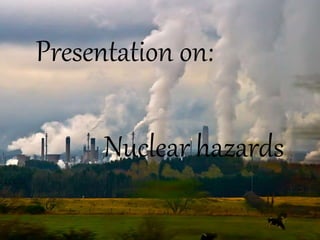
Presentation on:
Nuclear hazards
Group members :
Ahsan Jamal.
Ramakant Pandey.
Shripad Dongare.
Sahil Nikam.
Shahrukh Shaikh.
Nuclear Hazards :
Radioactive (nuclear) pollution is a special form of
physical pollution related to all major life-supporting
systems – air, water and soil.
 It is always convenient to discuss radioactive pollution
separately because its nature of contamination is
different from other types of pollution. Its effects are
also of special kinds.
Sources of nuclear hazards:
1. Natural sources :
1.)Cosmic rays from outer space. The
quantity depends on altitude and latitude; it is
more at higher latitudes and high altitudes.
2.)Emission from the radioactive
materials from the earth’s crust.
2. Man-made sources :
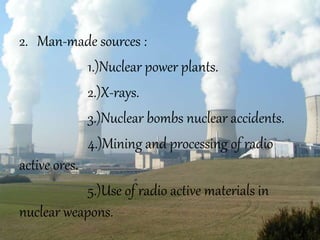
1.)Nuclear power plants.
2.)X-rays.
3.)Nuclear bombs nuclear accidents.
4.)Mining and processing of radio
active ores.
5.)Use of radio active materials in
nuclear weapons.
Causes & hazards of nuclear accidents:
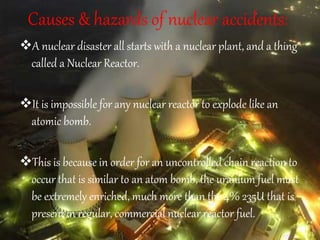
A nuclear disaster all starts with a nuclear plant, and a thing
called a Nuclear Reactor.
It is impossible for any nuclear reactor to explode like an
atomic bomb.
This is because in order for an uncontrolled chain reaction to
occur that is similar to an atom bomb, the uranium fuel must
be extremely enriched, much more than the 4% 235U that is
present in regular, commercial nuclear reactor fuel.
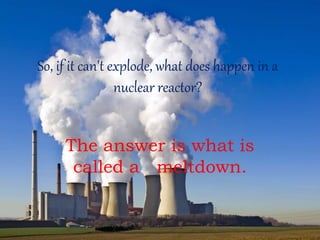
So, if it can't explode, what does happen in a
nuclear reactor?
The answer is what is
called a meltdown.
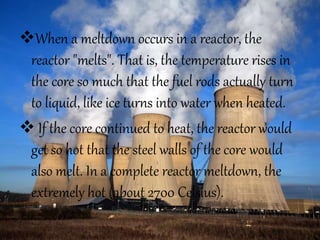
When a meltdown occurs in a reactor, the
reactor "melts". That is, the temperature rises in
the core so much that the fuel rods actually turn
to liquid, like ice turns into water when heated.
 If the core continued to heat, the reactor would
get so hot that the steel walls of the core would
also melt. In a complete reactor meltdown, the
extremely hot (about 2700 Celsius).
Effects of nuclear hazards:
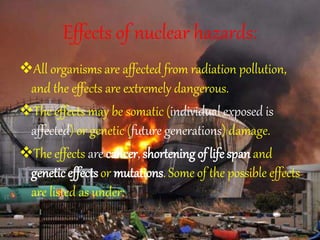
All organisms are affected from radiation pollution,
and the effects are extremely dangerous.
The effects may be somatic (individual exposed is
affected) or genetic (future generations) damage.
The effects are cancer, shortening of life span and
genetic effectsor mutations. Some of the possible effects
are listed as under:
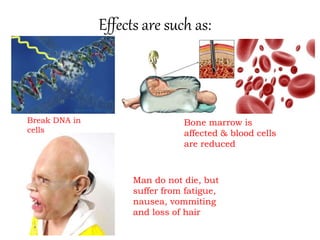
Effects are such as:
Break DNA in
cells
Man do not die, but
suffer from fatigue,
nausea, vommiting
and loss of hair
Bone marrow is
affected & blood cells
are reduced
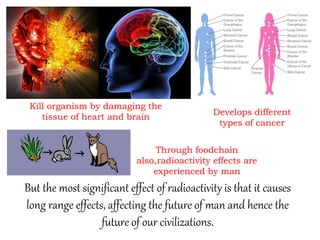
Kill organism by damaging the
tissue of heart and brain
Develops different
types of cancer
Through foodchain
also,radioactivity effects are
experienced by man
But the most significant effect of radioactivity is that it causes
long range effects, affecting the future of man and hence the
future of our civilizations.
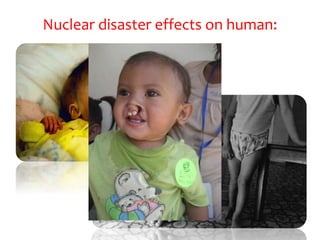
Nuclear disaster effects on human:
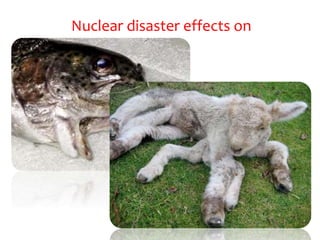
Nuclear disaster effects on
animals
Nuclear accidents
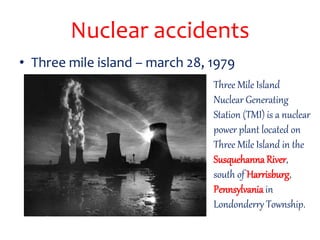
• Three mile island – march 28, 1979
Three Mile Island
Nuclear Generating
Station (TMI) is a nuclear
power plant located on
Three Mile Island in the
Susquehanna River,
south of Harrisburg,
Pennsylvania in
Londonderry Township.
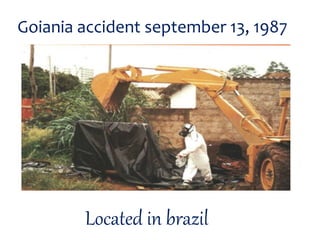
Goiania accident september 13, 1987
Located in brazil
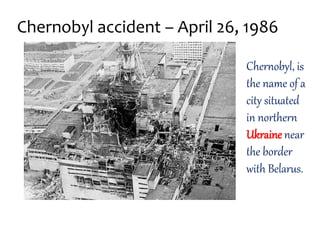
Chernobyl accident – April 26, 1986
Chernobyl, is
the name of a
city situated
in northern
Ukraine near
the border
with Belarus.
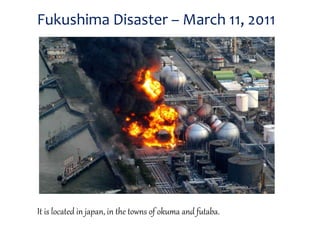
Fukushima Disaster – March 11, 2011
It is located in japan, in the towns of okuma and futaba.
Preventing measures for nuclear
hazards:
Basically, there are only few options for radiation waste
treatment involving:
1) Containment of the waste in radiation-shielded
containers usually buried under ground.
2) Isolation of radiation waste in remote locations such as
remote caves or abandoned mines - which may also
involve the use of some kind of barriers (shields).
3) When the first two alternatives are not possible, the waste
may be diluted till background values are achieved.
Source:
GOOGLE
NUCLEAR HAZARDS

NUCLEAR HAZARDS

  • 1.
  • 2.
    Group members : AhsanJamal. Ramakant Pandey. Shripad Dongare. Sahil Nikam. Shahrukh Shaikh.
  • 3.
    Nuclear Hazards : Radioactive(nuclear) pollution is a special form of physical pollution related to all major life-supporting systems – air, water and soil.  It is always convenient to discuss radioactive pollution separately because its nature of contamination is different from other types of pollution. Its effects are also of special kinds.
  • 4.
    Sources of nuclearhazards: 1. Natural sources : 1.)Cosmic rays from outer space. The quantity depends on altitude and latitude; it is more at higher latitudes and high altitudes. 2.)Emission from the radioactive materials from the earth’s crust.
  • 5.
    2. Man-made sources: 1.)Nuclear power plants. 2.)X-rays. 3.)Nuclear bombs nuclear accidents. 4.)Mining and processing of radio active ores. 5.)Use of radio active materials in nuclear weapons.
  • 6.
    Causes & hazardsof nuclear accidents: A nuclear disaster all starts with a nuclear plant, and a thing called a Nuclear Reactor. It is impossible for any nuclear reactor to explode like an atomic bomb. This is because in order for an uncontrolled chain reaction to occur that is similar to an atom bomb, the uranium fuel must be extremely enriched, much more than the 4% 235U that is present in regular, commercial nuclear reactor fuel.
  • 7.
    So, if itcan't explode, what does happen in a nuclear reactor? The answer is what is called a meltdown.
  • 8.
    When a meltdownoccurs in a reactor, the reactor "melts". That is, the temperature rises in the core so much that the fuel rods actually turn to liquid, like ice turns into water when heated.  If the core continued to heat, the reactor would get so hot that the steel walls of the core would also melt. In a complete reactor meltdown, the extremely hot (about 2700 Celsius).
  • 9.
    Effects of nuclearhazards: All organisms are affected from radiation pollution, and the effects are extremely dangerous. The effects may be somatic (individual exposed is affected) or genetic (future generations) damage. The effects are cancer, shortening of life span and genetic effectsor mutations. Some of the possible effects are listed as under:
  • 10.
    Effects are suchas: Break DNA in cells Man do not die, but suffer from fatigue, nausea, vommiting and loss of hair Bone marrow is affected & blood cells are reduced
  • 11.
    Kill organism bydamaging the tissue of heart and brain Develops different types of cancer Through foodchain also,radioactivity effects are experienced by man But the most significant effect of radioactivity is that it causes long range effects, affecting the future of man and hence the future of our civilizations.
  • 12.
  • 13.
  • 14.
    Nuclear accidents • Threemile island – march 28, 1979 Three Mile Island Nuclear Generating Station (TMI) is a nuclear power plant located on Three Mile Island in the Susquehanna River, south of Harrisburg, Pennsylvania in Londonderry Township.
  • 15.
    Goiania accident september13, 1987 Located in brazil
  • 16.
    Chernobyl accident –April 26, 1986 Chernobyl, is the name of a city situated in northern Ukraine near the border with Belarus.
  • 17.
    Fukushima Disaster –March 11, 2011 It is located in japan, in the towns of okuma and futaba.
  • 18.
    Preventing measures fornuclear hazards: Basically, there are only few options for radiation waste treatment involving: 1) Containment of the waste in radiation-shielded containers usually buried under ground. 2) Isolation of radiation waste in remote locations such as remote caves or abandoned mines - which may also involve the use of some kind of barriers (shields). 3) When the first two alternatives are not possible, the waste may be diluted till background values are achieved.
  • 19.