EE161 Handout #3
March 31, 2009
EE161 Spring 2009
Wireless Communications
Path Loss Models
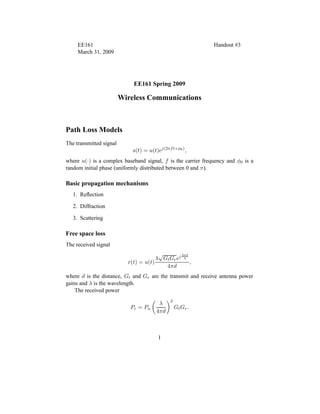
The transmitted signal
s(t) = u(t)ej(2πft+φ0)
,
where u(·) is a complex baseband signal, f is the carrier frequency and φ0 is a
random initial phase (uniformly distributed between 0 and π).
Basic propagation mechanisms
1. Reflection
2. Diffraction
3. Scattering
Free space loss
The received signal
r(t) = u(t)
λ
√
GtGrej 2πd
λ
4πd
,
where d is the distance, Gt and Gr are the transmit and receive antenna power
gains and λ is the wavelength.
The received power
Pr = Pu
λ
4πd
2
GtGr.
1
Ground reflection – Two-path model
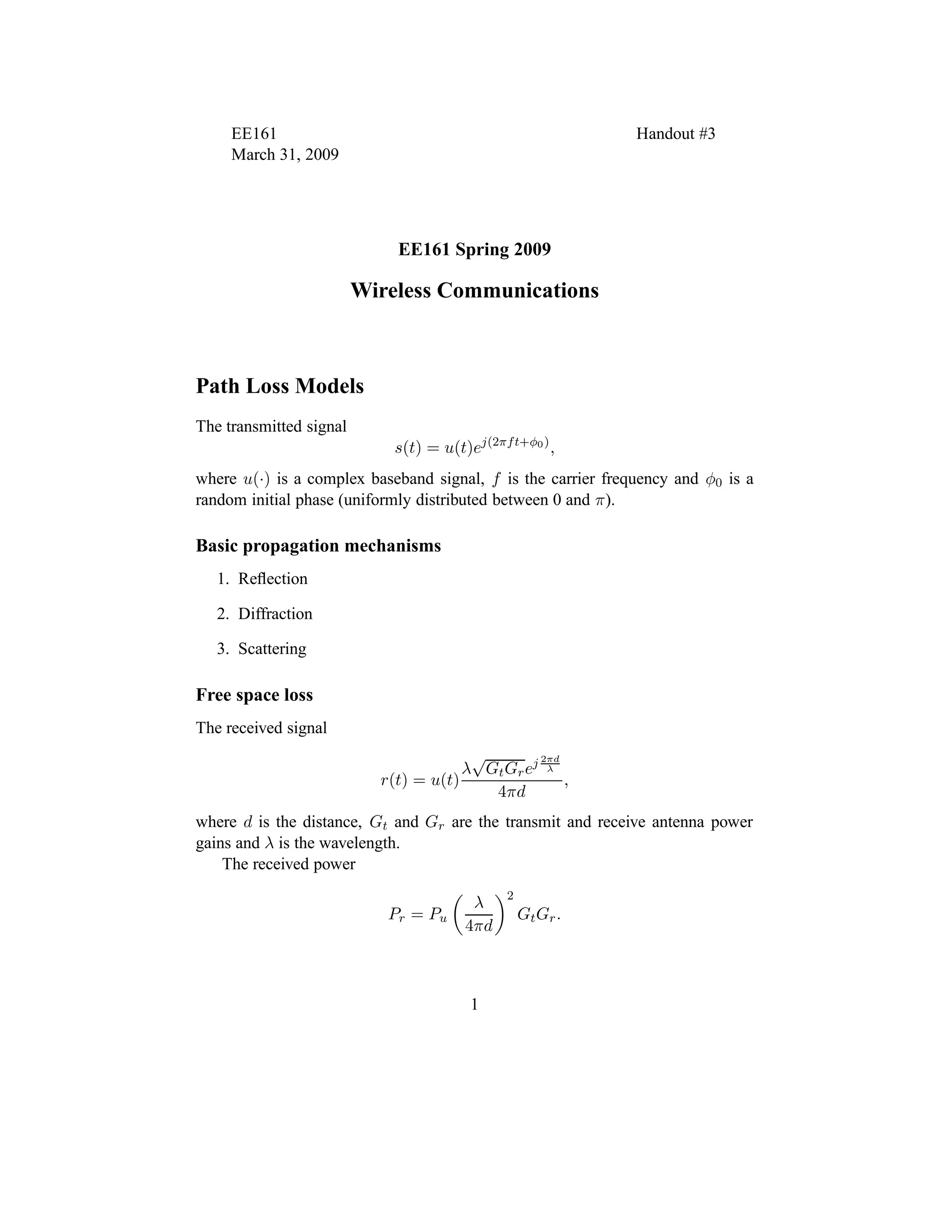
See figure 2.4 of Goldsmith.
r(t) =
λ
4π
GtGr

u(t)ej 2πd
′
λ
d′ +
u(t + τ)Rej 2πd
′′
λ
d′′

 , (1)
where d
′
is the LOS distance, d
′′
is the ground reflected distance, τ = d
′′
−d
′
c is the
path delay and
R =
sin θ −
√
ǫr − cos2θ
sin θ +
√
ǫr − cos2θ
,
for horizontal polarization and
R =
sin θ −
√
ǫr − cos2θ/ǫr
sin θ +
√
ǫr − cos2θ/ǫr
,
where θ is the angle of reflection.
For d > dc = 4hthr
λ , we have
Pr ≈
GtGr(hthr)2
d4
Pu,
i.e., the signal decays as d−4. For all values of d a reasonable approximation is
Pr ≈
GtGrd2
0
d2(1 + (d/dc)2q)1/q
Pu,
for some values of q and d0.
General ray tracing
r(t) =
λ
4π
GtGr

u(t)ej 2πl
λ
l
+
i∈all paths
u(t + τi)Riej
2πli
λ
li

 .
Simplified path loss model
Pr = PuK
d0
d
γ
,
with γ often between two and six.
2
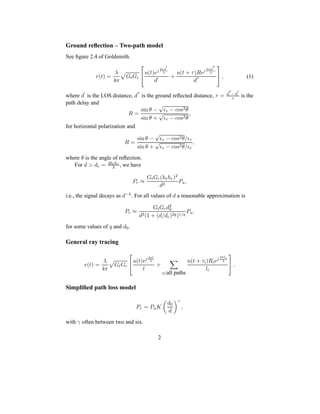
Log-normal shadowing
10 log10
Pr
Pu
= 10 log10 K − 10γ log10
d
d0
+ ψdb,
where ψdb is a zero-mean Gaussian random variable.
3

Path loss models

  • 1.
    EE161 Handout #3 March31, 2009 EE161 Spring 2009 Wireless Communications Path Loss Models The transmitted signal s(t) = u(t)ej(2πft+φ0) , where u(·) is a complex baseband signal, f is the carrier frequency and φ0 is a random initial phase (uniformly distributed between 0 and π). Basic propagation mechanisms 1. Reflection 2. Diffraction 3. Scattering Free space loss The received signal r(t) = u(t) λ √ GtGrej 2πd λ 4πd , where d is the distance, Gt and Gr are the transmit and receive antenna power gains and λ is the wavelength. The received power Pr = Pu λ 4πd 2 GtGr. 1
  • 2.
    Ground reflection –Two-path model See figure 2.4 of Goldsmith. r(t) = λ 4π GtGr  u(t)ej 2πd ′ λ d′ + u(t + τ)Rej 2πd ′′ λ d′′   , (1) where d ′ is the LOS distance, d ′′ is the ground reflected distance, τ = d ′′ −d ′ c is the path delay and R = sin θ − √ ǫr − cos2θ sin θ + √ ǫr − cos2θ , for horizontal polarization and R = sin θ − √ ǫr − cos2θ/ǫr sin θ + √ ǫr − cos2θ/ǫr , where θ is the angle of reflection. For d > dc = 4hthr λ , we have Pr ≈ GtGr(hthr)2 d4 Pu, i.e., the signal decays as d−4. For all values of d a reasonable approximation is Pr ≈ GtGrd2 0 d2(1 + (d/dc)2q)1/q Pu, for some values of q and d0. General ray tracing r(t) = λ 4π GtGr  u(t)ej 2πl λ l + i∈all paths u(t + τi)Riej 2πli λ li   . Simplified path loss model Pr = PuK d0 d γ , with γ often between two and six. 2
  • 3.
    Log-normal shadowing 10 log10 Pr Pu =10 log10 K − 10γ log10 d d0 + ψdb, where ψdb is a zero-mean Gaussian random variable. 3