The International Federation
          of Head and Neck Oncologic Societies
Current Concepts in Head and Neck Surgery and Oncology 2012


           Radiotherapy
     for Head and Neck Cancer

                 Brian O Sullivan


                                                          1
Outline / Scope
       •  Radiobiology of fractionation (normal tissue and tumor
         effects)

          –  Altered fractionation (MARCH meta-analysis)

       •  Precision radiotherapy
          –  IMRT etc

          –  Radiotherapy quality

          –  Late toxicity and strategies

       •  Interaction with other treatments
          –  Chemotherapy (sequential, concurrent)
2012
          –  Biotherapy (targeted agents)
2012
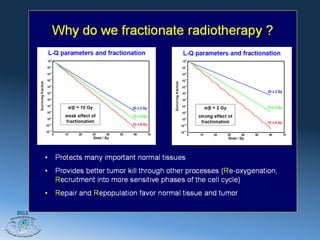
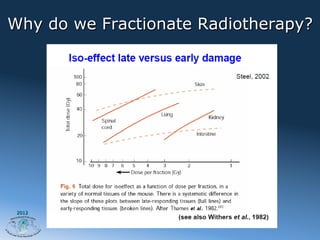
Why do we Fractionate Radiotherapy?


 2012
2012
2012
2012
Altered Fractionation
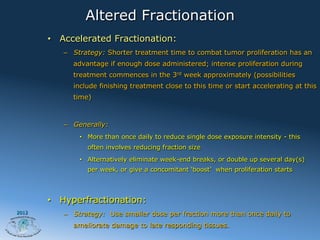
       •  Accelerated Fractionation:
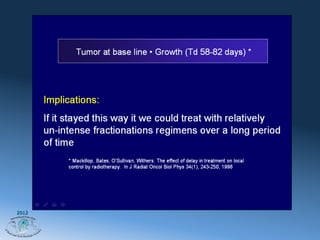
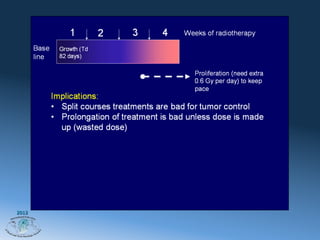
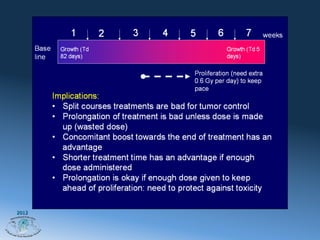
          –  Strategy: Shorter treatment time to combat tumor proliferation has an
            advantage if enough dose administered; intense proliferation during
            treatment commences in the 3rd week approximately (possibilities
            include finishing treatment close to this time or start accelerating at this
            time)


          –  Generally:
              •  More than once daily to reduce single dose exposure intensity - this
                often involves reducing fraction size
              •  Alternatively eliminate week-end breaks, or double up several day(s)
                per week, or give a concomitant ‘boost’ when proliferation starts


       •  Hyperfractionation:
2012      –  Strategy: Use smaller dose per fraction more than once daily to
            ameliorate damage to late responding tissues.
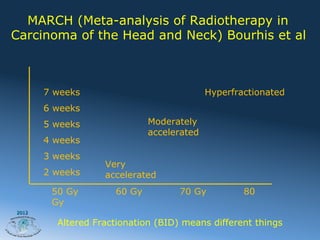
MARCH (Meta-analysis of Radiotherapy in
Carcinoma of the Head and Neck) Bourhis et al


       7 weeks                             Hyperfractionated
       6 weeks
       5 weeks               Moderately
                             accelerated
       4 weeks
       3 weeks
                   Very
       2 weeks     accelerated
        50 Gy        60 Gy          70 Gy          80
        Gy
2012

         Altered Fractionation (BID) means different things
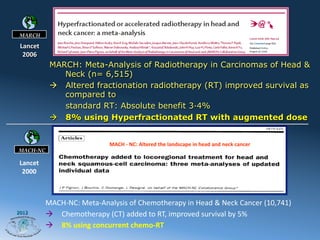
MARCH

 Lancet	
  
  2006	
  
               MARCH: Meta-Analysis of Radiotherapy in Carcinomas of Head &
                   Neck (n= 6,515)
               à  Altered fractionation radiotherapy (RT) improved survival as
                   compared to
                   standard RT: Absolute benefit 3·4%
               à  8% using Hyperfractionated RT with augmented dose


                                        MACH	
  -­‐	
  NC:	
  Altered	
  the	
  landscape	
  in	
  head	
  and	
  neck	
  cancer	


MACH-NC

 Lancet	
  
  2000	


              MACH-­‐NC:	
  Meta-­‐Analysis	
  of	
  Chemotherapy	
  in	
  Head	
  &	
  Neck	
  Cancer	
  (10,741)	
  
2012
              à  Chemotherapy	
  (CT)	
  added	
  to	
  RT,	
  improved	
  survival	
  by	
  5%	
  	
  
              à  8%	
  using	
  concurrent	
  chemo-­‐RT	


MARCH

 Lancet	
  
  2006	
  
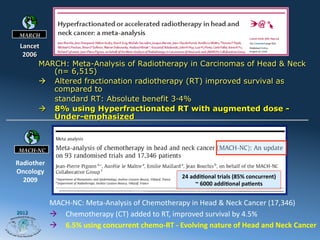
         MARCH: Meta-Analysis of Radiotherapy in Carcinomas of Head & Neck
             (n= 6,515)
         à  Altered fractionation radiotherapy (RT) improved survival as
             compared to
             standard RT: Absolute benefit 3·4%
         à  8% using Hyperfractionated RT with augmented dose -
             Under-emphasized


                                        MACH	
  -­‐	
  NC1	
  :	
  Altered	
  the	
  landscape	
  in	
  head	
  and	
  neck	
  cancer	


 MACH-NC

Radiother
Oncology	
  
                                                                                                    24	
  addiLonal	
  trials	
  (85%	
  concurrent)	
  
  2009	
                                                                                                    ~	
  6000	
  addiLonal	
  paLents	


               MACH-­‐NC:	
  Meta-­‐Analysis	
  of	
  Chemotherapy	
  in	
  Head	
  &	
  Neck	
  Cancer	
  (17,346)	
  
2012
               à  Chemotherapy	
  (CT)	
  added	
  to	
  RT,	
  improved	
  survival	
  by	
  4.5%	
  	
  
               à  6.5%	
  using	
  concurrent	
  chemo-­‐RT	
  -­‐	
  Evolving	
  nature	
  of	
  Head	
  and	
  Neck	
  Cancer	
  	
  
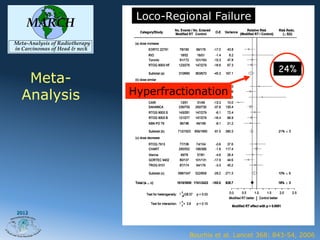
Loco-Regional Failure
    MARCH
Meta-Analysis of Radiotherapy
in Carcinomas of Head & neck


                                                                     24%
   Meta-
  Analysis                      Hyperfractionation


2012


                                          Bourhis et al. Lancet 368: 843-54, 2006
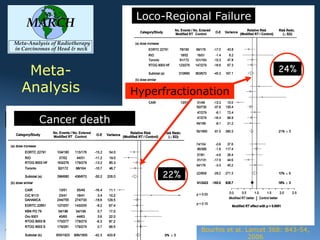
Loco-Regional Failure
    MARCH
Meta-Analysis of Radiotherapy
in Carcinomas of Head & neck


   Meta-                                                            24%

  Analysis                      Hyperfractionation

       Cancer death
        Cancer death


                                     22%


2012


                                            Bourhis et al. Lancet 368: 843-54,
                                                            2006
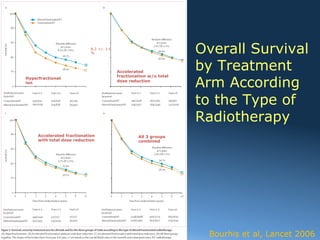
8.2 +/- 2.6
                               %                                       Overall Survival
                                             Accelerated
                                                                       by Treatment
                                                                       Arm According
                                             fractionation w/o total
   Hyperfractionat
   ion                                       dose reduction


                                                                       to the Type of
                                                                       Radiotherapy
        Accelerated fractionation                     All 3 groups
        with total dose reduction                     combined


2012


                                                                        Bourhis et al, Lancet 2006
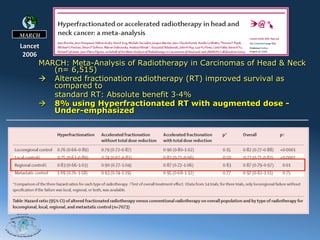
MARCH

 Lancet	
  
  2006	
  
         MARCH: Meta-Analysis of Radiotherapy in Carcinomas of Head & Neck
             (n= 6,515)
         à  Altered fractionation radiotherapy (RT) improved survival as
             compared to
             standard RT: Absolute benefit 3·4%
         à  8% using Hyperfractionated RT with augmented dose -
             Under-emphasized


2012
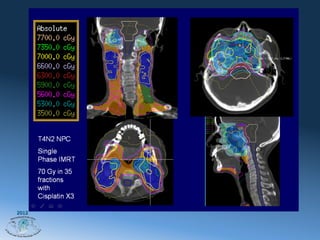
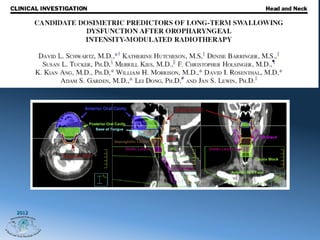
IMRT for Head and Neck Cancer
       •    Technologically robust means of improved dose delivery:
             –  Exquisite sharp dose gradients especially in areas of crucial interphase (Tumor vs
                Normal tissue)

             –  Delivers optimized non-uniform beam intensities to precisely delineated target
                volumes

             –  Improved outcomes (especially normal tissues)

       •    Requires specific approach:
             –  Immobilization and set-up issues and knowledge of uncertainties

             –  Optimal imaging modality acquisition and registration

             –  Clearly identified dose specification and prescription regarding dose-volume
                constraints

             –  Quality control on the whole procedure from Object delineation to delivery

             –  Knowledge of the pitfalls that exist (poor delineation, dose dumping, erratic
                planning, tumor or normal tissue deformation and set up uncertainties emerging
                throughout treatment)
2012
2012
2012
2012
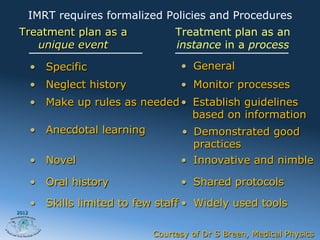
IMRT requires formalized Policies and Procedures
Treatment plan as a                 Treatment plan as an
   unique event                     instance in a process

       •  Specific                   •  General
       •  Neglect history            •  Monitor processes
       •  Make up rules as needed •  Establish guidelines
                                     based on information
       •  Anecdotal learning      •  Demonstrated good
                                     practices
       •  Novel                      •  Innovative and nimble

       •  Oral history               •  Shared protocols
       •  Skills limited to few staff •  Widely used tools
2012


                               Courtesy of Dr S Breen, Medical Physics
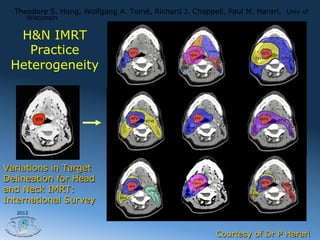
Theodore S. Hong, Wolfgang A. Tomé, Richard J. Chappell, Paul M. Harari, Univ of
     Wisconsin


  H&N IMRT
    Practice
 Heterogeneity


Variations in Target
Delineation for Head
and Neck IMRT:
International Survey
  2012


                                                        Courtesy of Dr P Harari
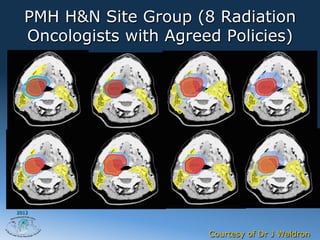
PMH H&N Site Group (8 Radiation
  Oncologists with Agreed Policies)


2012


                        Courtesy of Dr J Waldron
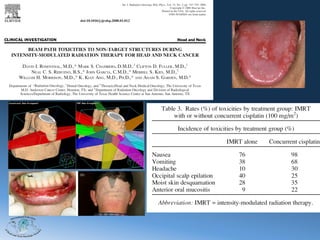
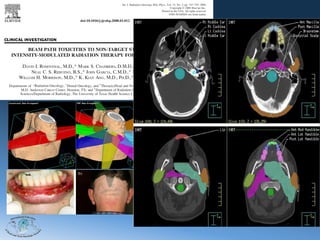
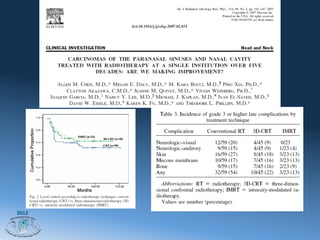
Summary of evidence for IMRT in head
         and neck cancer
•  Amelioration of normal tissue effect:
       –  Xerostomia and QOL (3 RCTs and numerous cohort
          studies)
       –  Blindness and ORN
•  Improvement:
       –  Dramatic for loco-regional control (NPC)
•  Comments:
       –  In some situations cannot perform trials due to normal
          tissue sequelae (e.g. advanced NPC)
       –  Strong support for NPC and Paranasal (efficicacy and
          morbidity)
       –  Other cancers: efficacy data weaker, but tissue
          protection is strong
2012
2012
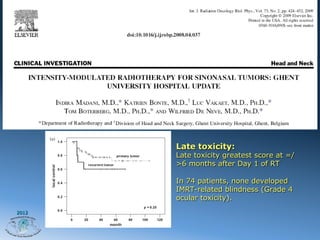
Late toxicity:
       Late toxicity greatest score at =/
       >6 months after Day 1 of RT

       In 74 patients, none developed
       IMRT-related blindness (Grade 4
       ocular toxicity).
2012
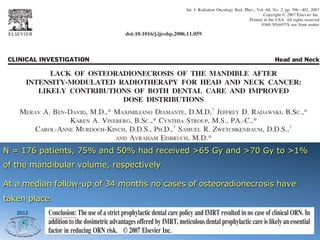
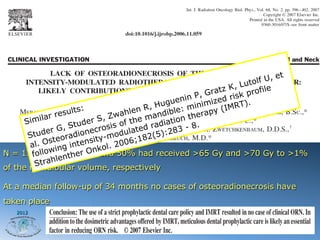
N = 176 patients, 75% and 50% had received >65 Gy and >70 Gy to >1%
of the mandibular volume, respectively

At a median follow-up of 34 months no cases of osteoradionecrosis have
taken place
   2012
et
                                                                       tolf U,
                                                              tz K, Lu ofile
                                                       P , Gra risk pr
                                              ug uenin nimized      T ).
                    ults:            len R, H      : mi apy (IMR
                                               ible
            lar res            , Zwah e mand ion ther
      Simi               der S is of th          t
                                           radia 3 - 8.
                 G, Stu       ro s     ted
       St uder radionec -modula 2(5):28
               teo          ity        ;18
       a l. Os g intens ol. 2006
                 n
           llowi th 75% k
N = 176opatients, er On and 50% had received >65 Gy and >70 Gy to >1%
        f        en
         S trahl
of the mandibular volume, respectively

At a median follow-up of 34 months no cases of osteoradionecrosis have
taken place
   2012
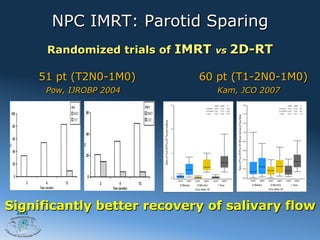
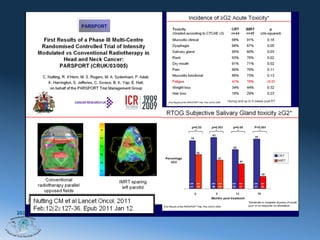
NPC IMRT: Parotid Sparing
         Randomized trials of IMRT vs 2D-RT

        51 pt (T2N0-1M0)       60 pt (T1-2N0-1M0)
         Pow, IJROBP 2004         Kam, JCO 2007


Significantly better recovery of salivary flow
 2012
2012
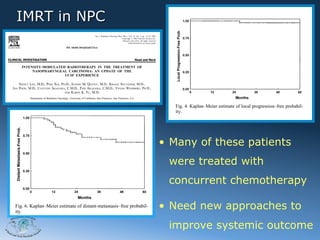
IMRT in NPC


              •  Many of these patients
               were treated with
               concurrent chemotherapy

2012
              •  Need new approaches to
               improve systemic outcome
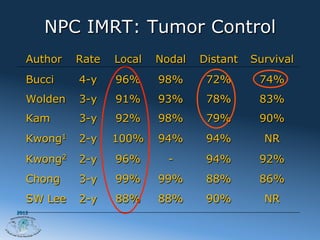
NPC IMRT: Tumor Control
   Author   Rate   Local   Nodal   Distant   Survival
   Bucci    4-y    96%     98%      72%       74%
   Wolden   3-y    91%     93%      78%       83%
   Kam      3-y    92%     98%      79%       90%
   Kwong1   2-y    100%    94%      94%        NR
   Kwong2   2-y    96%       -      94%       92%
   Chong    3-y    99%     99%      88%       86%
   SW Lee   2-y    88%     88%      90%        NR
2012
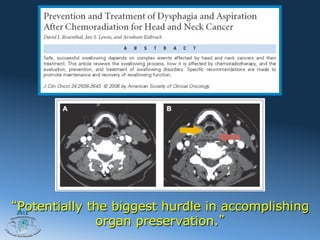
Potentially the biggest hurdle in accomplishing
2012

             organ preservation.
2012
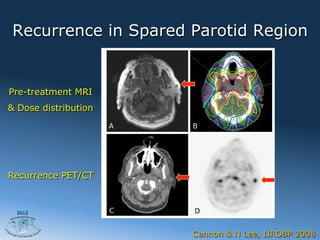
Recurrence in Spared Parotid Region


Pre-treatment MRI
& Dose distribution


Recurrence PET/CT


 2012


                      Cannon & N Lee, IJROBP 2008
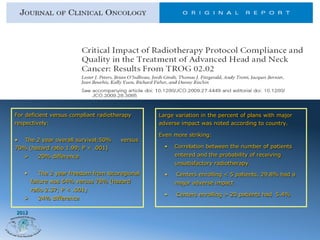
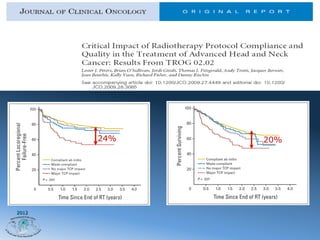
For deficient versus compliant radiotherapy         Large variation in the percent of plans with major
respectively:                                       adverse impact was noted according to country.

                                                    Even more striking:
•  The 2 year overall survival:50%        versus
70% (hazard ratio 1.99; P < .001)                     •    Correlation between the number of patients
   Ø      20% difference                                  entered and the probability of receiving
                                                           unsatisfactory radiotherapy.
   •         The 2 year freedom from locoregional     •    Centers enrolling < 5 patients, 29.8% had a
         failure was 54% versus 78% (hazard                major adverse impact
         ratio 2.37; P < .001)
                                                      •    Centers enrolling > 20 patients had 5.4%
   Ø      24% difference

2012
24%   20%


2012
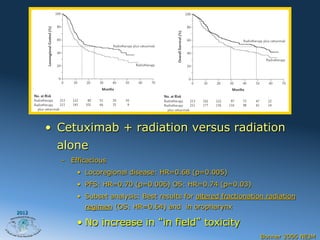
•  Cetuximab + radiation versus radiation
         alone
         –  Efficacious
             •  Locoregional disease: HR=0.68 (p=0.005)
             •  PFS: HR=0.70 (p=0.006) OS: HR=0.74 (p=0.03)
             •  Subset analysis: Best results for altered fractionation radiation
                regimen (OS: HR=0.64) and in oropharynx
2012

             •  No increase in in field toxicity
                                                                      Bonner 2006 NEJM
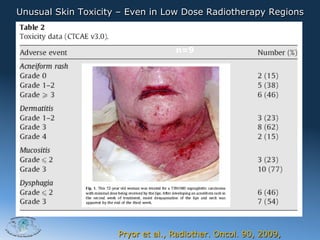
Unusual Skin Toxicity – Even in Low Dose Radiotherapy Regions

                                   n=13
                                   Cetux abgebrochen bei
                                   n=9


2012


                     Pryor et al., Radiother. Oncol. 90, 2009,
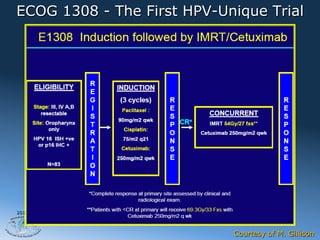
ECOG 1308 - The First HPV-Unique Trial


2012


                            Courtesy of M. Gillison
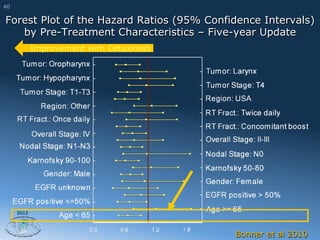
40

Forest Plot of the Hazard Ratios (95% Confidence Intervals)
   by Pre-Treatment Characteristics – Five-year Update
            Improvement with Cetuximab


     2012


                                           Bonner et al 2010
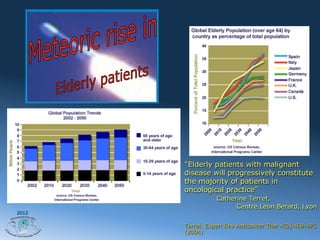
Elderly patients with malignant
       disease will progressively constitute
       the majority of patients in
       oncological practice
                  Catherine Terret,
                        Centre Leon Berard, Lyon
2012


       Terret. Expert Rev Anticancer Ther 4(3) 469-475
       (2004)
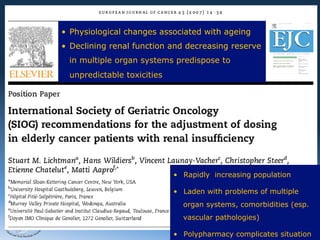
•  Physiological changes associated with ageing
       •  Declining renal function and decreasing reserve
         in multiple organ systems predispose to
         unpredictable toxicities


                                    •  Rapidly increasing population

                                    •  Laden with problems of multiple
                                      organ systems, comorbidities (esp.
2012
                                      vascular pathologies)

                                    •  Polypharmacy complicates situation
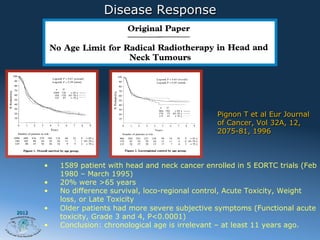
Disease Response


                                                      Pignon T et al Eur Journal
                                                      of Cancer, Vol 32A, 12,
                                                      2075-81, 1996


       •    1589 patient with head and neck cancer enrolled in 5 EORTC trials (Feb
            1980 – March 1995)
       •    20% were >65 years
       •    No difference survival, loco-regional control, Acute Toxicity, Weight
            loss, or Late Toxicity
       •    Older patients had more severe subjective symptoms (Functional acute
2012
            toxicity, Grade 3 and 4, P<0.0001)
       •    Conclusion: chronological age is irrelevant – at least 11 years ago.
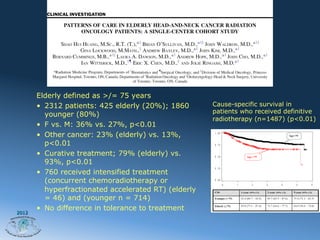
Elderly defined as >/= 75 years
       •  2312 patients: 425 elderly (20%); 1860       Cause-specific survival in
                                                       patients who received definitive
          younger (80%)
                                                       radiotherapy (n=1487) (p<0.01)
       •  F vs. M: 36% vs. 27%, p<0.01
       •  Other cancer: 23% (elderly) vs. 13%,
          p<0.01
       •  Curative treatment; 79% (elderly) vs.
          93%, p<0.01
       •  760 received intensified treatment
          (concurrent chemoradiotherapy or
          hyperfractionated accelerated RT) (elderly
          = 46) and (younger n = 714)
       •  No difference in tolerance to treatment
2012
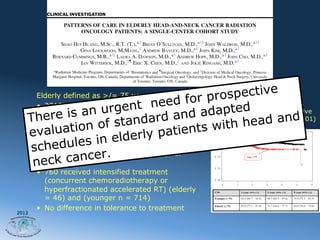
rospective
                                ed for pCause-specific survival in
        Elderly defined as >/= 75 years
                              e
            ei s an urgent n          adapted (n=1487)definitive
        •  2312 patients: 425 elderly (20%); 1860
                                   nd patients who received nd
       Theryounger (80%)
                     fs tandard a                head a (p<0.01)
                                        radiotherapy
                    o                       th
         aluation                tients wi
        •  F vs. M: 36% vs. 27%, p<0.01
       ev                      a
                      elderly p
        •  Other cancer: 23% (elderly) vs. 13%,

       sch edules in
           p<0.01

             cancer.
        •  Curative treatment; 79% (elderly) vs.
        neck
           93%, p<0.01
        •  760 received intensified treatment
           (concurrent chemoradiotherapy or
           hyperfractionated accelerated RT) (elderly
           = 46) and (younger n = 714)
        •  No difference in tolerance to treatment
2012
Summary
   •  We have many radiotherapy options (technical, biological,
      scheduling, prescriptive, combinations with other agents and
      other treatments)
   •  We must refine approaches, combine modalities more
      conservatively with potential equal or greater efficacy
   •  Molecular biology of tumors and of radiation interaction with
      tissues and in combination with systemic agents and
      surgery is essential
   •  We need especially to focus on management approaches
      that meet the needs of our aging population
   •  Quality assurance must become an accepted part of the
      delivery of high quality radiotherapy
   •  Clinical trials that address all domains of the practice of
      radiation medicine remain the cornerstone of progress
2012

Radiation therapy for head and neck cancer by Brian O'Sullivan

  • 1.
    The International Federation of Head and Neck Oncologic Societies Current Concepts in Head and Neck Surgery and Oncology 2012 Radiotherapy for Head and Neck Cancer Brian O Sullivan 1
  • 2.
    Outline / Scope •  Radiobiology of fractionation (normal tissue and tumor effects) –  Altered fractionation (MARCH meta-analysis) •  Precision radiotherapy –  IMRT etc –  Radiotherapy quality –  Late toxicity and strategies •  Interaction with other treatments –  Chemotherapy (sequential, concurrent) 2012 –  Biotherapy (targeted agents)
  • 3.
  • 4.
    Why do weFractionate Radiotherapy? 2012
  • 5.
  • 6.
  • 7.
  • 8.
    Altered Fractionation •  Accelerated Fractionation: –  Strategy: Shorter treatment time to combat tumor proliferation has an advantage if enough dose administered; intense proliferation during treatment commences in the 3rd week approximately (possibilities include finishing treatment close to this time or start accelerating at this time) –  Generally: •  More than once daily to reduce single dose exposure intensity - this often involves reducing fraction size •  Alternatively eliminate week-end breaks, or double up several day(s) per week, or give a concomitant ‘boost’ when proliferation starts •  Hyperfractionation: 2012 –  Strategy: Use smaller dose per fraction more than once daily to ameliorate damage to late responding tissues.
  • 9.
    MARCH (Meta-analysis ofRadiotherapy in Carcinoma of the Head and Neck) Bourhis et al 7 weeks Hyperfractionated 6 weeks 5 weeks Moderately accelerated 4 weeks 3 weeks Very 2 weeks accelerated 50 Gy 60 Gy 70 Gy 80 Gy 2012 Altered Fractionation (BID) means different things
  • 10.
    MARCH Lancet   2006   MARCH: Meta-Analysis of Radiotherapy in Carcinomas of Head & Neck (n= 6,515) à  Altered fractionation radiotherapy (RT) improved survival as compared to standard RT: Absolute benefit 3·4% à  8% using Hyperfractionated RT with augmented dose MACH  -­‐  NC:  Altered  the  landscape  in  head  and  neck  cancer                 MACH-NC Lancet   2000   MACH-­‐NC:  Meta-­‐Analysis  of  Chemotherapy  in  Head  &  Neck  Cancer  (10,741)   2012 à  Chemotherapy  (CT)  added  to  RT,  improved  survival  by  5%     à  8%  using  concurrent  chemo-­‐RT      
  • 11.
    MARCH Lancet   2006   MARCH: Meta-Analysis of Radiotherapy in Carcinomas of Head & Neck (n= 6,515) à  Altered fractionation radiotherapy (RT) improved survival as compared to standard RT: Absolute benefit 3·4% à  8% using Hyperfractionated RT with augmented dose - Under-emphasized MACH  -­‐  NC1  :  Altered  the  landscape  in  head  and  neck  cancer                 MACH-NC Radiother Oncology   24  addiLonal  trials  (85%  concurrent)   2009   ~  6000  addiLonal  paLents   MACH-­‐NC:  Meta-­‐Analysis  of  Chemotherapy  in  Head  &  Neck  Cancer  (17,346)   2012 à  Chemotherapy  (CT)  added  to  RT,  improved  survival  by  4.5%     à  6.5%  using  concurrent  chemo-­‐RT  -­‐  Evolving  nature  of  Head  and  Neck  Cancer    
  • 12.
    Loco-Regional Failure MARCH Meta-Analysis of Radiotherapy in Carcinomas of Head & neck 24% Meta- Analysis Hyperfractionation 2012 Bourhis et al. Lancet 368: 843-54, 2006
  • 13.
    Loco-Regional Failure MARCH Meta-Analysis of Radiotherapy in Carcinomas of Head & neck Meta- 24% Analysis Hyperfractionation Cancer death Cancer death 22% 2012 Bourhis et al. Lancet 368: 843-54, 2006
  • 14.
    8.2 +/- 2.6 % Overall Survival Accelerated by Treatment Arm According fractionation w/o total Hyperfractionat ion dose reduction to the Type of Radiotherapy Accelerated fractionation All 3 groups with total dose reduction combined 2012 Bourhis et al, Lancet 2006
  • 15.
    MARCH Lancet   2006   MARCH: Meta-Analysis of Radiotherapy in Carcinomas of Head & Neck (n= 6,515) à  Altered fractionation radiotherapy (RT) improved survival as compared to standard RT: Absolute benefit 3·4% à  8% using Hyperfractionated RT with augmented dose - Under-emphasized 2012
  • 16.
    IMRT for Headand Neck Cancer •  Technologically robust means of improved dose delivery: –  Exquisite sharp dose gradients especially in areas of crucial interphase (Tumor vs Normal tissue) –  Delivers optimized non-uniform beam intensities to precisely delineated target volumes –  Improved outcomes (especially normal tissues) •  Requires specific approach: –  Immobilization and set-up issues and knowledge of uncertainties –  Optimal imaging modality acquisition and registration –  Clearly identified dose specification and prescription regarding dose-volume constraints –  Quality control on the whole procedure from Object delineation to delivery –  Knowledge of the pitfalls that exist (poor delineation, dose dumping, erratic planning, tumor or normal tissue deformation and set up uncertainties emerging throughout treatment) 2012
  • 17.
  • 18.
  • 19.
  • 20.
    IMRT requires formalizedPolicies and Procedures Treatment plan as a Treatment plan as an unique event instance in a process •  Specific •  General •  Neglect history •  Monitor processes •  Make up rules as needed •  Establish guidelines based on information •  Anecdotal learning •  Demonstrated good practices •  Novel •  Innovative and nimble •  Oral history •  Shared protocols •  Skills limited to few staff •  Widely used tools 2012 Courtesy of Dr S Breen, Medical Physics
  • 21.
    Theodore S. Hong,Wolfgang A. Tomé, Richard J. Chappell, Paul M. Harari, Univ of Wisconsin H&N IMRT Practice Heterogeneity Variations in Target Delineation for Head and Neck IMRT: International Survey 2012 Courtesy of Dr P Harari
  • 22.
    PMH H&N SiteGroup (8 Radiation Oncologists with Agreed Policies) 2012 Courtesy of Dr J Waldron
  • 23.
    Summary of evidencefor IMRT in head and neck cancer •  Amelioration of normal tissue effect: –  Xerostomia and QOL (3 RCTs and numerous cohort studies) –  Blindness and ORN •  Improvement: –  Dramatic for loco-regional control (NPC) •  Comments: –  In some situations cannot perform trials due to normal tissue sequelae (e.g. advanced NPC) –  Strong support for NPC and Paranasal (efficicacy and morbidity) –  Other cancers: efficacy data weaker, but tissue protection is strong 2012
  • 24.
  • 25.
    Late toxicity: Late toxicity greatest score at =/ >6 months after Day 1 of RT In 74 patients, none developed IMRT-related blindness (Grade 4 ocular toxicity). 2012
  • 26.
    N = 176patients, 75% and 50% had received >65 Gy and >70 Gy to >1% of the mandibular volume, respectively At a median follow-up of 34 months no cases of osteoradionecrosis have taken place 2012
  • 27.
    et tolf U, tz K, Lu ofile P , Gra risk pr ug uenin nimized T ). ults: len R, H : mi apy (IMR ible lar res , Zwah e mand ion ther Simi der S is of th t radia 3 - 8. G, Stu ro s ted St uder radionec -modula 2(5):28 teo ity ;18 a l. Os g intens ol. 2006 n llowi th 75% k N = 176opatients, er On and 50% had received >65 Gy and >70 Gy to >1% f en S trahl of the mandibular volume, respectively At a median follow-up of 34 months no cases of osteoradionecrosis have taken place 2012
  • 28.
    NPC IMRT: ParotidSparing Randomized trials of IMRT vs 2D-RT 51 pt (T2N0-1M0) 60 pt (T1-2N0-1M0) Pow, IJROBP 2004 Kam, JCO 2007 Significantly better recovery of salivary flow 2012
  • 29.
  • 30.
    IMRT in NPC •  Many of these patients were treated with concurrent chemotherapy 2012 •  Need new approaches to improve systemic outcome
  • 31.
    NPC IMRT: TumorControl Author Rate Local Nodal Distant Survival Bucci 4-y 96% 98% 72% 74% Wolden 3-y 91% 93% 78% 83% Kam 3-y 92% 98% 79% 90% Kwong1 2-y 100% 94% 94% NR Kwong2 2-y 96% - 94% 92% Chong 3-y 99% 99% 88% 86% SW Lee 2-y 88% 88% 90% NR 2012
  • 32.
    Potentially the biggesthurdle in accomplishing 2012 organ preservation.
  • 33.
  • 34.
    Recurrence in SparedParotid Region Pre-treatment MRI & Dose distribution Recurrence PET/CT 2012 Cannon & N Lee, IJROBP 2008
  • 35.
    For deficient versuscompliant radiotherapy Large variation in the percent of plans with major respectively: adverse impact was noted according to country. Even more striking: •  The 2 year overall survival:50% versus 70% (hazard ratio 1.99; P < .001) •  Correlation between the number of patients Ø  20% difference entered and the probability of receiving unsatisfactory radiotherapy. •  The 2 year freedom from locoregional •  Centers enrolling < 5 patients, 29.8% had a failure was 54% versus 78% (hazard major adverse impact ratio 2.37; P < .001) •  Centers enrolling > 20 patients had 5.4% Ø  24% difference 2012
  • 36.
    24% 20% 2012
  • 37.
    •  Cetuximab +radiation versus radiation alone –  Efficacious •  Locoregional disease: HR=0.68 (p=0.005) •  PFS: HR=0.70 (p=0.006) OS: HR=0.74 (p=0.03) •  Subset analysis: Best results for altered fractionation radiation regimen (OS: HR=0.64) and in oropharynx 2012 •  No increase in in field toxicity Bonner 2006 NEJM
  • 38.
    Unusual Skin Toxicity– Even in Low Dose Radiotherapy Regions n=13 Cetux abgebrochen bei n=9 2012 Pryor et al., Radiother. Oncol. 90, 2009,
  • 39.
    ECOG 1308 -The First HPV-Unique Trial 2012 Courtesy of M. Gillison
  • 40.
    40 Forest Plot ofthe Hazard Ratios (95% Confidence Intervals) by Pre-Treatment Characteristics – Five-year Update Improvement with Cetuximab 2012 Bonner et al 2010
  • 41.
    Elderly patients withmalignant disease will progressively constitute the majority of patients in oncological practice Catherine Terret, Centre Leon Berard, Lyon 2012 Terret. Expert Rev Anticancer Ther 4(3) 469-475 (2004)
  • 42.
    •  Physiological changesassociated with ageing •  Declining renal function and decreasing reserve in multiple organ systems predispose to unpredictable toxicities •  Rapidly increasing population •  Laden with problems of multiple organ systems, comorbidities (esp. 2012 vascular pathologies) •  Polypharmacy complicates situation
  • 43.
    Disease Response Pignon T et al Eur Journal of Cancer, Vol 32A, 12, 2075-81, 1996 •  1589 patient with head and neck cancer enrolled in 5 EORTC trials (Feb 1980 – March 1995) •  20% were >65 years •  No difference survival, loco-regional control, Acute Toxicity, Weight loss, or Late Toxicity •  Older patients had more severe subjective symptoms (Functional acute 2012 toxicity, Grade 3 and 4, P<0.0001) •  Conclusion: chronological age is irrelevant – at least 11 years ago.
  • 44.
    Elderly defined as>/= 75 years •  2312 patients: 425 elderly (20%); 1860 Cause-specific survival in patients who received definitive younger (80%) radiotherapy (n=1487) (p<0.01) •  F vs. M: 36% vs. 27%, p<0.01 •  Other cancer: 23% (elderly) vs. 13%, p<0.01 •  Curative treatment; 79% (elderly) vs. 93%, p<0.01 •  760 received intensified treatment (concurrent chemoradiotherapy or hyperfractionated accelerated RT) (elderly = 46) and (younger n = 714) •  No difference in tolerance to treatment 2012
  • 45.
    rospective ed for pCause-specific survival in Elderly defined as >/= 75 years e ei s an urgent n adapted (n=1487)definitive •  2312 patients: 425 elderly (20%); 1860 nd patients who received nd Theryounger (80%) fs tandard a head a (p<0.01) radiotherapy o th aluation tients wi •  F vs. M: 36% vs. 27%, p<0.01 ev a elderly p •  Other cancer: 23% (elderly) vs. 13%, sch edules in p<0.01 cancer. •  Curative treatment; 79% (elderly) vs. neck 93%, p<0.01 •  760 received intensified treatment (concurrent chemoradiotherapy or hyperfractionated accelerated RT) (elderly = 46) and (younger n = 714) •  No difference in tolerance to treatment 2012
  • 46.
    Summary •  We have many radiotherapy options (technical, biological, scheduling, prescriptive, combinations with other agents and other treatments) •  We must refine approaches, combine modalities more conservatively with potential equal or greater efficacy •  Molecular biology of tumors and of radiation interaction with tissues and in combination with systemic agents and surgery is essential •  We need especially to focus on management approaches that meet the needs of our aging population •  Quality assurance must become an accepted part of the delivery of high quality radiotherapy •  Clinical trials that address all domains of the practice of radiation medicine remain the cornerstone of progress 2012