Principles of
Chemoradiotherapy with
few clinical examples
REJIL RAJAN
Definition
 Concomitant or Concurrent chemo-radiation
refers to administering chemotherapy during a
course of radiation.
GOALS
 The goals of combining chemotherapeutic drugs with
radiation therapy are to increase patient survival by
improving locoregional tumor control, decrease or
eliminate distant metastases, or both, while preserving
organ and tissue integrity and function
Rationale
 Initially given by Steel and Peckham in 1979
 Spatial cooperation
 Independent toxicity
 Enhancement of tumor response
 Protection of normal tissues
Spatial Cooperation
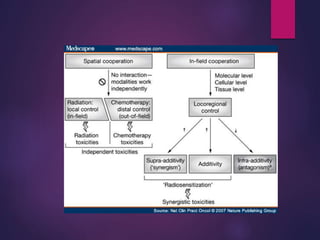
 Initial rationale for combining chemotherapy with radiation therapy
 The term spatial cooperation is used to describe the scenario whereby
radiotherapy acts locoregionally, and chemotherapy acts against distant
micrometastases, without interaction between the agents
 Example: Radiotherapy local regional control & chemotherapy 
prevent distant failure
Radiotherapy response
enhancement
 Sensitization of the cells to effects of radiation
 Additive: Amount of cytotoxic activity equal to summation of 2
modalities
 Supraadditive : cytotoxicity is more than simple sum
 Infra-additive drugs possess radio protective properties that
lessen the cytotoxic effect of radiation on the tumor and/or
normal tissue.
Toxicity Independence
Normal-tissue toxicity is the main dose-limiting factor for both
chemotherapy and radiation therapy. Therefore, combinations of
radiation and drugs would be better tolerated if drugs were selected
such that toxicities to specific cell types and tissues do not overlap
with,
or minimally add to, radiation-induced toxicities.
Normal tissue protection
 Clinical aim is to reduce the incidence, severity or
duration of early and/or late side-effects
 To protect normal tissues so that higher doses of
radiation can be delivered to the tumor. This can be
achieved through technical improvements in
radiation delivery or administration of chemical or
biologic agents that selectively or preferentially
protect normal tissues against the damage by
radiation or drugs
 E.g Amifostine
Biological cooperation
 Targeting distinct cell populations or using different
mechanisms of cell killing or inducing tumor regrowth
delays.
 E.g. Mitomycin C to target specifically hypoxic tumor
cells.
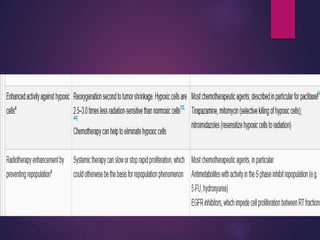
Temporal modulation
 Exploits the radiobiological principles of fractionation.
 Radiation & drugs used concomitantly or in a rapidly
alternating schedule.
 combining EGFR blockade with fractionated radiation
could reduce cell proliferation during therapy and
might possibly reduce the accelerated cell proliferation
induced by radiation
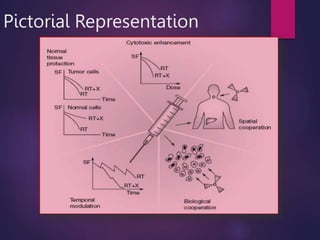
Pictorial Representation
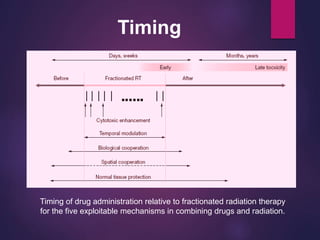
Timing of drug administration relative to fractionated radiation therapy
for the five exploitable mechanisms in combining drugs and radiation.
Timing
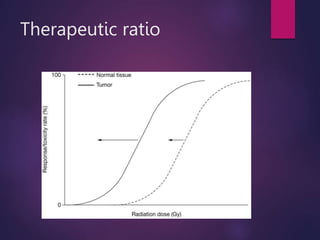
Therapeutic ratio
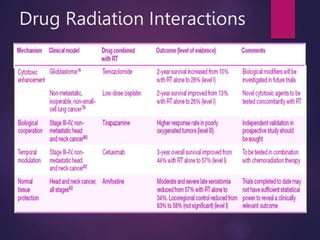
Drug Radiation Interactions
Assessment of Drug Radiation
Interaction
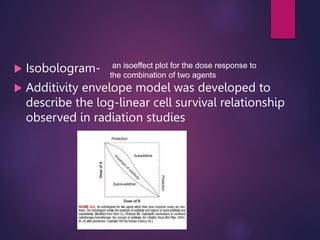
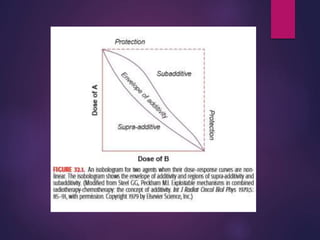
 Isobologram-
 Additivity envelope model was developed to
describe the log-linear cell survival relationship
observed in radiation studies
an isoeffect plot for the dose response to
the combination of two agents
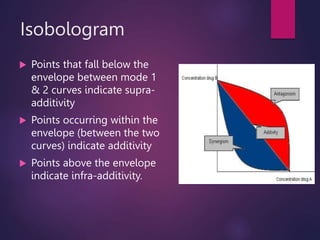
Isobologram
 Points that fall below the
envelope between mode 1
& 2 curves indicate supra-
additivity
 Points occurring within the
envelope (between the two
curves) indicate additivity
 Points above the envelope
indicate infra-additivity.
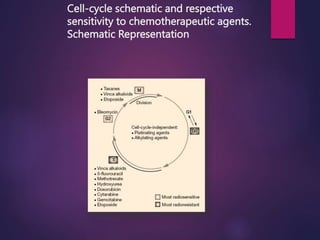
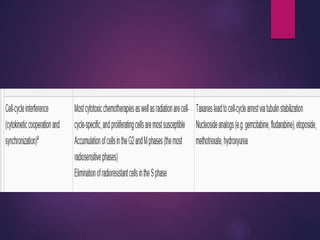
Cell-cycle schematic and respective
sensitivity to chemotherapeutic agents.
Schematic Representation
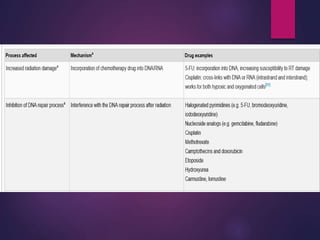
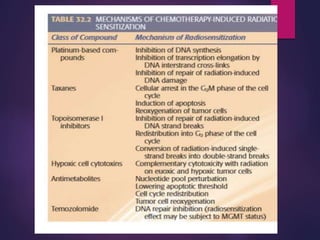
MECHANISM
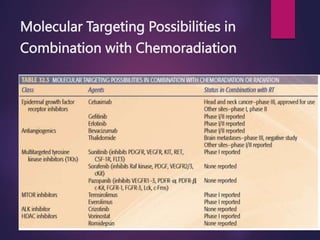
Molecular Targeting Possibilities in
Combination with Chemoradiation
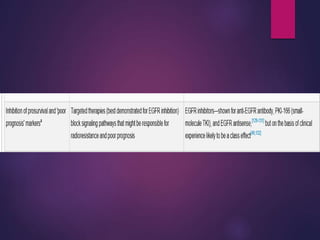
Epidermal growth factor receptor inhibitors
Altering chromatin architecture
DNA repair inhibitors
Farnesyltransferase inhibitors
Angiogenesis inhibitors
Cyclooxygenase-2 inhibitors
Proteosome inhibitors
Apoptosis inducers
Gene or siRNA transfer
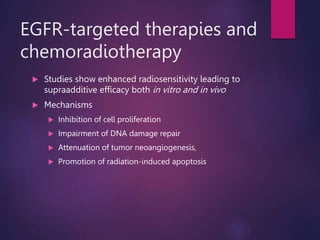
EGFR-targeted therapies and
chemoradiotherapy
 Studies show enhanced radiosensitivity leading to
supraadditive efficacy both in vitro and in vivo
 Mechanisms
 Inhibition of cell proliferation
 Impairment of DNA damage repair
 Attenuation of tumor neoangiogenesis,
 Promotion of radiation-induced apoptosis
Anti angiogenesis
 Target the VEGR ligand, such as bevacizumab
 Transient normalization of the abnormal structure in
tumour  reoxygenation
 antiangiogenic destruction of tumor vessels leads to
hypoxia
Dilemmas of Concurrent
chemoradiation
 Increases acute toxicities
 Cost issues
 Identify proper subset of patient who will benefit most
 Long term toxicities with newer agents awaited
 Absolute benefit in overall survival
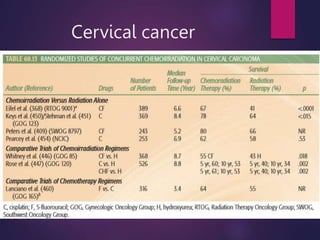
Cervical cancer
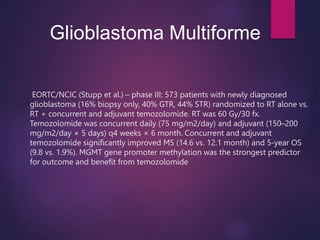
EORTC/NCIC (Stupp et al.) – phase III: 573 patients with newly diagnosed
glioblastoma (16% biopsy only, 40% GTR, 44% STR) randomized to RT alone vs.
RT + concurrent and adjuvant temozolomide. RT was 60 Gy/30 fx.
Temozolomide was concurrent daily (75 mg/m2/day) and adjuvant (150–200
mg/m2/day × 5 days) q4 weeks × 6 month. Concurrent and adjuvant
temozolomide significantly improved MS (14.6 vs. 12.1 month) and 5-year OS
(9.8 vs. 1.9%). MGMT gene promoter methylation was the strongest predictor
for outcome and benefit from temozolomide
Glioblastoma Multiforme
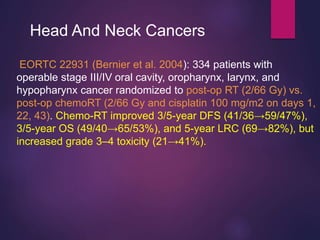
EORTC 22931 (Bernier et al. 2004): 334 patients with
operable stage III/IV oral cavity, oropharynx, larynx, and
hypopharynx cancer randomized to post-op RT (2/66 Gy) vs.
post-op chemoRT (2/66 Gy and cisplatin 100 mg/m2 on days 1,
22, 43). Chemo-RT improved 3/5-year DFS (41/36→59/47%),
3/5-year OS (49/40→65/53%), and 5-year LRC (69→82%), but
increased grade 3–4 toxicity (21→41%).
Head And Neck Cancers
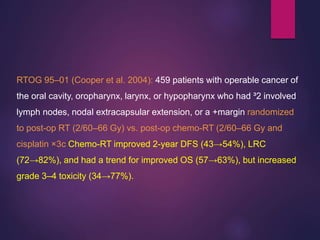
RTOG 95–01 (Cooper et al. 2004): 459 patients with operable cancer of
the oral cavity, oropharynx, larynx, or hypopharynx who had ³2 involved
lymph nodes, nodal extracapsular extension, or a +margin randomized
to post-op RT (2/60–66 Gy) vs. post-op chemo-RT (2/60–66 Gy and
cisplatin ×3c Chemo-RT improved 2-year DFS (43→54%), LRC
(72→82%), and had a trend for improved OS (57→63%), but increased
grade 3–4 toxicity (34→77%).
MACH-NC metaanalysis (Pignon et al. 2009): 87 phase III trials and
16,485 patients. 4.5% OS benefit at 5 years when chemotherapy was
added to RT, with greater benefit for concurrent chemo-RT vs. induction
chemo followed by RT (6.5% OS benefit with concurrent chemo-RT).
Similar results in trials with post-op RT, conventional, and altered
fractionation. No difference between mono or
polychemotherapy regimens, but increased benefit with
platinum-based compounds. Decreasing benefit with increasing age,
with no benefit observed if ³71 years.
Esophageal cancer
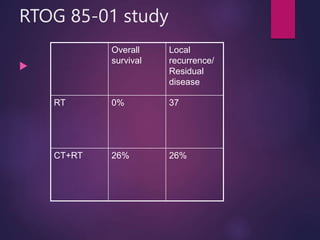
 RTOG 85-01 study established chemoradiotherapy
without surgery as a curative option for patients who
did not have evidence of distant metastasis of their
esophageal cancer and confirmed that radiotherapy
alone was not curative.
 Radiotherapy (64 Gy in 6·4 weeks) along with
radiotherapy (50 Gy in 5 weeks) combined with four
cycles of chemotherapy (fl uorouracil 1000 mg/m2 on
days 1–4) and cisplatin (75 mg/m2 on day 1 of weeks
1, 5, 8, and 11) in 121 patients
RTOG 85-01 study

Overall
survival
Local
recurrence/
Residual
disease
RT 0% 37
CT+RT 26% 26%
Anal cancer
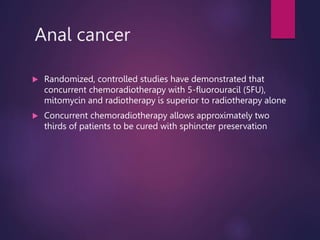
 Randomized, controlled studies have demonstrated that
concurrent chemoradiotherapy with 5-fluorouracil (5FU),
mitomycin and radiotherapy is superior to radiotherapy alone
 Concurrent chemoradiotherapy allows approximately two
thirds of patients to be cured with sphincter preservation
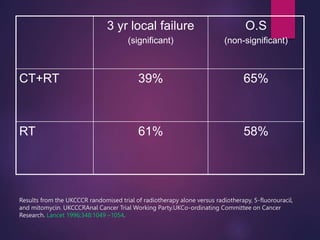
Results from the UKCCCR randomised trial of radiotherapy alone versus radiotherapy, 5-fluorouracil,
and mitomycin. UKCCCRAnal Cancer Trial Working Party.UKCo-ordinating Committee on Cancer
Research. Lancet 1996;348:1049 –1054.
3 yr local failure
(significant)
O.S
(non-significant)
CT+RT 39% 65%
RT 61% 58%
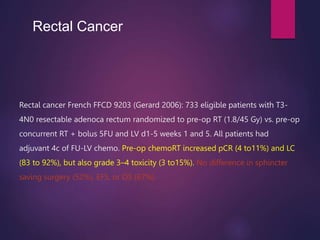
Rectal cancer French FFCD 9203 (Gerard 2006): 733 eligible patients with T3-
4N0 resectable adenoca rectum randomized to pre-op RT (1.8/45 Gy) vs. pre-op
concurrent RT + bolus 5FU and LV d1-5 weeks 1 and 5. All patients had
adjuvant 4c of FU-LV chemo. Pre-op chemoRT increased pCR (4 to11%) and LC
(83 to 92%), but also grade 3–4 toxicity (3 to15%). No difference in sphincter
saving surgery (52%), EFS, or OS (67%).
Rectal Cancer
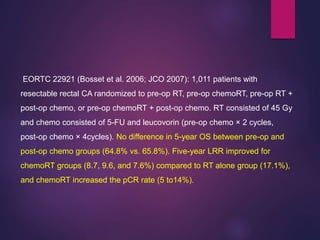
EORTC 22921 (Bosset et al. 2006; JCO 2007): 1,011 patients with
resectable rectal CA randomized to pre-op RT, pre-op chemoRT, pre-op RT +
post-op chemo, or pre-op chemoRT + post-op chemo. RT consisted of 45 Gy
and chemo consisted of 5-FU and leucovorin (pre-op chemo × 2 cycles,
post-op chemo × 4cycles). No difference in 5-year OS between pre-op and
post-op chemo groups (64.8% vs. 65.8%). Five-year LRR improved for
chemoRT groups (8.7, 9.6, and 7.6%) compared to RT alone group (17.1%),
and chemoRT increased the pCR rate (5 to14%).
Thank You

Concurrent Chemoradiotherapy-Principles.ppt

  • 1.
    Principles of Chemoradiotherapy with fewclinical examples REJIL RAJAN
  • 2.
    Definition  Concomitant orConcurrent chemo-radiation refers to administering chemotherapy during a course of radiation.
  • 4.
    GOALS  The goalsof combining chemotherapeutic drugs with radiation therapy are to increase patient survival by improving locoregional tumor control, decrease or eliminate distant metastases, or both, while preserving organ and tissue integrity and function
  • 5.
    Rationale  Initially givenby Steel and Peckham in 1979  Spatial cooperation  Independent toxicity  Enhancement of tumor response  Protection of normal tissues
  • 6.
    Spatial Cooperation  Initialrationale for combining chemotherapy with radiation therapy  The term spatial cooperation is used to describe the scenario whereby radiotherapy acts locoregionally, and chemotherapy acts against distant micrometastases, without interaction between the agents  Example: Radiotherapy local regional control & chemotherapy  prevent distant failure
  • 8.
    Radiotherapy response enhancement  Sensitizationof the cells to effects of radiation  Additive: Amount of cytotoxic activity equal to summation of 2 modalities  Supraadditive : cytotoxicity is more than simple sum  Infra-additive drugs possess radio protective properties that lessen the cytotoxic effect of radiation on the tumor and/or normal tissue.
  • 9.
    Toxicity Independence Normal-tissue toxicityis the main dose-limiting factor for both chemotherapy and radiation therapy. Therefore, combinations of radiation and drugs would be better tolerated if drugs were selected such that toxicities to specific cell types and tissues do not overlap with, or minimally add to, radiation-induced toxicities.
  • 10.
    Normal tissue protection Clinical aim is to reduce the incidence, severity or duration of early and/or late side-effects  To protect normal tissues so that higher doses of radiation can be delivered to the tumor. This can be achieved through technical improvements in radiation delivery or administration of chemical or biologic agents that selectively or preferentially protect normal tissues against the damage by radiation or drugs  E.g Amifostine
  • 11.
    Biological cooperation  Targetingdistinct cell populations or using different mechanisms of cell killing or inducing tumor regrowth delays.  E.g. Mitomycin C to target specifically hypoxic tumor cells.
  • 12.
    Temporal modulation  Exploitsthe radiobiological principles of fractionation.  Radiation & drugs used concomitantly or in a rapidly alternating schedule.  combining EGFR blockade with fractionated radiation could reduce cell proliferation during therapy and might possibly reduce the accelerated cell proliferation induced by radiation
  • 13.
  • 14.
    Timing of drugadministration relative to fractionated radiation therapy for the five exploitable mechanisms in combining drugs and radiation. Timing
  • 15.
  • 16.
  • 17.
    Assessment of DrugRadiation Interaction
  • 18.
     Isobologram-  Additivityenvelope model was developed to describe the log-linear cell survival relationship observed in radiation studies an isoeffect plot for the dose response to the combination of two agents
  • 20.
    Isobologram  Points thatfall below the envelope between mode 1 & 2 curves indicate supra- additivity  Points occurring within the envelope (between the two curves) indicate additivity  Points above the envelope indicate infra-additivity.
  • 21.
    Cell-cycle schematic andrespective sensitivity to chemotherapeutic agents. Schematic Representation
  • 22.
  • 28.
    Molecular Targeting Possibilitiesin Combination with Chemoradiation Epidermal growth factor receptor inhibitors Altering chromatin architecture DNA repair inhibitors Farnesyltransferase inhibitors Angiogenesis inhibitors Cyclooxygenase-2 inhibitors Proteosome inhibitors Apoptosis inducers Gene or siRNA transfer
  • 29.
    EGFR-targeted therapies and chemoradiotherapy Studies show enhanced radiosensitivity leading to supraadditive efficacy both in vitro and in vivo  Mechanisms  Inhibition of cell proliferation  Impairment of DNA damage repair  Attenuation of tumor neoangiogenesis,  Promotion of radiation-induced apoptosis
  • 30.
    Anti angiogenesis  Targetthe VEGR ligand, such as bevacizumab  Transient normalization of the abnormal structure in tumour  reoxygenation  antiangiogenic destruction of tumor vessels leads to hypoxia
  • 31.
    Dilemmas of Concurrent chemoradiation Increases acute toxicities  Cost issues  Identify proper subset of patient who will benefit most  Long term toxicities with newer agents awaited  Absolute benefit in overall survival
  • 33.
  • 34.
    EORTC/NCIC (Stupp etal.) – phase III: 573 patients with newly diagnosed glioblastoma (16% biopsy only, 40% GTR, 44% STR) randomized to RT alone vs. RT + concurrent and adjuvant temozolomide. RT was 60 Gy/30 fx. Temozolomide was concurrent daily (75 mg/m2/day) and adjuvant (150–200 mg/m2/day × 5 days) q4 weeks × 6 month. Concurrent and adjuvant temozolomide significantly improved MS (14.6 vs. 12.1 month) and 5-year OS (9.8 vs. 1.9%). MGMT gene promoter methylation was the strongest predictor for outcome and benefit from temozolomide Glioblastoma Multiforme
  • 35.
    EORTC 22931 (Bernieret al. 2004): 334 patients with operable stage III/IV oral cavity, oropharynx, larynx, and hypopharynx cancer randomized to post-op RT (2/66 Gy) vs. post-op chemoRT (2/66 Gy and cisplatin 100 mg/m2 on days 1, 22, 43). Chemo-RT improved 3/5-year DFS (41/36→59/47%), 3/5-year OS (49/40→65/53%), and 5-year LRC (69→82%), but increased grade 3–4 toxicity (21→41%). Head And Neck Cancers
  • 36.
    RTOG 95–01 (Cooperet al. 2004): 459 patients with operable cancer of the oral cavity, oropharynx, larynx, or hypopharynx who had ³2 involved lymph nodes, nodal extracapsular extension, or a +margin randomized to post-op RT (2/60–66 Gy) vs. post-op chemo-RT (2/60–66 Gy and cisplatin ×3c Chemo-RT improved 2-year DFS (43→54%), LRC (72→82%), and had a trend for improved OS (57→63%), but increased grade 3–4 toxicity (34→77%).
  • 37.
    MACH-NC metaanalysis (Pignonet al. 2009): 87 phase III trials and 16,485 patients. 4.5% OS benefit at 5 years when chemotherapy was added to RT, with greater benefit for concurrent chemo-RT vs. induction chemo followed by RT (6.5% OS benefit with concurrent chemo-RT). Similar results in trials with post-op RT, conventional, and altered fractionation. No difference between mono or polychemotherapy regimens, but increased benefit with platinum-based compounds. Decreasing benefit with increasing age, with no benefit observed if ³71 years.
  • 38.
    Esophageal cancer  RTOG85-01 study established chemoradiotherapy without surgery as a curative option for patients who did not have evidence of distant metastasis of their esophageal cancer and confirmed that radiotherapy alone was not curative.  Radiotherapy (64 Gy in 6·4 weeks) along with radiotherapy (50 Gy in 5 weeks) combined with four cycles of chemotherapy (fl uorouracil 1000 mg/m2 on days 1–4) and cisplatin (75 mg/m2 on day 1 of weeks 1, 5, 8, and 11) in 121 patients
  • 39.
  • 40.
    Anal cancer  Randomized,controlled studies have demonstrated that concurrent chemoradiotherapy with 5-fluorouracil (5FU), mitomycin and radiotherapy is superior to radiotherapy alone  Concurrent chemoradiotherapy allows approximately two thirds of patients to be cured with sphincter preservation
  • 41.
    Results from theUKCCCR randomised trial of radiotherapy alone versus radiotherapy, 5-fluorouracil, and mitomycin. UKCCCRAnal Cancer Trial Working Party.UKCo-ordinating Committee on Cancer Research. Lancet 1996;348:1049 –1054. 3 yr local failure (significant) O.S (non-significant) CT+RT 39% 65% RT 61% 58%
  • 42.
    Rectal cancer FrenchFFCD 9203 (Gerard 2006): 733 eligible patients with T3- 4N0 resectable adenoca rectum randomized to pre-op RT (1.8/45 Gy) vs. pre-op concurrent RT + bolus 5FU and LV d1-5 weeks 1 and 5. All patients had adjuvant 4c of FU-LV chemo. Pre-op chemoRT increased pCR (4 to11%) and LC (83 to 92%), but also grade 3–4 toxicity (3 to15%). No difference in sphincter saving surgery (52%), EFS, or OS (67%). Rectal Cancer
  • 43.
    EORTC 22921 (Bossetet al. 2006; JCO 2007): 1,011 patients with resectable rectal CA randomized to pre-op RT, pre-op chemoRT, pre-op RT + post-op chemo, or pre-op chemoRT + post-op chemo. RT consisted of 45 Gy and chemo consisted of 5-FU and leucovorin (pre-op chemo × 2 cycles, post-op chemo × 4cycles). No difference in 5-year OS between pre-op and post-op chemo groups (64.8% vs. 65.8%). Five-year LRR improved for chemoRT groups (8.7, 9.6, and 7.6%) compared to RT alone group (17.1%), and chemoRT increased the pCR rate (5 to14%).
  • 44.